Affiliate disclosure: this article contains affiliate links. If you buy through a link on kajuandouglas.com, the site may earn a commission at no extra cost to you.
The iso vs ansi keyboard layout question looks like a footnote and behaves like a fork in the road: two physical standards for how a keyboard’s keys are shaped and arranged, named for the standards bodies that codified them, dividing the world’s keyboards — and, more importantly, the world’s keycap sets — into two camps that only partially interoperate. ANSI, the American standard, uses a wide, flat Enter key and a full-length left Shift. ISO, the international standard common across Europe, uses a tall, inverted-L Enter, a shortened left Shift, and one extra key tucked beside it. Everything else — the letters, the numbers, the typing itself — is identical, which is exactly why the few differences cause so much purchasing grief.
This comparison exists to end that grief. It explains precisely what differs between the standards, key by key; why the difference is physical and not merely a matter of legends or software; how it constrains keyboard and keycap purchases; and how to decide which standard belongs on your desk based on where you live, what you type and what you already own. Verified boards in both standards are reviewed in the middle. The closing sections cover conversion questions, the mistakes that fill the second-hand market with beautiful incompatible keycap sets, and the questions buyers ask when a listing refuses to say which standard it is selling.
Key takeaways
ANSI: wide Enter, long left Shift, one fewer key — the North American standard and the default for most enthusiast gear. ISO: tall L-shaped Enter, short left Shift plus an extra key — the European standard, required for most European language layouts. The difference is physical (switch positions differ), so keycaps and boards must match the standard; software remapping cannot move a switch. Buy the standard your language and muscle memory use; filter every keycap purchase by it.
In this guide
The Differences, Key by Key
Begin at the Enter key, the standards’ most visible divergence. ANSI’s Enter is a single wide rectangle on one row. ISO’s Enter is a tall shape spanning two rows, like an inverted L, and reaching it is a slightly different motion — up rather than across — that its users’ pinkies consider the natural order of things. The switch beneath sits in a different position on the two standards, which is the fact from which all incompatibility flows: these are not two caps on one board design but two board designs.
The left side holds the second divergence. ANSI’s left Shift is a long key, and the row is simple. ISO shortens that Shift to make room for one additional key — carrying, depending on language, characters like the UK’s backslash and pipe or other national essentials — bringing ISO’s total key count one higher (105 versus 104 on full-size boards, with the same +1 logic down the sizes). A third, subtler difference lives beside the right Shift and around the number row on some national layouts, but the Enter and the left Shift are the two that decide purchases. The JIS keyboard layout explainer in this cluster covers the Japanese standard, whose differences run deeper still, for readers whose typing spans that world too.
Legends are where the standards meet language, and the two should not be confused. A board’s physical standard (ANSI or ISO) is its hardware; its legends are the printed characters, which follow national layouts — UK English, German, French, Nordic and dozens more within ISO alone. An ISO board can carry UK or German legends; an ANSI board usually carries US legends, though ANSI-with-international-legends exists for multilingual typists who prefer the American Enter. Buying correctly means specifying both halves: the physical standard your fingers expect, and the legend set your language needs. Listings that name only one are listings to interrogate.
Why the Difference Is Physical, and What That Costs
It is tempting to assume a keyboard is a keyboard and the rest is keycaps — that an ISO typist can buy the (cheaper, more available) ANSI board and simply type. The assumption fails at the switch plate: the ISO Enter’s switch occupies a position that does not exist on an ANSI board, and the extra ISO key’s switch likewise has no ANSI home. Software can relabel any key’s output, and does — operating systems cheerfully let an ANSI board produce ISO characters — but no software can give a finger a key that is not there, or move the Enter’s striking surface up a row. The muscle memory of a lifetime is stored in shapes, and shapes are hardware.
The practical consequence is a two-market world. Keycap sets must include the ISO Enter and the short Shift plus extra key to dress an ISO board, and many sets — especially limited and budget ones — are ANSI-only, which is why this cluster’s how to remove replace keyboard keys guide makes the kit diagram a contract to be audited. Keyboard availability skews the same way: the enthusiast market’s centre of gravity is American, so ISO variants of popular boards exist but in fewer finishes, fewer switch options and sometimes later production runs. None of this makes ISO a lesser choice; it makes it a choice to shop for deliberately, with the standard as the first filter rather than a checkout surprise.
There is one bridge between the camps, and it is worth knowing: many custom PCBs and kits support both standards on the same board, with switch positions for either Enter and Shift arrangement, the builder soldering or socketing the layout they want. The keyboard PCBs guide on types and features in this cluster explains these multi-layout boards. For a household or an office genuinely split between standards — or a typist whose life straddles the Atlantic — a dual-support kit built one way and keyed with a convertible set is the closest thing to having both, short of owning two boards, which is the solution the hobby, predictably, usually reaches.
Deciding: Geography, Language and Your Own Hands
For most buyers the decision was made for them long ago, by the keyboards they learned on. If your typing grew up on European boards, the tall Enter and the extra key are not preferences but reflexes, and an ANSI board will tax you daily in small change — the missed Enter struck at its absent upper half, the Shift fumbled at its missing neighbour. If your hands are American-trained, ISO’s arrangement reads as a charming eccentricity that your pinky will nonetheless vote against for a month. The honest first rule of this comparison is therefore conservative: buy the standard your fingers already speak, unless you have a specific reason to retrain and the patience the retraining honestly takes.
Language can overrule geography. Typists whose work is dense with the characters on ISO’s extra key — certain programming symbol sets in European layouts, specific national characters — may find ISO essential even in exile, while multilingual typists who write mostly English sometimes prefer ANSI’s simpler row and compose their special characters by software. The keyboard layouts QWERTY Dvorak Colemak explainer separates the character-layout question from this physical one, and the two decisions — which shapes, which characters — should be made separately and consciously, because the market will happily make both for you by default.
Availability is the deciding factor only at the margins, and it should be admitted rather than disguised. An ISO typist deep in the enthusiast hobby will occasionally face a keycap set or a kit that simply has no ISO path, and must choose between the object and the standard. There is no guide-approved answer; there is only the knowledge that the Enter key is struck thousands of times a week and a keycap set is looked at. Most veterans protect the standard and let the object go. A minority keep a second, ANSI board for the ANSI-only treasures — which is, the hobby notes with satisfaction, how collections begin.
ISO Vs ANSI Keyboard Layout: The Shortlist
The verified boards below include the same respected 75 percent platform in its ISO variant, its ANSI sibling for comparison, and a full-size ISO option — so the standards can be compared as purchasable objects rather than abstractions. The boards compared here were each confirmed in the Amazon catalogue records this site holds verified.
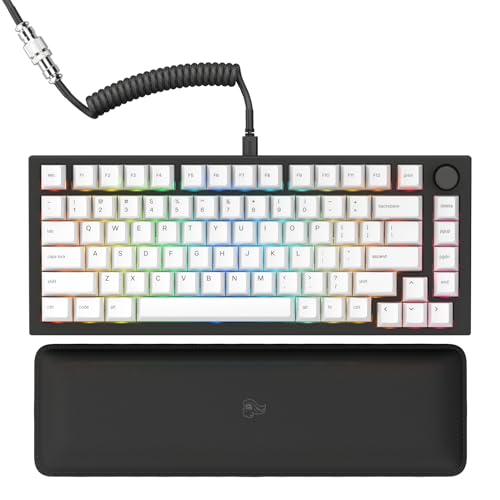
Keychron ISO-Layout Mechanical Keyboard
The ISO route, verified
- ISO physical layout: tall Enter, short left Shift + extra key
- Regional legend options (UK, DE, Nordic and others)
- Hot-swap models in the range
- Mac/Windows keycap sets included on many models
Keychron earns this slot by treating ISO as a first-class citizen rather than a variant of last resort: across its ranges, the popular boards are produced in genuine ISO versions — correct Enter, correct Shift arrangement, correct extra key — with the regional legend sets European buyers actually need, and with the same hot-swap sockets and firmware as their ANSI siblings. For an ISO typist, that parity matters more than any single feature, because it restores the whole decision tree of the how to choose a mechanical keyboard the buyers guide: size, switches and firmware can be chosen on merit, inside the correct standard.
Ordering discipline is the one caveat, and it is the listing’s fault line: the same model name spans ANSI and ISO production, so the standard must be confirmed in the listing’s own specification — the verified listing in the sources file is an ISO unit, and buyers should match its exact variant rather than the model name alone. With that check done, the ISO buyer gets what the ANSI buyer gets, which is all this comparison ultimately asks for.
Strengths
- True ISO hardware with regional legends
- Feature parity with the ANSI range
- Hot-swap and open firmware options
Trade-offs
- Variant must be verified at purchase
- Fewer finishes than ANSI runs
- Some switch options ANSI-first
Best for: European typists who refuse to compromise the standard.
Not suited for: ANSI-trained hands, however good the board is.
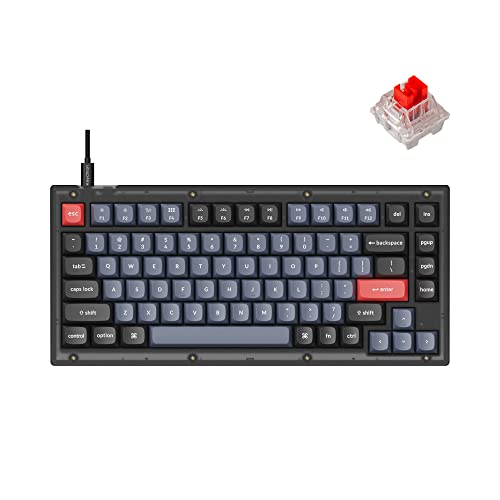
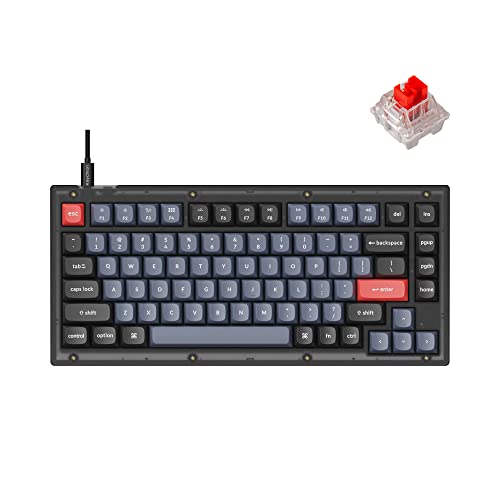
Keychron V1 (ANSI)
The ANSI benchmark
- ANSI layout: wide Enter, long left Shift
- 75 percent, hot-swap
- QMK/VIA firmware
- US legends standard
The V1 stands here as the ANSI reference object: the market’s default configuration, in which the wide Enter and the long left Shift are simply what a keyboard looks like, and around which the largest ecosystem of boards and keycaps in the hobby is organised. Its presence in this comparison makes the practical point concrete — an ANSI buyer never runs the census, never filters a keycap listing, never waits for a regional run, and that frictionlessness is ANSI’s real advantage, worth naming honestly in a comparison that ISO partisans sometimes pretend is purely about key shapes.
As a board it remains this site’s value benchmark: hot-swap, open firmware, a complete 75 percent layout at an entry price. For the buyer whose hands and language are ANSI-native, or whose typing is English-only and whose current board is ANSI, it is the frictionless path in purchasable form. For the ISO-trained reader it is a photograph of the other camp — excellent, available, and the wrong shape, in ascending order of importance.
Strengths
- The entire keycap market is its ecosystem
- Value-benchmark board in its own right
- Zero compatibility friction, ever
Trade-offs
- Wrong physical standard for ISO typists
- US legends only as standard
- No extra key beside left Shift
Best for: ANSI-native typists and English-only multilinguals.
Not suited for: Anyone whose fingers expect the tall Enter.
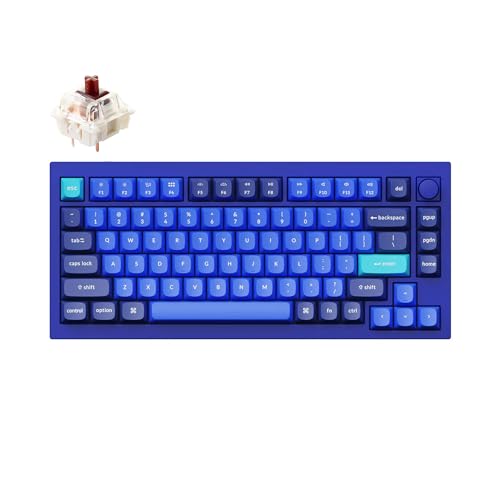
Keychron Q5
The near-full-size middle
- 96 percent layout with number pad
- Aluminium case, gasket mount
- Hot-swap, QMK/VIA
- ANSI standard production; check variants
The Q5 earns its place in this comparison by illustrating the size dimension of the standards question: at 96 percent it keeps a number pad in a footprint barely wider than a tenkeyless board, which makes it a favourite of the data-working typists who are also, disproportionately, the buyers most bound to their national layouts. Its lesson for the ISO reader is to check variant availability model by model rather than brand by brand — a maker’s ISO commitment often covers its high-volume sizes first, and the near-full-size class is exactly where availability thins.
As hardware it is the flagship formula — machined case, gasket mount, open firmware — compressed cleverly, and its ANSI form is verified below. ISO hunters should treat it as a template for the specification they are seeking and pursue the variant through the maker’s regional channels if the marketplace listing is ANSI-only. The comparison’s recurring moral applies: the standard is the first filter, and even flagship aluminium does not outrank it.
Strengths
- Number pad without full-size sprawl
- Flagship build and firmware
- Suits data-heavy workflows
Trade-offs
- ISO variants scarcer than smaller sizes
- Compressed nav cluster takes adjustment
- Premium price
Best for: Number-pad professionals choosing within their standard.
Not suited for: Buyers who need guaranteed ISO stock today.
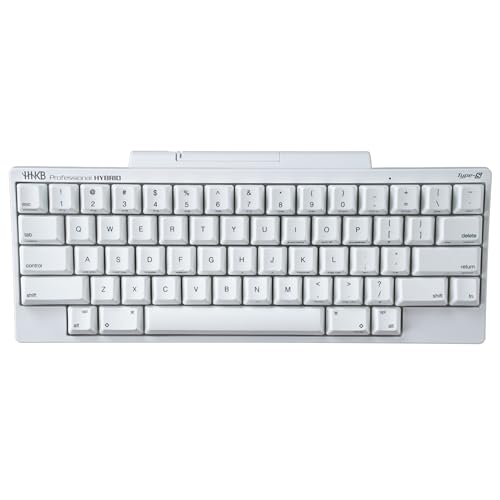
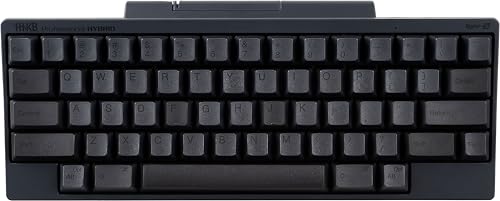
HHKB Professional Hybrid Type-S Snow
The third answer
- Topre electrostatic capacitive switches
- Compact layout of HHKB’s own design
- Bluetooth and USB wired connection
- Type-S silenced switches
- Snow colourway, printed legends
The HHKB earns its place in a layout comparison by refusing both contestants: its designers treated the keyboard map as a philosophy rather than a standard, moving Control to the home row, shrinking the board to a compact grid and arranging the function layer around a programmer’s habits decades before remapping became a menu item. Buying one is therefore not a vote for ISO or ANSI but an exit from the election — your hands learn the HHKB map, and the standards question stops applying to your desk. The Type-S variant adds silencing to the Topre switch’s soft, deep landing, and the Hybrid’s Bluetooth-plus-USB pairing suits the multi-machine desks its devotees tend to run.
Strengths
- A coherent layout philosophy, not a compromise
- Topre feel found nowhere else in this comparison
- Silenced switches suit shared spaces
Trade-offs
- Its map demands real relearning
- Topre keycap choice is a small ecosystem
- Premium pricing for a compact board
Best for: Programmers and minimalists ready to leave the standards debate.
Not suited for: Anyone whose language or muscle memory needs ISO or ANSI proper.
Living Between Standards: Travel, Work and Second Boards
Plenty of typists live astride the divide: the European working on American client hardware, the American posted to a Frankfurt office, the programmer whose home board is ISO and whose hot-desk pool is ANSI. Their accumulated wisdom is practical. First, the adaptation is asymmetric — moving to the standard you did not learn on costs a few weeks of small errors, concentrated in the Enter and the left Shift, and the errors fade fastest with exclusive use of one board at a time rather than hourly alternation. Second, software layout settings should follow the typist, not the machine: set the operating system’s input layout to your language on every machine you touch, so the characters stay constant even when the shapes under them change.
Third, and most hobby-flavoured: a personal board is the professional’s answer to a mixed world. The carry-your-own-keyboard culture that the HHKB Topre keyboards deep dive describes exists precisely because serious typists refuse to let random office hardware dictate their interface, and a board in your standard, in your bag, dissolves the whole problem at every desk you visit. It is not the cheapest solution. It is merely the one that works every time, which is why so many cross-standard lives end with a keyboard in the luggage and this comparison reduced to an interesting read.
The Keycap Question in Full: Buying Sets Across the Divide
Because keycaps are where the standards cost money repeatedly, the buying rules deserve a consolidated statement. Rule one: the set must contain your standard’s Enter — for ISO, the tall two-row shape — plus the short left Shift and the extra 1u key; these live, when they exist, in the base kit or a named ISO kit, and the kit diagram is the only trustworthy witness. Rule two: legends are separable from shapes — an ISO kit with international legends may still lack your national sublegends, which matters to touch typists not at all and to look-down typists a great deal. Rule three: budget sets and limited sets are the ANSI-only heartland; the mainstream makers’ fuller kits are where ISO coverage reliably lives, and group buys state their ISO support in the interest check, where the how to buy keyboard group buy guide teaches you to read for it.
Rule four is the resale corollary: an ISO set bought in error is harder to resell in an ANSI-majority market and vice versa, so the census discipline protects the purchase twice. None of these rules is burdensome once habitual — they compress, with practice, into a ten-second diagram check — but they are absolute, because the Enter key’s shape is the one specification in the entire hobby that no amount of money, software or enthusiasm can retrofit. The standards divide the market; the diagram check is how a buyer crosses it safely, every time.
The Enter Key Is Not the Point: What Layout Really Changes
Popular discussion reduces the ISO-ANSI question to the Enter key’s shape, and the reduction misses the layout’s actual daily texture. The tall Enter is the most visible difference and the least pressed of the divergent keys; the layout is lived in the small ones. The extra key beside the short left Shift — a whole additional character position that ISO languages use and ISO typists’ left pinkies own — changes the left hand’s geography permanently. The backslash’s relocation changes every path, command and regular expression a programmer types. The right Alt’s promotion to AltGr turns the right hand into a character instrument for the accented and symbolic registers. A layout is not a key shape; it is the distribution of a language’s characters across two hands, refined by a century of typewriters, and the Enter is merely its flag.
This is why the conversion experiences in the main guide are so asymmetric. The ANSI-native moving to ISO loses a wide Shift and gains a key they have no habits for; the ISO-native moving to ANSI loses a character their language needs hourly and gains a Shift their pinky overshoots for a month. Both conversions are survivable — millions have done each — and both are priced in the same currency of small errors at the worst moments: the password mistyped, the path broken, the accent that arrives as a backslash in a formal document. The JIS keyboard layout guide in this cluster tells the same story in a third geography, with the spacebar’s shortening as its flag and the thumb keys as its substance.
The buying consequence is the section’s point: layout is a language decision before it is a hardware one. The correct first question is not which layout is better — the main guide dismantles that framing — but which language’s typing your day actually consists of, including its programming symbols, its accents, its currencies. Buyers who answer that question honestly find that the layout chooses itself, and the remaining work — finding the board, the caps, the switches in that layout — is logistics. Buyers who start from the board and work backwards to the layout are shopping in the wrong direction, and their returns and regrets populate the forums accordingly.
Keycap Economics Across the Layout Divide
The layout decision’s longest shadow is cast over keycaps, and it deserves a full accounting because it operates for the life of every board the buyer owns. An ANSI buyer shops the whole keycap market: every set, every group buy, every profile, at the market’s full competitive pressure. An ISO buyer shops a subset — the sets whose kits include the tall Enter, the short Shift and the extra key, with legends in their language if they want them — and that subset is smaller, dearer, and slower to arrive. The international kit is the tax’s itemised form: an add-on, priced separately, occasionally failing to reach its production minimum in a group buy and being cut, leaving the ISO buyer’s base set elegant and unusable. The how to buy keyboard group buy guide‘s kit literacy applies here with doubled force: for the ISO buyer, the international kit’s existence and threshold are not details but the purchase itself.
The economics have a second term: the used and sale markets mirror the new market’s proportions. ANSI sets liquidate in days; ISO sets wait for their rarer buyer, and their prices sag accordingly — which makes the patient ISO buyer of used sets a beneficiary of the same scarcity that taxes them new. And the third term is the board-side one: ISO boards themselves are stocked in fewer variants in most regions, so the layout decision narrows two catalogues at once. None of this argues against ISO for the typist whose language needs it — the tax buys a keyboard that speaks their language natively, which is the entire point of a keyboard. It argues for paying the tax knowingly, budgeted, with the kit discipline that keeps it from being paid twice.
There is a mitigation worth naming for the bilingual and the borderline: the ANSI board with ISO-friendly keycap legends solves nothing physically, but the hybrid many Europeans actually run — ANSI hardware, language set in the operating system, the extra ISO key’s character remapped to a combination — serves typists whose ISO-language use is occasional. It serves them at the cost the main guide describes: the physical key does not exist, and its absence is felt exactly when the language is being typed at speed. Occasional is the operative word, and the honest census of one’s own typing — how many accented characters a day, really — decides whether the hybrid is a saving or a false economy with a monthly payment in errors.
The Programmer’s Layout Problem
Programmers occupy the layout question’s most interesting ground, because their character set is a third language that neither ANSI nor ISO was designed for — and the two layouts distribute its symbols very differently. ANSI places the brackets, braces, backslash and pipe in a right-hand cluster that generations of programmers’ muscle memory treats as home ground; the code written on ANSI carries that geography in its authors’ fingers. ISO scatters some of those symbols behind AltGr combinations — the same keystrokes that produce accents in prose produce brackets in code — which is learnable, and is learned by every European programmer, but which rearranges the right hand’s workload in ways that matter across a career of ten-hour days. The keyboard layouts QWERTY Dvorak Colemak guide treats the character-arrangement question at the letter level; this section is its physical counterpart.
The practical landscape that results is a quiet scandal of the European desk: a large population of programmers who type prose on ISO and code on ANSI settings, switching the operating system’s layout with their task and accepting the legends’ irrelevance — or who run ANSI boards outright and type their native language’s accents by compose key and dead key, trading prose fluency for code fluency with open eyes. Neither population is wrong; both are evidence that the layout decision, for the bilingual-symbolic worker, is a genuine optimisation with real terms on both sides, and any guide that calls it settled is selling something.
For the buyer in this position, the decision method is the census again, kept for a week with unusual honesty: count the accented characters, count the brackets, note which errors actually occur and which are merely feared. The feared errors are usually overweighted — the hands are more adaptable than their owners’ anxiety — and the occurring ones are the decision’s real data. Then buy the layout the census names, in a board whose keycaps can be had for it, and give the conversion its month. The programmers who thrive are the ones who made the decision once, from evidence, and stopped re-litigating it at every new board: the layout becomes infrastructure, invisible, and the work — in both languages — gets the attention the layout question was consuming.
AltGr: The Key That Explains a Continent
The right Alt key is where the two layouts’ philosophies diverge most completely, and it repays a section of its own. On ANSI it is a second Alt, a modifier of convenience. On ISO it is AltGr — a third level of character on every key it touches, the gateway to the accented capitals, the currency symbols, the typographic furniture of European languages. The key’s promotion changes the right hand’s whole education: ISO typists develop an AltGr vocabulary as extensive as their Shift vocabulary, chorded without thought, and the characters it produces are not exotic extras but the daily substance of their languages. An ANSI board in ISO software hands keeps AltGr’s function but not its position in the typist’s mental furniture, which is why conversions feel deeper than the key count suggests.
AltGr also explains a design pattern ANSI buyers misread: the European board’s crowded legends, with two and three characters stacked on a key, are not clutter but a map — the key advertising its levels, base, shifted and AltGr, in a visual density that ISO children learn to read the way ANSI children learn a single letter. Keycap sets for ISO must print that map or leave their owners navigating by memory, which is why the international kit’s legends, not merely its extra keys, are the ISO buyer’s real requirement — a blank extra key is a riddle, not a character. The keycap profiles explained families all have ISO citizens; the census discipline decides which sets’ citizenship is complete.
And AltGr has a modern afterlife worth noting: as European software and the euro sign made it indispensable, its combinations became a power user’s toolkit even on ANSI — the savvy ANSI typist who maps a right-Alt layer for symbols is reinventing AltGr privately, which suggests the ISO philosophy was never parochial. The layouts are two answers to the question of how many characters a keyboard owes its typist, and the answers reflect their languages’ honest needs. Understanding the key is understanding that neither answer is the primitive one; they are different optimisations, and the typist’s language is the objective function.
Buying Boards Across Regions: The Practical Map
The layout decision becomes concrete at the checkout, and the regional market’s map deserves drawing plainly. In North America, ANSI is the shelf: ISO boards exist as specialist imports, priced and stocked accordingly, and the ISO-native living there buys from European retailers or the brands’ international stores, paying the shipping and the patience. In most of Europe, ISO is the shelf in each country’s own legend variant — and ‘ISO’ is a family, not a single layout: the German, French, Nordic and UK variants share the physical shape and differ in legends and in several character positions, so the ISO buyer’s census includes their national variant, and a board stocked in the wrong nation’s ISO is a board whose legends lie politely on a dozen keys. In the UK the variant is close enough to ANSI in spirit that its buyers straddle both markets most easily of all.
The online market softens the map without erasing it. The enthusiast brands sell layouts as variants at the product level — the same board, ANSI or ISO, from the same page — and the group-buy system manufactures to order across the divide. What neither softens is the keycap aftermarket’s proportions and the local second-hand market’s stock, which follow the region’s installed base with a decade’s lag. A buyer choosing a minority layout in their region should therefore price the whole ecosystem, not the first board: the boards are shippable, but the caps, the used market and the borrowed-board test all live locally. The how to choose a mechanical keyboard the buyers guide’s ecosystem argument is, in the layout context, simply geography wearing its working clothes.
One region deserves a specific note: the multinational household and the expatriate desk, where two layouts’ speakers share equipment. The workable arrangements are the ones the main guide implies — separate boards where the desk allows (keyboards are personal in a way monitors are not), or a board in the primary typist’s layout with the second language handled in software, its cost accepted as the household’s compromise. What does not work is the alternating board, swapped per user, whose cable and dongle choreography will be abandoned within a month, leaving one layout’s speaker permanently converted by furniture. Households, like programmers, should make the layout decision once, from the census of both typists, and then let it become invisible.
The Layout Decision, Settled in One Sitting
This guide’s expansions have circled the decision from language, economics, programming and geography; the closing section compresses them into the sitting in which the decision should actually be made. Take the census: a week’s honest count of your characters — prose accents, code symbols, currencies, the extra key’s actual use. Take the inventory: the boards and sets you already own, whose layout is a sunk compatibility. Take the map: your region’s stock, your language’s variant, your household’s other typists. In most sittings, those three documents name the layout without further debate, because the decision was never really open — it was merely unexamined, and the examination is the sitting’s whole work.
For the genuinely borderline — the bilingual programmer, the expatriate, the household of two languages — the sitting has a tiebreaker with a good track record: choose the layout of the language you type when you are tired. Skill degrades to its deepest layer under fatigue, and the layout your hands own at midnight is the one your training built first and deepest. The other language’s needs can be served by software, by compose keys, by the occasional deliberate hunt for a character; the tired hands cannot be served by anything but their native geography. It is not a scientific instrument, but it has the merit of asking the only witness who will be present for every keystroke of the board’s life.
And then, the decision made, this guide releases you from it — which is the final service a layout guide can perform. The boards in the new layout want choosing by the ordinary criteria of fit and quality; the keycaps want their census; the conversion, if there is one, wants its month. The layout question, answered from evidence, should never be reopened by a listing’s photograph or a forum’s enthusiasm. Infrastructure is the name for decisions that have stopped consuming attention, and a keyboard layout, of all things, deserves to become infrastructure: the invisible geography under a decade of visible work.
Dead Keys, Compose Keys and the Typist’s Third Hand
Both layouts leave some characters unprinted on any key, and the software instruments that produce them deserve a section in a layout guide, because they quietly decide how livable each layout is outside its home language. The dead key is the oldest instrument: a key that types nothing alone and accents the next letter — the mechanism by which an ANSI board produces é and ü on demand, and by which ISO boards produce their less frequent accents. Its cost is a keystroke and its failure mode is the doubled accent on the space, familiar to every typist who has fenced with it. The compose key is the connoisseur’s instrument, a Linux-born convention now available everywhere through utilities: a designated key begins a sequence — compose, then the letter, then the mark — that produces any character the typist can describe, from the euro sign to the em dash to the obscure currency of a fourth language. A typist armed with compose stops experiencing their layout’s borders as walls; the borders become a customs post, with a small fee per crossing.
The instruments reframe the layout decision for a specific population: the typist whose second language is occasional. For them, the physical layout of the first language plus compose for the second is a complete answer, and the ISO board bought for three accented words a day is an expensive monument to a problem software solves for free. The census remains the arbiter — frequency is the whole question — but the census must now count with the instruments in view: the relevant figure is not how many foreign characters you type, but how many you type at speed, in flow, where a compose sequence’s two extra keystrokes actually cost something. Below that threshold, software wins; above it, geography wins; and the threshold, honestly measured, sits higher than most buyers’ anxiety places it.
There is also a professional population for whom the instruments are the layout: translators, typesetters and multilingual support staff, whose character sets span four alphabets before lunch. Their desks run layered software geographies that make the physical board almost a bystander — and their existence is the layout debate’s healthy reminder that the physical standard is one layer of a stack, decisive for most typists, negotiable for the fluent, and never the whole story. This guide has argued the physical layer’s importance at length because its readers are shoppers; the stack’s upper layers are where its graduates will spend their ingenuity, and the compose key is the first of them worth learning by name.
Confirming a Listing’s Standard Before You Pay
Five checks, applicable to any board or keycap set, that settle the standard question beyond argument.
- Look at the Enter key in the listing’s photographs: wide and flat means ANSI; tall and spanning two rows means ISO. If the photographs are renders or show another variant, distrust them and proceed to the text checks.
- Read the specification for the key count: on full-size boards, 104 keys signals ANSI and 105 signals ISO; on smaller boards, look for the standard named explicitly — reputable listings state it.
- For keycap sets, open the kit diagram and physically locate the ISO Enter, the short left Shift and the extra key, or the ANSI wide Enter and long Shift. Absence from the diagram is absence from the box.
- Confirm the legend set separately from the standard: ISO hardware with UK, German or Nordic legends are different listings, and the one you need is named in the variant selector, not implied by your delivery address.
- When a listing remains ambiguous after all four checks, ask the seller the direct question — ‘Is this the ISO or ANSI version?’ — and keep the answer with the order confirmation. Ambiguity resolved in writing is a return that cannot be argued with.
Standards Mistakes the Second-Hand Market Is Built On
Assuming legends define the layout.
A board with European legends printed on ANSI hardware exists — made for expatriates and the optimistic — and it types exactly as confusingly as it sounds. The standard is the shape of the Enter and the arrangement of the left Shift; the printing is paint. Buy shapes first and legends second, and never let a familiar character set talk you out of checking the Enter.
Believing software can convert the board.
An operating system can relabel outputs until every key sings in your language, and the ISO Enter will still not be there to strike, nor the extra key to hold your backslash. Remapping redistributes characters among existing keys — a genuine tool, covered in this cluster’s keyboard firmware QMK VIA guide — but it cannot manufacture hardware. Conversions are physical or they are compromises; know which you are accepting.
Ordering the ANSI version because it was in stock.
The discount or the delivery date whispers that the Enter is a small thing. It is struck more often than almost any key you own, and its absence from your reflexes will be re-announced at every paragraph’s end. The correct standard in three weeks beats the wrong one tomorrow, every time, and the market’s return statistics are the proof.
Skipping the standard check on keycap group buys.
Group buy sets render beautifully on ANSI boards in every photograph, while the ISO kit — if it exists — is a separate line item with its own minimum order quantity that may or may not be met. ISO buyers must confirm the kit’s existence and its production threshold during the window, not discover its cancellation at fulfilment.
Assuming your compact board follows the same rules as full-size.
Compact boards compress both standards further, and their ISO variants rearrange more than the Enter — right-side keys migrate and shrink in ways that make keycap coverage even more listing-specific. The census discipline doubles in importance below full size; the diagram, as ever, is the contract.
Buying the board first and discovering its layout at the desk.
Listings photograph boards beautifully and state their layout in a specification line that excitement skips — and the board that arrives in the wrong geography is a return, an exchange or a conversion nobody budgeted for. The layout is a first-order specification, like the size and the switch: confirm it in the listing’s text, in the variant selector, before the payment, every time, however certain the photographs made you feel.
Frequently asked questions
Which layout is better, ISO or ANSI?
Neither, in any sense that survives contact with an actual typist. They are regional standards optimised by history for their languages’ needs — ISO’s extra key serves European character sets; ANSI’s simplicity serves its market’s scale. The better layout is unambiguously the one your fingers learned and your language uses, and the comparison’s real subject is not superiority but compatibility.
Can I put ISO keycaps on an ANSI keyboard?
No — the Enter and Shift caps have no corresponding switch positions to sit on. The reverse is equally true. Keycaps, boards and standards form a matched set at those specific keys, which is why the kit-diagram census is this site’s repeated refrain. The remaining ninety percent of caps are interchangeable, which is precisely what makes the incompatible ten percent such an effective trap.
I am moving from Europe to the US. Should I switch standards?
Only if your life is switching with you permanently, and even then, gradually. Your ISO board works in America the day you land — the standard is in the board, not the country — and replacement keycaps can be ordered from ISO-supporting makers indefinitely. Most expatriate typists keep their standard for life and let the local market be the thing that adapts, via imports. Retraining is a month of errors bought for no functional gain.
Why do so many enthusiast products launch ANSI-only?
Market gravity: the largest single keyboard market is North American, tooling and inventory follow volume, and ISO variants multiply SKUs for makers already juggling switches, colours and sizes. The trend is slowly improving as European enthusiast demand organises — major makers now launch ISO alongside ANSI on flagship lines — but the long tail of small-run products remains ANSI-first, which ISO buyers must simply price into their hobby.
Does the standard affect gaming or performance?
Not in any measurable performance sense — the switches, polling and firmware are identical across a model’s standards. The only gaming-relevant difference is key availability: ISO’s extra key is one more bindable input beside the left Shift, and ANSI’s longer Shift is a marginally larger target. Players choose by the same rule as typists: the standard their hands know.
What about laptops — do they follow the same standards?
Yes, regionally: a laptop sold in Germany has an ISO board with the tall Enter; its American twin is ANSI. This is why the standard question often resolves by biography — your laptop history trained your hands long before your first mechanical board arrived. It is also why travellers should check a destination-market laptop’s keyboard before purchase with the same Enter-key glance this guide teaches.
Can I put ISO keycaps on an ANSI board?
Only partially, and the partiality is the answer: the alphas and most modifiers will fit, but the tall ISO Enter has no ANSI mounting position — the ANSI board’s Enter position is a different shape with different stabiliser geometry — and the extra ISO key’s position does not exist on the ANSI PCB at all. A board must be built for its layout at the PCB and plate level; keycaps dress a layout, they do not convert one. Buyers between layouts should note that a few enthusiast PCBs support both, chosen at build time — the one genuine exception, and it is a build decision, not a keycap one.
Is ISO or ANSI better for gaming?
Neither has a mechanical advantage that survives scrutiny: the keys report identically, and the differences are the geography of specific bindings. Two marginal notes exist — the ANSI long left Shift gives a larger target for the pinky’s sprint or crouch, which some players prefer, and the ISO extra key gives one more binding near the left hand, which a few games’ layouts exploit. Players should keep their native layout and bind around it; the month of conversion errors costs more ranked matches than either marginal note has ever won.
Can I type my language’s characters on the ‘wrong’ layout with software?
Almost always, yes — through dead keys, compose sequences, the operating system’s layout for your language applied to the foreign board (with its punctuation remapped in software), or a programmable board’s layers. The question is never possibility but price: each method charges keystrokes or learning per character, and the census of your daily characters decides whether the charge is trivial or a tax on every sentence. Occasional characters: software, happily. A language’s daily substance: the physical layout earns its shelf space.
ISO and ANSI are a reminder that even in a globalised hobby, keyboards remain local objects — shaped by the languages they serve and the hands that learned on them. The comparison has no winner to declare, and declaring one would miss the point: the standards’ importance lies entirely in their incompatibility at a handful of keys, and in the purchasing discipline that incompatibility demands. Check the Enter, audit the diagram, buy your own standard without apology, and the divide will never cost you a keycap set or a moment’s typing.
For the reader still genuinely undecided — the rare typist with no strong formation in either camp — the tiebreakers are practical: choose ISO if your language needs its extra key daily, ANSI if you want the widest possible product ecosystem, and either with confidence that the typing itself, the switches and the sound and the whole life of the board, will be identical. Standards divide the shelves. They do not divide the hobby, whose members on both sides of the Enter key are, in every way that matters, typing the same sentence.