Disclosure: As an Amazon Associate, kajuandouglas.com earns from qualifying purchases. Links on this page are affiliate links; they cost you nothing extra. Prices and availability change often, so check the current Amazon listing before you buy.
Abs Vs Pbt Keycaps Whats The Difference: The Answer, Directly
Players asking abs vs pbt keycaps whats the difference usually want one practical answer before the chemistry, so here it is. ABS and PBT are the two plastics nearly every mechanical keyboard keycap is molded from. ABS caps feel smoother, carry brighter and more varied colors, and are what most stock gaming keyboards ship with — but their surface polishes shiny under your fingers over months of play, and thin ABS can sound higher and hollower. PBT caps feel lightly textured, resist that shine for years, sound deeper and more muted, and hold their legends through dye-sublimation or double-shot molding — but PBT is harder to manufacture, so colors are often more muted, sets cost more at the quality end, and cheap thin PBT exists just as cheap thin ABS does. For most gamers who keep a board for years, PBT is the better default. For players who prioritize vivid colors, shine-through legends for RGB, or the smoothest possible feel, ABS remains a legitimate choice. The rest of this guide proves that summary criterion by criterion.
Four verified keycap sets are linked later in the guide — three PBT sets at different tiers and philosophies, and one quality ABS set chosen deliberately so the ABS side of this comparison is represented by a good example rather than a straw man. Every linked set was checked against Amazon’s catalog data before inclusion. Prices are discussed only in qualitative tiers, because keycap pricing moves with sales and kit configurations, and no fixed ratings or review counts are quoted for any set.
In this guide
Head-to-Head Comparison Table
| Criterion | ABS | PBT |
|---|---|---|
| Surface feel | Smooth, sometimes silky | Lightly textured, dry grip |
| Shine over time | Polishes shiny, especially WASD | Resists shine for years |
| Sound | Brighter, higher-pitched | Deeper, more muted |
| Colors | Vivid, wide range, easy gradients | Often muted; improving every year |
| Legends | Double-shot common; pads wear | Dye-sub or double-shot, both durable |
| Shine-through for RGB | Excellent; the RGB standard | Rare and usually specialized sets |
| Heat and chemical resistance | Lower; can warp with heat | Higher; very stable |
| Price tendency | Stock standard; premium sets exist | Mid to premium tiers typical |
| Best for | RGB builds, vivid themes, smooth feel | Long-term daily and gaming use |
Criterion 1: Shine — The Difference You Can See From Across the Room
Shine is the famous difference, and it is real. ABS is the softer of the two plastics at the surface, and the oils and friction of daily typing gradually polish the most-used keys — WASD, the spacebar, the vowels for typists — into glossy patches that catch the light. The legends survive if they are double-shot, but the cap’s texture changes permanently; no cleaning reverses it, because material has effectively been burnished, not dirtied. PBT’s harder, more chemically resistant surface resists this polishing to a degree that surprises people switching for the first time: a PBT spacebar can serve years of gaming and still look matte beside a three-month-old ABS one.
How much should shine weigh in your decision? If you replace keycaps seasonally for looks, barely at all — you will retire the set before shine matures. If you buy a set intending to keep it for the board’s whole life, shine is arguably the deciding criterion, and it is why long-term owners migrate to PBT and rarely return. Verdict: PBT, decisively, for keepers; irrelevant for rotators.
Criterion 2: Durability and Legends
Both plastics are mechanically tough — a keycap of either material will survive being dropped, stepped on in socks, and pulled a hundred times. The durability contest is really about legends and aging. Legend methods matter more than the base plastic here, so learn the three. Pad printing sits ink on the surface and wears away under fingers; avoid it on any set you intend to keep, in either plastic. Dye-sublimation infuses dye into the plastic itself, and it is PBT’s signature method: the legend cannot wear off because it is not on the surface, though dye-sub legends are one color per cap and cannot shine through. Double-shot molding forms the legend from a second plastic shot through the cap, making it permanent in both ABS and PBT; it is the premium method, it enables shine-through legends in ABS, and it produces the crispest characters.
Aging beyond legends also differs. ABS yellows with prolonged ultraviolet exposure — vintage collectors know this intimately — while PBT is far more resistant to yellowing and to heat, which is why PBT caps tolerate warm-water washing and sunny desks with less drama. Verdict: for legend permanence, choose the method first (double-shot or dye-sub) and the plastic second; for resistance to yellowing and heat, PBT wins outright.
Criterion 3: Sound
Keycap material is one ingredient in a keyboard’s sound, alongside switches, plate, case, and desk — but it is an ingredient your ears will identify. PBT’s density and typical thickness produce a lower, softer bottom-out note, the deep register currently fashionable in enthusiast builds. ABS, especially in the thin-walled form most stock sets take, produces a brighter, higher, sometimes plasticky note. Thick double-shot ABS narrows the gap considerably, which is why premium ABS sets sound far better than the material’s reputation suggests: wall thickness and cap height move the sound as much as the polymer does.
Practical guidance follows. If your board lives on a live microphone or in a shared room, PBT’s register is the safer default. If you play with a headset and enjoy sharp, articulate feedback, a good ABS set will not disappoint you. And if sound is your primary hobby, treat caps as tuning: the same board with a PBT set for the workday and an ABS set for game night is a legitimate, reversible experiment — the swap itself is covered in the how-to section below. Verdict: PBT for depth and quiet, quality ABS for brightness; cheap thin sets of either material sound cheap.
Criterion 4: Feel, Texture, and Grip in Play
ABS feels smooth — sometimes described as silky — because the molded surface takes a fine finish. PBT feels dry and lightly grainy, a texture many players describe as secure: fingertips stay planted during rapid movement-key work, and the surface does not turn slick with hand warmth during long sessions. Neither feel is universally preferred. Fighting-game and rhythm players who slide fingers across keys sometimes favor ABS’s glide; FPS players holding WASD for hours often favor PBT’s planted grip. Profile interacts here too — a tall sculpted profile in either material feels more deliberate than a low flat one — so judge a set as material plus profile, never material alone. Verdict: a genuine tie, decided by your hands and your genres.
Criterion 5: Color, Themes, and RGB
This is ABS’s home criterion. The plastic takes vivid, saturated color easily, molds cleanly in two-shot production, and dominates the world of themed sets, artisan collaborations, and shine-through gaming caps whose legends glow with the board’s backlight. If your build is a color statement or your room is dark and your legends must light up, ABS is usually the answer, and the industry’s best-looking sets prove it. PBT has closed much of the gap — dye-sub printing enables intricate multi-color artwork on a light base, and modern PBT sets are genuinely beautiful — but saturated dark themes and shine-through legends remain harder and rarer in PBT. Verdict: ABS for vivid themes and RGB shine-through; PBT fully competitive for matte, printed, and retro aesthetics.
Criterion 6: Price, in Honest Tiers
No fixed prices appear in this guide, by design, but the tier structure is stable enough to plan around. Stock ABS sets bundled with keyboards are effectively free and are the baseline. Aftermarket ABS ranges from budget replacement sets to genuinely premium double-shot sets whose cost reflects tooling and licensing, not the raw plastic. PBT aftermarket sets typically occupy the middle and upper tiers: dye-sub sets in the accessible middle, double-shot PBT and large-coverage kits above them. The useful rule is that within a tier, you are paying for legend method, wall thickness, kit coverage, and artwork — the plastic itself is the smallest part of the bill. A well-made ABS set is a better purchase than a thin, warped PBT set at the same tier, which is why the picks below name specific sets rather than declaring a plastic the winner and stopping.
Four Verified Sets That Show the Range

Womier Double Shot PBT Keycaps Set — The Modern PBT All-Rounder
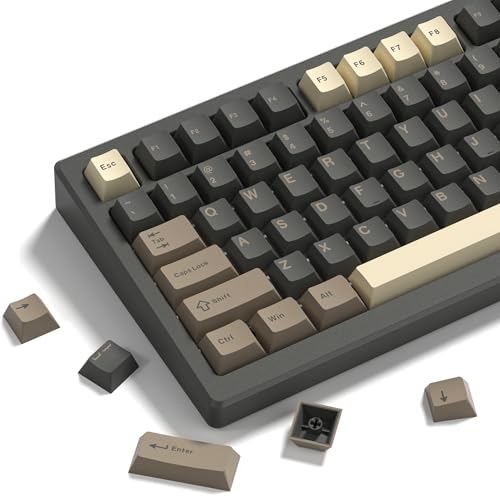
Badge: Best PBT starting point. This 138-key Cherry-profile set combines PBT’s shine resistance with double-shot legends — the most durable legend method in the more durable plastic — and covers boards from 60 percent through full-size, including the 75 percent layouts most readers of this site are shopping for. The retro colorway shows what modern PBT does well: a matte, deliberate palette that looks the same in year three as in week one.
- Material: PBT, double-shot legends
- Profile: Cherry
- Coverage: 138 keys; 60/65/75/100 percent boards
- Compatibility: MX-style switches
Strengths
- Double-shot PBT is the maximum-durability combination in this guide.
- Broad kit coverage fits compact and full-size boards alike.
- Cherry profile suits fast gaming and long typing equally.
Trade-offs
- Legends do not shine through, so RGB boards lose lit characters.
- Retro palettes are taste-specific compared with plain black or white sets.
- Compact boards with unusual right-column units should still be checked against the kit.
Best for: owners making their first PBT upgrade with permanence in mind. Not suited for: shine-through RGB builds. Check price on Amazon

YMDK 143 Shenpo Keycaps — Dye-Sub PBT With Mac Support
Badge: Best for Mac and retro setups. YMDK’s Shenpo set demonstrates dye-sublimation’s strengths: thick PBT, crisp printed legends that cannot wear away, a 143-key spread covering everything from 61-key boards to full-size and 96 percent layouts, and Mac legends included — a detail Windows-centric sets routinely forget. It is the set for a desk that mixes a gaming PC with a Mac and wants one aesthetic across both.
- Material: Thick PBT, dye-sub legends
- Profile: Cherry
- Coverage: 143 keys; ANSI layouts including 96 and 75 percent
- Extras: Mac keycaps included
Strengths
- Dye-sub legends are effectively permanent and crisply printed.
- Exceptional layout coverage, including the awkward compact sizes.
- Thick walls give the deep PBT sound this guide describes.
Trade-offs
- No shine-through; backlight becomes underglow only.
- The Shenpo colorway’s retro character will not suit minimalist desks.
- Dye-sub means single-tone legends, limiting some design options.
Best for: Mac-and-PC desks and retro-styled builds that keep caps for years. Not suited for: RGB-first gaming rigs. Layout coverage questions often pair with layout questions generally, and the 75 percent keyboard layout guide explains the boards these sets must fit. Check price on Amazon

Razer Doubleshot PBT Keycap Upgrade Set — The Big-Brand PBT Route
Badge: Best mainstream upgrade. Razer’s upgrade set exists because the shine problem reached the mainstream: it replaces the stock ABS caps on standard-layout gaming keyboards with doubleshot PBT that resists oil and shine, in a standard 104/105-key US and UK coverage. For a player who likes their current board and simply wants its caps to stop polishing, this is the lowest-risk first step into PBT — a known brand, a standard fit, and no aesthetic gamble.
- Material: PBT, doubleshot legends
- Coverage: Standard 104/105 US and UK layouts
- Compatibility: Mechanical and optical keyboards with standard layouts
- Character: Oil-resistant, textured finish
Strengths
- Purpose-built to fix shine on existing gaming boards.
- Standard bottom-row coverage fits most big-brand keyboards.
- Textured PBT grip suits long gaming sessions.
Trade-offs
- Standard-layout focus means compact boards with odd units may not be fully covered.
- Conservative styling compared with enthusiast colorways.
- Brand-tier pricing versus direct enthusiast sets.
Best for: owners upgrading a standard gaming board’s caps without changing boards. Not suited for: compact-layout owners needing exotic units. The brand question behind this pick is explored in our look at whether Razer keyboards are worth it. Check price on Amazon

Tai-Hao Dolch ABS Keycap Set — The Case for Good ABS
Badge: Best ABS example. Tai-Hao is one of the longest-running names in keycaps, and its Dolch set — the classic grey-and-charcoal scheme — shows ABS at its respectable best: clean molding, a smooth feel many typists genuinely prefer, and colors with a depth that matte PBT sets rarely attempt. Yes, it will eventually shine on your most-used keys; owners who choose it knowingly are trading that slow cosmetic change for feel and color today, which this guide considers a fair trade when made with open eyes.
- Material: ABS
- Colorway: Dolch (grey and charcoal)
- Compatibility: MX-style switches, standard layouts
- Character: Smooth finish, classic palette
Strengths
- Smooth ABS feel that many players and typists prefer outright.
- The Dolch palette is a proven, desk-friendly classic.
- A heritage manufacturer with consistent molding quality.
Trade-offs
- Shine will develop on gaming keys with sustained use.
- ABS demands more care around heat and harsh cleaners.
- Coverage targets standard layouts; compact owners must verify units.
Best for: feel-first buyers who love the Dolch look and accept the shine trade. Not suited for: keep-forever buyers who hate polished WASD keys. Check price on Amazon
How to Swap Keycaps Without Breaking Anything
The how-to layer of this comparison is the swap itself, because material debates end with your hands on a keycap puller. Work on a clear desk with the keyboard unplugged or its wireless mode off. Photograph the board first — that photo is your reassembly map, especially for the right column and bottom row. Use a wire puller, never a flat tool or your fingernails: hook the wires under opposite corners of a cap, rock gently, and lift straight up so the stem is not stressed sideways. Work row by row into a tray or onto a towel in layout order. Stabilized keys — spacebar, Enter, Shift, Backspace — lift slowly and evenly from both ends, because their stabilizer inserts can stay behind in the old cap; check for them and move them to the new caps before reinstalling.
Installing is the reverse with one discipline: align each cap over its switch and press straight down with even pressure until it seats. Test the full board before declaring victory — every key pressed once, stabilized keys checked for even return, and the spacebar struck at both ends and the middle. If a legend set leaves a compact board’s odd units uncovered, mix deliberately: keeping stock caps on the right column in a matching or intentionally contrasting color looks designed rather than incomplete. The whole job takes fifteen unhurried minutes, it is fully reversible, and it is the cheapest experiment in the hobby — which is why easy mechanical keyboard modifications rank it first, and why material opinions formed from reading, including this guide, should be confirmed with one set on your own board.
Care Guide: Making Either Plastic Last
PBT tolerates the full routine: pull the caps quarterly, wash them in warm water with a drop of mild soap, rinse, and dry them completely — a full day of air drying is not excessive — before reinstalling. ABS deserves gentler handling: lukewarm water only, no harsh solvents or alcohol-heavy cleaners on the surface, and no heat drying, because ABS softens and can warp at temperatures PBT shrugs off. Both plastics appreciate a weekly wipe of the installed caps with a dry or barely damp microfiber cloth, and both suffer under the same enemy — abrasive scrubbing, which manufactures the very shine PBT owners are avoiding. Store spare sets in their trays or in compartment boxes, out of direct sunlight; ultraviolet is ABS’s slow enemy and no plastic’s friend. Treated this way, a PBT set’s lifespan is effectively the board’s, and a quality ABS set’s only concession to time will be the shine you accepted at purchase.
The Decision Guide: Which Plastic for Which Player
Choose PBT if…
You keep gear for years, your WASD keys going glossy would annoy you every time you saw them, your board sits in sunlight or a warm room, you play or type for long daily hours, or you simply want the set-and-forget answer. Start with the Womier double-shot set for a first upgrade, the YMDK set for Mac or retro coverage, or the Razer set for a standard gaming board. This is the default recommendation for most readers, and it is not close.
Choose ABS if…
Your build is a color or RGB statement and you need vivid shades or shine-through legends, you rotate sets for looks and will retire this one before shine matures, or you have tried PBT’s dry texture and honestly prefer the smooth glide. Choose quality ABS — double-shot where possible, from a maker with a track record like the Tai-Hao set above — rather than the thinnest budget set, because construction quality decides whether ABS feels premium or disposable.
Choose based on the set, not the slogan, if…
You are comparing two specific sets at the same tier. Then rank the legend method first, wall thickness and kit coverage second, profile third, and the plastic fourth — a hierarchy that surprises people until they have owned a thin PBT set and a thick double-shot ABS set and discovered which one they kept. Material is a strong prior, not a verdict, and the four picks in this guide were chosen to be defensible under exactly this hierarchy.
Common Mistakes When Buying Keycaps
- Buying by plastic alone. A thin, poorly molded PBT set is worse than a quality double-shot ABS set. Method, thickness, and coverage matter.
- Ignoring kit coverage. Compact boards need shortened Shift keys and small right-column units. Check the kit diagram against your board before ordering.
- Assuming PBT means shine-through. Most PBT legends do not light up. RGB builds need sets explicitly made for shine-through.
- Washing ABS in hot water or with solvents. Heat and harsh chemicals are ABS’s weaknesses; lukewarm and mild is the rule.
- Judging sound from the plastic alone. Profile, thickness, switches, and case all contribute. Caps tune a board’s sound; they do not dictate it.
- Forgetting the bottom row. Non-standard bottom rows on some gaming boards reject standard sets. Measure or check your board’s layout first.
Buyers still choosing the board these caps will sit on can start with our roundup of 75 mechanical keyboards, and owners ready to go beyond caps will find the deeper end of the pool in advanced keyboard modding techniques. Topre-switch readers should note that this entire comparison concerns MX-style caps; that ecosystem is covered separately in our guide to the best Topre keyboards.
Final Verdict
PBT wins the comparison for the way most people actually live with a keyboard: it resists shine, ages gracefully, sounds deeper, and asks almost nothing of its owner. ABS wins the narrower but real contests of color, shine-through, and smooth feel, and a quality ABS set chosen knowingly is no one’s mistake. Decide which kind of owner you are — keeper or rotator, matte or vivid, set-and-forget or always-tinkering — and the plastic chooses itself. Then buy the best-made set in that plastic at your tier, because construction quality is the variable your fingers will actually judge every day.
The Hidden Variables: Thickness, Profile, and Stem Quality
Ask experienced owners why two sets in the same plastic feel like different products and they will name three variables the material debate ignores. The first is wall thickness. Keycaps are hollow shells, and the wall’s thickness changes weight, sound, and perceived solidity with every press. Thick-walled sets — common in enthusiast PBT and premium double-shot ABS — land with a deep, confident note and no flex; thin-walled sets feel light and can sound hollow regardless of polymer. When a product page mentions thick walls or a millimeter-class specification, that line is worth more than the marketing paragraph above it.
The second variable is profile, the cap’s height and sculpting. Low, uniform profiles favor fast, sliding gaming inputs. Medium sculpted profiles — the Cherry family that three of this guide’s picks use — balance speed with typing guidance your fingers can feel. Tall sculpted profiles slow nothing for typists but change the board’s sound toward the deep register and ask more of your fingers’ travel. Crucially, profile and material multiply: a tall thick PBT set and a low thin ABS set differ in every dimension at once, which is why swapping between them feels like a new keyboard, while swapping material alone at the same profile feels like a refinement.
The third variable is stem quality — the cross-shaped mount underneath that grips the switch. Poorly molded stems crack, wobble, or sit loose, and the failure has nothing to do with whether the shell is ABS or PBT. Heritage makers and established enthusiast brands earn their pricing partly here, in tolerances you cannot see in a product photo. The practical takeaway for buyers is a ranking habit: when two sets tempt you, compare legend method, then thickness claims, then the maker’s reputation for stems, and let the plastic break the tie — except on shine, where the plastic is the whole story and PBT’s advantage is unconditional.
What About Other Materials? POM, PC, and Metal Caps
Completeness requires a paragraph for the supporting cast. POM, occasionally used for caps, is dense, slick, and durable, with a deep sound — but it resists legends and decoration, so it appears mostly in blank or side-printed niche sets. Polycarbonate is the transparent material behind clear and frosted caps that turn a board’s RGB into a light show; it is a deliberate aesthetic choice, not a durability contender. Metal and resin artisan caps are jewelry for single keys — Escape and the arrows are the usual seats — priced and judged as objects, not as typing equipment. None of these changes the main comparison: for full sets that you type and game on daily, the market is ABS and PBT, and every other material is a special effect.
A Simple Home Test If You Already Own Both
Many readers already own the experiment without realizing it: a stock ABS set that came with a board, and any aftermarket set in a drawer. Load half the alphas with one material and half with the other, in a checkerboard or a left-right split, and play and type normally for two days. Your fingers will report the texture difference within an hour; your ears will separate the registers by the end of the first session; and the spacebar swap — one cap, thirty seconds — isolates the sound difference better than any other single test, because the spacebar is the loudest, most-struck cap on the board. This kind of split test is how reviewers form the opinions that fill pages like this one, and it converts an abstract material debate into a personal, settled preference for the price of an evening. Owners who catch the experimentation bug at this point are exactly the readers advanced keyboard modding techniques was written for.
Myths About Keycap Materials, Corrected
“PBT is always better.” PBT is better at resisting shine and aging, full stop. It is not better at color, shine-through, or universal feel, and a badly made PBT set loses to a well-made ABS set on the desk every day. “ABS is cheap junk.” ABS is the material of both the flimsiest stock caps and some of the most sought-after premium sets ever molded; the variable is construction, not chemistry. “Shine means the caps are worn out.” Shine is cosmetic polishing of the surface. A shiny double-shot ABS cap types and reads perfectly; owners replace such sets for looks and feel, not function. “You can hear the plastic in a recording and know.” Recordings compress every variable — microphone, desk, room, switches — into one impression. Use them to compare two sets on the same board in the same video, never as absolute evidence. “Expensive sets are a scam.” Tooling for double-shot molds, artwork, quality control, and broad kit coverage are real costs; whether they are worth it is a budget question, not a fraud question. “Keycaps affect gaming performance.” They affect comfort, grip, and confidence, which players experience as performance — but no cap changes your switch’s actuation or your keyboard’s latency, and any claim otherwise is marketing.
The Environmental and Longevity Angle, Briefly
One underappreciated argument belongs to PBT, and it is practical rather than sentimental. A keycap set that resists shine and legend wear for the life of the board is a set that is never replaced for cosmetic reasons, which means fewer sets bought, shipped, and discarded across a keyboard’s decade of service. The most sustainable keycap is the one you do not have to buy twice. ABS sets chosen for color and rotated for style follow a fashion logic instead — legitimate, enjoyable, and worth entering with the replacement cycle understood. Either way, a quality set in either plastic outlasts several generations of the switches beneath it, which is a pleasant rarity in gaming hardware and one more reason to buy the set itself well rather than cheaply.
A Short History of the Two Plastics
The rivalry is older than gaming keyboards. ABS became the default keycap plastic of the early personal-computer era because it molded beautifully, took color well, and suited the double-shot legends of the period’s best keyboards — some of those vintage ABS sets are still traded and typed on today, yellowed by decades of light but with legends as crisp as the day they were molded, which tells you the material’s ceiling has always been high. PBT rose with the enthusiast era: as mechanical keyboards became a hobby rather than office equipment, owners who kept boards for years demanded caps that would not polish, and dye-sublimation on PBT offered permanent legends in the bargain. The gaming industry’s RGB wave then pulled ABS back to center stage, because shine-through legends are fundamentally an ABS-friendly trick, and the modern market is the truce between those three eras — PBT for permanence, ABS for light and color, and construction quality as the referee. Understanding that history inoculates you against both nostalgias: neither plastic is the authentic one, and both have been the right answer in different decades for different reasons.
Material Choice by Genre and Habit
FPS and competitive play
Long holds on movement keys, sweaty late rounds, and years on one board point to PBT’s grip and shine resistance. The exception is the player whose setup is an RGB showcase photographed as often as played — that build is ABS’s natural home, and its owner usually rotates sets anyway.
Typing-heavy work and writing
Volume is the variable: high daily word counts polish ABS visibly within a school year, while PBT simply continues. Typists also tend to prefer the dry, planted texture during long sessions. PBT again, with profile chosen for comfort.
Streamers and creators
Your audience sees and hears the board. Matte PBT photographs consistently under changing light and keeps its register low on microphone; glossy ABS can flare under studio lighting as shine develops. Creators with a strong color brand may still choose ABS deliberately — and should budget it as a rotating wardrobe item rather than a permanent fixture.
Collectors and rotators
If changing sets is the hobby, the shine clock never matures and this entire comparison reduces to color, feel, and the day’s theme. Buy the sets that delight you in either plastic, store them properly, and enjoy the one category of gaming hardware where variety costs little and risks nothing.
Reading a Keycap Product Page Like a Reviewer
Product pages in this category reward a specific reading order. First, find the material and the legend method — they hide in specification lists more often than headlines, and a page that will not state its legend method is telling you it is pad printing. Second, find the kit diagram and count what your board needs: the spacebar size, the right Shift size, the small units for a compact right column, and any accent or novelty keys you actually care about. Third, look for thickness language and profile naming; a named profile from a known family predicts feel better than adjectives do. Fourth, check switch compatibility — MX-style stems are the standard this guide assumes — and confirm that low-profile boards, which use entirely different caps, are not your situation. Fifth, read the return policy rather than the reviews: keycap feel is personal enough that a clean return path is worth more than any consensus. Work that checklist and the material question settles in its proper place — one important line in a five-line decision, which is exactly the proportion this guide has argued for throughout.
The Spacebar Deserves Its Own Paragraph
Every material truth in this guide concentrates in the spacebar. It is the largest cap, the most frequently struck, the one your thumb polishes first in ABS and the one whose sound dominates a board’s character in either plastic. It is also the cap most likely to differ between kits in size and stem spacing, and the one whose stabilizer inserts hide during a swap. If you test one cap from a prospective set, test the spacebar. If you keep one stock cap when a new set lacks your size, keep the spacebar and build the mix around it. And if your current spacebar has gone glossy while the rest of the board still looks respectable, you have not ruined anything — you have simply read, in one key, the whole ABS story this guide set out to explain.
What to Do With the Set You Replace
A swap leaves you holding a full set of caps, and the hobby has sensible customs for them. Keep the stock set if the board may ever be sold or gifted — a complete original set preserves value and gives the next owner the shine-through or factory look the board shipped with. Keep a few favorite caps as accents: a contrasting Escape, arrow cluster, or Enter from an old set personalizes a new one at no cost, and mixed sets chosen deliberately look designed rather than leftover. Store the rest in their tray or a compartment box, labeled with the board they came from, out of sunlight. And if a friend is keyboard-curious, a spare set plus a hot-swappable board is the cheapest possible introduction to everything this guide discusses — lend the experiment, and let their fingers cast the next vote in the material debate.
If You Only Remember Three Things
First, shine is the material difference with no workaround: ABS polishes under your fingers and PBT, for practical purposes, does not — so keepers buy PBT. Second, legends are a method, not a material: double-shot and dye-sub are permanent in either plastic, pad printing is temporary in both, and the method line on a product page deserves your first look. Third, construction beats chemistry at equal tiers: thickness, profile, kit coverage, and stem quality decide whether any set — ABS or PBT — feels like an upgrade or a downgrade. Hold those three and you can walk into any keycap listing, render, or group buy with the comparison already settled, and spend your attention where it belongs: on the colors, the profile, and the board waiting underneath.
A Note on Children, Pets, and Other Real-World Hazards
Real desks are not studios. Keycaps get pulled by curious toddlers, batted off desks by cats, and soaked by the occasional spilled drink, and the two plastics handle the aftermath differently in ways worth knowing. Individual caps of either material survive drops and floor time without drama, and a lost cap is a nuisance rather than a disaster if you kept the stock set as a donor. For liquid incidents, the caps themselves are the least vulnerable part of the keyboard — remove them, wash PBT in warm soapy water or ABS in lukewarm water, dry everything thoroughly, and attend to the switches and case, which are where spills actually do damage. Households with enthusiastic small helpers may also appreciate that dye-sub and double-shot legends survive sticky fingers and repeated wiping without fading, one more quiet point for the permanent legend methods this guide keeps recommending. None of this changes the verdict; it simply confirms that the durable choices are durable in every sense a household can test.
Sources and Method for This Guide
The material claims in this guide reflect the well-established properties of the two plastics as used across the mechanical keyboard industry, and the four example sets were verified against Amazon’s catalog data for brand, model, and listing identity before being linked. Where a set’s coverage or configuration varies, the text says so and directs you to the listing rather than guessing. No fixed prices, ratings, or review counts are quoted for any set, because those figures change constantly and say nothing about the materials this guide compares.
One Last Buying Scenario: The Gift Purchase
Buying keycaps for someone else inverts the usual logic, because you cannot know their texture preference and they may never tell you the set felt wrong. Default to PBT with a permanent legend method and a broadly compatible kit: it suits the widest range of boards, it will not shine if they keep it for years, and a neutral or classic colorway respects a desk you have never seen. Include the receipt path for an exchange without making the gift feel provisional — in a category this personal, a graceful exchange option is part of the present.
Climate, Sweat and Storage: How Environment Ages Each Plastic
Material comparisons are usually made under laboratory manners: clean hands, indoor light, a tidy desk. Real keycaps live through summers, radiators, hand cream, gaming sessions and years in a drawer. Environment does not change which plastic wins the categories above, but it changes the margin — and in a few specific situations it changes the answer for a particular desk.
Heat, sunlight and the stored spare set
Sunlight is the slow enemy of both plastics, but it attacks them differently. Prolonged exposure yellows light-coloured ABS noticeably over seasons spent on a sunny desk, while PBT’s colour holds steadier; dark sets of either material show the effect far less. Heat alone, at any level a home produces, harms neither — the warping stories attached to PBT belong to its manufacturing, not to your windowsill. Storage is where owners accidentally age sets fastest: caps stored loose in a warm attic in a sealed bag with other plastics can pick up odours and surface marks from their neighbours. Store a spare set clean, dry, in its tray or a divided box, out of direct sun, and either plastic will wait years without complaint. The set you retire for a season should go away washed; skin oils left on caps for a year do more visible harm than the year itself.
Sweaty hands, hand cream and cleaning chemistry
Hands are a chemical environment. Sweat is mildly acidic and salty, hand creams and sunscreens add oils and solvents, and both plastics meet all of it daily. PBT’s resistance shows here as indifference: it shrugs off the cycle of moisture and wiping with its texture intact, which is one reason heavy-sweat players gravitate to it. ABS tolerates the same routine but polishes faster under it, because the friction of wiping a slightly oily surface is exactly the mechanism that shines it. Cleaning chemistry deserves one caution for both materials: warm water with a drop of mild detergent is the whole recipe, and it is sufficient. Solvent cleaners, aggressive disinfectant sprays and abrasive pads can cloud ABS, damage legends of any print type and dull PBT’s texture — the caps are being cleaned, not sterilised, and gentleness is the technically correct approach rather than a compromise.
Humidity, dust and long sessions
Humid rooms and dusty rooms test the gap between the caps more than the caps themselves. Dust mixed with moisture settles into the texture of PBT slightly more willingly than into smooth ABS, which is the one housekeeping point in ABS’s favour: a smooth set wipes clean in seconds, while a textured set rewards an occasional brush or a proper wash. During long sessions the same texture difference runs the other way — PBT’s matte grip stays consistent as hands warm and moisten, where a well-worn ABS set can feel increasingly slick by hour three. Neither effect should decide a purchase alone. Together they describe the real choice in this category: ABS asks for a little more cosmetic acceptance over time, PBT asks for a little more thorough cleaning, and both repay whichever small effort they ask with years of service.
The renter’s and returner’s footnote
One audience should weight this comparison differently: anyone whose keyboard situation is temporary. If the board is a loaner, a workplace issue you will hand back, or a first board you fully expect to replace within the year, the stock caps — whichever plastic they are — deserve a presumption of innocence. Shine that would bother you across five years of ownership is invisible across five months, and money held back from an interim board is money available for the board you actually settle on. The exception is comfort rather than cosmetics: if the stock caps’ profile or texture actively fights your hands, a single inexpensive PBT set that can move to your next board with you is not an indulgence but a transferable tool. Buy for the horizon you are actually on; both plastics will outlast a short one without help.
Frequently Asked Questions
Do PBT keycaps really not shine?
They resist shine far longer than ABS — typically years of heavy use before any visible polishing, and often effectively never at gaming-key intensity for casual players. Resistance is not immunity: extreme use over very long periods can smooth any plastic, but the practical difference versus ABS is large and is the main reason owners switch.
Are ABS keycaps bad?
No. ABS is the industry’s stock standard, it enables the most vivid colors and shine-through legends, and premium double-shot ABS sets are excellent products. Its genuine weaknesses are shine over time, yellowing under prolonged ultraviolet exposure, and sensitivity to heat and harsh cleaners. Bought knowingly, it is a fine material.
Which material sounds better?
PBT generally sounds deeper and more muted; ABS generally sounds brighter and higher. Thickness and profile can outweigh the material, so a thick ABS set can sound deeper than a thin PBT set. If sound is your priority, compare specific sets and profiles rather than relying on the material label alone.
Can I put PBT keycaps on any mechanical keyboard?
On any board with MX-style switch stems and a standard layout, yes — the swap takes minutes with a wire puller. The cautions are kit coverage for compact layouts with shortened keys, non-standard bottom rows on some gaming boards, and boards with low-profile switches, which use different caps entirely.
What does double-shot mean, and does it matter more than the plastic?
Double-shot means the legend is molded from a second plastic through the cap, so it can never wear off. Alongside dye-sublimation on PBT, it is one of the two permanent legend methods. For long-term ownership it matters at least as much as the choice of plastic: a double-shot ABS set will look legible long after a pad-printed PBT set has faded.
How do I stop my current keycaps from getting shiny?
If they are ABS, you can only slow it: keep hands and caps clean, wipe caps weekly, and accept that friction polishing is the material’s nature. The permanent fix is a PBT replacement set, which is why upgrade sets like the ones linked in this guide exist — the swap is quick, reversible, and cheaper than a new keyboard.
Can I mix ABS and PBT keycaps on the same keyboard?
Yes — nothing about either plastic objects to the other’s company, and deliberate mixing is more common than purists admit. The practical version is functional mixing: PBT on the high-wear letter and number keys where shine arrives first, a favourite ABS set’s accents, spacebar or arrow cluster kept for their colour or sound. Two things to manage. Height and profile must match across the rows you mix, or your fingers will trip on the seams between rows — keep each row one material rather than checkerboarding within a row. And expect a small sound difference between the two groups; many owners never notice it, and some come to like the map it gives their hands. Mixing is also the cheapest experiment in this whole comparison: one PBT spacebar or a PBT set for the home row teaches your fingers more than another hour of reading.
How can I tell what plastic my current keycaps are made of?
Start with the evidence your hands already own. A set that has developed a smooth shine on the most-used keys while its legends remain crisp is very likely double-shot ABS ageing exactly as this guide describes; a set that still feels dry and textured after long use, with legends you can faintly feel or that look printed into the surface, points to PBT. Turn a cap over: thick walls suggest a quality set of either kind, and maker markings inside sometimes name the material outright. The hobby’s traditional float check — PBT generally sinks in water where ABS tends to float — works as a rough confirmation on a single loose cap, though filled and unusually thick caps can blur it. Honestly, the identification matters less than the behaviour: if your current set shines and you dislike it, its replacement should be PBT whatever the old set was.