Disclosure: As an Amazon Associate, kajuandouglas.com earns from qualifying purchases. Links to Amazon on this page are affiliate links; they cost you nothing extra. Listing details such as price and availability change often, so check the current Amazon listing before you buy.
The bookshelf vs tower speakers question is really a question about your room and your furniture, dressed up as a question about sound. Both designs can sound excellent; they differ in bass reach, footprint, placement demands and cost once you count the stands that bookshelf speakers need. Get the match right and either choice delights. Get it wrong and you own a tower that booms in a small room, or a bookshelf speaker straining to fill a space twice its size.
This comparison works through the real differences — bass, volume capability, imaging, space, cost and upgrade paths — with a side-by-side table and honest recommendations by use case. It also settles the persistent myth that towers are automatically ‘better’: in a small room, a good bookshelf speaker on stands, especially with a subwoofer handling the lowest notes, is frequently the smarter and better-sounding system.
Bookshelf vs tower speakers: The Short Answer
Choose bookshelf speakers for small to medium rooms, desks and anywhere a subwoofer can handle the deep bass; choose towers for large rooms, high volumes and full-range sound without a subwoofer. Remember to add stand costs to bookshelf speakers, and room space to towers, before comparing fairly.
In this guide
Side-by-Side Comparison
| Factor | Bookshelf | Tower Speakers |
|---|---|---|
| Size and footprint | Compact cabinets; need stands or shelves | Tall floor-standing cabinets; no stands needed |
| Bass reach | Limited by cabinet size; often paired with a subwoofer | Deeper bass from larger cabinets and multiple woofers |
| Maximum volume | Suits small to medium rooms | Fills large rooms and plays louder cleanly |
| Placement | Flexible; stands, shelves, desks, wall brackets | Needs floor space and distance from walls |
| Cost picture | Lower speaker cost, plus stands; subwoofer optional | Higher cost per pair, but complete without a sub |
| Imaging | Excellent — small cabinets disappear sonically | Very good; larger baffles can be less invisible |
| Upgrade path | Add a subwoofer, better stands, then upgrade speakers | Upgrade amplifier and sources around them |
How to Decide, Step by Step
Step 1: Measure your room and listening distance
Room size and seat distance decide this more than taste does. Seats under about three metres from the speakers, in rooms where you cannot give speakers much space, favour bookshelf models. Long rooms and open-plan spaces, where sound must travel and fill volume, favour towers. Measure before you fall in love with either; a tower needs roughly the same wall clearance as a bookshelf speaker plus the floor area its cabinet occupies.
Step 2: Decide the subwoofer question
A subwoofer changes the verdict. With a sub handling everything below about 80 Hz, bookshelf speakers lose their main disadvantage — bass reach — and their advantages of imaging and flexibility dominate. Without a sub, towers are the only route to genuinely full-range sound from a stereo pair. So the real question is often ‘bookshelf plus sub, or towers alone?’ — and for film lovers the sub route usually wins on impact per step.
Step 3: Count the true cost
Price the complete setup, not the speakers alone. Bookshelf speakers need stands worthy of them, and possibly a subwoofer; towers need nothing but floor space, though they cost more as speakers and more to deliver. Amplification is similar for both. When the totals are compared honestly, the gap between the two routes is often smaller than the sticker prices suggest, which frees you to decide on sound and space instead.
Step 4: Listen for the differences that matter
Compare with the same amplifier and music. Towers will sound bigger and easier at high volume; bookshelf speakers may image more precisely and integrate better at low volume in a small room. Listen at your real volume, in a room like yours if possible. If a shop demo uses a huge treated room, discount the towers’ advantage accordingly — your smaller room will not flatter them the same way.
As you work through this guide, keep the bigger picture in mind. Our roundup of best bookshelf speakers under 500 shows how the main options compare, and the companion piece on how to position a speaker covers the neighbouring decision in the same detail.
Bass, Volume and Imaging in Detail
Towers earn their keep with air movement: bigger cabinets and often two or three woofers move more air, so bass goes deeper and high volumes stay composed. This matters for orchestral music, films without a subwoofer and parties. It matters much less at the moderate volumes most homes actually use, where a bookshelf speaker is nowhere near its limits. Judge by your loudest realistic listening, not by a hypothetical party you host once a year.
Imaging — the illusion of performers placed in space — often favours bookshelf speakers, because a small cabinet diffracts sound less and ‘disappears’ more easily, and because stands let you position them with precision. Towers can image beautifully too, but their larger baffles and fixed floor position give you fewer placement levers. In a dedicated listening seat, a well-placed bookshelf pair is a purist’s tool; across a big family room, the tower’s broader, bigger presentation serves more listeners better.
Who Each Option Suits
Bookshelf speakers suit desks, small and medium living rooms, shelves and stands, systems that will gain a subwoofer, and anyone who may move house or rearrange often — they are simply easier to live around. They also suit gradual builders: start with a good pair, add a sub, then better amplification, each step audible. Renters and the space-poor should default here unless the room is genuinely large.
Tower speakers suit large rooms, dedicated listening spaces, film systems without a subwoofer, and listeners who play loudly or love bass-rich music in full range. They also suit people who dislike the look of stands and want two complete pieces of furniture-like equipment. If your room is big and your seat is far, towers are not an indulgence; they are the correct engineering answer to the space.
Ready to Buy? Start Here

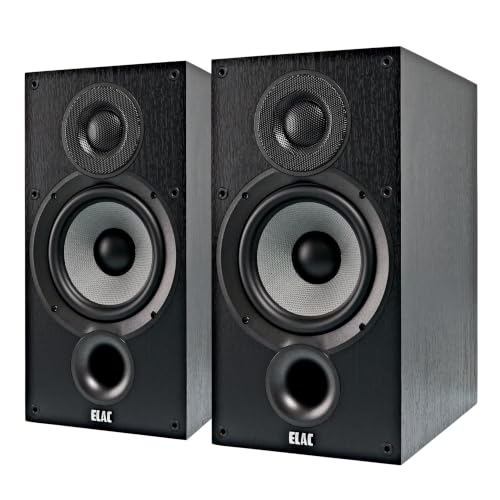
ELAC Debut 2.0 B6.2 Bookshelf Speakers
A passive bookshelf pair with a 6.5-inch aramid-fibre woofer, designed for use with a separate amplifier or AV receiver. It is a long-standing reference point for people building a first component stereo or home-theatre front stage. Check price on Amazon.

Polk Audio Monitor XT70 Tower Speaker
A large floor-standing tower with dual 6.5-inch woofers and a passive radiator, sold individually. Towers like this anchor a living-room stereo or the front left and right channels of a home-theatre system without needing stands. Check price on Amazon.

Klipsch R-51M Bookshelf Speakers
A passive bookshelf pair with Klipsch’s horn-loaded tweeter, which makes them efficient — they play loudly with modest amplifier power. That efficiency suits smaller receivers and lively, detailed presentation for movies and rock or pop music. Check price on Amazon.

KEF LS50 Meta Bookshelf Speakers
A premium passive bookshelf pair built around KEF’s Uni-Q coaxial driver, which places the tweeter at the centre of the woofer for consistent sound across a wide seating area. They reward a good amplifier and careful placement. Check price on Amazon.
Common Mistakes
Comparing sticker prices only
Bookshelf speakers without stands are an incomplete product. Always compare the full cost of a working, well-placed setup on both sides before declaring one route cheaper.
Assuming towers are always better
In a small room a tower’s extra bass becomes boom, and its size forces bad placement. The better speaker is the one matched to the room, not the bigger box.
Putting bookshelf speakers on the floor
A bookshelf speaker on the floor has its tweeter at ankle height and its bass doubled by the floor. Stands or a shelf at ear height are part of the product, not an optional extra.
Ignoring the subwoofer option
Dismissing bookshelf speakers for weak bass while refusing a subwoofer rigs the comparison. Bookshelf-plus-sub is a complete system design, and for films often the best one.
Pro Tips
- If you will add a subwoofer within a year, buy bookshelf speakers now.
- Towers need wall clearance too — budget floor space, not just money.
- Stands should put the tweeter at seated ear height; measure before ordering.
- For open-plan rooms, err toward towers or bookshelf-plus-sub, never bookshelf alone.
Going Deeper: Context That Helps
Returns windows are part of the buying process for audio gear, and you should use them deliberately. Sound is personal and room-dependent, so a product that reviews well can still disappoint in your space. Buy from sellers with clear return policies, keep packaging until you are sure, and test with your own content at your own volumes in the first days — not the night before the window closes. A structured test, with the same three songs or scenes each time, reveals differences that casual listening misses and turns a vague feeling into a decision you can act on.
Hearing safety deserves a mention in any audio guide. Comfortable TV and music listening sits well below the levels that risk hearing damage, but portable speakers at parties, and headphones especially, can creep upward in noisy environments as you compete with background sound. If you have to shout to be heard over your own system, it is too loud for long sessions. Many devices offer volume limiting — worth enabling for children — and taking listening breaks during long sessions protects both your ears and your enjoyment, because tired ears judge sound poorly.
Speaker sound is shaped as much by the room as by the speaker itself. Hard floors, bare walls and large windows reflect sound back at you, which can make even a good speaker seem harsh or echoey, while soft furnishings, rugs and curtains absorb those reflections and calm the result. Before blaming a speaker for disappointing sound, look at the room: a rug between the speakers and your seat, curtains over a large window, or a bookshelf filled with books behind you can change the sound more than a modest upgrade would. This is why the same speaker can sound impressive in a shop demo room and merely ordinary at home — the demo room was treated, and yours is not.
Stereo imaging depends on symmetry. When the left and right speakers are at different distances from you, or one is tucked into a corner while the other sits in open space, the stereo image pulls toward the closer or louder side and voices stop sounding centred. Aim for a rough triangle: the two speakers and your head at the corners, with both speakers the same distance from your seat and at the same height. Small adjustments — ten centimetres here, a slight toe-in there — are free, reversible and often more rewarding than new cables or accessories, so always finish placement before spending money on upgrades.
Bass behaves differently from the rest of the sound. Low frequencies are long waves that build up in corners and along walls, which is why a speaker can sound boomy in one spot and thin a metre away. Moving a speaker even slightly out from a wall reduces the wall’s reinforcement of the bass; moving your seat away from the back wall often fixes boominess that no tone control can. If your system has a subwoofer, its position matters even more, because a single subwoofer excites the room unevenly and your seat may sit in a peak or a null in the bass response.
Speaker sensitivity and impedance explain more about real-world loudness than headline wattage. Sensitivity tells you how loud a speaker plays with a given amount of power; a sensitive speaker on a modest amplifier can easily outplay an insensitive speaker on a powerful one. Impedance, measured in ohms, describes the load the speaker presents to the amplifier — most home speakers are nominally 8 or 6 ohms, and amplifiers are happiest when the speaker’s impedance stays within the range the amplifier is rated for. Matching these two figures sensibly matters far more than chasing the biggest watt number on a box.
Every speaker is a compromise between size, bass and efficiency — engineers call it Hoffman’s Iron Law: pick two, sacrifice the third. A tiny speaker can be efficient or produce deep bass, but not both at once, which is why small portable speakers sound impressive for their size yet cannot reproduce the lowest notes of a film soundtrack. Understanding this trade-off sets honest expectations. If a product promises room-filling deep bass from a box the size of a paperback, physics says the claim needs salt; the sound may still be enjoyable, but the lowest octave will be suggested rather than truly reproduced.
Burn-in and warm-up are debated endlessly, but the bigger variable is your own hearing. Your ears adapt to a new speaker over the first days of listening, which is why a speaker that sounded bright on day one often seems balanced by day five — your brain has recalibrated, not the hardware. The practical lesson is to live with a new setup for a week of normal listening before judging it or changing settings. Judge with familiar recordings you know well, at the volume you actually use, in the seat you actually sit in; first impressions in a shop or in the first ten minutes at home are unreliable.
Cables and connections cause more speaker problems than speakers do. A single stray strand of copper touching the neighbouring terminal can short an amplifier; a loose banana plug or a corroded RCA connector adds crackle that sounds like a failing driver. Oxygen-free copper wire of adequate gauge, clean tight connections and strain relief where cables bend will keep a system reliable for years. Expensive exotic cables, by contrast, have never been shown to change sound in controlled listening tests once gauge and connection quality are adequate — spend the difference on placement, room treatment or better recordings instead.
Listening level matters for judging any speaker. Human hearing perceives bass and treble as weaker at low volumes — the Fletcher-Munson effect — so a speaker auditioned quietly can seem thin, and the same speaker loud can seem bass-heavy. Many receivers and some speakers compensate with loudness or dynamic EQ features for late-night listening. When you compare speakers or settings, match the volume between them as closely as you can, because the louder option almost always sounds ‘better’ in a quick comparison even when it is not. A cheap sound-level app on a phone is accurate enough to level-match for home comparisons.
Multi-room and streaming speakers add a networking layer to ordinary audio problems. A speaker that drops off the network, lags behind its partner in a stereo pair, or refuses to appear in an app is usually suffering from weak Wi-Fi at its location, a congested 2.4 GHz band, or a router setting — not a failed speaker. Placing the router centrally, keeping speakers within a room or two of it, and updating firmware through the maker’s app solves most of these cases. Wired Ethernet, where a speaker offers it, removes the variable entirely and is worth using for a fixed living-room setup.
Protecting speakers is mostly about restraint. Amplifiers damage speakers in two ways: too much power can overheat or over-extend a driver, but far more commonly a small amplifier driven into distortion — clipping — produces harsh high-frequency energy that burns out tweeters. If the sound turns harsh, gritty or compressed as you raise the volume, turn it down; that harshness is the warning sign. Children, pets and parties are the other risks: a volume limit in the receiver’s settings, grilles left on, and speakers placed where they cannot be knocked over will prevent most household speaker casualties.
Speaker specifications reward careful reading. Frequency response figures only mean something with a tolerance attached — ’60 Hz to 20 kHz’ without a plus-or-minus figure could hide a response that is already far down at 60 Hz. Driver size tells you about potential, not results: a well-designed 5-inch woofer in a solid cabinet can sound cleaner than a cheap 8-inch driver in a resonant box. Weight is an unfashionable but useful clue, because rigid cabinets and real magnets are heavy. Treat specifications as a way to shortlist, then let placement, room and your own ears make the final decision.
Ageing affects speakers slowly and mostly at the edges. Foam woofer surrounds on older speakers can crumble after a couple of decades, rubber surrounds last longer, and capacitors in crossovers drift with age, subtly changing the balance. None of this matters for a new purchase, but it explains why a vintage speaker may not sound as its measurements once promised. For modern speakers, dust, sunlight and humidity are the main enemies: keep them out of direct sun, wipe dust with dry or barely damp cloths, and avoid placing drinks on top of cabinets, where one spill can stain veneer and swell the wood beneath.
Frequently Asked Questions
Do tower speakers sound better than bookshelf speakers?
Not automatically. Towers play deeper bass and louder volumes, which sounds ‘better’ in big rooms and demos. In small rooms, bookshelf speakers often sound cleaner and image better, and with a subwoofer they match towers for films. Sound quality depends on design quality at each price level and on matching the speaker to the room. The honest answer is that each wins in the conditions it was designed for, which is why room size comes first in this decision.
Do bookshelf speakers need stands?
They need their tweeters at ear height and a stable, non-resonant support. Stands are the usual answer and also free the speaker from furniture reflections; a solid shelf at the right height with isolation pads can work. What they cannot do is sit on the floor or inside a cabinet and perform as designed. When budgeting, treat stands as part of the purchase — a bookshelf pair plus stands is the true product being compared with a tower pair.
Is bookshelf plus subwoofer better than towers?
For films and bass-heavy music, frequently yes: a dedicated subwoofer placed where bass works best in the room, freeing the main speakers to do midrange and treble, is a powerful combination. For pure stereo music in a large room, towers alone can sound more seamless, because the bass comes from the same locations as the rest of the sound. Both are legitimate high-quality architectures; your content and room should choose between them.
How big should my room be for tower speakers?
There is no strict threshold, but towers come into their own when your seat is three metres or more from the speakers and the room can give them space from walls. In a small bedroom or study they are usually wasted and often counterproductive, producing excess bass and dominating the space. If you love towers in a modest room, choose compact models designed for closer placement, keep volumes moderate, and expect to use tone controls to tame the low end.
Can I mix bookshelf and tower speakers in one system?
Yes, and home theatre does it all the time: towers as front left and right, a matching centre, and bookshelf speakers as surrounds is a classic layout. The important rule is to keep the front three from the same family, because dialogue pans across them and mismatched voicing is obvious. Surrounds are more forgiving. For stereo music you would still use one matched pair, so buy the front pair for the music first and build around them.
Which is better for an apartment?
Bookshelf speakers, usually with no subwoofer or a small one used considerately. Apartments punish bass: it travels through floors and walls to neighbours, and small rooms overload easily. A bookshelf pair at modest volume gives you full musical satisfaction with far less neighbour impact, and stands or shelves keep them off shared walls. If you crave film bass in a flat, a small subwoofer placed near your seat, run gently, delivers it at lower overall levels than turning up tower speakers.
The Physics of Cabinet Size, Without the Romance
The difference between these two formats is, at bottom, a difference of air. A tower’s larger cabinet gives its drivers room to produce low frequencies efficiently and to house several of them, dividing the work so each operates in its comfort zone. A bookshelf speaker asks one or two drivers in a small box to cover nearly the same range, and physics collects its fee in the lowest octave and in maximum volume. Everything else — price, placement, the subwoofer question — is commentary on that single fact. Understanding it prevents the two classic errors: expecting a small speaker to fill a large room with cinema bass because its specifications gesture at low numbers, and assuming a tower’s size guarantees quality, when a large, poorly executed cabinet is merely a bigger disappointment. Size is capability, not virtue, and the comparison in this guide is really about matching capability to the room, the seat and the repertoire.
Efficiency and the amplifier’s workload
Towers are often, though not always, easier loads for an amplifier, playing louder with the same power because their larger cabinets and multiple drivers convert electricity to sound more efficiently at low frequencies. Bookshelf speakers, especially compact high-quality ones, can be notably thirsty, asking a modest amplifier to work hard for ordinary volumes. Neither fact decides the comparison alone, but both belong in the complete budget the main guide insists on: a bookshelf system with the amplifier it actually needs can cost what a tower system costs, and a tower system driven by an amplifier it overwhelms is a waste of both. Match the electrical partnership with the same care as the acoustic one.
Listening Scenarios: Where Each Format Earns Its Keep
The film lover in a dedicated room
Where films are the main event and the room can take them, towers earn their floor space honestly: they deliver the scale and dynamic ease that soundtracks assume, anchor a front stage that a centre channel can match in stature, and postpone or remove the subwoofer question for all but the most demanding material. The same money spent on bookshelf speakers in that room buys refinement the films will not use and leaves the scale unbought.
The music listener in a shared living room
Where the room is shared, furnished and negotiated, bookshelf speakers on stands often win socially before they win sonically: they fit the room’s life, they can be placed with the precision the positioning guidance in this series describes, and with a discreet subwoofer they cover music’s full range without dominating the furniture. Towers in such rooms can work beautifully, but they must earn their visual citizenship every day, and in some rooms they never quite do.
The desk and the small room
At a desk, the question answers itself: nearfield listening belongs to compact speakers, and towers are furniture arguing with a chair. In small rooms generally, a bookshelf speaker’s limited bass is a feature disguised as a limitation, because small rooms amplify bass at boundaries and punish excess; the tower that overwhelms a small room is not revealing its quality, it is revealing the mismatch.
The growing system
Buyers building toward surround sound should think in families. Bookshelf speakers multiply gracefully: the same model can serve as mains, surrounds and centre duties across years of upgrades, moving around the room as the system grows. Towers commit the front of the room gloriously and then ask the rest of the system to match their scale. Neither path is wrong, but the bookshelf path is the more forgiving of changing rooms, budgets and minds.
Ownership Over a Decade: Moving, Storing and Living With Them
Speakers are kept for years, and the formats age differently in a life. Towers are furniture: heavy, awkward on stairs, and the first thing a removal firm comments on. They reward stable households and punish renters, students and the chronically rearranging. Bookshelf speakers move in a box under one arm, store on a shelf, redeploy to a bedroom or a desk when the main system changes, and sell more easily because they ship more easily. Children and pets enter the calculation too: a tall tower must be stable against climbing and collisions, and some households anchor or avoid them for exactly that reason, while a bookshelf speaker on a stand can be knocked over in its own way and deserves the same honest assessment. None of this appears in reviews, because reviews last a week and ownership lasts a decade. Ask the decade’s questions before buying: where will these live in three years, who will move them, and what happens to them when the room changes? The format that answers kindly is usually the right one, whatever the demo room said.
Resale and the second system
Both formats hold value when bought from reputable makers, but they exit differently. Bookshelf speakers begin second careers — a child’s first system, a study pair, a kitchen upgrade — with an ease that keeps them in the family for decades. Towers tend to be sold whole or stay forever, and their size makes the selling slower. A household that enjoys cascading equipment through its rooms will get more total music from the bookshelf path; a household that buys a destination system and keeps it will get more from towers. Know which household you are.
The Subwoofer Question, Settled by Repertoire
Whether bookshelf-plus-subwoofer beats towers is really a question about what you play. Music with genuine low content — organ, electronic, large orchestral works, film scores — reveals the lowest octave as a physical presence that small cabinets cannot counterfeit, and a well-integrated subwoofer supplies it invisibly. Most popular music, jazz, folk and speech live almost entirely above that territory, and for those repertoires the subwoofer is a refinement rather than a necessity, while the towers’ advantage shrinks to scale and ease at volume. Films invert the judgement: soundtracks assume low-frequency capability as a storytelling tool, and the subwoofer stops being optional for anyone who wants the room to feel what the screen shows. Judge by your own library’s honest contents, not by the most demanding recording you own, because systems should be built for the median evening, not the exceptional one. And where a subwoofer joins bookshelf speakers, integration is the whole game: level matched by ear, crossover set where the mains naturally fade, and position found by the crawl method, so the bass seems to come from the music rather than from a box in the corner.
Choose by room, repertoire and the decade you can foresee, and the format chooses itself. The speakers that fit your life will be played daily; the ones that merely impressed you will be admired occasionally, and music rewards the daily.
What Reviews Won’t Tell You: Living Volume and Listening Distance
Comparisons are usually written at review volumes in treated rooms, and households live at neither. At the low volumes of ordinary evenings, the formats’ characters shift: a tower’s easy scale can turn to reticence, its several drivers not quite waking, while a good bookshelf speaker often sounds complete and intimate at a murmur, which is why small speakers dominate desks and bedrooms in practice. At the other end, a room-filling party volume exposes the bookshelf speaker’s ceiling quickly and flatters the tower’s headroom. Listening distance writes the same story in another hand. Close up, the tower’s separated drivers can fail to blend into a single voice, and the compact speaker’s coherence wins; across a long room, the tower’s output and dispersion carry the day. Before choosing, be honest about your median volume and your actual seat distance, because the format that wins at your median is the format you will love, and the format that wins at the extremes you rarely visit is a trophy, not a tool.
The centre-image test and other home diagnostics
If you are auditioning both formats, three home tests separate them better than any playlist of audiophile excerpts. Play a centred voice at your normal volume and ask whether it sounds like a person or like two speakers cooperating; the format that makes you forget the equipment wins the imaging round. Play the quietest passage you love and ask whether it survives intact at evening volume; that is the low-level round. Play the loudest moment you honestly use and listen for strain, hardness or a cabinet joining in; that is the headroom round. Score the three rounds for your room and your seat, and you will have a verdict no showroom could give you, because it was measured in the only laboratory that matters.
Aesthetics, Honestly Weighed
Sound guides pretend appearance is superficial, and households know better: speakers are seen every day and heard for hours, and a format you enjoy looking at will be forgiven much. Towers make a statement, contemporary or traditional depending on finish, and in the right room they are sculpture that sings. In the wrong room they are an apology repeated daily. Bookshelf speakers ask less of a room’s forgiveness and offer finishes from furniture-grade wood to studio minimalism, and on stands they can look intentional rather than accommodated. Let appearance vote, openly and without embarrassment, after the acoustic shortlist is drawn. A system you are proud to live with gets played; a system that wins arguments and loses the room gets dusty, and dust, as this series’ cleaning guide notes, is the one enemy every speaker shares.
The Verdict in One Breath, by Buyer
For the dedicated room and the film habit, towers, bought once and placed well. For the shared living room, the rented flat, the desk and the growing system, bookshelf speakers, with stands treated as part of the purchase and a subwoofer when the repertoire asks. For the small room, bookshelf, and be grateful physics made the decision easy. For the large room where music must fill real volume, towers, or bookshelf speakers will spend their lives at the edge of their ability. For the buyer who moves often, bookshelf, in their original boxes, under one arm. For the buyer who is furnishing a forever room, whichever format the room’s proportions flatter, because you will be looking at them longer than any other component you own. That is the whole comparison, and everything else in this guide is the reasoning that lets you trust it.
Keep that reasoning beside you in the shop, where the towers will be doing their impressive best and the bookshelf speakers their modest one, and remember that you are not buying the demo. You are buying your room, your repertoire and your next decade, and the right format is the one that serves all three.
A note on mixing generations and families
Households often inherit or accumulate speakers across years, and the formats mix more gracefully than purists suggest. A newer bookshelf pair can serve as surrounds behind older towers without disgrace, provided levels and distances are set with the receiver’s calibration, and a single centre from a different family will still clarify dialogue even if its voice differs slightly from the mains. Perfection in matching matters most across the front three, at high volumes, in dedicated rooms. Everywhere else, a well-set-up mixed system beats a theoretically pure one that exists only in a shopping basket. Spend the matching money where the ear can audit it.
And when the system is mixed, inherited or grown in stages, judge it as a whole, playing your favourite recording at your favourite volume. If it moves you, the format debate has been settled by the only authority that was ever going to count.
The last word on stands
Because it decides so many real comparisons, give the humble stand its paragraph. A bookshelf speaker’s true price and true footprint include its stand, and a tower’s price and footprint are simply themselves. Compared honestly that way — bookshelf on stands versus tower on the floor — the space they occupy is nearly identical, the cost gap narrows, and the decision returns to sound, room and life, where it belongs. Never let a comparison that pretends bookshelf speakers float in mid-air persuade you of anything.
Honest comparisons, honestly costed, produce systems that stay loved. That is the standard this guide has applied to every section, and it is the standard to hold any seller, review or friend to when they offer you a simpler story.
Simpler stories are available everywhere. Better systems come from the honest one.
Choose the honest system, place it with the care this series describes, and then let the format question rest. It has done its work the moment the music starts and nobody in the room is thinking about cabinets at all.
That disappearance is the trophy both formats are competing for.
Award it to the system that fits your room, and enjoy the ceremony of listening, which is what all of this was for.
The ceremony begins the moment you stop shopping.
Stop, then, with confidence in the reasoning behind you, and let the first record in the new system be one you have loved for years. It will tell you, within a minute, that you chose well.
And if it tells you otherwise, the return window and this guide’s reasoning will between them put it right.
Either way, you will end with the right speakers in the right room, which is the only victory this comparison has ever offered.
Claim it, and then claim the evening for the music.
The music has waited through the whole comparison. It can wait no longer, and neither should you.
Press play, in whichever format you chose, and let the room decide the rest.
The room, given good speakers and honest placement, always decides in your favour.
Trust it, and the format, and the decade of listening ahead of both.
A decade of listening is a fine thing to have ahead of you.
Begin it tonight, with the speakers your room asked for.
The room knew all along. Now you do too.
That shared knowledge, between an owner and a room, is where every great system in this series begins.
Begin yours, and let the towers or the bookshelves — whichever the room chose — sing.
Singing, in the right room, is what they were built for.
Give them the room, and they will give you the years.
Years of evenings, each one sounding like the right choice.
Because it was, and the room will keep proving it.
Proof, delivered nightly, is the best kind there is.
Collect it song by song.
Song by song is how a decade passes, pleasantly.
Pleasantly is the entire point.
Never let a format debate, however enjoyable, delay the point by a single evening.
Decide tonight, and the debate becomes a memory by the weekend.
A memory, and a system, are both better than a debate.
You now have both within reach. Choose the system.
And enjoy the memory of choosing well.
Well-chosen speakers make that memory easy to enjoy.
Almost as easy as the listening itself.
Which starts, as always, now.
Now, with the right speakers in the right places, in the room that asked for them.
The room asked, you listened, and the speakers answered. That is a system working as it should.
Let it work, nightly, for years.
Years are the currency speakers deal in. Spend yours on listening.
Listening, not comparing, is the hobby. The comparing was just the door.
Walk through it, and close it behind you.
The music is on the other side, waiting.
It has waited long enough.
Go to it, through whichever speakers earned the room.
They earned it honestly, and so did you.
Related Guides
These guides and roundups cover the closest decisions and fixes in this category:
- best tower speakers under 1000
- best floor standing speakers for music
- best bookshelf speakers for home theater
- best tower speakers for home theater under 400
- speaker buying guide
- what is a subwoofer for
Can I use tower speakers in a surround system with bookshelf surrounds?
Yes, and it is a common, sensible arrangement. Keep the front three speakers tonally matched, ideally from the same family, because dialogue pans across them; surrounds are more forgiving, and bookshelf models serve there excellently.
Do tower speakers always need more amplifier power?
Often the opposite: many towers are more efficient than compact bookshelf speakers and play louder with less power. Check sensitivity rather than assuming, because cabinet size and power appetite are not the same thing.


