Disclosure: As an Amazon Associate, kajuandouglas.com earns from qualifying purchases. Links to Amazon on this page are affiliate links; they cost you nothing extra. Listing details such as price and availability change often, so check the current Amazon listing before you buy.
Learning how to position a speaker is the highest-value skill in home audio, because placement changes sound more than most upgrades do — and it costs nothing. The same pair of speakers can sound spacious and precise or boomy and blurred depending on a few decisions: how far apart they are, how far from the walls, how high the tweeters sit, and where you sit relative to all of it. Shops know this, which is why demo speakers are always carefully placed.
This guide gives you a repeatable method: set up the listening triangle, set heights, manage wall distances, fine-tune with toe-in, and then test with familiar music while changing one thing at a time. It covers stereo pairs, single speakers, desktop setups and speakers that must live in imperfect places such as shelves and corners, with honest compromises for real rooms rather than ideal ones.
How to position a speaker: The Short Answer
Form an equilateral-ish triangle between the two speakers and your seat, put tweeters at ear height, start with speakers 30–60 cm from the back wall, angle them slightly toward you, and adjust in small steps while listening to familiar tracks. Symmetry between left and right matters most of all.
In this guide
What You Need
- A tape measure
- Your usual seat, in its usual position
- Two or three familiar test tracks with vocals and bass
- Masking tape to mark positions on the floor
- Stands, shelf space or isolation pads as your furniture allows
- A phone with a free sound-level app (optional, for matching levels)
Step by Step
Step 1: Set up the listening triangle
Place the speakers and your seat at the corners of a triangle. Start with the speakers as far apart as the distance from each speaker to your seat — an equilateral triangle — then adjust: slightly closer together sharpens the centre image for films and vocals; slightly wider spreads the soundstage for music. Mark the positions with tape so you can return to them after experiments. If the speakers must be far apart, angle them inward more; if close together, less.
Step 2: Put tweeters at ear height
High frequencies are directional, so the tweeters should aim at your ears when you are seated. For bookshelf speakers that usually means stands, or shelves at the right height, with the speaker upright as designed. If a speaker must sit low, angle it upward with a wedge or isolation pad; if it sits high, angle it down or even invert it if the design allows. Desktop speakers benefit from small angled stands that lift them off the desk and point them at your head rather than your chest.
Step 3: Manage distance from walls
Walls reinforce bass. Start with speakers 30 to 60 centimetres from the wall behind them and listen: boomy, thick bass means move them out or plug the rear port if the maker supplies bungs; thin, weak bass means move them closer. Rear-ported speakers need the most clearance because the port’s output must not be choked or reflected straight back. Side walls matter too — keep both speakers a similar distance from their nearest side wall so the pair stays balanced.
Step 4: Set toe-in
Toe-in is angling the speakers toward your seat. Start with them pointing straight ahead, then angle them inward in small steps. More toe-in sharpens the centre image and treble focus but narrows the sweet spot; less widens the area that sounds good but softens the centre. A common endpoint is speakers aimed at a point just behind your head. Judge with a centred vocal: it should sound like a person standing between the speakers, stable when you move your head slightly.
Step 5: Fix the seat’s position if you can
Your seat is half the geometry. Sitting hard against the back wall piles up bass and smears detail; moving the seat even half a metre into the room often improves sound more than moving the speakers. If the seat cannot move, pull the speakers further into the room instead to preserve the triangle. Avoid sitting exactly at the room’s midpoint, where bass often cancels, and avoid a seat much closer to one speaker than the other, which no balance control fully repairs.
Step 6: Test with familiar music and change one thing at a time
Play the same short passages after each adjustment: a centred vocal for imaging, a bass line for evenness, something with cymbals or strings for treble balance. Write down what changed. The discipline of one change at a time is what separates positioning from random shuffling — without it you will chase your tail and end up with tape marks everywhere and no idea which position was best. Give each candidate position a full track, not ten seconds, before judging.
Step 7: Compromise intelligently in imperfect rooms
Real rooms have fireplaces, doors and partners with opinions. If a speaker must go in a corner, expect extra bass and reduce it with the amplifier’s tone controls or EQ rather than fighting physics. If speakers must sit on a shelf, bring them to the front edge so sound does not reflect off the shelf surface, and decouple them with pads. If they must be at different heights or distances, use the receiver’s distance and level settings to compensate — imperfect symmetry, corrected, beats no correction at all.
As you work through this guide, keep the bigger picture in mind. Our roundup of best bookshelf speakers under 500 shows how the main options compare, and the companion piece on how to choose a speaker covers the neighbouring decision in the same detail.
How to Position a Speaker on a Desk, Shelf or in a Corner
Desks add a special problem: the desk surface reflects sound straight up into your ears a fraction after the direct sound, blurring detail. Raising speakers on stands or angled pads, so the drivers clear the surface and aim at your ears, removes most of it. Keep speakers at the back edge of the desk only if the wall behind is not immediately behind them; otherwise pull them forward. Nearfield listening forgives small speakers, so a compact pair placed well will beat a large pair placed badly at a desk every time.
Corners are the position of last resort: two walls and often the floor meet there, each reinforcing bass, so corner speakers boom. If a corner is unavoidable, choose a sealed or front-ported speaker, keep volume moderate, and use EQ to trim the low end. Single speakers — smart speakers and portables — follow simpler rules: put them at ear-ish height, away from corners, on a solid surface that will not buzz, and let them face the part of the room where people actually gather.
Positioning Surrounds, Centres and Subwoofers
In a home-theatre layout the centre speaker belongs directly above or below the screen, as close to ear height as the furniture allows, angled toward the listeners, because it carries nearly all dialogue. Surround speakers go to the sides of, or slightly behind, the main seat, a little above ear height, so effects envelop rather than distract. Small errors in surround position are forgiven by the receiver’s calibration, which measures distances and levels with a microphone — run it after any move.
Subwoofers ignore the triangle rules because low bass is omnidirectional, but their position still shapes what you hear: corner placement maximises output and boom alike, while a position along a wall near the front speakers usually balances output and evenness. The classic test is to place the subwoofer in your seat temporarily, play bass-heavy content and crawl around the room’s edges listening for where the bass sounds smoothest — that spot is where the subwoofer belongs.
Gear for This Guide

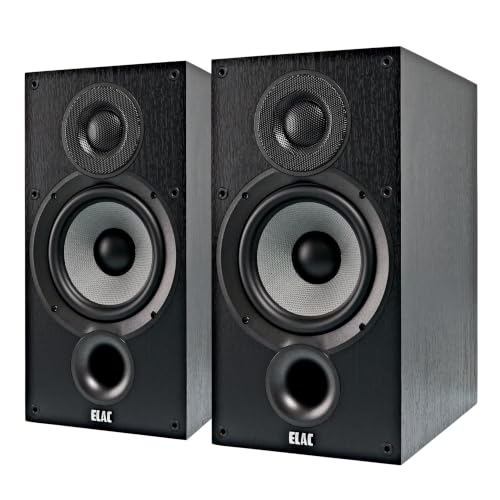
ELAC Debut 2.0 B6.2 Bookshelf Speakers
A passive bookshelf pair with a 6.5-inch aramid-fibre woofer, designed for use with a separate amplifier or AV receiver. It is a long-standing reference point for people building a first component stereo or home-theatre front stage. Check price on Amazon.

Klipsch R-51M Bookshelf Speakers
A passive bookshelf pair with Klipsch’s horn-loaded tweeter, which makes them efficient — they play loudly with modest amplifier power. That efficiency suits smaller receivers and lively, detailed presentation for movies and rock or pop music. Check price on Amazon.

Polk Audio Monitor XT70 Tower Speaker
A large floor-standing tower with dual 6.5-inch woofers and a passive radiator, sold individually. Towers like this anchor a living-room stereo or the front left and right channels of a home-theatre system without needing stands. Check price on Amazon.

KEF LS50 Meta Bookshelf Speakers
A premium passive bookshelf pair built around KEF’s Uni-Q coaxial driver, which places the tweeter at the centre of the woofer for consistent sound across a wide seating area. They reward a good amplifier and careful placement. Check price on Amazon.
Common Mistakes
Speakers on the floor or on top of a vibrating cabinet
Floors and hollow furniture add their own resonance and put tweeters far below ear height. Stands, solid shelves or isolation pads are not accessories; they are part of the speaker.
One speaker in a corner, one in open space
Asymmetry guarantees a lopsided image and uneven bass. If the room forces different surroundings, compensate with placement distances and the receiver’s level and distance settings.
Pushing rear-ported speakers flat against the wall
A choked port turns clean bass into a boomy thud. Give rear ports room to breathe, or choose front-ported or sealed speakers for against-wall positions.
Judging from the wrong seat
Tuning the system while standing in the doorway optimises it for the doorway. Always judge from the seat where listening actually happens, at the height your head will be.
Pro Tips
- Use tape marks so experiments are reversible — you can always go back.
- A rug between speakers and seat tames a lively room cheaply.
- Photograph the final setup; after any move you can restore it exactly.
- Re-run your receiver’s auto-calibration after every significant move.
Going Deeper: Context That Helps
Ageing affects speakers slowly and mostly at the edges. Foam woofer surrounds on older speakers can crumble after a couple of decades, rubber surrounds last longer, and capacitors in crossovers drift with age, subtly changing the balance. None of this matters for a new purchase, but it explains why a vintage speaker may not sound as its measurements once promised. For modern speakers, dust, sunlight and humidity are the main enemies: keep them out of direct sun, wipe dust with dry or barely damp cloths, and avoid placing drinks on top of cabinets, where one spill can stain veneer and swell the wood beneath.
Whatever the product, the cheapest upgrade is usually time spent with the manual and the settings menu. Manufacturers bury genuinely useful options — EQ presets, dialogue modes, level trims, firmware updates — several layers deep, and most owners never find them. An hour spent exploring settings with familiar content playing will teach you more about your system than a week of reading reviews, and it costs nothing. Keep notes of what you changed so you can undo anything that makes things worse, and change one thing at a time so you know which adjustment caused which result.
Returns windows are part of the buying process for audio gear, and you should use them deliberately. Sound is personal and room-dependent, so a product that reviews well can still disappoint in your space. Buy from sellers with clear return policies, keep packaging until you are sure, and test with your own content at your own volumes in the first days — not the night before the window closes. A structured test, with the same three songs or scenes each time, reveals differences that casual listening misses and turns a vague feeling into a decision you can act on.
Hearing safety deserves a mention in any audio guide. Comfortable TV and music listening sits well below the levels that risk hearing damage, but portable speakers at parties, and headphones especially, can creep upward in noisy environments as you compete with background sound. If you have to shout to be heard over your own system, it is too loud for long sessions. Many devices offer volume limiting — worth enabling for children — and taking listening breaks during long sessions protects both your ears and your enjoyment, because tired ears judge sound poorly.
Speaker sound is shaped as much by the room as by the speaker itself. Hard floors, bare walls and large windows reflect sound back at you, which can make even a good speaker seem harsh or echoey, while soft furnishings, rugs and curtains absorb those reflections and calm the result. Before blaming a speaker for disappointing sound, look at the room: a rug between the speakers and your seat, curtains over a large window, or a bookshelf filled with books behind you can change the sound more than a modest upgrade would. This is why the same speaker can sound impressive in a shop demo room and merely ordinary at home — the demo room was treated, and yours is not.
Stereo imaging depends on symmetry. When the left and right speakers are at different distances from you, or one is tucked into a corner while the other sits in open space, the stereo image pulls toward the closer or louder side and voices stop sounding centred. Aim for a rough triangle: the two speakers and your head at the corners, with both speakers the same distance from your seat and at the same height. Small adjustments — ten centimetres here, a slight toe-in there — are free, reversible and often more rewarding than new cables or accessories, so always finish placement before spending money on upgrades.
Bass behaves differently from the rest of the sound. Low frequencies are long waves that build up in corners and along walls, which is why a speaker can sound boomy in one spot and thin a metre away. Moving a speaker even slightly out from a wall reduces the wall’s reinforcement of the bass; moving your seat away from the back wall often fixes boominess that no tone control can. If your system has a subwoofer, its position matters even more, because a single subwoofer excites the room unevenly and your seat may sit in a peak or a null in the bass response.
Speaker sensitivity and impedance explain more about real-world loudness than headline wattage. Sensitivity tells you how loud a speaker plays with a given amount of power; a sensitive speaker on a modest amplifier can easily outplay an insensitive speaker on a powerful one. Impedance, measured in ohms, describes the load the speaker presents to the amplifier — most home speakers are nominally 8 or 6 ohms, and amplifiers are happiest when the speaker’s impedance stays within the range the amplifier is rated for. Matching these two figures sensibly matters far more than chasing the biggest watt number on a box.
Every speaker is a compromise between size, bass and efficiency — engineers call it Hoffman’s Iron Law: pick two, sacrifice the third. A tiny speaker can be efficient or produce deep bass, but not both at once, which is why small portable speakers sound impressive for their size yet cannot reproduce the lowest notes of a film soundtrack. Understanding this trade-off sets honest expectations. If a product promises room-filling deep bass from a box the size of a paperback, physics says the claim needs salt; the sound may still be enjoyable, but the lowest octave will be suggested rather than truly reproduced.
Burn-in and warm-up are debated endlessly, but the bigger variable is your own hearing. Your ears adapt to a new speaker over the first days of listening, which is why a speaker that sounded bright on day one often seems balanced by day five — your brain has recalibrated, not the hardware. The practical lesson is to live with a new setup for a week of normal listening before judging it or changing settings. Judge with familiar recordings you know well, at the volume you actually use, in the seat you actually sit in; first impressions in a shop or in the first ten minutes at home are unreliable.
Frequently Asked Questions
How far apart should stereo speakers be?
Start with the speakers separated by about the same distance as from each speaker to your seat, forming a triangle, then adjust by ear. Closer together gives a stronger centre image for TV and vocals; wider gives a bigger soundstage for music but can open a hole in the middle if you go too far. In most living rooms the answer lands between one and a half and three metres. Let a centred vocal be your judge: it should sound solid and located, not smeared.
How far from the wall should speakers be?
Begin 30 to 60 centimetres from the wall behind them and adjust in small steps. More distance usually cleans up bass and deepens the soundstage; less distance strengthens bass, which thin-sounding small speakers sometimes need. Rear-ported speakers need the most clearance. There is no universal number because rooms and speakers differ — the method is to start in the middle of the range and move one speaker pair at a time while listening to a familiar bass line.
Should speakers be angled toward me?
Usually yes, to some degree. Toe-in sharpens the stereo image and increases treble clarity at your seat, at the cost of a narrower sweet spot. Speakers with wide dispersion may sound best almost straight ahead, while others want to aim nearly at your ears. Adjust in small increments with a centred vocal playing: stop when the voice sounds focused and stable but the soundstage still feels wide. Both speakers must match — mismatched angles unbalance the image.
Can I put speakers on a bookshelf?
Yes, despite the name mismatch — most ‘bookshelf’ speakers are designed for stands but work acceptably on shelves if you help them. Bring them to the front edge of the shelf so sound does not bounce off the shelf surface, decouple them with pads or feet, and avoid enclosing them between books on both sides, which colours the sound. Keep rear ports a few centimetres from the back panel of the unit, and angle the speakers toward your seat if the shelf height is off ear level.
Where should a single smart or portable speaker go?
Put it where its sound can spread: on a solid surface, roughly at the height of seated listeners’ ears, out of corners and away from walls that will overload the bass. Centre it on the area where people gather rather than on the room’s geometry. In a kitchen, a shelf away from the hob’s steam works well; in a living room, a sideboard or stand near the seating. If the speaker supports stereo pairing later, leave a matching spot free on the other side of the room.
Why does my system sound great in one seat and poor in another?
Because rooms create peaks and dips in the bass and reflections vary by position, every room has better and worse seats. The main seat, centred between the speakers and away from walls, is optimised by your placement work; seats against walls or far off to one side will always compromise. Accept this and optimise for the seat used most. For film nights with guests, a slightly wider toe-in compromise spreads acceptable sound across a sofa rather than perfecting one cushion.
The Physics in Plain Language: Why Position Changes Everything
A speaker does not simply send sound at you; it fills a room with waves that reflect, reinforce and cancel in patterns set by geometry. Low frequencies are long waves that wrap around furniture and build up where they meet walls and corners, which is why bass can boom in one seat and vanish in another a metre away. High frequencies are short, directional and easily absorbed, which is why the tweeter’s height and aim decide clarity. When you move a speaker, you are not adjusting a detail; you are renegotiating its relationship with every surface in the room. The encouraging news is that the negotiation follows learnable rules, and the main steps in this guide encode most of them. This section explains the reasoning underneath, because an owner who understands why the triangle works can adapt it intelligently to rooms that refuse to be ideal, which is to say, all real rooms.
Boundary reinforcement: walls as unwilling amplifiers
Every nearby surface adds bass, whether you asked it to or not. A speaker in open space radiates bass in all directions and much of it is lost to the room; the same speaker against a wall gains output from that wall’s reflection, in a corner gains more, and on a shelf inside a bookcase gains most of all, because each boundary returns energy the speaker would otherwise waste. Makers design for an assumed placement — some speakers are voiced expecting wall support, others expecting open space — and a mismatch explains many disappointments: the open-space design shoved into a corner booms, and the wall design pulled into the room sounds thin. When a system sounds bass-heavy, the cheapest equaliser ever made is distance from boundaries, applied a few centimetres at a time. When it sounds thin, the same control works in reverse. No setting in any menu does what those centimetres do, because the menu cannot move the reflections.
The first reflection and the clarity of voices
Sound reaches you twice: directly from the speaker, and reflected off the nearest surfaces a fraction later. Your ears fuse the two arrivals, and the reflection, when strong, blurs detail and smears the stereo image sideways. The strongest early reflections usually come from the side walls, the floor and the ceiling at predictable points between speaker and seat. Softening those points — a rug between speakers and listener, a bookcase or curtain on a side wall — sharpens voices and imaging more than many equipment upgrades, and it costs nothing but attention. You can find the side-wall reflection points with a mirror: sit in the listening seat and have someone slide a mirror along the wall; where you can see the speaker in the mirror is where its reflection reaches you. Treat that spot, even with a cushion or a plant, and the improvement is frequently the largest in the whole positioning journey.
Room Shapes and Their Personalities
The small square room
Small square rooms are the bass player’s nightmare, because equal dimensions reinforce the same low frequencies from both directions and create strong peaks and nulls. The countermeasures are asymmetry and modesty: place the speakers along one wall but offset from dead centre, sit slightly off the room’s exact middle where bass cancels or piles up worst, and choose speakers whose bass suits the space rather than overwhelming it. Diagonal placement, speakers firing across a corner, looks unconventional and often works beautifully in square rooms precisely because it breaks the symmetry the room was punishing you with. In a small room, nearfield listening is also your friend: the closer you sit, the more direct sound and the less room you hear.
The long room and the open plan
Long rooms reward firing along the length, which gives waves room to develop and keeps side reflections later and weaker. Open-plan spaces are really several rooms sharing air, and the honest approach is to define a listening zone within them rather than filling the whole volume: speakers and seat arranged as an island, with the rug-and-furniture treatment concentrated there. Trying to energise an entire open plan from one pair of speakers leads to volume wars with the kitchen; a well-made island, by contrast, sounds intimate at civilised levels while life continues around it.
Low ceilings, high ceilings and awkward architecture
Ceiling height changes the reflection pattern overhead and the volume the speakers must fill. Low ceilings bring the ceiling reflection early and strong, favouring speakers with controlled vertical dispersion and seats a little closer. High ceilings forgive more and reward speakers that can fill space. Beams, alcoves, bay windows and fireplaces all break the textbook diagrams, and the working method is always the same: start from the main steps’ geometry, then adjust one variable at a time, listening to familiar material, until the room’s particular accent becomes a feature rather than a fight. Perfection is not available; a good compromise, knowingly chosen, is.
Multi-Seat Reality: Positioning for More Than One Listener
The main steps optimise the single sweet spot, but households listen in groups, and group listening has its own geometry. The wider the seating, the more you should favour speakers with broad, even dispersion and a gentler toe-in, because extreme toe-in builds a magnificent image for one head and a lopsided one for everyone else. Accept a slightly less holographic centre image in exchange for a sofa where nobody hears only one speaker. For film nights, the centre of the sofa becomes the reference seat and the system should be balanced there, with the understanding that the end seats trade some imaging for comfort, as they do in cinemas. The honest summary is that positioning is a choice about whose experience to privilege, and households that make that choice deliberately, rather than by accident, argue about sound far less.
Stands, Shelves, Mounts and What They Do to Sound
What a speaker stands on is part of the speaker. A stand’s job is to hold the tweeter at ear height, keep the cabinet still, and add no voice of its own. Wobbly stands, hollow resonant shelves and vibrating cabinets all sing along quietly, colouring the sound and blurring detail, which is why the main guide warns against speakers perched on furniture that buzzes. Isolation pads or feet between speaker and surface help on desks especially, where the desk itself is a large, eager sounding board. Wall mounts free floor space and can work well for surrounds and smaller speakers, but they fix the distance-to-wall variable at its maximum, so expect the bass reinforcement that comes with it and choose speakers voiced for that life. Bookshelf placement, the eternal temptation, is a compromise with rules: pull the speaker to the shelf’s front edge so sound does not reflect off the shelf surface, keep it away from the cavity’s deepest bass boost if it booms, and never let it share the shelf with objects that rattle in sympathy. Each of these is a small act of respect for the physics in the first section, and together they are worth more than the price difference between speaker models.
Measuring with your ears: a repeatable routine
Positioning advice fails when listening is random, so use a routine. Choose three short passages: a single voice, a recording with a stable central image, and something with deep bass you know well. Play them at the same volume after every change, from the same seat, and change one thing at a time — distance from the wall, then separation, then toe-in — returning to a reference position whenever you get lost. Take notes in plain words: clearer, boomier, wider, harsher. A session run this way converges in an afternoon; a session run by vibes can wander for a year. And when the sound clicks into focus — voices solid in the centre, bass present without bloom, details easy at low volume — stop, mark the positions with small pieces of tape under the cabinets, and write the measurements down, because speakers get moved for cleaning, decorating and life, and your future self deserves the map back to this exact spot.
Positioning the Rest of the System
The main guide covers surrounds, centres and subwoofers; here is the connective tissue. A centre channel belongs as close to the screen’s height as the furniture allows, tilted toward the listeners’ ears if it sits low or high, because dialogue anchored to the picture is the entire point of its existence. Surrounds serve envelopment, not localisation, so their exact aim matters less than their height and their freedom from obstructions. A subwoofer’s position is the room’s bass map made physical, and the crawl method — placing the sub at the listening seat, playing bass, and crawling the room’s edges to hear where the bass sounds best, then putting the sub there — remains the most reliable technique ever devised for it, however undignified it looks. Cable runs and power reach will argue with all of these ideals; the art is knowing which ideals are load-bearing. Distance from walls for the mains, tweeter height, and a sub position found by ear are load-bearing. Millimetres of surround angle are not, and peace in the household is a legitimate acoustic treatment.
Desktop and Nearfield Positioning in Depth
Desks deserve their own chapter because they break the living-room rules in specific ways. The desk surface is a mirror for sound, reflecting the direct wave upward so the two interfere, which hollows out parts of the midrange exactly where voices live. Raising the speakers so their drivers clear the surface, and angling them up toward your ears, removes most of that interference, which is why small angled stands transform desktop sound out of all proportion to their cost. Distance behaves differently too: at a metre, small movements matter enormously, and a few centimetres of extra separation can be the difference between a soundstage inside your head and one spread convincingly across the desk. Keep the pair symmetric around your monitor, keep them clear of the wall behind the desk if they are rear-ported, and resist placing anything resonant — a hollow printer stand, an empty box — between or beneath them. A desk system positioned with this care is not a compromise version of a living-room system; it is a different and in some ways superior instrument, because nearfield listening hears the speakers and barely hears the room at all.
Single speakers and soundbars: positioning without a triangle
A single speaker cannot form a triangle, so its positioning rules simplify to height, freedom and aim. Put it where its sound can spread without obstruction, roughly at the height of seated ears, facing the gathering rather than a wall, and out of corners unless its bass needs the help and your taste forgives the boom. Soundbars follow the centre-channel logic: centred on the screen, at the screen’s height as nearly as furniture allows, at the front edge of whatever they sit on so the surface in front does not reflect their output upward, and never inside a closed cabinet, which turns a soundbar into a radio in a cupboard. These are modest instructions, and that is the point: single-box products live or die by being placed with the same respect as a pair, not by being dropped wherever a socket happens to be.
When to Stop Adjusting: The Good-Enough Summit
Positioning has a summit beyond which effort stops paying, and reaching it is a skill. The signs are practical: voices sit solidly in the centre without you thinking about them, bass lines are even enough that no note leaps or vanishes, the system sounds good at the volume you actually use, and guests stop commenting on the equipment and start commenting on the music. At that point, mark the positions, write the measurements, and declare the project finished, because the remaining improvements belong to the room’s furnishing and the speakers themselves, not to another afternoon of centimetres. Owners who cannot stop adjusting usually have a different problem — a speaker that does not suit the room, or an expectation no placement can meet — and the honest cure is to name that, using the choosing guidance in this series, rather than to keep shuffling a mismatch around the floor. Placement is powerful, but it is not alchemy: it reveals what a speaker and a room can do together, and when the revelation is good, the correct response is to listen to music.
Keep the tape marks, the measurements and the mirror trick in your household’s shared knowledge, because speakers get moved by cleaners, children, decorators and earthquakes of domestic life, and the person who restores them may not be the person who placed them. A small note taped inside a cabinet door — distances from the wall, separation, toe-in, and the seat the system was tuned for — turns a half-day of rediscovery into five minutes of restoration. Positioning, done once and documented, becomes a permanent asset of the room rather than a fragile achievement of one attentive afternoon, and that is the final lesson this guide has to teach.
A last experiment worth trying
Before you declare any setup final, try the speakers one modest step further into the room than domestic politics usually allows, just for one evening’s listening, with the tape marks waiting to restore order afterwards. Owners are often startled by how much clarity was being traded for tidiness, and some renegotiate the furniture on the spot. Others confirm that their compromise was wise. Either way, you will know the true price of your placement rather than guessing it, and knowing is what separates a positioned system from a merely placed one.
Then settle, document and listen. The geometry is simple, the physics is patient, and the reward — a system that sounds like music rather than equipment — is available in almost every room, at no cost beyond an afternoon of honest attention.
The five numbers to write down
Distance from each speaker to the wall behind it. Distance between the speakers. Distance from each speaker to your seat. Tweeter height above the floor. Toe-in, described as where the speakers’ aim crosses relative to your head. Five numbers, recorded once, preserve the whole achievement of your positioning session against every future disturbance, and they fit on the note inside the cabinet door with room to spare.
Write them in pencil, because a new room or a new sofa will one day invite a fresh session, and the method in this guide will be waiting, unchanged, to produce a new set of five numbers just as satisfying as the first.
That is the quiet pleasure of a learnable skill: it travels with you from room to room and system to system, long after any particular pair of speakers has been replaced.
Learn it once, on the speakers you own today, and every system you ever own will sound better for it.
Few skills in audio pay so reliably, for so long, for free.
So clear a little floor space, put the kettle on, and give your speakers the afternoon they have been waiting for since the day they were unboxed.
They will repay it the same evening, in the first track you play.
And in every track after that, for as long as the tape marks hold and the note stays taped inside the cabinet door.
Which, with luck and a good rug, will be a very long time indeed.
Long enough, certainly, for the music to stop sounding positioned and start simply sounding right.
Right is the destination. The triangle is just the road.
Walk it once, carefully, and the room is yours.
Yours, and your speakers’, in the best sense of both.
Now sit in the seat, and listen.
That listening is the whole reward.
Collect it in full.
Starting now.
Related Guides
These guides and roundups cover the closest decisions and fixes in this category:
- best tower speakers under 1000
- best speakers for small room
- best floor standing speakers for music
- best ceiling speakers for atmos
- speaker buying guide
- bookshelf vs tower speakers
How do I position speakers in a room where the only wall has a window?
Work with it: speakers either side of the window, curtains drawn during serious listening if the glass causes harsh reflections, and the usual triangle from there. A window behind the speakers is far less harmful than one behind the listener, whose reflections arrive from the rear and confuse the image.
Is it acceptable to place one speaker higher than the other?
It is a compromise to avoid where possible, because mismatched heights tilt the stereo image and unbalance the pair. If architecture forces it, match the tweeters’ heights with a stand or mount on the lower side rather than accepting the tilt; your ears will thank you every day.


