Disclosure: As an Amazon Associate, kajuandouglas.com earns from qualifying purchases. Links to Amazon on this page are affiliate links; they cost you nothing extra. Listing details such as price and availability change often, so check the current Amazon listing before you buy.
If you are asking what is a subwoofer for, the short answer is: a subwoofer is a speaker dedicated to the lowest bass notes — the frequencies your main speakers are too small to reproduce — and its job is to supply the physical foundation of films and music, the rumble you feel as much as hear. Everything else follows from the physics of low frequencies: they need large drivers and lots of air movement, which is exactly what ordinary speakers cannot provide from small cabinets.
This explainer covers which sounds live in subwoofer territory, why separating bass into its own box improves the whole system (not just the bass), where subwoofers matter most and least, and the basics of placing and setting one up. It also addresses the honest counter-question — who does not need one — because plenty of listeners, rooms and neighbours are better served without.
What is a subwoofer for: The Short Answer
A subwoofer reproduces the lowest octave or two of sound — film effects, kick drums, organ and synth bass — that main speakers cannot reach. It also relieves the main speakers and amplifier of the hardest work, cleaning up the midrange. Films and bass-heavy music gain most; speech and small-room listening may not need one.
In this guide
Key Terms
- Subwoofer: A speaker dedicated to low bass frequencies, typically below about 80–100 Hz, with its own amplifier in most home designs.
- Crossover: The frequency where sound is handed from the main speakers to the subwoofer; set correctly, the handover is seamless.
- LFE channel: The ‘.1’ in 5.1 — a dedicated effects channel in film soundtracks carrying explosions and rumble, routed to the subwoofer.
- Frequency response (Hz): The range of pitches a speaker reproduces. Lower Hz figures mean deeper bass; subwoofers aim for the region under 40 Hz that small speakers miss.
- Room gain: The natural bass reinforcement a room adds, especially in corners and small spaces — free output, but often uneven.
- Satellite speakers: The small main speakers in a system where a subwoofer handles the bass; the classic 2.1 and 5.1 arrangement.
As you work through this guide, keep the bigger picture in mind. Our roundup of best speakers and subwoofer for under 150 shows how the main options compare, and the companion piece on bookshelf vs tower speakers covers the neighbouring decision in the same detail.
What Lives Down There: The Subwoofer’s Territory
Human hearing spans roughly 20 Hz to 20,000 Hz, and the bottom two octaves — from 20 to about 80 Hz — are the subwoofer’s workplace. This region holds the kick drum’s thump, the bass guitar’s lowest notes, cinema’s explosions and earthquakes, church organs, and the synth foundations of electronic music. Much of it is felt in the chest and the floor as much as heard, which is why films without it seem thin even when everything else is loud: the physical scale of the sound is missing.
Main speakers, especially bookshelf and satellite models, roll off somewhere between 50 and 100 Hz because their cabinets and woofers are too small to move enough air at those depths. Turning up their bass control cannot fix this — it just makes the speaker strain and distort trying. A subwoofer exists because the honest solution is a bigger driver, in a bigger box, with its own amplifier, placed where bass works best in the room. It is a division of labour, not an accessory.
Why a Subwoofer Improves More Than the Bass
Handing the lowest frequencies to a subwoofer relieves the main speakers and their amplifier of the most power-hungry work in all of audio. Freed from attempting deep bass, small speakers play their own range — voices, instruments, detail — more cleanly and with less distortion, especially at higher volumes. Listeners often report that adding a subwoofer ‘opened up’ the midrange, and they are right: the improvement is system-wide, even though the new box only plays the bottom notes.
Placement freedom is the second hidden benefit. Bass behaves best from positions that are terrible for stereo speakers — along walls or in corners where room gain helps — while stereo imaging demands speakers out in the room at ear height. A subwoofer lets each part of the system sit where its frequencies work best. Because low bass is hard for our ears to localise, one subwoofer can serve both channels, which is why a single box transforms a stereo pair into a 2.1 system so effectively.
Who Needs One — and Who Does Not
Film lovers need one most: soundtracks are mixed with a dedicated LFE channel that simply has nowhere to go in a sub-less system, and receivers discard or downmix it. Gamers gain the same physical impact. Bass-led music — electronic, hip-hop, organ, large-scale orchestral — uses the bottom octaves as musical content, not garnish. Large rooms also argue for a subwoofer, because filling space with bass takes air movement that small speakers cannot summon at distance.
The honest exceptions: listeners devoted to speech, podcasts, radio and gentle acoustic music in small rooms may never miss the bottom octave, and large tower speakers already reach deep enough for most music. Apartments add a social calculation — deep bass travels through structure to neighbours more than any other sound — so flat-dwellers often choose restraint, or a small subwoofer run gently near the seat. A subwoofer is a tool for specific content and rooms, not a compulsory badge of a serious system.
Ready to Buy? Start Here
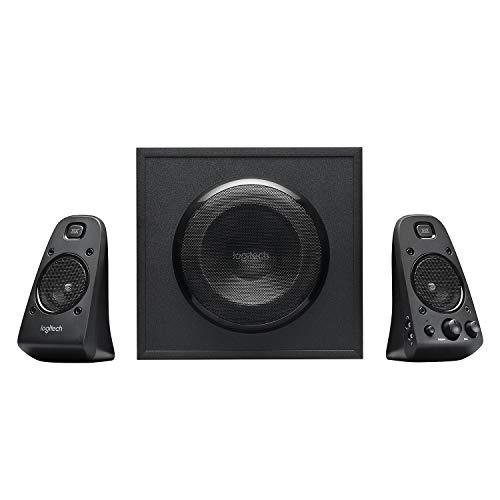
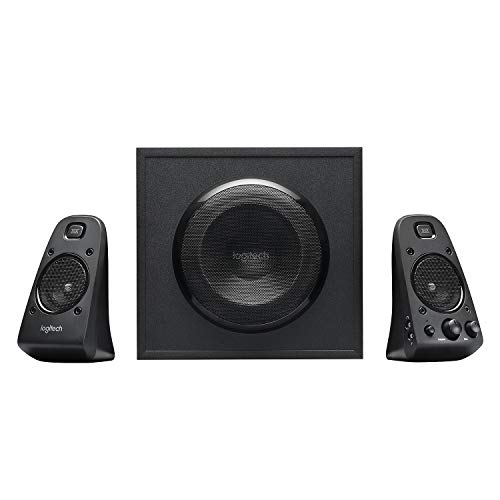
Logitech Z623 2.1 Speaker System
A desktop 2.1 system with two satellites and a separate subwoofer, THX certified and built for computers, consoles and TVs with analogue or optical-style setups via its inputs. The subwoofer carries the low bass that small desk speakers cannot reproduce on their own. Check price on Amazon.
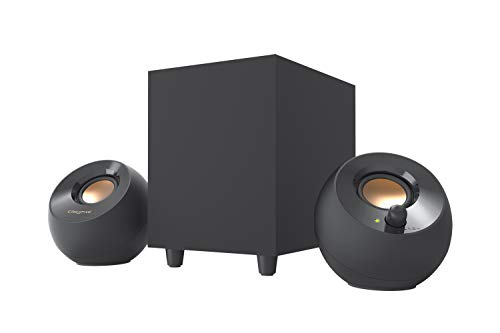
Creative Pebble Plus 2.1 Desktop Speakers
A small USB-powered 2.1 set with a down-firing subwoofer, made for laptops and desks where space is tight. It is a simple way to add separate bass to a computer without a power-hungry amplifier. Check price on Amazon.
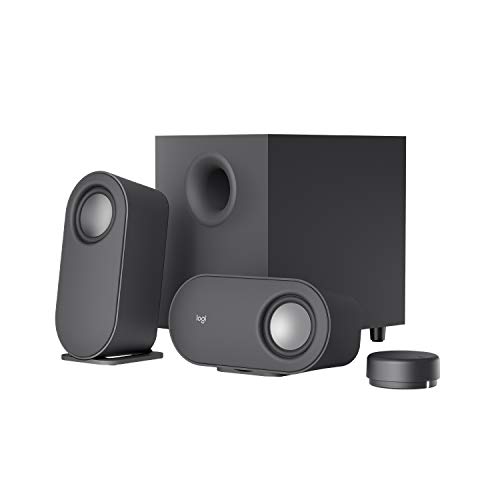
Logitech Z407 Bluetooth Computer Speakers
A 2.1 computer speaker system with a wireless control dial, Bluetooth, USB and 3.5 mm inputs, and a down-firing subwoofer. The mix of wired and wireless inputs suits a desk that hosts both a computer and a phone. Check price on Amazon.

Sonos Beam (Gen 2) Soundbar
A compact Atmos-capable soundbar for smaller TVs and rooms, with Wi-Fi, voice control and the option to add Sonos surrounds and a sub later. Its size suits desks, bedrooms and apartments where a wide bar will not fit. Check price on Amazon.
Common Misconceptions
Turning the subwoofer up until you can ‘hear it’
A correctly set subwoofer is not separately audible; it extends the main speakers seamlessly. If you can point at the bass, it is too loud or the crossover is too high.
Setting the crossover by guesswork
Match the crossover to where your main speakers naturally roll off — often around 80 Hz for small speakers. The manual and the receiver’s calibration both help; guessing creates boomy overlaps or thin gaps.
Corner-loading for maximum boom
Corners maximise output and unevenness together. Start along a wall near the front speakers, and move the sub in small steps while listening from your seat.
Buying a huge subwoofer for a small room
Small rooms amplify bass naturally and unevenly. A modest subwoofer, well placed and gently run, beats a monster exciting every room mode at once.
Key Takeaways
- Set level so bass sounds like part of the main speakers, not a separate event.
- An 80 Hz crossover is the standard starting point for small main speakers.
- Run your receiver’s calibration after placing the sub, then adjust by ear.
- In flats, a small sub near the seat at low level beats loud speakers for impact.
Going Deeper: Context That Helps
Whatever the product, the cheapest upgrade is usually time spent with the manual and the settings menu. Manufacturers bury genuinely useful options — EQ presets, dialogue modes, level trims, firmware updates — several layers deep, and most owners never find them. An hour spent exploring settings with familiar content playing will teach you more about your system than a week of reading reviews, and it costs nothing. Keep notes of what you changed so you can undo anything that makes things worse, and change one thing at a time so you know which adjustment caused which result.
Returns windows are part of the buying process for audio gear, and you should use them deliberately. Sound is personal and room-dependent, so a product that reviews well can still disappoint in your space. Buy from sellers with clear return policies, keep packaging until you are sure, and test with your own content at your own volumes in the first days — not the night before the window closes. A structured test, with the same three songs or scenes each time, reveals differences that casual listening misses and turns a vague feeling into a decision you can act on.
Hearing safety deserves a mention in any audio guide. Comfortable TV and music listening sits well below the levels that risk hearing damage, but portable speakers at parties, and headphones especially, can creep upward in noisy environments as you compete with background sound. If you have to shout to be heard over your own system, it is too loud for long sessions. Many devices offer volume limiting — worth enabling for children — and taking listening breaks during long sessions protects both your ears and your enjoyment, because tired ears judge sound poorly.
Speaker sound is shaped as much by the room as by the speaker itself. Hard floors, bare walls and large windows reflect sound back at you, which can make even a good speaker seem harsh or echoey, while soft furnishings, rugs and curtains absorb those reflections and calm the result. Before blaming a speaker for disappointing sound, look at the room: a rug between the speakers and your seat, curtains over a large window, or a bookshelf filled with books behind you can change the sound more than a modest upgrade would. This is why the same speaker can sound impressive in a shop demo room and merely ordinary at home — the demo room was treated, and yours is not.
Stereo imaging depends on symmetry. When the left and right speakers are at different distances from you, or one is tucked into a corner while the other sits in open space, the stereo image pulls toward the closer or louder side and voices stop sounding centred. Aim for a rough triangle: the two speakers and your head at the corners, with both speakers the same distance from your seat and at the same height. Small adjustments — ten centimetres here, a slight toe-in there — are free, reversible and often more rewarding than new cables or accessories, so always finish placement before spending money on upgrades.
Bass behaves differently from the rest of the sound. Low frequencies are long waves that build up in corners and along walls, which is why a speaker can sound boomy in one spot and thin a metre away. Moving a speaker even slightly out from a wall reduces the wall’s reinforcement of the bass; moving your seat away from the back wall often fixes boominess that no tone control can. If your system has a subwoofer, its position matters even more, because a single subwoofer excites the room unevenly and your seat may sit in a peak or a null in the bass response.
Speaker sensitivity and impedance explain more about real-world loudness than headline wattage. Sensitivity tells you how loud a speaker plays with a given amount of power; a sensitive speaker on a modest amplifier can easily outplay an insensitive speaker on a powerful one. Impedance, measured in ohms, describes the load the speaker presents to the amplifier — most home speakers are nominally 8 or 6 ohms, and amplifiers are happiest when the speaker’s impedance stays within the range the amplifier is rated for. Matching these two figures sensibly matters far more than chasing the biggest watt number on a box.
Every speaker is a compromise between size, bass and efficiency — engineers call it Hoffman’s Iron Law: pick two, sacrifice the third. A tiny speaker can be efficient or produce deep bass, but not both at once, which is why small portable speakers sound impressive for their size yet cannot reproduce the lowest notes of a film soundtrack. Understanding this trade-off sets honest expectations. If a product promises room-filling deep bass from a box the size of a paperback, physics says the claim needs salt; the sound may still be enjoyable, but the lowest octave will be suggested rather than truly reproduced.
Burn-in and warm-up are debated endlessly, but the bigger variable is your own hearing. Your ears adapt to a new speaker over the first days of listening, which is why a speaker that sounded bright on day one often seems balanced by day five — your brain has recalibrated, not the hardware. The practical lesson is to live with a new setup for a week of normal listening before judging it or changing settings. Judge with familiar recordings you know well, at the volume you actually use, in the seat you actually sit in; first impressions in a shop or in the first ten minutes at home are unreliable.
Cables and connections cause more speaker problems than speakers do. A single stray strand of copper touching the neighbouring terminal can short an amplifier; a loose banana plug or a corroded RCA connector adds crackle that sounds like a failing driver. Oxygen-free copper wire of adequate gauge, clean tight connections and strain relief where cables bend will keep a system reliable for years. Expensive exotic cables, by contrast, have never been shown to change sound in controlled listening tests once gauge and connection quality are adequate — spend the difference on placement, room treatment or better recordings instead.
Listening level matters for judging any speaker. Human hearing perceives bass and treble as weaker at low volumes — the Fletcher-Munson effect — so a speaker auditioned quietly can seem thin, and the same speaker loud can seem bass-heavy. Many receivers and some speakers compensate with loudness or dynamic EQ features for late-night listening. When you compare speakers or settings, match the volume between them as closely as you can, because the louder option almost always sounds ‘better’ in a quick comparison even when it is not. A cheap sound-level app on a phone is accurate enough to level-match for home comparisons.
Multi-room and streaming speakers add a networking layer to ordinary audio problems. A speaker that drops off the network, lags behind its partner in a stereo pair, or refuses to appear in an app is usually suffering from weak Wi-Fi at its location, a congested 2.4 GHz band, or a router setting — not a failed speaker. Placing the router centrally, keeping speakers within a room or two of it, and updating firmware through the maker’s app solves most of these cases. Wired Ethernet, where a speaker offers it, removes the variable entirely and is worth using for a fixed living-room setup.
Protecting speakers is mostly about restraint. Amplifiers damage speakers in two ways: too much power can overheat or over-extend a driver, but far more commonly a small amplifier driven into distortion — clipping — produces harsh high-frequency energy that burns out tweeters. If the sound turns harsh, gritty or compressed as you raise the volume, turn it down; that harshness is the warning sign. Children, pets and parties are the other risks: a volume limit in the receiver’s settings, grilles left on, and speakers placed where they cannot be knocked over will prevent most household speaker casualties.
Speaker specifications reward careful reading. Frequency response figures only mean something with a tolerance attached — ’60 Hz to 20 kHz’ without a plus-or-minus figure could hide a response that is already far down at 60 Hz. Driver size tells you about potential, not results: a well-designed 5-inch woofer in a solid cabinet can sound cleaner than a cheap 8-inch driver in a resonant box. Weight is an unfashionable but useful clue, because rigid cabinets and real magnets are heavy. Treat specifications as a way to shortlist, then let placement, room and your own ears make the final decision.
Frequently Asked Questions
Do I need a subwoofer for music, or only for films?
Films make the strongest case because of the dedicated LFE effects channel, but plenty of music uses the bottom octaves too — kick drums, bass synths, organ and double bass all reach into subwoofer territory. If your main speakers are small, a subwoofer completes the musical picture and cleans up their midrange as a bonus. If you own large tower speakers and listen to acoustic music at moderate volume, the gain is smaller and many listeners happily live without one.
Why is it called 2.1 or 5.1?
The number before the point counts the main channels — two for stereo, five for a typical surround layout. The ‘.1’ counts the subwoofer channel: the dedicated low-frequency effects channel in film soundtracks, which is routed to the subwoofer along with redirected bass from the other speakers. A 2.1 system is a stereo pair plus a subwoofer; a 5.1 adds centre and surround speakers to the same idea. The subwoofer is the one component every configuration shares.
Where should a subwoofer go in the room?
Start along the front wall near the main speakers, which keeps bass timed and blended with the soundstage, then experiment. Corners add output but also boom; positions along a wall usually balance the two. The reliable method is the ‘subwoofer crawl’: put the sub in your seat, play bass-heavy content, and move around the room’s edges listening for where bass sounds smoothest — place the sub there. Always judge from your seat afterwards, and re-run calibration after any move.
Can a subwoofer annoy neighbours more than speakers?
Yes — low bass passes through walls and floors as vibration far more readily than midrange and treble, which is why neighbours complain about the thump rather than the tune. In flats, keep levels modest, place the subwoofer away from shared walls where possible, consider isolation feet or a platform to reduce structure-borne vibration, and use night modes in the evening. A smaller subwoofer near your seat delivers perceived impact at lower total energy than a large one across the room.
How do I set the crossover and volume?
If you have a receiver, run its automatic calibration first — it measures your speakers and sets sensible values. Manually, start with an 80 Hz crossover for small speakers (lower for large towers), phase at 0, and the subwoofer’s level matched so bass blends invisibly: play familiar music and adjust until the bass sounds like an extension of the main speakers. If dialogue sounds chesty or bass booms, reduce the level or crossover slightly. Small steps, judged from your seat, with familiar material.
Is one subwoofer enough, or do I need two?
One is enough for the great majority of systems — it supplies the depth and impact that define the subwoofer’s job. A second subwoofer does not mainly add loudness; placed well, it evens out bass across multiple seats by cancelling the room’s peaks and dips. That is a refinement for dedicated rooms and multi-seat cinemas. Spend on one good subwoofer, placed and set up carefully, before considering a second; placement quality beats quantity at this level.
The Bottom Octave: What Actually Lives Down There
To understand the subwoofer’s job, visit its workplace. The lowest stretch of human hearing is less a place of melody than of physical information: the fundamental weight of a bass drum and the room it was struck in, the lowest strings of a piano arriving as pressure as much as pitch, the synthesised foundations of electronic music, the rumble that tells a film audience a building is unhappy before a single brick moves. Main speakers reproduce the upper part of this territory and gesture at the rest; the subwoofer exists to supply the rest with authority. Crucially, humans localise low frequencies poorly, which is why one subwoofer can serve both channels and sit where the room flatters it rather than where symmetry demands. The subwoofer is therefore not a bass booster in the toy sense. It is a specialist instrument for the one region where ordinary speakers are physically outmatched, assigned there so the rest of the system can stop straining at work it was never sized to do.
Feeling versus hearing, honestly divided
At the very bottom of the range, sound crosses from something heard to something felt in the chest and through the floor, and honest discussion should admit that this physical dimension is a large part of the subwoofer’s appeal, especially for film. There is no shame in it: composers and sound designers compose for the body as well as the ear, and a system that reproduces only the audible half of their work is telling half the story. Music listeners sometimes dismiss the felt dimension as a cinema trick, until an organ recording or a double bass at full voice reminds them that acoustic music lives there too, and always has.
What a Subwoofer Does for the Speakers You Already Own
The subwoofer’s least advertised benefit is what it does for everyone else in the system. When the lowest frequencies are handed to the specialist, the main speakers are relieved of the longest, hardest cone excursions, and they repay the relief with cleaner midrange, because a driver no longer flinging itself at bass it cannot reach is a driver free to do its real work precisely. The amplifier is relieved too, since low frequencies consume the bulk of its power; offloading them is like hiring a lorry so the family car stops towing. This is why a modest system with a well-integrated subwoofer can sound not merely bassier but clearer everywhere, a result that surprises owners who expected only more bottom. It is also why integration matters more than the subwoofer’s own heroics: a subwoofer that announces itself has failed, however impressive its solo performance, because its job is to make the whole system sound as if the main speakers had simply grown deeper voices overnight.
The crossover: where the handover happens
The meeting point between subwoofer and mains is set by the crossover, and its correct setting is where the main speakers naturally fade, so that each instrument works in its strength and neither doubles the other’s labour in the overlap. Set the handover too high and the subwoofer becomes localisable and boomy, intruding on voices; too low and a valley opens between the speakers’ reach and the subwoofer’s start. Modern receivers automate much of this with calibration, and their results are a fine starting point, but the final authority is a familiar recording played at honest volume, adjusted until the bass seems to come from the music rather than from a box. When that illusion holds, the subwoofer has achieved its defining trick: total contribution, zero presence.
Placement: The Room Decides Where the Bass Lives
Low frequencies interact with rooms more dramatically than any other part of the spectrum, pooling in corners, cancelling in some seats and doubling in others, which is why subwoofer placement is an experiment rather than a measurement. The famous crawl — subwoofer placed temporarily at the listening seat, the owner crawling the room’s edges listening for where the bass sounds smoothest, then the subwoofer installed in that spot — endures because it works, converting the room’s acoustics from an obstacle into the instrument of its own solution. Corner placement maximises output and often boom in equal measure; placement along a wall trades some power for smoothness; and a second subwoofer, counterintuitively, is bought not for more bass but for evener bass across more seats, since two sources can fill each other’s cancellations. Households should expect to move the subwoofer several times in its first week and to regard that week as calibration, not indecision. A subwoofer in its right place is the difference between bass as weather — everywhere, oppressive, directionless — and bass as architecture: structural, proportioned, and unnoticed until it is removed.
Neighbours, floors and the diplomacy of low frequencies
Bass travels through structures with an enthusiasm that treble never manages, which makes the subwoofer the component most likely to be heard by people who did not buy it. Isolation feet or a decoupling platform reduce the mechanical handshake with the floor; sensible levels at unsocial hours preserve the diplomatic relations that make future loud evenings possible; and in flats, honest conversation with the neighbours outperforms any accessory. A subwoofer owned considerately is a pleasure shared only with the invited.
Who Needs One, Who Wants One, and Who Should Wait
Need, in this subject, is a function of repertoire and room. Film-first households in dedicated rooms need a subwoofer the way a car needs wheels: the content assumes it, and without it the largest dynamic events in modern soundtracks are simply absent. Music-first households should audit their libraries honestly: the listener of string quartets, folk and vocal jazz may find a subwoofer a refinement that visits rarely, while the listener of organ works, electronic music, hip-hop and full orchestral scores will find it a foundation used nightly. Small rooms counsel patience, because they amplify bass at boundaries and punish excess; a small room with modest speakers may gain more from placement and patience than from a subwoofer wrestling the architecture. Large rooms and open plans argue the other way, diluting bass until a subwoofer restores the foundation the space dissolves. And every household should sequence honestly: main speakers placed well first, because a subwoofer added to a badly placed system builds its foundation under a crooked house.
One subwoofer or two, settled plainly
Start with one, placed by the crawl and integrated by ear. Add a second when the problem is unevenness — one seat thumping while another starves — rather than insufficiency, because the second subwoofer’s gift is smoothness across seats, not violence in one. Households with a single beloved seat may never need the second; households with a sofa full of film fans are its natural constituency.
The Subwoofer’s Paradox, and the Final Test
Everything in this guide converges on a paradox that owners learn in their first month: a subwoofer is bought for bass and judged by its invisibility. Turn it up until it impresses and it will fatigue within an hour; integrate it until it disappears and it will be missed, instantly and enormously, the first time it is switched off during a familiar recording. That switch-off is the final test and the true answer to this guide’s title. What a subwoofer is for is revealed in its absence: the foundation under the orchestra, the weight inside the kick drum, the pressure that told your body the on-screen world was real. Present, it is nothing you can point to. Absent, it is everything you can suddenly name. Buy one when your repertoire and your room ask for that foundation, place it where the room’s own acoustics direct, integrate it until it vanishes, and thereafter let it do the most selfless job in audio: holding up the music from underneath, unheard, unthanked, and utterly indispensable.
A Short Field Guide to Living With One
The first week with a subwoofer follows a script so reliable it deserves recording. Day one is excess: the level too high, the films too rumbly, the household delighted and faintly seasick. Day three is correction: the level down, the placement moved, the first suspicion that less might be more. By the end of the week the settings stop changing, and that stillness is the signature of integration achieved. Thereafter the subwoofer enters the category of household infrastructure, noticed only during its rare absences — a power cut, a borrowed weekend, a fuse — each of which teaches the household, again, what it is for. Owners contemplating the purchase should be reassured by this script: the adjustment period is normal, the destination is stable, and the stable destination is a system that sounds complete in a way visitors feel before they can describe. When a guest says the room sounds like a cinema without knowing why, the subwoofer has filed its report, and it is favourable.
Care and feeding, briefly
Subwoofers ask little: ventilation for their amplifiers, dust kept from their cones and controls as the cleaning guidance in this series describes, and a surge-protected supply like any amplifier deserves. Their drivers are robust, their cabinets more so, and a well-kept subwoofer routinely outlives the receivers that feed it, moving from system to system like a family retainer. Buy a good one once, integrate it honestly, and it will hold up several generations of the equipment above it — from underneath, as always.
That, in the end, is the complete answer. A subwoofer is for the foundation: the part of music and film that other speakers point at but cannot carry, delivered from wherever the room prefers, at a level the music itself dictates, in service of a whole system that sounds larger, clearer and more truthful than its parts. Everything else is commentary — including, the subwoofer would be the first to insist, the subwoofer.
The switch-off test, as a household ritual
Once a year, or whenever a sceptical friend visits, perform the ritual: play a beloved recording, and midway, switch the subwoofer off. The foundation will leave the room like a tide, and everyone present will understand this entire guide in four seconds. Switch it back on, and let the tide return. No argument about bass survives that demonstration, in either direction — the sceptic converted, the enthusiast reminded that the magic was never the box, but the completeness it quietly restores.
Completeness, restored at the flick of a switch, is the subwoofer’s whole biography in one gesture.
Foundations, elsewhere in the house
It is worth noticing, as this series closes its speaker guides, how often the same lesson has appeared in different costumes. The stand beneath the bookshelf speaker, the placement behind every good system, the headroom inside every honest amplifier, the foundation beneath the music: the unglamorous supports decide the performance, and the celebrated parts merely deliver it. A subwoofer is simply the lesson made literal — a box whose entire purpose is to be the support, asking for no spotlight and receiving none, holding up everything above it. Households that learn to value the supports, in audio and elsewhere, tend to build things that last.
Things that last, in a listening room, are the things worth buying. The subwoofer, properly chosen, is near the front of that queue.
Queue patiently, buy once, and let the foundation settle under years of music.
Years of music, standing on something solid, is the entire promise.
Solid, silent about itself, and felt in every note above it.
Every note above it: that is a foundation’s reach, and a subwoofer’s job description.
Fill the position well, and the whole system stands taller.
Taller, clearer and more complete — the three gifts of a foundation properly laid.
Lay yours, by the crawl and by ear, and accept the gifts nightly.
Nightly gifts are the best kind a system can give.
Give one to your system, and your system will return the favour in full.
In full, from the first recording you play on the finished system.
Finished systems have a sound, and it is completeness.
Completeness, once heard, cannot be unheard. That is the subwoofer’s quiet power over every listener who meets one.
Meet one properly — placed, integrated, invisible — and the meeting will settle the question this guide’s title asks.
Settled questions, like settled foundations, let everything above them flourish.
Flourish, then, all of it — speakers, room and listeners alike.
Alike in flourishing, the system and its audience become one happy household.
Happy households are the true output of every component in this series. The subwoofer just supplies their foundation.
Supplies it silently, nightly, and without asking for thanks.
Thank it anyway, the next time the floor gently answers a bass drum.
That gentle answer is the sound of a question, asked in this guide’s title, being answered by the room itself.
Rooms answer honestly, when the equipment asks properly.
Ask properly — placement, crossover, level, patience — and listen to the answer.
The answer arrives as weight, warmth and the feeling that nothing is missing.
Nothing missing: the shortest review a subwoofer can earn, and the highest.
Earn it in your room, with your repertoire, at your volume.
Your volume is the only one the foundation was built for.
Built for it, tuned to it, and content to disappear beneath it.
Disappearance, in a subwoofer, is not absence. It is mastery.
Mastery, felt rather than heard, is the subwoofer’s signature.
Sign yours into the system, and let the signature go unread — as intended.
Intended invisibility, achieved nightly, is the whole design.
The whole design, in one box, under everything you love listening to.
Under everything, holding everything. That is what a subwoofer is for.
For that, and for the moment the tide goes out when it is switched off.
Keep the tide in. Keep the foundation laid. Keep the music whole.
Whole music, in a whole room, for a whole household.
Whole households are the final beneficiaries of every guide in this series.
Beneficiaries, all, of foundations laid with care.
Care, in the end, is the specification beneath all specifications.
Beneath them, like the subwoofer itself, holding everything up.
Everything up, everything playing, everything complete.
Complete is the word the whole series has been reaching for.
Reach for it, from the foundation upward.
Upward is where foundations point everything they support.
Support yours, and it will point your listening upward for years.
Years of upward listening begin with one well-placed box.
Place it well, and the years take care of themselves.
Themselves, and the music, and the household gathered around both.
Gathered around the music: the final image of every guide in this series, and the right one to end on.
End on it, then, with the foundation humming quietly beneath the gathering.
Quietly beneath, as it prefers, as it was designed, as it will remain.
Remain, and hold, and let the music above it flourish.
Flourishing music, on a firm foundation, in a gathered household.
That is the complete picture, and the subwoofer is content to be its base.
Content at the base, it asks only to be integrated and left to work.
Left to work, it works for decades. Grant it the courtesy.
Courtesy, repaid in foundation, is a fair exchange.
Fair exchanges, nightly repeated, are the economics of a happy system.
Happy systems are the goal. Yours, now, has its foundation.
Foundations, once laid, are forever. Build the rest of the system with confidence.
Confidence, from the ground up, is a fine way to listen.
Listen that way tonight, with the whole range present and accounted for.
Present and accounted for, from the highest string to the lowest drum.
The lowest drum, answered by the floor, is the signature at the bottom of it all.
Related Guides
These guides and roundups cover the closest decisions and fixes in this category:
- best 2.1 speakers for under 100
- best speakers for bass under 100
- best computer speakers with subwoofer for under 50
- best speakers for bass and sound quality
- speaker wattage explained
- 2.1 vs 5.1 soundbar
Will a subwoofer help with dialogue clarity?
Indirectly, yes. When the main speakers and centre channel are relieved of deep bass, their midrange — where voices live — is reproduced more cleanly, and many owners report clearer dialogue after adding a properly integrated subwoofer. Set the crossover sensibly so the subwoofer itself never intrudes on voices.
Can a subwoofer be too big for a small room?
A physically large subwoofer can overwhelm a small room if run at high level, but size itself is not the problem — level and placement are. A capable subwoofer turned down and placed well usually sounds smoother than a small one straining; the discipline is in the setup, not the dimensions.