Disclosure: As an Amazon Associate, kajuandouglas.com earns from qualifying purchases. Links to Amazon on this page are affiliate links; they cost you nothing extra. Listing details such as price and availability change often, so check the current Amazon listing before you buy.
This speaker buying guide exists because speakers are the hardest hi-fi purchase to make from a specification sheet: the numbers are easy to inflate, the differences that matter are about rooms and habits, and the same speaker can be perfect for one household and wrong for the next. What follows is a decision framework, not a list of models — the criteria that genuinely separate speakers, explained in plain language, and how to prioritise them for music, film, desks and parties.
Work through it in order: the job, the room, the architecture (powered or passive, with or without a subwoofer), the connections, and only then the specifications and the listening test. Each stage eliminates whole categories of wrong purchases, so by the time you compare individual models the field is small and every candidate is defensible. That is what a buying guide should do: not crown a winner, but make your shortlist honest.
Speaker buying guide: The Short Answer
Buy for the job and the room first, the format second and the specifications last. Powered speakers simplify stereo; passive speakers enable surround and upgrades. Sensitivity predicts loudness, continuous wattage predicts handling, and a home trial in your own room beats every specification and every showroom demo.
In this guide
What You Need
- Your main use: music, TV and film, desk work, gaming or parties
- Room size, seating distance and where speakers can physically go
- Your sources and their outputs (TV, phone, turntable, computer, console)
- Whether you own an amplifier or receiver already
- A returns-friendly seller, because your room is the real audition
The Decision Process
Step 1: Fix the primary job and let it lead
Every speaker design trades something away. A system optimised for film dialogue and effects, one for critical music listening and one for garden parties are three different products wearing the same category name. Name your primary job in one sentence — ‘clear dialogue and decent music in a small living room’ — and let it arbitrate every later decision. Secondary uses can be accommodated; they must not be allowed to veto the primary one, or you will buy a compromise that serves nothing well.
Step 2: Choose the architecture: powered, passive or portable
Powered speakers are the simplest complete purchase: amplifier inside, source plugged in, music out — ideal for stereo music, turntables, TVs and desks. Passive speakers plus an amplifier or receiver cost more and do more: many inputs, surround expansion, component upgrades. Portable and smart speakers serve mobility and voice control. Decide the architecture before comparing models, because comparing a powered pair with a passive pair on price alone is comparing a complete system with half of one.
Step 3: Decide the bass strategy
Small speakers cannot reproduce deep bass; that is physics, not a flaw to shop around. Your options are larger speakers, a subwoofer, or accepting the limit because your content does not go there. Film and gaming content argues strongly for a subwoofer; speech and acoustic music do not. If a subwoofer is likely, choose speakers or an amplifier with a subwoofer output now — retrofitting bass into a system with no provision for it is the most common upgrade dead end in home audio.
Step 4: Verify connections against every source you own
Make the list and check it physically: the TV’s outputs, the turntable’s need for a phono stage, the computer’s USB, the phone’s Bluetooth. The system you buy must accept all of them gracefully, with inputs to spare for the next device. HDMI ARC or optical for TV, Bluetooth for phones, and an analogue input for legacy gear is the combination most households need. A speaker that fails this audit will not be saved by sounding wonderful with the one source it does accept.
Step 5: Use specifications to shortlist, not to crown
Sensitivity tells you loudness per watt — prioritise it. Continuous (RMS) power handling tells you limits — verify it. Frequency response with a stated tolerance tells you bass reach — distrust it without the tolerance. Impedance tells you amplifier compatibility — match it. Ignore peak wattage, ignore exotic cable claims, and treat weight and cabinet solidity as quiet proxies for build quality. Specifications should reduce ten candidates to three; your ears, in your room, choose among the three.
Step 6: Audition properly, or buy with an exit
In a shop, use your own familiar tracks, at your volume, from your distance, and beware the demo room’s acoustic treatment flattering everything. Online, the returns window is your audition: test in your room during the first week, with the content you actually consume, including late-night dialogue at low volume. A speaker is a five-to-ten-year purchase; spending the first week deciding carefully is proportionate. Keep packaging until the decision is final.
As you work through this guide, keep the bigger picture in mind. Our roundup of best speakers for music shows how the main options compare, and the companion piece on how to choose a speaker covers the neighbouring decision in the same detail.
Priorities by Use Case
For music-first systems, prioritise a smooth, natural midrange and stereo imaging — a matched pair of bookshelf speakers, powered or passive, positioned on stands. For TV and film, prioritise dialogue clarity and connection simplicity: a centre channel or dialogue processing, HDMI ARC, and a subwoofer path for effects. For desks, prioritise compact powered speakers with nearfield tuning, front controls and a headphone output. For parties and gardens, prioritise output, durability and battery or weather resistance over refinement.
Households with mixed uses should buy for the daily case and forgive the occasional one. The living-room system that plays radio all day and films twice a week is a music-and-dialogue system with film ambitions, not the reverse. Gamers sit between camps: dialogue and effects matter, latency rules out careless Bluetooth, and a subwoofer adds physicality — a wired powered pair or a receiver system serves best. Let the calendar, not the imagination, rank your uses.
Tier Framing Without the Hype
Entry-tier speakers transform TV and laptop sound and serve small rooms honestly; the money buys competence, and the limits are bass depth and ultimate volume. Mid-tier is the enthusiast sweet spot: real cabinets, real drivers, matched amplification or quality passives, and sound that satisfies for years. Premium tiers buy refinement, materials, consistency and pride of ownership — genuine, but subject to diminishing returns, and only audible when the room, placement and sources are already good. Upgrade in that order and every tier performs at its best.
Whatever the tier, reserve part of the budget for the system’s unglamorous half: stands, adequate wire, a subwoofer if the content needs one, and the cables your sources require. The most common buying error in audio is spending the entire budget on the speakers and nothing on the things that let them work. A mid-tier speaker properly supported and connected will embarrass a premium speaker balanced on a bookcase with a corroded cable, in your room, every single evening.
Ready to Buy? Start Here
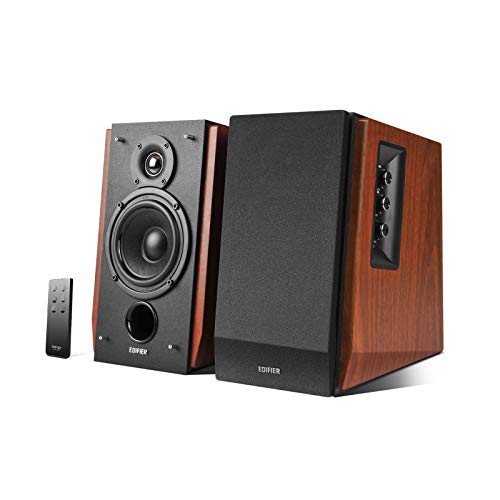
Edifier R1700BT Bluetooth Bookshelf Speakers
A powered bookshelf pair with Bluetooth for phones and wired inputs for a turntable or TV, plus a remote for volume and input switching from the couch. The angled front baffle aims sound slightly upward when the speakers sit on a low shelf or desk. Check price on Amazon.

ELAC Debut 2.0 B6.2 Bookshelf Speakers
A passive bookshelf pair with a 6.5-inch aramid-fibre woofer, designed for use with a separate amplifier or AV receiver. It is a long-standing reference point for people building a first component stereo or home-theatre front stage. Check price on Amazon.

JBL Charge 5 Portable Speaker
A portable Bluetooth speaker with an IP67 waterproof and dustproof rating, designed for bathrooms, gardens and trips away. Its rugged build also makes it a forgiving speaker to clean and to move from room to room. Check price on Amazon.

Polk Audio Monitor XT70 Tower Speaker
A large floor-standing tower with dual 6.5-inch woofers and a passive radiator, sold individually. Towers like this anchor a living-room stereo or the front left and right channels of a home-theatre system without needing stands. Check price on Amazon.
Common Mistakes
Buying on peak wattage and headline numbers
Peak watts are marketing. Sensitivity and continuous ratings are information. A buyer who cannot be sold a meaningless number is a buyer the industry has to serve honestly.
Spending the whole budget on speakers alone
Stands, wire, a subwoofer and cables are part of the system. A complete mid-tier setup beats an incomplete premium one in every real room.
Ignoring the room and seating distance
Oversized speakers in small rooms boom; undersized speakers in big rooms strain. Room and distance are specifications of your system just as much as the speaker’s are.
Forgetting the second user
If a partner, parent or child must operate it daily, complexity is a defect. One-remote operation and automatic input switching are features worth paying for.
Pro Tips
- Write the primary job in one sentence before opening any product page.
- Shortlist to three models using connections and sensitivity, then listen.
- Budget for stands and wire from the start, not as an afterthought.
- Use the returns window as your audition — your room is the only honest demo room.
Going Deeper: Context That Helps
Multi-room and streaming speakers add a networking layer to ordinary audio problems. A speaker that drops off the network, lags behind its partner in a stereo pair, or refuses to appear in an app is usually suffering from weak Wi-Fi at its location, a congested 2.4 GHz band, or a router setting — not a failed speaker. Placing the router centrally, keeping speakers within a room or two of it, and updating firmware through the maker’s app solves most of these cases. Wired Ethernet, where a speaker offers it, removes the variable entirely and is worth using for a fixed living-room setup.
Protecting speakers is mostly about restraint. Amplifiers damage speakers in two ways: too much power can overheat or over-extend a driver, but far more commonly a small amplifier driven into distortion — clipping — produces harsh high-frequency energy that burns out tweeters. If the sound turns harsh, gritty or compressed as you raise the volume, turn it down; that harshness is the warning sign. Children, pets and parties are the other risks: a volume limit in the receiver’s settings, grilles left on, and speakers placed where they cannot be knocked over will prevent most household speaker casualties.
Speaker specifications reward careful reading. Frequency response figures only mean something with a tolerance attached — ’60 Hz to 20 kHz’ without a plus-or-minus figure could hide a response that is already far down at 60 Hz. Driver size tells you about potential, not results: a well-designed 5-inch woofer in a solid cabinet can sound cleaner than a cheap 8-inch driver in a resonant box. Weight is an unfashionable but useful clue, because rigid cabinets and real magnets are heavy. Treat specifications as a way to shortlist, then let placement, room and your own ears make the final decision.
Ageing affects speakers slowly and mostly at the edges. Foam woofer surrounds on older speakers can crumble after a couple of decades, rubber surrounds last longer, and capacitors in crossovers drift with age, subtly changing the balance. None of this matters for a new purchase, but it explains why a vintage speaker may not sound as its measurements once promised. For modern speakers, dust, sunlight and humidity are the main enemies: keep them out of direct sun, wipe dust with dry or barely damp cloths, and avoid placing drinks on top of cabinets, where one spill can stain veneer and swell the wood beneath.
Whatever the product, the cheapest upgrade is usually time spent with the manual and the settings menu. Manufacturers bury genuinely useful options — EQ presets, dialogue modes, level trims, firmware updates — several layers deep, and most owners never find them. An hour spent exploring settings with familiar content playing will teach you more about your system than a week of reading reviews, and it costs nothing. Keep notes of what you changed so you can undo anything that makes things worse, and change one thing at a time so you know which adjustment caused which result.
Returns windows are part of the buying process for audio gear, and you should use them deliberately. Sound is personal and room-dependent, so a product that reviews well can still disappoint in your space. Buy from sellers with clear return policies, keep packaging until you are sure, and test with your own content at your own volumes in the first days — not the night before the window closes. A structured test, with the same three songs or scenes each time, reveals differences that casual listening misses and turns a vague feeling into a decision you can act on.
Hearing safety deserves a mention in any audio guide. Comfortable TV and music listening sits well below the levels that risk hearing damage, but portable speakers at parties, and headphones especially, can creep upward in noisy environments as you compete with background sound. If you have to shout to be heard over your own system, it is too loud for long sessions. Many devices offer volume limiting — worth enabling for children — and taking listening breaks during long sessions protects both your ears and your enjoyment, because tired ears judge sound poorly.
Speaker sound is shaped as much by the room as by the speaker itself. Hard floors, bare walls and large windows reflect sound back at you, which can make even a good speaker seem harsh or echoey, while soft furnishings, rugs and curtains absorb those reflections and calm the result. Before blaming a speaker for disappointing sound, look at the room: a rug between the speakers and your seat, curtains over a large window, or a bookshelf filled with books behind you can change the sound more than a modest upgrade would. This is why the same speaker can sound impressive in a shop demo room and merely ordinary at home — the demo room was treated, and yours is not.
Stereo imaging depends on symmetry. When the left and right speakers are at different distances from you, or one is tucked into a corner while the other sits in open space, the stereo image pulls toward the closer or louder side and voices stop sounding centred. Aim for a rough triangle: the two speakers and your head at the corners, with both speakers the same distance from your seat and at the same height. Small adjustments — ten centimetres here, a slight toe-in there — are free, reversible and often more rewarding than new cables or accessories, so always finish placement before spending money on upgrades.
Bass behaves differently from the rest of the sound. Low frequencies are long waves that build up in corners and along walls, which is why a speaker can sound boomy in one spot and thin a metre away. Moving a speaker even slightly out from a wall reduces the wall’s reinforcement of the bass; moving your seat away from the back wall often fixes boominess that no tone control can. If your system has a subwoofer, its position matters even more, because a single subwoofer excites the room unevenly and your seat may sit in a peak or a null in the bass response.
Speaker sensitivity and impedance explain more about real-world loudness than headline wattage. Sensitivity tells you how loud a speaker plays with a given amount of power; a sensitive speaker on a modest amplifier can easily outplay an insensitive speaker on a powerful one. Impedance, measured in ohms, describes the load the speaker presents to the amplifier — most home speakers are nominally 8 or 6 ohms, and amplifiers are happiest when the speaker’s impedance stays within the range the amplifier is rated for. Matching these two figures sensibly matters far more than chasing the biggest watt number on a box.
Every speaker is a compromise between size, bass and efficiency — engineers call it Hoffman’s Iron Law: pick two, sacrifice the third. A tiny speaker can be efficient or produce deep bass, but not both at once, which is why small portable speakers sound impressive for their size yet cannot reproduce the lowest notes of a film soundtrack. Understanding this trade-off sets honest expectations. If a product promises room-filling deep bass from a box the size of a paperback, physics says the claim needs salt; the sound may still be enjoyable, but the lowest octave will be suggested rather than truly reproduced.
Frequently Asked Questions
How much should I spend on speakers?
Spend in proportion to how much you will listen and how long you will keep them — speakers are among the longest-lived electronics you will own, routinely serving a decade. Within a system budget, speakers deserve the largest share because they shape the sound most, but reserve funds for stands, wire and possibly a subwoofer. The mid-tier is where most listeners find lasting satisfaction; entry tier transforms poor sound competently, and premium tiers reward rooms and sources that are already sorted.
Are powered or passive speakers better value?
As a complete first system, powered speakers usually deliver more sound per total spend, because the amplifier is included and matched to the drivers, and no receiver or wire is needed. Passive systems cost more to start but can be better value across a decade of upgrades, since the amplifier survives speaker changes. Value also depends on ambition: for stereo, powered; for surround and component building, passive. Compare complete working systems, never a powered pair’s price against a passive pair’s alone.
What specifications actually matter?
Sensitivity, because it predicts how loud the speaker plays on your amplifier. Continuous power handling, because it states real limits. Frequency response with a tolerance figure, because it indicates bass reach honestly. Impedance, because it must suit your amplifier. Driver sizes and cabinet dimensions, because they must suit your room. Everything beyond that — peak watts, exotic materials language, cable mythology — is decoration. If a listing hides the honest figures, that absence is itself a specification worth reading.
Do I need a subwoofer with my new speakers?
If your content is films, games or bass-led music and your speakers are bookshelf-sized or smaller, yes — the lowest octaves are simply absent without one, and no setting can invent them. If your speakers are large towers, or your content is speech and light music in a small room, you may never miss it. The safe purchase is a system with a subwoofer output, so the option stays open. Adding a sub later is easy; discovering your system cannot accept one is not.
How can I judge speakers I cannot hear before buying?
Use measurements and specifications to shortlist, read reviews for consistent character descriptions rather than scores, and buy from a seller whose returns process you have actually read. Then audition at home, systematically: same tracks, sensible volumes, a full week of your real content including quiet dialogue. Your room changes speakers more than small model differences do, so the home trial is not a compromise — it is the most valid test available to anyone, including people who did visit a shop.
Should I buy a matched pair or two separate speakers?
For stereo, always a matched pair — imaging depends on the two channels behaving identically, and manufacturers voice and tolerance pairs accordingly. Single speakers are for mono roles: a kitchen smart speaker, a portable, a centre channel (which is its own matched-to-the-front-pair question). If you buy one half of a pair second-hand, verify the exact model and revision; small production changes between years can leave a ‘pair’ that is not truly matched, and stereo is unforgiving about it.
Defining the Listening Job in Real Detail
Rooms, distances, and how loud you actually listen
- Specifications mean little until they meet your room. Measure the distance from your usual seat to where the speakers will sit, and be honest about volume: background listening while cooking, focused album listening, or film nights where dialogue and effects both matter. A small speaker that is delightful at two metres for evening listening will sound thin and strained filling a large open-plan space, while a big floorstanding design in a tiny room can overwhelm it and excite every bass boom the room can offer.
- Room surfaces shape the result as much as the speaker does. Bare floors, large windows, and sparse furniture make a lively, reflective space where a speaker with a forward treble can turn tiring. Carpets, sofas, curtains, and bookshelves absorb energy and forgive brighter designs. If you cannot change the room, choose the speaker for the room you have, and remember that placement experiments, pulling speakers away from walls and corners, are free upgrades that often matter more than a step up in model.
One system or several smaller ones
- Decide whether this purchase is your main system or one of several around the home, because that changes where the money should go. A single well-chosen pair in the room where you actually listen beats spreading the same budget thinly across rooms you rarely use. Conversely, if your listening is genuinely spread through the day, a flexible powered speaker you can move, or a pair in the kitchen where you spend your mornings, may bring more music into your life than a formal setup in a seldom-used lounge.
- Think also about who else uses the system. A setup that only you can operate will quietly fall out of use in a shared household. Simple sources, a remote everyone understands, and automatic switching to the television’s sound when it turns on are features that decide whether a system gets used daily. The best speaker purchase is the one that removes friction between wanting music and hearing it.
How your music and media habits should steer the choice
- Streaming-only listeners can prioritise speakers with the platform they use built in, or plan on a small streamer feeding a traditional amplifier. Vinyl listeners need a phono input somewhere in the chain and should value low background noise, because record playback reveals hiss readily. Film and television viewers should weight dialogue clarity and consider how a centre channel or soundbar format fits their screen, while gamers should check latency on any wireless or processed input so sound keeps pace with the picture.
- Podcasts and radio place almost all their information in the midrange, so a modest speaker with a clear, natural voice presentation serves them better than a bass-heavy design aimed at electronic music. Keep a short playlist of your own reference material, including one track you love, one that is badly recorded, one with spoken voice, and one with deep bass, and use it for every audition or home trial. Speakers reveal their character fastest against material you already know by heart.
Driver Sizes, Cabinets, and What They Really Mean
Woofer size and the physics of bass
- Bass requires moving air, and a larger woofer moves more air with less effort than a smaller one. That is why compact speakers, however clever their engineering, sound lean when asked for deep bass at volume, and why the honest solutions are a larger cabinet, a subwoofer, or accepting graceful limitation. Specifications that promise very deep bass from a tiny box usually describe a frequency the speaker can produce faintly, not one it can produce with authority at listening level.
- When comparing, look at how a maker presents low-frequency figures and whether they state the conditions. Treat any single impressive number with suspicion and trust your reference tracks instead. A speaker that handles an upright bass or a kick drum with texture and control at your normal volume is giving you real bass, even if another model’s printed figures reach lower on paper. Also remember that rooms add their own bass reinforcement near walls, which flatters small speakers in shops and at home alike until you move them.
Tweeter materials and cabinet construction, demystified
- Dome tweeters come in soft fabrics and various metals, and each material has advocates, but implementation matters more than material: the same metal dome can sound smooth in one design and sharp in another depending on the crossover and waveguide around it. Let your ears arbitrate with material that exposes treble character, such as brushed cymbals, strings, and sibilant voices. What you are listening for is detail without a hard edge that makes you want to turn down.
- Cabinets should feel inert: rap a knuckle on the side and listen for a dull thud rather than a hollow ring. Weight is a rough ally here, since substantial cabinets usually reflect thicker panels and bracing. Ports should be smoothly finished, because rough port edges can add chuffing noise on bass-heavy passages. None of this guarantees a good speaker, but flimsy construction almost guarantees a compromised one, and these checks take seconds in a shop.
- Choose driver size for your room and listening distance first; add a subwoofer later if the deepest bass still matters.
- Judge treble with voices and cymbals you know well, not with a maker’s description of its tweeter material.
- Check cabinet solidity, port finish, and terminal quality in person; build shortcuts you can feel usually accompany sound shortcuts.
- Treat printed frequency response as a rough guide, and your reference playlist as the verdict.
Powered, Passive, and Portable: Ownership Realities
What living with each architecture is actually like
- Passive speakers separate the amplifier from the speakers, which means more boxes and cables but easy upgrades and repairs: if the amplifier fails in ten years, the speakers carry on with a new one. Powered speakers put amplification inside the cabinet, shortening the signal path and removing a box, but a failed amplifier section can sideline the whole speaker and repairs are model-specific. Neither is superior; they suit different tolerances for clutter, tinkering, and long-term maintenance.
- Portable and battery speakers trade ultimate sound for freedom, and their ownership questions are different: how the battery ages, whether it can be replaced, how the speaker behaves while charging, and whether it still works over a cable when the battery eventually fades. If a portable speaker will mostly live in one room, a mains-powered model may serve you better and never present a battery bill. Buy the architecture that matches the life the speaker will actually lead.
Inputs, controls, and the daily experience
- List every source you own today and expect to own soon, then check the connections against that list: television, turntable, computer, games console, streaming box, and the phone in your pocket. Confirm not just that a socket exists, but that the right format is supported and that switching between sources is painless. A system that needs a menu dive to change inputs will irritate you daily in ways no audition reveals.
- Remote controls, app quality, and automatic standby behaviour belong on the checklist too. Ask how the speaker wakes when the television turns on, whether volume can be controlled by the television remote, and whether firmware updates have a track record of improving or breaking things. Read the support pages for any model you shortlist; a maker who publishes clear manuals and maintains updates is telling you something about the years after the sale.
Budget Allocation and Value Thinking
Where the money makes an audible difference
- Within a complete system, the speakers themselves usually deserve the largest share, because they convert everything upstream into sound and their character dominates the result. Amplification needs to be adequate and reliable rather than exotic, cables need only be sound and well terminated, and accessories should come last. Spending heavily on accessories while under-buying the speakers is the most common allocation mistake, and it is encouraged by how easy accessories are to market.
- Leave room in the budget for the unglamorous essentials: stands or isolation pads that place the speakers at ear height, a subwoofer cable if you add one, and delivery or installation if the speakers are large. A pair of bookshelf speakers sitting on a low sideboard is performing below its ability, and the modest cost of proper stands often buys more improvement than the price difference to the next model up would have done on that same sideboard.
New, outgoing models, and second-hand judgement
- Outgoing models replaced by a refreshed range are often the sweet spot for value, since the sound changes between generations are usually modest while the price difference is not. Second-hand speakers can be excellent buys because passive speakers age slowly, but inspect surrounds for cracking, check that both speakers of a pair work and match, and be wary of powered models whose batteries or amplifier sections carry the ageing risk. Always audition a used pair with your reference playlist before committing.
- Whatever route you choose, protect the purchase: confirm the warranty terms, the returns window, and who pays return shipping on a large item. A home trial in your own room is worth more than any shop demonstration, because your room, your furniture, and your listening distance are the conditions that count. A retailer confident in the product will make that trial easy, and that confidence is itself useful buying information.
After the Purchase: Setup That Earns the Money Back
First-week placement experiments
- Spend the first week experimenting before deciding the speakers are settled. Try them closer to and further from the wall behind them, vary the distance between the pair, and angle them toward your seat and then straight ahead, listening to the same track after each change. Small movements have large effects on bass balance and stereo imaging, and the best position is the one where voices lock into the centre and bass sounds even rather than boomy on some notes and absent on others.
- Keep notes or phone photos of positions you have tried; memory for sound is unreliable after a few minutes. Once you find the arrangement that works, mark it discreetly so cleaning or decorating does not silently undo it. If the speakers still disappoint after honest placement work and a few days of varied listening, use the returns window rather than hoping you will grow to love a sound that currently makes you listen less.
Living with them: break-in myths and real settling
- You will read claims that speakers need long break-in periods. Mechanical parts do loosen slightly in early use, but the larger change is your own hearing adapting to a new presentation. Give a new pair a fair few days of normal listening before judging, yet do not let that advice talk you out of a genuine mismatch; if sibilance hurts or bass overwhelms your room after placement work, that character will not transform with time.
- Finally, register the warranty, keep the packaging until the returns window closes, and file the receipt with the serial numbers. If a subwoofer or matching centre channel may join later, note the exact model name now while it is fresh. Good records turn any future warranty claim, insurance question, or matching purchase into a five-minute task instead of an archaeological dig through old emails.
Matching Speakers to Specific Listening Lives
The film-first household
- If films and television dominate, dialogue clarity is the specification that matters and it is not printed on any box. Voices live in the midrange, so prioritise speakers that present speech naturally at low volume, because much television listening happens at modest levels in the evening. If your system will grow, choose a speaker family that includes a matching centre channel, since a centre from the same range keeps voices tonally consistent as sound moves across the screen. Check also how the speakers behave off to the sides: in most living rooms, half the seats are not in the centre, and a speaker whose sound collapses off-axis punishes everyone on the ends of the sofa.
- Plan the layout before buying. A soundbar suits a television on furniture with no room for separates, while separate speakers need space to breathe and stands or shelves at the right height. Measure the actual gaps beside and below your screen, and photograph them to take to the shop. Many disappointing purchases are simply good speakers that never fitted the room, and returning large boxes is a chore that a tape measure prevents entirely.
The music-first listener in a small room
- Small rooms reward quality over quantity. A well-made compact speaker, correctly placed on stands and listened to from a couple of metres, delivers a more coherent and enjoyable result than a large floorstanding model crammed into corners it was never designed for. In a small room your money works hardest in the speakers themselves and in their placement, and least in amplifier power, because modest levels in a small space need little wattage to sound full.
- Pay attention to how a candidate behaves at low volume, since small-room listening is often quiet listening. Some systems only come alive when driven hard, sounding thin and lifeless in the evening range where you will actually use them. Test with your quietest typical material during audition, and favour the speaker that keeps its balance and detail turned down. That single test eliminates more unsuitable models for apartment listeners than any measurement you can look up.
The shared family system
- When children, partners, and guests all use the system, durability and simplicity become buying criteria in their own right. Grilles that stay on protect drivers from curious fingers, finishes that wipe clean survive real life, and a system that turns on with the television and responds to one remote will be used ten times more than a technically superior one that needs a ritual. Ask in the shop how the system behaves when a child presses every button: volume limits and input memory are features, not afterthoughts.
- Consider also how the system handles many sources gracefully: a phone over Bluetooth for one person, the television for everyone, a games console for another. Automatic input switching and a guest-friendly connection method prevent the cable-swapping that loosens connections and generates the faults covered elsewhere in our guides. The family system that wins is rarely the one with the finest sound in a silent demonstration room; it is the one still sounding good, and still being used, three years later.
The desktop and near-field listener
- Listening at a desk is a different discipline: the speakers are a metre away, your ears are level with them, and small flaws are magnified while small virtues shine. Choose compact speakers designed for near-field use or angle ordinary ones up toward your ears with pads or small stands, because a tweeter firing at your chest loses the detail you sit at a desk to hear. At this distance, hiss from cheap amplification is audible in quiet rooms, so low background noise deserves a place on your checklist alongside tone.
- Desk space is a budget too. Measure the footprint honestly, including the space cables need behind, and consider whether a single good speaker in mono serves a background-listening desk better than a cramped pair. If you make calls or record anything, keep speakers far enough from your microphone to avoid feedback and echo complaints. The right desktop choice is the one that fits the desk, the work, and the listener all at once.
The vinyl listener building slowly
- If records are your main source and the system will grow over time, buy speakers you can keep through several upgrades of everything else. Speakers outlast electronics generations, so a pair chosen for sound you love, from a maker who keeps matching models available, is the foundation to build on. Confirm the chain includes a phono stage somewhere, in the turntable, the amplifier, or as a small separate box, and budget for it if not, because a turntable plugged into an ordinary line input will sound faint and thin regardless of the speakers.
- Records also reward a quiet room and a stable, level surface for the turntable, isolated from the speakers’ vibration. Never place a turntable on the same shelf as a speaker if you can avoid it, and keep it away from the woofer’s air movement. These placement details cost nothing, yet they decide whether a growing vinyl system sounds promising or plagued, long before any upgrade money needs to be spent.
Related Guides
These guides and roundups cover the closest decisions and fixes in this category:
- best speakers under 500
- best bookshelf speakers under 500
- best wireless speakers for home
- best speakers for small room
- active vs passive speakers
- speaker wattage explained
How long should good speakers last?
Passive speakers routinely serve for decades, with foam surrounds on some older designs being the main wear item, and those can be professionally renewed. Powered speakers depend on their electronics and batteries, so their realistic service life is shorter and maker support matters more. In both cases, keeping speakers away from heat, direct sun, and overdriving is what most determines how long they stay sounding as they should.
Should I buy the speakers or the amplifier first?
Choose them together as a system, because the amplifier must suit the speakers’ sensitivity and impedance and offer the inputs your sources need. If you must sequence purchases, start with the speakers whose sound you love at a demonstration, then select an amplifier that drives them comfortably and covers your sources, rather than buying a powerful amplifier first and hoping suitable speakers follow.
Do I need a subwoofer with bookshelf speakers?
Not necessarily, and not immediately. Live with the pair first in your room, correctly placed, and judge with your own music and films. If deep bass in films or certain music feels missing rather than merely modest, a well-integrated subwoofer is the right addition; if voices and most music sound complete, your money may serve you better elsewhere.