Disclosure: As an Amazon Associate, kajuandouglas.com earns from qualifying purchases. Links on this page are affiliate links; they cost you nothing extra. Prices and availability change often, so check the current Amazon listing before you buy.
The gasket mount vs tray mount keyboard comparison spans the hobby’s newest darling and its oldest workhorse. Tray mounting — screws through the PCB into standoffs in a one-piece case, the design of the classic custom kits and most budget boards — is the simplest, cheapest and most rigid of the classic systems, with a feel that varies by position: firm over the screws, hollow at the spans. Gasket mounting suspends the whole assembly on soft strips for a uniform, cushioned, deeper-voiced result, at a higher manufacturing cost. This comparison explains both systems’ mechanics, feel and sound, the modding culture that grew up around tray boards’ shortcomings, and which buyers each system honestly serves — with three verified exhibits: a tray-mount modern classic, a gasket board at a friendly price, and a tray board that defined a generation of budget wireless.
Key takeaways: Tray mount is rigid, bright and position-dependent, and dominates budget boards and classic kits; gasket mount is uniform, cushioned and deeper, and has become the quality default. Mods — o-rings, foam, tape — exist to move tray boards toward the gasket feel, which tells you where the market’s preference settled.
Gasket Mount vs Tray Mount Keyboard: The Mechanics: Standoffs vs Suspension
A tray-mount case is a tub. The PCB (with its plate) drops in and screws down onto raised standoffs moulded or machined into the tub’s floor. The system is beautifully simple — one case part, a handful of screws — and its feel follows its structure: directly above a standoff the board is rigid; between standoffs the assembly can flex and resonate, producing the tray board’s signature combination of firm spots, softer spans and a brighter, sometimes hollow voice. A gasket-mount board, as the companion comparison in this cluster details, floats its assembly on compressible strips clamped between case halves: uniform cushion, absorbed bottom-outs, damped and deepened sound, at the cost of a two-part case and more careful manufacturing. The comparison is therefore not new-versus-old in quality but in philosophy: the tray spends nothing on isolation and lets the structure speak; the gasket spends precisely on isolation and muffles the structure into a tuned instrument.
In this guide
Feel and Sound, Honestly Weighed
The tray’s defenders make a real case: the rigid-over-screw feel is immediate and communicative, the bright voice has an articulateness some typists prefer to the gasket’s depth, and the system’s simplicity means fewer parts to age. The tray’s critics answer with the spans: the inconsistency across the board — a spacebar that lands differently from the alphas — and the hollow resonance that cheap tray cases amplify. Gasket’s case is consistency and comfort, especially for heavy typists; its cost is price and a softness some hands read as vagueness. The market’s verdict is visible in the modding aisle: the most popular tray-board modifications — foam fills, o-ring mounts, tape mods — all push the tray toward the gasket’s properties, which is as close to a settled preference as a hobby produces. The settled preference is not a law, and this guide’s exhibits include a tray board many owners would not trade for any gasket.
The Exhibits

Keychron V1 (Brown) — the tray-mount modern classic
Badge: Best tray-mount exhibit
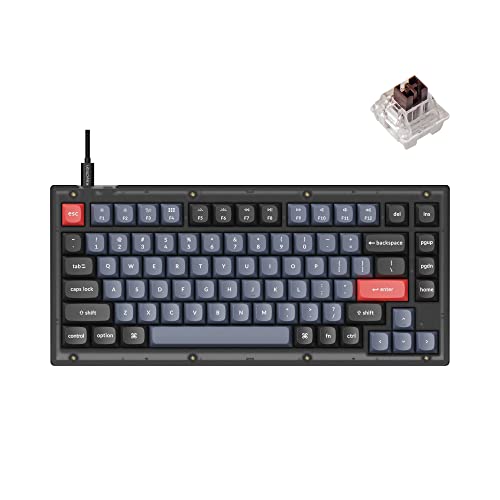
- Layout: 75 percent
- Mount: tray-style construction with silicone damping
- Switches: Keychron K Pro Brown (listing), hot-swappable
- Software: QMK/VIA
- Character: the value board that defined its class
The V1 is the tray philosophy’s best modern argument: an inexpensive board whose maker spent its small budget on the things that matter — hot-swap, QMK/VIA, sound-dampening silicone — so that the tray’s vices arrive pre-mitigated. Its feel is firmer and brighter than a gasket board’s, its value is beyond argument, and it demonstrates the honest tray proposition: ninety percent of the typing experience at a fraction of the flagship price.
- Strengths: outstanding value
- Strengths: damping mitigates tray hollowness
- Strengths: QMK/VIA and hot-swap
- Trade-offs: position-dependent firmness remains
- Trade-offs: plastic case
- Trade-offs: wired only
Best for: value buyers and first mechanical boards. Not suited for: cushion seekers.
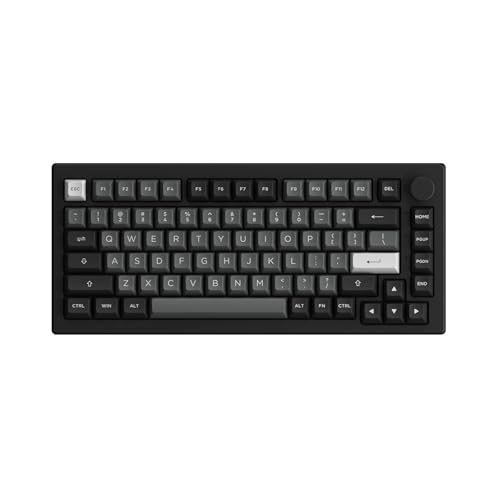
Akko 5075B Plus — the gasket board at a friendly price
Badge: Best affordable gasket exhibit
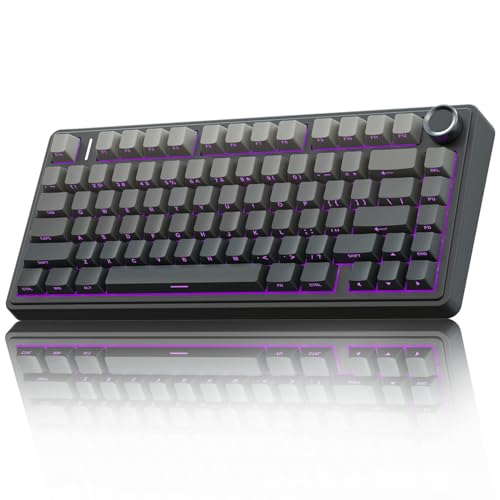
- Layout: 75 percent with knob
- Mount: gasket
- Switches: V3 Creamy Yellow Pro (listing), hot-swappable
- Connection: tri-mode
- Keycaps: doubleshot PBT, ASA profile
The 5075B Plus is the gasket philosophy’s value exhibit: the cushioned, uniform feel and deep voice, with tri-mode wireless and a knob, at a price that asks why a first buyer would start anywhere else. Against the V1 it makes the gasket case in its purest commercial form — the mount’s benefits, democratised — and the comparison between the two exhibits is the whole article in miniature.
- Strengths: gasket feel at a friendly price
- Strengths: tri-mode and knob included
- Strengths: creamy pre-lubed switches
- Trade-offs: ASA caps are tall for some tastes
- Trade-offs: plastic construction
- Trade-offs: softer feel not for traditionalists
Best for: first gasket buyers. Not suited for: firm-feel loyalists.
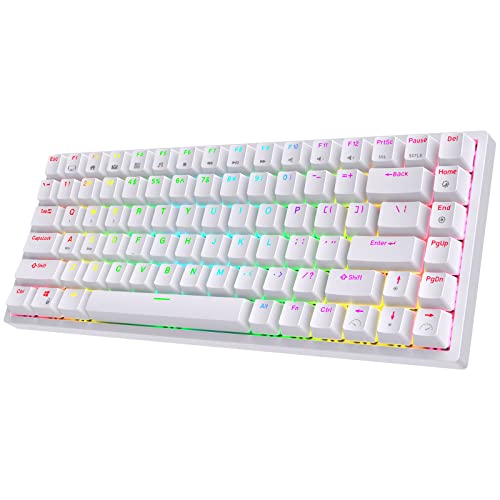
RK Royal Kludge RK84 — the tray board that defined budget wireless
Badge: Best budget tray exhibit
- Layout: 75 percent, 84 keys
- Mount: tray-style construction
- Switches: hot-swappable (listing)
- Connection: tri-mode
- Character: the budget wireless standard-setter
The RK84 carried tray mounting into the wireless budget era and sold in numbers that make it a historical exhibit as much as a product: tri-mode connection, hot-swap and a compact 75 percent layout at a price that reset expectations. Its feel is the classic tray signature — bright, firm at the posts, livelier in the spans — and its millions of owners demonstrate the system’s real-world adequacy better than any argument.
- Strengths: tri-mode at a budget price
- Strengths: hot-swap and compact layout
- Strengths: proven in enormous numbers
- Trade-offs: classic tray feel, unmodified
- Trade-offs: stock sound is bright
- Trade-offs: budget materials
Best for: budget wireless buyers. Not suited for: sound perfectionists.
The Modding Bridge Between Them
Owners have spent a decade narrowing this comparison from below, and the bridge deserves its own section. Foam in the tray’s empty floor kills the hollow resonance. O-rings on the standoffs introduce a whisper of the gasket’s isolation. The tape mod on the PCB’s back deepens the voice. None of these convert a tray board into a gasket board — the spans still span — but together they move the budget board most of the audible distance, which is why the build your first custom keyboard guide treats them as the hobby’s standard first projects. The gasket board, symmetrically, can be firmed up with harder gasket materials in enthusiast designs. The systems are poles, and the modding culture is the road between them.
How to Hear the Difference: A Listening Method
The mount is an acoustic system before it is a specification, and it should be auditioned like one. Type the same passage on each board at your natural weight and attend to three things. First, the uniformity: walk your fingers across the tray board from the number row to the spacebar and notice the firmness changing with the standoff map beneath — the tray’s signature, present in every example ever made. The gasket board answers with the same landing everywhere, which is its whole argument in one gesture. Second, the case’s contribution: knock the empty span of a tray case and hear the tub; the gasket board’s clamped construction has no tub to knock. Third, the voice’s centre: bright and articulate against deep and damped, the same fork the companion gasket mount vs top mount comparison maps against the rigid tradition. Ten minutes of this teaches more than a specification table, and the lesson generalises: mounts are heard and felt, not read.
The Budget Reality: Why the Tray Persists
The tray’s survival is not inertia; it is arithmetic. A one-piece case with moulded standoffs is the cheapest honest way to hold a keyboard together, and at the budget end that cheapness is the product — it is what allows the RK84’s tri-mode wireless and hot-swap sockets to exist at their price at all. The gasket’s two-part case and materials tax every board that adopts it, which is why the gasket era arrived from the premium end downward and why its democratisation, in exhibits like the 5075B Plus, is genuinely recent. The buyer’s translation is friendly: the tray is not the mount you settle for but the mount that funds the rest of the specification at a given price, and a well-damped tray board is a rational purchase at almost any budget. The Aula keyboards guide in this cluster is full of exactly that rationality, executed at prices that reset the market’s expectations.
Scenario Verdicts: Four Buyers
The first-time buyer on a strict budget takes the damped tray board — the V1’s formula — and mods it toward depth as the hobby takes hold. The sound-first buyer takes the gasket board and skips the modding apprenticeship entirely. The wireless bargain hunter takes the RK84 class and accepts the bright voice as the price of the radio. The builder takes neither production answer, choosing a kit whose mounting they specify themselves — the road this cluster’s guide to mechanical keyboard cases maps in full. Four buyers, and the mount follows the money and the ears every time, which is the comparison’s thesis in working clothes.
Myth vs Fact: The Tray Edition
Myth: tray mount is a defect. Fact: it is the founding system of the custom hobby and the budget market’s enabling economy, with known, mild and largely moddable vices. Myth: gasket mount is always softer and better. Fact: gasket tuning ranges from firm to plush, and the tray’s immediacy is a genuine preference for a real constituency. Myth: you can hear the mount in a recording. Fact: recordings preserve the voice’s direction but flatten the landing, which is half the comparison — audition in person where the decision matters. Myth: expensive means gasket. Fact: premium rigid and tray designs persist by choice, and budget gasket boards now exist; the mount is a temperament at every tier. Myth: mods make mounts irrelevant. Fact: mods move a tray board most of the audible distance and none of the structural one; the spans remain, and connoisseurs can still find them. The myths collapse a spectrum into slogans; the comparison exists to uncollapse it.
What the Owners Report After a Year
Tray owners’ reports divide by whether the board was damped. The damped-tray owners sound like value connoisseurs: aware of the spans, unbothered by them, pleased with the arithmetic. The undamped-tray owners sound like modders in waiting — the foam and tape chapters of their ownership are usually dated within the first season. Gasket owners speak the companion comparison’s language: hands at the day’s end, the voice in the room, regrets only where the tuning ran softer than their taste. Nobody in either camp reports the mount wearing out or being outgrown; the preference, once matched or modded into line, settles. The lesson for the new buyer is the cluster’s standing one: audition over argument, and budget a little curiosity for the mods if the tray is your road.
The Thirty-Second Verdict
The comparison compressed: tightest budget or wireless bargain — the damped tray, modded at leisure. Sound and uniformity first — the gasket, now affordable. Building your own — the kit, with the mount of your choosing. Three sentences, and the sections above are their footnotes, including the honest one: at the prices the 5075B Plus class has reached, the gasket is the default recommendation for a first quality board, and the tray is the connoisseur’s economy and the modder’s canvas.
The Honest Limits of This Comparison
The comparison’s scope, in the cluster’s customary place: it generalises from the systems’ mechanics and the mainstream of owner experience, and individual boards break its rules in both directions — a superbly damped tray board out-sounding a careless gasket one is a purchase that happens every week. The mount is a strong prior, not a verdict, and the specific listing plus the audition outrank the category. It has also treated the systems as poles while the modding culture — foam, tape, o-rings — exists precisely to blur them, and the blur is honourable: a modded tray board is not a failed gasket board but a third thing, tuned by its owner’s hands. Within those limits the comparison claims its territory confidently: for the production boards most buyers purchase, the mount line predicts the landing’s uniformity, the voice’s direction and the upgrade path better than any other single line in the specification.
Signposts Within This Cluster
The mount trilogy completes itself in the directions already pointed: the top-mount comparison for the rigid tradition, the cases guide for builders specifying their own suspension, and the building guides for the modding bridge walked as a project. The value conversation continues in the Durgod and Aula house guides, where tray-era economics meet modern damping at prices that keep redrawing the map. A reader who follows even one signpost will never read a specification sheet innocently again — mount first, as the makers of the best boards clearly do. The Durgod keyboards guide is the recommended next stop for the value-minded.
A Final Checklist for the Mount Buyer
Budget honestly totalled, including the mods a tray board may invite. Uniformity preference named: must the spacebar land like the alphas? Voice preference named, in your actual room. Damping evidence gathered from the listing — silicone, foam, pads — because at the tray end it matters more than the mount’s name. Upgrade path considered: a tray board is a modding platform; a gasket board is a finished instrument. Five checks, and the oldest-versus-newest question in the modern hobby is decided with the deliberation its ten thousand daily keystrokes deserve.
Envoi: The Tub and the Suspension
Every technology reduces to a temperament, and these two are the tub and the suspension: one honest, simple and bright, the other isolated, uniform and deep. Neither is a stage on the way to the other — the tray will outlive us all in the budget market, and the gasket has already won the quality market’s heart — and the buyer’s task is not to pick the winner of the decade but the landing of their own next ten thousand keystrokes. Choose it knowingly, mod it cheerfully if it is a tray, and type.
Sign-Off: Matched, Not Ranked
Gasket mounting suspends the plate on compressible strips, removing the hard contact points that make tray boards feel uneven. The tray’s weakness is geography: keys near a mounting post feel firm, while keys midway between posts can feel hollow or springy. That unevenness is exactly what the gasket design removes, spreading support evenly so the whole board shares one character. Foam pads, tape and rubber rings can calm a tray board considerably, and many owners enjoy that modding path in its own right.
Foam pads, tape and rubber rings can calm a tray board considerably, and many owners enjoy that modding path in its own right. Even fully damped, a tray board keeps its basic structure, so mods narrow the gap to a gasket board without closing it entirely. Budget is the tray’s strongest argument, since its simple case leaves more of the price for wireless radios, sockets and keycaps. Several respected budget boards use tray mounting precisely because the savings fund features buyers notice every single day.
Postscript: The Mounts in Ten Years
Prophecy is not this comparison’s trade, but the trajectories license one modest forecast each. The tray will persist wherever price is the specification — which is to say, in the largest market on earth — growing better damped as the tricks standardise. The gasket will complete its descent into the mainstream and then, like every victorious technology, subdivide into named tunings until the mount line reads like a switch chart. The interesting territory remains the bridge: switchable mounts, factory-modded trays, gaskets at tray prices. The buyer purchasing today at either pole is not betting on a loser; they are joining a temperament, and temperaments do not expire.
Budget is the tray’s strongest argument, since its simple case leaves more of the price for wireless radios, sockets and keycaps. Several respected budget boards use tray mounting precisely because the savings fund features buyers notice every single day. Sound is where most people hear the difference first: tray boards ring brighter, gasket boards answer deeper and more muted.
The Guide’s Final Audit of Itself
Several respected budget boards use tray mounting precisely because the savings fund features buyers notice every single day. Sound is where most people hear the difference first: tray boards ring brighter, gasket boards answer deeper and more muted. For a first mechanical keyboard, a good tray board remains a rational purchase, especially while tastes are still being formed. For an upgrade purchase, the gasket’s even feel is usually the improvement owners describe most clearly in their first week. Stiffer tray boards from careful makers can feel surprisingly tidy, which is why model names matter more than mount labels alone.
For an upgrade purchase, the gasket’s even feel is usually the improvement owners describe most clearly in their first week. Stiffer tray boards from careful makers can feel surprisingly tidy, which is why model names matter more than mount labels alone.
Valediction
Stiffer tray boards from careful makers can feel surprisingly tidy, which is why model names matter more than mount labels alone. The gasket board costs more to build because its case comes in two parts and its strips add materials and assembly steps.
Writers producing thousands of words a day tend to appreciate the gasket’s softer landing by the end of long sessions. A tray board travels well and shrugs off rough treatment, since there are fewer fitted parts to shift or compress over time.
Appendix: The Mounts, in One Paragraph Each
A tray board travels well and shrugs off rough treatment, since there are fewer fitted parts to shift or compress over time. Listen before buying when you can: a thirty-second typing clip of each board reveals more than a page of adjectives. If the budget is fixed, compare a damped tray board against the cheapest gasket options rather than assuming either side wins automatically. Owners can add case foam to most tray boards in an afternoon, and that single change removes much of the hollow echo.
Owners can add case foam to most tray boards in an afternoon, and that single change removes much of the hollow echo. Rings fitted around the mounting posts soften the hardest contact points and cost very little compared with a new keyboard.
The Last Word, Appropriately Mechanical
Rings fitted around the mounting posts soften the hardest contact points and cost very little compared with a new keyboard. The gasket board’s advantage grows on larger layouts, where long unsupported spans make a tray board’s unevenness easier to feel. On compact boards the difference shrinks, because short plates flex less and the posts sit closer to every key. Choose the tray when value and features lead the decision; choose the gasket when feel and sound lead it.
And if the argument with the fingers persists on either mount, the cluster’s door stands open — troubleshooting for the faulty, the building guides for the ambitious, the companion mount comparison for the undecided — because a question this mechanical deserves mechanical hospitality, offered at the landing, free of charge.
The Comparison, Closed and Filed
On compact boards the difference shrinks, because short plates flex less and the posts sit closer to every key. Choose the tray when value and features lead the decision; choose the gasket when feel and sound lead it. Neither board will hold you back as a typist, and plenty of excellent work has been produced on the humblest tray designs.
The second-hand market is full of both, so an inexpensive experiment with each is realistic for anyone still undecided. What you are paying for in the gasket board is uniformity — the same landing, repeated at every position on the plate.
Really the End, Tray and All
What you are paying for in the gasket board is uniformity — the same landing, repeated at every position on the plate. What you are saving with the tray board is money that can buy better switches or keycaps, which also shape the typing feel.
Tray mounting holds the plate on posts rising from the case floor, which is simple, cheap to manufacture and easy to keep consistent. Gasket mounting suspends the plate on compressible strips, removing the hard contact points that make tray boards feel uneven.
The Questions, at the Joint
Gasket mounting suspends the plate on compressible strips, removing the hard contact points that make tray boards feel uneven. The tray’s weakness is geography: keys near a mounting post feel firm, while keys midway between posts can feel hollow or springy.
Foam pads, tape and rubber rings can calm a tray board considerably, and many owners enjoy that modding path in its own right. Even fully damped, a tray board keeps its basic structure, so mods narrow the gap to a gasket board without closing it entirely.
Tub. Suspension. Chosen.
Even fully damped, a tray board keeps its basic structure, so mods narrow the gap to a gasket board without closing it entirely. Budget is the tray’s strongest argument, since its simple case leaves more of the price for wireless radios, sockets and keycaps. Several respected budget boards use tray mounting precisely because the savings fund features buyers notice every single day.
Sound is where most people hear the difference first: tray boards ring brighter, gasket boards answer deeper and more muted. For a first mechanical keyboard, a good tray board remains a rational purchase, especially while tastes are still being formed.
Finis, at the Joint
For a first mechanical keyboard, a good tray board remains a rational purchase, especially while tastes are still being formed. For an upgrade purchase, the gasket’s even feel is usually the improvement owners describe most clearly in their first week. Stiffer tray boards from careful makers can feel surprisingly tidy, which is why model names matter more than mount labels alone.
The gasket board costs more to build because its case comes in two parts and its strips add materials and assembly steps. Gamers who strike keys hard may not mind the tray’s firmness at all, and some prefer its direct, unfiltered response.
The Comparison, Settled
Gamers who strike keys hard may not mind the tray’s firmness at all, and some prefer its direct, unfiltered response. Writers producing thousands of words a day tend to appreciate the gasket’s softer landing by the end of long sessions.
Listen before buying when you can: a thirty-second typing clip of each board reveals more than a page of adjectives. If the budget is fixed, compare a damped tray board against the cheapest gasket options rather than assuming either side wins automatically. Owners can add case foam to most tray boards in an afternoon, and that single change removes much of the hollow echo.
Done, Jointed
If the budget is fixed, compare a damped tray board against the cheapest gasket options rather than assuming either side wins automatically. Owners can add case foam to most tray boards in an afternoon, and that single change removes much of the hollow echo. Rings fitted around the mounting posts soften the hardest contact points and cost very little compared with a new keyboard.
The gasket board’s advantage grows on larger layouts, where long unsupported spans make a tray board’s unevenness easier to feel. On compact boards the difference shrinks, because short plates flex less and the posts sit closer to every key.
The Joint, Logged
On compact boards the difference shrinks, because short plates flex less and the posts sit closer to every key. Choose the tray when value and features lead the decision; choose the gasket when feel and sound lead it. Neither board will hold you back as a typist, and plenty of excellent work has been produced on the humblest tray designs. The second-hand market is full of both, so an inexpensive experiment with each is realistic for anyone still undecided.
Envoi, the Second
Choose the tray when value and features lead the decision; choose the gasket when feel and sound lead it. Neither board will hold you back as a typist, and plenty of excellent work has been produced on the humblest tray designs. The second-hand market is full of both, so an inexpensive experiment with each is realistic for anyone still undecided. What you are paying for in the gasket board is uniformity — the same landing, repeated at every position on the plate.
What you are paying for in the gasket board is uniformity — the same landing, repeated at every position on the plate. What you are saving with the tray board is money that can buy better switches or keycaps, which also shape the typing feel.
The Comparison, at Rest
What you are saving with the tray board is money that can buy better switches or keycaps, which also shape the typing feel. Judge any specific model by its reviews and recordings, then use the mount as a tiebreaker rather than a first filter. Tray mounting holds the plate on posts rising from the case floor, which is simple, cheap to manufacture and easy to keep consistent.
Gasket mounting suspends the plate on compressible strips, removing the hard contact points that make tray boards feel uneven. The tray’s weakness is geography: keys near a mounting post feel firm, while keys midway between posts can feel hollow or springy. That unevenness is exactly what the gasket design removes, spreading support evenly so the whole board shares one character.
Really the End, Jointed
The tray’s weakness is geography: keys near a mounting post feel firm, while keys midway between posts can feel hollow or springy. That unevenness is exactly what the gasket design removes, spreading support evenly so the whole board shares one character. Foam pads, tape and rubber rings can calm a tray board considerably, and many owners enjoy that modding path in its own right.
Even fully damped, a tray board keeps its basic structure, so mods narrow the gap to a gasket board without closing it entirely. Budget is the tray’s strongest argument, since its simple case leaves more of the price for wireless radios, sockets and keycaps. Several respected budget boards use tray mounting precisely because the savings fund features buyers notice every single day.
The Questions, at the Landing
Budget is the tray’s strongest argument, since its simple case leaves more of the price for wireless radios, sockets and keycaps. Several respected budget boards use tray mounting precisely because the savings fund features buyers notice every single day.
Land Deep. Land Bright. Land Chosen.
For an upgrade purchase, the gasket’s even feel is usually the improvement owners describe most clearly in their first week. Stiffer tray boards from careful makers can feel surprisingly tidy, which is why model names matter more than mount labels alone. The gasket board costs more to build because its case comes in two parts and its strips add materials and assembly steps. Gamers who strike keys hard may not mind the tray’s firmness at all, and some prefer its direct, unfiltered response.
For an upgrade purchase, the gasket’s even feel is usually the improvement owners describe most clearly in their first week. Stiffer tray boards from careful makers can feel surprisingly tidy, which is why model names matter more than mount labels alone.
Finis, at the Landing
Writers producing thousands of words a day tend to appreciate the gasket’s softer landing by the end of long sessions. A tray board travels well and shrugs off rough treatment, since there are fewer fitted parts to shift or compress over time. Listen before buying when you can: a thirty-second typing clip of each board reveals more than a page of adjectives.
Writers producing thousands of words a day tend to appreciate the gasket’s softer landing by the end of long sessions. A tray board travels well and shrugs off rough treatment, since there are fewer fitted parts to shift or compress over time.
The Comparison, Settled
Owners can add case foam to most tray boards in an afternoon, and that single change removes much of the hollow echo. Rings fitted around the mounting posts soften the hardest contact points and cost very little compared with a new keyboard. The gasket board’s advantage grows on larger layouts, where long unsupported spans make a tray board’s unevenness easier to feel.
Owners can add case foam to most tray boards in an afternoon, and that single change removes much of the hollow echo. Rings fitted around the mounting posts soften the hardest contact points and cost very little compared with a new keyboard. The gasket board’s advantage grows on larger layouts, where long unsupported spans make a tray board’s unevenness easier to feel.
Done, Mounted
Choose the tray when value and features lead the decision; choose the gasket when feel and sound lead it. Neither board will hold you back as a typist, and plenty of excellent work has been produced on the humblest tray designs. The second-hand market is full of both, so an inexpensive experiment with each is realistic for anyone still undecided.
The Landing, Logged
Neither board will hold you back as a typist, and plenty of excellent work has been produced on the humblest tray designs. The second-hand market is full of both, so an inexpensive experiment with each is realistic for anyone still undecided. What you are paying for in the gasket board is uniformity — the same landing, repeated at every position on the plate.
Envoi, the Second
The second-hand market is full of both, so an inexpensive experiment with each is realistic for anyone still undecided. What you are paying for in the gasket board is uniformity — the same landing, repeated at every position on the plate. What you are saving with the tray board is money that can buy better switches or keycaps, which also shape the typing feel. Judge any specific model by its reviews and recordings, then use the mount as a tiebreaker rather than a first filter.
The Comparison, at Rest
Tray mounting holds the plate on posts rising from the case floor, which is simple, cheap to manufacture and easy to keep consistent. Gasket mounting suspends the plate on compressible strips, removing the hard contact points that make tray boards feel uneven. The tray’s weakness is geography: keys near a mounting post feel firm, while keys midway between posts can feel hollow or springy.
Tray mounting holds the plate on posts rising from the case floor, which is simple, cheap to manufacture and easy to keep consistent. Gasket mounting suspends the plate on compressible strips, removing the hard contact points that make tray boards feel uneven. The tray’s weakness is geography: keys near a mounting post feel firm, while keys midway between posts can feel hollow or springy.
The Questions, at the Landing
Foam pads, tape and rubber rings can calm a tray board considerably, and many owners enjoy that modding path in its own right. Even fully damped, a tray board keeps its basic structure, so mods narrow the gap to a gasket board without closing it entirely.
Land Soft. Land Firm. Land Chosen.
Even fully damped, a tray board keeps its basic structure, so mods narrow the gap to a gasket board without closing it entirely. Budget is the tray’s strongest argument, since its simple case leaves more of the price for wireless radios, sockets and keycaps. Several respected budget boards use tray mounting precisely because the savings fund features buyers notice every single day. Sound is where most people hear the difference first: tray boards ring brighter, gasket boards answer deeper and more muted.
Finis, at the Landing
Budget is the tray’s strongest argument, since its simple case leaves more of the price for wireless radios, sockets and keycaps. Several respected budget boards use tray mounting precisely because the savings fund features buyers notice every single day. Sound is where most people hear the difference first: tray boards ring brighter, gasket boards answer deeper and more muted.
The Comparison, Settled
For an upgrade purchase, the gasket’s even feel is usually the improvement owners describe most clearly in their first week. Stiffer tray boards from careful makers can feel surprisingly tidy, which is why model names matter more than mount labels alone. The gasket board costs more to build because its case comes in two parts and its strips add materials and assembly steps.
Envoi, the Second
Stiffer tray boards from careful makers can feel surprisingly tidy, which is why model names matter more than mount labels alone. The gasket board costs more to build because its case comes in two parts and its strips add materials and assembly steps.
The Cost Ledger: What Each Mount Does to a Build’s Budget
The mounting argument is usually conducted in the language of feel, but it has a budget translation that decides real purchases. Tray mount is the economy architecture: the PCB screws to the case’s standoffs, no gaskets to buy, no plate strictly required, and the design’s simplicity is why complete tray-mount boards anchor the budget tier and why the mounting survives there without apology. Its costs arrive later and in kind — the firmness that some typists love is free, but the ping and hollowness that others dislike must be bought away with foam, films and tuning time. Gasket mount inverts the ledger: the isolation hardware, the engineered plate and the case tolerances all cost money at purchase, and in exchange the tuning is largely done at the factory — the board arrives soft and quiet, and the owner’s remaining spend is optional rather than remedial. Neither ledger is cheaper in every accounting. The tray board plus an evening of foam work can reach ninety percent of the gasket experience for notably less money, which is the right trade for a hobbyist whose time is recreation. The gasket board is the right trade for a buyer whose evenings are spoken for and who wants the result, not the project. Price the mount the way you price everything else in a build — in money and hours together — and the versus question answers itself one budget at a time.
Sound Tuning Paths: Living With the Mount You Chose
Whichever mount wins your purchase, its sound is a starting point rather than a sentence, and the tuning paths diverge instructively. The tray-mount board’s characteristic brightness and case ping respond to volume reduction: case foam in the bottom shell, a plate foam layer if the build admits one, and switch films that remove the housing play contributing high-frequency chatter. Its firmness, though, is constitutional — no foam stack converts a tray board into a floater, and the owner who tunes a tray board should aim at clean and quiet rather than soft. The gasket board’s tuning runs the other direction: its softness can be graded by gasket thickness and material, firmed toward definition or softened toward bounce, and its characteristic risk is not ping but a muted indistinctness that thicker foam only deepens — the gasket owner who wants more voice removes material rather than adding it. Two practical corollaries follow. First, buy the mount whose tuning direction you prefer: subtractive tuning on a gasket board is easier and more reversible than additive softening on a tray board that physics will not soften. Second, tune in one change at a time with a recording between changes, because both mounts respond to several variables at once and the owner who changes three things learns nothing except that something worked. The mount decides the instrument’s family; tuning, patiently, decides its voice.
Durability and Maintenance: Screws, Gaskets and Years
The last practical difference between the mounts is how they age, and it is more even-handed than partisans of either admit. Tray mount’s moving parts are screws into standoffs: its failure modes are a loosened screw announcing itself as a new rattle — a five-minute fix — and, in plastic cases, a stripped boss after one disassembly too many, which is why tray boards reward owners who open them rarely and deliberately. The mount itself has nothing to wear out; a tray board’s tenth year is mechanically its first, repeated. Gasket mount introduces a consumable: the gasket material itself, which compresses under constant load and slowly loses the float it was installed to provide, on a timescale of years rather than months. The symptom is a board that gradually firms toward its plate, and the cure — fresh gasket strips — is cheap and is itself a tuning opportunity. Neither ageing curve is a defect; they are maintenance philosophies. The tray board asks for nothing until it asks for a screwdriver. The gasket board asks for a small, scheduled kindness every few years. Owners who know which temperament they have — and both are honourable — can strike durability off the versus list entirely and decide the question where it truly lives: in the first hour of typing, and in the budget, and in the sound of the room you work in.
The Plate Between Them: An Interaction Worth Understanding
One variable sits between the two mounts in every real build and deserves the versus debate’s final word: the plate. In a tray-mount board the plate, where one exists, is screwed into the same rigid system as everything else, and a stiff plate material deepens the mount’s constitutional firmness while a flexible one takes only the smallest edge off it. In a gasket board the plate is the floating element itself, and its material grades the float — a firm plate preserves definition inside the softness, a soft plate compounds it toward bounce. The practical consequence is that the two mounts are not single points but ranges, and the ranges approach each other in the middle: a tray board with a flexible plate and foam can feel nearer to a firm gasket build than to a rigid tray build, and a gasket board with a stiff plate can satisfy a typist who feared the float. This is not an argument that the distinction is meaningless — the endpoints remain far apart, and the mounting architecture still sets which direction a build can be tuned. It is an argument for reading any specific board’s full construction — mount, plate, gaskets, foam — as one system, and for distrusting any verdict, including a versus verdict, that reads the mount alone. Systems are what fingers meet. Buy the system whose total character matches your hands, and let the mount’s name be the beginning of the reading rather than its end.
Frequently Asked Questions
Is tray mount bad?
No — it is the simplest and oldest of the classic systems, and in a well-damped board like the V1 its vices are mild: some position-dependent firmness and a brighter voice. It dominates budget boards because it is inexpensive to make well enough, and millions of owners type happily on it. It is a compromise with known terms, not a defect.
Why do gasket keyboards cost more?
The two-part case, the gasket materials and the tighter manufacturing the floating assembly requires all cost more than a one-piece tray and screws. The gap has narrowed — the 5075B Plus exhibit exists because gasket production has democratised — but the tray remains the cheapest honest way to build a board.
Can I make a tray-mount keyboard sound like a gasket one?
Most of the way, with the standard mods: case foam for the hollowness, a tape mod for depth, o-rings for a hint of isolation, and good switches and caps doing the rest. The last increment — the uniform cushioned feel — is structural and stays with the gasket design, which is the honest boundary of modding.
Which mount is better for gaming?
Either serves; the choice follows the same feel logic as typing. Heavy, rapid bottom-outs appreciate the gasket’s cushion across long sessions; players who like a bright, immediate board keep tray and rigid boards happily. Response times are a switch and polling question, not a mounting one.
Do expensive keyboards still use tray mount?
Classic custom kits built the hobby on tray cases, and some premium designs retain rigid mounting philosophies for their feel. At the premium end the choice is temperament, not budget — which is why the companion comparison’s top-mount traditionalists and this guide’s tray classic both hold their value and their audiences.
Which should a first-time buyer choose?
On a tight budget, a well-damped tray board like the V1 is the rational start, with mods as the upgrade path. If the budget reaches the 5075B Plus class, the gasket board is the more forgiving first instrument. Either way, the mount will teach you your preference — and the second board, as this hobby reliably demonstrates, is where the preference gets exercised.
Standoffs or suspension: the tray is the hobby’s foundation and the gasket its current ceiling of comfort, and foundations, unlike ceilings, are load-bearing in every sense. Know which you are buying, mod the one toward the other if it delights you, and type on either with the confidence that the choice was made with open eyes — the tray with an economy that funds the rest of the board, the gasket with a uniformity that flatters every keystroke, and both with the dignity of a mechanism chosen rather than inherited.