Disclosure: As an Amazon Associate, kajuandouglas.com earns from qualifying purchases. Links on this page are affiliate links; they cost you nothing extra. Prices and availability change often, so check the current Amazon listing before you buy.
Every gaming keyboard shortlist eventually becomes corsair vs razer vs logitech gaming keyboards compared, because the three majors define the market’s centre: Corsair with its iCUE ecosystem and aluminium flagships, Razer with its esports-obsessed optical and magnetic instruments, Logitech G with LIGHTSPEED wireless and the pro-tour pedigree. This comparison refuses the lazy version — three spec tables and a shrug — and instead compares what ownership actually consists of: each brand’s switch philosophy, its software’s character, its wireless engineering, its esports technology, and the kind of gamer each ecosystem quietly assumes you are. Five current boards, verified against Amazon catalogue data, carry the argument: one flagship per brand, plus the two specialist instruments that show where each company’s ambitions really live.
Key takeaways: Razer leads on esports switch technology — analog optical and Snap Tap live here first. Logitech G leads on wireless freedom and low-profile polish, and its ecosystem is the gentlest to live with. Corsair leads on full-size flagship completeness — dials, macro columns, Stream Deck kinship — and on the PC-component ecosystem around the keyboard. The right brand is the one whose assumptions match your games and your desk; the boards below make each brand’s assumptions concrete.
Corsair vs Razer vs Logitech Gaming Keyboards Compared: Three Philosophies of the Switch
Start where the brands most deeply differ: what happens under your finger. Razer’s philosophy is speed through sensing — its flagship switches are optical and analog, measuring how far a key travels rather than merely whether it crossed a point, which enables rapid trigger, adjustable actuation and Snap Tap’s counter-strafe logic. Razer treats the switch as a sensor array that happens to feel like a keyboard. Logitech G’s philosophy is refinement of the proven: mechanical and optical-mechanical switches tuned for consistency, and — in its low-profile line — a short-travel elegance that treats the gaming board as a piece of desk furniture as much as an instrument. Logitech treats the switch as a craft object. Corsair’s philosophy is range through engineering partnerships and its own MLX switch line: pre-lubed mechanical switches across a broad catalogue, magnetic Hall Effect at the performance edge, and an emphasis on the complete board — dials, displays, macro keys — around the switch. Corsair treats the switch as one instrument in an orchestra it conducts. None of the three philosophies is wrong; they are answers to three different questions — how fast can a key be read, how good can a key feel, how much can a keyboard do — and your games decide which question is yours.
In this guide
Software: iCUE, Synapse and G HUB, as Landscapes
You will live in the software more than in any single match, so compare the countries honestly. Razer Synapse is the deepest gaming customisation environment of the three — per-key actuation, Snap Tap configuration, layered profiles, Chroma’s vast lighting integrations — and it asks the most of its citizens: an account culture, a heavier footprint, a learning curve with real altitude. Logitech G HUB is the gentlest: cleaner, lighter in spirit, centred on profiles and LIGHTSYNC, with LIGHTSPEED device management that treats keyboard, mouse and headset as one household; it does less of the exotic and does the ordinary beautifully. Corsair iCUE is the broadest: it does not merely configure the keyboard but conducts an entire PC — fans, lighting, cooling, Stream Deck kinship — which makes it the natural capital for the Corsair-built rig and the heaviest commitment for a keyboard-only buyer. The rule that emerges: choose the keyboard whose software country you would happily hold citizenship in, because the switch differences, at this level, are smaller than the daily difference between software you enjoy and software you endure. This cluster’s game-specific guides — best keyboards for MOBA games and best keyboards for MMO games — apply the same ecosystems to specific titles, for readers whose choice is narrower than the whole market.
The Five Boards

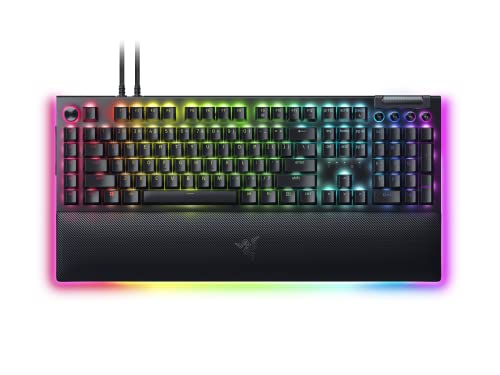
Razer BlackWidow V4 Pro — Razer’s maximalist flagship
Badge: Best flagship for features and macro power
- Layout: full-size with macro column
- Switches: Razer Yellow mechanical — linear and silent (variant listed)
- Extras: Command Dial, 8 dedicated macro keys, wrist rest
- Keycaps: doubleshot ABS
- Features: Chroma RGB, Snap Tap support
The BlackWidow V4 Pro is Razer in full ceremonial dress: a full-size board with a dedicated macro column, a Command Dial, a plush wrist rest and Chroma lighting, built around Razer’s own mechanical switches. It represents the brand’s breadth rather than its esports edge — the board for the gamer whose life includes streaming, editing and MMO keybind empires alongside ranked play. Its doubleshot ABS caps are the one specification that reads a tier below its station, and the honest summary is that this is a command centre first and a duelling instrument second.
- Strengths: unmatched macro and dial hardware
- Strengths: wrist rest and full-size completeness
- Strengths: Synapse depth behind it
- Trade-offs: ABS keycaps at a flagship tier
- Trade-offs: wired, and large
- Trade-offs: maximalism costs maximally
Best for: streamers, MMO players, command-centre desks. Not suited for: minimalists or compact setups.

Razer Huntsman V3 Pro TKL — Razer’s esports instrument
Badge: Best for competitive FPS
- Layout: tenkeyless esports
- Switches: analog optical, adjustable actuation
- Features: rapid trigger, Snap Tap
- Keycaps: doubleshot PBT
- Extras: media keys and dial, wrist rest
The Huntsman V3 Pro TKL is the purest expression of Razer’s philosophy in this comparison: analog optical switches whose actuation point and rapid-trigger behaviour are set per key, in a tenkeyless frame with PBT caps and a wrist rest for tournament-length days. For the FPS player whose movement mechanics are a discipline — the counter-strafing, the jiggle-peeking — this is the board the technology was invented for, and it is the comparison’s clearest single-purpose recommendation.
- Strengths: class-defining analog optical technology
- Strengths: rapid trigger and Snap Tap
- Strengths: PBT caps, esports layout
- Trade-offs: wired
- Trade-offs: priced at the frontier
- Trade-offs: overkill for casual play
Best for: competitive FPS players. Not suited for: wireless desks or macro empires.

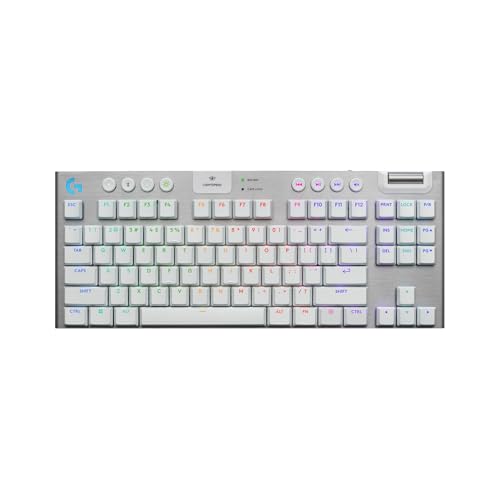
Logitech G915 X LIGHTSPEED TKL — Logitech’s wireless flagship
Badge: Best wireless gaming flagship
- Layout: tenkeyless, low profile
- Connection: LIGHTSPEED wireless, Bluetooth, wired
- Switches: low-profile mechanical, tactile (variant listed)
- Keycaps: double-shot PBT
- Build: aluminium finish
The G915 X is Logitech’s philosophy made metal: a slim, aluminium, low-profile board whose LIGHTSPEED wireless performs at wired standards, whose battery life is measured in weeks of play, and whose manners suit a desk that works by day. It is the comparison’s answer for the gamer who refuses cables and compromises in equal measure — and, as this cluster’s are wireless keyboards good for gaming investigation concluded, the refusal is now entirely defensible. Against the Razers it concedes the analog frontier; against everything it wins the desk.
- Strengths: best-in-class wireless system
- Strengths: slim aluminium elegance
- Strengths: PBT caps, multi-device life
- Trade-offs: low-profile feel divides gamers
- Trade-offs: no analog actuation technology
- Trade-offs: flagship pricing
Best for: wireless-first gamers with refined desks. Not suited for: esports-technology maximalists.

Logitech G PRO X 60 — Logitech’s tournament compact
Badge: Best compact for travelling competitors
- Layout: 60 percent, ultra-compact
- Connection: LIGHTSPEED wireless
- Switches: optical, tactile (variant listed)
- Keycaps: dual-shot PBT
- Design: pro-tour informed, carry-friendly
The PRO X 60 shows Logitech’s esports face: a 60 percent LIGHTSPEED board designed with professional input, small enough for the tournament bag, with optical switches and the brand’s wireless certainty. It lacks the Huntsman’s analog depth, and answers with freedom — the board a travelling competitor plugs into any stage PC via dongle and trusts completely. In the comparison’s terms, it is Logitech’s argument that the best tournament technology is the one that works identically everywhere.
- Strengths: tournament-grade wireless in 60 percent
- Strengths: PBT caps, pro pedigree
- Strengths: travel-ready size
- Trade-offs: 60 percent layers for desktop duties
- Trade-offs: no analog actuation
- Trade-offs: compact premium pricing
Best for: competing and travelling players. Not suited for: full-layout desktop workers.

Corsair K70 CORE — Corsair’s value flagship
Badge: Best full-size value in the comparison
- Layout: full-size with palm rest
- Switches: Corsair MLX Red linear, pre-lubed
- Features: SOCD Flashtap, media control dial
- Keycaps: ABS double-shot
- Sound: sound-dampening construction
The K70 CORE carries Corsair’s banner at the comparison’s friendliest tier: a full-size board with pre-lubed MLX linear switches, a media dial, sound-dampening that gives it an unusually composed voice for a gaming board, and Flashtap — Corsair’s SOCD answer to Snap Tap — for the FPS movement wars. It demonstrates the brand’s modern formula: the complete board, thoughtfully voiced, inside the iCUE nation. Corsair’s higher flagships add aluminium and magnetic switches above it; the CORE is where the brand’s value argument is strongest, and it earns its place here on that strength.
- Strengths: composed, dampened sound
- Strengths: Flashtap SOCD for FPS
- Strengths: full-size completeness with dial
- Trade-offs: ABS keycaps
- Trade-offs: wired only
- Trade-offs: iCUE is a big country for one keyboard
Best for: full-size gamers in or entering the Corsair ecosystem. Not suited for: wireless or compact desks.
The Esports Technology Ledger, Brand by Brand
The current competitive frontier is SOCD handling and rapid trigger, and the three brands’ positions deserve a plain ledger. Razer holds the frontier’s naming rights: Snap Tap and rapid trigger on analog optical switches are the reference implementation, the Huntsman line is their home, and tournament culture treats them as the standard to answer. Corsair answers with Flashtap on its performance boards — the same SOCD logic, delivered inside iCUE’s ecosystem — and with magnetic Hall Effect flagships at the top of its range, making Corsair the frontier’s fast follower with the broadest surrounding system. Logitech G, characteristically, declines to sprint: its competitive boards emphasise optical consistency and wireless certainty, and its pro presence rests on reliability rather than on the newest actuation logic. Whether that is wisdom or lag depends on your titles: in the tactical FPS arena the SOCD features are now close to table stakes at high ranks, while in MOBA, MMO and battle-royale play they are minor characters. Read your own games before you read the ledger — the frontier matters exactly where your matches are decided by counter-strafes, and hardly at all where they are decided by rotations and cooldowns.
Wireless, Compared as Engineering Rather Than as a Checkbox
The three brands’ wireless positions summarise their characters in a single department. Logitech’s LIGHTSPEED is a mature, dedicated gaming link with a decade of tournament trust behind it, and the G915 X wraps it in the comparison’s most complete wireless life — multi-device pairing, Bluetooth alongside, weeks of battery, a board that can run a desk’s whole device family. Razer’s HyperSpeed is equally serious engineering, deployed more selectively: the brand’s wireless flagships exist and perform, but Razer’s centre of gravity stays wired, because its esports heart beats for the cable’s certainty — a defensible theology in a field where its flagship technology, analog optical sensing, is at its best untethered by battery budgets. Corsair’s Slipstream wireless occupies the ecosystem position: excellent within iCUE’s nation, where one receiver philosophy can serve a whole Corsair desk. The practical verdict mirrors the philosophy section: the wireless-first gamer belongs to Logitech almost by definition, the esports purist’s wired loyalty keeps Razer’s flagships cabled without apology, and the Corsair rig-builder gets wireless as one instrument among many. The technology, as the are wireless keyboards good for gaming investigation established, has outgrown the old suspicions at all three houses; what remains different is intent.
Build, Keycaps and the Honesty of Materials
A materials audit across the five boards teaches a useful cynicism. The flagship tier’s expected substance is PBT keycaps and metal in the frame, and the ledger reads: Razer splits its vote — PBT on the Huntsman esports line, doubleshot ABS on the BlackWidow flagship, a choice that privileges the macro board’s legends and cost over its caps’ longevity; Logitech is the comparison’s materials purist, with PBT and aluminium across both its boards here; Corsair’s K70 CORE ships ABS double-shot at its value tier, with PBT reserved higher in the range. None of this is hidden — it is all in the listings this guide verified — but it is rarely compared, and it should be, because keycaps are the surface your fingers actually marry, and their material decides whether the board looks and feels new in year three. The buyer who cares can also correct it later: every board here accepts standard MX-stemmed caps, and the Cherry vs OEM keycaps comparison is the map for that upgrade. Judge the boards as shipped first, though — a flagship should not need its first purchase to be an apology for its caps.
Price Tiers and the Shape of Each Range
The comparison sharpens when each brand’s range is read as a ladder. Razer’s ladder climbs from membrane-adjacent entry boards through the BlackWidow mechanical heartland to the Huntsman frontier, and its pricing logic is technology-led: you pay for sensing. Logitech’s ladder climbs from the G213’s membrane foothills through the G413 and G512 heartland to the G915’s wireless summit and the PRO tournament line, and its logic is refinement-led: you pay for polish, wireless and pedigree. Corsair’s ladder climbs from the K55 membrane base through the K70 heartland — the CORE in this comparison is its value-bright rung — to aluminium flagships, magnetic performance boards and the Stream Deck-infused heights, and its logic is system-led: you pay for completeness. The ladders matter because most buyers do not buy the flagship in the window; they buy a rung, and the rung inherits its brand’s philosophy in diluted form. A mid-tier Razer still thinks in switches, a mid-tier Logitech still thinks in wireless manners, a mid-tier Corsair still thinks in systems. Choose the philosophy first and the rung second, and the purchase will age consistently; choose the rung by discount alone and you may find yourself a citizen of a country whose language you never meant to learn.
Three Gamers, Three Verdicts
Comparisons conclude best in people. The tactical FPS climber — thousands of hours in counter-strike-shaped games, movement mechanics practised like scales, a wired desk by conviction. Her comparison is the shortest: the Huntsman V3 Pro TKL’s analog frontier is the technology her discipline monetises, and Razer’s software depth is the practice room she lives in. The hybrid professional — games hard at night, works from the same desk by day, allergic to cables and to compromise in equal measure. His board is the G915 X, the only flagship here that a morning stand-up and an evening ranked queue both welcome, with the PRO X 60 as his travel understudy. The system builder — a Corsair-lit rig, a Stream Deck on the desk, MMO raids on weekends and video edits between them. Her board is the K70 CORE today and the flagship tier above it tomorrow, because her keyboard is one citizen of a nation she has already chosen, and the BlackWidow’s macro column is the only rival hardware that even argues with her. Three gamers, three brands, zero contradiction — the comparison’s whole thesis in a single paragraph.
Longevity, Support and the Second Owner
The majors’ least glamorous advantage deserves a section, because it is where the three brands most resemble each other and most differ from the new-wave challengers elsewhere in this cluster: they endure. All three maintain firmware for years, stock replacement parts and keycap sets across generations, honour warranties through established channels, and hold resale value in a way young brands cannot yet promise. Between themselves the differences are of flavour — Logitech’s support operation is the industry’s benchmark for reach, Razer’s community and content ecosystem is the loudest, Corsair’s integration with its case-and-component support makes whole-rig troubleshooting a single conversation. For the buyer, the practical translation is risk: a flagship from any of the three is among the safest large peripheral purchases in gaming, and the second-hand market in all three brands is liquid enough that a board can be sold onward when the next frontier calls. That safety is part of what the flagship prices buy, and comparisons that ignore it underprice the majors exactly as surely as comparisons that ignore keycap materials overprice them.
Sound and Feel, Brand Signatures Described
Each house has a sensory signature, and long familiarity lets this guide describe them as tendencies. Razer’s boards run bright and assertive — optical switches with a crisp, sometimes hollow-edged voice on the larger decks, a gaming sound that announces itself; the Huntsman’s PBT caps and esports frame tighten it into the range’s most focused instrument. Logitech’s boards run composed and quiet for gaming decks — the G915 X’s low-profile switches produce a muted, refined report that suits shared rooms, and the brand’s tuning generally prefers understatement. Corsair’s recent boards, the K70 CORE emphatically among them, run dampened and deep for their class — the sound-dampening construction is a deliberate courtship of the custom world’s ears. None of these signatures is a verdict; all three are consistent enough that a buyer who knows their room — shared or solo, streamed or silent — can use them as a real axis of choice, ranked just below software citizenship and switch philosophy in this comparison’s order of operations.
The Layout Map: Where Each Brand Is Strongest by Size
Brand strength is not uniform across sizes, and the buyer shopping a specific layout should know the terrain. At full-size, Corsair’s completeness — dials, macro support, the conducted system — makes it the natural capital, with the BlackWidow V4 Pro as Razer’s macro-rich counter-claim and Logitech comparatively quiet in the category. At tenkeyless, the arena is the most contested in gaming: the Huntsman V3 Pro TKL owns the esports-technology argument, the G915 X owns the wireless argument, and Corsair’s K70 TKL performance editions contest both from the system side. At 60 and 65 percent, Logitech’s PRO X 60 brings tournament wireless credibility that neither rival’s compact line quite matches for pedigree, while Razer’s Huntsman Mini line brings the analog technology down to the smallest frames. At the low-profile frontier, Logitech stands nearly alone among the three — the G915 family created the category’s flagship tier and still defines it. The lesson generalises the whole comparison: do not ask which brand is best, ask which brand is best at your size, for your games, in your software tolerance — three coordinates that, once fixed, usually leave exactly one door standing open.
What the Challengers Taught the Majors — and Vice Versa
No comparison of the majors is complete without the context this whole cluster documents: the new-wave brands pressing from below. The challengers — the Aulas, Epomakers and Chilkeys of the guides around this one — taught the market to expect gasket mounts, dampened voices, hot-swap everything and screens at prices the majors once reserved for membrane boards, and the majors have visibly learned: the K70 CORE’s sound-dampening is a challenger’s idea wearing a Corsair badge, and hot-swap sockets have marched up all three majors’ ranges. In return, the majors still teach the lessons of scale: firmware maintained for years, software ecosystems with real depth, tournament validation, and support organisations that answer. The sophisticated buyer in the current market is not choosing between eras but composing them — a major’s flagship for the desk’s centre, perhaps, with a challenger’s board as the second instrument — and this comparison’s three doors all open onto ranges that have absorbed the challengers’ best ideas. That absorption is why the majors remain the centre: not by resting, but by metabolising. Judge each new generation by how much it has metabolised, and you will rarely buy a stale flagship from any of the three houses.
Mac, Console and the Edges of Each Ecosystem
The majors’ worlds are PC-centred, but their edges differ and the edge-dwellers should know them. Mac support is Logitech’s home advantage — the company’s dual-platform heritage runs through G HUB’s macOS presence and its boards’ legends — while Razer and Corsair serve Mac users more as honoured guests than as natives, functional but PC-first in software and keycap detail. Console gaming inverts some of the order: wired boards from all three houses serve the consoles that accept keyboards, and the full-size, macro-rich decks are overkill there, which quietly favours the simpler instruments. Linux users, as elsewhere in this cluster, are best served by boards whose configuration lives on the device or in open tooling, and least served by the deepest software countries — a point in favour of setting profiles on a Windows machine and letting the board remember them. None of these edges decides the comparison for the mainstream PC gamer, and each of them decides it completely for somebody. A comparison’s honesty is measured at its edges as much as at its centre, which is why they are printed here rather than footnoted.
The Decision Procedure, in the Order to Apply It
For the reader who wants the comparison operationalised, here is the sequence that resolves it, in the order the evidence says matters. First, your games: if competitive FPS movement mechanics are your discipline, Razer’s analog frontier leads and the Huntsman is the shortlist of one; if your titles are everything else, all three doors stay open. Second, your desk: wireless by conviction sends you to Logitech’s LIGHTSPEED flagships; a full-size command centre sends you to Corsair’s or Razer’s macro decks; a compact or travelling life sends you to the PRO X 60 or the Huntsman Mini class. Third, your software tolerance: download the three applications before you buy, spend twenty minutes in each, and strike the country you would not want to live in — this step eliminates more wrong purchases than any specification. Fourth, your materials standards: PBT and metal as shipped, or a willingness to upgrade caps later. Fifth, and only fifth, price — applied within the brand and size the first four steps selected, where it becomes a rung choice rather than a philosophy accident. Run the five steps in order and the three-way comparison resolves into a single board with a clear conscience, which is the most any honest comparison can deliver.
What Ownership Feels Like in Year Two
Reviews end at the unboxing; comparisons should not, so here is the second year with each house, as owners consistently describe it. The Razer owner’s second year is a software relationship: Synapse profiles have multiplied into a small civilisation, the analog settings have been tuned per game and largely forgotten — the highest compliment a configuration can earn — and the board’s identity is its responsiveness, still startling in the first match of the day. The Logitech owner’s second year is an absence of incidents: the battery is a monthly non-event, the dongle has never been thought about, the board has served two machines and a laptop without a single pairing drama, and the satisfaction is the quiet kind that never trends on forums. The Corsair owner’s second year is a system at rest: the keyboard’s lighting breathes with the case fans, the dial’s assignments are muscle memory, iCUE’s profiles switch with the games, and the board feels less like a peripheral than like the rig’s front panel. Three different textures of contentment — intensity, tranquillity, integration — and the buyer who can recognise their own temperament in one of them has found the comparison’s answer in its most durable form, because year two is a longer country than the first week, and it is where flagships earn their prices.
The Lighting Question, Taken Seriously for Once
RGB is usually treated as decoration in comparisons, which undersells what the three ecosystems actually differ in. Razer’s Chroma is an integration platform: hundreds of games and applications speak to it, Philips Hue and smart-home bridges answer it, and the keyboard’s lighting becomes a notification layer — health warnings, cooldown states, stream events — for the whole desk. Logitech’s LIGHTSYNC pursues the same idea with a tidier hand, synchronising across the G household and offering screen-sampling and game profiles with less sprawl. Corsair’s iCUE lighting is the most granular per-key canvas of the three and the only one that natively conducts the PC’s internal lighting in the same composition. The mature way to value all this is neither worship nor dismissal: if your desk’s lighting is a system you enjoy conducting, the ecosystems differ meaningfully and Razer’s integrations and Corsair’s granularity lead; if lighting is a backlight you set once to white, all three serve you identically and the department should cost the comparison nothing. Know which citizen you are before the lighting demos vote in your purchase — showrooms are lit by the departments that photograph best, and keyboards are bought for the departments you will use at midnight in year two.
Entry Points: Buying Into Each Nation Cheaply, to Test Citizenship
Because the comparison’s deepest claim is that ecosystems are citizenships, it owes readers the cheapest honest way to test each one before committing a flagship’s price. Logitech’s test is its mid-range wireless and wired heartland — a G413-class or G512-class board carries G HUB and the brand’s manners at a fraction of the G915’s tier, and a month in G HUB tells you whether Logitech’s tranquillity is your temperament. Razer’s test is a BlackWidow heartland board or a Huntsman Mini: Synapse in full, the switch philosophy in hand, at mid-tier money. Corsair’s test is the K70 CORE itself — the reason it anchors this comparison — because iCUE citizenship, Flashtap and the conducted-system feel are all present at the value rung, and a month with it prices the flagship tier above it with real information. The strategy generalises the cluster’s recurring advice: buy the philosophy at the cheapest rung that expresses it honestly, live in it, and let the flagship purchase be a promotion rather than a wager. Nations, like keyboards, are best joined deliberately.
The Switch Feel Audit, Without Instruments
One experiential axis remains unexamined in prose: how the three houses’ switches actually feel to an unaided hand, described with the usual caveat that variants differ. Razer’s mechanical switches run assertive — the Yellow linears in the BlackWidow are smooth and quiet for gaming switches, the Greens are unapologetically clicky, and the optical Huntsman switches feel like precision instruments, light and immediate, with a character some typists call sterile and others call perfect. Logitech’s switches run civilised — the low-profile tactiles in the G915 X have a rounded, quiet bump that feels designed by people who also make office keyboards, because they are, and the PRO line’s opticals are similarly composed. Corsair’s MLX line runs modern — factory-lubed smoothness, a dampened board around them, a feel that owes audible debts to the custom world the challengers built. A buyer choosing on feel alone, blindfolded, would sort the three houses by temperament — Razer the athlete, Logitech the professional, Corsair the conductor — and would not be wrong. Feel is not the comparison’s first axis, but it is the one your fingers will audit ten thousand times a day, and the audit’s result should be allowed to break a tie the specifications cannot.
What to Do If You Already Own One Brand’s Peripherals
A common reader arrives mid-ecosystem — a Logitech mouse, a Razer headset, a Corsair case — and asks whether the keyboard must match. The honest answer has two halves. The convenience half is real: shared software, shared receivers in Logitech’s case, synchronised lighting, one support relationship, and profiles that travel as a set are worth a genuine premium in daily friction saved. The independence half is equally real: a keyboard is the peripheral you touch most and replace least often, and a mediocre keyboard bought for ecosystem tidiness will irritate you daily for years, long after the tidiness has stopped registering. The resolution this comparison recommends: let the ecosystem break ties, never make them. If two boards from different houses serve you equally on games, desk, software and feel, buy your existing nation’s board and enjoy the consolidation. If one board clearly serves you better, buy it, run two software countries with the equanimity of most of the gaming world, and let the mouse and headset follow the keyboard at their next replacements rather than the other way round. Citizenship should be adopted, not inherited by accident.
The Comparison’s One Firm Conclusion
After five boards, three philosophies and a dozen departments, this comparison permits itself exactly one universal claim, and it is about the buyer rather than the brands. The gamers who regret flagship keyboards almost never regret the switch, the polling rate or the keycaps; they regret the ecosystem — the software they fight, the wireless theology that never matched their desk, the macro hardware they never use or the analog frontier they paid for and play games that ignore. Every one of those regrets is a philosophy mismatch, discoverable in advance by the decision procedure this article laid out, and none of them is discoverable by a specification table. That is the whole argument for comparing the majors as nations rather than as products, and it is why this guide spent its pages on software, intent and year-two texture instead of on a tenth comparison of debounce times. The three houses are all excellent. Excellence was never the question. Fit is the question, and fit — games, desk, software, feel, in that order — is a set of facts about you that no brand can supply and no review can assume. Supply them honestly, and the right door, as promised, is the only one left open.
A Short History of How the Centre Formed
The three-way centre of the gaming keyboard market was not inevitable, and its formation explains its stability. Logitech arrived from the professional periphery business with a decade of wireless engineering and a reputation for devices that simply work, and it converted that trust into the gaming desk’s default. Razer arrived as gaming’s first lifestyle insurgent — a brand built by gamers, priced without apology, and willing to treat a keyboard as an athlete’s instrument years before the industry agreed — and it converted that conviction into the esports frontier it still holds. Corsair arrived from inside the PC itself, from memory and cases and cooling, and it converted the builder’s trust into the conducted-rig ecosystem that makes its keyboards feel like components of a machine rather than guests upon it. Three different trusts — reliability, conviction, integration — built the centre, and the centre holds because each trust is still being honoured by its house’s current boards, as the five in this comparison attest. Challengers can win departments; displacing a trust takes a generation. Buyers are not required to care about any of this — but a buyer who understands why the centre holds also understands what they are paying for at a flagship’s price: not merely a keyboard, but a kept promise with a history.
Gift-Buying Across the Three Nations
A practical coda for the reader buying for someone else, because the three nations make very different gifts. The Razer flagship is the spectacular gift — the brand’s theatre, the esports halo, the unboxing that announces itself — and it suits the known competitive player whose games you can name. The Logitech flagship is the safe gift: universally mannered, wireless, elegant on any desk, and the least likely of the three to mismatch an unknown recipient’s setup, which is why it is the comparison’s recommendation for the gamer whose details you know only in outline. The Corsair board is the insider’s gift — perfect for the rig-builder whose case already glows with the brand’s lighting, puzzling as a standalone present for anyone else. And the standing rule of peripheral gifting applies to all three: a keyboard is a daily-touch object with strong personal geometry, so a gift card toward the recipient’s chosen door, however less theatrical, beats a confident guess at the wrong nation. Give the door, not the room — unless you know the room’s tenant very well indeed.
Final Administration: Returns, Variants and Switch Choices
The comparison closes with the paperwork that protects the purchase, because even a perfectly chosen nation ships in variants. Each flagship here is sold in switch variants — the BlackWidow in its Green, Yellow and Orange tempers, the G915 X in tactile, linear and clicky, the Huntsman in its analog line — and the variant, not the model, is what your fingers will live with, so order by switch first and colour second. Buy through a channel with a genuine return window and use its first week as the citizenship test this article prescribed: software installed, profiles built, real matches played, and the honest question asked while the answer is still free. Keep the receiver, the cable and the box until the window closes; flagships travel with accessories that second owners value. And register the warranty — all three houses honour theirs, and the two minutes it takes is the cheapest insurance in gaming. Do these unglamorous things and the comparison’s work is complete: a philosophy chosen, a board matched, a purchase protected, and a desk that — whichever of the three nations now flies over it — was chosen on evidence rather than on allegiance.
The Verdict Table, for the Reader in a Hurry
Everything above, compressed without apology. For esports switch technology: Razer, and the Huntsman V3 Pro TKL is its proof. For wireless freedom and desk refinement: Logitech G, and the G915 X is its proof. For the complete full-size system inside a conducted rig: Corsair, and the K70 family is its proof. For the travelling competitor: Logitech’s PRO X 60, with Razer’s compact Huntsmans as the analog alternative. For macro empires and streaming desks: the BlackWidow V4 Pro, unopposed in its hardware. For the office-tolerant gaming desk: the G915 X first, the dampened K70 CORE second. For software depth: Synapse. For software peace: G HUB. For software breadth: iCUE. The table is the comparison with its reasoning removed — useful for the second visit, dangerous for the first, because the reasoning is where your own facts enter. Read the sections, then use the table; in that order, it will not mislead you.
A Note on Trying Before Committing
Because the comparison’s verdicts are temperamental as much as technical, it ends its analysis with a shopping method rather than a ranking. Wherever possible, put hands on the boards: a retail display, a friend’s desk, a return-window purchase treated as a formal trial with the software installed and real matches played. The trial’s questions are this article’s questions in miniature — do I like this software’s country, does this wireless theology match my desk, does this switch philosophy feel like my games — and a week of evidence answers them more reliably than a month of reviews. The majors’ ubiquity is, in this respect, their final shared virtue: all three are findable, triable and returnable through ordinary channels, which makes the citizenship test this guide prescribes a practical errand rather than a leap of faith.
The Second-Hand Flagship: A Route the Comparison Endorses
One buying route deserves explicit endorsement before the questions, because all three nations support it unusually well: the previous generation’s flagship, bought used or discounted at a refresh. The majors’ build quality, firmware support and parts availability mean a two-year-old Huntsman, G915 or K70 flagship remains a first-class instrument, and the market prices the refresh cycle rather than the remaining lifespan — which is measured in many years. The checklist is the standard used-flagship one: test every key, verify the wireless and battery on wireless models, confirm the accessories and receiver are present, and buy through a channel with returns. Run it, and the three-way comparison acquires a fourth door — the same nations, entered at a lower tier of money, with the citizenship fully intact.
Frequently Asked Questions
Which brand makes the best gaming keyboards overall?
There is no overall — there are three excellences. Razer for esports switch technology, Logitech G for wireless and refinement, Corsair for complete full-size systems and the surrounding PC ecosystem. The gamer who names their games and their desk constraints will find the “best” brand is the one whose excellence matches them, and this comparison’s five boards are the evidence for each claim.
Is Razer or Logitech better for FPS?
For pure FPS mechanics, Razer’s Huntsman V3 Pro line holds the technology lead — analog actuation, rapid trigger and Snap Tap are built for counter-strafing disciplines. Logitech answers with wireless freedom and consistency, and its PRO boards are tournament-proven. Choose Razer for the actuation frontier, Logitech for the untethered desk, and know that both are represented at the highest levels of play.
Which brand has the best software?
By depth, Razer Synapse; by daily pleasantness, Logitech G HUB; by breadth across a whole PC, Corsair iCUE. The honest recommendation is to weight this heavily: you will open the software weekly for years, while the difference between the brands’ top switches is measured in milliseconds and millimetres. Download and explore each before buying if your shortlist is close.
Are Corsair keyboards good for competitive gaming?
Yes — the K70 line’s performance editions and Corsair’s magnetic flagships carry Flashtap SOCD and high-polling wired performance into the same arena as Razer’s, inside a more complete full-size package. Corsair’s competitive case is the system around the speed: dials, macro support, iCUE profiles and a rig-wide ecosystem.
Which brand is best for a keyboard that also does office work?
Logitech G, on the strength of the G915 X’s low-profile manners, multi-device wireless and refined voice — it is the flagship here that a shared office or a working desk welcomes without negotiation. The K70 CORE’s dampened sound makes it Corsair’s most office-tolerant entry, and Razer’s flagships are the most unapologetically gaming-first.
Which of the three brands is best for a first mechanical gaming keyboard?
The one whose mid-range you can afford without stretching, because first boards are citizenship tests as much as instruments. In practice that usually means a K70 CORE-class Corsair for the full-size beginner, a BlackWidow heartland board for the Razer-curious, or a G413/G512-class Logitech for the wireless-leaning — each cheap enough to be an experiment, each honest enough to teach you whether its nation is yours before a flagship asks for real money.
A last word on timing, because flagship lines refresh on cycles and buyers ask whether to wait. The honest answer is that the three houses refresh their flagships on multi-year rhythms, the current generations in this comparison are mature rather than newborn, and a keyboard bought today will not be embarrassed by next season’s announcement in any way that affects a match. Buy when your current board fails your games or your hands — the only two deadlines that matter — and let the product cycles keep their own calendar. The gamers still playing on five-year-old flagships from all three houses are the comparison’s final evidence: at this level, obsolescence is a rumour, and fit is forever.
One more consideration belongs in the record before the close, because it decides real purchases in households rather than in theory: noise citizenship. Gaming flagships are loud objects in shared homes, and the three nations differ in how much they care. Logitech’s low-profile line is the considerate citizen almost by accident of design; Corsair’s dampened modern boards show a major deliberately learning consideration; Razer’s performance lines treat sound as the instrument’s voice and make no apology for it. If your matches happen at midnight in a thin-walled home, that ordering is not a footnote but a headline, and it should be allowed to outrank a polling figure without embarrassment. The best keyboard is the one your whole household can live with at full volume — a criterion no laboratory measures and every owner eventually does.
The three-way comparison ends, as honest comparisons do, with three doors rather than one throne. Razer’s door opens on the actuation frontier; Logitech’s on wireless refinement; Corsair’s on the complete, conducted system. Walk through the one that matches your games, your desk and your tolerance for software citizenship — and the board behind it, whichever of the five it is, will serve for years.