The best Fuji cameras share one thing that no other brand quite matches: color that looks finished straight out of the camera, thanks to Fujifilm film simulations that mimic classic film stocks. From the pocketable X100VI to the 102-megapixel medium format GFX100S II, the Fujifilm range covers street shooting, travel, portraits, landscapes, and serious video, and every camera in this guide is a current Fujifilm body with the exact model name verified against the product listing. The six picks below span the whole range, so buyers can find the Fuji that fits the way they shoot, not just the one with the biggest number on the box.
Fujifilm builds cameras around the shooting experience as much as the sensor. Dials on top for shutter speed and exposure, aperture rings on the lenses, and film simulations that change the look of a photo without editing all make Fuji cameras feel different in the hand. The X Series uses APS-C sensors that keep bodies and lenses small, while the GFX Series uses medium format sensors that capture far more detail for large prints and commercial work. The guide below explains where each camera fits, so a buyer can pick the right body the first time.
Every camera below is a genuine Fujifilm body, verified for the exact brand and model, and each one suits a different kind of shooting. The X100VI is the fixed-lens street camera, the X-T5 is the all-round stills camera, the X-S20 is the light travel and video body, the X-T30 II is the affordable entry point, the GFX100S II is the medium format flagship, and the X-H2S is the speed and video specialist.
In this guide
Quick picks: best fuji cameras
| # | Product | Where to buy |
|---|---|---|
| 1 | FUJIFILM X100VI Digital Camera | Check on Amazon |
| 2 | FUJIFILM X-T5 Mirrorless Camera Body | Check on Amazon |
| 3 | Fujifilm X-S20 Mirrorless Camera Body | Check on Amazon |
| 4 | Fujifilm X-T30 II Mirrorless Camera Body | Check on Amazon |
| 5 | Fujifilm GFX100S II Mirrorless Camera Body | Check on Amazon |
| 6 | Fujifilm X-H2S Mirrorless Camera Body | Check on Amazon |
How the picks were chosen for best fuji cameras
Sensor and image quality came first. Every pick here uses a current Fujifilm X-Trans or GFX sensor, with the resolution and dynamic range to match its job, from 26.1MP for travel and video to 40.2MP for detailed stills and 102MP for medium format work. Cameras with older sensors or unclear listings were left out, because the sensor is the heart of the camera and the hardest thing to upgrade later.
Handling and the shooting experience came next. Fujifilm cameras are bought as much for how they feel as for what they capture, so dials, grip, weight, and viewfinder quality all mattered. The X100VI earned its place for the fixed-lens street experience, the X-T5 for the classic dial layout, the X-S20 for the deep grip in a light body, and the X-H2S for the stacked sensor speed that keeps up with fast action.
Video ability and lens choice were the third check. A modern camera must shoot good video as well as stills, so video resolution, stabilization, and frame rates were checked for every pick. The lens mount mattered too: X Series bodies share the X mount with a wide range of Fujifilm and third-party lenses, while GFX bodies use the larger G mount, so buyers should know which lens family they are buying into before choosing a body.
The six best fuji cameras

FUJIFILM X100VI Digital Camera
The FUJIFILM X100VI is the most loved street camera in this guide, a compact fixed-lens camera with a 40.2MP sensor, a sharp 23mm f/2 lens, and film simulations that make photos look finished the moment they leave the camera. It fits in a jacket pocket, shoots quietly, and draws little attention on the street, which is exactly what street and travel photographers want. The in-body stabilization holds the shot steady in low light, and the internal ND filter lets the buyer shoot wide open in bright sun.
This camera suits photographers who want one camera that is always with them, and who value the shooting experience as much as the result. The fixed lens is a limit and a freedom at once: there is no zoom to fuss with, so the photographer moves to frame the shot, and the 23mm view suits street scenes, travel, and environmental portraits. Buyers who need a zoom lens or a longer reach should look at the X-T5 or X-S20 instead, since the X100VI cannot change lenses.
Key specs: 40.2MP X-Trans CMOS 5 HR sensor; up to 6 stops in-body image stabilization; 4-stop internal ND filter; 1.4x and 2x digital teleconverter; 20 film simulations including REALA ACE; fixed 23mm f/2 lens
Strengths:
- 40.2MP sensor and 20 film simulations give finished-looking photos with no editing
- Fixed 23mm f/2 lens is sharp, fast, and always ready
- In-body stabilization and internal ND filter handle low light and bright sun
Trade-offs:
- Fixed lens means no zoom and no lens changes, ever
- Small body can feel cramped for buyers with large hands
- High demand means it can be hard to find at the usual outlets
Best for: Street and travel photographers who want a pocketable camera with great color.
Not suited for: Buyers who need a zoom lens, a longer reach, or interchangeable lenses.
Check price on Amazon: FUJIFILM X100VI Digital Camera

FUJIFILM X-T5 Mirrorless Camera Body
The FUJIFILM X-T5 is the all-round stills camera in this guide, a classic-dial mirrorless body with a 40.2MP sensor, 7-stop stabilization, and a 15 frames per second mechanical shutter that keeps up with moving subjects. It is the camera for photographers who want high resolution for landscapes and portraits, with dials on top for shutter speed, ISO, and exposure that make settings visible at a glance. The pixel shift mode builds 160MP images for static subjects, which suits product and landscape work where detail matters most.
This camera suits photographers who shoot mostly stills and want the highest resolution in the X Series without stepping up to medium format. The body is light for what it does, and the X mount lens range covers everything from wide landscapes to long wildlife shots. Video is capable but not the main strength, so buyers who shoot mostly video should look at the X-H2S, while buyers who want the lightest travel body should look at the X-S20.
Key specs: 40.2MP X-Trans CMOS 5 HR BSI sensor; up to 7 stops in-body image stabilization; 15 frames per second mechanical shutter; 160MP pixel shift multi shot; 1/180,000 second electronic shutter
Strengths:
- 40.2MP sensor captures fine detail for landscapes, portraits, and large prints
- Classic dial layout puts shutter speed, ISO, and exposure under the fingers
- 7-stop stabilization and 15 fps keep up with moving subjects
Trade-offs:
- Video features lag behind the video-first X-H2S in the same range
- 40.2MP files are large and need more storage and processing power
- Pixel shift mode only works for fully static subjects on a tripod
Best for: Still photographers who want the highest resolution X Series body.
Not suited for: Video-first buyers, who should look at the X-H2S instead.
Check price on Amazon: FUJIFILM X-T5 Mirrorless Camera Body

Fujifilm X-S20 Mirrorless Camera Body
The Fujifilm X-S20 is the lightest serious camera in this guide, a 491g body with a deep handgrip that holds steady even with a large lens attached, and a 26.1MP sensor that delivers the Fujifilm color buyers love. It is built for travel and for creators who shoot both stills and video, with 6.2K video and a vlog mode that makes self-recording simple. The small size means it fits in a day bag with a lens or two, and the grip means it never feels like a toy in the hand.
This camera suits travelers and content creators who want a real camera without a heavy bag. The 26.1MP sensor is plenty for prints and for online work, and the video features cover vlogging, interviews, and short films. Buyers who need the highest resolution for large prints should look at the X-T5, and buyers who need the fastest autofocus for sports should look at the X-H2S, but for most travel and creator work the X-S20 is the sweet spot.
Key specs: 26.1MP X-Trans CMOS 4 sensor; 491g body; deep handgrip; Fujifilm color science; 6.2K video; vlog mode
Strengths:
- 491g body with a deep grip is easy to carry all day and steady to hold
- 26.1MP sensor with Fujifilm color science gives lovely stills and video
- 6.2K video and vlog mode suit creators who film as much as they shoot
Trade-offs:
- 26.1MP shows less detail than the 40.2MP X-T5 for very large prints
- Smaller body means a smaller battery than the larger X Series bodies
- No classic top dials, so settings live more in menus than on the body
Best for: Travelers and creators who want a light camera that shoots great stills and video.
Not suited for: Buyers who need maximum resolution or the fastest sports autofocus.
Check price on Amazon: Fujifilm X-S20 Mirrorless Camera Body

Fujifilm X-T30 II Mirrorless Camera Body
The Fujifilm X-T30 II is the affordable entry point to the Fujifilm system in this guide, a compact body with the same 26.1MP X-Trans CMOS 4 sensor family that powers the larger cameras, and sensitivity down to ISO 160 for clean images in good light. The X-Trans color filter array keeps moire and false colors low without an optical low-pass filter, so photos stay sharp and clean. It is small, light, and simple to learn, which makes it the right first interchangeable-lens Fuji for many buyers.
This camera suits buyers who want to try the Fujifilm system without paying for the top bodies, and photographers who want a second body that shares lenses with a larger Fuji. The image quality is close to the bigger X Series cameras in most light, and the compact size makes it easy to carry everywhere. Buyers who need in-body stabilization should look at the X-T5 or X-S20, since the X-T30 II relies on stabilized lenses, and buyers who shoot fast action should look at the X-H2S.
Key specs: 26.1MP X-Trans CMOS 4 back-illuminated sensor; ISO down to 160; X-Trans color filter array; compact body
Strengths:
- Same 26.1MP X-Trans image quality as the larger X Series bodies, for less money
- Compact and light, easy to carry all day with a small lens
- Simple to learn, a good first interchangeable-lens Fujifilm
Trade-offs:
- No in-body stabilization, so steady shots depend on the lens
- Smaller grip and battery than the larger X Series bodies
- Autofocus and burst speed lag behind the X-T5 and X-H2S
Best for: New Fujifilm buyers and photographers who want a light second body.
Not suited for: Buyers who need in-body stabilization or the fastest action autofocus.
Check price on Amazon: Fujifilm X-T30 II Mirrorless Camera Body

Fujifilm GFX100S II Mirrorless Camera Body
The Fujifilm GFX100S II is the most detailed camera in this guide by a wide margin, a medium format body with a 102-megapixel sensor and the X-Processor 5 that turns that huge file into sharp, clean images. It is built for landscape, studio, and commercial photographers who print large or crop hard, and who need the dynamic range and depth that only a larger sensor can give. The body is smaller than most medium format cameras, but it is still a serious tool for serious work, not a travel camera.
This camera suits professionals and committed enthusiasts who print large, shoot commercial work, or want the most detail Fujifilm can offer. The G mount lens range is smaller and more costly than the X mount range, so buyers should budget for lenses as well as the body. The 102MP files are very large and need fast cards, plenty of storage, and a strong computer, so buyers should be ready for the workflow as well as the camera.
Key specs: 102MP CMOS II medium format sensor; X-Processor 5; G mount; high-speed burst; 4K video
Strengths:
- 102MP medium format sensor captures more detail than any other camera here
- X-Processor 5 keeps the huge files fast and the colors accurate
- Dynamic range suits landscapes, studio work, and large prints
Trade-offs:
- Very large files need fast cards, big storage, and a strong computer
- G mount lenses cost more and the range is smaller than X mount
- Body is larger and heavier than any X Series camera in this guide
Best for: Landscape, studio, and commercial photographers who print large.
Not suited for: Travelers, casual shooters, and anyone on a tight budget.
Check price on Amazon: Fujifilm GFX100S II Mirrorless Camera Body
Fujifilm X-H2S Mirrorless Camera Body
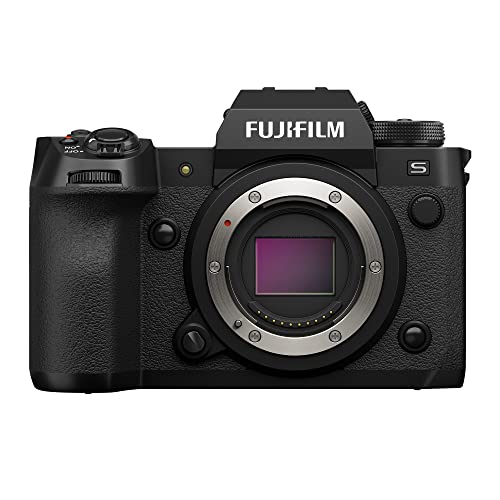
The Fujifilm X-H2S is the fastest camera in this guide, built around a 26.1MP stacked sensor that reads out quickly enough for high-speed bursts and serious video. It is the first X Series camera with the stacked X-Trans 5 sensor, and the design gives up to 14 stops of dynamic range with strong low-light performance. The X-Processor 5 keeps autofocus locked on moving subjects, which makes it the Fuji for sports, wildlife, and video work where speed matters more than megapixels.
This camera suits photographers who shoot action, wildlife, or video and need the camera to keep up without missing the moment. The stacked sensor cuts rolling shutter distortion in video and stills, and the video features cover 4K and 6.2K recording for professional work. Buyers who shoot mostly landscapes or portraits and want maximum resolution should look at the X-T5 or the GFX100S II, since the X-H2S trades megapixels for speed.
Key specs: 26.1MP X-Trans 5 stacked back-illuminated sensor; X-Processor 5; up to 14 stops dynamic range; high-speed burst; 4K and 6.2K video
Strengths:
- Stacked 26.1MP sensor gives the fastest bursts and the least rolling shutter
- Up to 14 stops of dynamic range with strong low-light performance
- Serious video features suit professional video and hybrid shooting
Trade-offs:
- 26.1MP shows less detail than the 40.2MP X-T5 for large prints
- Larger and heavier than the X-T5 and X-S20, with a higher cost
- Speed features matter little for slow, static subjects
Best for: Sports, wildlife, and video shooters who need speed above all.
Not suited for: Landscape photographers who want maximum resolution for large prints.
Check price on Amazon: Fujifilm X-H2S Mirrorless Camera Body
Comparison table
| Camera | Sensor | Resolution | Best for |
|---|---|---|---|
| FUJIFILM X100VI | APS-C X-Trans 5 HR | 40.2MP | Street, travel |
| FUJIFILM X-T5 | APS-C X-Trans 5 HR BSI | 40.2MP | Stills, landscapes |
| Fujifilm X-S20 | APS-C X-Trans 4 | 26.1MP | Travel, vlogging |
| Fujifilm X-T30 II | APS-C X-Trans 4 | 26.1MP | Entry point, second body |
| Fujifilm GFX100S II | Medium format CMOS II | 102MP | Studio, large prints |
| Fujifilm X-H2S | APS-C X-Trans 5 stacked | 26.1MP | Sports, wildlife, video |
For more camera options on this site, see our guides to pocket cameras better than phones, digital cameras under 150, mirrorless cameras under 1000 for stills, and cameras for nature photography beginners.
best fuji cameras: how to choose
Start with the kind of shooting, because the Fujifilm range splits cleanly by job. Street and travel photographers should look at the X100VI or the X-S20, stills photographers who want detail should look at the X-T5, video and action shooters should look at the X-H2S, and professionals who print large should look at the GFX100S II. The X-T30 II suits buyers who want to join the system for less money. Picking by job first avoids paying for speed or resolution that never gets used.
Think about lenses before buying a body. X Series bodies share the X mount, which has a wide range of Fujifilm primes and zooms, plus third-party options, so a buyer can start with one lens and grow the kit over time. GFX bodies use the larger G mount, with fewer lenses at higher costs, so the total cost of a GFX kit is far above the body alone. Buyers should price at least one lens with the body, and check that the lens they want exists in the right mount.
Weigh resolution against speed and file size. A 40.2MP sensor captures more detail than a 26.1MP sensor, but the files are larger, the camera works harder, and the computer must keep up. A 102MP medium format file is larger still, and needs fast cards and plenty of storage. Buyers who print large or crop hard will use the extra pixels, while buyers who share photos online or print small will never see the difference, and should favor speed, handling, or a lower cost instead.
Handle the camera if possible before buying. Fujifilm bodies differ in grip, dial layout, and weight, and a camera that feels wrong in the hand will stay at home no matter how good the sensor is. The X100VI is small and fixed-lens, the X-T30 II is compact, the X-S20 has the deepest grip in a light body, and the X-H2S and GFX100S II are larger tools. Buyers with large hands should favor the bigger grips, while buyers who carry a camera all day should favor the lighter bodies.
Check video needs honestly. Every camera in this guide shoots video, but the X-H2S and X-S20 are the video-first bodies, with the frame rates and features that video work demands. The X-T5 and X-T30 II shoot good video for occasional use, while the GFX100S II shoots video as a secondary feature. Buyers who film often should pick a video-first body and budget for fast cards and a microphone, while buyers who rarely film should not pay for video features they will never use.
Setting up and caring for best fuji cameras
Protect the sensor and the lens from dust. Change lenses with the camera pointing down, in still air, and away from wind and dust, and keep a cap on the body whenever no lens is attached. A blower removes loose dust from the sensor, while a lens cloth keeps the front element clean. Never touch the sensor with fingers or a rough cloth, and send the camera for a professional cleaning if spots appear in photos that will not blow away.
Keep batteries charged and firmware current. Fujifilm releases firmware updates that improve autofocus, add features, and fix bugs, and most updates install through the app or a memory card. Keep at least one spare battery charged for a long day, since mirrorless cameras use power for the viewfinder and the screen, and cold weather shortens battery life further. Store batteries at room temperature and charge them before a shoot, not after.
Store the camera dry and safe. A camera bag with padding protects the body and lenses from knocks, while silica gel packs absorb moisture in humid climates. Avoid leaving the camera in a hot car or in direct sun for hours, since heat can damage the battery and the sensor. For travel, carry the camera in a bag that fits under a seat, and keep memory cards in a separate case so a lost bag does not mean lost photos.
Clean the camera with care after a shoot. Wipe the body with a dry cloth to remove dust and sweat, and check the lens mount and dials for grit after a beach or desert trip. A rocket blower clears the viewfinder and the hot shoe, while a soft brush cleans the grip. Never use harsh cleaners or paper towels on the lens or the screen, since they can scratch coatings that are hard to replace.
Common mistakes when buying best fuji cameras
The most common mistake is buying the most expensive body first. A GFX100S II will not make a better photographer, and a beginner with a medium format camera and no lenses will take worse photos than the same person with an X-T30 II and a good lens. Buyers should match the body to their skill and their subjects, and spend the saved money on a lens, a tripod, or a course that improves the photos.
Another common mistake is ignoring the lens cost. A camera body is only half the system, and the lens often matters more than the body for image quality. Buyers should price the body and the first lens together, and check that the lens they want exists in the right mount at a cost they can accept. A cheap body with a great lens beats an expensive body with a poor lens in almost every case.
A third mistake is buying for resolution alone. A 40.2MP or 102MP sensor needs sharp lenses, a steady hand, and a strong computer to show its advantage, and buyers who share photos online or print small will never see the extra pixels. Buyers should pick resolution to match their output, and favor handling, speed, or video features when the output is small.
A fourth mistake is skipping the hands-on check. Fujifilm cameras feel different from each other, and a body that looks right on paper can feel wrong in the hand. Buyers should hold the camera, try the dials, and check the grip and the viewfinder before buying, especially when choosing between the compact bodies and the larger ones. A camera that feels good gets used, and a camera that feels awkward stays on the shelf.
Our final recommendation
For most buyers, the FUJIFILM X-T5 is the strongest all-around pick, because it pairs the 40.2MP sensor with classic dials, strong stabilization, and the full X mount lens range. Street and travel photographers should pick the X100VI for its pocketable fixed-lens design, creators should pick the X-S20 for light travel and video, new Fujifilm buyers should pick the X-T30 II for value, professionals should pick the GFX100S II for maximum detail, and action shooters should pick the X-H2S for speed.
Whatever the choice, buy the exact model in this guide, pair it with a lens that fits the way the buyer shoots, and learn the film simulations before buying more gear. A good Fuji camera should feel right in the hand, produce color that needs little editing, and stay with the buyer on every walk, trip, and shoot. The six cameras above do exactly that, each in its own corner of the Fujifilm range.
Fuji film simulations and color: what makes Fujifilm different
Film simulations are the signature feature of Fujifilm cameras, and they explain why so many photographers choose Fuji over brands with similar sensors. Each simulation mimics a classic film stock, from the vivid colors of Velvia to the soft tones of Astia, the muted look of Classic Chrome, and the warm tones of the newer REALA ACE mode on the X100VI. The simulations change the color, contrast, and tone of the photo in the camera, so the image looks finished without editing, and photographers can pick a look that fits the subject before pressing the shutter.
The practical benefit is time saved and photos shared faster. A photographer who shoots with a film simulation can send photos to a phone and share them at once, with no editing step in between, which suits travel, street, and family photography. The simulations also teach color: by trying different looks on the same scene, a photographer learns what warm, cool, vivid, and muted color do to a photo, which improves the eye faster than editing alone. Buyers should try the simulations on the camera screen and pick the two or three they like best, then set them as quick options.
Film simulations are not a substitute for good light or good composition, and they cannot fix a poorly exposed photo. They work best when the exposure is right and the subject suits the look, such as Velvia for landscapes, Classic Chrome for street scenes, and Astia or Pro Neg for portraits. Buyers who shoot raw can apply simulations later in software, while buyers who shoot JPEG should pick the simulation before the shot, since the look is baked into the file. Either way, the simulations are a tool, and the photographer who learns them gets more from the camera.
New Fujifilm owners should spend the first week trying each simulation on the same subjects, from a portrait to a landscape to a street scene, and note which looks they return to again and again. Most photographers settle on two or three favorites and leave the rest alone, which keeps the choice simple on a busy shoot. The simulations cost nothing, need no extra gear, and change the look of a photo more than most accessories ever will, so learning them is the fastest way to get more from any Fuji camera in this guide.
Frequently asked questions
Which Fuji camera is best for beginners?
The Fujifilm X-T30 II is the best entry point, because it offers the same 26.1MP X-Trans image quality as the larger X Series bodies in a compact, affordable package. New buyers should pair it with a small zoom or prime lens and learn the film simulations before buying more gear.
Is the Fujifilm X100VI worth it for street photography?
Yes, for photographers who want a pocketable fixed-lens camera with great color and a quiet shutter. The 40.2MP sensor, in-body stabilization, and film simulations make it the strongest street camera in the Fujifilm range, though buyers who need a zoom should pick an interchangeable-lens body instead.
What is the difference between X Series and GFX Series?
X Series cameras use APS-C sensors and the X mount, which keeps bodies and lenses small and affordable. GFX Series cameras use medium format sensors and the G mount, which capture far more detail for large prints and commercial work, at a higher cost and with larger files.
Do Fuji cameras shoot good video?
Yes, especially the X-H2S and X-S20, which are built for video with high frame rates and strong stabilization. The X-T5 and X-T30 II shoot good video for occasional use, while the GFX100S II treats video as a secondary feature. Buyers who film often should pick a video-first body.
Can I use old lenses on a Fuji camera?
Yes, with the right adapter, many older manual lenses fit X Series and GFX bodies, and Fujifilm cameras offer focus aids that make manual focus easy. Native X mount and G mount lenses give the best autofocus and image quality, so buyers should start with a native lens and add adapted lenses later.