The best DB8 antennas are built around one of the most proven designs in over the air television: the eight bay bowtie, a large outdoor antenna with eight bowtie elements that gathers weak UHF signals from far away. The DB8 name belongs to the Antennas Direct 8-Element Bowtie, the antenna that leads this guide, and the other picks here are its close relatives and its honest alternatives, from another eight bay bowtie to smaller bowtie designs and a long range Yagi. Each one suits a different distance from the broadcast towers and a different kind of home.
Many buyers come to DB8 antennas after trying an indoor antenna and finding it is not enough. An indoor antenna works well close to the towers, but it struggles through walls, roofs, and distance, and the channels break up or vanish. An outdoor eight bay bowtie changes that completely, because it sits above the roofline with a clear view and enough gain to hold distant channels steady. The antennas below are current models from known brands, with exact brand and model names, so buyers can find the same antenna again.
This guide judges DB8 antennas by reception first, then by size and install. An antenna that cannot hold the channels that matter is a poor buy no matter how cheap it is, and an antenna that does not fit the attic or the roof is equally useless. The picks below balance gain, frequency coverage, and practical mounting, and each one fits a different buyer, from the rural home at the edge of reception to the suburban home that wants a smaller outdoor antenna.
In this guide
Quick picks: best db8 antennas
| # | Product | Where to buy |
|---|---|---|
| 1 | Antennas Direct 8-element bowtie DB8 antenna | Check on Amazon |
| 2 | Stellar Labs 80 mile deep fringe bowtie antenna | Check on Amazon |
| 3 | Dual bay bowtie antenna UHF HDTV | Check on Amazon |
| 4 | Antennas Direct ClearStream 4V outdoor TV antenna | Check on Amazon |
| 5 | Antennas Direct ClearStream 2V outdoor TV antenna | Check on Amazon |
| 6 | Five Star Yagi outdoor TV antenna | Check on Amazon |
How the picks were chosen for best db8 antennas
An antenna earns a place in this guide when it is a current outdoor TV antenna in the DB8 class, judged by gain, frequency coverage, and build. First, the antenna must be a genuine outdoor TV antenna with a clear brand and model, and it must suit the DB8 idea: a multi-element design for long range UHF reception, with the DB8 itself leading the list. Second, it must handle the channels buyers actually need, with VHF support where the design includes it, since some local channels still broadcast on VHF.
Build and mounting were checked next. Every pick here is built for outdoor or attic use, with a weatherproof design and a mast or mounting option, and each one is honest about its range. Antennas with no stated range, with a purely indoor design, or with a decorative build and no real gain were left out. The result is a shortlist of six antennas that genuinely deliver long range over the air television.
The six best db8 antennas

Antennas Direct 8-Element Bowtie UHF Outdoor HDTV Antenna (DB8)
The Antennas Direct 8-Element Bowtie UHF Outdoor HDTV Antenna is the antenna this guide is named for: the DB8, the classic eight bay bowtie design that has pulled in distant UHF channels for years. It uses eight bowtie elements arranged in two panels that can turn to aim at towers in different directions, which gives it extreme range and a wide reception pattern that suits homes where the broadcast towers sit in more than one direction. It is an outdoor antenna built for the roof or a mast, and it supports modern 4K and 8K broadcasts, so it will not need replacing when broadcast standards move on.
The DB8 design works because bowtie elements are naturally wideband, gathering UHF channels across the band with strong gain, and the eight element layout adds the gain needed for distant towers. The panels turn independently, which helps when one group of channels comes from one direction and another group from somewhere else. The trade is size and install effort: this is a large outdoor antenna that needs a mast, a clear view, and a proper cable run, and it is not a plug and play indoor product. For buyers who want the strongest over the air reception from a proven design, it is the pick to start with.
Key specs: 8 bowtie elements; UHF; outdoor; panels turn for multi-directional reception; supports 4K and 8K
Strengths:
- The DB8 itself, the best known eight bay bowtie design
- Turning panels aim at towers in different directions
- Strong UHF gain for distant channels
Trade-offs:
- Large outdoor antenna that needs a mast and a proper install
- UHF focused, so VHF channels may need a separate element
- No amplifier included, so very distant signals may need one added
Best for: Buyers who want the strongest proven eight bay bowtie for distant UHF channels.
Not suited for: Apartment renters who need a small indoor antenna with no install.
Check price on Amazon: Antennas Direct 8-element bowtie DB8 antenna
Stellar Labs HDTV 80 Mile Deep Fringe Bowtie Television Antenna 30-2431
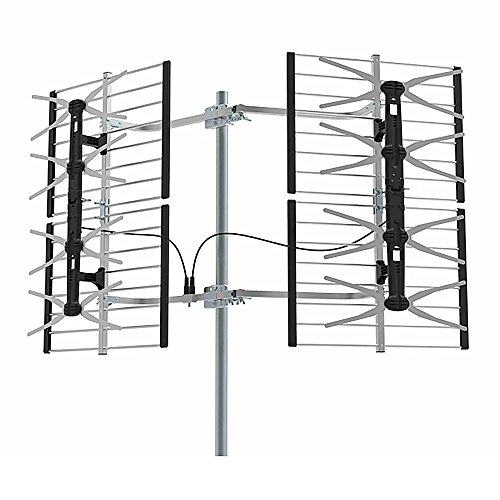
The Stellar Labs HDTV 80 Mile Deep Fringe Bowtie Television Antenna, model 30-2431, is the second eight bay bowtie in this guide, built for deep fringe reception up to 80 miles from the broadcast towers. Deep fringe means the far edge of reception, where the signal is weak and only a large high gain antenna will hold it, and this antenna is built exactly for that job, with a large bowtie array that gathers as much signal as possible. It is an outdoor antenna for the roof or a mast, and it suits rural homes and homes in valleys where the towers are far away and the signal has to cross hills and trees.
The 80 mile figure is a best case number, and buyers should treat it that way: real range depends on terrain, tower power, and obstacles between the home and the transmitter, and a home behind a hill will get less than a home with a clear view. Even so, a deep fringe bowtie is the right tool for the job when the signal is weak, and the Stellar Labs model is a straightforward no frills version of the design. It has no amplifier and no moving parts, which keeps it simple and reliable, and it pairs well with a separate amplifier when the cable run is long.
Key specs: Deep fringe bowtie; up to 80 mile range; model 30-2431; outdoor; UHF and VHF
Strengths:
- Built for deep fringe reception up to 80 miles
- Large bowtie array gathers weak signals well
- Simple design with no amplifier to fail
Trade-offs:
- 80 mile range is a best case figure, not a promise
- Large size needs a sturdy mast and a clear view
- No amplifier included for long cable runs
Best for: Rural homes far from broadcast towers that need maximum range.
Not suited for: Homes close to towers, where a large deep fringe antenna is overkill.
Check price on Amazon: Stellar Labs 80 mile deep fringe bowtie antenna

Dual Bay Bowtie Antenna UHF HDTV
The Dual Bay Bowtie Antenna UHF HDTV is the smaller sibling in the bowtie family, using two bowtie bays instead of eight, and it suits homes where the full DB8 is more antenna than needed. A dual bay design still gives the wideband bowtie advantage, gathering UHF channels across the band, but with less gain and a smaller size, which makes it easier to mount in an attic or on a short mast. For homes in the suburbs with moderate distance to the towers, it often pulls in every available channel while taking up far less space than an eight bay array.
The trade is range, and it is honest: two bays cannot match eight for gain, so this antenna will not hold the weakest distant channels that the DB8 can. That is fine when the towers are within a moderate distance and the signal is decent, and it is the wrong choice when the home is at the edge of reception. Its compact size is a real advantage in an attic, where a full eight bay antenna may not fit between the rafters, and its simple build means there is little to go wrong.
Key specs: Dual bay bowtie; UHF; HDTV; compact outdoor and attic use
Strengths:
- Compact bowtie design that fits attics and short masts
- Wideband UHF reception across the channel band
- Simple build with little to go wrong
Trade-offs:
- Less gain than an eight bay antenna, so weaker distant channels may drop
- UHF focused, so VHF channels may need a separate element
- No mast or mounting hardware described in the listing
Best for: Suburban homes that want bowtie reception in a smaller package.
Not suited for: Deep fringe homes that need the full gain of an eight bay array.
Check price on Amazon: Dual bay bowtie antenna UHF HDTV
Antennas Direct ClearStream 4V Outdoor TV Antenna
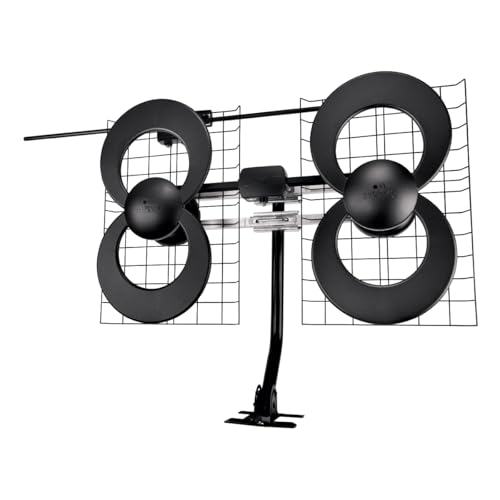
The Antennas Direct ClearStream 4V Outdoor TV Antenna is a four element outdoor antenna with a 20 inch mast, reflectors, and high VHF elements, built for homes that want strong reception in a more compact package than the DB8. It handles both UHF and VHF signals, which matters because some local channels still broadcast on VHF, and a UHF only antenna would miss them entirely. The reflectors behind the elements help reject signals from behind the antenna, which reduces interference from towers in the wrong direction, and the multi-directional design gives it a forgiving aim.
The ClearStream 4V is a good alternative when the DB8 is too large or when the home needs VHF as well as UHF. Its 20 inch mast makes it easy to mount on a roof or a pole, and the build is weatherproof for outdoor use. The trade is gain: four elements cannot match eight for raw distance, so very distant UHF channels may be weaker than on the DB8. For most suburban homes with a mix of UHF and VHF channels, it is a balanced and proven choice.
Key specs: 4 element design; 20 inch mast; reflectors; Hi-VHF elements; UHF and VHF; multi-directional
Strengths:
- Handles both UHF and VHF channels, so no local channel is missed
- Reflectors reduce interference from behind the antenna
- Compact 20 inch mast mounts easily on a roof or pole
Trade-offs:
- Less UHF gain than the eight bay DB8
- Needs careful aiming for the weakest channels
- No amplifier included for very long cable runs
Best for: Homes with a mix of UHF and VHF channels that want a compact outdoor antenna.
Not suited for: Deep fringe homes that need maximum UHF gain above all else.
Check price on Amazon: Antennas Direct ClearStream 4V outdoor TV antenna

Antennas Direct ClearStream 2V Outdoor TV Antenna
The Antennas Direct ClearStream 2V Outdoor TV Antenna is the smallest ClearStream in this guide, a two element outdoor antenna with a 20 inch mast, reflectors, and high VHF elements, built for homes close to the broadcast towers. It is the right size when the towers are within a moderate distance and the signal is strong, because a large antenna would be wasted there, and the 2V pulls in the available channels cleanly without the size, weight, and wind load of a big array. It handles both UHF and VHF, so it covers the full local channel list, and the reflectors help keep the picture clean.
The 2V is honest about its limits: it is a near and mid range antenna, not a deep fringe one, and homes far from the towers will miss channels that the DB8 or the 4V would hold. That is not a flaw, it is a design choice, and buyers who match the antenna to their distance will be happy with it. Its small size makes it the easiest antenna in this guide to install, and it is a good pick for a first outdoor antenna, for a rental home, or for a second television in a part of the house where a big antenna is not wanted.
Key specs: 2 element design; 20 inch mast; reflectors; Hi-VHF elements; UHF and VHF; multi-directional
Strengths:
- Smallest and easiest outdoor antenna in this guide to install
- Handles both UHF and VHF for a full local channel list
- Low wind load and discreet size suit rentals and small roofs
Trade-offs:
- Not a deep fringe antenna, so distant channels will be missed
- Less gain than the 4V and far less than the DB8
- No amplifier included for long cable runs
Best for: Homes close to towers that want a small easy outdoor antenna.
Not suited for: Rural homes that need deep fringe gain for distant channels.
Check price on Amazon: Antennas Direct ClearStream 2V outdoor TV antenna
Five Star TV Antenna Indoor Outdoor Yagi Satellite HD Antenna
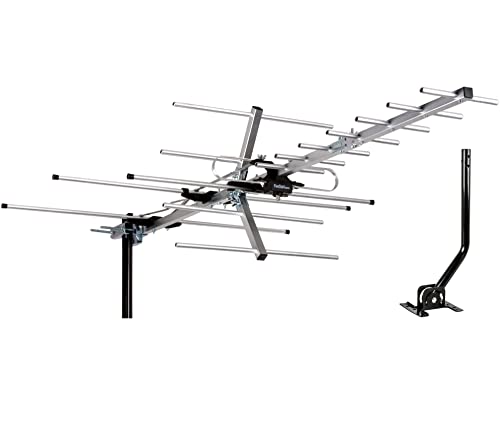
The Five Star TV Antenna Indoor Outdoor Yagi Satellite HD Antenna is the Yagi alternative in this guide, a long boom directional antenna rated for up to 200 miles, built for attic or roof mounting. A Yagi works differently from a bowtie: its long boom and many small elements focus reception in one direction, which gives it very high gain toward a single tower group and strong rejection of signals from other directions. That makes it the right choice when all the local towers sit in one direction and the home is far away, because the focused design squeezes the most signal from that one direction.
The 200 mile figure is a best case number, and real range depends on terrain and tower power, but the Yagi design is genuinely the highest gain option here for a single direction. The trade is aiming: a Yagi must point at the towers accurately, and channels from a different direction will be weak or missing, unlike the multi-directional bowtie designs. It can mount in an attic or on a roof, which gives flexibility, and it is a good pick for rural homes where every tower is in the same direction and maximum range matters most.
Key specs: Yagi design; up to 200 mile range; attic or roof mount; indoor and outdoor; 4K support
Strengths:
- Highest single direction gain in this guide for distant towers
- Attic or roof mounting gives flexible install options
- Focused design rejects interference from other directions
Trade-offs:
- Must be aimed accurately at the towers, or channels are lost
- Poor for towers in different directions
- 200 mile range is a best case figure, not a promise
Best for: Rural homes where all towers sit in one direction and range matters most.
Not suited for: Homes with towers in several directions, where a multi-directional bowtie suits better.
Check price on Amazon: Five Star Yagi outdoor TV antenna
Comparison table
| Antenna | Design | Range | Frequencies |
|---|---|---|---|
| Antennas Direct DB8 | 8 bay bowtie | Extreme | UHF |
| Stellar Labs 30-2431 | 8 bay bowtie | Up to 80 miles | UHF and VHF |
| Dual Bay Bowtie | 2 bay bowtie | Moderate | UHF |
| ClearStream 4V | 4 element | Long | UHF and VHF |
| ClearStream 2V | 2 element | Near to mid | UHF and VHF |
| Five Star Yagi | Yagi | Up to 200 miles | UHF and VHF |
Best db8 antennas: how to choose
Start with distance, because it decides the size of antenna needed. Check how far the home sits from the broadcast towers using a coverage map, and note whether the towers sit in one direction or several. Homes within a moderate distance with towers in several directions suit a multi-directional bowtie like the DB8 or the ClearStream models, while homes far away with all towers in one direction suit a directional Yagi. A home at the edge of reception needs the largest antenna it can mount, while a home close to the towers can use a smaller model and save on size and wind load.
Next, check the channels. Some local channels broadcast on VHF, and a UHF only antenna will miss them, so buyers should confirm whether their area needs VHF support and choose a model that covers it. The ClearStream models in this guide include high VHF elements, while the pure bowtie designs are UHF focused. Check the channel list for the area before ordering, since a missing VHF channel is the most common disappointment after install.
Finally, check the mounting. An outdoor antenna needs a mast, a clear view toward the towers, and a cable run to the television, while an attic antenna needs enough space between the rafters and a roof that does not block the signal. Metal roofing, radiant barrier foil, and solar panels all reduce signal, and a home with those materials may need a larger antenna or an outdoor mount instead of an attic install.
Installing and caring for a DB8 antenna
When a new DB8 antenna arrives, check the parts against the listing before climbing anywhere, and confirm the mast, the mounting bracket, and the cable are all present. Mount the antenna as high as practical with a clear view toward the towers, and aim it using the signal meter on the television or a coverage map, adjusting slowly until the signal is strongest. Keep the cable run short and use a low loss cable when a longer run is unavoidable, since long cables lose signal.
For care, check the mount and the cables twice a year, and after every major storm, since wind and ice loosen hardware over time. Keep the antenna clear of branches and debris, and check that the mast is still plumb, since a leaning antenna loses aim. Rescan for channels every few months, because broadcast lineups change and a fresh scan picks up new channels. An outdoor antenna that is mounted well and kept clean will deliver free channels for years.
Common mistakes when buying a DB8 antenna
The most common mistake is buying the largest antenna available for a home close to the towers, which wastes money and adds wind load for no benefit. Another common mistake is mounting the antenna in an attic under a metal roof and wondering why the signal is weak, since metal roofing blocks far more signal than asphalt shingles. A third mistake is skipping the channel scan after install, which leaves channels undiscovered even though the antenna receives them.
Buyers also forget to check for VHF channels, and they order a UHF only bowtie when their area needs VHF as well. Finally, many buyers use a long thin cable that loses more signal than the antenna gains, and they blame the antenna for a cable problem. A short low loss cable matters as much as the antenna itself.
Our final recommendation
For most buyers, the best DB8 antenna in this guide is the Antennas Direct 8-Element Bowtie itself, mounted outdoors with a clear view toward the towers. That combination gives the strongest proven eight bay reception and covers the widest range of homes. Buyers close to the towers should choose a smaller ClearStream model instead, while buyers far away with all towers in one direction should consider the Yagi for its focused gain.
Whatever the choice, buy the exact model in this guide, check the distance and the channel list for the area, and keep the receipt until the antenna has been aimed and the channels scanned. A good DB8 antenna should pull in every available channel cleanly and hold it through weather and seasons. For more antenna options, see our guides to amplified antennas, attic antennas, 5G antennas, and long range HDTV antennas.
Eight bay bowtie versus Yagi: which design suits the home
The two big outdoor antenna designs in this guide work in opposite ways, and the choice between them comes down to where the towers sit. An eight bay bowtie gathers signal from a wide arc, because its eight elements face in more than one direction, and the panels can turn to cover towers that sit apart from each other. That makes it the right choice for most suburban homes, where the broadcast towers for different channel groups sit in different directions and no single aim would catch them all. A Yagi does the opposite: its long boom and many small elements focus all the gain in one narrow direction, which gives it more range toward that one direction and stronger rejection of everything else. That makes it the right choice for rural homes where every tower sits in the same direction and the signal is weak. The practical way to decide is to check a coverage map for the home and count the directions: towers in two or more directions point to a bowtie, while towers in one direction point to a Yagi. When in doubt, the bowtie is the safer first choice, since it forgives a bad aim and still catches channels from the sides, while a Yagi that is aimed wrong catches almost nothing at all.
A quick check before ordering a DB8 antenna
Before ordering a DB8 antenna, run through a short check that takes a few minutes and prevents most disappointments. First, check a coverage map for the home, noting the distance to the towers and the directions they sit in, since that decides between a multi-directional bowtie and a directional Yagi. Second, check the channel list for the area, and note whether any local channels broadcast on VHF, since a UHF only antenna would miss them. Third, look at the roof, and note whether it is asphalt, metal, or covered with solar panels, since that decides between a roof mount and an attic install. With those three answers, the choice in this guide becomes clear, and the antenna that arrives will suit the home, the channels, and the roof.
How far a DB8 antenna can really reach
Antenna range figures are best case numbers, and understanding what they really mean will keep expectations honest. A figure such as 80 miles or 200 miles assumes flat land, a clear view, a powerful transmitter, and no obstacles, and real homes rarely have all four. Hills, trees, buildings, and weather all reduce the range, and a home in a valley may get half the stated range while a home on a hill may get more. The transmitter matters too, since a powerful station reaches farther than a weak one, and the channel matters as well, since UHF signals behave differently from VHF signals over distance. The practical way to judge range is to check a coverage map for the home, which shows the real distance to each tower and the expected signal strength, and to choose an antenna that covers the weakest channel that matters, not the average. A larger antenna helps at the edge of reception, and an amplifier helps when the cable is long, but no antenna can receive a channel that does not reach the home at all, and a coverage map will show that before any money is spent. Buy the antenna for the real distance, not the advertised one, and the channels will come in clearly.
Indoor versus outdoor mounting for DB8 antennas
A DB8 antenna can mount outdoors on a roof or indoors in an attic, and the choice changes the reception more than any other decision. An outdoor mount with a clear view toward the towers gives the strongest signal, since the antenna sits above the roofline with nothing between it and the transmitter except air. An attic mount is easier and safer to install, and it protects the antenna from weather, but the roof blocks some signal, and the loss is far worse under metal roofing, radiant barrier foil, or solar panels, which can block most of the signal entirely. A home with asphalt shingles loses some signal in the attic but often still receives well, while a home with a metal roof may get almost nothing from an attic antenna. The practical rule is to mount outdoors when possible, and to use the attic only when a roof mount is not allowed or not practical. When the attic is the only option, mount the antenna as high as possible, away from metal ductwork, wiring, and foil insulation, and keep the cable run away from power lines to avoid interference. Check the signal after install with a channel scan, and if channels are missing, try moving the antenna a little, since a small move in an attic can make a large difference to which channels come in clearly.
Splitting the signal to several televisions
One outdoor antenna can feed several televisions, and that is one of the best reasons to install a DB8 antenna instead of buying a separate indoor antenna for each room. The signal from the antenna goes to a splitter, which divides it between the televisions, and each television tunes its own channels from the same antenna. The catch is that every split loses some signal, so a two way split loses a little and a four way split loses more, and a weak signal that was fine on one television may break up when it is split four ways. An amplifier fixes that by boosting the signal before the split, and a distribution amplifier is the right tool when the home has several televisions or a long cable run. The amplifier should sit close to the antenna, not at the television, since boosting a weak signal at the far end also boosts the noise. Use a low loss cable for the long runs, keep the cable away from power lines, and use a proper splitter rather than a cheap adapter, since a good splitter loses less signal. With a good amplifier and good cable, one DB8 antenna can feed every television in the house with clear channels, and the cost of the amplifier is small compared with the cost of a monthly cable bill.
Frequently asked questions
What does DB8 mean in an antenna name?
DB8 is the model name for the Antennas Direct 8-Element Bowtie antenna, an outdoor UHF antenna with eight bowtie elements. The name has become shorthand for eight bay bowtie antennas in general.
Do I need an amplifier with a DB8 antenna?
Not always. A DB8 has strong gain on its own, and an amplifier helps most when the cable run is long or the signal is split to several televisions. A home close to the towers may not need one at all.
Can a DB8 antenna receive VHF channels?
The pure eight bay bowtie design is UHF focused, and some VHF channels may be weak or missing. Homes with VHF channels should choose a model with VHF elements, such as the ClearStream models in this guide.
Is an attic install as good as a roof install?
Usually not. An attic blocks some signal, and metal roofing, radiant barrier foil, and solar panels block far more. A roof mount with a clear view gives the strongest reception, while an attic suits homes where a roof mount is not possible.
How far can a DB8 antenna reach?
It depends on terrain, tower power, and obstacles. In a clear flat area, a large outdoor antenna can reach towers 60 to 80 miles away, while hills, trees, and buildings reduce that range. A coverage map for the home gives a realistic figure.


