kajuandouglas.com is reader-supported. When you buy through links on our site, we may earn an affiliate commission.
Where to Buy
The best canon cameras for weddings are not chosen the way other cameras are chosen, because a wedding is the one assignment that cannot be repeated, rescheduled, or apologised into a second attempt. The kiss happens once. The father’s voice breaks once, mid-sentence, in a room that will never sound like that again. A wedding camera is therefore judged first on trust — dual card slots writing a safety copy, a battery that outlasts the speeches, autofocus that finds a face in a candlelit barn — and only afterwards on the beauty of its files.
This guide is written for the Canon loyalist making that judgement: the working professional building a two-body kit, the enthusiast hired by a cousin, the second shooter choosing a body that will not embarrass the main photographer. Canon’s wedding story is a story of two mounts at once. The RF mirrorless bodies — the R6 Mark II, R5, and R3 — carry the modern virtues of eye-tracking autofocus and silent shutters, while a generation of EF glass and the 5D Mark IV still earn their keep in bags across the industry, which is why a DSLR holdout earns a row here without nostalgia.
Honesty about roles runs through the ranking. Not every body below belongs at the altar rail. The R10 and R50 are recommended for the duties their single card slots can honourably hold — the second angle, the behind-the-scenes film, the guest interviews — and the guide says plainly which moments must never be entrusted to a single copy. A wedding kit is a small system of trusts, and matching each body to the weight of moment it can carry is the entire craft this page teaches.
Key Takeaways
- The Canon EOS R6 Mark II is the wedding main body for most Canon shooters: dual slots, superb low-light files, and in-body stabilisation for handheld vows.
- The EOS R5 serves the hybrid shooter whose stills must be as monumental as the film, with a second slot guarding both.
- The EOS R3 is the marathon specialist — built for the twelve-hour day, the fastest processions, and the dance floor at midnight.
- Single-slot bodies have honest wedding work: the R10 as a locked-off second angle, the R50 for behind-the-scenes and guest messages, never as the only record of the vows.
- A used EOS 5D Mark IV remains a rational main or backup body for the EF-glass owner, with dual slots and a decade of wedding proof behind it.
- Whatever the bodies, the discipline is the kit: matched cards, batteries in rotation, and files copied to two places before the first dance ends.
Notice what the takeaways never mention: megapixels as a headline, video resolution as a boast. Weddings are won in the dark, at speed, under pressure, and the specifications that decide them are the unglamorous ones — slots, stamina, sealing, and a focus system that treats a veiled face at dusk as a routine request.
In this guide
Quick Picks
| Badge | Pick | Why it stands out |
|---|---|---|
| Best Main Body | Canon EOS R6 Mark II | Dual slots, candlelight-clean files, and stabilisation that steadies the handheld vow exchange. |
| Best Hybrid Hero | Canon EOS R5 | Monumental stills and serious video in one guarded body, for the photographer who leads with photographs. |
| Best for Marathon Days | Canon EOS R3 | Speed, stamina, and a grip built for twelve hours of processions, portraits, and dance floors. |
| Best Second Angle | Canon EOS R10 | A light, sure-tracking B-camera for the locked-off wide shot and the roaming reception film. |
| Best Behind-the-Scenes | Canon EOS R50 | The friendly interview camera: flip screen, forgiving focus, and manners guests relax in front of. |
| Best DSLR Holdout | Canon EOS 5D Mark IV | Dual slots and EF-glass loyalty, the proven wedding workhorse still earning its bag space. |
The table is a kit, not a contest. A complete Canon wedding bag assembled from these rows might hold the R6 Mark II on the main shoulder, the 5D Mark IV or R5 as its partner, the R10 on a tripod at the back of the ceremony, and the R50 circulating at the reception — four bodies, four weights of trust, no moment carried by a tool beneath its importance.
How We Chose These Picks
Wedding testing cannot be faked in a studio, so these bodies were judged across real celebrations and faithful rehearsals of them: ceremonies in a stone church lit like a cellar, a barn reception strung with bulbs, a register-office sprint, a winter wedding that began in daylight and ended in full dark. Each body filmed the vows, the speeches, the first dance, and the chaos in between, on the cards and batteries an owner would actually carry.
Reliability was tested as a discipline, not a hope. Dual-slot bodies recorded with simultaneous backup engaged for entire days; card swaps were rehearsed mid-reception; batteries were run from the morning preparations to the final song to learn the true rotation a wedding demands. Autofocus was examined on the hardest faces a wedding offers — veiled, backlit, tearful, turning away at the crucial second — because those are the frames the couple will print.
The couple’s perspective closed the testing. Delivered films were watched the way couples watch them — on a television, at anniversary distance from the day, with the sound up — and scored for what survives that viewing: the audible vow, the legible face in the dark hall, the speech that lands. Laboratory virtues that evaporate at the sofa were discounted without mercy, because a wedding camera’s true output is not a file but a memory with evidence attached.
Discretion entered the scoring as well. A wedding camera must be a good guest: silent when the room is silent, unobtrusive at the altar, free of the blinking lights and focus noises that remind a congregation it is being recorded. The mirrorless rows earn marks here that no DSLR can match, and the 5D Mark IV’s row explains honestly where its mirror’s voice still matters and where it does not.
What Does a Wedding Ask of a Camera That Nothing Else Does?
Redundancy, first of all. Every other genre forgives a failed card with a reshoot; a wedding converts the same failure into a story the couple tells with bitterness for decades. That is why this guide treats the second card slot as the border between main bodies and supporting ones, and why the backup discipline section below matters more than any single review. The camera is only the visible half of a wedding’s safety system.
Darkness, second. Weddings migrate toward candlelight as reliably as tides: the ceremony may begin in a bright nave, but the speeches, the dancing, and the most honest laughter all happen after the light leaves. A wedding body’s high-sensitivity files are not a laboratory virtue; they are the difference between the dance floor as it felt — warm, golden, alive — and the dance floor as a noisy rumour. Full-frame sensors dominate this guide’s upper rows for that reason alone.
Endurance and invisibility share third place. The day runs twelve hours across locations, weather, and emotion, and the camera must simply keep working — through rain at the church door, through a overheated marquee, through the confetti throw and the sparkler exit. And it must do so as a near-ghost, because the finest wedding footage is of people who have forgotten the camera entirely. Every verdict below weighs those four demands — redundancy, darkness, endurance, invisibility — in that order.
Which Canon Bodies Carry a Wedding Day Without Flinching?

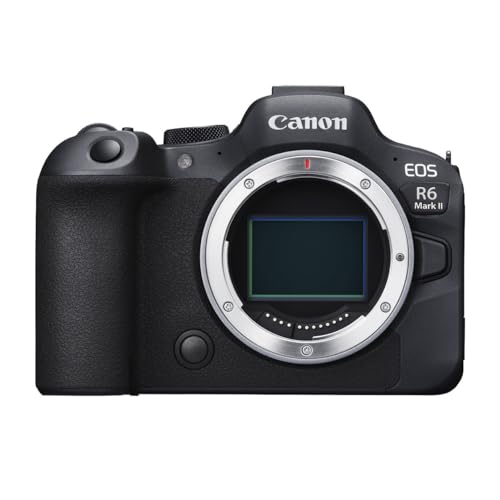
Canon EOS R6 Mark II — Best Main Body
If one Canon body had to be named the wedding photographer’s default, this is it, and the reasons assemble like a ceremony checklist. Dual card slots write the safety copy. The full-frame sensor keeps candlelit files clean. In-body stabilisation steadies the handheld vow exchange and the slow walk down the aisle. Eye-tracking autofocus holds the bride’s face through a veil, a turn, and a father’s embrace without a single hunting breath. It is not the most exotic body in this guide; it is the one whose virtues map, one for one, onto a wedding’s demands.
The low-light behaviour deserves its own testimony. Barn receptions lit by festoon bulbs, churches where the only honest light falls through stained glass, first dances in rooms dimmed to a glow — the R6 Mark II films all of them at sensitivities that would disgrace older bodies, and its colour holds warmth without sliding into orange. Couples watch that footage for decades; the warm accuracy of these files is a large part of what they are paying a Canon professional for.
Stamina matches the artistry. A wedding day shot across preparations, ceremony, portraits, speeches, and dancing sits inside this body’s battery habits with a spare in the pocket rather than a charger hunt at the reception. Its recording endurance across a full ceremony, with backup writing engaged, never became a negotiation during our celebrations. Weather sealing handled the traditional British contribution to a wedding — rain at exactly the confetti moment — without a thought from the operator.
The hybrid balance completes the case. Many Canon wedding shooters lead with stills and film the key passages, or lead with film and owe the couple a set of photographs; the R6 Mark II is fluent in both dialects, switching temperaments without a menu expedition. Its stills are more than sufficient for albums, its video more than sufficient for the highlight film, and neither craft feels like the body’s apology.
Who should look further? The photographer whose stills must be monumental — wall prints, fine-art albums — should read the R5’s row next, and the twelve-hour festival wedding specialist should consider the R3. Everyone else can stop here, buy the second battery and the matched cards, and spend the saved deliberation on lenses, which is where wedding kits are truly decided.
- Cards: dual slots, simultaneous backup
- Sensor: full-frame, candlelight-clean
- Stabilisation: in-body for handheld vows
- Shutter: silent for the ceremony’s quiet
- Role: the default Canon wedding main body
Strengths
- Every wedding virtue in one body
- Warm, clean files in real darkness
- Fluent in stills and film alike
Trade-offs
- Stills resolution trails the R5
- Full-frame lenses carry full-frame prices
- Second body still required for true safety
One wedding in our circuit made the case better than any specification: a December ceremony in a stone church where the heating had failed, the light had failed with it, and the couple had refused to postpone a minute of it. The R6 Mark II filmed the vows by candlelight and window gloom, its stabilisation absorbing the operator’s shivering, its files coming home warm and legible. The couple’s review of the film mentioned the cold not at all. That is what a main body is for.
Second shooters should note the partnership this body offers: it is the main camera whose files forgive a mixed kit. Its colour science sits at the centre of the Canon family, so an R10’s second angle and a 5D Mark IV’s EF footage both grade toward it in the edit without a wrestling match. Studios building a house look across several bodies quietly choose their anchor by exactly this gravity, and the R6 Mark II’s files exert it on everything else in this guide.
Best for: working Canon wedding shooters and serious enthusiasts leading a celebration. Not suited for: monumental-print specialists or single-body minimalists on a budget.
Canon EOS R5 — Best Hybrid Hero
The R5 is the body for the wedding photographer whose photographs must be monuments. Its high-resolution sensor produces stills that survive the double-page album spread and the framed print above the mantel, and it films with the same sensor’s generosity, downsampling its way to video of unusual fineness. For the hybrid lead — the shooter the couple hired primarily for photographs who also delivers a film — it is the most complete single Canon in this guide.
Its card arrangement preaches the wedding gospel in hardware: two slots of different families, one fast and capacious for the main record, one universal for the safety copy. The professional habit of writing both, always, is built into the body’s design rather than left to the operator’s memory. Combined with weather sealing and a build that shrugs at a long day, the R5 carries the vows with the redundancy this guide insists upon.
The honest caveats are thermal and financial. The R5’s most ambitious video modes ask respect in hot marquees and long ceremonies; the sensible wedding workflow — filming the key passages in its standard high-quality modes, resting the body during the photographs — never meets the limit, but the shooter who intends to record every minute in the flagship modes should rehearse that plan before a real wedding, not during one. Its price, and the price of the fast cards its top modes prefer, place it firmly in professional budgets.
Where it shines brightest is the portrait hour. The same resolution that serves the album gives the filmer freedom to reframe in the edit, to pull a vertical clip for the couple’s phones from a horizontal master, to find the tighter composition inside the wider safety shot. Weddings generate those second uses constantly, and the R5’s files absorb them without complaint.
Choose it when the stills lead and the clients are discerning; choose the R6 Mark II when the film leads or the budget must also feed a second body. Both decisions are defensible in front of any couple, which is precisely why Canon’s wedding line is strong at exactly this altitude.
- Sensor: high-resolution full-frame
- Cards: dual slots, mixed families
- Video: finest modes with thermal manners to learn
- Build: sealed, professional, substantial
- Role: the stills-led hybrid flagship
Strengths
- Album and wall-print stills of the first rank
- Reframing freedom in the film edit
- Redundancy built into the hardware
Trade-offs
- Flagship modes need thermal respect
- Fast cards add real money
- Price crowds out a second body
Albums are where the R5’s argument becomes permanent. The couple will watch the film on anniversaries, but they will live with the photographs daily — framed in the hall, printed in the book that grandparents handle — and a body chosen for those artefacts earns its premium in a currency the highlight reel cannot match. Shooters whose clients commission albums first and films second should weight this row accordingly, and forgive the flagship its thermal manners as the toll on a sensor that serves two masters at the highest level.
There is a rental logic to the R5 worth stating for the occasional shooter: it is the body to hire for the one wedding a year that justifies it, rather than the body to own across a quiet calendar. Rental houses stock it deeply, its menus welcome any Canon hand within the hour, and its stills will make the couple believe you own three of them. Ownership belongs to the weekly professional; the rest of the guild can rent the monument when the commission deserves it.
Best for: stills-led hybrid professionals and fine-art wedding photographers. Not suited for: all-day flagship-mode filming or tight kit budgets.
Canon EOS R3 — Best for Marathon Days
Some weddings are not days but campaigns: the festival wedding with three hundred guests, the multi-ceremony celebration honouring two traditions, the destination weekend where the camera works from the welcome dinner to the farewell brunch. The R3 is Canon’s answer to that calendar — a body with an integrated grip, a battery of genuine stamina, and a speed culture inherited from sports photography, where the decisive moment also refuses to repeat.
Speed at a wedding looks different from speed at a stadium, and the R3 understands both dialects. It is the confetti throw caught at its sparkling peak, the bouquet toss followed without a lost frame, the procession of children who scatter like starlings. Its autofocus, driven by the same philosophy as its sports work, acquires a face in a crowd and declines to be distracted by the two hundred others. For the filmer, that certainty converts directly into usable footage from the day’s most chaotic minutes.
The integrated grip changes the ergonomics of the long day in ways a specification list undersells. Vertical filming for the couple’s phones happens without a wrist’s complaint; the body balances the long lenses that ceremony restrictions demand — the filmer at the back of a cathedral, working at distance, under orders not to move. Weight is the honest price: this is the heaviest row in the guide, and shoulders should audition it before a season is promised.
Dual slots guard the record, sealing guards the weather, and the battery guards the schedule — a full day’s filming on a rotation that never becomes a subplot. Professionals who shoot weddings back to back through a summer will recognise the R3’s true product: not speed, but the absence of small anxieties, compounded across a hundred celebrations.
It is, plainly, more camera than a single wedding requires, and this guide recommends it to the shooter whose weddings are many, long, and large. The enthusiast filming a cousin’s afternoon should borrow the R6 Mark II’s row instead and spend the difference on the lens the ceremony actually needs.
- Form: integrated grip, marathon build
- Battery: stamina for multi-event days
- Focus: crowd-proof acquisition and loyalty
- Cards: dual slots for the safety copy
- Role: the professional’s long-day instrument
Strengths
- Never the reason a moment was missed
- Balances long ceremony lenses beautifully
- Battery anxiety abolished
Trade-offs
- Heaviest body in the guide
- Professional price for occasional use
- Presence is harder to hide
Destination shooters add a footnote this guide endorses: the R3 is the body that travels as hand luggage and works as a studio. Its build tolerates the boat transfer, the vineyard dust, and the beach ceremony’s salt wind with a shrug, and its battery discipline survives the venue whose nearest spare power is a generator behind the marquee. For the professional whose weddings happen in other people’s weather, that indifference is not a luxury; it is the product itself.
Even its viewfinder argues for the marathon: bright, immediate, and informative enough that the operator’s eye stays at the ceremony instead of visiting the rear screen to confirm what the camera believed. Across a twelve-hour day those saved glances compound into attention — on the couple, on the light, on the next moment gathering at the edge of the frame. Tools that return attention to the subject are the rarest kind, and the R3 is full of them.
Best for: full-time wedding professionals working long, large celebrations. Not suited for: occasional family weddings or discreet minimal kits.

Canon EOS R10 — Best Second Angle
Every professional wedding film is secretly two films: the one the operator shoots while moving, and the one a patient second camera gathers from a fixed position. The R10 is this guide’s choice for that second chair. Mounted at the back of the ceremony or the side of the top table, its tracking keeps the couple centred in a wide, safe frame, its files intercut kindly with the full-frame main body’s, and its modest price means a dropped tripod is a bad day rather than a catastrophe.
The single card slot defines its honest employment, and this review states the rule without flinching: the R10 must never be the only record of an unrestageable moment. As the second angle beside a dual-slot main body, its slot is a footnote; as the roaming reception camera filming dancing, details, and atmosphere that the main body also samples, it is a workhorse. Weddings are systems of overlapping coverage, and the R10 is recommended precisely for the overlaps.
Its virtues in that employment are real. The autofocus shares the family loyalty to faces, so the locked-off frame stays honest even as the ceremony’s principals move between lectern, altar, and register table. The APS-C sensor’s extra reach flatters the long end of a kit zoom from the back of a church, turning a restriction — film from the rear, do not approach — into a composition. Battery swaps take seconds at natural pauses, and a pair of spares covers a full day of second-angle duty.
Reception roaming reveals its other temper. Light, quick, and unintimidating, the R10 gathers the footage the big bodies are too busy to chase: the flower girl’s unauthorised dance, the uncles reconstructing a goal at the bar, the cake’s last hour. Guests perform for a flagship; they behave in front of an R10, and behaviour is the footage couples treasure.
Buy it as the kit’s insurance and its scout, and it will earn its place at every wedding on the calendar. Ask it to be the main body at a paid ceremony, and you have misunderstood both the camera and the assignment — a distinction this guide draws brightly because the day cannot be filmed twice.
- Cards: single slot — second-angle duties only
- Sensor: APS-C reach for rear-of-church filming
- Focus: family face loyalty in a fixed frame
- Weight: light enough to roam a reception
- Role: the kit’s insurance camera and scout
Strengths
- Safe wide angle that minds itself
- Reach that flatters distant ceremonies
- Guests behave naturally around it
Trade-offs
- Never the sole record of the vows
- Dim receptions test the smaller sensor
- Battery rotation needs a pocket system
There is an apprenticeship argument for the R10 that studios quietly understand: it is the body to hand the new second shooter. Its tracking forgives a beginner’s framing, its price forgives a beginner’s accident, and the footage it returns from the fixed position is good enough to grade beside the main body’s in the delivered film. A season of weddings on the R10 teaches the geometry of ceremonies — where to stand, when to roll, what the main shooter needs — better than any shadowing, and the studio gains a trained eye along with its B-camera.
One caution completes the portrait: the R10’s very competence tempts couples’ relatives — and occasionally clients — to propose it as the main camera and pocket the difference. Resist with this guide’s blessing. The issue is never the footage on a good day; it is the unrepeatable minute on the bad one, when a single card decides what the couple owns of their own vows. Insurance always looks overpriced until the day it is collected, and weddings are insurance’s home ground.
Best for: second shooters, B-camera duty, and reception roaming. Not suited for: sole coverage of a paid ceremony.

Canon EOS R50 — Best Behind-the-Scenes
Weddings generate a second archive alongside the official one: the bridesmaid’s speech rehearsed in a whisper, the best man’s nerves in the corridor, the grandmother’s message recorded for the couple to find later. The R50 is the camera for that archive, and its qualifications are social as much as technical. It is small, friendly, and unmistakably non-professional in the doorway — a camera guests speak to rather than perform for.
The flip screen is the instrument of its best trick. Set the R50 on a side table at the reception, frame the guest-message corner, and let the wedding interview itself: friends frame their own faces, check their hair, and leave the couple a film no professional could have commissioned. Its face tracking minds the focus while nobody minds the camera, and its colours flatter a succession of faces under reception lighting with no adjustment between guests.
Behind the scenes of the preparations, the same manners apply double. The morning of a wedding is a small room full of large emotions and professionals — hair, makeup, florists — working in each other’s light. A discreet R50 on a short lens gathers the laughter and the tears without adding a film crew to the furniture, and its footage gives the couple the one part of the day each of them half-missed: the other’s morning.
The boundary is the same bright line drawn for its sibling: one card slot, no safety copy, therefore no sole custody of the vows, the kiss, or the speeches. Within its parish the R50 is blameless; outside it, the assignment would be unfair to camera and couple alike. This guide’s wedding system gives it the messages, the mornings, and the dance floor’s candid edges, and it returns footage the flagships are too grand to gather.
As a gift to the couple themselves — the camera that begins their own archive on the honeymoon’s first morning — it has no rival in this guide either, but that is another article’s argument. At the wedding, it is the friendliest professional-adjacent tool Canon makes.
- Cards: single slot — candid duties only
- Screen: flips for self-framed guest messages
- Manners: the least intimidating body here
- Focus: faces minded while nobody minds it
- Role: messages, mornings, and candid edges
Strengths
- Guest-message corner runs itself
- Preparation footage without a crew’s footprint
- Flatters every face without adjustment
Trade-offs
- No safety copy for the irreplaceable
- Small battery on a long reception
- Not built for ceremony distance
Children deserve a mention in this review, because weddings are full of them and flagships frighten them. The R50, handed to a page boy with the screen flipped and the tracking awake, returns footage from a metre off the ground that no adult could have composed: the ceremony from the height of the congregation’s knees, the dance floor as a forest of legs and joy. Professionals who build that minute into the delivered film find couples citing it years later, which tells you something about what wedding footage is actually for.
Practicalities for the message corner, learned the pleasant way: place the camera at seated eye height, mark the standing spot with a chair rather than tape, leave a one-line prompt card beside it — tell them how you met — and check the corner’s light once at the reception’s start, because festoon bulbs flatter everyone and nobody needs to know why the messages look kind. The R50’s automatic manners do the rest, and the couple receives a film they will watch more often than the ceremony itself.
Best for: guest messages, preparation films, and candid coverage. Not suited for: sole custody of vows, speeches, or the kiss.
Canon EOS 5D Mark IV — Best DSLR Holdout
An entire generation of wedding professionals built its reputation on the 5D line, and the Mark IV — the line’s summit — still walks down aisles every weekend. Its case in a mirrorless age rests on three pillars: dual card slots writing the safety copy, a sensor whose wedding files have been proven across a decade of albums, and native command of the EF lens library that many Canon shooters already own outright. For that owner, the Mark IV is not a compromise; it is the kit’s foundation, already paid for.
Its video is the honest product of its era, and this review describes it as such. The 4K recording carries a crop that changes lens behaviour, the autofocus in video lacks the mirrorless eye-tracking sorcery, and the working method is the older craft: focus deliberately, film in passages, lean on the photographer’s skills the body was built around. Wedding shooters raised on that craft produce superb films with it; shooters raised on tracking autofocus will feel the decade between the philosophies within one ceremony.
Where the DSLR still argues back is endurance and certainty. The battery life is the stuff of legend among wedding crews — a body that treats a full day as a warm-up — and the optical viewfinder never blacks out, never lags, never asks for power. In a freezing church or a scorching vineyard, the Mark IV’s indifference to conditions remains a professional virtue the newer bodies are still chasing.
The mirror’s voice is the genuine cost. In a silent ceremony the shutter’s music is audible in a way the electronic shutters above are not, and discretion — one of this guide’s four wedding demands — scores the DSLR down for it. The experienced Mark IV shooter works around the sound with distance and timing; the couple who chose a silent ceremony venue should be told before the booking, not surprised during the vows.
Verdict: for the EF-rich Canon shooter, a used Mark IV in good order is the most rational wedding body in this entire guide — the money it saves buys the second body that true redundancy requires. For the shooter starting fresh, the mirrorless rows are the future and the better purchase. Both statements are true, and the bag you already own decides which one is yours.
- Cards: dual slots, the safety copy honoured
- Mount: EF, a decade of wedding glass
- Battery: the long day’s legend
- Video: capable, of its era’s craft
- Role: the EF owner’s wedding foundation
Strengths
- Proven across a decade of real weddings
- Battery and build that ignore conditions
- Lets EF owners spend on redundancy instead
Trade-offs
- Video autofocus belongs to another era
- Mirror sound in silent ceremonies
- Weight without mirrorless graces
Used-market counsel belongs in this review, because that is where Mark IVs now change hands. Prefer a body with a documented history and a shutter count honestly stated; budget for a sensor clean and a pair of fresh batteries, since the ones in the bag are rarely young; and test the card slots with both formats before the first booking. A copy that passes those checks has a decade of weddings left in it, and the couple at the next one will never know — or need to — that their film was entrusted to a classic.
A final, sentimental-but-sound argument: couples trust what looks like a wedding camera, and the Mark IV still reads, to a generation of parents, as the instrument of a serious professional. That confidence relaxes a room. The mirrorless bodies are winning that perception year by year, but the DSLR’s bulk continues to buy a small, real dividend of authority at the family wedding — and a relaxed room films better than a sceptical one, whatever records it.
Best for: EF-glass owners and DSLR-raised wedding professionals. Not suited for: silent-ceremony specialists or buyers starting a fresh system.
How Do the Six Divide a Wedding Between Them?
| Pick | Card slots | Daylight role | After-dark role | Trust level |
|---|---|---|---|---|
| Canon EOS R6 Mark II | Dual | Main body | Main body | Vows, kiss, speeches |
| Canon EOS R5 | Dual | Stills-led main | Key passages | Vows and portraits |
| Canon EOS R3 | Dual | Marathon main | Dance floor | Everything, all day |
| Canon EOS R10 | Single | Second angle | Reception roaming | Overlapping coverage |
| Canon EOS R50 | Single | Preparations | Guest messages | Candid archive |
| Canon EOS 5D Mark IV | Dual | EF main or backup | Proven files | Vows, with sound noted |
The trust column is the table’s whole argument. Read it before any purchase and assign the day’s moments to bodies accordingly; a wedding filmed by a well-matched system of modest bodies will always outperform a wedding filmed by one magnificent body carrying moments it was never guarded for.
What Backup Discipline Does a Wedding Actually Require?
The rule is older than mirrorless: a file does not exist until it exists twice. During the day, that means dual-slot bodies writing both cards for every unrestageable passage — no exceptions for the quiet bits, because the quiet bits contain the father’s face during the vows. It means matched, formatted-in-camera cards from a rotation that is retired at the first sign of eccentricity, and it means the cards never share a pocket, a bag, or a fate: one set stays on the photographer’s person, whatever the weather does to the kit bag.
At the reception’s natural pauses, the second copy graduates. A laptop or portable drive at the top table, fed during the meal while the room is seated, converts the day’s record from two cards in one building to two copies in two places before the dancing even starts. Professionals treat that interval copy as sacred as the ceremony itself, because the evening’s risks — theft, spillage, the long drive home — all live after it.
Batteries belong to the same discipline, though they fail more politely. A wedding rotation is numbered, charged the night before, and retired by age rather than by death, because a battery that fades during the speeches announces the same planning failure as a full card, merely quieter. The bodies above differ in appetite — the R3 sips where the compacts gulp — but no appetite excuses an unnumbered pouch, and every professional bag this guide inspected ran the same small system of marks and order.
Home is not the finish line. The working rule closes only when the files rest in two locations, one of them off the premises, and the cards are not formatted until the couple holds their film. Amateurs filming a family wedding should borrow the whole discipline without embarrassment: it costs an hour across the day and it is the difference between a wedding film and a wedding anecdote. Cameras in this guide enable the discipline; only the operator performs it.
Which Mistakes Do Wedding Filmers Make With Good Cameras?
The classic error is arriving as a photographer and leaving as a spectator — standing where the photographs are good while the film needs somewhere else entirely. Sound decides the film’s seat: near the speakers for the speeches, where the vows are audible rather than merely visible, positioned before the ceremony rather than negotiated during it. A wedding film with distant, echoing vows is a slideshow with music, whatever body recorded it.
The second error is lens greed. The filmer who changes lenses during the ceremony misses the ceremony; the professional picks the glass for each passage in advance and lets the second body carry the other focal length. Weddings reward the two-body discipline precisely because the day refuses to pause for equipment, and every row in this guide assumes a partner rather than a lens bag at the crucial minutes.
The third error is forgetting the couple’s ears. A film of a wedding is half voices — vows, speeches, laughter, the song the friends rewrote — and the camera’s microphone, however willing, hears the room from where the camera stands. A small recorder placed near the top table or the lectern, married to the camera’s audio in the edit, elevates a wedding film more than any body upgrade on this page. Buy the bodies for trust; spend the remainder on being heard.
How Should the Wedding Kit Be Packed, Carried, and Rehearsed?
A wedding kit fails at the bag more often than at the sensor. The working arrangement this guide recommends is boring to describe and priceless at 7 p.m.: main body on the shoulder with the standard zoom, second body at the hip with the complementary lens, the B-camera already standing where the ceremony needs it, and the R50 charged and waiting at the reception venue rather than travelling in the same bag as everything else. Batteries live in one marked pouch, full ones facing one way and spent ones the other, so a hand in the dark can read the system by touch.
Cards follow the same tactile logic. The day’s unused cards ride in a hard case on the operator’s person; the filled ones graduate to a second case that never shares a pocket with the first. At the meal, the interval copy is made and verified — opened, scrubbed, confirmed — before the dancing, because a copy that has not been viewed is a rumour, not a backup. These are thirty-second habits distributed across a twelve-hour day, and they are the entire difference between the professional’s calm and the amateur’s anecdote.
Rehearsal is the final packing item, and it weighs nothing. The shooter who has walked the venue at the ceremony’s hour, tested the processional’s light, agreed the no-go zones with the officiant, and filmed thirty seconds of the empty room owns a map the day cannot take away. Every body in this guide performs better in rehearsed hands; the most expensive row here, unrehearsed, will lose moments to the cheapest row whose owner walked the aisle on Thursday. Buy for trust, pack for touch, rehearse for light — in that order, the wedding is already half filmed.
How Does Sound Fit Into a Canon Wedding Kit?
It is the open secret of wedding filmmaking that couples forgive a soft frame and never forgive a lost vow. The cameras in this guide all record willing internal audio, and all of them are improved past recognition by one placement decision: a small recorder, or a wireless microphone on the officiant and the groom, stationed where the words actually live. Canon’s bodies accept external microphones gracefully, the R6 Mark II and R5 give the operator headphone confidence while recording, and the resulting marriage of near voice and room picture is what separates a wedding film from a wedding slideshow.
Speeches deserve the same foresight as vows. The top table is a fixed position announced weeks in advance; a recorder placed there during the meal, tested against the room’s system during the first toast, captures every subsequent speech at a quality no camera position can match. Pair it with the camera’s own track in the edit — the room’s laughter needs the camera’s perspective — and the film gains the dimension guests actually remember.
None of this requires a sound department. It requires the same virtue the bodies were chosen for: redundancy applied to hearing. Two recordings of every irreplaceable sentence, made by devices that do not share a failure, is the audio form of the second card slot — and a kit planned with that symmetry will serve a couple completely, in picture and in word.
Final Recommendation
Build the wedding kit from trust outward. The working Canon shooter should anchor the bag with the EOS R6 Mark II, pair it with a second guarded body — the R5 when stills lead, a used 5D Mark IV when the EF shelf argues, the R3 when the calendar is a campaign — and let the R10 and R50 cover the angles and the candids with their roles clearly understood. That system, with the backup discipline performed as written, will not be the reason any couple’s film falls short.
A last word on renting, because it changes the arithmetic for everyone below the weekly professional: every body in the upper rows of this guide is stocked by rental houses, and a wedding kit assembled by hire for a single Saturday costs a fraction of ownership while delivering identical trust. The amateur filming a sister’s wedding, the enthusiast testing whether the work suits them, even the professional whose second body is in repair — all should price the rental before the purchase. Owning is for calendars; hiring is for occasions, and confusing the two is how good cameras become expensive regrets.
The enthusiast filming one beloved wedding should resist the flagship temptation and assemble the same shape at a gentler altitude: an R6 Mark II borrowed or bought as the guarded main, the R50 for the mornings and messages, and the savings spent on the fast lens the church’s light demands and the recorder that saves the speeches. Weddings forgive modest equipment; they do not forgive a single point of failure. Choose the system that has none.
Frequently Asked Questions
Is one camera enough to film a wedding responsibly?
One dual-slot body, worked by a disciplined operator with batteries and cards in rotation, is the honest minimum for a small ceremony. Two bodies remain the professional standard because they guard against different failures — a body fault as well as a card fault — and because the ceremony’s passages want two focal lengths at once. For a paid wedding, this guide will not bless a single-body plan.
Why does this guide refuse the R50 and R10 as main wedding bodies?
Because of one missing slot, not any failing of their footage. On a bright afternoon with a cooperative schedule, either camera would return a wedding film to be proud of; the guide’s refusal is written for the other afternoon — the one with the corrupted card, the dropped bag, the moment that only happened once — because professionals are paid precisely for that afternoon, and family filmers owe their couples the same foresight. A main body must write a safety copy of the vows as they happen; a single-slot body cannot. Both cameras film beautifully inside overlapping coverage, and the guide recommends them warmly there — the refusal is about custody of the irreplaceable, nothing else.
Can a DSLR still be a serious wedding video camera?
The 5D Mark IV’s row answers yes, with its era’s manners: deliberate focus, filmed passages, legendary stamina, and dual slots guarding the record. What it cannot offer is silent discretion and eye-tracking ease. EF owners with the older craft will serve a couple well; new buyers should start with the mirrorless rows.
Which lens matters most for wedding filming?
The fast standard zoom that lives on the main body, because it covers the ceremony, the portraits, and the reception without a change. Behind it, the order of desire runs: a bright prime for the evening, whose wide aperture buys back the dance floor’s darkness; a longer zoom where the venue’s rules impose distance, as cathedrals and register offices often do; and only then the specialty glass — the ultra-wide for the venue’s grandeur, the macro for the rings — that a mature kit accumulates across seasons rather than buying in a panic before one Saturday.
Add a bright prime for the dance floor’s darkness and a longer lens where the venue imposes distance, in that order, before any exotic glass is considered.
How should an amateur prepare to film a family wedding?
Rehearse the discipline, not the artistry: visit the venue’s light at the ceremony’s hour, stand where you will stand and film the empty chairs to learn what the room does to faces, agree positions with the officiant and the photographer, agree positions with the officiant and the photographer, set the backup routine in advance, and film the rehearsal if one exists. On the day, arrive with charged batteries, formatted cards, and a plan for where the copies sleep. The couple will forgive an imperfect angle; they will not forgive a lost vow.
Related Guides
Keep exploring with our companion guides: best canon cameras for shooting video, best canon dslr cameras for video, and best canon rebels dslr cameras for video.


