kajuandouglas.com is reader-supported. When you buy through links on our site, we may earn an affiliate commission.
Where to Buy an Action Camera, and Why the Drop-In Forgives Nothing
The best cameras for shooting action sports share one trait no studio camera needs: they expect to be crashed. A mountain-bike camera lives inches from flying gravel, a ski camera spends its winter at temperatures that murder batteries, and a surf camera gets held under by the same wave it was filming. Buying one is therefore less like choosing a camera and more like choosing a sparring partner — the question is not whether it takes punishment, but how gracefully it keeps recording while the punishment arrives.
Buy from a dealer who stocks the mounts and spares, not merely the box. Action cameras are systems: the chest mount, the adhesive pads, the spare lens covers and the second battery decide whether a Saturday ride gets filmed or merely remembered, and a retailer who sells the ecosystem saves you three separate deliveries in your first month. Every camera below was picked for a different flavour of fast — the trail, the wave, the skatepark, the snowfield — because “action sports” is a shelf of different sports wearing one label, and a camera that rules the bike park can be dead weight on a climbing wall.
A note on buying used or last-season: this category renews annually, but the improvements are refinements rather than revolutions, and a previous flagship at a discount often serves a beginner better than a current mid-tier body. The mounts, batteries and cases in this guide were described with that continuity in mind — ecosystems reward loyalty across generations, which is worth money to anyone planning to film for years rather than months.
Settle one argument before the list begins: resolution is not the headline. Stabilisation is. Footage from a moving body shakes at frequencies no editing software fully forgives, and the cameras below were ranked first by how calmly they render chaos, then by durability, battery honesty and the speed of their controls when your gloves are on and the moment is already leaving.
Key Takeaways
- Stabilisation decides whether action footage is watchable; resolution only decides how large the shake appears.
- Waterproofing without a housing keeps a camera ready at the shoreline, the pool deck and the rainy ridgeline.
- Battery life quoted in minutes must be read against cold, wind and high frame rates, all of which tax it hard.
- A 360 camera trades editing work later for zero aiming work now — valuable when the action surrounds you.
- Mounts are half the product: budget for chest, helmet and handlebar options from the first order.
- The best action camera for a beginner is the one already charged and already mounted when the session starts.
- Sound is half the memory: wind handling and a cheap foam cover rescue more footage than any resolution upgrade.
- Cold, heat and altitude are specifications too — the camera that suits your climate beats the camera that wins a showroom.
In this guide
Quick Picks
| Pick | Badge | Why it earns the spot |
|---|---|---|
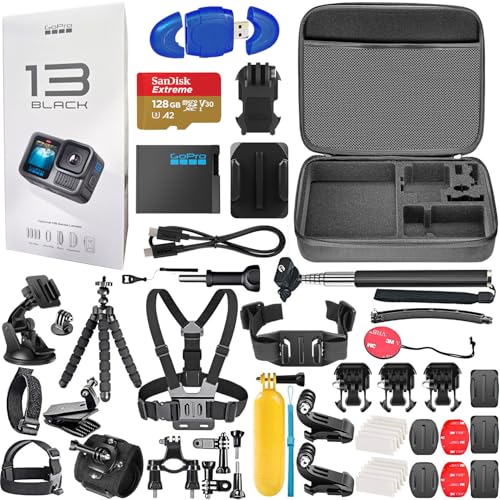
| GoPro HERO13 Black | Best all-round action camera | The deepest mount ecosystem, magnetic-lens flexibility and stabilisation every rival is measured against. |
| DJI Osmo Action 5 Pro | Best for long days and dim light | Outstanding endurance, strong low-light video and dual screens that suit solo filming. |
| Insta360 Ace Pro 2 | Best image quality | A large sensor and Leica-tuned optics give action footage unusual clarity and colour. |
| Insta360 X4 | Best 360 coverage | Records everything in every direction, so framing happens calmly at home instead of mid-descent. |
| OM SYSTEM Tough TG-7 | Best stills in rough water | A genuinely rugged stills camera with macro talents, waterproof without any housing at all. |
| AKASO Brave 7 LE | Best budget gateway | Dual screens, weather resistance and a generous accessory bundle at a learner-friendly cost. |
How Did We Choose the Best Cameras for Shooting Action Sports?
We weighted survival first. Each candidate had to be waterproof or weather-sealed as sold, tolerate drops onto hard ground, and keep its controls usable with wet or gloved hands, because a camera that needs nursing is a camera left in the car. Stabilisation came next, judged on footage shot while running downhill rather than walking across a showroom — the difference between the best and the rest only appears when the ground itself is moving. Battery claims were discounted by the conditions action sports actually impose: cold air, wind chill, high frame rates and screens left on between runs.
Weight on the body was audited with equal suspicion. A hundred grams is nothing in a rucksack and everything at the end of a helmet on a long descent, where it levers the neck and drags the frame’s aim downward over an afternoon. Compactness also decides whether a camera is mounted at all on the days you travel light — the session filmed on the camera that came along outranks, forever, the masterpiece specifications of the one that stayed home.
Then came the ecosystem audit. A brilliant sensor behind a mount that wobbles is a rumour, not footage, so we favoured cameras whose mounting systems are rigid, widely stocked and shared across generations of accessories. Editing burden counted as well: some riders want a clip on their phone before the lift ride ends, others happily reframe 360 footage at midnight, and the list below keeps both temperaments fed. Finally, stills mattered more than the category admits — plenty of athletes want one frame for the wall — which is how a rugged compact with no action-cam shape at all fought its way into the six.
What Separates an Action Camera From a Camera That Merely Survives?
Three engineering choices. The first is the stabilisation stack: mechanical stillness is impossible on a helmet, so these cameras combine wide lenses, huge sensor crops and gyroscopic data recorded alongside the video, letting software iron the shake out afterwards with knowledge of exactly how the camera moved. The second is thermal honesty — recording high-resolution video generates heat, and bodies that manage it record the whole descent instead of the first four minutes. The third is interface speed: a record button findable by touch, a screen readable in glare, a voice command that works when your hands are on the bars. Action sports are filmed by people whose attention belongs to the sport; the camera must ask for almost none of it.
Repairability is the overlooked fourth choice. Action cameras live where lenses meet gravel, so the makers above were also judged on what breaks cost: replaceable lens covers, doors sold as spares, batteries shared across model years. A camera whose every injury is fatal will, over a sporting life, cost more than a flagship whose injuries are errands. Ask any rental shop which bodies come back and which come back repairable; their answer shaped this list more than any laboratory test.
Durability, meanwhile, is a specification with fine print. Waterproof ratings describe still, clean water at gentle pressure, not a kayak roll or a dive off a board, and every maker quietly assumes you will close the doors properly and rinse the seals. The cameras below were chosen partly for how forgiving their sealing is of real-world carelessness — doors that announce when they are not shut, lens covers that unscrew and replace after the inevitable gravel strike, bodies that treat a drop as an anecdote rather than a funeral.
Which Action Camera Belongs on Your Helmet, Board or Handlebars?
Mounting position changes the camera you need. A chest mount forgives weight and rewards battery life; a helmet punishes grams and rewards a low profile; a board wants waterproofing above eloquence. Read the six with your own mounting point in mind.

GoPro HERO13 Black — Best all-round action camera
Fifteen years of iteration show in the small mercies. The HERO13’s stabilisation remains the reference the category is judged by, smoothing a downhill run into something a television audience can watch without leaning, and its lens system now swaps magnetically — an ultra-wide for the skatepark, a macro for the workshop — without tools or a new body. Voice control works at the trailhead with gloves on, the GPS overlays speed and line data that riders genuinely rewatch, and the accessory universe is so deep that any mounting problem you invent has already been solved by somebody’s garage.
Heat is the honest shadow in this story: long static recordings at the highest settings can end early on a still, hot day, which matters to anglers and time-lapse shooters more than to anyone actually moving, since airflow is the action camera’s natural coolant. Battery swaps are quick, the batteries themselves are shared with recent siblings, and the app trims a clip to a phone before the chairlift docks. For a first serious action camera — or the only one a household ever buys — the argument for starting with the benchmark remains embarrassingly strong.
There is also a maturity to its files that rivals chase. Colours come out punchy without tipping into cartoon, skin tones survive the green cast of forest light, and the slow-motion modes turn a single jump into the clip the whole group chat waits for. Riders upgrading from a phone will feel the difference in the first descent: not sharpness, but calm. The picture stops arguing with the terrain, and the sport finally looks the way it felt.
- Format: flagship action camera, waterproof as sold
- Lenses: interchangeable magnetic lens mods, ultra-wide available
- Stabilisation: flagship electronic stabilisation with horizon levelling
- Data: GPS telemetry overlays for speed and route
- Mounting: the widest accessory ecosystem in the category
Strengths
- Benchmark stabilisation turns violent motion into calm, watchable footage.
- Magnetic lens swaps change the camera’s character in seconds.
- Every mount, case and spare a rider could want already exists for it.
Trade-offs
- Long static recordings at maximum settings can overheat in still heat.
- The ecosystem’s depth tempts owners into accessory spending sprees.
- Low-light video is competent rather than class-leading.
Best for: riders, skiers and surfers wanting one proven camera for every mount they own.
Not suited for: patient tripod work in hot, windless conditions at maximum resolution.
Ownership deepens the case over time. Firmware updates keep arriving with new modes rather than apologies, second-hand mounts trade briskly because the standard never changes, and a cracked front element or lens is a replaceable part rather than a write-off — the economics of a camera you intend to crash occasionally. Riders who film weekly will also appreciate how invisible the GoPro has become socially: nobody at the trailhead performs for it, nobody asks what it is, and the footage stays honest. Benchmarks are usually boring. This one is boring the way a good helmet is boring, and for the same reason.

DJI Osmo Action 5 Pro — Best for long days and dim light
DJI built this camera around the two complaints action shooters repeat most: the battery died, and the evening session looked like soup. Endurance is the headline — recording stretches that swallow a full morning on one charge — and the low-light video holds colour and detail in the blue hour after the lifts close, when the GoPro above starts to smear. Both faces of the body carry screens, so a solo rider framing a selfie segment at a summit gets the same confidence as a filmer standing behind it.
The magnetic quick-release mounting deserves its own sentence, because swapping between chest, helmet and a trailside branch takes seconds with cold fingers, and those seconds are the difference between filming the descent and describing it later. Underwater, the body is rated deeper than rivals without a case and even reports depth and altitude data for divers and climbers who like their footage annotated. Audio from the built-in microphones is unusually present, and DJI’s wireless microphone pairing is there for narrated runs.
Choosing between this and the GoPro is the category’s happiest dilemma. Pick the DJI when your days are long, your light is low or your filming is solo; its screens, stamina and dusk performance answer those briefs directly. The mount ecosystem is younger, though growing fast, and long-time GoPro owners will find their drawer of accessories only partly compatible. New buyers starting from zero give up little and gain the camera that treats a winter afternoon as a beginning rather than a warning.
- Format: action camera with front and rear touchscreens
- Endurance: extended recording time per charge, fast charging
- Low light: dedicated night modes for urban and dusk scenes
- Waterproofing: deep rating without a housing, depth and altitude logging
- Mounting: magnetic quick-release system
Strengths
- Battery stamina outlasts a morning of runs where rivals need a swap.
- Dusk and night footage keeps colour that other action cameras surrender.
- Dual screens make solo framing honest instead of hopeful.
Trade-offs
- Accessory shelves are thinner than the GoPro universe.
- The very longest recordings still ask for airflow or shade.
- Owners invested in rival mounts face a partial re-buy.
Best for: endurance riders, dawn patrols and solo creators filming whole days.
Not suited for: athletes with a decade of GoPro mounts they refuse to retire.
Divers and winter mountaineers keep choosing this body for a detail buried in its menus: it wakes and records from a single button press with the screen dark, a discipline that saves both battery and attention at depth or on a ridge. Subject tracking, borrowed from DJI’s drones, follows a rider through a frame the filmer cannot watch — set it at the top of a course, walk away, and collect a followed run. Small intelligences like these compound across a season into hours of footage a dumber camera would have framed wrongly, which is why so many working guides now carry the DJI as their primary and something else as the spare.

Insta360 Ace Pro 2 — Best image quality
Co-engineered with Leica, the Ace Pro 2 is the action camera for people who keep noticing that action footage usually looks a little cheap. Its large sensor drinks in light the smaller chips cannot, so forest singletrack keeps its greens instead of going grey, and night street sessions hold neon and shadow in the same frame. The flip screen — big, bright, genuinely useful — makes it the easiest of the pure action cameras to frame with, whether it faces a rider or the rider’s own commentary.
Clarity has a workflow attached. Insta360’s app leans on automated editing that finds jumps and highlights, and the camera’s gesture and voice controls suit gloved starts at a summit cairn. Stabilisation is excellent in the modern manner, if a half-step behind the GoPro’s sorcery at the violent extremes, and the body is waterproof for the shoreline and the pool. Wind-noise reduction earns specific praise: commentary recorded at cycling speed arrives intelligible, which quietly changes how much of a trip gets narrated rather than muted.
Think of this pick as the cinematographer’s action camera. It rewards riders who grade their footage, shoot into evenings, and care how a clip looks on the big screen in the lounge — and it asks, in return, a slightly gentler life than the DJI’s expedition manners. For mixed households where the action camera doubles as the holiday video camera, that image quality does double duty no spec sheet captures: birthdays and black runs from the same small body, both looking expensive.
- Format: action camera with large flip touchscreen
- Sensor: large-format sensor for the category, Leica co-engineered lens
- Video: high-resolution recording with strong low-light performance
- Audio: wind-noise reduction tuned for speed
- Controls: voice and gesture start for gloved or distant operation
Strengths
- Image quality leads the class, especially once light turns difficult.
- Flip screen frames selfies and low angles without guesswork.
- Usable wind commentary makes narrated ride videos practical.
Trade-offs
- Stabilisation at the roughest extremes trails the benchmark slightly.
- The flip screen is a moving part in a category that punishes them.
- Serious low-light colour asks the user to learn its night modes.
Best for: riders who watch their footage on televisions and care how it grades.
Not suited for: crash-test riding where every gram and hinge is a liability.
Street and park skaters have adopted this camera for a reason the trails crowd missed: its colour science flatters concrete, sodium light and skin in the same frame, so an evening session at the plaza grades like a short film rather than a security tape. The flip screen also turns it into the vlog camera of the group between sessions, recording the talk that gives the tricks their context. One body doing the plaza, the commentary and the ride home is a consolidation most action kits never achieve, and it is why the Ace Pro 2 keeps appearing in bags whose owners swore they were finished buying cameras.

Insta360 X4 — Best 360 coverage
The X4 abolishes the oldest anxiety in action filming: pointing the camera the wrong way. Two lenses record the entire sphere, so the camera rides the helmet or the selfie stick and simply witnesses; the framing decision moves to the sofa that evening, where you pan the finished video across the moment like a spectator who was everywhere at once. For sports where the action surrounds the athlete — surfing, skiing in a group, skating a crowded park — that omniscience captures the near-miss behind you that a forward camera would have missed forever.
The invisible selfie stick effect remains the party trick with substance: the stick vanishes from the footage, leaving drone-like third-person shots from a camera you held in one hand. Resolution across the sphere is high enough that reframed flat clips stay crisp, and the single-lens mode behaves like a conventional wide action camera when 360 feels like overkill. The costs are real and mostly editorial — files are large, reframing takes an evening’s patience, and the bulging lenses demand respect and their protective guards whenever the camera leaves a bag.
Groups divide sharply over this camera, and the dividing line is temperament. Filmmakers who love the edit adore it; riders who want a clip before the drive home should look at the GoPro or DJI above. But for the family ski trip, the boat day, the once-a-year descent — occasions where nobody can be asked to perform camera work — the X4’s guarantee that the moment is in there somewhere outweighs its homework. It is insurance, purchased in resolution.
- Format: dual-lens 360 camera with single-lens mode
- Capture: full-sphere recording, reframed later in the app
- Effect: selfie stick rendered invisible in footage
- Waterproofing: rated for shallow water as sold; lens guards advised on land
- Workflow: app-based reframing with subject tracking
Strengths
- Nothing escapes the frame, including the action behind you.
- Third-person drone-style shots come from a stick in your hand.
- Reframing lets one recording become several different clips.
Trade-offs
- Editing homework is mandatory; nothing is postable straight away.
- Exposed lenses scratch if the guards are left at home.
- Files are heavy on cards, phones and patience.
Best for: group trips and surround-action sports where nobody wants camera duty.
Not suited for: riders who post from the car park within ten minutes.
Motorcyclists deserve a specific mention, because the X4 has quietly become their camera: mounted on a chin bar or a mirror stalk, it records the car that merged without looking and the mountain road with equal indifference, and the reframed export can face either direction from the same ride. Loop recording turns it into a witness that happens to make beautiful films on the days nothing goes wrong. No other pick here serves that double duty, and for riders whose sport shares the road with strangers, the argument is not really about cinematography at all.

OM SYSTEM Tough TG-7 — Best stills in rough water
Everything else on this page is a video camera that takes photographs. The TG-7 inverts the arrangement: a proper stills camera — RAW files, a bright zoom, microscope-grade macro modes — sealed inside a body that can be dropped on rocks, frozen on a lift and taken snorkelling without a housing or a prayer. Kayakers, anglers and beach families have kept this line alive for a decade because nothing else lets a photographer shoot first and worry never.
Video exists and is perfectly serviceable, but the stills are the argument: the macro system photographs the fly you tied and the reef fish you chased with equal conviction, the GPS and field sensors stamp dives and hikes with data, and the controls work through ski gloves. On a boat, its wrist strap and bright lens make it the camera actually used while the mirrorless stays below deck in a dry bag — the oldest story in outdoor photography, still true. Image quality is compact-camera class rather than mirrorless class; the trade is survival, and at the waterline survival wins.
Consider it the documentary camera of an action household. While the helmet cams capture the descent from inside it, the TG-7 stands on the shore and makes the photograph that gets framed: the launch, the landing, the grin afterwards, salt water still dripping off both subject and camera. It asks for no rig, no case and no courage. For watersports families especially, it may quietly become the most-used camera in the house — the one that goes where the expensive gear is afraid to.
- Format: rugged compact stills camera, waterproof and crushproof as sold
- Lens: bright zoom with celebrated macro and microscope modes
- Files: RAW capture, unusual in this class
- Sensors: GPS plus depth, temperature and compass logging
- Video: 4K recording as a supporting feature
Strengths
- Shoots stills in places no other camera here would survive unhoused.
- Macro modes open a second hobby hiding inside the first.
- Glove-friendly controls and a lanyard make it boat- and lift-proof in practice.
Trade-offs
- Video stabilisation and quality sit below the dedicated action cameras.
- Sensor size limits low-light stills compared with mirrorless bodies.
- The rugged styling is function-first rather than sleek.
Best for: kayaking, fishing, snorkelling and beach families who shoot stills first.
Not suited for: creators whose deliverable is stabilised 4K video of themselves.
Field scientists and lifeguards form this camera’s least glamorous fan club, and their loyalty says plenty: it survives being lent, dropped in sand, rinsed under a tap and stuffed into a buoyancy aid, season after season, while producing records good enough for reports and identifications. The microscope mode, absurd as it sounds at the beach, photographs everything from a tick to a tide-pool anemone with the same indifference. A camera that can document a rescue and a rockpool in one shift has earned a kind of trust no stabilisation score can confer.

AKASO Brave 7 LE — Best budget gateway
Every action household starts with a question the flagship cameras answer too expensively: will we actually film our riding, or is this a phase? The Brave 7 LE exists for that question. It brings the category’s essential grammar — stabilised 4K video, waterproofing for the shallows, screens on both faces for framing, a remote and a bundle of mounts in the box — at a price that survives being wrong about the hobby, or about a teenager’s care with equipment.
Expect honest compromises and plan around them. Stabilisation smooths a trail rather than erasing it, low light turns grainy earlier than the premium picks, and the app is functional rather than delightful. Yet the dual-screen arrangement at this price is genuinely generous, the weather sealing shrugs off rain rides, and the included accessories mean a beginner films on day one instead of day ten. Many owners’ first seasons look better than they feared, and the footage teaches them exactly which flagship feature they actually need next.
There is a second, quieter role for this camera in experienced hands: the expendable angle. Mounted low on a fork, strapped to a board’s nose, placed at the lip of a jump where a flagship’s price would make you flinch — the AKASO films the shots anxiety would otherwise veto. Rental fleets, school clubs and group-trip organisers buy it for the same reason. It is the camera that lets a sport be filmed before it is funded, and plenty of channels now thriving began exactly there.
- Format: budget action camera with front and rear screens
- Video: 4K recording with electronic stabilisation
- Waterproofing: weather resistant bare; housing extends depth
- Bundle: remote control and mounting accessories included
- Audio: external microphone support
Strengths
- The full starter kit — mounts, remote, dual screens — arrives in one box.
- Low cost removes the fear from risky mounting positions.
- Dual screens at this price help beginners frame solo shots correctly.
Trade-offs
- Stabilisation and low-light quality sit a clear tier below the flagships.
- The companion app is serviceable rather than slick.
- Battery life shortens quickly at the highest settings.
Best for: beginners, clubs and second-angle duty where loss is a real possibility.
Not suited for: filmmakers selling footage or shooting flagship-quality night sessions.
Parents of young athletes may be this camera’s wisest buyers. A first action camera will be crashed, lent, flooded by a badly closed door and left in a kit bag until spring; better that education happens on a body whose replacement is an errand rather than an insurance claim. The footage from a ten-year-old’s first season is treasure regardless of its grain, and the Brave 7 LE’s honest limitations teach framing, light and patience — the curriculum every flagship owner eventually wishes somebody had charged them less to learn.
How Do the Six Action Cameras Compare at a Glance?
| Camera | First talent | Water manners | Editing burden | Biggest caution |
|---|---|---|---|---|
| GoPro HERO13 Black | Stabilisation and ecosystem | Waterproof as sold | Low — clips trim fast | Heat on long static takes |
| DJI Osmo Action 5 Pro | Endurance and dusk video | Deep rating, no housing | Low | Thinner accessory shelf |
| Insta360 Ace Pro 2 | Picture quality | Waterproof as sold | Low to medium | Flip screen vulnerability |
| Insta360 X4 | Total coverage | Shallow-water ready | High — reframing required | Exposed lenses |
| OM SYSTEM Tough TG-7 | Rugged stills and macro | Swims without a housing | Low for stills | Video is secondary |
| AKASO Brave 7 LE | Value starter bundle | Weather resistant; case for depth | Low | A tier below on polish |
The table also hides a tie worth breaking aloud: the GoPro and the DJI are close enough that ownership history should decide. A drawer of GoPro mounts is a real asset; a clean start is a real freedom. Either flagship will film a decade of sport happily, and the athlete who chooses by coin toss and then films weekly will out-produce the athlete who researches for a season. Decision speed is, in this category, a feature.
Notice, too, what no row promises: a substitute for being there. Every camera in the table is a witness, not a participant, and the footage that gets rewatched for years is the footage shot by someone who was having the day as well as recording it. Mount the camera, press the button, and go back to your sport — that discipline is the through-line of every verdict below the table as well.
Two rows of this table deserve emphasis. The X4’s editing burden is not a flaw but a philosophy: it moves work from the mountain to the sofa, which suits some athletes perfectly and others not at all. And the TG-7’s presence among video cameras is deliberate — an action day produces photographs as well as clips, and the stills are usually what survives the decade.
How Should You Mount and Set an Action Camera for a First Session?
Start with the chest mount for cycling and skiing, the helmet for skating, and the board’s nose for surfing; those three positions give the most honest sense of speed, because the frame includes the athlete’s own hands, bars or board as a reference the viewer’s body understands. Set stabilisation to its standard strong mode rather than the maximum crop, record at a frame rate that matches your delivery — fast for slow-motion plans, ordinary for everything else — and lock exposure only when moving between sun and deep shade, where auto exposure hunts visibly. Then film a boring practice run and watch it at home before the day that matters; every action camera’s disappointments are settings, discovered early or discovered too late.
Audio settings deserve the same rehearsal. Switch wind reduction on for anything faster than a jog, test a voice command at the distance your sport actually imposes, and record a sentence of commentary on the practice run — most athletes have never heard their action footage talk until the day it matters, and the shock of a muffled voice over a perfect descent is entirely avoidable by then. Ten minutes of rehearsal at home buys a season of footage that needs no apologies.
Rinse seals, close doors until they click, and check the lens before the session rather than after it — a water spot filmed at the summit is a water spot forever. Carry the spare battery in an inside pocket where body heat defends it, and swap at half-day rather than at empty, because action cameras die at summits with the reliability of a natural law.
What Mistakes End Most Action Videos Before They Start?
Filming everything at maximum resolution and frame rate is the beginner’s tax: cards fill, batteries fade, editors groan, and the footage — destined for a phone screen — gains nothing the viewer can see. A second classic is the lonely camera angle, an entire holiday from one helmet’s perspective, when thirty seconds of a friend filming from the trailside would have doubled the story. Third, owners trust waterproofing they have not maintained: a single hair across a door seal turns a rated camera into a paperweight at the first duck-dive, so seals get inspected like climbing gear, every time.
Sound neglect deserves its place in this list as well: a season of roaring, unintelligible wind noise teaches athletes to mute their own memories, when a foam cover and one menu setting would have saved them. And beneath all of these sits the simplest failure — arriving with a flat battery because the camera was never given a home by the door with its charger. Action filming is a logistics hobby wearing a creative costume.
The subtlest error is aiming like a photographer. Action footage improves when the camera goes where a photographer would never stand — low at the lip, close at the pass, underneath the line — and the cheap second-angle camera exists precisely to make that courage affordable. Shoot the risky angle with the expendable body and the safe master with the flagship, and your edits will look braver than your budget.
How Do Cold, Heat and Altitude Rewrite the Rules?
Winter is the action camera’s audit. Lithium cells lose their nerve in the cold, screens slow, and plastic mounts grow brittle exactly when falls get harder; the athletes who film all season treat batteries like climbers treat ropes — rotated warm from an inside pocket, retired before they are empty, and never trusted to a number the box printed in a warm laboratory. Shorter, deliberate clips beat one heroic continuous recording, both for the battery and for the edit, and a camera worn under a jacket between runs will outlast a fancier one left freezing on a helmet. The DJI’s stamina and the GoPro’s swappable cells are the two honest answers on this page; the 360’s appetite makes it a fair-weather friend by comparison.
Rain, the commonest condition of all, deserves its sentence: every pick here shrugs off weather, but water drops on a lens ruin footage more thoroughly than rain on a body ever will. A hydrophobic lens cover, a cloth in a sealed bag, and the habit of wiping at every stop separate the athletes with watchable wet footage from the ones with impressionist art.
Heat plays the opposite trick at the skatepark and the summer trailhead, where a camera recording on a still dashboard or a sunlit rock can reach its thermal limit before the athlete does. Shade, airflow and shorter takes are the fieldcraft here, along with the discipline of pressing record at the drop-in rather than at the car park. Altitude adds thin air and thinner judgement: everything takes longer, batteries included, so the mountain kit shrinks to the camera, two warm cells and one mount you trust with gloves on. Conditions, in short, are a specification — read your sport’s weather as carefully as any sensor size in this guide.
What About Sound, the Half of Action Nobody Budgets For?
Watch any beloved action clip with the sound off and it halves in value: the scrape of an edge, the held breath before a drop, the shoreline noise under a surf session are the sport’s signature, and cameras capture them through microphones the size of a fingernail, usually buried behind waterproof membranes and wind. The picks differ more here than brochures admit. The Insta360 Ace Pro 2’s wind handling lets a cyclist narrate at speed; the GoPro and DJI both accept wireless microphones for commentary that sounds hosted rather than shouted; the TG-7 records honest ambient sound for stills-led days; and the AKASO’s external microphone support punches far above its price for a chest-mounted narrator.
Fieldcraft matters as much as hardware. A foam wind cover — divers call them dead cats and cyclists should steal the idea — rescues more audio than any setting, and positioning the camera a body-width away from direct wind transforms a descent’s soundtrack from roar to information. Record a few seconds of pure ambient sound at every spot, too: editors call it wild track, and it papers over every cut. Athletes who treat sound as a sense rather than an accident find their footage rewatched twice as often, which is the only metric this category ultimately answers to.
Which Camera Suits Which Sport, Honestly?
Surfing asks for waterproofing that survives impact, not just immersion, plus a floaty or a leash — the ocean keeps unmounted cameras with total reliability. The DJI and GoPro ride boards and chests daily; the TG-7, on a wrist strap, is the photographer’s choice from the shoulder. Snow sports invert the problem: cold and glare dominate, screens wash out, and battery discipline outranks every other virtue, which is the DJI’s home ground and the GoPro’s with warm spares. Cycling splits by discipline — road riders prize the Ace Pro 2’s clarity and wind audio, gravity riders the GoPro’s stabilisation and crash economics, and tourers the 360’s indifference to aiming when the scenery is the point.
Skateboarding and BMX reward the expendable and the beautiful in equal measure: the AKASO at the lip of the bowl, the Ace Pro 2 in a friend’s hand at golden hour. Climbing, where hands are the whole sport, belongs to voice-controlled cameras and chest or helmet mounts that never ask for a free hand — GoPro and DJI territory — while the TG-7 waits at the belay for the summit photograph. Team sports filmed from the touchline are the honest exception to this whole guide: reach matters there, none of these wide lenses has it, and a parent’s phone zoom or a camcorder serves better than pretending otherwise. Knowing where a category ends is part of choosing well inside it.
How Should a Beginner Grow Into Action Filming Across a Season?
Month one belongs to one mount and one setting. Learn what the chest view does to speed, where the horizon sits, how long a battery truly lasts in your weather — knowledge no second accessory can substitute for. Film every session, watch everything once, and delete without ceremony; the eye you are training is the real purchase, and it develops on a diet of honest review. This is the season the AKASO was built for, and the season in which flagship owners most often discover they bought resolution when they needed reps.
By month three, add exactly one variable: a second angle, a slow-motion mode, or the 360’s reframing if your sport surrounds you. By the season’s end you will know — from your own footage, not a forum — whether your ceiling is stabilisation, light, sound or stamina, and the upgrade that answers a known ceiling is the only upgrade that ever feels cheap. Athletes who skip this apprenticeship own drawers of capability they cannot operate at speed; athletes who serve it end up filming like the cameras on this page were designed by people who had done the same. In a sense, they were.
What Should You Carry Around the Camera?
The camera is the smallest part of a working action kit. A rigid mount you trust, a spare battery kept warm, a card with room for the day you actually have rather than the day you planned, a short tether for anything mounted over water or height, and a microfibre cloth that lives in the same pocket every time — that is the whole religion. Add a foam wind cover if your sport involves speed and talking, and a small dry bag if it involves weather, and the kit is complete at a cost the flagship debate never mentions: less than one replacement lens cover, spent once.
Pack it the night before, in the same order, in the same bag. Action mornings are lost to logistics more than to weather, and the athlete who films consistently is rarely the one with the best camera — it is the one whose camera was charged, mounted and rolling while everyone else was still looking for a cable. Every pick in this guide rewards that person equally, which is a comforting thought at any budget.
Final Recommendation
One last filter before the verdicts: be honest about your edit. Every camera here can fill a card; only some owners will ever open the footage. If your history says the clips will be trimmed on a phone and sent the same day, weight the GoPro and DJI heavily and forgive yourself the 360’s possibilities. If your history says evenings at a computer are a pleasure rather than a debt, the X4’s homework is not a cost at all — it is the hobby. The camera that matches your temperament will be used at ten times the rate of the camera that merely matches your sport.
Most athletes should start where the category starts: the GoPro HERO13 Black, whose stabilisation, lenses and accessory universe make it the safest pair of hands in the sport. Choose the DJI Osmo Action 5 Pro instead when your sessions run long, your light runs low or you film alone — its stamina and screens are answers, not features. The Insta360 Ace Pro 2 serves the quality-obsessed, the X4 serves groups who refuse camera duty, the OM SYSTEM Tough TG-7 serves the water and the stills, and the AKASO Brave 7 LE serves the beginning of the story and the angles too dangerous for pride. Whichever you mount first, mount it before the season’s best day, not during it — the best cameras for shooting action sports are the ones already rolling when the moment refuses to repeat itself.
Frequently Asked Questions
Do I need a waterproof housing for these cameras?
For surface water and shallow swims, most picks here are sealed as sold. Housings still earn their place for proper diving, for protecting lenses in gritty environments like motocross, and for the budget AKASO at any real depth. Read your model’s rating as a description of gentle water, and treat pressure — waves, speed, depth — as a separate demand.
Which frame rate should I record action sports at?
Record at a high frame rate only the moments you intend to slow down — jumps, tricks, finishes — because slow motion is the one effect that cannot be invented later. Ordinary riding and running footage looks natural at standard rates and costs half the battery and card space, which buys you the afternoon’s second half.
Can an action camera replace my phone for holiday video?
For the sport itself, yes, and it should: the phone’s stabilisation, sealing and mounting options all lose. Around the sport — meals, towns, evenings — the phone’s convenience usually wins, which is why most athletes carry both and let each do the work it is built for.
Why does my action footage look slower than the sport felt?
Wide lenses stretch distance and flatten speed; it is physics, not a fault. Get the camera lower and closer to the action’s edge, include foreground references like bars, hands or spray, and let sound back in — wind and effort are half of speed on screen. The 360 and chest-mount angles in this guide exist largely to cure that flatness.
Is a second-hand action camera a sensible buy?
Often, yes — the category’s durability cuts both ways, and last year’s flagships flood the market each autumn in fine health. Inspect the lens and the door seals in person, confirm the battery holds a charge, and favour models whose mounts and batteries your current kit already speaks. The TG-7 in particular ages gracefully, since its job description has not changed in a decade.
How many batteries does a full day need?
Plan on two for the flagships in summer and three in winter, when cold taxes every cell. The DJI’s endurance stretches that arithmetic kindly, while high frame rates and 360 recording tighten it again. A battery in an inside pocket, rotated at midday, is the cheapest insurance in the whole sport.
Finally, a word about the footage itself a year from now. Cards get wiped, phones get replaced, and the season’s best descent deserves better than existing in one fragile place: copy the keepers to a computer monthly, name the folders by place and date, and let the rest go without grief. The athletes whose early footage survives are never the ones with the best cameras. They are the ones with a folder system and ten spare minutes — the least glamorous equipment in this entire guide, and the only part of it that cannot be bought back later at any price.
Related Guides
Action filming branches quickly. Riders who caught the bug should compare our favourite cameras for cycling footage next, while water households will get more from our guide to waterproof cameras for snorkelling. And if the helmet footage is destined for a channel, our action camera editing workflow covers the evening half of the sport — the half where the story actually gets told. Take the camera off the shelf this weekend, whatever the weather is doing — a grey, ordinary session filmed now teaches more, and means more in a decade, than the perfect expedition you are still planning for next year.


