Disclosure: this article contains affiliate links, and we may earn an affiliate commission when you buy through them, at no extra cost to you.
Most deer are spotted in the first and last twenty minutes of legal light, when the woods are still more shadow than shape. That is exactly when a cheap binocular gives up: the image turns grey, edges smear, and a bedded buck becomes just another dark lump under a cedar. A good hunting binocular is not really about magnification bragging rights. It is about pulling usable detail out of low light, holding steady after a long climb, and surviving seasons of rain, dust, and truck-cab abuse without fogging at the worst possible moment.
We built this guide around how hunters actually glass. Whitetail hunters in thick eastern timber scan short lanes and food-plot edges. Western hunters sit on a ridge for hours, picking apart basins a mile away. Turkey hunters want a compact glass that rides in a vest. Each style pushes you toward a different mix of magnification, objective size, weight, and glass quality, and each of the six picks below earned its place by doing one of those jobs especially well.
Every model here is a real, current production binocular from a maker with a track record in the hunting market. We do not print prices, because street prices move with seasons and sales; each pick is positioned in plain words — budget, mid-range, or premium — and you can check price on Amazon before you decide. What follows is what to look for first, then the six picks in depth, then the technique and care advice that makes any of them work harder in the field.
Quick comparison
| Binocular | Configuration | Glass tier | Best for | Field character |
|---|---|---|---|---|
| Vortex Diamondback HD 10×42 | 10×42 | Mid-range HD | All-round first hunting binocular | Bright, tough, easy to live with |
| Vortex Viper HD 10×50 | 10×50 | Premium HD | Serious western and open-country glassing | Sharper edges, brighter at dusk |
| Leupold BX-2 Alpine HD | 10×42 (also 8×42, 12×52) | Mid-range HD | Hunters who prioritise light weight | Feather-light build, twilight-friendly coatings |
| Athlon Optics Midas UHD | 8×42 and 10×42 | Mid-range UHD/ED | Value hunters who still want ED glass | Wide, flat field with strong colour |
| Nikon Monarch M5 | 8×42, 10×42, 12×42 | Mid-range ED | Long sits and careful scanning | Calm, wide image with easy eye placement |
| Bushnell Engage | 10×42 (Engage X and EDX lines) | Budget to mid ED | New hunters and backup/truck glass | Surprising clarity for the money tier |
Read the table as a map, not a verdict. If you hunt dark timber where shots are close and light is poor, the 8×42 versions of these same lines often serve you better than the 10×42 headliners, and we flag those options inside each review. If you glass open country, stay with 10×42 and plan on a tripod adapter from day one.
how to choose first mechanical keyboard
In this guide
What to look for in a hunting binocular
Magnification: 8×42 versus 10×42 is the real fork in the road
Magnification multiplies everything — including your heartbeat. A 10×42 shows a buck’s antler tips noticeably larger than an 8×42 at the same distance, which matters when you are judging whether a distant animal is legal or worth a stalk. But the 10x image also shakes more in cold, tired hands, shows a narrower slice of country at once, and dims faster at dusk because its exit pupil is smaller. An 8×42 gives a wider field of view, so you catch movement at the edge of a clearing sooner, and it stays steadier for one-handed glassing off a treestand rail.
A workable rule: if most of your glassing happens inside 300 yards — eastern whitetail, hogs over feeders, black bear over bait, turkey in spring woods — 8×42 is the calmer, brighter tool. If you regularly scan beyond 400 yards — mule deer basins, pronghorn flats, elk parks — 10×42 earns its shake. Hunters who do both often end up with a 10×42 on a tripod and accept the trade, because a tripod removes the shake penalty entirely and leaves only the reach advantage.
Exit pupil and the last fifteen minutes
Divide the objective diameter by the magnification and you get the exit pupil: 5.25 mm for an 8×42, 4.2 mm for a 10×42. Your own pupil dilates to roughly 5–7 mm in deep twilight when you are young, less as you age. When the exit pupil is smaller than your eye’s pupil, the image dims no matter how good the coatings are. This is why an 8×42 can look startlingly brighter than a 10×42 in the same product line at last light, and why older hunters often “see better” through 8x glass. A 10×50, like the Viper HD below, keeps 10x reach with a 5 mm exit pupil that holds brightness longer into the evening. Coatings and glass quality narrow the gap, but physics sets the ceiling.
Glass quality: HD, ED, and what the letters actually buy you
“HD” on a binocular box is marketing shorthand, not a regulated standard. The meaningful term is ED — extra-low dispersion glass — used in the objective lenses to control chromatic aberration, the purple and green fringing you see around antlers against a bright sky. ED glass also tends to travel with better coatings and tighter assembly, so ED models usually show cleaner colour, crisper edges, and better contrast in flat light. You notice it most in the exact moments hunting happens: a grey-brown deer against grey-brown brush at dawn, where contrast, not raw sharpness, separates animal from background.
Phase-corrected roof prisms and fully multi-coated lenses matter just as much. Every pick in this guide has both. Cheaper glass that skips phase coating looks fine at noon in a store parking lot and falls apart in November woods, which is why we set the floor of this guide where we did.
Field of view and the discipline of scanning
Field of view is listed in feet at 1,000 yards, and wider is genuinely better for finding game: you cover more country per sweep and spend less time re-scanning the same ground. Wide-field models like the Athlon Midas UHD and Nikon Monarch M5 let you work a hillside in a grid with fewer passes. Narrow glass forces a slower, more methodical search — not wrong, just slower — and makes it easier to glass right past a bedded animal at the frame’s edge. Whatever you choose, scan in overlapping strips and stop the binocular completely on each strip; movement hides in a moving image.
Waterproofing, fogproofing, and armour
A hunting binocular will get rained on, dropped in leaf litter, and left in a cold truck overnight before being carried into a warm blind — a perfect recipe for internal fogging in a poorly sealed optic. Every pick here is nitrogen- or argon-purged and O-ring sealed, rated waterproof, and wrapped in rubber armour that quiets bumps against a stand ladder and grips with gloves on. Check that the focus wheel turns smoothly with a gloved finger and that the diopter adjustment locks or at least resists drifting; a diopter that creeps will quietly ruin your focus all season.
Weight and carry: the binocular you bring beats the one at home
Most full-size hunting binoculars in this class weigh between roughly a pound and a half and two pounds. That sounds trivial until mile six of an elk hunt, when every ounce on your chest competes with your pack, rifle, and water. A good chest harness — not the neck strap in the box — spreads the load, keeps the glass from swinging, and protects the lenses. Lighter models like the Leupold BX-2 Alpine HD exist precisely for hunters who count ounces. Eastern stand hunters can ignore a few ounces; mountain hunters should not.
Eye relief, eyecups, and glasses wearers
If you wear glasses, look for at least 15–16 mm of eye relief and twist-up eyecups that hold their positions. Too little eye relief and you see a tunnel instead of the full field, which silently costs you the edge-of-frame movement that finds game. All six picks here work for glasses wearers, but the Nikon and Leupold models are especially forgiving about eye placement, which also helps when you are glassing uphill at an awkward angle from a seated position.
Warranty culture in hunting optics
Hunting optics live hard lives, and the brands in this guide know it. Vortex and Athlon back their binoculars with unconditional lifetime coverage that famously includes accidental damage. Leupold guarantees its optics for life as well. Nikon and Bushnell offer strong but more conventional warranty terms. Read the fine print before you buy, and remember that a warranty you trust changes how you hunt: you stop babying the glass and start using it the way it was meant to be used.
The six picks, reviewed

Vortex Diamondback HD 10×42 — the all-round first hunting binocular
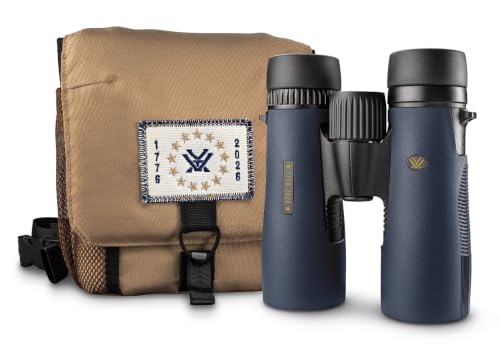
If a hunter asked us for one binocular to cover whitetail in October, turkeys in April, and a first western trip without apology, the Diamondback HD is the answer we would give. It sits squarely in the mid-range tier, and it spends that money in the right places: fully multi-coated HD optical system, phase-coated BaK-4 roof prisms, and a magnesium alloy chassis under the rubber armour that keeps it lighter than its rugged feel suggests.
In the field, the Diamondback HD’s defining trait is how little it asks of you. The focus wheel is large, lightly textured, and turns with the right amount of resistance — enough to hold a setting when you brush against brush, not so much that fine focus at dawn feels like work. The image is bright and honest through the central two-thirds, with a gentle roll-off at the edges that you stop noticing after the first morning. Colour runs slightly warm, which many hunters prefer on brown game against green cover.
At last light the 10×42 configuration shows its physics: the image stays usable several minutes past the point where budget glass has gone to mush, but its 8×42 sibling in the same line stays brighter still. If your hunting is mostly dark timber, order the 8×42 and lose nothing. If you split time between field edges and open ground, the 10×42 reviewed here is the more versatile single purchase.
Strengths:
- Bright, high-contrast image that holds up in genuine hunting light, not just midday
- Excellent focus wheel ergonomics with gloves, and a diopter that stays where you set it
- Magnesium chassis keeps weight reasonable for a full-size 10×42
- Generous field of view for a 10×42 makes scanning field edges efficient
- Vortex’s unconditional lifetime VIP warranty removes the fear of actually using it hard
- Tripod adaptable out of the box for seated glassing sessions
Trade-offs:
- Edge sharpness softens noticeably in the outer third of the frame
- Included case and harness are serviceable rather than good; budget for a chest harness
- Chromatic fringing appears on high-contrast edges — antlers against bright sky — if you look for it
- The 10×42’s smaller exit pupil gives up a few minutes of dusk to the 8×42 version
Who it suits: the hunter buying one serious binocular for mixed eastern and occasional western use, who wants modern HD glass and a bulletproof warranty without stepping into the premium tier. It is also the easiest pick on this list to recommend to a new hunter, because nothing about it needs explaining or forgiving.
Positioned in the mid-range of the hunting market, the Diamondback HD is the value anchor of this guide — check price on Amazon.

Vortex Viper HD 10×50 — the step-up glass for open country
The Viper HD is what the Diamondback wants to be when it grows up. Same family, same unconditional warranty, but this 10×50 version pairs the higher-grade HD optical system with a larger 50 mm objective — a combination that shows its worth picking apart shadowed basins at first light and judging animals at distances where the air itself is part of the problem.
The difference is not obvious in a store. It becomes obvious at 800 yards, where the Viper holds antler points and ear tips together as distinct shapes while lesser glass smears them into suggestion. Edge-to-edge clarity is the headline: the usable frame is wider, so you reposition less while grid-searching a slope. Colour fidelity is neutral and true, which helps when the whole question is whether that tan patch is a bedded doe or a dead bush.
The 50 mm objective buys light, not magnification: dividing 50 by 10 gives a 5 mm exit pupil, against 4.2 mm on a comparable smaller-objective 10x glass, and that larger circle of light keeps the image brighter and easier to read at dawn and dusk, when western game moves. The price is physical: bigger objectives mean a larger, heavier binocular that asks more of a chest harness on a long climb. It is tripod adaptable, and on a tripod it is superb — a genuine spotting-scope alternative for all but the longest looks — while the included GlassPak case helps carry and protect that extra size.
Strengths:
- Noticeably better edge sharpness and contrast than mid-range glass, especially at distance
- 50 mm objectives and a 5 mm exit pupil stretch the first and last shooting windows
- HD optics with XR coatings make the most of low, flat hunting light
- Refined mechanics: focus, eyecups, and a locking diopter all feel a class above
- Same unconditional lifetime warranty as its cheaper sibling
Trade-offs:
- Costs meaningfully more than the Diamondback HD; the gain is real but it is a step, not a leap
- Bigger and heavier than a 42 mm glass, which ounce-counters on backpack hunts will register
- In the darkest timber a lower-magnification configuration can still feel brighter and wider
- Demands good technique; hand-held shake wastes what the glass can show you
Who it suits: the committed western or open-country hunter, and the eastern hunter who glasses big agricultural country at range and will keep this binocular for a decade. If dawn and dusk detail decides your hunts, the larger objectives earn their carry weight, and buying the Viper first is cheaper than buying twice.
A premium-tier hunting binocular that earns the step up — check price on Amazon.
Leupold BX-2 Alpine HD — the light one you forget you are carrying
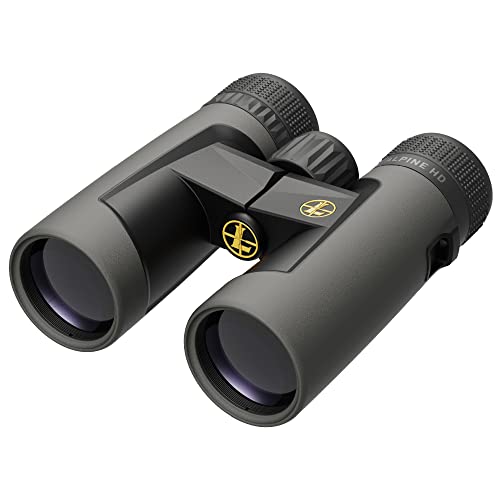
Leupold built the BX-2 Alpine HD around a simple observation: a binocular left in the truck because it is heavy has an effective magnification of zero. The Alpine HD is one of the lightest full-size hunting binoculars in its class, and that lightness is not a spec-sheet party trick — it changes how the glass gets used on long hikes, steep climbs, and spot-and-stalk hunts where you raise and lower the binocular a hundred times a day.
Optically, Leupold leans on its Twilight Max HD light management system, coatings and glass chosen to squeeze contrast out of the blue-grey light of dawn and dusk. The image has the slightly crisp, high-contrast character Leupold scopes are known for, and low-light performance punches above what the price tier suggests. The 10×42 is the headline model, but the line also offers 8×42 for dark timber and a 12×52 for hunters who glass from a tripod across serious distance.
The trade for the light weight is a slightly less planted feel in the hand; some hunters prefer more heft for steadiness, and the Alpine’s focus wheel, while smooth, is smaller than the Vortex wheels. Eyecups and eye relief are generous, and glasses wearers will be happy. The armour is thinner-feeling than the Viper’s, though the binocular is fully waterproof and fogproof, and Leupold’s lifetime guarantee stands behind it — this is an American-designed optic from a company that has equipped hunters for generations.
Strengths:
- Among the lightest full-size hunting binoculars available; disappears in a harness
- Twilight-optimised coatings deliver strong dawn and dusk contrast
- Available in 8×42, 10×42, and a tripod-friendly 12×52 for different hunting styles
- Generous eye relief and easy eye placement for glasses wearers
- Backed by Leupold’s lifetime guarantee
Trade-offs:
- Light build feels less substantial than heavier rivals; steadiness comes from technique
- Field of view is a touch narrower than the widest models in this guide
- Focus wheel is smaller and less glove-friendly than the Vortex design
- Edge performance is good rather than class-leading
Who it suits: mountain and backcountry hunters, spot-and-stalk archers, and anyone whose hunts involve more walking than sitting. Also a smart pick for smaller-framed hunters and older hunters who find full-weight 42 mm glass a burden by midday.
A mid-range binocular priced by its glass, not its weight — check price on Amazon.
Athlon Optics Midas UHD — ED glass and a huge field, without the premium bill
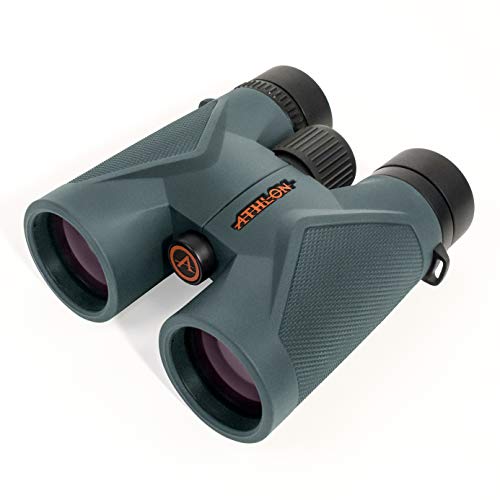
Athlon is the brand hunters mention when the conversation turns to getting the most glass for the money, and the Midas UHD is the reason. It brings genuine ED glass, a magnesium chassis, and one of the widest, flattest fields of view in this price class — a combination that used to require spending deep into the premium tier. In both 8×42 and 10×42, the Midas UHD produces an image that makes hunters check the price twice.
The field of view is the story. The Midas presents a broad, calm window on the world with very little of the rolling distortion that makes some wide-field binoculars swimmy when you pan. Scanning a basin feels like looking through a picture window rather than a porthole, and the flat field means a deer at the frame’s edge is nearly as identifiable as one in the centre. Colour is vivid and slightly rich, which helps separate game from autumn foliage.
Low-light performance is strong for the class, helped by good coatings and, in the 8×42, that generous exit pupil. The focus wheel is smooth with a slightly longer travel than the Vortex models — precise, if a touch slower from close to far. Athlon’s lifetime warranty is unconditional in the same spirit as Vortex’s, covering accidental damage, which makes the Midas an easy binocular to actually hunt with rather than protect.
Strengths:
- True ED glass at a mid-range price, with the colour and fringing control that implies
- Exceptionally wide, flat field of view — the best scanning experience in this guide
- Magnesium alloy body keeps it durable without excessive weight
- Strong low-light image, especially in the 8×42 configuration
- Unconditional lifetime warranty, including accidents
Trade-offs:
- Focus travel is longer; fast refocusing between near and far targets takes practice
- Brand resale value and dealer networks are thinner than the legacy names
- Eyecup stops are less positive than the best in class
- The wide field makes the binocular slightly bulky in smaller harnesses
Who it suits: the value-driven hunter who researches before buying and wants ED performance and a panoramic field without paying for a legacy badge. The 8×42 Midas UHD is, specifically, one of the finest dark-timber and bowhunting glasses in this entire guide.
Mid-range money buying a genuinely premium view — check price on Amazon.

Nikon Monarch M5 — the calm, wide view for long sits
The Monarch name has been a default answer in hunting optics for decades, and the M5 generation keeps the family’s virtues while modernising the optics with ED glass. What distinguishes the Monarch M5 in use is composure: a wide field, easy eye placement, and an image that stays relaxed and natural over hours of glassing. If your hunting involves a tripod or a shooting-house window and long, patient scanning, the M5 is built for exactly that rhythm.
Nikon’s coatings deliver neutral, faithful colour — the least “processed” looking image in this guide — and the ED elements keep high-contrast edges clean. The 10×42 is the versatile choice, the 8×42 the low-light and timber specialist, and Nikon also offers a 12×42 for open-country hunters who glass seated and supported. Eye relief is generous across the line, and the eyecups have a quality, damped feel that cheaper binoculars never match.
The Monarch’s focus wheel is smooth and precise, though its close focus and focus speed are tuned more for distance work than for butterfly-range timber scanning. The body is polycarbonate rather than magnesium under the armour, which keeps weight moderate but feels a half-step less premium than the Viper or Midas. Nikon’s warranty is solid but more conventional than the unconditional coverage from Vortex and Athlon, so the M5 asks you to be a little more careful with it.
Strengths:
- Wide, natural, low-fatigue image ideal for long glassing sessions
- ED glass keeps edges clean and colour honest
- Excellent eye relief and eyebox forgiveness for glasses wearers
- Three configurations, including a seated-hunter 12×42
- Refined eyecups and smooth, precise focus
Trade-offs:
- Warranty terms are conventional rather than unconditional
- Polycarbonate chassis feels less premium than magnesium rivals
- Focus is distance-biased; very close focus work is slower
- Slightly soft at the extreme edges compared with the flattest fields here
Who it suits: stand, blind, and tripod hunters who glass for hours and value an easy, natural view over spec-sheet drama; glasses wearers; and hunters stepping up from an older Monarch who want to stay with a known quantity, improved.
A mid-range classic, modernised with ED glass — check price on Amazon.

Bushnell Engage — the honest budget entry that does not embarrass itself
Every guide needs a floor, and the Engage is ours: the least expensive binocular we are comfortable sending into the woods. Bushnell’s Engage line spans the budget-friendly Engage X up through ED-glass Engage EDX models, and even the entry versions carry features that used to define mid-range glass — fully multi-coated lenses, phase-coated prisms, waterproof and fogproof construction, and Bushnell’s EXO Barrier coating that sheds water and dirt from the outer lenses.
That EXO Barrier coating deserves emphasis, because it solves a real hunting problem: the dawn when your binocular mists, beads with drizzle, or picks up a fingerprint of gun oil at the exact moment a deer steps out. The Engage’s outer glass clears faster and smears less than uncoated budget glass, and in miserable weather that can matter more than a small sharpness deficit. The image itself is bright and centre-sharp, with edges that soften and colours that run a little less saturated than the ED models above it.
Ergonomics are straightforward: a centre focus wheel of reasonable size, twist-up eyecups, and a body that shrugs off the bumps of a first season. It is not the lightest or the toughest binocular here, and its low-light reach gives up several minutes to the Diamondback. But as a first binocular, a loaner for a new hunter, or a dedicated truck and UTV glass that lives behind the seat, it makes a case nothing else in this guide can: it removes price as the reason someone hunts without a binocular at all.
Strengths:
- The most affordable route in this guide to genuinely huntable glass
- EXO Barrier outer coating sheds rain, mist, and grime better than rivals at the tier
- Fully waterproof and fogproof with phase-coated prisms — no deal-breaking omissions
- EDX versions add ED glass for buyers who can stretch slightly
- Perfectly suited as a truck, loaner, or youth hunter’s first binocular
Trade-offs:
- Edge softness and fringing are visible if you compare directly with ED models
- Low-light performance trails the mid-range picks by a few crucial minutes
- Focus and eyecup mechanics feel utilitarian
- Warranty and finish are a tier below the guide’s leaders
Who it suits: new hunters, budget-conscious hunters furnishing a second setup, parents buying a teenager’s first real binocular, and anyone who needs a spare glass for the truck, the boat, or the buddy who always forgets his.
The budget tier of this guide, and a respectable one — check price on Amazon.
Getting more from whatever you buy
Put it on a tripod and change your hunting
The single biggest upgrade in glassing is not a more expensive binocular; it is a tripod under the one you own. A 10×42 on a tripod out-resolves a premium 10×42 in your hands by a wide margin, because the limiting factor in handheld glassing is your body, not the glass. Mounted glass lets you grid a hillside in disciplined strips, hold on a suspicious shape for a full minute while it decides whether to move, and rest your eyes and shoulders during long sits. Every pick in this guide is tripod adaptable with an inexpensive stud or adapter. Western hunters know this secret; eastern hunters glassing big fields and powerline cuts should steal it.
Set the diopter once, correctly
Half the “soft binocular” complaints we hear are diopter problems. The diopter compensates for the difference between your eyes, and it takes ninety seconds to set: cover the right lens, focus the left eye with the centre wheel on a distant, detailed target, then cover the left lens and use the diopter ring — not the centre wheel — to sharpen the right eye. Note the setting. Check it monthly, and after anyone else uses your glass. A binocular focused for someone else’s eyes will tire yours in an hour and quietly blur the detail you paid for.
Glassing technique: slow down, use your eyes first
Scan the country with your naked eyes before raising the binocular; movement and shape register faster in your peripheral vision than through a narrow field. Then glass in a grid — horizontal strips, overlapping by a third, pausing fully on each strip. Bedded animals reveal themselves by parts: an ear flick, a horizontal back line that does not match the slope, antler tips above brush. In timber, glass the edges and transitions — where field meets woods, where thick meets open — rather than the middle of anything. And glass the shadows in the morning: deer feed in the open at first light but bed where the shade is, and a binocular that holds contrast in shadow is worth everything it cost at that moment.
Care that keeps glass hunting for decades
Blow grit off the lenses before wiping, always — a dry wipe with dust on the glass is how coatings get scratched. Use a lens pen or microfibre, keep the caps or a harness chest panel between the glass and the world, and store the binocular dry at room temperature rather than in a damp truck cab. If it gets soaked, let it air dry before casing it. Treat the armour with nothing harsher than water. Do these few things and any pick in this guide will outlast several rifles.
Transport deserves the same discipline as storage. A binocular riding loose in a truck bed or boat hull takes impacts its seals were never designed for, and most “mystery fogging” stories begin with exactly that kind of unnoticed knock. Keep it in its harness or a padded case whenever it is not on your chest, hang it rather than stacking gear on it at home, and bring it indoors after cold hunts so condensation forms on the case instead of inside the barrels. Once a season, check the hinge tension, the diopter setting, and the eyecup stops, and snug anything that has drifted. Five minutes of attention a year is the entire maintenance contract for an optic with no batteries, no electronics, and no moving parts beyond a focus wheel — one more reason a good binocular is the best long-term value in a hunter’s kit.
best cameras for hunting photography
Reading the spec sheet without being fooled by it
Coating language, translated
Coating claims come in a ladder: coated, fully coated, multi-coated, and fully multi-coated. Only the last one — every air-to-glass surface treated with multiple layers — is acceptable in a modern hunting binocular, and every pick in this guide clears that bar. Coatings are not a luxury feature; uncoated glass surfaces reflect several percent of the light hitting them, and a binocular has many surfaces. The cumulative loss is the difference between a bright dawn image and a dim one, which is why two binoculars with identical numbers on the box can look a full class apart in the woods.
Roof prisms versus Porro prisms
Nearly all modern hunting binoculars use roof prisms, which allow the slim, straight-barrel shape that fits a chest harness and a gloved hand. Roof prisms need phase coating to perform at their best — included on all six picks — and good ones now match or beat the older Porro design optically. Porro prism binoculars, with their offset barrels, can offer lovely depth perception and value, but they are bulkier, harder to waterproof, and increasingly rare in hunting lines. If you are shopping this guide’s class of optic, roof prism is the default and the right choice.
Twilight factor and relative brightness: use with suspicion
Older hunters may remember twilight factor — the square root of magnification times objective diameter — printed on binocular boxes as a low-light score. Treat it as a rough conversation starter, not a verdict. It rewards magnification, which is why a mediocre 10×42 can outscore an excellent 8×42 on paper while losing to it at dusk, where exit pupil and coatings decide what you actually see. Relative brightness, the exit pupil squared, flatters the 8×42 for the mirror-image reason. Neither number knows anything about glass quality. Use the configuration logic in this guide instead, and trust coatings, ED glass, and exit pupil in that order.
Close focus: the spec bowhunters should check
Close focus — the nearest distance at which the binocular focuses sharply — rarely matters for rifle hunting and quietly matters a great deal for bowhunting and turkey hunting, where you may want to confirm a beard, a rub line, or movement in brush twenty feet away. Most full-size hunting glass focuses down to somewhere between five and eight feet, which is plenty. If a specification reads much beyond ten feet, that model is telling you it was designed for distance only, and timber hunters should look elsewhere in the line.
Accessories that are not optional
A chest harness, first
We have mentioned the harness in nearly every review above because it matters that much. A padded chest harness from makers like Vortex, Alaska Guide Creations, FHF Gear, or Marsupial Gear holds the binocular against your sternum, protected by a flap or enclosed pouch, ready in one motion and silent in all of them. It ends the swing-and-clatter of a neck strap, keeps lenses out of the rain and dust until the moment you need them, and distributes weight across your shoulders instead of your neck. If you buy one accessory with your binocular, buy this; hunters consistently report glassing more, and more carefully, simply because the glass is always there and never in the way.
A tripod adapter and a tripod you already own
Most hunters own a shooting tripod, a window mount, or at least a trekking pole with a threaded top. An inexpensive binocular tripod adapter — a small stud or tray that fits the hinge of any pick in this guide — connects the two and delivers the steadiest glassing you have ever experienced. For stand hunters, a clamp mount on the shooting rail does the same job. This is a small purchase with an outsized effect, and it is the reason our western recommendations keep returning to the tripod.
Lens protection and cleaning in the field
Objective covers that tether to the barrel, a microfibre cloth in a sealed bag, and a lens pen in the harness side pocket: that is the whole field kit. Tethered covers matter because loose ones get lost on the first hunt, and an uncovered objective collects the dust, seeds, and drizzle of a season. Clean with a blow and a brush first, cloth second. Never use a shirttail — modern shirttails are synthetic, gritty, and exactly how coatings die.
Which tier should you actually buy?
Hunters ask us to skip the nuance and name a tier, so here is the honest version. If this is your first real binocular and the budget is firm, the Engage gets you hunting with legitimate glass, and its EDX sibling narrows the gap further. If you can reach the mid-range — and most hunters should stretch here, because this purchase lasts decades — the Diamondback HD and Midas UHD are the sweet spot of the entire market: modern coatings, ED or near-ED performance, lifetime warranties, and nothing important missing. The Monarch M5 belongs in the same conversation for hunters who value a calm, wide view over raw specifications.
The premium step to the Viper HD is justified by hours, not by features. If you glass more than a few dozen hours a season, at distance, in hard light, the better edges, contrast, and mechanics repay you every single morning, and the cost per season over a decade becomes trivial. If you glass a handful of weekends a year from a stand, it does not — buy the Diamondback, spend the difference on tags, boots, or a better harness, and hunt more. And if weight is your governing constraint, the Alpine HD rearranges the whole calculation: the best binocular is the one still on your chest at the end of the climb.
One more consideration cuts across all tiers: buy from a maker whose warranty you have read and believe. Hunting optics get dropped from stands, left in wet packs, and knocked off truck seats. Vortex and Athlon will repair or replace their glass under almost any circumstances; Leupold stands behind its products for life; Nikon and Bushnell offer strong conventional coverage. That safety net is part of the product, and for many hunters it is worth as much as a coating.
Beyond 42 mm: the other configurations worth knowing
Compact 8×32 and 10×32 glass
Most of the main picks above use a full-size 42 mm objective — the Viper HD 10×50 is the deliberate exception — but a smaller 32 mm binocular earns a place in two hunts: spring turkey, where you glass field edges from a seated position against a tree and travel light, and archery elk or treestand whitetail, where the shots are close and the binocular’s job is confirming what your eyes already suspect. A good 8×32 is noticeably smaller and lighter, gives up surprisingly little at midday, and only falls behind the 42 mm glass in the final minutes of light. If your hunting rarely stretches to true last light, a quality 32 mm from the same families as our picks — Vortex, Leupold, and Nikon all make them — can be the smarter carry.
High-power 12x and 15x glass
At the other extreme, 12×50 and 15×56 binoculars have become the western hunter’s open secret. They are not handheld tools; they live on tripods, where their magnification resolves bedded bucks and distant elk herds at ranges where a 10×42 can only confirm that something is there. Hunters who glass coues deer, pronghorn, and high-country mule deer increasingly carry a compact spotter less and a 15×56 binocular more, because two eyes tire less than one over hours of searching. The cost is weight, bulk, and uselessness off the tripod — which is why we treat them as a second optic, not a first.
Rangefinding binoculars
Rangefinding binoculars from makers like Vortex, Leupold, and Sig Sauer combine the glass with a laser rangefinder and, in premium models, ballistic solutions. For rifle hunters in open country they remove a whole step — glass, identify, range, shoot — and for bowhunters they simplify the treestand routine. They cost substantially more than the glass in this guide, weigh more, and their optical quality at a given price trails a dedicated binocular. They are the right answer for some hunters and an expensive distraction for others; if your shots are inside 200 yards, spend the difference on better glass instead.
Matching the binocular to your hunting style
The treestand and blind hunter
Your glassing distances are short, your light is bad, and your movement must be minimal. Prioritise exit pupil and field of view over magnification: an 8×42 from any line in this guide, with the Athlon Midas UHD 8×42 and the 8×42 Diamondback HD at the top of the list. Wide fields let you check a whole food plot edge in two sweeps, and brightness buys you the minutes when deer actually move. Weight matters little; you are carrying it two hundred yards, not ten miles.
The western spot-and-stalk hunter
Your binocular is a primary hunting tool, used for hours daily at long range. Start with the Viper HD 10×50 if the budget allows, or the Diamondback HD 10×42 if it does not — on a tripod, in a chest harness, with the diopter set and checked. Weight still matters, which is why the Leupold BX-2 Alpine HD tempts so many mountain hunters, but at distance the Viper’s edge clarity finds more animals. Add a 15×56 later if the country demands it.
The still-hunter and tracker
You move slowly through thick country and glass short openings, often one-handed, often with the binocular raised for seconds at a time. Steadiness and one-hand ergonomics rule: an 8×42 with a large, smooth focus wheel you can run with a single finger of your holding hand. The Diamondback HD’s focus design shines here. Keep the harness snug so the glass does not swing when you shoulder your rifle or bow.
The turkey and small-game hunter
Compactness and close focus matter more than reach. A 8×32 or an 8×42 with a close focus under six feet lets you confirm a beard across a field edge and check the treeline without a full-size binocular banging against your vest. The Engage, in its smaller configurations, is a sensible vest glass that you will not mourn when it gets rained on, dusty, and used hard all spring.
Buying mistakes we see every season
The first is buying magnification instead of glass: a 12×50 from a no-name brand looks impressive in the specification table and miserable at dawn, while a quality 8×42 quietly out-hunts it. The second is judging a binocular in a brightly lit store, where even poor glass looks fine; if a retailer allows it, look toward the darkest corner of the building, read small print at distance, and check the edges of the frame against a straight door frame for distortion. The third is ignoring eye relief until the first hunt, when a glasses wearer discovers they are seeing through a keyhole.
The fourth mistake is forgetting the carry system. A binocular on a thin neck strap gets left behind, swings into bow limbs and rifle stocks, and ends the day in a pack where it does no good. A chest harness costs little compared with the optic and transforms how often the glass is actually used. And the fifth is treating the purchase as finished when the box opens: set the diopter, adjust the harness, mount the tripod adapter, and spend one evening glassing from your porch before the season. Familiarity is a feature no manufacturer can sell you.
How the picks stack up on a real morning
Imagine the same November dawn through each of them. The Engage finds the deer — a shape, a flicker of ear, movement confirmed — and for many hunters that is the whole job done at a friendly price. The Diamondback HD finds it sooner and shows you it is a doe, not the buck you are waiting for, which is information that changes a morning. The Midas UHD shows you the doe and, at the frame’s edge without repositioning, the second deer you would otherwise have missed. The Monarch M5 lets you watch the whole field edge for two hours without your eyes filing a complaint. The Alpine HD does its work at the end of a four-mile climb when your legs, not your wallet, are the limiting factor. And the Viper HD, on its tripod, settles the question a ridge away: legal, worth the stalk, go now. None of them is the wrong answer; they are answers to different mornings, and the right choice is the one that matches the mornings you actually hunt.
One binocular, four seasons
A hunting binocular earns its keep across the calendar, and each season asks something slightly different of it. Spring turkey season wants close focus, a compact carry in a vest, and a wide field for catching a fan’s edge through green timber — the season when an 8×42 or even a 32 mm glass feels purpose-built. Summer scouting is the binocular’s longest shift: velvet bucks in bean fields at dusk, glassed from a truck window or a fence line, reward brightness and reach, and it is the season to learn your new optic’s habits before the stakes rise. Autumn is the main event, when the same glass must handle frost on the armour, gloves on the focus wheel, and the compressed, golden light of November evenings — the conditions every pick in this guide was chosen under. Winter brings late-season sits in bitter cold, when focus wheels stiffen on cheap grease and batteries are irrelevant but finger dexterity is not; a large, positive focus wheel, like the Vortex design, becomes a genuine functional advantage rather than a preference.
Thinking of the purchase this way — as four seasons of use a year for a decade or more — reframes the price conversation entirely. The difference between the budget and premium tiers of this guide, spread across forty seasons of hunting, is small. The difference in what you see during them is not.
Frequently asked questions
Is 8×42 or 10×42 better for deer hunting?
It depends on your cover. Inside 300 yards — most eastern whitetail, hog, and bear hunting — an 8×42 is brighter at last light, wider, and steadier, and it is the better tool. Where shots and sightings stretch past 400 yards, a 10×42’s extra reach wins, especially on a tripod. Hunters who do both usually pick the 10×42 and support it.
Do I need ED glass in a hunting binocular?
You do not need it to kill deer, but you will notice it. ED glass controls the colour fringing that blurs high-contrast edges and generally comes with better coatings and contrast, which is what separates a bedded deer from brush at dawn. If your budget allows one upgrade, ED glass is the upgrade to buy.
Can I use a hunting binocular for birding or football games?
Yes — a good 8×42 or 10×42 hunting binocular is a fine all-purpose optic. The 8×42 configurations, with their wide fields and bright images, cross over best. Hunting models are typically armoured and a little heavier than birding-specific designs, which most people experience as durability rather than a drawback.
How long should a hunting binocular last?
Decades, with basic care. The optics do not wear out; failures come from fogging after seal damage, scratched coatings from dry wiping, and lost diopters, not age. Buy from a maker with a lifetime warranty culture — several picks in this guide qualify — and one purchase can cover a hunting lifetime.
Should a beginner start with a budget binocular or buy once?
Buy the best you can reasonably afford, once. A mid-range glass like the Diamondback HD or Midas UHD will not need replacing as your hunting matures, while a bargain binocular usually gets replaced within two seasons — making it the more expensive path. The exception is the true beginner unsure hunting will stick; for them, the Engage is an honest starting point.
Whatever ridge, food plot, or dark hollow you hunt, the right glass turns the last grey minutes of light into the most productive minutes of the day — choose the binocular that fits your country, mount it steady, and let the shadows give up their secrets.