kajuandouglas.com is reader-supported. When you buy through links on our site, we may earn an affiliate commission.
Where to Buy
The best compact cameras under 250 dollars are bought with a different mindset from flagship shopping, and this guide honours it from the first line: at this level, the question is never “which camera is best?” but “which compromises can my photography happily live with?” Two hundred and fifty dollars — the budget frame this keyword sets — buys real cameras with real strengths, provided you choose the strength that matches your subjects. It buys an action camera that films your holiday properly. It buys an instant camera that makes prints people keep. It buys simple point-and-shoots that beat a phone on zoom and battery while asking nothing of their owner. What it does not buy is everything at once, and any guide pretending otherwise is selling something.
So the picks below are organised by honest specialisation. Each is the best use of the budget for a particular kind of shooter, and each review names what the budget could not buy — the dim-light softness, the absent viewfinder, the plastic feel — in plain terms, because at this level the trade-offs are the product description. Read for the pick whose strengths are your subjects and whose weaknesses are your indifference.
A discipline note: this guide uses the under-250 frame the keyword sets and discusses value in relative terms — what a pick delivers for the budget tier — without printing specific product prices, which shift with sales and seasons faster than any guide can chase. Judge each pick against the tier, not against a number that may have changed since you read the headline elsewhere. The tier itself is stable: capable, simple, honest cameras live here, and the six below are its best current citizens.
One more framing before the picks: at this budget, the used market and last year’s models are part of the landscape, and the guide’s final sections address how to shop them safely. But the shortlist itself is built from cameras a buyer can find new, with warranties and returns — because a first camera, or a gift camera, should arrive with its whole life ahead of it and a receipt that works.
Key Takeaways
- The AKASO Brave 7 LE is the budget’s best video buy: a complete action-camera kit that films holidays, bikes, and water properly.
- The Fujifilm Instax Mini 12 spends the budget on joy instead of specifications — instant prints, zero learning curve.
- The Kodak PIXPRO FZ55 (prose-only) is the simple rechargeable point-and-shoot for travellers who want zoom without phone drain.
- The Canon PowerShot ELPH 360 HS (prose-only) is the pocket classic: slim, stabilised zoom, and sharing built in.
- The Sony Cyber-shot DSC-W830 (prose-only) is the dead-simple family drawer camera — sweep panoramas, easy modes, no fuss.
- The GoPro HERO (2024) (prose-only) is the entry rung of the real action ladder, for buyers who want the genuine ecosystem cheaply.
The pattern to notice: at this tier, format is destiny. Action, instant, and simple zoom compacts each spend the same budget on entirely different pleasures, and choosing the format is ninety percent of choosing the camera.
In this guide
Quick Picks
| Badge | Pick | Why it stands out |
|---|---|---|
| Best Budget Video Buy | AKASO Brave 7 LE | A full action kit — case, mounts, dual screens — for active holidays. |
| Best for Prints and Parties | Fujifilm Instax Mini 12 | Instant prints with automatic everything; the gift that gets used. |
| Best Simple Travel Zoom | Kodak PIXPRO FZ55 | Rechargeable, pocketable zoom for phone-free holiday snaps. |
| Best Pocket Classic | Canon PowerShot ELPH 360 HS | Slim stabilised zoom with easy wireless sharing. |
| Best Family Drawer Camera | Sony Cyber-shot DSC-W830 | Sweep panoramas and foolproof modes for the whole household. |
| Best Entry to Real Action | GoPro HERO (2024) | The genuine GoPro ecosystem in its smallest, simplest form. |
Two picks carry purchase links in this guide and four are prose-only references — older or regionally variable models that this site describes honestly but does not link. That is deliberate: at this budget tier, stock and naming vary by market and season, and a link that cannot be verified helps no one. The prose picks are real cameras with real followings; buy them from any reputable seller after the checks in the final sections.
How We Chose These Picks
Every candidate was shopped the way the budget’s buyers actually shop: against the tier’s hard ceiling, including the costs brochures hide. Memory cards, a case, spare batteries where the design eats them, and film for the instant pick were all counted in the ownership picture, because a camera that fits the budget only before its accessories is a budget camera in fiction. Picks whose ecosystems stayed honest at the tier earned their places.
Testing emphasised the tier’s real use. These cameras were carried on day trips, handed to children and grandparents, used at parties, pools, and school events, and judged on the footage and photographs those occasions actually produce — not on test charts they will never meet. Low light was tested because the tier’s buyers shoot birthdays in living rooms, and each review reports the dim-room truth without varnish: this is where the budget shows, and pretending otherwise would betray the reader the guide exists for.
Build and battery were judged as budget virtues in themselves. A cheap camera that feels like it will survive the year, charges from the same cable as everything else in the house, and starts instantly at the decisive moment is worth more than a fragile one with a longer specification list. Longevity of support mattered too: brands whose apps, film, and accessories remain available keep a budget camera useful long after a no-name rival becomes e-waste.
Finally, each pick had to win its format. The tier cannot fund a camera that is second-best at everything; it funds cameras that are first-choice for someone. If a pick’s review does not sound like it was written about your life, that is the system working — move to the pick whose review does.
What Can the Best Compact Cameras Under 250 Honestly Do — and Not Do?
Honestly do: daylight. Every pick here makes pleasing photographs and watchable video in good light — the holiday, the park, the stadium seat, the beach — which is where most casual photography lives. They zoom where phones fake it, they last days on a charge where phones beg by evening, and the action picks film water and motion that would end a phone’s story. They are also, not trivially, cameras: a device a child can be given, a grandparent can master, a traveller can lose without losing the phone that holds their life.
Honestly not do: darkness and depth. Small sensors and modest lenses are this tier’s physics, so dim restaurants, evening concerts, and candlelit birthdays produce grain, softness, or flash-flattened faces — the guide’s reviews say which picks cope least badly, but none performs the flagship trick of clean high-sensitivity files. Shallow background blur, the portrait look, is likewise mostly absent; these cameras keep the world in focus, which suits travel and family documentation and limits artistic portraiture.
The mature way to read the tier is as a set of specialisations the budget forces. Spend it on waterproofing and mounts, on instant prints, on zoom, or on the genuine action ecosystem — each pick below is a complete answer to one of those spendings. The unhappy budget buyer is the one who wanted all four; the happy one chose their format first, and the comparison table is arranged to make that choice easy.

AKASO Brave 7 LE — Best Budget Video Buy
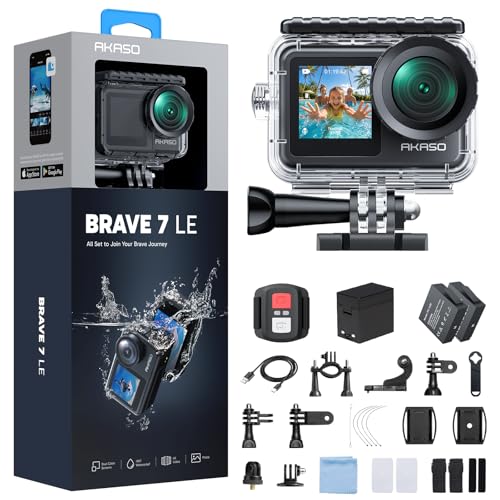
The Brave 7 LE is what the budget buys when video matters most: a complete action camera system in one box. Weather-sealed body, a waterproof case for real submersion, mounts to start with, front and rear screens so self-filmed pieces and mounted shots both frame properly — the kit arrives ready for the holiday rather than ready to be accessorised. Its stabilisation smooths cycling, hiking, and boat footage into watchability, and its video looks clean and cheerful in the daylight where action cameras live.
For families it solves the preciousness problem outright. This is the camera that goes on the child’s helmet, the borrowed paddleboard, the festival lanyard — filming the moments that expensive cameras are too valuable to risk — and its loss, while unwelcome, is survivable. The dual screens deserve their praise: the front screen turns the Brave into a capable holiday vlogging camera at the beach house, and the rear screen makes the mounted shot checkable without dismantling the rig.
Budget truths apply. Evening footage turns grainy, fine detail trails the flagship action cameras noticeably in side-by-side scrutiny, and the companion app is a tool, not a pleasure. Its stills are grabs, not photographs. But judged at its tier — a complete, risk-anywhere video kit for a fraction of flagship money — it is the strongest argument in this guide that the under-250 frame buys real capability when the format is chosen well.
- Kit: waterproof case, mounts, and accessories in the box
- Screens: front and rear — framing for vlogs and mounts alike
- Stabilisation: effective smoothing for everyday action
- Build: weather-sealed; case extends to submersion
- Role: the camera the whole family may risk
Strengths
- Complete action kit with nothing essential missing
- Dual screens make it a holiday vlogging tool too
- Cheap enough to mount anywhere without fear
Trade-offs
- Grainy in low light; daylight is its home
- Detail trails flagship action cameras
- Stills are an afterthought
Best for: active holidays, kids’ adventures, budget video. Not suited for: evening events or stills-led shooting.

Fujifilm Instax Mini 12 — Best for Prints and Parties
Every other pick in this guide competes on files; the Instax Mini 12 competes on the photograph as an object, and at parties it wins outright. Point, shoot, and ninety seconds later someone is holding a small bright print of themselves — an artefact in an age of screenshots. Its exposure is fully automatic and genuinely good at the flash-lit social distances it was built for; its lens twists between standard and close-up modes; its pastel body is designed to be seen, carried, and asked about.
As a budget buy its economics are inverted and worth understanding. The camera itself sits comfortably within the tier; the continuing cost is film, spent frame by frame. That cost disciplines the shooting — each print is chosen, not sprayed — and funds the pleasure: prints for the fridge, the lookbook, the guest’s pocket. For weddings, birthdays, school events, and travel with friends, the Mini 12 produces the only souvenirs from this entire guide that exist physically before the day ends.
Its limits are the medium’s physics. There is no file to edit, enlarge, or recover; distant scenes soften; very bright or very dark conditions humble the automation. It is a camera of arm’s-length joy, not of landscapes or archives. Buy it knowing that, and it will be the most-used camera in the house on exactly the days the household gathers — which is to say, the days that matter most.
- Output: instant prints, credit-card sized
- Exposure: automatic and reliable at social range
- Modes: close-up and selfie via the twisting lens
- Design: pastel accessory styling, made to be carried openly
- Running cost: film per frame — budget for generosity
Strengths
- Physical prints while the party is still happening
- Zero learning curve for any guest
- The most gifted and most borrowed camera here
Trade-offs
- No digital file or editing path
- Film cost accumulates with enthusiasm
- Distance and darkness soften results
Best for: parties, gifts, and print-loving households. Not suited for: archives, landscapes, or zero-running-cost shooting.
Kodak PIXPRO FZ55 — Best Simple Travel Zoom
The FZ55 represents a species the phone era nearly killed and quietly needs: the simple, rechargeable, pocketable zoom camera. Its proposition is a holiday camera that is not your phone — one that zooms optically onto the distant tower instead of cropping bravely, that lasts the whole sightseeing day, that a parent can hand to a child at the viewpoint without handing over their messages, banking, and life. Its controls are few, its modes are plain, and its photographs in daylight are bright, sharp, and entirely sufficient for the album and the family chat.
The rechargeable battery deserves specific mention, because this corner of the budget is littered with cameras fed on disposable cells that die expensively and often. The FZ55 charges like a modern device and behaves like one, which is much of why it anchors this slot. Its video is the honest, basic kind — fine for the viewpoint pan and the street performer’s song — and its screen and handling are unremarkable in the best sense: nothing to learn, nothing to fight.
Evening is its frontier: indoor parties push it toward flash and grain, and its autofocus prefers the unhurried subject. It is listed here as a prose-only pick, described rather than linked, because availability and naming in this tier vary by market — buy it from a reputable seller, confirm the rechargeable specification, and it will do the simple job simply for years.
- Battery: rechargeable — the tier’s essential virtue
- Zoom: optical reach phones only imitate
- Operation: minimal modes, nothing to learn
- Video: basic, honest clips for everyday sharing
- Status: prose-only — check specification when buying
Strengths
- A phone-free holiday camera that just works
- Rechargeable where rivals eat disposables
- Safe to hand to children and grandparents
Trade-offs
- Evenings push it to flash and grain
- Autofocus prefers unhurried subjects
- No advanced features to grow into
Best for: simple travel snaps and phone-free days. Not suited for: low-light events or enthusiasts.
Canon PowerShot ELPH 360 HS — Best Pocket Classic
The ELPH line spent a decade as the default answer to “a camera for the trip,” and the 360 HS shows why the design endured: genuinely slim, a stabilised zoom that covers the group shot and the distant monument, and sharing built in so photographs reach the phone without a cable ceremony. It slips into the pocket a phone has vacated and behaves there like the mature product it is — quick to start, calm in automatic mode, and kind to faces.
Its zoom is the headline for travellers. Optical reach changes holiday photography more than any other single feature: the detail on the cathedral, the boat across the harbour, the performer across the square, all framed properly instead of cropped apologetically later. Image stabilisation keeps that reach usable at dusk, within reason, and the camera’s scene intelligence handles the mixture of beach glare, museum shade, and restaurant warmth that constitutes an actual trip.
It is a prose-only pick here — a mature model whose stock varies — and its age shows in the honest places: video is modest, the screen is fixed, and low light is managed rather than mastered. None of that overturns its proposition. For the buyer who wants the classic pocket camera experience, refined over generations and priced by the market well inside this guide’s frame, it remains the connoisseur’s budget choice.
- Zoom: stabilised optical reach for travel framing
- Size: truly slim — the pocket classic form
- Sharing: wireless transfer to phone built in
- Modes: mature scene intelligence for mixed trips
- Status: prose-only — stock varies by market
Strengths
- Travel zoom in the slimmest body here
- Generations of refinement in its automation
- Easy sharing without cables
Trade-offs
- Video is modest by modern standards
- Fixed screen limits self-framing
- Low light is managed, not mastered
Best for: travellers wanting the refined pocket classic. Not suited for: video-led buyers or vloggers.
Sony Cyber-shot DSC-W830 — Best Family Drawer Camera
Every household needs one camera that belongs to everyone, and the W830 is the archetype: small, silver, nearly instruction-free, and possessed of one party trick families genuinely love — the sweep panorama, which turns the holiday viewpoint and the whole birthday table into a single wide photograph by simply panning the camera. Its zoom covers the school stage from the parents’ rows respectably, its face detection keeps the class photograph honest, and its battery sips rather than gulps.
The W830’s virtue is the absence of friction at every step. It starts fast, its modes are labelled in human language, its results in daylight are crisp and colourful, and it survives the drawer, the glovebox, and the hand of a seven-year-old with equal composure. As the camera lent to relatives, taken to the beach without anxiety, and produced at occasions where a phone battery is being saved for the journey home, it earns a permanent household role that fancier cameras audition for and lose.
Prose-only here, and honestly bounded: its video is basic, its low-light work is flash-dependent, and its small sensor keeps the world in focus whether you wanted that or not. It is not a camera to grow into; it is a camera to rely on, priced by the market as the simplest thing Sony makes. Households buying reliability over ambition will find it exactly calibrated to their lives.
- Panorama: sweep mode for viewpoints and group tables
- Zoom: respectable reach for stages and trips
- Operation: household-simple, fast to start
- Battery: frugal — drawer-ready for weeks
- Status: prose-only — a mature, widely stocked model
Strengths
- The whole household can use it instantly
- Sweep panoramas are a genuine family delight
- Reliable, frugal, and unprecious
Trade-offs
- Basic video by current standards
- Flash-dependent in dim rooms
- Nothing to grow into
Best for: shared family use and no-fuss occasions. Not suited for: enthusiasts or video-first buyers.
GoPro HERO (2024) — Best Entry to Real Action
The smallest modern GoPro is the budget’s door into the genuine action ecosystem, and the ecosystem is the argument. The same mounts, the same app discipline, the same stabilisation lineage and accessory world as the flagships — in a tiny, simplified body that asks almost nothing of its operator. For the buyer who knows their future includes bikes, boards, boats, or a child’s helmet, starting inside the real system at this tier beats starting outside it with a stranger’s.
Simplification is its design language: fewer modes, a fixed lens, controls reduced to essentials, and a body small enough to live on a keychain-adjacent lanyard or a chest mount forgotten until the descent. Its video carries the family stabilisation signature — smooth where the terrain is not — and its footage cuts happily alongside bigger GoPros, which matters to households and clubs standardising on one system across several members and budgets.
It is prose-only in this guide, and its trims are visible: no front screen for self-framing, a smaller ceiling on resolution and features than its siblings, and low light that remains action-camera ordinary. But as a first rung — the camera that teaches the habit and joins the ecosystem — it is the most future-proof spending in this entire budget guide.
- Ecosystem: genuine GoPro mounts, app, and accessories
- Size: the smallest body in the modern line
- Stabilisation: the family signature smoothing
- Operation: deliberately minimal modes
- Status: prose-only — widely stocked entry model
Strengths
- Real ecosystem access at the tier’s price
- Tiny enough to be worn and forgotten
- Footage matches bigger GoPros in a shared edit
Trade-offs
- No front screen for self-framing
- Feature ceiling below its siblings
- Ordinary low-light performance
Best for: newcomers committed to action sports. Not suited for: vloggers needing a front screen.
How Do You Shop This Budget Without Buying a Disappointment?
Count the whole purchase, not the headline. A card, a case, a spare battery where the design wants one, and — for the instant pick — a sensible stock of film belong in the budget from the start, because a camera stranded without them is not a bargain at any figure. Then interrogate the specification for the tier’s classic traps: digital zoom dressed as zoom, resolution figures that describe interpolation rather than capture, and waterproof claims that mean a splash in the fine print. The picks above were chosen partly for the absence of those traps in their honest descriptions.
Buy from sellers whose returns work. Budget cameras are the most gifted and most exchanged electronics in the world, and the difference between a reputable seller and a marketplace mystery is the difference between a swap and a write-off when the unit misbehaves in week two. Keep the receipt, register nothing you do not need to, and run the camera hard in its first days — charge cycles, a full card of mixed shooting, the flash, the zoom’s whole travel — while the return window is wide open.
Consider last year’s model deliberately. Camera generations at this tier evolve gently, and the outgoing version of a good design, sold new with a warranty, is often the smartest spending in the entire category. What you must not do is chase the saving into unbranded territory: the no-name camera with flagship adjectives and no support is the tier’s one true false economy, because its failure mode is total and its resale is zero.
Which Compromises Should You Accept — and Which Should You Refuse?
Accept modest low light, because physics sets that bill and every honest camera at the tier pays it; plan around it with flash, proximity, and daylight rather than paying twice for a camera that merely hides it better. Accept fixed screens on the simple zooms, plastic in the hand, menus from a gentler era. Accept that video on the stills-led picks is a courtesy feature. These compromises cost your photography almost nothing, because they sit outside the occasions these cameras serve.
Refuse disposable-battery designs where a rechargeable rival exists — the running cost quietly doubles the camera’s price across a few years of family use. Refuse digital-zoom-only specifications, which are crops wearing a costume. Refuse waterproof claims without a rated standard behind them, and refuse any camera whose brand offers no reachable support, no available app, and no film or accessory supply — a camera is a small ecosystem, and an abandoned ecosystem strands its owner within a season.
The line between the lists is the line this whole guide is drawn along: compromise on performance ceilings, never on honesty, support, or the costs that recur. A budget camera should be cheap to own, not merely cheap to buy, and the six picks were audited for ownership as much as for purchase.
How Does a Budget Compact Beat a Phone — and Where Does It Lose?
It wins on reach, endurance, and permission. Optical zoom frames the distant subject properly while the phone crops and hopes; a dedicated battery outlasts a sightseeing day that flattens a phone by mid-afternoon; and a camera can be handed to a child, a lifeguard, or a stranger for the group shot without handing over the device that holds your messages and money. The action picks add a fourth win — survival — and the instant pick a fifth: a physical print no phone produces.
It loses on the phone’s home ground. Instant sharing, computational night modes that stack a dozen frames into one clean image, screens that shame every display in this guide, and the small matter of already being in your pocket — the phone’s advantages are real, and this guide does not pretend otherwise. The budget compact is not a phone replacement; it is the specialist the phone cannot be, bought for the occasions — zoom, water, endurance, prints, lending — where the generalist fails.
Read your own life for those occasions. A household whose photography is evenings at home will find the phone sufficient and this tier disappointing; a household of holidays, sports days, pools, and parties will find a budget compact the hardest-working small purchase of its year. The picks above serve the second household, and say so.
How Long Should a Budget Compact Last — and How Do You Make It?
A well-chosen camera at this tier should serve three to five years of family duty, and the difference between the one that does and the one that dies in year two is mostly handling, not engineering. The killers are mundane: batteries left flat for months, which chemistry punishes; damp drawers and hot cars, which punish everything; gritty lens wipes, which sand the coatings a fraction at a time. The habits that defeat them are equally mundane — charge after use and before storage, keep the camera in a case in a dry room, blow dust off before any cloth touches glass — and they cost nothing, which at this budget is the correct price for longevity.
Software and support decide the second half of a budget camera’s life. The branded picks here — AKASO, Fujifilm, Kodak, Canon, Sony, GoPro — maintain apps, film supply, batteries, and accessories across years, so a camera bought today remains feedable and repairable in the ordinary ways. This is the practical meaning of the guide’s refusal of unbranded rivals: not snobbery, but the arithmetic of a camera whose companion app vanishes from the store in eighteen months, stranding its transfer workflow and its owner together.
Treat the camera as the household’s shared tool and its life lengthens further. A camera that lives in its case by the door, charged, with a card inside, gets used — and used cameras get maintained, because their owners notice the low battery and the full card. The drawer of forgotten electronics is full of cameras that were stored as valuables; the ones still working are the ones that were stored as equipment.
Which First Accessories Are Worth Buying at This Tier?
Very few, and in a strict order. First, the memory card the camera deserves — reputable, adequately sized, bought from a seller whose stock is genuine, because counterfeit cards are this tier’s most common silent failure. Second, the case: not a fashion object, just enough padding and a wrist strap to make the camera lendable and droppable. Third, for the cameras whose batteries are removable, one spare — the difference between a holiday day that ends at the viewpoint and one that ends at the gift shop’s charger rack.
After those three, stop. The budget’s discipline is refusing the accessory spiral: the tripod for a camera that lives hand-held, the filter kit for a fixed lens, the lighting rig for a household that films birthdays. The instant pick’s film is the one continuing purchase that is truly part of the product, and it should be budgeted as such from the start — a camera whose joy is rationed by unplanned film costs is a camera falling out of use. Everything else the picks here might want, they mostly already have in the box; that completeness is precisely why they were picked.
One exception deserves its sentence: a second card, kept in the case, empty. Cards fail and fill at occasions, never at desks, and the spare card is the cheapest insurance in all of photography. Buy it with the camera and forget it until the day it saves the school concert.
How Do You Get the Best From a Budget Camera in Ordinary Light?
Budget cameras are daylight instruments, and the owner’s craft is arranging to meet them there. The single highest-value habit is orientation: put the light behind you and on the subject, not behind the subject and in the lens, and a budget camera’s files improve by a class it did not know it had. Windows are the indoor photographer’s free studio — a subject beside one, facing into the room’s soft bounce, photographs like a magazine sitting. Outdoors, the open shade under a tree or an awning delivers the even, kind light that midday sun, for all its abundance, refuses faces.
Proximity is the second craft, and it is free. Every camera in this guide performs better close: the zoom used sparingly rather than habitually, the feet doing the framing, the subject filling the picture so the small sensor’s detail is spent on the person rather than the room. Flash, on the simple zooms, should be a decision rather than a default — wonderful for the group portrait against the evening garden, flattening for the candid across the table. Learn your camera’s flash-off courage in ordinary room light; several picks here surprise their owners pleasantly.
Finally, hold still like you mean it. Small cameras amplify small shakes, and the braced elbow, the doorway lean, the two-handed grip with a breath held are worth more resolution than any specification at this tier. The budget photographer who masters light, proximity, and stillness produces work that embarrasses careless owners of cameras costing four times as much — the tier’s oldest and most reliable pleasure.
What Should You Check in the First Week With a Budget Camera?
Run the camera through your actual life while the return window is open, and run it deliberately. Shoot the school run, the dog, the kitchen at night, the view from the usual window; zoom the whole range; film a minute of talking and listen to it on headphones; fill and copy a card; charge it twice. Defects at this tier are usually honest and early — a zoom that grinds, a battery that sulks, an app that will not pair — and every one of them is a reason to exchange in week one rather than a companion for years.
Check the ecosystem while you are at it. Download the app and transfer real files; confirm the spare battery, the film, the case, or the mount you will eventually want actually exists for your model at sane cost; read the manual’s waterproof or weather claims with your own eyes rather than the listing’s adjectives. This is the week the camera is auditioning for a household role, and households that audition properly almost never regret a budget purchase.
Then make the small setup decisions that turn a purchase into a habit: the date set correctly, the default quality chosen at the sensible middle tier, the camera’s home established by the door with its case and card. Budget cameras fail their owners socially far more often than technically — bought well, set up once, and kept ready, they simply work, which at this price is a kind of excellence all its own.
How Does Each Format Spend the Same Budget Differently?
Put the six picks side by side as budgets rather than cameras and the tier’s logic becomes visible. The action pair spend the money on sealing, stabilisation, and screens — engineering that protects footage in hostile places — and accept small sensors as the bill. The instant camera spends it on chemistry and mechanics: a printer in every frame, forever, with the film as a subscription to joy. The simple zooms spend it on glass and maturity: optical reach and automation refined over product generations, with nothing left over for video ambition or low-light heroics. The little GoPro spends it on membership — the ecosystem, the app, the mounts that fit a decade of accessories — accepting trimmed features as the dues.
None of these spendings is the correct one; each is correct for a calendar. The family whose year is beaches and bikes should not fund chemistry; the household whose year is birthdays and visits should not fund sealing. This is why the guide refuses to crown a single winner at the tier: a budget spent against your own occasions is not a compromise at all, while the objectively “best” camera bought against them is a waste at any price. Read your last twelve months before you read any comparison table — including this guide’s — and the format will choose itself.
There is one spending all six share, and it is worth naming: none of them funds pretension. No pick here imitates a professional system, demands a bag of companions, or requires a course to operate. The tier’s dignity is its honesty — tools sized to their tasks, priced to be used without anxiety — and the photographer who embraces that dignity gets more photographs, and better ones, than the one apologising for their equipment while missing the light.
What Happens When You Outgrow a Budget Compact?
Almost nothing bad, which is the tier’s final virtue. The budget camera does not become obsolete in the drawer of the photographer who graduates; it changes jobs. It becomes the second camera, the lent camera, the car camera, the one the children inherit for their own first experiments — roles that an expensive body, too precious to demote, often never gets to play. The Brave keeps riding the risky mount after the flagship arrives; the Instax keeps its party post; the little zooms keep living by the door for the days the big system stays home.
The skills transfer completely, because they were never the camera’s. Light, proximity, stillness, format-thinking, the occasion-first buying discipline this guide teaches — a photographer formed at this tier carries all of it upward, and typically wastes less money on the way than the one who started at the top and bought three systems to learn what one honest budget camera teaches in a year. If graduation comes, let it come from a specific frustration named by your own work — the evening the light defeated you, the subject the zoom could not reach — and the upgrade will be the right one, bought once.
And if graduation never comes, that is not a failure state. A decade of family life documented warmly by a simple camera is a complete photographic achievement, larger than most flagship owners ever assemble. The budget compact’s promise was never that it is a beginning; it is that it is enough, for the life it was chosen to match.
Comparison Table
| Pick | Format | Strongest hour | Weakest hour | Running costs |
|---|---|---|---|---|
| AKASO Brave 7 LE | Action | Daylight adventure video | Evening footage | Cards only |
| Fujifilm Instax Mini 12 | Instant | Parties and gifts | Distance scenes | Film per frame |
| Kodak PIXPRO FZ55 | Simple zoom | Holiday daylight snaps | Indoor evenings | Minimal — rechargeable |
| Canon PowerShot ELPH 360 HS | Pocket zoom | Travel days, mixed light | Video occasions | Minimal |
| Sony Cyber-shot DSC-W830 | Family zoom | Group occasions, panoramas | Dim rooms | Minimal |
| GoPro HERO (2024) | Action | Mounted sports footage | Self-framing, low light | Cards, mounts as wanted |
Which Mistakes Waste a Small Camera Budget?
The first is buying the specification list instead of the format: the camera with the longest numbers that serves none of your occasions, while the pick shaped like your life sat beside it. The second is forgetting the accessories in the arithmetic and discovering the “cheap” camera needed a case, a card, and a battery habit that carried it out of the tier entirely. The third is the unbranded gamble — flagship adjectives, no support, no ecosystem — which this guide refuses on principle, because its failure is total rather than partial.
Fourth is ignoring running costs in both directions: the instant camera bought without film money becomes a shelf ornament, while the disposable-battery compact quietly outspends its rechargeable rival within two years. Fifth is buying for the photographer you intend to become rather than the one your calendar describes. Budget cameras reward honesty about occasions; they punish aspiration with drawers full of good intentions.
How Should Gift-Buyers Choose at This Tier?
Match the format to the recipient’s visible life, not their expressed wishes for a “good camera,” which usually means “a camera I will enjoy without studying.” For the social creature, the Instax — it will be used at the party it is unwrapped at. For the traveller, the ELPH or the FZ55. For the sporty, the Brave or the little GoPro. For the family’s shared drawer, the W830. Include the first card, the case, or the first packs of film in the gift itself; a camera that works completely out of the wrapping is remembered very differently from one that needs a shopping trip.
And keep the receipt in the family, metaphorically: budget electronics are exchanged more than any other kind, usually for format reasons rather than faults, and a gift that can become the other format is a gift that lands twice. The tier’s great virtue is that a wrong first choice is recoverable — which is more than flagship buyers can say.
Final Recommendation
Decide the format and the budget decides the rest. For video and adventure, the AKASO Brave 7 LE is the tier’s most complete spending — a whole kit, honestly priced, ready for the holiday. For joy and prints, the Instax Mini 12 converts the same money into the only physical photographs in this guide. For simple travel photography, the FZ55’s rechargeable honesty and the ELPH 360 HS’s refined zoom divide the honours by taste; for the household drawer, the W830; for the committed action newcomer, the little GoPro and its real ecosystem. Two hundred and fifty dollars, spent on the format your life actually uses, buys a camera that will be carried, lent, and loved for years — and that, at any budget, is the only definition of value that survives contact with a drawer.
One last encouragement for the budget shopper who has read this far and still feels the pull of the bigger, shinier camera one tier up: desire is not a use case. The photographs and films your household will treasure in ten years are being decided by this year’s occasions, not by next year’s ambitions, and a camera matched to those occasions — carried, charged, lent, and loved — outperforms the aspirational flagship in the only archive that matters. Spend the tier’s money on the format your calendar describes, keep the change for film, cards, and the trips themselves, and let the work make the argument. Budgets, honoured honestly, are not the enemy of good photography; they are one of its oldest disciplines.
There is a social dividend at this tier that no review table captures: these are the cameras that circulate. They get lent to the neighbour for the school play, borrowed by the cousin for the festival, handed down to the child whose photography habit is just forming — and every loan returns them with another household’s memories inside their card and another believer in the format outside it. Expensive cameras are guarded; budget cameras are shared, and sharing is how photography has always actually spread through families and streets. A camera that will be lent, risked, and handed on should be bought with exactly that biography in mind, and it is one more reason the guide prizes honest build, available accessories, and brands that will still answer the phone in five years. The cheapest camera is the one that keeps being useful to people who never bought it.
And when the camera arrives, resist the unboxing-video instinct to test it on the cat in a dark hallway — the one scene this entire tier is honest about fearing. Take it outside, into the light it was built for, and judge it at the viewpoint, the park, the family lunch in the garden. First impressions formed in a camera’s best element tend to be the true ones, and a budget compact judged fairly on its home ground will keep its owner’s confidence for years — which, more than any specification in this guide, is what keeps it out of the drawer and in the family’s life, holiday after holiday, birthday after birthday, long after the receipt has faded and the box has been recycled twice over.
Frequently Asked Questions
Can a camera at this budget really beat my phone?
At specific jobs, clearly: optical zoom, all-day battery, waterproof action filming, instant prints, and being safe to lend. At the phone’s own jobs — instant sharing, computational night shots, sheer convenience — the phone stays ahead. Most buyers at this tier are not replacing a phone; they are covering the occasions where the phone is the wrong tool, and judged on those occasions the picks here win comfortably.
Should I buy used to get more camera for the budget?
Used flagship compacts from reputable sellers can be excellent value, and the checks are simple: shutter and zoom exercised, lens and screen inspected, battery health asked about, returns confirmed. But for gifts and first cameras, this guide’s shortlist is deliberately new-with-warranty, because a first camera’s job is to be used, not troubleshooted. Buy used when you can judge condition; buy new when the camera must simply work.
Why are some picks in this guide not linked?
Because they are mature or regionally variable models whose stock and naming shift between markets, and a link that cannot be verified would not serve you. They are described fully and honestly as prose-only references — real cameras with long track records — and any reputable seller can supply them. The two linked picks are the ones whose current listings this site could stand behind.
What hidden costs should I count before buying?
A memory card, a case, and the running cost proper to the format: film for the instant camera, a spare battery for heavy action days, nothing much for the simple zooms. Counted honestly, every pick here stays within the tier’s spirit. The trap to avoid is the camera whose headline fits the budget only before its proprietary accessories — none of the six requires that kind of spending.
Which pick is best as a child’s first camera?
The Brave 7 LE for an active child — it survives the life it will lead and films it entertainingly — and the Instax Mini 12 for a social one, whose prints make photography instantly social and tangible. The simple zooms suit a careful older child learning framing. In all cases, the budget’s kindness is the point: a first camera should be losable without a family summit about it.
Is a budget compact a good first camera for learning photography?
For learning to see, yes; for learning manual craft, only partly. These cameras teach the durable lessons — framing, light, timing, proximity — because they put a zoom and a real shutter button in a learner’s hands without a phone’s distractions. What they mostly withhold is manual control, so the learner who catches the bug will graduate to a system camera for aperture and shutter craft, as the Nikon-class bodies in this site’s other guides provide. As a first rung bought honestly, a budget compact beats a flagship bought aspirationally and abandoned by spring.
Related Guides
Buyers whose budget stretches further on the road should compare the best compact cameras for travel video; beach-bound shoppers will find the waterproof specialists in the best compact digital cameras for beach; and for the everyday-video questions this tier raises, see the best compact cameras for vieo.


