kajuandouglas.com is reader-supported. When you buy through links on our site, we may earn an affiliate commission.
Where to Buy
The best compact cameras for landscapes are asked to do the hardest thing in photography with the smallest hardware: hold a sky that is blazing and a valley that is in shadow inside the same frame, and hand you a file that still has something left in both when you sit down to edit it. Landscape photography is where dynamic range stops being a specification and becomes the photograph itself. It is also where exposure bracketing, a pocketable tripod, and honest RAW files earn their keep — because the landscape shooter plans to work on the file afterwards, and a camera that bakes its decisions into a fragile JPEG has ended the conversation before it began.
Six compacts are ranked here by the landscape workflow, end to end: the capture in difficult light, the discipline of the small tripod, and the file’s behaviour in editing. Some of these picks are resolution instruments built to print a mountainside at the size of a door. One is a computational specialist that builds enormous files and long exposures inside the camera. One is sealed for the waterfalls and sea cliffs where landscapes are wettest. All of them fit in a jacket pocket or a small sling, which is the point of the exercise — the landscape you reach because the camera was light enough to bring.
There is a second, quieter reason the compact format suits this genre: landscapes are usually reached on foot, and every gram of camera is a gram carried uphill in the dark. The six cameras here were chosen partly for the viewpoints they make reachable — the extra ridge crossed because the bag was light, the dawn start that felt possible because the kit was a pocket rather than a project. Landscape photography’s history is full of masterpieces made with modest equipment by photographers who were simply there, rested and early, while heavier expeditions were still packing.
A note on expectations. A compact will not out-resolve a large-format system, and this guide will not pretend otherwise. What the best of these cameras do is narrower and more valuable: they capture the scene’s full brightness range without surrendering either end, they focus and expose with a precision the genre demands, and they produce RAW files with enough depth that your editing — the second half of landscape photography — has real material to work with.
Key Takeaways
- The Fujifilm X100VI leads on file quality: a high-resolution APS-C sensor, a superb fixed lens, and RAW files with generous editing latitude.
- The OM SYSTEM OM-5 Mark II is the computational landscape specialist — high-resolution composite modes, in-camera neutral-density effects, and full weather sealing.
- Travelling landscape shooters get the versatile option in the Sony RX100 VII, its zoom composing everything from grand vistas to compressed ridge layers.
- The Leica D-Lux 8 (prose-only here) offers a large-sensor zoom compact with a photographer’s controls and rich files for editing.
- The Canon PowerShot G7 X Mark III serves the golden-hour shooter: a fast lens and lovely colour for the edges of the day.
- For wet landscapes — waterfalls, tide pools, and storm coasts where other compacts stay bagged — the OM SYSTEM Tough TG-7 stands alone.
The list divides by philosophy. Fujifilm and Leica trust the single, excellent exposure. OM SYSTEM trusts computation — merging frames into files no single capture could hold. Sony trusts versatility. Choose your philosophy first; the camera follows from it more honestly than from any specification comparison.
In this guide
Quick Picks
| Badge | Pick | Why it stands out |
|---|---|---|
| Best File Quality | Fujifilm X100VI | High-resolution APS-C files and a lens that honours every pixel of them. |
| Best Computational Tools | OM SYSTEM OM-5 Mark II | High-resolution composites, live ND effects, and sealing for wet viewpoints. |
| Best Zoom Versatility | Sony RX100 VII | A long zoom that composes the vista and the layered detail alike. |
| Best Photographer’s Compact | Leica D-Lux 8 | Direct controls, a fast zoom, and files that reward careful editing. |
| Best for Golden Hour | Canon PowerShot G7 X Mark III | Fast lens and warm colour for dawn and dusk hand-held work. |
| Best for Wet Landscapes | OM SYSTEM Tough TG-7 | Sealed and armoured for waterfalls, surf, and storm light. |
Notice what the badges reward: not resolution alone, but the whole chain from difficult light to finished print. A landscape camera is a file factory with a view attached, and each of these six runs a different, defensible production line.
How We Chose These Picks
Landscape testing followed the genre’s own calendar: dawn starts, dusk finishes, and the difficult middle hours in between. Each camera worked the same set of scenes — a high-contrast valley with a bright sky, a woodland interior with shafts of light, a coastline at sunset, and a night town for long exposures — shooting single frames and brackets, hand-held and on a mini tripod, in RAW throughout. The files then went through a real editing session: highlights recovered, shadows lifted, white balance corrected, and prints made at sizes a landscape photographer would actually hang.
Dynamic range was judged in the edit, not on a chart. The practical question is how far a sky can be pulled down before it turns grey and banded, and how deep a shadow can be lifted before noise eats the detail — and the answers separated these six cameras more clearly than any other test. Bracketing behaviour mattered alongside: how easily a bracket is set, how many frames it spans, and whether the camera aligns the set well enough for hand-held merging in still air.
Tripod behaviour was tested with the supports landscape travellers actually carry — mini tripods, table pods, and the occasional fence post — including self-timer and remote-release options, screen visibility in bright conditions, and how gracefully each camera handles a long exposure as the light dies. Weather sealing was assessed on the coast in genuine spray, where two of these picks kept working bare and the rest worked from under a cloth.
Finally, the files were printed. Landscape photography ends on paper more often than any other genre, and a camera whose files fall apart at print size has failed its only examination that matters.
One more judgement ran quietly through the whole exercise: how a camera treats the photographer at the viewpoint. Landscape work involves long waits in cold wind, repeated small adjustments, and decisions made by feel as the light changes. Dials that turn with gloves on, screens that tilt for a low tripod, menus that remember where you left them — these are not conveniences in this genre but working tools, and they explain several of the rankings above more honestly than the sensors do.
Why Does Dynamic Range Decide Landscape Quality?
A landscape’s brightness range routinely exceeds what any sensor captures in one exposure: the sky above a sunset ridge can be ten times brighter than the valley floor the photograph is actually about. Dynamic range is the measure of how much of that spread a single frame holds — how bright the highlights can be before they clip to featureless white, how deep the shadows before they dissolve into noise. Everything in landscape technique is a negotiation with this limit: expose for the sky and rescue the land in editing, bracket three frames and merge them, or wait for the minute when the light’s own range narrows to fit the sensor.
This is why the guide weighs RAW behaviour so heavily. A RAW file holds the sensor’s full evidence, including highlight and shadow information a JPEG discards as it bakes in contrast and colour. In editing, that evidence converts directly into sky gradation and shadow detail — the difference between a sunset that glows and one that bands into stripes. Cameras whose RAW files bend gracefully under this treatment are landscape cameras; cameras whose files snap are merely cameras that were present at a landscape.
Sensor size enters this conversation honestly but not decisively. Larger sensors generally hold more range and cleaner shadows, which is why the APS-C Fujifilm leads this guide’s file rankings and the small-sensored TG-7 trails them. But technique moves the boundary further than hardware does at this level: a bracketed one-inch file from the Sony will hold a sunset that defeats a careless single frame from the Fujifilm, and a well-exposed Canon frame at golden hour needs no rescue at all. Buy the depth you can afford; then learn the technique that makes depth less necessary.
Bracketing is the other half of the answer, and it deserves demystifying: the camera takes a rapid sequence at different exposures, and software — in the camera, in the OM SYSTEM’s composite modes, or on your computer — merges the best-held regions of each. Done well, a bracketed landscape holds a range no single exposure on earth could capture. Done carelessly, it produces the garish, haloed look that gave HDR a bad name. The picks below support the technique to different degrees, and the reviews say which philosophy each serves.

Fujifilm X100VI — Best File Quality
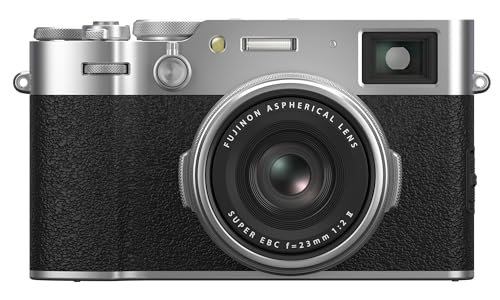
The X100VI is the compact landscape photographers argue about, because it breaks the genre’s first assumption: that you need a zoom. Its fixed lens frames the classic landscape view — wide enough for grandeur, honest enough to avoid distortion — and behind it sits a high-resolution APS-C sensor whose RAW files are the deepest in this guide. Skies pull down through stop after stop of recovery without banding; shadowed valleys lift into detail instead of noise; and the lens renders the frame’s corners with a fidelity that cheaper glass reserves for the centre. On a mini tripod at dawn, this camera produces files that print at sizes its pocketable shape seems to forbid.
The in-body stabilisation changes the tripod calculus rather than replacing it. For the walking landscape shooter, stabilisation buys hand-held frames in the dim blue minutes before sunrise and after sunset — the genre’s best light — at shutter speeds that would otherwise demand support. When the tripod does come out, the camera’s aperture ring, shutter dial, and exposure compensation dial allow adjustment by feel, in gloves, without waking a screen in the dark. The built-in neutral-density filter is a landscape tool hiding in plain sight: it stretches exposures for moving water and clouds in daylight without a filter kit.
Its disciplines are real. The fixed focal length means composing with your feet, and some viewpoints — the far shore, the cliff you cannot leave — will simply refuse the frame. Weather resistance requires the adapter ring and filter fitted, and even then it is resistance, not the OM SYSTEM’s sealing. Bracketing is present and competent rather than elaborate. But for the single-exposure philosophy executed at the highest level a compact can reach, the X100VI is this guide’s summit.
- Sensor: high-resolution APS-C with deep, forgiving RAW files
- Lens: fixed, exceptionally sharp across the frame
- Stabilisation: in-body, for dawn and dusk hand-held work
- Filters: built-in ND for long exposures in daylight
- Controls: tactile dials that work in gloves and darkness
Strengths
- The most editable files and finest detail here
- Built-in ND and stabilisation extend the shooting day
- Dials suit the deliberate, tripod-paced landscape method
Trade-offs
- Fixed lens — no zooming out of a composition problem
- Weather resistance needs the adapter and filter fitted
- Bracketing is basic beside the OM SYSTEM’s composites
Best for: dedicated landscape shooters who print and edit seriously. Not suited for: travellers wanting one zoom for every subject.

OM SYSTEM OM-5 Mark II — Best Computational Tools
The OM-5 Mark II approaches the landscape problem from the opposite direction to Fujifilm: if one exposure cannot hold the scene, take many and compute. Its high-resolution shot mode shifts the sensor in fine steps and merges the captures into a file with far more detail than a single frame — on a tripod, at a still viewpoint, the results rival cameras with much larger sensors. Its Live ND feature simulates neutral-density filtration electronically, blending frames into long-exposure effects — silk water, streaked clouds — in daylight, without carrying glass filters at all. And its live composite mode builds long night exposures progressively, so light trails and star movement accumulate on screen while you watch, ending the exposure when the image is right rather than when a timer guesses.
Weather sealing is the other half of its landscape case, and it is genuine, system-grade sealing: this camera works in rain, at waterfall bases, and on spray-soaked headlands with the lens ecosystem’s sealed optics, where the rest of this guide is sheltering. For coastal and mountain photographers whose best light arrives with weather attached, that confidence is not a feature but a permission slip.
The sensor is smaller than the Fujifilm’s, and a single un-assisted frame shows it in the deepest shadows — which is precisely why the computational modes matter, since stacking frames also averages noise away. It asks more of its owner: menus to learn, a tripod for its best tricks, and patience for the composite philosophy. Landscape photographers who enjoy the craft’s technical side will find it the most capable tool here; those who want one perfect exposure and a walk home should look at the Fujifilm.
- Sensor: Micro Four Thirds with computational composite modes
- High-resolution: sensor-shift merging for very detailed files
- Live ND: electronic long-exposure effects without filters
- Sealing: full weather sealing for rain and spray
- System: interchangeable lenses within a compact travel body
Strengths
- Composite modes out-resolve and out-smooth its sensor class
- Long-exposure effects without a filter kit
- Sealing that permits shooting inside the weather
Trade-offs
- Single frames trail APS-C rivals in deep shadow
- Best modes require a tripod and a still scene
- Menu depth asks for a learning investment
Best for: technical landscape shooters, coastal and waterfall photographers. Not suited for: minimalists who reject computation and menus.

Sony RX100 VII — Best Zoom Versatility
Landscapes are not all wide. Some of the finest landscape photographs are compressions — ridge behind ridge fading into haze, a lighthouse isolated by a long lens, moonrise over a far summit — and the RX100 VII is the only camera in this guide that shoots both the grand vista and the compressed detail from the same pocket. Its zoom range is a compositional education in itself: walk less, frame more, and discover how many landscapes were hiding inside the one you came for.
The one-inch sensor’s files are a clear step below the Fujifilm’s in editing depth, and this guide will not pretend otherwise — skies recover less far, shadows lift less cleanly. But they are honest, detailed files, and the camera’s bracketing is quick and well-implemented, so the disciplined shooter merges frames and closes much of the gap. The pop-up viewfinder earns special landscape praise: on a bright ridge, composing through a finder beats squinting at a washed-out screen, and the finder also steadies the camera against your face for the hand-held dawn frames.
What it asks in return is care. Unsealed, small-batteried, and menu-driven, it is a fair-weather instrument that rewards preparation — exposure set deliberately, bracket dialled in before the light peaks, spare battery in the pocket. For the travelling landscape photographer who also photographs everything else a journey contains, it remains the most complete single answer here.
- Sensor: one-inch with a long-range zoom lens
- Composing: wide vistas and telephoto compressions from one body
- Viewfinder: pop-up, for glare and steady hand-holding
- Bracketing: fast, well-implemented exposure sequences
- Carry: the flattest, most pocketable serious camera here
Strengths
- Zoom finds the second and third landscape in every scene
- Bracketing discipline closes the file-quality gap
- Pocketable enough to be present at every viewpoint
Trade-offs
- Single-frame dynamic range trails the Fujifilm
- Unsealed — wet viewpoints need shelter and patience
- Small battery on long dawn-to-dusk days
Best for: travelling photographers who shoot landscapes among everything else. Not suited for: print perfectionists or foul-weather specialists.
Leica D-Lux 8 — Best Photographer’s Compact
The D-Lux 8 is built around a conviction landscape photographers share: that a camera should be operated, not navigated. Aperture on the lens barrel, shutter speed on a dial, exposure compensation under a thumb — the exposure triangle sits on the body in metal, so the settings a landscape shooter adjusts at a viewpoint are changed by feel while the eye stays on the scene. Its zoom covers the classic landscape range from genuinely wide to short telephoto, and the larger-than-one-inch sensor behind it produces files with a depth in editing that sits between the Sony’s and the Fujifilm’s.
In the field, that control philosophy pays its dividend at the day’s edges. As light falls at a viewpoint, the landscape method is a rhythm of small corrections — a third of a stop here, a bracket there, a focus check magnified on the rear screen — and the Leica’s directness keeps the rhythm unbroken by menus. Its files take editing gracefully: skies grade smoothly, and the lens’s rendering gives distant detail a clarity that survives cropping into the compressed compositions its zoom invites.
The honest debits are weather sealing, which it lacks, and the price class it inhabits, which buys the control experience and the optics rather than computational tricks — there is no high-resolution composite mode here, no live ND. It is a camera for the single-exposure traditionalist who found the Fujifilm’s fixed lens too strict and wants a zoom without surrendering the dials. Within that brief, it is deeply satisfying.
- Sensor: larger-format compact sensor with a fast zoom lens
- Controls: aperture ring and shutter dial on the body
- Files: RAW with smooth highlight gradation for editing
- Composing: wide-to-short-telephoto range for varied viewpoints
- Character: traditional operation, no computational modes
Strengths
- Direct dials keep the viewpoint rhythm unbroken
- Files grade and recover beautifully in editing
- Zoom range suits most classic landscape framing
Trade-offs
- No weather sealing for wet viewpoints
- No composite or high-resolution modes
- Premium pricing buys experience more than features
Best for: traditionalist landscape shooters who think in dials. Not suited for: computational shooters or buyers on a strict budget.

Canon PowerShot G7 X Mark III — Best for Golden Hour
Ask landscape photographers when their favourite photographs happen and the answer is a time, not a place: the hour when the light goes low and warm, and then the blue quarter-hour after it. Built for exactly that window is the G7 X Mark III. Its fast lens gathers the failing light generously, letting you keep working hand-held deep into the dusk; its one-inch sensor’s files are clean at the sensitivities twilight demands; and its colour — Canon’s warm, humane rendering — makes a lit valley or a harbour at last light look the way standing there felt.
Its zoom is biased wide, which suits the grand near-far compositions of golden hour: foreground rocks or grasses large in the frame, the lit distance arranged behind. The tilting screen helps the low camera positions those compositions love, down among the heather or at the water’s edge, without the photographer lying full-length in the damp. Bracketing is available for the disciplined, though the camera’s natural constituency shoots single frames and trusts the light’s own narrowing range at day’s end — a legitimate philosophy this guide respects.
Against the specialists it concedes dynamic range in the harsh middle hours and offers no viewfinder for glare, no sealing for spray. It is not the camera for a noon plateau or a waterfall’s base. It is the camera for the walk out at six and the light at eight, and for a great many landscape lovers, that is the whole hobby.
- Sensor: one-inch with a fast, wide-biased zoom
- Light: excels hand-held in dawn and dusk light
- Screen: tilts for low near-far compositions
- Colour: warm rendering that flatters golden light
- Character: a golden-hour companion, not a noon instrument
Strengths
- Fast lens extends hand-held shooting into twilight
- Colour made for the genre’s favourite hours
- Simple operation suits unhurried evening walks
Trade-offs
- Midday dynamic range trails the leaders
- No viewfinder and no weather sealing
- Shorter zoom limits compressed compositions
Best for: evening and dawn walkers, harbour and valley golden hours. Not suited for: high-noon deserts or wet coastal work.

OM SYSTEM Tough TG-7 — Best for Wet Landscapes
Some landscapes are wet by definition: the waterfall’s gorge, the tide pool at dawn, the sea cliff in a storm that has just blown itself out and left the light extraordinary. Those scenes are this guide’s final pick’s native country. The TG-7 is sealed and armoured, so it works at the waterfall’s base in the spray, kneels in the tide pool’s margin, and rides out the squall on the headland that sends every other camera here into a bag. Its landscape photographs exist because the camera was present in conditions that define the genre’s drama.
Within its limits it is cleverly equipped for the work. The field-sensor system logs position and altitude into the files, so a coastal series arrives home already mapped. Its close focus turns foregrounds — wet rock texture, shells, ice — into the near element of classic near-far compositions. Long exposures for silky water are within its scene-mode repertoire, and on a mini tripod at a stream it behaves like a camera twice its seriousness.
The sensor is small and the dynamic range is this guide’s narrowest; a TG-7 sunset needs bracketing discipline or a graduated approach to exposure, and its files will not print at the Fujifilm’s sizes. Judge it instead as the landscape camera of access: the one that goes where the water is. Photographers whose landscapes are dry and elevated should buy elsewhere in this list; photographers whose boots are usually wet have found their camera.
- Body: waterproof, shockproof, freezeproof, sealed against spray
- Logging: GPS and altitude recorded into landscape files
- Focus: close focus for wet foreground detail
- Modes: scene support for long-exposure water effects
- Character: access to wet viewpoints above file finesse
Strengths
- Works inside waterfalls, surf, and storm light
- Route logging enriches coastal and mountain series
- Close foregrounds for near-far compositions
Trade-offs
- Narrowest dynamic range in this guide
- Small files limit print sizes
- Zoom reach is modest for distant scenery
Best for: waterfalls, coasts, and storm-light chasers. Not suited for: large-print or high-contrast purists.
How Do You Expose for a Sky You Intend to Rescue?
The working landscape exposure is a deliberate wager: you protect the highlights absolutely, because clipped sky is gone forever, and you trust the file’s shadow depth — or your bracket — to carry the land. In practice that means metering the brightest part of the scene you still care about, the lit cloud rather than the blue, and letting the foreground fall darker than it looks to your eye. Your eye adapts; the sensor does not, and the photograph is made of the sensor’s evidence, not your impression of the evening.
The histogram is the instrument of this wager, and every camera here displays one. The shape you want touches neither wall: a spike hard against the right edge is clipped sky, against the left is buried shadow, and the skilled landscape exposure nudges the whole distribution into the space between, using exposure compensation in small, deliberate steps. Blink warnings for blown highlights, enabled on all these cameras, turn the rear screen into a map of exactly what you are sacrificing — use them at the viewpoint, not in the edit, when the sacrifice can still be renegotiated.
There is a temperament point buried in the technique. Exposing for rescue means the file on the camera’s screen looks wrong — dark, muted, unfinished — and the beginner’s instinct is to fix it by brightening the next frame into clipping. Resist. The landscape file is a negative, not a postcard, and its beauty is latent. Photographers who make peace with the dark preview come home with skies; photographers who chase a pretty screen come home with white ones.
What Makes a Landscape Composition Work at This Scale?
Compact cameras compose like all cameras — the sensor’s size changes the file, not the geometry — but their lightness changes the photographer’s behaviour, and behaviour is where composition is won. Because the camera is always present, the landscape shooter with a compact scouts constantly: the walk to the viewpoint is a series of test frames, the viewpoint itself is worked from six positions instead of one, and the descent produces the photograph the ascent walked past. Volume of honest attempts is a compositional technique, and small cameras enable it shamelessly.
The classical structure still governs the results. A near element to give the eye entry, a middle distance to travel through, and a far distance to arrive at — arranged so the light connects them. The wide-biased picks, the Canon and the Fujifilm’s fixed view, are built for exactly this architecture. The zooms add the counter-architecture: exclusion. A long lens edits the landscape by refusing most of it, isolating the one ridge, the one tree, the one fall of light, and the RX100 VII in particular rewards shooters who alternate between the grand arrangement and the strict exclusion at every stop.
Height is the cheapest compositional variable and the most neglected. The same scene from standing, from kneeling, and from a metre of climbed boulder are three different photographs, and two of them are usually better. Mini tripods earn their place here not through stability alone but through the discipline of a chosen height, held while the light finishes. Set the camera low, live with the composition for a full minute before shooting, and you will see the frame’s weaknesses while they are still free to fix.
How Should You Work With a Mini Tripod and Bracketing?
The mini tripod is the landscape compact’s natural partner because the whole system stays honest about its purpose: light enough to bring, stable enough to matter. Choose one with legs that splay low — the near-far composition lives at ankle height — and a head that locks without creeping, since a landscape exposure at dusk will find any weakness in the lock. Set the camera’s self-timer or use a remote release so your hand is gone before the shutter opens, disable nothing the stabilisation system needs you to disable without checking its guidance, and shield the rig from wind with your body during long exposures; a mini tripod’s enemy is not weight but gusts.
Bracketing technique on a support is a calm ritual. Frame, focus once on the element that must be sharpest, and let the camera fire its sequence without touching it between frames — your editing software or the camera’s own merge will thank you for pixel-aligned captures. Take the bracket even when the single frame looks fine on the screen; screens lie kindly at viewpoints, and the file you need at home is the one with the sky’s gradation intact. In moving scenes — water, grass, clouds — expect the merge to ghost, and keep the single best exposure as your primary frame with the bracket as insurance for the sky alone.
Hand-held bracketing has its place on still days and with the stabilised picks, the Fujifilm and OM SYSTEM especially, but treat it as the exception. The landscape genre’s pace is slow by nature; the support is part of its discipline, and the photographers whose work you admire are, almost without exception, the ones who stopped, set up, and waited for the light to finish arriving.
Comparison Table
| Pick | File depth | Bracket/composite | Sealing | Landscape role |
|---|---|---|---|---|
| Fujifilm X100VI | Deepest RAW latitude | Standard bracketing, built-in ND | Resistant with adapter | Single-exposure quality and prints |
| OM SYSTEM OM-5 Mark II | Strong, composite-boosted | High-res, Live ND, live composite | Fully sealed | Computation and wet viewpoints |
| Sony RX100 VII | Good one-inch files | Fast bracketing | Unsealed | Zoom versatility for travellers |
| Leica D-Lux 8 | Rich, smooth gradation | Standard bracketing | Unsealed | Dial-driven traditional craft |
| Canon PowerShot G7 X Mark III | Good, warm-toned files | Standard bracketing | Unsealed | Golden-hour hand-held work |
| OM SYSTEM Tough TG-7 | Modest small-sensor files | Scene modes, exposure discipline | Waterproof armour | Waterfalls, surf, storm coasts |
What About Night Landscapes, Stars, and the Blue Hour?
The blue hour — the twenty minutes after sunset when the sky holds a deep even blue and the land has gone to silhouette with detail still in it — is the compact landscape camera’s finest appointment, because the light’s range has narrowed to something every sensor here can hold in a single frame. Town lights come up to balance the sky, water goes to glass, and the fast-lensed picks, the Canon especially, shoot it hand-held; on a mini tripod, all six produce the kind of frame that sells the genre to beginners.
True night is stricter. Stars demand a tripod without negotiation, a lens fast enough to gather them before the earth’s rotation smears them into trails, and manual focus set with care on a bright star magnified on the screen. The Fujifilm’s aperture and stabilisation-off tripod discipline, and the OM SYSTEM’s live composite — which builds star trails and night scenes progressively while you watch, forgiving exposure guesses — are the two serious night tools here. The one-inch cameras produce pleasing night-town and moonlit work a class below, and the TG-7’s night is for camp scenes and lightning rather than the Milky Way.
Long-exposure noise is the night tax every small sensor pays, and the mitigations are classical: keep exposures as short as the subject allows, let the camera’s long-exposure noise reduction work, and embrace the composite philosophy where it exists, since stacked frames average the noise away. A night landscape shot patiently on any of these cameras will shame a hurried one shot on finer equipment — the genre’s recurring lesson, taught again by the dark.
How Do the Seasons Rewrite the Landscape Brief?
Spring landscapes are about water and new green — saturated, fast-moving, and shot best in the soft light after rain, when the sealed pair and the TG-7 earn their keep at streams and falls. Summer is the season of altitude and hard noon light, where the game becomes schedule discipline: dawn and dusk at the viewpoint, woodland and gorge interiors at midday, and a viewfinder — the Sony’s pop-up, the Fujifilm’s hybrid — earning its place against the glare.
Autumn is the landscape photographer’s harvest and the most forgiving season for every camera here, because colour does the compositional work and the light angles kindly for hours. Winter is the connoisseur’s test: the sun stays low and theatrical, snow exposes every weakness in exposure and white balance, batteries sag in the cold, and the TG-7’s freeze rating and the Fujifilm’s dials-in-gloves operation stop being specifications and become the difference between shooting and sheltering. A camera chosen for your dominant season is a camera chosen honestly; the all-season buyer should weight winter, because winter is where compromises surface.
How Should Landscape Files Be Edited Without Ruining Them?
Begin with the sky, because it is where landscape edits live or die. Recover highlights gradually and watch the gradation at the horizon, where heavy-handed recovery turns a glowing transition into a grey band. If the sky needs more than the single file holds, that is the bracket’s moment — merge for the sky’s sake and keep the land from the best single exposure, a hybrid approach the professionals use without embarrassment. White balance deserves a decision rather than a default: the camera’s guess at sunset is usually cooler than the evening felt, and warming the file restores the memory the photograph exists to serve.
Shadows are the second sitting. Lift them until the detail you stood in front of is legible, then stop a breath before it looks impressive — shadow detail that announces itself reads as processing, while shadow detail that simply exists reads as depth. Local adjustments beat global ones throughout: the foreground pool brightened alone, the distant ridge’s contrast deepened alone, the sky’s colour enriched without touching the land’s. Every pick in this guide produces files that accept this local work; the smaller sensors accept less of it, which is a difference of degree to respect, not a disqualification.
Sharpen for the print size, not for the screen at full magnification, and let noise be in the shadows of a dusk file — a whisper of grain in a valley at blue hour looks like atmosphere, while the plastic smoothness of aggressive noise reduction looks like a rendering. The landscape edit is finished when the photograph looks like the place on its best evening, not when it looks like the software on its best behaviour.
Which Mistakes Flatten Landscape Photographs?
The first is arriving at the light’s climax rather than before it. Landscape light is an appointment: the photographers whose work fills this genre’s calendars are in position, composed and bracketed, twenty minutes before the moment, watching it build. The second is the level horizon neglected — a tilted sea is a small error that shouts — and every pick here offers a level gauge that costs nothing to enable.
A fifth mistake hides in the camera bag: the polariser left at home on the one day the wet rocks and the sky needed it, or the spare battery forgotten for the dawn start that turned into a morning. Landscape photography’s failures are disproportionately logistical — the genre is slow enough that equipment forgotten is equipment mourned at leisure. A small, permanent viewpoint kit — support, cloth, spare battery, spare card, headtorch — checked once at the door, prevents more lost photographs than any upgrade in this guide.
Third is the empty foreground: the grand vista with nothing near the camera reads as a postcard of nowhere, because scale and depth live in the near ground. Kneel, find the rock, the pool, the tuft of grass, and let the distance arrange itself behind it. Fourth is editing the bracket into candy — saturation and clarity pushed until the scene looks laminated. The files from these cameras reward restraint; a landscape that still looks like weather, rather than a poster, is the one that survives on a wall.
How Should a Beginner Spend a First Landscape Season?
Spend it returning. The beginner’s landscape education is not a tour of famous viewpoints but a courtship of one local place — the nearest hill, reservoir, stretch of coast — visited across the season’s weathers and hours until its light is legible to you. Any camera in this guide can serve the apprenticeship; the TG-7 removes weather excuses, the Canon flatters the evening visits, and the Fujifilm rewards the growing seriousness with files that keep pace. What matters is the rhythm: same place, new light, honest review afterwards.
Keep the technical curriculum in its proper order. First the tripod habit and the level horizon, because they improve every frame regardless of camera. Then exposure for the sky, with the histogram as your instrument. Then bracketing, once single frames have taught you what range really costs. Editing comes last and grows from the files you actually bring home — a beginner who edits fifty honest dawns learns more than one who watches a hundred tutorials about other people’s photographs.
And keep a season’s journal of failures. The clipped skies, the tilted seas, the viewpoints reached ten minutes late — written down, they become the checklist that the second season runs on. Landscape photography looks like a talent and behaves like a practice, and the compact camera’s gift to the beginner is that it can be present for all of the practice, not just the expeditions.
Final Recommendation
One practical word before the verdicts, about the second-hand market and patience: landscape photographers upgrade slowly, because the genre rewards familiarity more than novelty, and a previous-generation body from any of these families, bought carefully, will teach the craft as well as the current one. Spend the difference on the support, the boots, and the alarm clock — the three accessories that demonstrably make landscape photographs.
Choose by the file you want to edit and the weather you shoot in. The X100VI is the connoisseur’s answer — the deepest files, the finest lens, the fixed-frame discipline. The OM-5 Mark II is the engineer’s — computation that manufactures resolution and long exposures, sealed for the wet places. The RX100 VII serves the traveller who landscapes among other subjects, the D-Lux 8 the traditionalist who thinks in dials, the G7 X Mark III the golden-hour romantic, and the TG-7 the photographer whose landscapes have water in them. Any of the six will make real landscape work; the right one is the one whose philosophy matches the way you already stand at a viewpoint.
Related guides
- Best Compact Digital Cameras for Large Photos: Resolution, Lenses, and Files That Print at Wall Size
Frequently Asked Questions
Is a fixed-lens camera really suitable for landscapes?
For many landscape photographers it is ideal. The classic landscape focal length sits in the wide-to-normal range the X100VI offers, a fixed lens is sharper than a zoom at the same size, and the discipline of composing with your feet produces stronger viewpoints. There is a subtler benefit, too: a fixed frame teaches you to see your local landscape in that frame before you ever raise the camera, so the scouting walk becomes a composition exercise in itself and the keeper rate climbs season by season. What you surrender is the compressed telephoto landscape — layered ridges and isolated details — which is the RX100 VII’s or D-Lux 8’s territory.
Should I shoot RAW or JPEG for landscapes?
RAW, whenever the scene’s brightness range is wide — which in landscape work is most of the time. RAW preserves the highlight and shadow evidence your editing will spend. The sensible compromise many landscape shooters adopt is RAW plus JPEG together: the JPEG for the evening’s quick review and sharing, the RAW archived as the negative for the frames that deserve the full edit. Cards are cheap; unrepeatable dawns are not. JPEG suits the finished-look shooter in gentle light; several picks here, Fujifilm especially, produce beautiful JPEGs, but they cannot recover a clipped sky the way the RAW file can.
What does exposure bracketing actually do?
The camera records the same scene at several exposures, typically one measured, one darker, one brighter. Set the bracket before the light peaks — fumbling for the setting while the sky performs is the classic way to own a beautiful memory and a mediocre file — and review the sequence’s darkest frame at the viewpoint to confirm the sky is held, since that is the frame the whole technique exists to secure. Merged, the set holds detail across a brightness range wider than any single frame — sky from the dark frame, shadows from the bright one. It is the standard answer to high-contrast scenery, and it works best on a support with nothing in the scene moving quickly.
Do I need filters with these cameras?
Less than you used to. The X100VI’s built-in ND and the OM SYSTEM’s Live ND cover the long-exposure case electronically, and editing handles much of what graduated filters once did. If you do carry one filter, make it the polariser and learn its rotation by heart at home — its effect peaks at right angles to the sun and vanishes facing it, and the viewpoint is a poor classroom for discovering that geometry while the light performs. A polariser remains genuinely useful — it cuts reflections on water and wet rock and deepens skies in ways software cannot fully imitate — where the camera accepts one via an adapter.
How large can I print from a compact landscape file?
Further than sceptics expect. The Fujifilm’s high-resolution files and the OM SYSTEM’s composite mode print at genuinely large sizes with care; the one-inch cameras satisfy most wall sizes a home photographer hangs. The honest way to learn your own camera’s ceiling is a test print of your best-held file at the largest size you would actually hang — one print teaches more than a season of pixel-peeping, and it usually retires the anxiety permanently, in one direction or the other. Print quality depends as much on the exposure’s quality — a well-held sky, a steady support — as on the sensor, which is why this guide weighs workflow so heavily.
What is the best time of day for compact landscape photography?
The hours around sunrise and sunset, when the light’s brightness range narrows into what a sensor can hold and the low sun models the land’s texture. Sunrise has the practical edge for the compact shooter: the camera that slept in your jacket pocket is already with you, the viewpoints are empty, and the air is at its stillest for the long exposures water and cloud work loves. Sunset is kinder to the alarm clock and crueller to the descent — carry the headtorch and let the blue hour, rather than the dark, be your deadline for the walk down. Midday asks the most of dynamic range and flatters the least; it is the time for woodland interiors, waterfalls in shade, and the TG-7’s wet subjects, where diffuse light is a gift rather than a compromise.
Can a compact replace a bigger camera for a landscape trip?
For most photographers, on most trips, yes — with eyes open. You surrender some resolution headroom, some dynamic range, and lens interchangeability, and you gain presence: the compact is carried on the walks where the big system would have been left at the lodging, and landscape photography rewards the camera that attends. Photographers whose work is sold at large sizes or shot in extreme contrast should keep the bigger system for those assignments and let the compact carry the rest of the year.
What mini tripod features matter most?
Legs that splay wide and low without slipping, a head that locks firmly and stays locked during a long exposure, and a total weight you will genuinely carry. Test the whole assembly on the kitchen table with your actual camera before the first dawn: a head that creeps under the Fujifilm’s weight or legs that skate on wet rock are discoveries to make at home, where the fix is a different purchase rather than a ruined morning. A slightly heavier mini tripod that attends every walk beats a featherweight one left behind twice. Pair it with the camera’s self-timer or a remote release, and learn its setup in daylight at home so the dawn assembly is muscle memory.
Related Guides
Landscape shooters who reach their viewpoints on foot should weigh the carry questions in our best compact cameras for backpacking, and those whose scenery includes the miniature world at their feet will enjoy the best compact cameras for close up photos. When the landscape starts to move — rivers, clouds, coasts in time-lapse — the best compact cameras for movies takes the story further.


