kajuandouglas.com is reader-supported. When you buy through links on our site, we may earn an affiliate commission.
Where to Buy a Camera for the Passenger Seat, and the One Rule That Comes First
The best cameras for recording scenery from car journeys exist for one of travel’s purest pleasures: the landscape that only exists from a moving road. The coastal corniche at dawn, the desert straight running at a red horizon, the mountain pass unwinding above a valley — these views cannot be walked to or waited for. They are seen at speed, through glass, from a seat, and the cameras in this guide are the ones that bring them home as more than a smeared rumour.
The first rule comes before any recommendation, and it is absolute: the driver does not film. Every pick, position and workflow in this guide assumes a passenger holding the camera, a mounted camera started before the journey and ignored during it, or a car lawfully parked. A scenery video is worth nothing against a moment’s inattention at speed, and any setup that invites the driver to check a screen has failed before the engine starts.
That settled, the technical problem is distinctive. A car is a vibrating, glare-filled observatory: the windscreen tints and reflects, the suspension telegraphs every surface change into the frame, and the scenery — the actual subject — is moving at two speeds at once, the near verge blurring past while the far mountains barely move. Cameras for this work are judged on stabilisation, on how they handle glass and glare, and on whether they can be trusted unattended for the hour when the light finally happens.
This guide is the outward-looking sibling of our in-vehicle coverage: that article is about recording the cabin and its occupants; this one is about the world outside the windows. The overlap in hardware is real — action and 360 cameras serve both — but the craft is different, and the picks are ranked here for scenery alone.
Window-seat storytellers are the intended audience here: the passenger-seat cinematographer on a great road trip, the tourer who wants the journey to be the film, the location scout recording routes, and the family whose holiday exists mostly as landscape seen through a windscreen. Each pick below is matched to one of those travellers.
A note on honesty: specifications quoted here are the manufacturers’ published figures, and the judgements about glass, glare and vibration are presented as what they are — the accumulated experience of people who have filmed from passenger seats on several continents and deleted most of it.
Key Takeaways
- Rule one is not technical: the driver never films — passenger, mount, or parked car only.
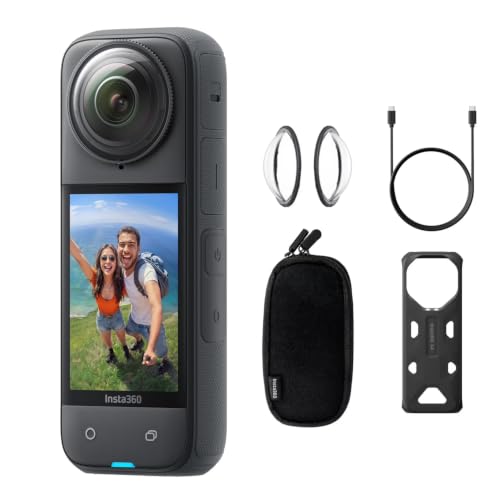
- The Insta360 X4 is the scenery insurance policy: it records the whole horizon and chooses the view later.
- The DJI Osmo Pocket 3 gives the passenger the smoothest, most cinematic road footage here.
- The GoPro HERO13 Black on a suction mount is the set-and-forget windscreen standard.
- The DJI Osmo Action 5 Pro’s endurance covers the long empty miles between the moments.
- Shoot through an open window or a clean windscreen corner; glass quality decides more than sensors do.
In this guide
Quick Picks
| Camera | Badge | Why it is here |
|---|---|---|
| Insta360 X4 | Best for never missing the view | 360 capture means the valley on the left is recorded while you watch the right. |
| DJI Osmo Pocket 3 | Best passenger cinematography | A real gimbal turns a moving car into a tracking shot. |
| GoPro HERO13 Black | Best mounted windscreen camera | Suction it, start it, and let HyperSmooth handle the road. |
| DJI Osmo Action 5 Pro | Best for long driving days | Battery endurance and low light for dawn starts and dusk finishes. |
| Insta360 Ace Pro 2 | Best image quality in an action body | A larger sensor and flip screen for the passenger who directs. |
| AKASO Brave 7 LE | Best budget second angle | The affordable camera for the risky exterior-adjacent positions. |
How Did We Choose These Cameras for Scenery Work?
Stabilisation was judged against the car’s specific violence: not the walker’s bob or the cyclist’s buzz, but engine idle tremor, suspension thumps and the slow wallow of a soft-sprung tourer. Mechanical gimbals, class-leading electronic systems and 360 capture’s reframing stability were each credited for what they actually deliver from a passenger seat, which is a horizon that behaves like a horizon.
Glass tolerance came second, because scenery from a car is scenery through a windscreen until proven otherwise. We considered how each format handles reflections, tint and the polarising weirdness of laminated glass — and how easily the camera can be positioned to avoid the glass altogether: at an open window, at the windscreen’s cleanest corner, or on a mount that puts the lens where the view is.
Unattended trustworthiness was the third test. The great scenery hour — dawn over the desert, the pass at last light — arrives while the car is mid-journey and the passenger is also navigating, snacking and living. Cameras that can be started at the fuel stop and trusted until the destination, with batteries and heat behaviour to match, outrank cameras that demand supervision.
Field of view philosophy divided the field honestly. A 360 camera records the entire sphere and defers every decision; a gimbal camera records one beautiful direction and demands the passenger choose it in real time; an action camera records a wide, honest slab of world. None is correct in the abstract — the ranking assigns each to the traveller whose temperament it matches.
Audio was considered as atmosphere rather than dialogue: wind, road song and the cabin’s murmur are the scenery film’s soundtrack, and cameras that manage wind noise without sealing the world away were credited. Engine and exhaust recording for driving films is a specialist art this guide touches only to admire from a distance.
What was ignored: studio image quality contests and stills performance. A scenery camera from a car is a motion instrument judged on moving footage at journey’s end, and the ranking never pretended otherwise.

1. Insta360 X4 — Best for never missing the view
Scenery’s oldest tragedy is directional: the eagle crosses on the left while the camera points right, the valley opens behind while everyone watches the summit ahead. The X4 abolishes the tragedy by recording the entire sphere from its mount — roof-side window, windscreen corner, the passenger’s hand at the open window — and letting the journey’s geography be chosen in the edit, when the whole route can be reviewed like a map.
For road films it has a second, quieter gift: the reframed footage is stabilised by the sphere itself, so the car’s wallow becomes a gentle drift rather than a shake. The costs are editing time, big files and lenses that must be guarded from stone chips and grit. For the traveller whose creed is ‘record everything, decide later’, no other pick here is even arguing the same case.
The Insta360 X4 builds everything on reframing after the fact in the app, FlowState stabilisation across the sphere, and a second chance at every angle plus sphere-wide steadiness is the passenger-seat argument entire.
The invisible selfie-stick effect viewers love and removable lens guards for risky positions make the Insta360 X4 the floating-camera trick of the road film. The list continues with a single-lens mode that behaves like an action cam, while 8K 360 capture that records every direction at once colours every session when the road unspools toward a lit horizon. Lit horizons at the end of long straights are the X4’s signature shot, the 360 file keeping the shoulders and sky the driver never saw.
Road-trippers who adopted the X4 describe the edit as a second journey: the route replayed with the freedom to look left at the exact bend where, in the car, everyone was looking right. Tour companies use it to scout, because a single drive yields every angle a brochure might need. The discipline owners repeat is lens care — grit and stone chips are the scenery car’s weather, and the guards stay on whenever the window is open.
Long-term Insta360 X4 users name one camera becomes many angles, shoot first, aim later freedom and me Mode keeps you centred; the honest debits are guards can flare in sun, files are huge and fragile protruding lenses. Fragile protruding lenses, huge files and guards that flare in sun require respect, because one mount becoming many angles and shoot-first-aim-later freedom transform how a mountain road gets remembered.
Key specs
- Reframe in app or desktop
- FlowState stabilisation
- Invisible selfie stick effect
- Dual-lens 360 capture, 8K
- Waterproof to 10 m
Strengths
- Shoot first, aim later freedom
- One camera becomes many angles
- Me Mode keeps you centred
Trade-offs
- Files are huge
- Fragile protruding lenses
- Guards can flare in sun
Best for: road-trippers and scouts who cannot afford to have pointed the wrong way
Not suited for: creators who need footage edited and posted the same evening

2. DJI Osmo Pocket 3 — Best passenger cinematography
In the passenger’s hand, the Pocket 3 performs the trick every road film wants: it makes a moving car feel like a camera crane. The mechanical gimbal irons the suspension’s grammar out of the footage, the one-inch sensor renders dawn and dusk with a richness action cameras envy, and the rotating screen follows the passenger’s instinct as the view swings from windscreen to side window. This is the pick for the traveller who directs the journey as it happens.
Its limits are the gimbal’s delicacy — it is a hand-held instrument, not a mount-and-forget one — and a fixed lens that frames wide or not at all. Neither matters to its intended user, who is awake, engaged and composing. Road films shot on it have a finished, intentional quality that audiences describe as ‘like a real film’, because mechanically, it is.
The DJI Osmo Pocket 3 builds everything on a wireless microphone ecosystem made for it, a rotating screen that switches orientation in a twist, and narration-ready audio with a screen that flips to the view is the pairing a moving car rewards most.
Two features do the heavy lifting for the DJI Osmo Pocket 3 on the road: ActiveTrack that follows faces and subjects and 4K slow motion up to one hundred twenty frames. Further down the list sits pocket size with a gimbal’s grace, while a one-inch sensor on a three-axis mechanical gimbal earns its keep when a coastal bend opens without warning. Coastal bends opening without warning are gone in seconds for everyone except the Pocket 3’s passenger, whose gimbal was already looking the right way.
Passenger cinematographers praise the Pocket 3 for making other travellers jealous at the evening playback: footage that looks scouted and crewed, shot from a moving hatchback by whoever drew the window seat. Its low-light manners at dusk — the scenery hour — draw the strongest testimony. The caution is universal and physical: it rides in its case between uses, because a gimbal among road-trip clutter lives dangerously.
Owners of the DJI Osmo Pocket 3 tend to praise superb one-inch image quality, beautiful skin tones in 10-bit and starts in seconds; the honest debits are fragile in a crash, accessories are DJI-priced and rain stops play. DJI-priced accessories, rain sensitivity and crash fragility are the admission price for superb one-inch image quality, beautiful ten-bit skin tones and a camera that starts in seconds.
Key specs
- 3-axis mechanical gimbal
- ActiveTrack subject following
- Rotating 2-inch touchscreen
- 1-inch sensor
- 4K 120 fps video
Strengths
- Beautiful skin tones in 10-bit
- Starts in seconds
- Superb one-inch image quality
Trade-offs
- Rain stops play
- Accessories are DJI-priced
- Fragile in a crash
Best for: engaged passengers who compose the journey in real time
Not suited for: drivers seeking a mounted, unattended solution — this is not that tool

3. GoPro HERO13 Black — Best mounted windscreen camera
The HERO13 is the windscreen’s incumbent for good reasons: a suction mount inside the glass, a horizon that HyperSmooth keeps honest over broken tarmac, and a body that tolerates the dashboard’s heat and the journey’s length with a battery rotation at fuel stops. Started at the depot and forgotten, it records the route’s honest chronicle — the weather arriving, the light changing, the landscape unspooling — which is the raw material of every road film ever cut.
Its wide lens is both the virtue and the limit: everything is in frame, and everything is small. Scenery with a subject — the lighthouse, the pass summit sign — wants the reframing of the X4 or the directing of the Pocket 3. As the journey’s always-on witness, though, the GoPro’s ecosystem of mounts and its tolerance for abuse keep it on this list’s podium.
A waterproof body needing no housing and interchangeable lens mods including ultra-wide make the GoPro HERO13 Black the windscreen mount’s answer to weather that changes by the valley, from river mist at dawn to summit hail by lunch, with glass swapped to match the road instead of the forecast.
GPS and data overlays for telemetry fans and HyperSmooth stabilisation that erases shake turn the GoPro HERO13 Black into a rolling instrument cluster. Still in the locker: a mounting ecosystem deeper than any rival, while 5.3K recording with headroom to reframe decides its manners when dawn catches the motorway nearly empty. Nearly empty motorways at dawn are the HERO13’s quiet showcase, 5.3K headroom turning a windscreen mount into a reframing studio.
The HERO13’s scenery reputation is built on journeys it witnessed entire: the transcontinental timelapse, the weather front crossed at noon, the pass in cloud that cleared for ninety seconds while the camera, alone among the car’s occupants, was watching. Owners value the boring virtues — mounts that hold, files that are simply there — and forgive the wide lens its democracy, in which the mountain and the mirror share the frame.
Seasoned GoPro HERO13 Black hands list burst slo-mo for peak moments, voice control when hands are busy and tough, waterproof, mountable anywhere; the honest debits are small sensor struggles at night, app workflow divides opinion and touchscreen with wet gloves is fussy. Wet gloves fight its touchscreen and nights stretch its small sensor, although voice control, waterproof toughness and mounting freedom anywhere keep the journey filmable in almost any weather.
Key specs
- HB-Series lens mods
- 5.3K video at 60 fps
- Waterproof to 10 m without housing
- HyperSmooth 6.0 stabilisation
- 1/1.9-inch sensor
Strengths
- Tough, waterproof, mountable anywhere
- Burst slo-mo for peak moments
- Voice control when hands are busy
Trade-offs
- Small sensor struggles at night
- Touchscreen with wet gloves is fussy
- App workflow divides opinion
Best for: tourers who want the whole route recorded without operating a camera
Not suited for: passengers seeking composed, cinematic framing of specific views

4. DJI Osmo Action 5 Pro — Best for long driving days
Scenery keeps scenic hours: the pass is beautiful at seven in the morning and again at eight at night, with nine hours of transit between. The Action 5 Pro is built for that arithmetic. Its battery endurance spans the empty miles without a rotation ritual, and its larger sensor holds the dawn and dusk ends of the day — exactly when the scenery performs — with more grace than its action-camera rivals.
Mounted or passenger-held, it is the dependable second camera of the scenery kit: less magical than the gimbal, less omniscient than the 360, and more awake than either at the moment the light finally breaks over the ridge you have been driving toward since breakfast. Reliability is a creative feature on a long road, and this camera is its argument.
Hours of endurance change everything for the DJI Osmo Action 5 Pro: subject tracking that keeps people centred and battery endurance measured in hours, not minutes, are the combination a full driving day consumes gratefully, sparing the driver both a midday battery swap and a second camera for the walking stops.
The DJI Osmo Action 5 Pro also brings 4K recording up to one hundred twenty frames and a larger 1/1.3-inch sensor than most action rivals. Also fitted: waterproofing to twenty metres bare, while dual touchscreens that work from either side earns its keep when rain stipples the windscreen over a valley. Rain stippling the windscreen over a valley is weather this camera ignores professionally, its screens readable from whichever seat is filming.
Dawn patrol is the Action 5 Pro’s testimony genre: drivers who leave at five to cross a range by sunrise report a camera still cheerful at the summit when other devices are rationing their last battery. Its footage of the blue hour, held a little longer than rivals manage, has a following among tourers who plan journeys around light. The front screen converts it, at stops, into the group’s selfie-and-scenery camera without a mount change.
The DJI Osmo Action 5 Pro’s ownership highlights are built-in storage as backup, better low light than GoPro and pressure gauge for divers; the honest debits are lens is fixed focus, case needed for deep dives and voice control is basic. Fixed-focus glass, a case for deep dives and basic voice control matter less once built-in storage backup, better low light and a diver’s pressure gauge join the glovebox kit.
Key specs
- RockSteady 3.0 stabilisation
- Waterproof to 20 m
- 1/1.3-inch sensor
- 4K 120 fps video
- Battery rated up to 4 hours
Strengths
- Better low light than GoPro
- Pressure gauge for divers
- Built-in storage as backup
Trade-offs
- Case needed for deep dives
- Voice control is basic
- Lens is fixed focus
Best for: long-distance tourers filming dawn-to-dusk journeys
Not suited for: creators who want gimbal grace or 360 reframing as their main effect

5. Insta360 Ace Pro 2 — Best image quality in an action body
The Ace Pro 2 is the action camera for the passenger who notices light. Its larger sensor and Leica-co-engineered lens render the scenery’s difficult ends — the bright valley, the shadowed gorge — with a dynamic confidence the smaller-sensor action cameras cannot match, and its flip screen lets the passenger frame a side-window composition without contorting. Night driving footage, city lights streaking a river crossing, is its party piece.
It asks more of its operator than the mount-and-forget picks: it is a camera to be aimed, exposed and appreciated, and its battery life, while respectable, is not the DJI’s marathon. For the quality-first traveller who treats the passenger seat as a director’s chair, it is the action-format answer.
The Insta360 Ace Pro 2’s story starts with a 1/1.3-inch sensor behind a Leica-co-engineered lens, waterproofing to twelve metres, and serious glass with real sealing is why this action body keeps being mistaken for a travel camera.
8K recording unusual in an action body and a wind-guard design for cleaner audio give the Insta360 Ace Pro 2 its open-window manners at speed. Further equipment includes AI processing tuned for night scenes, while a flip screen that faces the presenter tells you the most when the pass climbs into thinning cloud. High passes thinning into cloud are where the Ace Pro 2’s presenter-facing screen and night processing stop being specs and start being footage.
Ace Pro 2 owners among scenery shooters are the quality dissidents: they accepted an action camera’s shape and demanded a travel camera’s files, and they report getting most of that bargain. The flip screen’s effect on passenger filming is praised out of proportion to its simplicity — framing the side window without neck injury changes how much footage gets composed rather than merely captured. Night crossings and city arrivals are its showcase reels.
Talk to Insta360 Ace Pro 2 owners and they mention fast wake from standby, clarity zoom without quality cliff and sharp, detailed daylight footage; the honest debits are mounts mostly proprietary adapters, ecosystem smaller than GoPro and app required for full features. Proprietary mounting adapters, a smaller ecosystem and an app requirement for full features are offset by fast wake from standby, clarity zoom without a quality cliff and sharp daylight footage.
Key specs
- FlowState stabilisation
- 1/1.3-inch sensor, Leica co-engineered lens
- Flip touchscreen
- Waterproof to 12 m
- 8K video recording
Strengths
- Fast wake from standby
- Sharp, detailed daylight footage
- Clarity zoom without quality cliff
Trade-offs
- App required for full features
- Mounts mostly proprietary adapters
- Ecosystem smaller than GoPro
Best for: quality-first passengers who direct and frame actively
Not suited for: unattended all-day recording where battery changes are impractical

6. AKASO Brave 7 LE — Best budget second angle
Every scenery kit develops a position nobody wants to risk a good camera on: the low mount near the wheel arch for the road-rush shot, the rear-facing angle for the road unwinding behind, the borrowed car where suction marks are unwelcome. The Brave 7 LE exists for those duties. Its footage is honest rather than beautiful, its stabilisation adequate rather than magical, and its price makes it the only camera here whose loss would be an anecdote rather than an insurance claim.
As a main scenery camera it is outclassed by everything above it, and this guide will not pretend otherwise. As the second angle that makes an edit feel produced — the wheels, the wake of road behind, the driver’s-eye view from a cheap mount — it earns its small space in the bag and its place at the foot of this ranking.
A remote control in many kits and electronic stabilisation adequate for moderate shake form the AKASO Brave 7 LE’s budget pairing — steadiness enough for washboard roads, and it earns its mount on vehicles whose suspension long ago stopped pretending, started from the driver’s seat without a passenger reaching across to press record.
Spare power is part of the deal: two batteries in most bundles and a waterproof case included in the box stretch the AKASO Brave 7 LE’s value well past its price tag. Worth naming too: dual screens, front and rear, for framing, while 4K recording at a fraction of flagship prices governs how it copes when a desert straight runs at a red mesa. Desert straights running at a red mesa are the Brave 7 LE’s big scene, and 4K at its price makes the second angle an easy yes.
The Brave 7 LE’s field reports are cheerfully unpretentious: it has been taped, suctioned and wedged into positions its owners would never offer a flagship, and the resulting angles — tarmac rushing under the arch, the road folding away behind — punch far above their cost in finished edits. Nobody claims it rivals the leaders for quality. Everybody who runs one as a second angle claims the edit is better for its recklessness.
The AKASO Brave 7 LE’s ownership highlights are case and extras included, simple menus and value for risky mounting positions; the honest debits are audio is thin, build feels plasticky and app polish is rough. Thin audio, plasticky build and a rough app set expectations correctly, while included extras, simple menus and low cost make it the sensible camera for risky mounting positions.
Key specs
- Dual screens (front and rear)
- Electronic image stabilisation
- 4K 30 fps video
- Two batteries typically included
- Waterproof case included to 40 m
Strengths
- Value for risky mounting positions
- Case and extras included
- Simple menus
Trade-offs
- Build feels plasticky
- Audio is thin
- App polish is rough
Best for: budget-conscious creators adding risky or secondary angles
Not suited for: anyone expecting flagship stabilisation or low-light quality
How Do the Six Compare From the Passenger Seat?
| Camera | Badge | Standout trait | Watch out for |
|---|---|---|---|
| Insta360 X4 | Best for never missing the view | Records every direction at once | Editing time and fragile lenses |
| DJI Osmo Pocket 3 | Best passenger cinematography | True gimbal smoothness, rich sensor | Hand-held only; delicate |
| GoPro HERO13 Black | Best mounted windscreen camera | Mount ecosystem and stabilisation | Wide lens makes subjects small |
| DJI Osmo Action 5 Pro | Best for long driving days | Endurance and dawn/dusk quality | Less magical than gimbal or 360 |
| Insta360 Ace Pro 2 | Best image quality in an action body | Sensor and lens quality, flip screen | Battery life is mid-pack |
| AKASO Brave 7 LE | Best budget second angle | Price permits risky positions | Quality trails the field honestly |
Should You Film Through the Windscreen or the Open Window?
Through the windscreen is the convenient answer and often the wrong one. Laminated glass tints the view, reflects the dashboard’s pale top into the frame on bright days, and adds the wiper’s arc of grime to every composition. When through-glass filming is unavoidable — weather, speed, motorway rules — mount the camera close to the glass at its cleanest area, shade the dashboard’s reflection with a dark cloth, and clean the outside of that corner at every fuel stop.
The open side window is the cinematographer’s choice: unfiltered light, a frame the passenger can compose like a tracking shot, and the landscape arriving with its sound attached. Its costs are wind — in the microphone and in the buffeting of a hand-held camera — and the discipline of keeping everything inside the car’s silhouette. The gimbal and 360 picks handle the motion best; all of them prefer the window’s honesty to the windscreen’s convenience.
The rear window is the underrated third position: the road unwinding behind, the pass diminishing, the storm outrun. A rear-facing angle in the edit gives a journey its grammar of departure, and it is the natural home of the budget pick in this ranking, whose loss to a stone chip would be survivable.
How Do You Beat Reflections, Tint and Glare?
Reflections are geometry: they appear at angles, and they vanish when the camera sits close enough to the glass that the reflected dashboard falls outside the frame, or when the glass is removed from the equation entirely at the open window. A dark cloth over the dashboard’s top — the oldest trick in location filming — kills the pale reflection that haunts through-windscreen footage on sunny days.
Tint is a colour problem with an editing answer and a capture discipline: fix the white balance rather than letting it chase the glass’s green, and the footage grades back to the landscape’s true colours in one move. Auto white balance through mixed glass and open-window shots produces a journey whose colour temperature changes at every cut, and no audience believes that journey.
Glare from a low sun is sometimes the photograph. The pass at last light, the desert straight running into the sunset — these frames want their flare, controlled by a slight change of angle rather than eliminated. The larger-sensor picks hold flare’s edges most gracefully; the craft is to aim the glare, not to fight it.
Which Mounts Are Safe, Legal and Steady?
Suction mounts on interior glass are the scenery standard: rated for the camera’s weight, attached to clean glass, and tethered where possible so a failed cup drops the camera into the footwell rather than the driver’s lap. Exterior mounting is a different legal and moral country — it varies by jurisdiction, it risks other road users, and nothing in this guide recommends it for public roads, however the adverts behave.
Headrest and seat-rail mounts serve the passenger’s positions, holding a camera at window height without a hand’s fatigue. Their steadiness depends on the seat’s own isolation from the car’s vibration, which varies by vehicle; test on the first morning’s drive, not during the pass itself. A mount that drifts slowly downward over an hour is the category’s signature disappointment, and the test is the cure.
The hand is a mount, and for the gimbal pick it is the intended one — but a hand tires, drifts and eventually films the door card. Rotate the duty among passengers, brace elbows against the door and the centre console, and let the mounted cameras carry the hours while hands carry the moments.
How Do You Film a Mountain Pass Properly?
Approach it as a sequence, not a view. The pass film needs its establishing frames — the valley approach, the first hairpins — gathered on the climb, so the summit footage lands as a climax rather than a context-free panorama. The 360 camera earns its keep here, because the climb’s geography unfolds on both sides and nobody in the car knows which side the light will choose.
Hairpins are the pass’s grammar: the car slows, the view swings through a hundred degrees, and the landscape rotates like a stage set. A passenger with the gimbal pick, anticipating the swing, produces the road film’s signature shot here. Mounted cameras should be angled for the swing’s middle, accepting imperfection at its extremes — the edit cuts on the swing’s energy anyway.
Descend with the same respect: the far side of a pass is a different country with different light, and the journey’s film needs the moment of emergence — tunnel mouth, col, the sudden valley — which arrives exactly once. Be recording before it. Every scenery camera in this ranking has disappointed somebody who pressed record during it.
What Settings Keep Moving Scenery Smooth?
Frame rate is the first decision: the standard cinematic rates give the landscape’s motion its natural blur, while higher rates suit slow-motion studies of waterfalls, spray and roadside detail at the cost of light. Whatever the choice, keep the shutter near the conventional rhythm for the rate, because scenery’s pleasure is motion rendered as the eye renders it, not stuttered into a slideshow.
Lock what hunts. Exposure that breathes as the car passes between shadow and sunlit rock, and white balance that chases the windscreen’s tint, are the two amateur signatures in car scenery. Set both deliberately for the prevailing light, let the extremes fall where they fall, and the footage acquires the calm of a professional’s even when the landscape is doing anything but.
Stabilisation modes have a car-specific caveat: horizon-lock features are gold on straights and can fight the composition on long, banked curves, where the road’s tilt is the truth. Learn each camera’s behaviour on a familiar road before the great one, because the pass will not wait while you read the manual at altitude.
How Should a Road Film Be Edited From Hours of Scenery?
Cut by geography and light, not by the clock. A road film’s chapters are the landscape’s own: the plain, the climb, the coast, the storm. Within each chapter, the grammar alternates — the wide establishing frame, the passing detail, the human moment in the cabin for scale — and the 360 and second-angle footage exists to provide the alternation without a film crew.
Speed is a seasoning with strict dosage. Timelapse devours the empty miles honestly — the Action 5 Pro’s endurance makes whole transit days compressible into the film’s connective tissue — while the great passages deserve real time and real sound. An edit that timelapses the pass and lingers on the motorway has its values exactly inverted, and audiences feel it without knowing why.
Sound finishes the illusion: wind at the open window, the road’s changing song on different surfaces, the cabin’s murmur under the landscape’s silence. Keep the camera’s audio even when it seems uneventful; the uneventful is the atmosphere, and atmosphere is what separates a road film from a slideshow with ambitions.
What About Filming Scenery on Trains, Coaches and Ferries?
The train is the car’s civilised cousin: a steadier platform, a bigger window, and a landscape unrolling at a photographer’s pace. The same cameras apply, with the gimbal pick promoted — a train’s gentle sway is exactly what a mechanical gimbal eats — and the window discipline doubled, because carriage glass is older, dirtier and shared with a reflection of the whole compartment.
Coaches give the height cars lack: the elevated view over hedges and walls that turns ordinary countryside into a survey. Sit high and forward where choice allows, brace the camera against the window’s frame rather than the glass, and accept the driver’s commentary as part of the soundtrack or none of it, according to the film’s honesty policy.
Ferries are scenery platforms disguised as transport: open decks, no glass at all, and horizons that belong in this guide’s dreams. Every pick here works on deck, the weather-sealed reputations matter, and the only discipline is the wind, which the microphones will report faithfully unless shielded. Some of travel film’s most-loved footage is a ferry leaving a harbour at dawn, shot by a passenger who simply stood still.
How Much Should a Scenery Setup Cost, in What Order?
Mount before camera, because the mount decides whether the footage exists at all: a trustworthy suction mount and a headrest solution, bought once and bought well, serve every camera you will ever own. The scenery graveyard is full of superb cameras filmed wobbling on bargain mounts, and the footage cannot be un-wobbled by any purchase made afterwards.
Then the philosophy purchase: 360 for insurance, gimbal for beauty, action for endurance. Most travellers need exactly one of the three as a main camera, and this guide’s reviews are written to make that single choice well. The second camera — often the budget pick, for the rear window and the risky angles — comes when the edits start asking for it, which is the only honest trigger for any second camera.
Accessories follow the same discipline as everywhere in this series: power for the long days, cards with room for the unrepeatable hour, lens cloths in every pocket.
What Mistakes Ruin Car Scenery Footage?
Filming everything and composing nothing is the volume error: nine hours of windscreen, from which the editor must rescue nine minutes, at the cost of their affection for the journey. Record the transits in timelapse or not at all, and spend the camera’s attention — and the battery’s — on the passages the map promised.
Trusting the windscreen is the quality error, for the tint and reflection reasons this guide has detailed. One stop spent cleaning the glass, shading the dash and opening the window transforms the same camera’s footage more than an upgrade would.
Distracting the driver is the unforgivable one, and it ends this list as it began the guide. The camera that needs the driver’s glance, the mount that falls into their eyeline, the question asked at the hairpin — all of it is priced in a currency no footage can repay. Passenger, mount, or parked: those are the three positions of scenery filming, and there is no fourth.
How Do You Film Golden Hour and Night Driving?
The day’s last hour is the scenery car’s dividend, and it is spent on the road by definition — the traveller is between places when the light turns. Prepare for it in the afternoon: the camera with the best low-light manners assigned to the window, batteries fresh, and the route’s timing — which the navigator, not the driver, watches — arranged so the pass or the coast road coincides with the gold rather than the dark after it.
Exposure for golden hour from a car is an exercise in surrender: the sun will blow out, the shadows will go blue, and the footage will be beautiful precisely because the eye saw it the same way. Lock the exposure for the landscape rather than the sky, let the highlights bloom, and resist the auto mode’s urge to correct the scene into a passport photograph of itself.
Night driving footage is a different genre — light trails, lit towns arriving like islands, the dashboard’s glow against a black land — and the larger-sensor picks here own it. Accept the darkness as the subject, keep the camera steady against the window’s frame, and let the road’s own lighting write the film.
How Does a Scenery Filming Day Actually Run?
It begins at the fuel stop before the good road: mounts seated and tethered, glass cleaned inside and out at the camera’s corner, cards with the day ahead of them, and the unattended cameras started while the car is stationary and the driver’s attention is free.
The passenger works in watches. Scenery comes in passages — the coast road, the climb, the forest section — separated by transits where the cameras rest or timelapse and the crew navigates, snacks and argues about the playlist.
At the scenic stops, the hierarchy inverts: out of the car, the cameras become ordinary travel cameras, and the passenger who has been framing through glass all morning composes on foot like a person reborn. The journey’s film needs both grammars — the moving survey and the stood-still portrait — and the stops are where the second is gathered.
Evening is for the day’s rushes and the night’s discipline: batteries charged in the room, cards copied, one sequence skimmed to prove the system honest. The great light of a road trip is perishable and so is its footage; the professionals of the genre treat the evening copy with the same seriousness as the morning mount.
And through it all, the rule that opened this guide stands guard: the driver drives.
One passenger habit deserves naming, because it separates the footage families rewatch from the footage they archive: narrate sparingly, on camera, at the moments themselves. The name of the pass, the altitude, the joke about the map — thirty seconds of the journey’s own voice, recorded as it happened, will anchor an hour of silent landscape when the film is watched in a decade’s time.
What Are the Most Common Car Scenery Mistakes?
Letting the driver operate or check the camera. It is the one mistake in this guide with consequences beyond footage. Passenger, mount or parked car — there is no fourth option, ever.
Filming a whole journey through a dirty windscreen. Tint, reflection and the wiper’s grime arc tax every frame. Clean the camera’s corner at every stop, shade the dash, or open the window.
Recording the motorway and resting through the pass. Effort must follow the map’s promises. Timelapse the transits; spend batteries and attention where the landscape performs.
Mounting without a tether or a test drive. Suction fails slowly, then suddenly. Tether the camera, and prove the mount on the first morning’s ordinary road, not at altitude.
Leaving exposure and white balance on auto through glass. The footage breathes and shifts colour at every cut. Lock both for the prevailing light and let the journey look continuous.
Final Recommendation
Choose by temperament, because all six work. The traveller who wants the journey guaranteed chooses the Insta360 X4 and accepts the edit. The traveller who wants the journey beautiful chooses the DJI Osmo Pocket 3 and accepts the operating. The traveller who wants the journey simply recorded chooses the GoPro HERO13 Black or the DJI Osmo Action 5 Pro, mounts it, and goes back to watching the road with unaided eyes — which is, not coincidentally, also a way to travel.
The Insta360 Ace Pro 2 serves the quality dissident in the passenger seat, and the AKASO Brave 7 LE serves everyone’s second angle. Between them, the six cover the moving landscape’s whole grammar: the survey, the portrait, the wake behind and the light ahead.
Check prices on Amazon when the trip is real, and spend the first money on the mount. Scenery from a car is a gift the road gives to the prepared, and preparation — as this guide has insisted from its first paragraph — begins with a passenger, a clean window and a driver who never has to think about the camera at all.
Frequently Asked Questions
Is it legal to film scenery from a moving car?
For a passenger, or from a camera mounted and started before the journey, filming the passing scenery is generally unproblematic in most places — the legal problems begin with the driver handling a device, with mounts that obstruct the driver’s view, and with exterior mounts in some jurisdictions. Rules vary, so check yours, and build the setup this guide describes: passenger-operated or mounted, invisible to the driver’s attention.
Why does my through-windscreen footage look green and flat?
That is the laminated glass: its tint shifts colour and its reflections wash contrast. Fix the white balance so the footage can be corrected consistently, clean the glass at the camera’s corner, shade the dashboard’s reflection with a dark cloth, or move the camera to the open side window, which is what most of the footage in this genre’s best work quietly does.
Which is better for road trips: a 360 camera or a gimbal camera?
They answer different temperaments. The 360 camera guarantees coverage — nothing on the route is missed — at the cost of editing time. The gimbal camera gives composed, cinematic footage in real time, at the cost of whatever happened outside its frame. Travellers who hate editing choose the gimbal; travellers who hate missing things choose the 360; many serious road filmmakers eventually carry both, which is why they lead this ranking together.
Can I mount a camera outside the car for scenery?
On private land and closed courses, with proper mounts, it is done professionally. On public roads it raises legal, safety and insurance questions that vary by place and can be serious — a detached camera is a hazard to everyone behind you. This guide recommends interior positions for public-road filming and treats exterior mounting as a specialist activity for controlled environments only.
How do I stop the footage shaking on rough roads?
Layer the defences: the camera’s own stabilisation, a mount with some isolation rather than a rigid arm, a seat position away from the worst of the suspension’s travel, and — for hand-held work — braced elbows and a two-handed grip. The gimbal pick removes the most shake; the 360’s reframing hides much of the rest. Some roads, honestly, defeat every layer, and their footage should be cut short and forgiven.
What frame rate suits scenery from a car?
The conventional cinematic rates suit most road footage, giving the landscape’s motion its natural blur. Higher frame rates earn their place for specific studies — waterfalls, spray, a river crossing — and for slowing the near verge’s rush. Timelapse modes serve the long transits. The mistake is novelty for its own sake: the journey’s feeling lives at honest speed, with the treatments used as punctuation.
Do I need a polarising filter for car scenery?
A polariser is the scenery shooter’s classic glass tool — it deepens skies and cuts reflections — but through a laminated windscreen it can produce strange colour banding from the glass’s own stresses, and on action cameras it complicates mounting and exposure. Test it on your own car before the great road; many car filmmakers skip it and manage reflections by position, as this guide’s glass section describes.
Should the passenger film continuously or in clips?
In passages. Continuous recording has its place — the 360 camera’s insurance across a famous road — but scenery filming by clips, started as the landscape gathers and stopped as it thins, produces editable journeys and survivable batteries. The map tells you where the passages are; the fuel stops tell you where the batteries change.
How do I keep wind noise from ruining open-window footage?
Open the window fully rather than a crack if conditions allow, because a narrow gap concentrates the buffeting that thumps in a microphone. Hold or mount the camera just inside the car’s silhouette and slightly behind the window’s front edge, where the airflow has already broken, and brace it there instead of leaning it into the stream. A small foam wind cover helps on cameras that accept one. When a gusty stretch still overwhelms the recording, close the window for that passage and keep the pictures; the road’s quieter sound can be laid under the edit later from a calmer mile of the same journey.
Related Guides
Road filming continues in our guides to in-vehicle recording, car filming and roadtrip cameras. best cameras for recording inside of vehicle best cameras for car filming best cameras for roadtrips.


