kajuandouglas.com is reader-supported. When you buy through links on our site, we may earn an affiliate commission.
Where to Buy a Camera for Novice Photographers to Take Photos — and Actually Learn
The best cameras for novice photographers to take photos with are not the simplest cameras, and this guide is deliberately different from a foolproof-first list. Its reader has made a decision the complete beginner has not: they want to learn photography — really learn it, the exposure and the composition and the light — and they want a camera that will serve as the instrument of that education for years. The right tool for that reader is a camera with a complete curriculum built in: honest manual controls that teach by touch, files deep enough for editing to become the second half of the craft, and a lens system that grows in the directions a developing photographer’s work actually grows. The six below were chosen as teachers first and cameras second, which in this category is the same thing said twice.
The distinction is worth protecting, because the market blurs it for profit — “beginner-friendly” being a phrase that sells equally to the reader who wants decisions removed and the reader who wants them explained, two customers a less scrupulous guide would happily confuse. A camera can be beginner-friendly in two opposite ways: by removing decisions, or by making decisions learnable. The first kind serves the novice who wants photographs; the second serves the novice who wants photography. Neither reader is wrong, but they should not buy each other’s cameras — the decision-free camera frustrates the student within a season, and the full-control camera can drown a casual beginner in a month. This guide is written, unapologetically, for the student.
What does the student need, concretely — the matriculation requirements, stated plainly enough to take into a shop? Aperture, shutter and ISO available as physical or near-physical controls, because lessons learned by fingers are retained. A viewfinder or a screen honest enough to judge exposure before firing. RAW files, because editing is where half of photography’s understanding lives. Autofocus good enough to be forgotten while composition is learned. And a system — lenses, community, literature — deep enough that the student’s third year is not spent shopping for a replacement. Every pick here delivers that list entire; they differ in temperament, format and price, which is to say in the kind of student they flatter.
One more promise before the picks: nothing here requires buying the whole education at once — a fact worth underlining for a reader population that shops like it studies, which is to say thoroughly and in advance, because the staged purchase is not a compromise but the curriculum’s own financial design. Each of these cameras, with its standard lens, is a complete first year of study. The lenses, the tripod and the printer arrive later, summoned by specific photographs, in an order your own work will dictate. Buy the instrument, start the lessons, and let the portfolio write the shopping list — in the portfolio’s own handwriting, which by month six will be more legible, and considerably more honest, than any reviewer’s, including this one’s.
Key Takeaways
- This list is for novices who want to learn the craft, not just collect photographs.
- The Canon EOS R10 is the student’s best all-round instrument: fast, tactile and complete.
- The Fujifilm X-T5 teaches exposure through its dials — the triangle under your fingers.
- The Nikon Z50 II and Canon EOS R50 are the value and guided routes into the same education.
- The Sony ZV-E10 II serves the student whose photography is half film.
- The OM SYSTEM OM-5 Mark II packs the whole curriculum into the lightest travelling kit.
In this guide
Quick Picks
| Camera | Badge | Why a learning novice thrives with it |
|---|---|---|
| Canon EOS R10 | Best student camera overall | Joystick control, fast handling and a complete manual curriculum in a keenly priced body. |
| Fujifilm X-T5 | Best for learning by touch | Physical dials for every exposure leg and 40MP files that reward careful craft. |
| Nikon Z50 II | Best value student system | Serious controls and detection at a price that funds the lenses learning requires. |
| Canon EOS R50 | Best guided route into craft | Plain-language teaching on the surface, the full manual depth underneath. |
| Sony ZV-E10 II | Best for photo-video students | Excellent stills and class-leading video in one small learning instrument. |
| OM SYSTEM OM-5 Mark II | Best travelling classroom | Computational tools and a full curriculum in the smallest serious kit here. |
How Did We Choose the Best Cameras for Novice Photographers to Take Photos?
We judged each camera as a syllabus — reading its controls the way an examiner reads a course outline, asking not what the camera can do but what it will teach, in what order, and at what cost in confusion along the way. Term one: does it let a novice take over one variable at a time — aperture this month, shutter next — with the camera honestly handling the rest, and does it show its working, through live exposure simulation, histograms and review information a student can learn to read? Term two: are the controls arranged so that the hands learn faster than the manual can be forgotten? Term three: do the files reward editing, and does the system offer the lenses the student’s developing subjects will demand?
Control layout was weighted as pedagogy, not preference — the difference being that preference asks which arrangement a photographer likes, while pedagogy asks which arrangement a photographer learns from, and the two questions crown different cameras more often than the industry admits. A dial that changes aperture and shows the change’s effect in the viewfinder is a lesson delivered at the speed of photography; the same setting buried in a menu is homework. The Fujifilm’s full dial layout is the extreme of the philosophy, the Canon pair its mainstream, and all six picks keep the exposure triangle within a finger’s reach, which is the non-negotiable entry requirement for this list.
Autofocus was judged by a student’s standard: it must be good enough to disappear — because the first year contains exactly one irreplaceable resource, the student’s attention, and a curriculum that spends it on machinery has none left for light. The learning novice’s attention is a scarce resource spent on light and composition; a camera that makes them spend it on focus failures is a bad teacher whatever its image quality. Every pick here finds subjects — people, animals, vehicles — with a reliability that lets the student forget the mechanism for months at a time.
Finally, we examined the ecosystem as a faculty — interviewing, in effect, each system’s lens catalogue, its second-hand market and its community, since a student spends four years in their company and only afternoons with the body itself: the depth of each system’s lens catalogue, the quality of its third-party support, the size of its learning community, and the second-hand market that lets a student buy next term’s lens at a discount. A camera is a four-year relationship for this reader, and the relationship’s other party is the system entire.
What Should a Novice Photographer Learn, and in What Order?
First term is seeing, and it requires no settings at all — a liberation the new student rarely believes, having bought the camera precisely for its settings, until the first month’s honest review shows the seeing lessons outnumbering the technical ones ten to one: light’s direction, the frame’s edges, the discipline of moving closer. The student who spends a month on automatic, reviewing honestly, builds the foundation every later technique stands on — and the cameras here, with their excellent automatic modes, are designed to make that month productive rather than merely preliminary.
Second term is aperture, because it is the most creative of the three exposure legs — the one that decides not merely how bright the photograph is but what the photograph means, emphasis being the beginning of authorship: it decides what is sharp, which is to say what the photograph is about. A month of aperture priority — portraits wide open, landscapes stopped down, the same scene at both extremes — teaches more photography than any other single month in the curriculum. Third term is shutter speed, the time leg: freezing the waterfall or letting it silk, panning the cyclist, holding the night street. Fourth is ISO, understood not as a quality dial but as the currency the other two legs trade in.
Composition runs as a parallel subject through all four terms — the curriculum’s continuous thread, assessed in every review and present in every exercise, because it is the subject the student will still be studying, happily, in their fortieth year: the thirds and when to break them, leading lines, the foreground’s anchoring weight, the background’s veto power over an otherwise good frame. And editing arrives in the second year as the major it deserves to be — the student’s RAW files, gathered since the first term, become the raw material of a second education, which is why this guide insisted on RAW from the start.
The order matters less than the discipline of one thing at a time — the curriculum’s single rule, from which all its results follow and without which its terms are merely a list of topics a confused person once visited. The novice who changes three variables per photograph learns nothing except that photography is confusing; the novice who isolates variables becomes, within a year, the photographer other novices ask for advice. The cameras below were chosen to make isolation easy — each leg of the triangle independently controllable, its effect visible before the shutter fires.
Why Does the Lens System Matter More Than the Body for a Student?
Because the student will keep the lenses longer than the body, and because the lenses, not the body, decide which photographs exist — a truth the industry states in its pricing and then hopes the novice will not notice until the second body. A body is a three-to-five-year instrument; a good lens is a decade’s. The novice who understands this buys into a system the way one chooses a university — for the faculty and the library, not for the first lecture hall — and every system in this guide was audited as exactly that: the range of lenses at student prices, the bright primes that teach depth of field, the telephotos that open wildlife and sport, the wides that open interiors and landscapes.
The standard zoom that arrives with the body is the first textbook, and it should be read thoroughly — cover to cover, at every focal length, in every light the house provides — before any second lens is bought. Its focal lengths, studied across a season of the student’s own photographs, reveal the student’s natural vision — the length they live at, the length they keep wishing for — with an honesty no review can supply. The second lens purchase, made from that evidence, is the moment a kit becomes personal.
Third-party lenses deserve the student’s early attention, because they have democratised the curriculum — putting the bright prime that teaches depth of field, and the telephoto that teaches patience, within a student’s part-time-job arithmetic: bright primes and specialist glass at prices that let a student own the lens a lesson requires rather than merely reading about it. Sony’s and the L-mount’s shelves are the deepest in that economy, Canon’s and Nikon’s are growing into it, and Fujifilm’s and OM’s own lines cover the student’s needs at fair prices. No pick here strands its owner in an expensive desert.

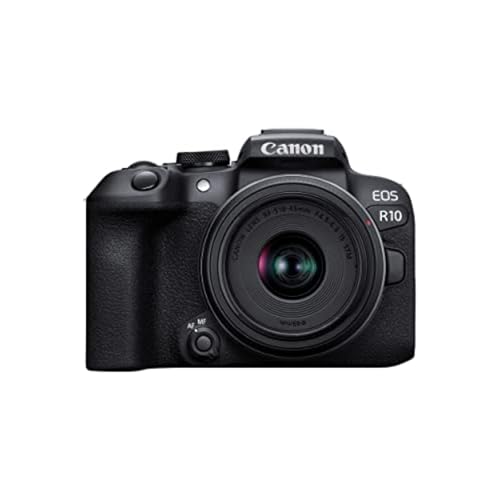
Canon EOS R10 — Best student camera overall
The Canon EOS R10 leads this list because it is the most complete learning instrument at a student’s price — the rare body whose specification reads like a syllabus and whose price reads like a bursary: fast, tactile, honest, and deep enough to remain the main camera long after the novice title has been shed. Its joystick puts autofocus placement under the thumb where a photographer’s thumb wants it; its dials put aperture and shutter under the fingers without menu mediation; its burst speed and buffer let action subjects — sport, wildlife, children — join the curriculum from the first term rather than awaiting a future upgrade.
The sensor’s files teach well: clean at the sensitivities indoor and evening work demand, forgiving in editing — the two qualities a student’s archive needs, since the archive will be re-marked by its owner’s improving eye for years, and detailed enough that cropping becomes a composition lesson rather than a quality collapse. Canon’s menu system explains itself in the plain language a student deserves, and the RF lens system behind the body offers the student’s whole future — bright primes, serious telephotos, specialist glass — at every level of budget, with a used market deepening yearly.
Its compromises are a student’s compromises, fairly dealt: no in-body stabilisation, so lenses provide it — and the student learns stabilisation as a property of the system rather than a magic of the body, which is the correct first understanding anyway; a battery sized for a day’s study rather than a weekend’s; and a viewfinder and build that serve the enthusiast tier rather than the professional’s decade. None of them interrupts the education. For the novice who has decided to learn photography properly and wants the instrument the learning deserves, the R10 is the guide’s unhesitating first recommendation.
Consider its signature student year — the calendar this camera seems almost to have been timetabled around, term by term. Autumn: aperture priority and the bright prime, portraits blooming. Winter: manual mode by the window, the triangle learned in the hands. Spring: a telephoto borrowed or bought used, the first wildlife mornings. Summer: the camera unrecognisable from its first month only in its owner’s fluency — same body, same menus, a photographer where a novice stood. Instruments that support that arc without replacement are rare at any price; at this one, the R10 stands nearly alone.
- Sensor: APS-C mirrorless, RF lenses
- Controls: joystick, dual dials, full manual curriculum
- Speed: fast bursts for action subjects
- Files: RAW with editing headroom
Strengths
- The complete curriculum in one keenly priced body.
- Handling that teaches at the speed of photography.
- A lens system for every year of the education.
Trade-offs
- Stabilisation lives in the lenses, not the body.
- Battery is a day’s, with a spare advised.
- Enthusiast build rather than professional armour.
Best for: committed novices learning the whole craft. Not suited for: casual shooters wanting decisions removed.

Fujifilm X-T5 — Best for learning by touch
The Fujifilm X-T5 is the purist’s classroom: a camera whose top plate is the exposure triangle rendered in aluminium — and whose every photograph therefore begins with the student’s hands restating the lesson before the eye composes a thing. Shutter speed has a dial. ISO has a dial. Aperture lives on the lens’s ring, exposure compensation on its own wheel — and the student who learns on this layout does not memorise settings, they absorb them, the way a pianist absorbs scales. Instructors who teach with this camera report the same phenomenon: its students stop asking what the settings are and start asking what the settings do, which is the entire transition from novice to photographer compressed into a change of question.
The imaging rewards the discipline it teaches — files with the resolution to survive the student’s growing ambitions and the colour to make the colour term of the curriculum a pleasure rather than a correction exercise. Forty megapixels produce files with the resolution to print large and crop honestly; in-body stabilisation frees the student’s lens choices and steadies the slow-shutter term; and the film simulations give the colour curriculum a set of considered answers to study against. Weather sealing protects the semesters spent outdoors, where the best lessons are.
The costs are the highest price here — tuition at the conservatory rather than the comprehensive — an autofocus that trails the Canon and Sony leaders in the fastest chaos, and a learning curve that — while tactile — is unapologetically a curve. The X-T5 does not offer the guided hand-holding of the R50; it offers something the serious student may value more, which is respect. Buy it when the ambition is certain, and it will feel less like a purchase than like matriculation.
Its community is part of the faculty: Fujifilm’s owners are disproportionately teachers by temperament — the dial layout having selected, over a decade, for photographers who think about the craft while they practise it, their forums and local groups unusually generous with critique, and the camera’s aesthetic seriousness tends to attract the student to exactly the rooms where photography is discussed as a craft. A novice does not only buy a camera here; they buy a peer group, and peer groups finish more educations than equipment does.
- Sensor: 40MP APS-C with in-body stabilisation
- Controls: dedicated dials for shutter, ISO, compensation
- Colour: film simulations as a colour curriculum
- Build: weather-sealed, traditional layout
Strengths
- Exposure learned through the fingers, permanently.
- Files that reward the craft they teach.
- A community of craftspeople to learn among.
Trade-offs
- The highest price in this list.
- No guided hand-holding for the uncertain.
- Autofocus a step behind the leaders at speed.
Best for: tactile learners and committed students of craft. Not suited for: the undecided or the budget-bound.

Nikon Z50 II — Best value student system
The Nikon Z50 II makes the student’s economic argument better than any camera here — an argument this guide regards as academic rather than commercial, since the education’s total cost, not the body’s, is the figure a student actually pays: the body’s price leaves the budget where an education actually spends it — on lenses, on a tripod, on the travel to subjects worth learning on. And it makes that argument without academic compromise: subject detection inherited from Nikon’s flagships, a bright viewfinder, serious burst capability, and controls laid out with the clarity Nikon has refined over decades of teaching photographers their trade.
The crop sensor, so often framed as a limitation, is a student’s asset twice over — and a third time in the classroom of depth of field, where its forgiveness lets composition be learned before blur becomes a variable to manage. It multiplies lens reach, admitting wildlife and sport — the curriculum’s most equipment-hungry subjects — at student prices. And it disciplines the budget toward the glass, where a photographer’s capital belongs. The files are clean, the colour is Nikon’s honest naturalism, and the Z system’s growing lens shelf, including attainable bright primes, covers the syllabus entire.
Its limits are the familiar pair: stabilisation by lens rather than by body — a lesson in system thinking the student absorbs free of charge —, and a low-light ceiling that the full-frame world exceeds at prices the student is wisely not paying. For the novice whose education is funded from a real budget — which is to say, nearly every novice — the Z50 II is the rational matriculation: full craft, honest compromises, and money left over for the lessons themselves.
There is a confidence argument specific to students that deserves air — the psychology of the sensibly priced instrument, which its owner carries into the weather and the crowd without the flinch that expensive glass teaches: a camera whose price did not consume the whole budget is a camera that gets taken to the skate park, the coast in February, the festival crowd — the risky, vivid places where a student’s portfolio actually grows. Precious cameras produce careful students; sensibly priced ones produce adventurous ones, and adventurous students learn faster.
- Sensor: APS-C with reach multiplication
- Autofocus: flagship-bred subject detection
- Controls: clear, serious, student-priced
- System: Z lenses across student budgets
Strengths
- The full curriculum at the friendliest total cost.
- Reach that admits wildlife and sport early.
- Money preserved for lenses and lessons.
Trade-offs
- Stabilisation depends on the fitted lens.
- Low-light ceiling below full frame.
- Buffer suits study more than sustained action.
Best for: budget-wise students buying the whole education. Not suited for: those wanting in-body stabilisation above all.

Canon EOS R50 — Best guided route into craft
The Canon EOS R50 is this list’s bridge: the camera for the novice who wants to learn but wants the learning introduced politely — a temperament this guide honours rather than hurries, since politeness, in a teacher, is a method and not a dilution. Its surface is all guidance — menus in sentences, creative assist that demonstrates rather than describes, automatic modes whose competence carries the first season. Underneath, without announcement, sits the complete manual curriculum: every mode, RAW files, the full RF lens system. The student crosses from guided to self-directed at their own pace, on the same body, without the disruptive purchase that so often interrupts a developing practice.
That continuity is a pedagogical position, and Canon has engineered it deliberately — the guided screens and the manual depths sharing one menu logic, so that nothing learned in the easy months must be unlearned in the serious ones. The R50’s guided interfaces do not merely simplify; they translate — each assist screen is a small lesson in what the underlying setting does — so the student who outgrows the guidance discovers they have been learning the vocabulary all along. By the time aperture priority feels necessary, it also feels familiar, which is exactly how a well-designed first year should work.
Against its sibling the R10 it concedes speed, the joystick and some depth of customisation — the honours modules, in curriculum terms, which the guided student can live without until the second body makes them relevant; against the field it concedes nothing on image quality for stills. Its video is capable, its colour is the warm Canon rendering that flatters the people a novice photographs most, and its price undercuts the R10 enough to fund the first prime lens — the purchase that, for a portrait-leaning student, may matter more than the sibling’s speed. Choose between them by temperament: guided or keen.
The R50 also serves the student whose learning is social — the one whose curriculum includes being watched, asked and eventually hired by the friends who watched the portfolio grow — the camera club’s new member, the friend-group’s designated photographer — because its results arrive early and its handling never embarrasses its owner in company. Confidence, for the learning novice, is not vanity; it is the fuel the second term runs on, and this body manufactures it reliably.
- Sensor: APS-C mirrorless, RF lenses
- Guidance: creative assist that teaches while it helps
- Curriculum: full manual modes beneath the guidance
- Colour: warm Canon rendering
Strengths
- The gentlest on-ramp to the complete craft.
- Guidance that secretly teaches the vocabulary.
- Price leaves room for the first prime lens.
Trade-offs
- Less speed and control depth than the R10.
- Kit lens is a starting point, as ever.
- Battery life is a day’s measure.
Best for: novices who want to learn with a guide present. Not suited for: the already-keen, who should take the R10.

Sony ZV-E10 II — Best for photo-video students
A growing share of novice photographers are, in truth, novice image-makers — their notebooks full of video ideas beside the still compositions, their ambitions addressed to audiences who expect both crafts from one pair of hands: their education spans the still and the moving frame, and they need an instrument that teaches both without treating either as an accessory. The Sony ZV-E10 II is that instrument in this list. Its stills are fully serious — APS-C files, eye autofocus that frees the student to compose, the E-mount’s vast lens library — and its video is the class standard, with the colour, the autofocus behaviour and the audio options that a filming curriculum requires.
The student’s advantage compounds across the two crafts — each discipline grading the other’s homework, the stills eye sharpening the filmed frame and the filmed frame’s patience disciplining the stills. Exposure learned for stills transfers to the moving frame with interest; composition learned in video — where the frame must hold for seconds, not instants — returns to stills with a discipline pure photographers take years to build. The ZV-E10 II’s handling supports the double life: a flip screen for the filmed pieces to camera, quick mode changes, and a body small enough that the whole classroom travels in a jacket’s worth of bag.
Its compromises are a screen-only composition style and controls that serve the filming layout first — the hybrid student’s timetable made physical, stills and film sharing one desk rather than keeping separate rooms. Stills purists will feel both; the hybrid student will not notice either for a year. Sony’s menu depth rewards the systematic learner — which, in this guide’s reader, is a compliment — and the lens system’s third-party riches keep the student’s glass budget survivable across both crafts.
For the novice whose ambition includes an audience — the portfolio that must also move, the clients who ask for both, the channel that is half the point — the channel, the portfolio, the clients who increasingly ask for both crafts in one booking — this is the matriculation that does not force a choice the student has not yet earned the knowledge to make. Learn both, on one body, and let the work itself declare the major.
- Sensor: APS-C mirrorless, E-mount lenses
- Video: class-leading specification and autofocus
- Stills: full manual curriculum, RAW
- System: the deepest third-party lens shelf
Strengths
- Two crafts, one instrument, no compromises that matter.
- Lens economy across stills and film.
- Autofocus that lets composition be the lesson.
Trade-offs
- No viewfinder for stills traditionalists.
- Controls lean toward the filming layout.
- Menus reward systematic study.
Best for: hybrid students of stills and film. Not suited for: eyepiece purists or stills-only traditionalists.

OM SYSTEM OM-5 Mark II — Best travelling classroom
The OM SYSTEM OM-5 Mark II is the student’s travelling classroom — the one whose timetable is set by weather windows and trailheads rather than by weekends, and whose small kit is therefore not a compromise but a timetable kept: a complete photographic curriculum — full manual control, computational tools found nowhere else in this list, weather sealing for the outdoor semesters — packed into the smallest, lightest serious system here. For the novice whose education will happen on the road, on the trail and in the weather, its arithmetic is decisive: the whole school fits in a daypack, beside the tent, and a curriculum that travels gets studied.
Its computational features are pedagogical instruments in disguise — each one a small demonstration of a principle the textbooks state abstractly, performed live on the student’s own scene while the lesson is still warm. Live Composite teaches long exposure by showing it happen; the focus-stacking tools teach depth of field by assembling it; the stabilisation — the strongest here — forgives the hand-holding errors of the early terms while the student’s technique matures. Micro Four Thirds’ depth of field character even assists the landscape term, where front-to-back sharpness is the lesson and larger formats make it harder.
The sensor’s size sets the honest boundaries: low-light headroom and background-blur extremes belong to the larger formats — boundaries stated here without anxiety, since the travelling student’s syllabus contains more weather, distance and daylight than either extreme, and the student whose heart is set on those specific aesthetics should matriculate elsewhere. Within its physics, the OM offers the most complete education per gram in photography, backed by a lens line of small, sharp, sealed glass that keeps the travelling kit’s weight honest for years.
Its owners form the hobby’s most evangelical faculty, and a novice who joins them inherits mentors with a missionary streak — the forum threads run long, the lens loans are real, and the welcome is a curriculum in itself — the OM shooter who lends a lens and an afternoon to a beginner is a recognised type. A student’s environment teaches as surely as their equipment does, and this system’s environment is unusually generous.
- Sensor: Micro Four Thirds, computational depth
- Tools: Live Composite, focus stacking, starry-sky focus
- Stabilisation: class-leading in-body system
- Kit: the lightest complete student system
Strengths
- The whole curriculum at daypack weight.
- Computational tools that teach by showing.
- Sealing for the outdoor semesters.
Trade-offs
- Low-light and blur extremes trail larger formats.
- Smaller files for the largest prints.
- Its menus hide riches that take finding.
Best for: travelling students and outdoor learners. Not suited for: low-light or blur maximalists.
Why Does Editing Deserve Its Own Term in the Curriculum?
Because the RAW file is a second photograph waiting inside the first, and the student who never develops it has learned only half the craft — the half that happens in the world, while the half that happens in the darkroom, where photographers have always finished becoming photographers, goes unstudied. The cameras here were required to produce files with editing headroom — shadows that lift, highlights that hold, colour that grades without breaking — precisely so the second education, in the second year, has material worthy of it. A student re-editing their first term’s files with second-year eyes performs the single most instructive exercise in photography: watching their own seeing improve.
The editing term has its own discipline — and its own characteristic sin, which is rescue: the attempt to edit a photograph that should have been retaken, a temptation the curriculum answers by sending the student back to the scene with the lesson the file just taught. Global adjustments before local ones; restraint as the house style; the honest crop as the last composition lesson, teaching the frame’s edges by showing what should have been excluded at capture. Software matters less than sequence, and every system’s files open in every serious editor, so the student’s software choice can be made on taste and budget alone.
Colour is the editing term’s major subject, and the systems here offer distinct tutors — none of them neutral, all of them instructive, the differences between them being precisely the education: Fujifilm’s simulations as a studied palette to grade against, Canon’s warmth, Nikon’s naturalism, Sony’s neutrality as a blank and honest page, OM’s vividness. The student who learns colour on any of them learns it properly; the student who learns it on all of them, through a library’s worth of other photographers’ files, learns it completely.
Where Do Mentors and Community Fit the Novice’s Education?
Photography is taught by cameras for a term and by people for a career — a sentence every graduate of the craft confirms, usually while naming the two or three photographers whose casual remarks rearranged their seeing more thoroughly than any course. Every system in this guide carries a community of a distinct flavour — Canon’s vastness, Fujifilm’s craft culture, Nikon’s traditionalism, Sony’s hybrid creators, OM’s travelling evangelists — and the student should enrol in theirs deliberately: the club, the forum with real critique, the local walk where the experienced photographers can be watched working, which is a masterclass disguised as a stroll.
Critique deserves a student’s protocol — partly to extract its value, and partly to survive it, since the first honest critique of beloved work is an experience the curriculum should schedule rather than leave to ambush. Seek it on finished work, not on experiments; ask specific questions rather than for general verdicts; receive it in silence and judge it a week later, when the ego’s weather has passed. The cameras here, with their files and their communities, put a novice within reach of critique of a quality that previous generations queued for — one more way in which the modern student’s education is richer than the one their teachers received.
How Do the Six Student Cameras Compare as Curricula?
| Camera | Control style | Curriculum depth | System future | Student it flatters |
|---|---|---|---|---|
| Canon EOS R10 | Dials and joystick | Complete, fast | RF, deep and growing | The keen all-rounder |
| Fujifilm X-T5 | Full physical dials | Complete, tactile | X-mount, characterful | The tactile purist |
| Nikon Z50 II | Clear conventional | Complete, value-priced | Z, growing | The budget-wise student |
| Canon EOS R50 | Guided to manual | Complete, introduced gently | RF, deep and growing | The guided learner |
| Sony ZV-E10 II | Screen and filming layout | Complete, hybrid | E-mount, deepest third-party | The photo-video student |
| OM SYSTEM OM-5 Mark II | Conventional plus computational | Complete, inventive | Micro Four Thirds, compact | The travelling student |
Every row is a complete education; the columns are temperaments — and the table’s deepest row is the invisible one, the student’s own patience, which multiplies whichever camera it is paired with and whose absence no specification can replace. The student who reads the table honestly — choosing the control style their hands will enjoy for four years rather than the badge their forum admires — has already passed the first test the craft sets, which is self-knowledge.
How Should a Novice Photographer’s First Year of Learning Be Structured?
Months one to three belong to seeing and to aperture, in that order — seeing first because it is the foundation, aperture second because it is the first setting whose misuse is visible in every frame and whose mastery is visible in every portfolio, with the camera’s other variables on automatic and the review habit — weekly, honest, specific — installed from the start. The student’s portfolio goal for the term is modest and achievable: ten photographs they can defend, each illustrating one thing they now understand about light or depth.
Months four to six add shutter speed and the first deliberate lens decision, made from the evidence of the portfolio’s focal lengths — the term in which the student’s kit stops being the shop’s suggestion and becomes, lens by lens, a personal instrument. This is also the term for the first printing — real prints, on a wall, where the year’s work stops being a scroll and becomes a standard the student can measure the next term against. Months seven to nine bring full manual fluency, not as a badge but as a by-product: the student discovers they have been pre-visualising exposures for weeks.
The final quarter is for a project: one subject, one place or one idea, pursued to a small, finished body of work — finished being the operative word, since a project teaches by ending, and the student who has never finished anything has practised photography without yet experiencing it. Projects are where the curriculum’s separate lessons fuse into authorship, and every camera in this guide — its files, its lenses, its handling — was chosen to carry a student to that fusion without a change of instrument. The novice who finishes the year with a project owns something no purchase provides: proof, addressed to themselves, that they are a photographer.
What Mistakes Do Learning Novices Make Most Often?
Studying everything at once is the student’s classic error — the syllabus consumed as a buffet, each dish sampled and none digested, by a novice whose enthusiasm is genuine and whose method wastes it — aperture on Monday, flash on Tuesday, composition on Wednesday, mastery by Friday — and it produces the recognisable graduate who can recite the exposure triangle and cannot take a photograph in a kitchen. The curriculum exists in an order for a reason. One variable, one month, one portfolio piece per lesson: the slowness is the method.
Buying the second lens in the second week runs close behind — an error with a financial cost the first mistake lacks, and one whose evidence, a shelf of strangers’ lenses, tends to accuse its owner every time the cupboard opens. The student’s early photographs cannot yet tell them what they need, because the student has not yet learned to see what the photographs are missing — that perception is itself a third-term skill. The standard zoom, thoroughly read, is the syllabus’s first book; the second lens bought from its evidence will be right, and bought from a forum’s enthusiasm will be a stranger’s lens.
Neglecting to print is the quiet failure — quiet because nothing announces it; the photographs simply remain provisional forever, unjudged at honest size, unhung, unlearned-from, a curriculum attended but never examined. A student’s work that lives only as a scroll is never finished, never judged at the size where its flaws and virtues are honest, and never hung where it can teach by daily presence. Print the term’s best, however humble the printer; the wall is the strictest and kindest tutor in the curriculum.
Finally, hiding the work — the mistake that masquerades as humility while functioning as avoidance, since work that is never shown is never finished, and a student can hide inside “not ready” for the whole of a promising education. The student who shows photographs — to a club, a class, one honest friend — receives the curriculum’s rarest input, which is another person’s eyes. Every system here has a community attached; joining it is not an accessory purchase but a course enrolment, and it is free.
Which Camera Should a Novice Photographer Commit To?
The Canon EOS R10 for the keen all-round student; the Fujifilm X-T5 for the tactile purist with the budget for matriculation; the Nikon Z50 II for the student funding an education from real money; the Canon EOS R50 for the learner who wants a guide on the shoulder; the Sony ZV-E10 II for the hybrid of stills and film; and the OM-5 Mark II for the student whose classroom is the road. Each is a four-year instrument, and the choice among them is a choice of temperament, not of quality.
Commit, then, in the word’s full sense: one system, learned deeply, its lenses arriving by evidence — and its owner’s attention, the curriculum’s true tuition, paid weekly in photographs rather than in shopping. The novice photographer’s enemy was never the wrong camera. It is the interrupted education — and every camera here, chosen once and used weekly, interrupts nothing.
Frequently Asked Questions
What is the difference between this list and a beginner camera list?
Intent. A beginner list optimises for photographs with the least learning — a perfectly honourable optimisation, aimed at a reader whose photography is a means to family, travel and memory rather than an end in itself; this list optimises for learning with the photographs as its exercises. The cameras here all offer complete manual control, RAW files and lens systems, because their reader has decided to become a photographer rather than to own a camera. If that decision sounds like yours, you are in the right guide; if it sounds like homework you did not sign up for, the foolproof-first list in our library will serve you better.
Do I need full manual mode to learn photography?
You need the ability to control each exposure variable independently — aperture with one control, shutter with another, sensitivity with a third, none of them exiled to a submenu — — aperture, shutter speed and sensitivity — and to see the effect of changing them. Full manual mode is where that control is complete, but the learning happens mostly in the priority modes, where one variable is yours and the camera honestly manages the rest. Every camera here offers the full ladder from automatic to manual, and the student should climb it one rung per term rather than leaping to the top in week one.
How much should a novice photographer spend on the whole first year?
Plan for the body with its standard lens now, one additional lens by evidence around month six — bought used, ideally, from the deep second-hand shelves every system here maintains —, and small sums for printing and a tripod when the work asks for them. The systems here were chosen partly because that staged spending is possible in all of them — no pick requires an expensive lens to be itself, and every system’s student-tier glass is genuinely good. Resist front-loading the budget; the education will spend it more wisely than the shop can.
Is APS-C good enough for serious learning, or should I start full frame?
APS-C is not a compromise for learning; for several lessons it is an advantage — and the student who masters it owns a fluency that transfers whole to any format the future holds — reach for wildlife, depth of field for landscapes, prices that admit the lenses the curriculum needs. Full frame’s gifts are real but specific, and none of them is a prerequisite for any lesson in the first four years. The professional world is full of photographers who matriculated on crop sensors and carry the fluency still. Start where the lenses are affordable; the format debate can wait until your portfolio raises it.
Should a novice photographer join a camera club or take a course?
Yes to whichever is available, and ideally to the club first — its subscription costing less than a memory card and its critique nights worth a shelf of tutorials: its critique nights and shared outings deliver the curriculum’s social half at the lowest cost, and its experienced members — most of whom matriculated on systems in this guide — are the mentors the community section describes. A structured course earns its fee when the student’s questions have become specific enough to aim it; taken too early, its syllabus and the student’s needs pass like trains. Join the club in term one, consider the course in year two, and keep the camera — whichever of these six it is — at the centre of both.
When will I stop being a novice photographer?
There is no ceremony, but there is a recognisable morning — unphotogenic, ordinary, and afterwards unmistakable in the diary: you arrive at a scene, read its light without raising the camera, set the exposure from judgement, and spend your attention entirely on composition and timing. The camera has become transparent — an instrument you think through rather than about. Every pick in this guide is capable of carrying a student to that morning, and most of their owners report it arriving somewhere in the second year, unannounced, mid-photograph.
Related Guides
The learning path branches by temperament in our library, and the neighbouring guides cover the closest branches — the gentler on-ramp for the not-yet-committed, the wider beginner field for comparison, and the second-lens decision that this guide’s curriculum schedules for the middle of the first year. Compare the gentler start in our guide to cameras for novice photographers buying their very first camera, browse the wider field in the best cameras for newbies, and plan the second year with our guide to choosing your second lens.


