kajuandouglas.com is reader-supported. When you buy through links on our site, we may earn an affiliate commission.
Where to Buy a Landscape Camera, and Why the Best Light Rarely Waits for Anyone
The best cameras for landscape photos are not decided on a spec sheet in a warm shop. They are decided at 5:40 in the morning on a ridge above Glencoe, when the cloud tears open for ninety seconds and your fingers are too cold to feel the dials. A landscape camera has to resolve a whole hillside sharply enough for a large print, hold detail in a bright sky and a peat-dark valley at the same time, shrug off the drizzle that produces the best light, and be light enough that you actually carried it up the hill instead of leaving it in the car park. This guide is built around that reality: six cameras, each chosen because it solves a different part of the landscape problem honestly.
Where to buy: every linked camera name below leads to that model’s Amazon listing, where you can check the current kit options and lens bundles. Buy the body wherever you like, but spend your second tranche of money on the unglamorous kit that makes landscape photographs happen — a tripod that does not shiver in wind, a circular polariser, spare batteries for cold mornings, and a rain cover. Those four items will improve more of your frames than the gap between any two bodies in this guide.
The six picks divide into three philosophies. The full-frame trio — Sony, Panasonic and Canon — chase maximum dynamic range and print size. The Fujifilm X-T5 and OM SYSTEM OM-5 Mark II argue that a smaller sensor carried everywhere beats a bigger one left at home. The Fujifilm X100VI makes the most radical case of all: one fixed lens, no decisions, nothing to weigh you down on the walk in. None of them is the answer for everyone, and the detailed sections below are frank about who should skip each one.
Key Takeaways
- Dynamic range matters more than megapixels for most landscapes, but resolution decides how large you can print — know which one your walls actually need.
- The Fujifilm X-T5 is the colour-lover’s pick; the Sony Alpha 7 IV is the safest all-round full-frame choice here.
- Weather sealing is not a luxury in landscape work — the best light usually arrives with weather attached.
- The OM SYSTEM OM-5 Mark II is the pick for walkers: its computational tricks and tiny lenses change what a day on the hill feels like.
- A fixed-lens camera like the X100VI sounds like a limitation and behaves like a discipline — some photographers produce their best work under exactly that constraint.
- Budget for the tripod, filter and batteries before you budget for a body upgrade; support gear fails more landscape shoots than sensors do.
In this guide
Quick Picks
| Camera | Badge | Why it is here |
|---|---|---|
| Fujifilm X-T5 | Best for colour straight from camera | A high-resolution APS-C sensor, beloved film simulations and dials you can work with gloves on. |
| Sony Alpha 7 IV | Best all-round full frame | Deep dynamic range, a vast lens catalogue and files that forgive heavy-handed editing. |
| Panasonic LUMIX S5II | Best value full frame | Full-frame reach, strong stabilisation and a price of entry that leaves money for glass. |
| Canon EOS R6 Mark II | Best for dawn-to-dusk days | Confident autofocus and clean high-ISO files for the walk out after sunset. |
| OM SYSTEM OM-5 Mark II | Best for long walks | Featherweight body, serious sealing and computational modes that replace a bag of filters. |
| Fujifilm X100VI | Best fixed-lens companion | One lens, one focal length, zero faff — a camera that disappears until the light arrives. |
How Did We Choose the Best Cameras for Landscape Photos?
We started from the failures. Ask landscape photographers about ruined shoots and the same stories recur: a sky blown to white because the sensor ran out of headroom, a print that fell apart because the file was too small for the wall it was promised to, a body that fogged or froze in the weather that made the scene worth shooting, and — most common of all — the perfect camera sitting at home because the bag was too heavy for the walk. Our shortlist was scored against those four failure modes first, and against brochure features second.
Dynamic range was weighed at base ISO, where landscape work lives, and we favoured sensors whose raw files let you lift shadows two or three stops without the blacks turning to mush. Resolution was judged by print arithmetic rather than bragging rights: a 33-megapixel file prints beautifully at sizes most homes can hang, and anything beyond that buys cropping freedom more than visible sharpness. We checked sealing claims against each maker’s own documentation, tested how each control layout behaves with numb fingers — dials beat menus at dawn — and weighed every body with a typical landscape lens attached, because the number that matters is the one on your shoulder at hour three.
Finally, we considered the lens ecosystem each camera locks you into. A landscape kit usually means a wide zoom, a standard zoom and eventually a telephoto for compressing ridges, and some mounts offer those at half the weight and cost of others. Every camera below earned its place under those tests; the differences that remain are about temperament, and temperament is what the detailed reviews try to describe.
What Does a Landscape Sensor Actually Have to Survive?
A landscape frame is a stress test disguised as a picture. Within one exposure you may have sunlit snow, a sky near clipping, and a gorge in full shade — a brightness span that punishes sensors with shallow highlight headroom. This is why experienced landscape shooters expose for the highlights and rescue the shadows in editing, and why the quality of that rescue separates the cameras in this guide. Files from the full-frame picks tolerate aggressive shadow recovery with grace; the smaller sensors here manage it too, provided you expose carefully and accept a little more texture in the darkest tones.
The second demand is stillness. Landscape work happens at small apertures on tripods, at long shutter speeds, in wind. In-body stabilisation matters less here than in almost any other genre — the tripod does that job — but electronic shutter options, remote release support and a screen you can read in bright sun all matter more than marketing suggests. A tilting screen that lets you compose from knee height without lying in wet grass is worth more at a lakeshore than another half-stop of anything.
The third demand is weather, and it is the one beginners underestimate. Sea spray at a coastal sunrise, drizzle on a moor, condensation when you step from a cold hillside into a warm car — a landscape camera lives a harder life than a studio camera, and sealing, battery behaviour in the cold, and a grip you can hold with gloves are working specifications, not luxuries.
Which Six Cameras Earn the Early Alarm? The Picks in Detail

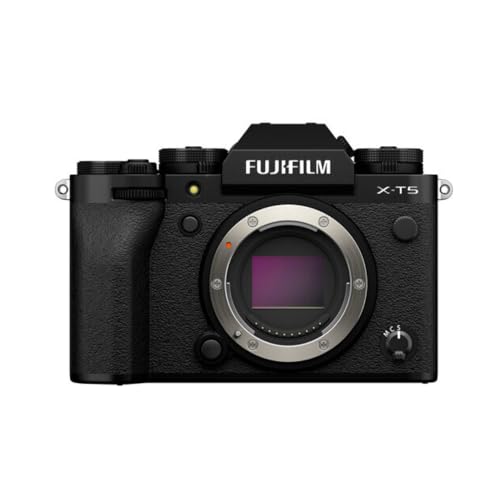
Fujifilm X-T5 — Best for colour straight from camera
There is a particular kind of landscape morning — autumn mist sitting in a Cotswold valley, bracken turning rust-red — where the Fujifilm X-T5 makes photographs that look finished before you have touched a slider. Its 40-megapixel APS-C sensor resolves far beyond what the format used to promise, and Fujifilm’s film simulations are not a gimmick in this genre: Velvia’s saturated greens and blues were designed for exactly this subject, and shooting raw-plus-JPEG means you carry both the faithful file and the characterful one home.
The second thing the X-T5 gets right for landscape work is its skin. Dedicated dials for shutter speed, ISO and exposure compensation sit on the top plate where cold fingers can find them, and the three-way tilting screen handles both waist-level composition and the awkward portrait-format shot wedged between rocks. On a February morning in the Brecon Beacons, that control layout is the difference between adjusting exposure by feel and taking your gloves off to hunt through a menu while the light dies. The body is weather-resistant, the lenses in the XF line include superb small primes and zooms, and the whole kit rides lighter than any full-frame equivalent — a fact your knees will confirm on the descent.
- Sensor: 40MP APS-C, raw files with generous editing headroom
- Controls: dedicated top-plate dials, three-way tilting touchscreen
- Sealing: weather-resistant body (pair with WR lenses)
- Stabilisation: in-body, up to high stops with compatible lenses
Strengths
- Colour science that flatters landscape subjects straight out of camera
- Resolution that supports large prints and confident cropping
- Physical dials that stay usable with gloves and cold hands
Trade-offs
- APS-C dynamic range trails the full-frame picks when shadows are pushed hard
- The best XF wide zooms add real cost to the total kit
- Autofocus, while good, is not the tool for fast wildlife detours
Best for: photographers who love the editing process less than the hillside, and want colour that arrives already composed. Not suited for: shooters who routinely print enormous or recover four stops of shadow as a habit.

Sony Alpha 7 IV — Best all-round full frame
If the X-T5 is the romantic’s camera, the Sony Alpha 7 IV is the professional’s insurance policy. Its 33-megapixel full-frame sensor is the balanced one in Sony’s line — enough resolution for serious prints, files that stay clean when you drag shadows upward, and a dynamic range that handles the classic landscape insult of a bright sky over a dark foreground without bracketing gymnastics. Photograph a summer sunset over the Amalfi Coast, where the sea-facing cliffs fall into shade while the sky still burns, and the A7 IV’s raw files simply contain the scene.
The deeper argument for the Sony is everything around the sensor. The E-mount lens catalogue is the broadest in mirrorless: native glass at every price, plus third-party wide zooms that make building a landscape kit genuinely affordable over time. Battery life is the strongest here, which matters on multi-day trips where charging is a negotiation. The menus have grown more logical than Sony’s old reputation suggests, and custom buttons let you park focus peaking, zebras and your preferred grid exactly where your thumbs expect them. It is not a charming camera, and nobody writes poems about its dials — but when a once-a-year sky happens over a viewpoint you may never revisit, charm is not the specification that saves the frame.
- Sensor: 33MP full-frame, wide dynamic range at base ISO
- Mount: Sony E, the deepest lens catalogue in this guide
- Battery: longest endurance of the six picks
- Video: strong hybrid capability for motion landscapes
Strengths
- Forgiving raw files that survive aggressive highlight-shadow balancing
- Lens choice at every budget, including excellent third-party wides
- Battery stamina suited to multi-day trips away from power
Trade-offs
- Handling is functional rather than pleasurable; dials are less tactile
- The screen mechanism favours video angles over low tripod work for some
- Rolling shutter in silent mode asks for care with moving foliage
Best for: the landscape shooter who wants one system to grow with for a decade. Not suited for: minimalists who find deep menus and options a burden rather than a toolkit.

Panasonic LUMIX S5II — Best value full frame
The Panasonic LUMIX S5II exists to answer an awkward question: how much full-frame landscape quality can you buy while still affording the lenses, the trip and the time off to use them? Its 24-megapixel sensor gives up print size against the Sony and Fujifilm picks, and in exchange delivers files with lovely highlight roll-off, excellent colour, and high-ISO behaviour that keeps blue-hour and night landscapes clean. For the wall sizes most homes accommodate — and for the screens where most landscape work is actually admired — 24 megapixels honestly resolved is plenty.
Two Panasonic traits lift the S5II beyond its price. The in-body stabilisation is superb, which converts it into a handheld dawn camera on mornings when the tripod stays in the car: scrambling over wet rock at a Cornish cove, you can work at slow shutter speeds braced against a boulder and come home with sharp frames. And the L-mount alliance means Sigma and Leica share the lens mount, so your wide-angle options span sensible money to silly money without an adapter. Phase-detect autofocus, new in this generation, removed the old objection to Panasonic for hybrid shooters. It is the thinking person’s route into full frame: spend the saving on a better tripod and a week in the mountains, which will do more for your portfolio than eight extra megapixels.
- Sensor: 24MP full-frame, clean files at high ISO
- Mount: L-mount, shared with Sigma and Leica lenses
- Stabilisation: among the best in-body systems here
- Autofocus: phase-detect, a first for this Panasonic line
Strengths
- Full-frame landscape quality at the friendliest entry cost in this guide
- Stabilisation that genuinely enables handheld low-light landscapes
- Highlight handling that flatters skies and water
Trade-offs
- 24MP limits aggressive cropping and the very largest prints
- L-mount landscape lens range is growing but thinner than Sony’s
- Body is compact, which larger hands may find cramped with gloves
Best for: photographers entering full frame who would rather spend on lenses and locations. Not suited for: print-makers whose walls demand the maximum file size available.

Canon EOS R6 Mark II — Best for dawn-to-dusk days
Landscape trips rarely stay in their lane. The morning shoot becomes a walk, the walk passes a waterfall, the waterfall has a dipper working the rocks, and by evening you are photographing the Milky Way over the same valley. The Canon EOS R6 Mark II is the pick for that kind of day: a 24-megapixel full-frame sensor with superb high-ISO manners, autofocus that finds birds and eyes as happily as it finds horizons, and a burst rate that turns a landscape camera into a wildlife camera when the opportunity walks into frame.
Canon’s colour rendering of greens and skin-warm tones has loyalists for a reason, and its RF landscape lenses — particularly the compact wide zooms — pair with this body into a kit that travels well. Where the R6 Mark II quietly excels for landscape specifically is the twilight bookends of the day: pre-dawn starts and the walk back under a headtorch, shooting handheld at sensitivities that would have been unusable a generation ago. Its files at high ISO hold together with a smoothness the resolution-led picks cannot match. The honest cost is print headroom — at 24 megapixels you compose carefully rather than crop later — and Canon’s lens prices at the wide end are not shy. But as a single camera for trips where the landscape is the plan and everything else is a bonus, nothing else here covers as much ground.
- Sensor: 24MP full-frame, outstanding high-ISO cleanliness
- Autofocus: fast, confident subject detection for wildlife detours
- Mount: Canon RF, with compact wide zooms suited to travel
- Speed: high burst rate for a landscape-adjacent all-rounder
Strengths
- The most versatile day-trip camera here — landscape, wildlife, night
- Twilight and astro files that stay clean at high sensitivities
- Canon colour that many landscape shooters prefer unedited
Trade-offs
- 24MP asks you to compose precisely; cropping room is limited
- RF wide-angle lenses carry premium pricing
- Resolution-led rivals beat it for the largest exhibition prints
Best for: trip photographers whose landscape days keep turning into wildlife and night shoots. Not suited for: gallery printers who measure success in maximum file dimensions.

OM SYSTEM OM-5 Mark II — Best for long walks
Every landscape photographer eventually faces the arithmetic of the hill: the best viewpoints are rarely near the car, and every gram in the bag is a gram your legs negotiate with for six hours. The OM SYSTEM OM-5 Mark II is built for that arithmetic. Its Micro Four Thirds sensor is the smallest here, yet the system around it — tiny weather-sealed lenses, a body you can palm, sealing rated to shrug off the weather that empties viewpoints of other photographers — produces a full landscape kit that can weigh less than a rival’s body alone.
The OM-5 Mark II also cheats, delightfully, with computation. Live ND simulates neutral-density filters electronically, so long-exposure waterfalls and cloud-streaked skies need no filter stack on a windy ridge. Handheld high-resolution modes build larger files from a tripod-free stance on ground too uneven for legs and spikes. A starry-sky autofocus mode handles the astro detour. None of this replaces a big sensor’s raw headroom — push the shadows hard and the smaller sensor shows its limits sooner — but landscape photography is mostly made at base ISO in good light at f/8, and there the gap narrows to something most viewers will never see in print. For the walker-photographer, the camera that is present for a hundred viewpoints beats the camera that is perfect for ten.
- Sensor: Micro Four Thirds, with high-res modes for larger files
- Weight: lightest complete landscape kit in this guide
- Features: Live ND, starry-sky AF, strong weather sealing
- Lenses: compact sealed zooms ideal for hill use
Strengths
- A whole sealed landscape kit at a weight rivals cannot approach
- Computational modes that replace filters and tripod time
- Sealing that invites shooting in the weather others shelter from
Trade-offs
- Smallest sensor here — shadow recovery and high ISO show it first
- Micro Four Thirds is a commitment; the mount’s future is niche
- Deep menus hide the best features until you learn the system
Best for: hillwalkers and travellers who measure a kit by the mile, not the spec sheet. Not suited for: photographers whose work lives in dark shadows and huge prints.

Fujifilm X100VI — Best fixed-lens companion
The Fujifilm X100VI should not work as a landscape camera at all: its lens does not zoom, does not come off, and frames the world at one moderately wide angle forever. And yet landscape photographers keep producing remarkable work with this line, because constraint is a composition teacher. With the X100VI you stop hunting for the perfect focal length and start hunting for the perfect position — you move your feet, find the foreground, and build the frame from where you stand. A 40-megapixel sensor behind that fixed lens means the files are serious: detailed, printable, and open to sensible cropping when the scene insists.
As a travel and second camera it has no equal in this guide. It slips into a jacket pocket on the walk to a viewpoint, draws no attention in a village at dawn, and its film simulations make the journey photographs — the bothy, the ferry, the weather closing in — as pleasurable as the summit frames. In-body stabilisation and a leaf shutter add quiet superpowers: silent shooting, flash sync at any speed for the rare lit portrait against a sunset. The honest limitations are real — no weather sealing worthy of a storm, no ultra-wide for grand interiors of canyons, no telephoto compression of ridge lines — and battery life is modest. Treat it as the camera that accompanies every trip rather than the camera that carries one, and it earns its place in more bags than any system camera here.
- Sensor: 40MP APS-C behind a fixed 23mm-equivalent-wide lens
- Design: pocketable, discreet, hybrid viewfinder
- Shutter: leaf shutter, silent and flash-friendly
- Stabilisation: in-body, unusual in a fixed-lens compact
Strengths
- Resolution and quality far beyond its pocketable size
- Constraint that sharpens compositional discipline
- The travel companion every other pick wishes it could be
Trade-offs
- One focal length, permanently — no wides, no telephoto compression
- Sealing is light; storms are for the system cameras
- Availability has been notoriously tight since launch
Best for: photographers who travel light and compose with their feet. Not suited for: anyone whose landscapes depend on a range of focal lengths.
How Do the Six Compare at a Glance?
| Camera | Sensor | Landscape strength | Watch out for |
|---|---|---|---|
| Fujifilm X-T5 | 40MP APS-C | Colour and dials | Shadow headroom vs full frame |
| Sony Alpha 7 IV | 33MP full frame | Files and lens choice | Utilitarian handling |
| Panasonic LUMIX S5II | 24MP full frame | Value and stabilisation | Cropping headroom |
| Canon EOS R6 Mark II | 24MP full frame | Twilight and versatility | Print size ceiling |
| OM SYSTEM OM-5 Mark II | Micro Four Thirds | Weight and sealing | Sensor limits in extremes |
| Fujifilm X100VI | 40MP APS-C fixed lens | Portability and discipline | One focal length only |
Read the table as a map of trade-offs rather than a ranking. The Sony and Fujifilm X-T5 lead on file quality for print; the OM-5 Mark II leads on everything that happens before the shutter — the walk, the weather, the willingness to keep going. The two 24-megapixel full-frame cameras trade resolution for cleanliness and price, and the X100VI trades flexibility for presence. Landscape photographers who know their own habits can locate themselves in that table in seconds.
How Do You Actually Photograph a Landscape, Step by Step?
Begin the night before. Check the sunrise time, the cloud forecast at altitude rather than at sea level, and the tide if the coast is involved; a landscape shoot is scheduled by astronomy and weather, not by enthusiasm. Arrive while it is still dark enough to need a headtorch, because the twenty minutes before sunrise frequently hold better colour than the sunrise itself, and because arriving early lets you scout foregrounds — a pool, a boulder, a line of frost — while your eyes adjust.
Work the scene in a fixed order. First the wide establishing frame from the obvious viewpoint, because it banks a usable photograph whatever happens next. Then slow down: drop the tripod to knee height and look for a foreground anchor that gives the eye a way in. Expose for the highlights — check the histogram, not the screen brightness — and bracket only when the sky-to-ground span defeats a single frame. Use a two-second timer or a remote release so your hand is not on the camera when the shutter opens. Shoot the obvious frame, then turn around: the light behind you, on the hill you climbed, is somebody else’s landscape and frequently the better picture.
Finish deliberately. As the light hardens, switch to details — patterns in sand, frost on a gate, the telephoto compression of ridge behind ridge — before packing up. Review nothing critically on the small screen beyond exposure and focus at maximum magnification; judgement belongs to the evening, at home, on a big display, with the kettle on. Photographers who follow that rhythm with any camera in this guide will out-shoot photographers who chase gear with none.
One last habit separates the regulars from the occasional visitors: they keep a notebook, paper or phone, of what the light did. Not the settings — the camera remembers those — but the facts the file cannot hold: that the mist lifted from the left, that the gap in the cloud lasted ninety seconds, that the viewpoint works only when the river is low. Next season, that notebook is worth more than any upgrade.
What Are the Most Common Mistakes Landscape Beginners Make?
The classic error is arriving at the famous viewpoint at noon, when the light is at its flattest, and concluding the location is overrated. The second is composing with the horizon dead centre and no foreground, producing a picture that is technically a landscape and emotionally a screensaver. The third is trusting the rear screen’s brightness in sunshine and coming home with a card of underexposed files. The fourth is buying a second body before buying a decent tripod — support fails more landscape photographs than sensors ever will.
A subtler mistake is editing every frame with the same heavy hand: saturation pushed until greens turn fluorescent, clarity until hillsides look carved from foil. Landscape photographs age better with restraint. And the most expensive mistake of all is the kit that never leaves the house — a system so heavy it stays behind on the walks where the photographs were. Every pick in this guide was chosen partly to protect you from that one.
How Do You Choose Between Sensor Sizes for Landscape Work?
The sensor-size argument is usually conducted as a war, and it would be more useful conducted as a budget meeting. Full frame buys you three concrete things: more dynamic range at base ISO, cleaner files when the light fails, and shallower depth of field that landscape photographers — who typically want everything sharp from foreground fern to far ridge — mostly do not need. What full frame costs you is equally concrete: heavier bodies, heavier and pricier lenses, and a bag that grows by a third. APS-C, as the Fujifilm picks show, returns most of the image quality at notably less weight, and its smaller lenses make a two-lens landscape kit a realistic daypack load. Micro Four Thirds pushes the same trade furthest, exchanging the last reserves of shadow recovery for a system so light it changes which walks are photographic walks at all.
A practical way to decide is to audit your own archive. Look at your fifty favourite landscape frames and ask how they were made. If most sit at base ISO on a tripod in decent light, the sensor-size gap in this guide will be invisible in your prints, and you should optimise for weight, sealing and handling — the things that decide whether the camera is with you. If your favourites are full of twilight, storms, night skies and rescued shadows, the full-frame premium is buying you something you demonstrably use, and it is money honestly spent. The mistake is buying for the photographer in the brochure rather than the one in your archive.
There is also a depth-of-field subtlety that cuts in the smaller formats’ favour. At a given aperture, smaller sensors deliver more depth of field, which means the APS-C and Micro Four Thirds picks reach front-to-back sharpness at wider, faster apertures — gathering more light and keeping shutter speeds safer in wind. Full-frame shooters chasing the same depth of field stop down further and pay for it in shutter speed or ISO. On a gusty ridge, that is a genuine working advantage, and it is one reason experienced hill photographers are less sniffy about small sensors than forum debates suggest.
How Do You Keep Shooting When the Weather Turns?
Bad weather is not an interruption to landscape photography; in temperate climates it is the main event. The practical routine starts before you leave: check the sealing on body and lens as a pair, because the system is only as sealed as its weakest joint, and pack a microfibre cloth somewhere it stays dry — a lens cloth in a sealed sandwich bag has saved more shoots than any filter. Carry the camera under your jacket between frames in heavy rain rather than swinging from a strap, and learn to change lenses facing away from the wind, crouched, with the body opening pointed down.
Condensation is the quieter enemy. Moving a cold camera into a warm car or cottage fogs elements inside and out, and the fix is patience: seal the camera in a plastic bag before bringing it indoors, so condensation forms on the bag instead of the glass, and let it warm slowly. Batteries deserve the same respect — cold cells sag, so carry the spare in an inside pocket where your body keeps it warm, and rotate it in when the gauge drops suspiciously fast on a frosty summit. The OM-5 Mark II and the sealed system picks in this guide tolerate all of this as a working environment; the X100VI, with its lighter sealing, is the one to shelter first and shoot between showers.
Finally, protect the photograph, not just the equipment. Rain on a front element softens a frame more surely than a modest sensor ever will, so check the glass every few shots and wipe with a dry part of the cloth. A lens hood is a rain shield as much as a flare shield. And when the weather closes in completely, put the camera away and watch: the break, when it comes, often gives ninety seconds of the best light of the day to the photographer who is ready rather than the one who is drying a camera.
What Should You Spend on Everything That Is Not the Camera?
Landscape photography has a second price list that beginners discover too late, and it is written in accessories rather than bodies. The tripod is the big one: a wobbly support defeats a great sensor, so buy the tripod you can carry all day and that stands without flexing in wind — and accept that this costs real money once, rather than small money three times. A ball head with a smooth panning base, an L-bracket for painless portrait-format work, and a remote release or a camera app you trust complete the support kit.
Filters reduce to one essential and several luxuries. The circular polariser is the essential. Graduated filters have largely been replaced by exposure blending in software, and neutral-density filters matter mainly to photographers who love long exposures — though the OM-5 Mark II’s Live ND feature exists precisely to spare its owners that purchase. Storage and power follow: fast cards sized to your habits, a card reader that does not waste evenings, and enough batteries for the coldest day you shoot, because landscape light and low temperatures are frequent companions.
Then there is the bag, which is a photographic tool in disguise. It decides how fast you can deploy on a hillside, whether the camera survives a stumble, and whether you carry the kit at all on marginal days. A bag that opens from the back, carries a tripod without swaying, and leaves room for the layers and food a hill day demands will produce more photographs than any lens upgrade. Spend on the system around the camera in that order — support, bag, polariser, power — and every body in this guide will perform closer to its ceiling.
How Do You Plan a Landscape Shoot Before You Leave Home?
Great landscape photographs are usually scheduled before they are taken. The planning begins with light direction: a mapping app that shows sunrise and sunset azimuths tells you whether a given valley will be lit or in shadow at the hour you care about, and a viewpoint that sings at sunset may be a grey trench at dawn. Photographers who work the same coastline for a year learn that a west-facing cove is an evening location, that the harbour wall works only when the tide is mid-height, and that the famous ridge needs the sun low from the south — knowledge no camera in this guide can substitute for.
Weather planning deserves the same rigour. Read the mountain or coastal forecast rather than the town forecast, and learn the signatures of the conditions you want: a clear night followed by a still dawn promises mist in the valleys; a front clearing from the west promises drama; high thin cloud promises a soft, long twilight. Cloud cover at the horizon matters more than cloud overhead — a small gap at the horizon at sunset can ignite the underside of a dull sky. Build a shortlist of locations matched to conditions, so that whatever the morning offers, you have somewhere it will be welcomed.
Then rehearse the logistics. How long is the walk, honestly, in the dark, with the bag? Where exactly will you park, and is the viewpoint the obvious one or the shoulder fifty metres along that nobody photographs? Charge batteries the night before, format cards at home rather than on the hill, and set the camera’s clock and your preferred starting settings — base ISO, aperture priority, raw — before you sleep. Every one of the six picks rewards that preparation equally; the planning is the one upgrade that transfers perfectly when you eventually change systems.
How Should You Edit a Landscape File Without Ruining It?
The editing of a landscape photograph should feel like developing, not decorating. Start with the global decisions the scene itself dictates: set the white balance to the light you remember, not the light the camera guessed, and build the exposure around protecting the brightest part of the sky. The raw files from the full-frame picks here tolerate strong shadow lifting; use that tolerance to open the foreground gradually, watching for the moment the blacks turn grey and the image loses its anchor. A landscape with no true black in it looks like a photograph of a photograph.
Local adjustments do the real compositional work. Darken a distracting bright corner, lift the pool of light on the subject ridge, and let the eye travel where you intended it to when you chose the viewpoint. Colour deserves restraint: the Fujifilm simulations exist because believable colour is usually more saturated in memory than in measurement, and the honest middle is a small step from the file, not a leap. Sharpen for the output — a screen, a book and a wall print each want different amounts — and soft-proof before printing, because the print is where landscape photographs in this guide’s class are ultimately judged.
Keep a consistent hand across a series. A set of frames from one trip, edited with one restraint and one colour logic, hangs together as a body of work; a set where every frame has been pushed in a different direction looks like a competition. The photographers whose landscape work endures tend to edit less each year, not more — the camera choice, the viewpoint and the light did the heavy lifting, and the file merely needed to be allowed to show it.
How Do the Seasons Rewrite the Landscape Brief?
Spring is the season of water and new green, and it flatters every camera here without favour. Rivers run high, waterfalls perform, and the fresh green of new leaves is the exact subject that separates good colour science from bad — it is the season where the Fujifilm picks earn their admirers, because rendering young beech leaves without tipping into fluorescence is harder than any spec sheet admits. Spring’s working hazard is mud and midges rather than cold, and its light, while lovely, hardens quickly; the photographic day compresses into the first and last two hours sooner than beginners expect.
Summer trades quality of light for quantity of access. The high paths are clear, the nights are short enough that dawn and dusk shoots can share one day, and the full-frame picks come into their own at the extremes — astro-landscapes under the Milky Way’s core, where clean high-ISO files and fast wide lenses decide everything. Summer haze is the enemy: heat shimmer over a valley at midday softens telephoto landscapes in ways no sharpening repairs, which is why the season’s serious work still happens at the day’s edges. Carry more water than feels reasonable, and treat the midday hours as scouting time for the evening.
Autumn is the landscape photographer’s high season and the sternest test of dynamic range in this guide. Low sun rakes across turning colour, mist sits in valleys until mid-morning, and a single frame may hold sunlit gold foliage and a gorge in blue shadow — precisely the span the Sony and Panasonic files were built to hold. It is also the season of rain, when sealed kits stop being a specification and start being the shoot. The OM-5 Mark II’s indifference to weather and the X-T5’s dials-under-gloves handling both make their strongest cases in October.
Winter strips the landscape to structure: bare trees, low raking light all day, frost that outlines every hedge and ridge. The photographic day is short and the light is kind for most of it, but the cold taxes batteries, fingers and resolve. This is the season where handling design — dial size, button feel with gloves, a grip that works in mitts — outweighs sensor arguments entirely, and where the lightest kit wins again because the walk in is through snow or mud. Photographers who shoot all four seasons with one of these six cameras will find the camera disappears as a variable by the second year; what remains is the looking, which was the point all along.
How Do You Print a Landscape Photograph So It Deserves the Wall?
Printing is the final examination every camera in this guide is really sitting. A screen forgives: it is bright, backlit and small. A print is honest about resolution, about shadow detail, and about whether the colours you chose survive translation onto paper. Begin by matching ambition to file: the 40-megapixel Fujifilm files and the 33-megapixel Sony files support genuinely large prints with fine detail intact, while the 24-megapixel cameras print beautifully to the sizes most rooms take and ask only that you not crop away half the frame first. The OM-5 Mark II’s high-resolution modes exist for exactly the photographer who prints big from a small kit.
Paper choice is a creative decision, not an afterthought. Matte papers flatter mist, soft light and muted colour, and they forgive a slightly heavy editing hand; glossy and baryta papers deliver the deep blacks and punch that coastal drama and night landscapes want. Order small test prints of the same frame on two papers before committing to the large one — the difference is not subtle, and the paper that suits your winter work may betray your summer colour. Soft-proof in your editor with the paper’s profile, lift the shadows a touch beyond what the screen suggests, because prints render darker than backlit displays, and give the frame a margin of breathing room rather than filling the sheet edge to edge.
Finally, print regularly and print small as well as large. A shoebox of modest prints from a year’s shooting teaches more about your own seeing — which viewpoints you repeat, which light you actually catch, which camera you reached for — than any review of specifications. Several photographers we know keep the small print of a favourite frame from each camera they have owned; the differences that mattered, in the end, were rarely the ones the spec sheets argued about.
How Do You Compose a Landscape That Holds a Viewer’s Eye?
Composition in landscape work is mostly subtraction performed with your feet. The frame you want is rarely the first frame you see; walk twenty metres and the distracting fence post leaves, the foreground pool aligns with the gap in the hills, and the picture simplifies into its essentials. Work with three questions. What is the subject — not the location, but the one thing this frame is about: a ridge line, a pool of light, a tree against mist? What leads the eye to it — a stream, a wall, a shadow’s edge? And what can be excluded, by moving, crouching or waiting for cloud to shade it, without the picture collapsing?
Height is the most underused control a landscape photographer owns. The standard viewpoint is standing eye level because that is where the photographer happens to be; dropping to knee height turns grasses and stones into foreground architecture, while standing on the boulder behind you flattens the middle ground and layers the ridges. Every camera in this guide has a tilting or articulating screen precisely so that these heights are comfortable rather than punishing. Use the grid overlay, keep horizons honest, and leave a little more sky or a little less than instinct suggests — the crop you regret is almost always the one with no room in it.
Final Recommendation
Choose by the photographer you actually are. If you print large and edit deeply, the Sony Alpha 7 IV is the safest decade-long answer, with the Fujifilm X-T5 the choice when colour and handling pleasure matter as much as files. If the budget must stretch to lenses and trips, the Panasonic LUMIX S5II is the intelligent route into full frame, and the Canon EOS R6 Mark II wins whenever the day refuses to stay purely landscape. Walkers should take the OM SYSTEM OM-5 Mark II seriously — presence beats perfection — and everyone who travels should consider the X100VI as the companion that guarantees a camera is always within reach. Whichever you choose, spend the next money on a tripod and a dawn alarm, not another body.
Related guides
- Best Digital Cameras for Landscape Pictures: Six Bodies for Dynamic Range, Weather and Big Prints
- Best Cameras for Photos: Six Picks for the Pictures You Actually Take
- Best Cameras for Nightscapes: Six Tripod Cameras for Blue Hour, Skylines and Light Trails
Frequently Asked Questions
How many megapixels does a landscape camera really need?
For prints up to the sizes most homes hang, 24 megapixels is genuinely sufficient, and every pick here meets or exceeds that. More resolution buys cropping freedom and very large prints; it does not buy better light, better composition or better weather, which are what actually separate landscape photographs.
Is full frame essential for landscape photography?
No. Full frame leads on dynamic range and shadow recovery, and that lead is real in extreme light. But APS-C and Micro Four Thirds cameras in this guide produce excellent landscape work at base ISO — where the genre lives — while saving substantial weight and cost.
Which single lens should a landscape beginner buy first?
A versatile wide-to-standard zoom covering the classic landscape range. It handles the great majority of viewpoints, teaches you which focal lengths you actually use, and its usage data — not a shop’s opinion — should decide your second lens.
Do I still need filters in the digital era?
A circular polariser remains irreplaceable: it cuts reflections on water and wet rock and deepens skies in ways software cannot fully reproduce. Neutral-density effects can increasingly be simulated or bracketed, but the polariser earns its place in every landscape bag here.
How important is weather sealing for landscapes?
More than in any other genre. The light landscape photographers chase arrives with rain, spray and mist attached, and a sealed body and lens let you keep working through the minutes when the scene is at its best and everyone else has packed away.
Can a fixed-lens camera like the X100VI really do landscapes?
Yes — within its one focal length, and many photographers find the constraint improves their seeing. It will not replace a system camera for grand wides or compressed ridges, but as an always-carried landscape tool its files are entirely serious.
What changes when I print a cropped landscape file at exhibition size?
Cropping before a large print removes pixels from every edge, so a generous composition in the field protects your final dimensions better than any upscaling step afterwards. Leave breathing room around ridges, waterfalls and foreground rocks whenever the viewpoint allows it, then trim distractions at home without surrendering the resolution your printer needs. Viewing distance rescues moderate files, because gallery visitors rarely press close enough to count grain across a wide scene. Output sharpening belongs last in the chain, applied for the chosen paper and final size rather than for screen display. Matte papers soften fine detail and suit misty mornings, whereas glossy stock holds micro contrast in wet stone and foliage. Proof one narrow strip at full scale before committing the whole sheet, checking shadow separation and sky banding under the lighting where the print will hang.
Related Guides
Continue with our companion reading: best cameras for landscape and nature for the wildlife crossover, best cameras for image quality for a deeper look at sensors, and best cameras for adventure travel when the landscape involves a plane ticket.


