kajuandouglas.com is reader-supported. When you buy through links on our site, we may earn an affiliate commission.
Where to Buy
The best cameras for digital theater projection feature film are chosen by a screen forty feet wide. Footage that flatters a phone can fall apart at theatrical scale, where resolution becomes texture, noise becomes weather, and a focus miss becomes a landscape of blur in front of a paying audience. A feature camera destined for the projector must therefore deliver what the cinema pipeline actually demands: resolution with detail rather than mere pixel count, a colour gamut and dynamic range that survive the grade and the digital cinema package, clean shadows at theatrical brightness, and files robust enough for professional post-production.
This guide ranks the reachable end of that summit honestly. The hybrid bodies here — led by cameras whose video has genuinely screened in festivals and cinemas — are the independent feature’s instruments, the ones a funded micro-budget production can own rather than rent. Above them stand the dedicated cinema cameras, two of which close this list as prose-only benchmarks: the tools the hybrids are measured against, and the rentals a production books when the budget reaches them. Buy through the Amazon listings linked below, and budget as features do — the camera is one line among lenses, light, sound and post, and the projector forgives none of them.
Key Takeaways
- Panasonic’s LUMIX S5II is the independent feature’s workhorse — cinema colour tools, stamina, and footage that holds a big screen.
- Sony’s Alpha 7 IV brings festival-proven hybrid video and the lens shelf a feature can actually be shot on.
- Canon’s EOS R6 Mark II offers Canon colour that audiences have watched in cinemas for a decade.
- Fujifilm’s X-T5 gives a feature a film-stock identity that suits the projector’s romance.
- The Blackmagic URSA-class cinema camera is the dedicated-tool benchmark — prose-only here.
- The RED KOMODO is the rental-house summit — prose-only, the look features are finished with when budgets allow.
In this guide
Quick Picks
| Pick | Badge | Why it earns its place |
|---|---|---|
| Panasonic LUMIX S5II | Best indie feature workhorse | V-Log depth, LUT-guided shooting and cooling for a feature’s long days. |
| Sony Alpha 7 IV | Best festival hybrid | S-Log3 depth and the deepest lens shelf a feature can be shot on without renting everything. |
| Canon EOS R6 Mark II | Best colour for faces | Canon Log and the skin rendering that has carried a decade of screened independent film. |
| Fujifilm X-T5 | Best film-look feature | Film simulations and F-Log in a system whose whole identity suits the cinema’s romance. |
| Blackmagic URSA Mini Pro 12K | Dedicated cinema benchmark | A true cinema camera’s workflow and image — prose-only, the hybrids’ measuring stick. |
| RED KOMODO | The rental summit | The compact cinema camera features graduate to when the production can — prose-only here. |
How Did We Judge Cameras by a Forty-Foot Screen?
We applied the projector’s own criteria. Resolution was judged as resolved detail after the grade, not as a menu number — the screen magnifies the difference between sharpness and mere pixel count without mercy. Colour was scored on the pipeline: log depth, highlight behaviour, and whether the footage grades toward the cinema’s standard colour space without breaking into banding in the skies and walls a theatre screen exposes. Low-light cleanliness was weighed at theatrical brightness, where shadow noise invisible on a phone becomes a cinema’s weather. Finally, we scored production reality — recording stamina, media the post house accepts gladly, and a lens ecosystem a feature can be shot on without renting every focal length — because a camera that cannot finish the film cannot project it.
What Does Digital Theater Projection Actually Require From Footage?
Less mystique and more discipline than the phrase suggests. Theatrical projection works to a defined standard — the digital cinema package, with its own colour space, its JPEG 2000 compression and its expectation of a mastered, graded finish — and footage reaches it by surviving three translations intact: the camera’s own recording, the colourist’s grade into cinema colour, and the mastering encode. Cameras serve that chain by recording robust files: high-bit-depth log or raw, with highlight and shadow detail that grading can move without tearing, and clean enough shadows that the projector’s brightness does not turn noise into a blizzard over the night scenes. Resolution matters within reason — the world’s cinemas projected 2K happily for years and 4K now — but the screen punishes softness and noise far more than it rewards pixel arithmetic. The hybrids in this guide have all, in real productions, survived that chain onto real screens; the criteria above are how, and a filmmaker testing any candidate should grade a hard scene — a face, a window, a night street — and watch it as large as possible before believing it.

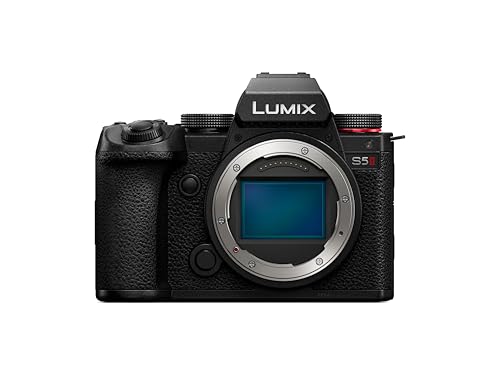
Panasonic LUMIX S5II — Best indie feature workhorse
The S5II is this guide’s recommendation to the funded independent feature, because its design reads like a micro-budget’s prayer answered: a log profile with the depth a cinema grade can spend, real-time LUTs so the set sees the film’s intended face while recording its flexible negative, and cooling that treats a feature’s twelve-hour day as a specification rather than a hope. Its footage, graded toward cinema colour, holds the big screen with the composed shadows and honest highlights that separate a projected feature from a projected video.
Its ecosystem is the honest cost — the L mount’s cinema glass shelf is younger than its rivals’ — and a feature will rent its exotic lengths regardless of system. For the production that owns its camera and shoots for weeks, it is the most complete theatrical instrument at its price in this guide, and the one whose workflow was designed by people who have actually delivered films.
- Sensor: full-frame, L-mount system
- Colour: V-Log of cinema grade
- Monitoring: real-time LUT preview
- Cooling: feature-day stamina
- Role: the indie feature’s anchor
Strengths
- Footage that grades to cinema colour.
- A feature schedule without thermal drama.
- Set sees the look while shooting log.
Trade-offs
- Lens shelf younger than rivals’.
- A production tool, priced as one.
- Stills are the supporting act.
Best for: funded independent features and festival shorts. Not suited for: casual video work.

Sony Alpha 7 IV — Best festival hybrid
The Alpha 7 IV’s theatrical case is ecosystem plus evidence: its S-Log3 has carried independent features through festival projection for years, and the E mount beneath it is the deepest shelf in this guide — fast primes, cinema-minded zooms and anamorphic options at prices a feature can own selectively and rent rationally. Its autofocus serves the small crew that independent features actually field, holding a moving actor through a scene that a larger production would give to a focus puller, and its low-light files keep night exteriors gradeable at the sensitivities real locations impose.
It is a hybrid, with a hybrid’s manners — the dedicated cinema benchmarks below outclass its production ergonomics — and its log punishes the underexposure that small crews commit at midnight. Lit and exposed with discipline, it produces footage that has already proven, on real screens in real festivals, that the audience cannot tell which tax bracket the camera came from. For most independent features, that proof is the whole argument.
- Format: full-frame mirrorless, E mount
- Profile: S-Log3 for the cinema grade
- Lenses: deepest feature-shooting shelf
- Autofocus: small-crew reliable
- Role: festival-proven hybrid
Strengths
- Footage with a festival track record.
- Glass for every scene, ownable or rentable.
- Night exteriors stay gradeable.
Trade-offs
- Hybrid manners on a feature set.
- Log exposure discipline required.
- Rolling compromises of its class.
Best for: independent features and festival filmmakers. Not suited for: large-crew production ergonomics.

Canon EOS R6 Mark II — Best colour for faces
Features are faces, projected huge, and the R6 Mark II’s claim on this guide is the rendering of those faces: Canon’s colour science, the one directors request by name, separating and flattering skin through the grade and onto the screen with a humanity that survives magnification. Its Canon Log gives the colourist a workable negative, its autofocus serves the small crew, and its all-round excellence covers the feature’s second jobs — the poster, the production stills, the behind-the-scenes film — in one body.
Its cinema manners are a hybrid’s, its long-take thermals a planning item, and its lens shelf a professional’s commitment. For the feature whose story is people in rooms — which is to say, the feature most independents can actually finance — it offers the image audiences have been loving in cinemas for a decade, at an ownership price. The projector is kind to faces it likes, and it likes these.
- Format: full-frame mirrorless, RF mount
- Profile: Canon Log
- Colour: benchmark skin rendering
- Autofocus: deep-learning subject work
- Role: the people-first feature camera
Strengths
- Faces the projector loves.
- A decade of screened precedent.
- Stills and BTS in the same body.
Trade-offs
- Hybrid cinema ergonomics.
- Long takes need thermal respect.
- RF glass is a commitment.
Best for: dialogue-led and people-first features. Not suited for: effects-heavy production pipelines.

Fujifilm X-T5 — Best film-look feature
The X-T5 is the romantic’s feature camera, and the projector is romance’s home. Its film simulations offer a feature a stock’s identity — Eterna’s cinema-bred restraint above all — either baked for the production that grades lightly or echoed through its F-Log for the one that grades deeply, and its high-resolution sensor gives the grade and the crop their material. A feature shot on it arrives at the cinema with a look that audiences read as intention, the quality that separates a film from footage at any budget.
Its crop sensor concedes the low-light extremes to the full-frame picks, and its cinema toolset is a hybrid’s rather than a production camera’s. For the feature whose identity is its look — the period piece, the intimate drama, the film that wants to have been shot on film — it is the most characterful instrument in this guide, and character, projected forty feet wide, is a kind of budget no money in the camera line can otherwise buy.
- Sensor: high-resolution APS-C, X mount
- Palette: Eterna and the simulation shelf
- Profile: F-Log for grading routes
- Stills: a serious stills body alongside
- Role: the look-led feature camera
Strengths
- A stock’s identity in-camera.
- Footage that reads as intention.
- High-resolution material for post.
Trade-offs
- Low-light ceiling of the crop format.
- Hybrid cinema tooling.
- Baked looks demand commitment.
Best for: look-led, intimate and period features. Not suited for: night-heavy productions.
Blackmagic URSA Mini Pro 12K — Dedicated cinema benchmark
The URSA-class Blackmagic is included without a link as the dedicated cinema tool against which this guide’s hybrids earn their praise. Its proposition is a production’s: raw recording as the native language, a sensor and colour pipeline built solely for motion, ergonomics that assume a crew, and internal filtration and connections that treat the camera department as a profession. Features shot on the family fill festival programmes yearly, and its footage’s journey to the cinema screen is the least translated of any camera in this guide.
The commitments are a cinema camera’s own: size, crew, storage that eats raw at a feature’s appetite, and a price that buys the hybrids above outright. It stands here as the honest rental decision — the camera a production books when the budget crosses the line where ownership stops being the economy — and as the standard that proves the hybrids’ claim by contrast: the gap is real, it is about workflow and manners more than image, and it narrows every year.
- Format: dedicated cinema camera, prose-only
- Recording: raw-native workflow
- Design: crew ergonomics, internal ND class tools
- Pipeline: grading-suite native
- Role: the dedicated benchmark
Strengths
- A cinema tool without compromise.
- Raw images of reference depth.
- Footage born for the big screen.
Trade-offs
- Crew, size and storage assumed.
- Price buys a hybrid outright.
- No stills or casual life.
Best for: crewed features with a cinema budget. Not suited for: solo and micro-budget ownership.
RED KOMODO — The rental summit
The KOMODO closes the list as the summit most independent features actually reach for: a genuinely compact cinema camera whose raw workflow, colour science and global-shutter manners have made it the rental house’s answer for productions that have outgrown hybrids but not budgets. Its images carry the RED lineage that a generation of screened features shares, in a body small enough for the gimbals and confined locations micro-budget work lives in. Directors of photography request it by name, which in the rental economy is the whole review.
It is prose-only here because its purchase is a production company’s decision — body, media, rigging and the ecosystem around them — rather than a guide reader’s cart. Treat it as the category’s graduation certificate: the camera your feature rents for the shoot, while the hybrids above own the rehearsals, the pickups and the next film’s development. Knowing where the summit is makes the climb from the hybrid base camp a plan instead of a grievance.
- Format: compact cinema camera, prose-only
- Recording: raw workflow, global shutter class
- Colour: established cinema lineage
- Hire: rental-house staple
- Role: the graduation benchmark
Strengths
- Cinema image in a compact body.
- The DP’s requested name.
- Global-shutter motion manners.
Trade-offs
- An ecosystem purchase, not a camera.
- Rental economics for most features.
- Crew workflow assumed.
Best for: productions graduating to dedicated cinema. Not suited for: ownership on a micro budget.
Why Do Independent Features Shoot on Hybrid Cameras at All?
Because ownership rewrites a production’s economics and its calendar. A hybrid body costs less than a cinema camera’s weekly rental across a feature’s schedule, travels in a bag rather than a case truck, shoots in locations a large rig cannot enter, and — decisive for micro-budget work — is available for the pickup shot in month four without a new negotiation. The image gap that once justified the rental has narrowed to a working difference rather than a chasm: modern log hybrids, lit and graded with discipline, screen indistinguishably from their betters to any audience that came for the story. What the rental still buys is production manners — the cinema camera’s ergonomics, its internal filtration, its raw workflow and its crew’s fluency — and this guide’s benchmarks mark that territory honestly. The independent feature’s real camera question is therefore scheduling and discipline, not permission: the hybrids here have projected in cinemas, and the films that failed on them failed in light, sound and story, the ancient addresses of failure, long before the sensor was consulted.
What Actually Breaks on a Big Screen?
Focus, first — a miss that a phone forgives becomes, at forty feet, an actor dissolving while the background’s brickwork stays eloquently sharp, and no post-production rescues it. Noise, second, in the shadows of night scenes, where the projector’s lamp turns a sensor’s quiet murmur into visible weather across a wall of darkness. Banding, third, in the gradients — skies, walls, fog — where insufficient bit depth steps the tones into visible terraces the cinema screen displays like contour lines. Compression artefacts, fourth, in the foliage and crowds and water that cheap recording turns to soup. The defences are the craft’s classics: focus discipline with proper monitoring and a first assistant’s marks, exposure that feeds the shadows, the highest-quality recording the media budget allows, and a grade conducted on a screen large enough to confess these sins before the audience’s does. The cameras in this guide were ranked partly on how much of that defence they build in — bit depth, monitoring, clean high-ISO files — and the rest is, as ever, the crew.
How Does a Feature Crew Test a Camera Before Committing?
With a day shot like a film and judged like an audience. The test stages the production’s three hardest scenes — the night exterior, the mixed-light interior, the face against a bright window — with the actual lenses, the actual profiles and the actual exposure habits the shoot will use. The footage is then graded by the production’s own colourist, or the closest available pair of hands, all the way to a cinema-colour master, and watched on the largest screen the production can borrow, in the dark, from the back row. Every candidate camera in this guide has survived that examination in someone’s production; the point of repeating it is that the variables are yours — your light, your locations, your colourist — and cameras separate under your conditions in ways no showreel reveals. Budget the test day as insurance, because its cost is a rounding error against a feature shot on the wrong instrument, and its footage becomes the production’s colour bible: the reference the whole shoot will be matched against.
What Does the Colourist Need From the Camera Department?
Consistency, information and honesty, in that order. Consistency: the same profile, the same white-balance discipline, the same exposure philosophy across every setup and every day, so the grade is built once and applied rather than reinvented per shot. Information: grey and colour references filmed at each lighting change, slates that tell the truth, and exposure that feeds the shadows the grade will need. Honesty: notes about what went wrong — the scene shot a stop under, the mixed light that could not be corrected — delivered with the footage rather than discovered in it. The cameras in this guide serve these needs with their monitoring and LUT tools, but the needs themselves are a department’s culture, and a feature whose camera team feeds its colourist well will look more expensive than a richer production that starved them. The projector, at the chain’s end, displays the sum of that relationship; audiences call the result ‘cinematography’ and are, for once, exactly right.
How Should a Micro-Budget Feature Allocate Its Camera Budget?
Across the image’s whole chain, in the proportions the screen will audit. The body is one line — and the hybrids in this guide exist to keep it a sane one — but the screen grades the lenses, the light and the grade itself with the same severity. A working allocation many micro-budget features converge on: the body owned, the hero lenses owned or long-rented, the lighting package rented by the week, and a colourist paid as a head of department rather than tipped as an afterthought. Sound, though outside this guide’s camera brief, outranks every item on it. The allocation’s principle is that the audience cannot see a budget line, only its absence — the scene that failed for want of a lens, a lamp or a grade announces the saving that caused it. Spend where absence shows, save where it does not, and the camera line’s modesty becomes a production virtue rather than a confession.
Why Do Features Still Shoot on Location With Small Cameras?
Because locations are the micro-budget’s production design department, and small cameras are how you afford them. A real street, a working café, a coastline at dawn — these give a feature a scale no set budget at this level can build, and the hybrid bodies in this guide can be carried into them at a walking pace, permitted cheaply, and operated by crews small enough for the location to tolerate. The cinema benchmarks earn their rental on the stages and the controlled builds; the location days belong, increasingly, to the hybrids, whose footage intercuts under a competent grade more gracefully than the old hierarchies admitted. Plan the feature’s visual economy accordingly: the owned hybrid as the location instrument and second unit, the rented cinema camera for the stage days where its manners pay. That division, unthinkable a generation ago, is now the standard arithmetic of independent features that reach screens — and reaching screens is, after all, the entire subject of this guide.
How Does Aspect Ratio Interact With the Camera Choice?
The frame’s shape is a storytelling decision the camera must be able to keep. Theatrical features live mostly in the wide ratios — the scope frame’s sweep for landscapes and ensembles, the narrower widescreen for intimacy — and the camera’s job is to record with those ratios in mind: frame lines in the monitor, enough recorded height or width to compose the chosen shape without amputating the negative, and a grade that protects the intended frame from the edit’s temptations. Hybrid bodies serve this with their guides and, in some cases, open-gate recording that lets the ratio be chosen with more freedom in post. Decide the ratio in pre-production, from the story’s geography rather than from fashion, and test it in the camera test this guide prescribes — a face and a landscape in the intended frame, projected. The screen will tell you whether the shape is the film’s or merely its letterbox, and it is a cheaper conversation in the test than in the edit.
What Is the Role of the DIT and Data Discipline on a Feature?
The digital imaging technician is the camera department’s memory and its insurance policy, and on hybrid features the role is often a hat worn by the most organised person on set rather than a separate hire — which makes its discipline more important, not less. The liturgy is this batch’s familiar one at feature scale: cards copied twice and verified before formatting, the day’s footage viewed at magnification while the set that made it still stands, backups separated geographically before the unit sleeps. A feature loses a day to a card failure exactly once in its folklore and never again in its practice. The cameras’ media appetites — log’s moderation, raw’s hunger — set the DIT’s budget of drives and hours, and that budget belongs in the camera decision itself: a raw workflow whose data discipline the production cannot staff is not a workflow, it is a hope. Choose the recording format your DIT reality can honour, and the feature’s footage will survive to meet the projector.
How Should a Filmmaker Choose Lenses for a First Feature?
By the film’s faces and rooms, not by the set’s completeness. Most dialogue-led features live within a short span of focal lengths — the conversational normal, the intimate portrait length, one wide for the rooms’ geography — and owning or long-renting those few, fast and well-matched, serves the film better than a thin spread of everything. Consistency of rendering across the set matters at projection scale, where a mismatched lens announces itself between cuts; a single family of glass, however modest, grades as one voice. Test the finalists on the test day, on faces, at the apertures the light will impose, and let the screen arbitrate. Anamorphic and other characterful choices belong to the same discipline: chosen for the story’s sake, tested at scale, and committed to for the whole film, because the projector rewards a coherent visual decision and exposes a sampler. The lens budget, like the camera’s, is audited by an audience that cannot name it and never misses it.
What Happens Between the Final Cut and the Projector?
A chain of translations that should be supervised by the people who shot the film. The grade is finished in cinema colour, on a screen and in a room that approximate the theatre’s; the master is encoded into the cinema package with its sound mixed to the theatre’s loudness standard, its captions and accessibility tracks prepared as deliverables rather than favours. Then the package is tested — actually projected, in an actual cinema or the festival’s technical check — because every link in the chain has a dialect and the only proof of translation is performance. First features most often stumble here, in the unglamorous fortnight after the celebration, which is why this guide insists the deliverable conversation happens in pre-production. The cameras in this guide record footage that survives the chain when the chain is respected; respecting it is a producer’s virtue, learned once and carried into every subsequent film like a vaccination.
Why Does the Projector Reward Light More Than Resolution?
Because the audience’s eye is a light-measuring instrument long before it is a detail-measuring one. A scene lit with intention — faces modelled, backgrounds separated, the frame’s brightness composed like music — reads as expensive and cinematic at resolutions the spec sheet would apologise for, while a flat, under-lit scene at maximum resolution reads as expensive video. The history of projected features proves it in both directions: beloved films shot on modest formats, forgotten ones shot on flagships. The camera decision should therefore be made after the lighting decision it serves, and the budget’s order — light, lenses, colourist, then the body — is the projector’s own order of values, which this guide has now stated in every section it owns. Buy the S5II or its peers with confidence, then spend the difference between it and the benchmarks on the light that will make its footage indistinguishable, at forty feet, from footage three times its price. That is not a consolation. It is the industry’s open secret, printed here at the end of the batch where the diligent reader earns it.
How Do Lenses Behave Differently at Projection Scale?
Their flaws acquire square footage. A lens’s softness at the frame’s edge, invisible in a phone’s crop of the world, becomes a visible geography on a cinema screen; its chromatic fringing colours the high-contrast edges like neon’s halo; its breathing — the frame’s subtle zoom as focus moves — reads as the room itself inhaling. This is why features test lenses on the largest available screen and why matched sets matter: the audience may never name a lens, but they feel a production’s coherence, and coherence is partly glass. The hybrids in this guide sit in ecosystems with genuinely cinema-capable lenses, and the feature’s lens budget should be allocated with the projector as its auditor — fewer, better, matched. Vintage glass inverts the argument deliberately: its flaws, chosen and consistent, become the film’s texture, and the screen rewards the intention as it punishes the accident. Either way, the lens decision is a look decision, and it is made in the test, on the big screen, or it is made by default in the edit, at the price of surprise.
How Does a Feature Plan Its Pickup Shots and Reshoots?
By keeping the camera package’s recipe reproducible for a year. Pickups — the insert, the corrected line, the scene the edit discovers it needs — are where owned hybrids earn their deepest keep, because the production can reassemble the exact instrument in an afternoon. The discipline that makes pickups invisible is documentation: the camera’s settings, the lenses, the lighting diagrams and the colour references filed per scene, so month four’s insert grades into month one’s scene without a seam the projector would announce. The benchmarks’ rental model taxes pickups with a fresh negotiation, which is why many features shoot their pickups on the owned hybrid even when the principal photography rented — the grade, competently handled, marries the two under the audience’s notice. Plan the pickup day in the schedule before it is needed, while the sets and the actors’ hair still exist. The feature that treats pickups as a system rather than an embarrassment finishes stronger, and the audience never learns which frames arrived late — only that the film feels complete.
What Is the Sound Designer’s Place in a Camera Guide?
At the head of it, by the projector’s own arithmetic. A cinema’s sound system reproduces a production’s audio decisions at a scale that makes the theatre’s dialogue clarity the film’s true resolution — audiences leave a screening quoting lines, not pixels, and a film they could not hear is a film they did not see. This guide has kept its camera brief, but it states the hierarchy plainly for the feature reader: the sound budget is protected before the camera budget is discussed, the production sound recordist is a head of department, and the camera choice itself is partly an audio decision — quiet operation on set, timecode and scratch-track manners, a body whose fan never auditions for the microphone. The S5II’s cooling, to take the sharpest example, was judged partly by ear. Let the camera department and the sound department plan the set together, and the projector will repay the diplomacy in the only currency it mints: an audience that stays inside the story for two unbroken hours.
How Should a First Feature Choose Between Owning and Renting?
By the calendar, honestly drawn. Ownership wins when the schedule is long, fragmented or likely to sprout pickups — the micro-budget’s natural shape — and when the same package will serve the next production’s development work. Renting wins when the schedule is a single concentrated block, when the production’s ambitions need the benchmarks’ manners for exactly those weeks, and when insurance, maintenance and obsolescence are better carried by the rental house. The hybrid answer many features actually live is the mixed fleet: the owned body as the constant — rehearsals, locations, second unit, pickups — and the rented cinema camera for the stage block. Cost the three models across the real calendar, including the test days and the pickups’ probability, and let the arithmetic argue with the romance. Either way, decide in pre-production and document the package; the worst camera budget is the one renegotiated mid-shoot, when every day of indecision is billed at production rates.
What Does a Festival’s Technical Check Actually Examine?
Everything the audience will experience, measured without sentiment. The package’s image is checked for the colour space and levels the projector expects, the sound for its loudness and channel discipline, the captions and accessibility files for their presence and sync. Films fail technical checks for reasons that have nothing to do with art — a master exported in the wrong colour space, a soundtrack mixed for a laptop — and the failures are discovered at the deadline’s worst hour. The defence is the chain discipline this guide has preached: the deliverable specified in pre-production, the post house chosen for its festival experience, a test projection arranged before the premiere’s week. Directors of photography who attend the check with their colourist learn more in an hour about their own footage than a season of laptop reviews teaches. The projector is not the enemy of the small film; it is its most honest friend, and the technical check is the friendship’s formal introduction — arrive prepared, and it will introduce you to the audience as a professional.
How Do Aspect, Light and Colour Survive the Journey to Different Screens?
A feature today lives on many screens after its premiere — the cinema first, then the television, the laptop, the phone in a train’s window light — and the grade’s job has become a diplomacy among them. The theatrical master is the reference, made for the dark room and the big lamp; the home versions are translations, supervised rather than automatic, because the phone’s brightness will flatten what the projector deepened and the television’s motion settings will vandalise the cadence if the deliverable does not protect it. Filmmakers protect the film by deciding its non-negotiables in the grade — the faces’ truth, the night scenes’ depth, the palette’s identity — and checking each translation against them. The cameras in this guide record the material those translations need: highlight and shadow held in reserve, colour that can be steered without breaking. Shoot for the cinema, finish for the cinema, and translate with supervision; the film that survives its smallest screen with its soul intact began as footage with something in reserve, which is the deepest definition of the cameras this guide chose.
Why Do Some Features Look Expensive and Others, at the Same Budget, Do Not?
Because expense on screen is mostly the appearance of decisions. The expensive-looking feature has a palette and it keeps it; its light has a direction and a reason; its camera moves when the story moves and rests when it rests; its locations were chosen as arguments, not as availabilities. None of those cost what a camera costs. The cheap-looking feature, at the identical budget, has a sampler’s colour, light from wherever the ceiling offered it, and coverage shot like insurance rather than like cinema. The projector magnifies the difference without caring about the cause, which is why this guide’s final counsel is budgetary heresy: after the honest camera — and every pick here is honest — the next money belongs to the production designer, the gaffer and the colourist, the three signatures an audience can actually see. A feature is not photographed by its camera. It is photographed by its decisions, recorded by its camera, and judged by a screen that has never once read a receipt.
How Should a Filmmaker Grow From Hybrid Features Toward Cinema Cameras?
By letting productions, not desire, promote the package. The hybrid years teach the crafts the cinema camera assumes — lighting for a negative, focus discipline, the colourist’s collaboration — at ownership prices and forgiving schedules. The graduation signals are specific: a production whose crew size makes the hybrid’s manners the bottleneck, a schedule whose stage days justify the rental’s arithmetic, a director of photography whose fluency the benchmarks reward. Rent for that production, with the hybrid as the second body it naturally becomes, and let the two systems teach each other across the shoot. Buy into dedicated cinema only when the calendar shows the pattern repeating — the same lesson as every system purchase in this batch of guides. The filmmaker who climbs this way arrives at the summit with a hybrid’s resourcefulness intact, which the summit’s natives, raised on rental abundance, sometimes conspicuously lack. The projector, at the end of the climb, shows the same film either way; the climb is for the filmmaker, and it should be made at the pace the work, not the catalogue, sets.
How Does a Feature Handle Its Own Publicity Stills and Behind-the-Scenes?
As a second production sharing the first one’s discipline. The stills that will sell the film — the poster’s image, the festival’s key art, the press kit’s evidence — deserve a dedicated eye, even when the same hybrid body shoots them between setups, because the still frame’s grammar differs from the moving one’s and the projector’s audience will meet the stills first. Behind-the-scenes footage is the film’s future memory and its marketing’s raw material; shoot it with the sound and care of the main unit in miniature, or do not pretend it will be usable. The hybrid bodies in this guide serve both duties natively, which is a quiet line in their favour in the ownership argument. Archive the stills and the BTS with the production’s main data discipline, named and backed up — in five years, the anniversary re-release will ask for them by name, and the production that can answer owns an asset the careless one must mourn. Publicity is not the film’s vanity; it is the bridge the audience crosses to reach the projector at all.
What Is the Role of the Teaser and Trailer in the Camera Decision?
None in the specification, and a real one in the schedule. Trailers are cut from the feature’s own footage, so the camera decision is already inside them — the look the teaser sells is the look the camera recorded, and a production that tests its camera with the teaser in mind learns early whether its footage has the trailer’s grammar: the striking wide, the face in close-up, the image that survives being a poster. Schedule the teaser’s edit while the film is still warm, when a missing establishing shot can still be picked up by the owned hybrid in an afternoon — one more entry in the ownership ledger this guide has kept. And let the trailer’s discipline feed back into the feature’s own coverage on the next production: the shots trailers always need are known, and a camera department that shoots them deliberately is doing marketing’s work at production’s prices, which is the only exchange rate independent film can afford.
How Should a Filmmaker Think About Archiving a Feature?
As the film’s second delivery, addressed to the future. The camera originals, the graded master, the cinema package, the sound stems, the captions, the stills and the paperwork — contracts, releases, cue sheets — constitute the film, and they belong in at least two places, on media whose health is checked on a calendar rather than on a hope. The archive’s cost is a rounding error against the production’s, and its absence is discovered at the worst moments: the distributor’s request, the anniversary, the restoration. Hybrid productions, whose files live on a producer’s drives rather than in a studio’s vault, carry the duty personally. Write the archive’s inventory as the production’s final document, store it with the film’s legal papers, and let the next production inherit the template. A feature is a message to an audience that includes people not yet born; the archive is how the message survives its messenger, and the projector, in the end, can only show what somebody kept.
What Mistakes Do First-Time Feature Filmmakers Make?
Testing on a phone is the founding error: footage approved at five inches is condemned at forty feet, so the discipline is to screen tests as large as life allows before the shoot, not after. Second is starving the grade — shooting a hungry log profile underexposed on night exteriors, then asking the colourist to manufacture the light the set did not provide, at a noise cost the projector will announce to the whole auditorium. Third is the camera-line budget fantasy: the body bought, the feature attempted without the lenses, light, sound and post the same footage demands, when the projector grades all of them together. Fourth is focus by hope on a small screen, without the monitoring and marks the big screen’s scrutiny requires. Finally, first features forget the deliverable until the end — the cinema package, its colour space, its loudness and caption requirements — and discover in the festival’s technical check what a conversation with the post house in week one would have made routine. The screen is honest; meet it early, on a test, and it becomes an ally rather than a judge.
Comparison Table
| Camera | Screen strength | Best feature role | Watch out for |
|---|---|---|---|
| Panasonic LUMIX S5II | Log depth, stamina | Indie feature anchor | Lens shelf growing |
| Sony Alpha 7 IV | Festival-proven S-Log3 | Hybrid feature work | Exposure discipline |
| Canon EOS R6 Mark II | Face rendering | People-first features | Thermal planning |
| Fujifilm X-T5 | Film-stock identity | Look-led features | Low-light ceiling |
| Blackmagic URSA Mini Pro 12K | Raw cinema pipeline | Crewed features | Crew and storage |
| RED KOMODO | Compact cinema summit | Graduating productions | Ecosystem cost |
Final Recommendation
Own the hybrid, rent the summit, and test on the largest screen you can borrow. The S5II anchors the funded independent feature; the Alpha 7 IV brings the deepest shelf and the festival record; the R6 Mark II serves the people-first film; the X-T5 signs the look-led one. The URSA and KOMODO stand as the honest benchmarks — the rentals that mark a production’s graduation, and the standard the hybrids are praised for approaching. Whatever body carries your feature, remember the projector’s democracy: it shows the audience your light, your focus and your story at forty feet, and it has never once asked what the camera cost.
Related guides
- Best Digital Cameras for Children: A Parent's Guide to Safe, Durable Picks
- Best Cameras for Vintage Looking Photos: Digital, Instant, and Real Film Picks
Frequently Asked Questions
Is 4K enough for theatrical projection?
Yes — and it is more than the historical standard. Cinemas projected 2K masters for most of the digital era, and many still do; a well-shot, well-graded 4K or even high-quality lower-resolution master screens beautifully because the audience reads sharpness, contrast and cleanliness more than pixel counts. What the big screen punishes is softness, noise and banding, which is why this guide ranks those above resolution arithmetic.
What is a DCP and do I need one?
The Digital Cinema Package is the delivery format projectors play — a defined colour space, compression and file structure — and any film screening theatrically or at most festivals will need one made. Post houses produce them routinely from your graded master; the time to discuss it is before the shoot, because the mastering conversation sets the grade’s targets and prevents expensive surprises at the festival’s technical deadline.
Can a hybrid camera really hold a cinema screen?
It has, repeatedly, in real festivals and commercial releases — when the production around it behaved like a film production: lit properly, focused with discipline, exposed generously, graded by someone who had seen a big screen before. The camera’s share of the result is smaller than the crew’s, which is the most encouraging fact in this guide for the micro-budget filmmaker reading it.
Should I shoot raw for a feature?
If the production can feed it — storage, backup, post time and a colourist who will use what raw offers. Raw buys grading freedom at a logistics price, and many fine features have been shot in high-quality log for exactly that arithmetic. The honest test is your hardest scene graded both ways in pre-production; let the screen, not the ideology, decide for your budget.
What lens matters most for a feature?
The one the film’s grammar lives in — for most dialogue-led features, a fast normal-to-short-telephoto range that renders faces at conversational distance. Features are shot disproportionately at a handful of focal lengths, and owning those well beats renting a full set thinly. Test faces at your intended lengths on the largest screen available; the projector will confirm which lens your film is actually shot on.
How important is sound to theatrical projection?
Total, and louder than the picture. A cinema’s sound system is as unforgiving as its screen — dialogue recorded poorly cannot be projected into clarity, and audiences forgive a soft image scenes they will not forgive an unintelligible one. The feature budget that starves sound to feed the camera has misread the projector completely; this guide’s camera advice assumes the sound department was funded first, as it should be.
Related Guides
Keep exploring: best cameras for cinematography and photography, best cameras for cine cinestyles, and best cameras for professional movie making.


