kajuandouglas.com is reader-supported. When you buy through links on our site, we may earn an affiliate commission.
Where to Buy
Choosing a first camera for a child is not a smaller version of choosing one for an adult. The best cameras for beginner child photographers survive being dropped on the path, work the moment a small finger finds the button — before the butterfly leaves, not after a menu — and teach the real lesson of photography, which is looking, without burying it under settings a seven-year-old cannot read. The best cameras for beginner child photographers also respect the adults in the equation: film and printing costs you can predict, no social feeds wired into the device, and durability that means the camera is a companion for years rather than a birthday week’s casualty. Buy through the Amazon listings linked in this guide, check the model name against the pick, and buy for the child you actually have — their age, their carefulness, and whether they want a picture to hold or a picture to keep.
The list divides by a question most parents never think to ask: does the child want the photograph as an object or as a file? Instant cameras answer the first desire — a print in the hand, ninety seconds later, to trade, stick on a wall and give to a grandmother — and they have revived childhood photography almost single-handedly. Digital cameras answer the second, with screens, hundreds of free experiments, and a path that grows toward “real” photography. Both are honourable; they are simply different childhoods, and the reviews below are frank about which child each camera suits.
A safety note that shapes several picks: we favoured cameras that work entirely without accounts, uploads or feeds. A child’s first camera should connect them to the world in front of them, not to an audience, and every pick here can be used happily with no online component at all.
Key Takeaways
- The Fujifilm Instax Mini 12 is the joyful default for younger children: point, shoot, print, with nothing to configure and nothing to break on a screen.
- The Polaroid Go Generation 2 is the smallest instant option, sized for small hands and big adventures in a pocket.
- The OM SYSTEM Tough TG-7 is the digital camera that survives childhood — waterproof, drop-proof and good enough to grow with them for years.
- Sony’s ZV-1F suits the older child who wants to film as well as photograph, with simple controls and face-focused automation.
- The GoPro HERO12 Black is the action answer for the child whose photography happens on bikes, boards and in the sea.
- The Canon EOS R50 is the step-up for the teenager whose interest has become serious, with real lenses and real skills to grow into.
In this guide
Quick Picks
| Badge | Pick | Why it stands out |
|---|---|---|
| Best First Camera | Fujifilm Instax Mini 12 | Instant prints with truly nothing to learn. |
| Best for Small Hands | Polaroid Go Generation 2 | The tiniest instant camera, made for pockets. |
| Best Indestructible Digital | OM SYSTEM Tough TG-7 | Waterproof, drop-proof and genuinely capable. |
| Best for Young Creators | Sony ZV-1F | Simple video and stills for the filming generation. |
| Best for Active Kids | GoPro HERO12 Black | Mounts to the bike, the board and the adventure. |
| Best Teen Step-Up | Canon EOS R50 | A real system camera for a serious young photographer. |
How We Chose These Picks
We judged these cameras as adults who remember being children with cameras, which produced a different checklist from any other guide in this series. Survival came first: the camera must endure the drop, the puddle, the sand and the school bag, because a first camera that dies teaches only that photography is fragile. Immediacy came second — the shutter must answer the finger at once, and the picture must be visible, holdable or at least reviewable in the moment, because a child’s feedback loop is measured in seconds and a camera that makes them wait teaches waiting, not seeing.
Third came the economics of experimentation. Children learn photography by volume — hundreds of frames, most of them gloriously unimportant — so the cost per experiment matters: instant film’s price per shot shapes a child’s shooting into deliberate choices, which is its own education, while digital’s free frames license the glorious waste that is also an education. Neither is wrong; they teach different virtues, and the reviews say which is which. Fourth came the growth question: does this camera become a dead end or a doorway? The list deliberately ends with a doorway.
What we excluded matters too: toy cameras with novelty filters and unusable image quality, which teach children that photographs are supposed to look bad, and any camera whose fun depends on an account, an upload or a feed. A first camera should belong to the child completely.
What Does a Child Actually Need From a First Camera?
Less than the marketing says and more than a toy provides. A child needs a camera that is theirs — small enough for their hands, simple enough that the photograph is the only puzzle, and honest enough that a good picture looks good. The developmental gift of photography is attention: the child with a camera walks slower, looks up, notices the light on a wall and the pattern of a shell, and that noticing is the entire point. Equipment serves it by disappearing.
Age is the honest variable. Under about seven, the camera is a magic object and the instant print is the spell; complexity is pure loss. From seven to eleven, durability and digital freedom dominate — this is the TG-7’s and the GoPro’s territory, the years of dens, bikes and rockpools. From twelve up, the child’s eye often outruns simple cameras entirely, and the conversation becomes about the real system cameras that close this list. Buy for the band your child is in, not the one you are nostalgic for, and the camera will be loved at the right depth.

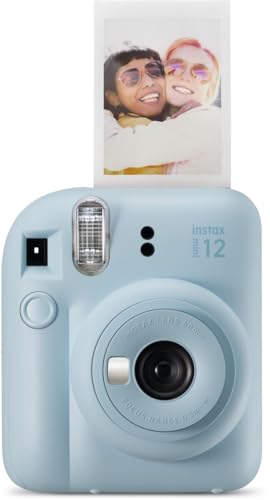
Fujifilm Instax Mini 12 — Best First Camera
The Instax Mini 12 is the camera that has introduced more children to photography than any other this century, and the reason is a design decision of genius: there is almost nothing to operate. Twist the lens to switch it on, point it, press the button, and a print slides out and develops in the child’s hand. The automation handles exposure and focus; the child handles the only decision that matters, which is what deserves a photograph. For a five-to-nine-year-old, that division of labour is perfect.
The print is the pedagogy. A photograph you can hold is a different object from one on a screen — it gets traded in the playground, stuck on the bedroom wall, posted to grandparents and treasured with a seriousness that files rarely earn. The cost of film, often raised as the format’s flaw, is in truth its curriculum: children with ten shots in a pack learn to look before they press in a way that unlimited digital frames never teach. Most parents find a pack lasts longer than feared, because children ration what is precious with an instinct adults underestimate.
It is not a camera for image quality purists or for a child who wants to review and delete. It is a camera for joy, immediacy and the shoebox of prints that will outlast every phone in the house. For the youngest photographers, nothing else on this list comes close.
- Format: instant prints that develop in the hand
- Operation: automatic exposure, twist-on lens, one button
- Build: chunky, grippy and forgiving of small hands
- Running cost: film packs are the ongoing expense
- Role: first camera for roughly ages five to nine
Strengths
- Zero learning curve between the child and the picture.
- Prints create keepsakes, gifts and playground currency.
- Film cost teaches deliberate, thoughtful shooting.
Trade-offs
- Film is a continuing cost that must be budgeted.
- No review, no delete, no second chances per frame.
- Image quality is charming rather than detailed.
Best for: younger children and any family that values the printed photograph. Not suited for: a child who wants to shoot hundreds of frames or film video.

Polaroid Go Generation 2 — Best for Small Hands
The Polaroid Go’s argument is size, and it is a better argument than adults expect. It is the smallest instant camera in its class — genuinely pocket-sized — which means it goes where a child goes: on the walk, up the tree, to the friend’s house, instead of living in a drawer because it was too much to carry. Cameras teach photography in proportion to how often they are present, and presence is this little machine’s whole design philosophy.
Its prints are smaller than the Instax’s, a format children tend to love precisely because it is theirs — miniature, collectible, suited to small albums and small hands. Operation is as simple as its rival’s, the build shrugs off the knocks of a carried life, and the whole experience has a toy-like delight that should not be mistaken for toy-like results: the pictures are real photographs, with the soft, warm character instant film is loved for.
Choose between the two instant picks on the child’s hands and habits: the Instax for the home-based photographer and the bigger print, the Go for the roamer whose camera must fit the pocket of the adventure itself.
- Format: miniature instant prints
- Size: the smallest in its class, truly pocketable
- Operation: simple point-and-shoot automation
- Build: made to be carried daily by a child
- Role: roaming first camera for smaller children
Strengths
- Goes everywhere because it fits anywhere.
- Small prints delight the children they are made by.
- As simple to use as any camera on this list.
Trade-offs
- Tiny prints show less detail than the Instax format.
- Its film is its own size; no sharing packs with Instax owners.
- Small body means small controls for adult helpers.
Best for: younger, active children who will carry a camera daily. Not suited for: families wanting larger prints for the wall.

OM SYSTEM Tough TG-7 — Best Indestructible Digital
The TG-7 is the answer to the parent’s real question, which is not “which camera is best?” but “which camera will still work in October?” It is waterproof to depths a child will never reach, shockproof against the drops a child will certainly perform, freezeproof, dustproof and crushproof — and unlike the toy cameras that borrow that language, it is also a genuinely good camera, with a bright lens, excellent macro modes for the small worlds children love, and image quality that respects a young photographer’s eye.
Its macro abilities deserve special mention in a child’s hands. The TG-7 focuses close enough to turn a ladybird into a portrait and a dewdrop into a landscape, and children — whose world is physically closer to the ground and its details than ours — take to macro like the natives they are. Add underwater shooting for rockpools and holiday swims, and you have the camera of an entire childhood’s summers.
It asks a little more learning than the instant picks: a screen to review, a memory card, a charger in the family routine. In exchange it removes the film budget entirely and grows with the child for years — the rare first camera that is also plausibly the third and fourth year’s camera.
- Build: waterproof, shockproof, dustproof, freezeproof
- Lens: bright zoom with outstanding macro modes
- Format: digital stills and video on memory cards
- Extras: underwater modes and GPS-era toughness features
- Role: the durable digital for roughly ages seven to twelve
Strengths
- Survives the childhood it will be used in.
- Macro modes open the small world children inhabit.
- No film costs; hundreds of free experiments.
Trade-offs
- Costs more upfront than the instant picks.
- Menus reward a parent’s setup help at first.
- No print appears unless you print it yourself.
Best for: adventurous children and families wanting one camera for years. Not suited for: the youngest children, who need the instant print’s magic.

Sony ZV-1F — Best for Young Creators
Some children do not want to take photographs; they want to make films — of their dances, their builds, their friends, their wonderfully serious explanations of things. The ZV-1F is the camera for that child. Sony designed it for creators and stripped it to their essentials: a wide fixed lens that frames a face at arm’s length, autofocus that finds and holds eyes without being asked, a screen that flips to face the performer, and controls reduced to what a young presenter can run while thinking about their material instead of their equipment.
Its stills are perfectly capable, but its heart is moving pictures with clear sound and a face kept in focus — the grammar of the video world this generation is native to. Used within the family’s own sharing rules, it lets a child learn framing, light and presentation with a tool that flatters their efforts rather than fighting them.
It is not rugged, and it is not for the under-eights. For the ten-to-thirteen-year-old whose creativity runs to video, it is the first camera that takes their ambition seriously without handing them a professional’s complexity.
- Lens: fixed wide lens for arm’s-length filming
- Autofocus: face and eye priority, set-and-forget
- Screen: flips forward for self-framing
- Audio: built with talking-to-camera in mind
- Role: first creator camera for older children
Strengths
- The simplest route to good-looking self-filmed video.
- Autofocus lets the child perform instead of operate.
- Compact enough for a school bag’s safer pocket.
Trade-offs
- Not waterproof or drop-proof; needs a careful owner.
- Fixed lens limits still-photography ambitions.
- Video-first design is wasted on a stills-only child.
Best for: older children whose creativity is video-shaped. Not suited for: rough-and-tumble younger children or keen stills photographers.

GoPro HERO12 Black — Best for Active Kids
For the child whose life happens at speed, the photograph that matters is the one taken from inside the action: the handlebar view of the trail, the board-level run, the underwater lap. The HERO12 is the camera of that viewpoint. It mounts to bikes, helmets, boards and chest straps, survives the water and the crashes as a matter of design, and shoots stills and video with a simplicity — one button, enormous depth of field, everything in focus — that suits a photographer whose attention is rightly on the riding, not the camera.
Parents should understand its bargain clearly. As a conventional camera it is eccentric: no zoom, a fisheye-wide view, stills that serve the moment rather than the album. As a sports diary it is unmatched, and for the skatepark generation the footage is the photograph — the thing shown to friends, kept, and rewatched. Its toughness also reframes the drop conversation: this is a camera designed to be fallen on.
Buy it for the child whose camera must keep up with them, in a case, with the mounts for their actual sport. For a quiet child who photographs flowers and family, the other picks serve better; for the one who is airborne in half their pictures, this is the only honest choice.
- Build: waterproof and crash-tolerant by design
- Mounts: the largest action-mount ecosystem available
- View: ultra-wide, everything-in-focus perspective
- Operation: one-button simplicity while moving
- Role: action diary for sporty children and teens
Strengths
- Captures the action from inside it, safely.
- Survives water, mud and falls as routine.
- Stills and video both serve the sports-diary purpose.
Trade-offs
- Ultra-wide view distorts ordinary subjects.
- No zoom and no portrait-style photography.
- Mounts and cases add to the real cost.
Best for: active, sporty children and young teens. Not suited for: a child whose subjects are portraits, pets and gardens.

Canon EOS R50 — Best Teen Step-Up
There comes a point — a school course, a portfolio ambition, a flicker of genuine vocation — where a young photographer’s eye outgrows simple cameras, and the family conversation changes from “a camera for a child” to “a first real camera”. The R50 is where that conversation should land. It is a proper interchangeable-lens system camera with Canon’s friendly colour and guided menus, real eye autofocus, and access to the portrait and telephoto lenses through which a photographer learns what photography actually is.
Its kindness to beginners is structural rather than patronising: the guides explain, the automation assists, and nothing about the body punishes the experiments through which teenagers learn. Paired first with its kit zoom and then with an affordable portrait prime, it will carry a young photographer from their first deliberate composition to a school exhibition without a single dead end.
It is also, deliberately, the first pick here that requires care: it is not waterproof, not drop-proof, and it costs real money. That is the point of the step-up — it is given when the young person has shown they will honour it, and its arrival marks the moment the family stops buying a toy and starts backing a talent.
- System: interchangeable lenses on Canon’s RF mount
- Sensor: APS-C with strong colour and eye autofocus
- Menus: guided modes that teach real photography
- Screen: vari-angle for stills and video work
- Role: first serious camera for teens roughly twelve and up
Strengths
- A real system with years of growth in it.
- Teaches genuine skills that transfer to any camera.
- Results reward a serious young photographer’s ambition.
Trade-offs
- Needs the care a younger child’s camera does not.
- Lens purchases become the ongoing conversation.
- Overkill — and over-fragile — for a young child.
Best for: teenagers whose photography has become a serious pursuit. Not suited for: young children or rough outdoor play.
How Do the Picks Compare by Age and Temperament?
| Pick | Format | Toughness | Typical age | The child it suits |
|---|---|---|---|---|
| Fujifilm Instax Mini 12 | Instant print | Good | 5–9 | Wants a picture to hold |
| Polaroid Go Generation 2 | Instant print | Good | 5–9 | The roamer with pockets |
| OM SYSTEM Tough TG-7 | Digital | Exceptional | 7–12 | The explorer and macro hunter |
| Sony ZV-1F | Digital video-first | Moderate | 10–13 | The young filmmaker |
| GoPro HERO12 Black | Action digital | Exceptional | 9–14 | The athlete |
| Canon EOS R50 | System digital | Moderate | 12+ | The serious student |
Age bands in this table are guides, not gates, and never have been treated as such here — a careful seven-year-old may honour an R50 and a boisterous thirteen-year-old may still need the TG-7’s armour. Temperament is the truer column: match the camera to how the child treats their possessions and what they actually point cameras at, and the choice makes itself.
How Do You Teach a Child to See Like a Photographer?
With games, mostly, because children learn photography the way they learn everything else that lasts. Send them for one colour: a walk where every photograph must contain something red, and watch a familiar street become a treasure hunt. Send them for one shape, one letter, one shadow. Give them the family dog’s day to document, or the garden across a whole season from one marked spot, and you have taught composition, patience and project-thinking without a single lecture. The camera in their hands matters less than the errands you invent for it.
Review together, kindly and specifically, and at the child’s pace rather than the adult’s — a slideshow that ends when the photographer’s commentary ends, not when the grown-ups have finished improving it. Ask them which frame is their favourite and why, and take the answer seriously even when it is the blurry one, because the reason is usually a story, and the story is the photograph’s other half. Children flourish under praise that names what worked — “you got down to the flower’s level, look how big it looks” — and they absorb one suggestion at a time far better than a critique. Print the successes. A photograph on the fridge is a publication, and a child who has been published takes the next walk with a professional’s eye.
Resist the urge to art-direct. The crooked horizon, the thumb at the frame’s edge, the forty photographs of the same beloved cat — these are the drafts of a visual voice. The child who is allowed their own subjects becomes a photographer; the child who is only allowed yours becomes a camera operator, and the difference shows by the second summer.
What Mistakes Do Adults Make Buying a Child’s First Camera?
The first is buying the camera they wanted at that age, or the one that flatters their own taste, rather than the one matched to the child’s hands, habits and desires. The second is buying capability the child cannot reach: a menu-driven camera handed to a six-year-old teaches that photography is for grown-ups, and the lesson sticks. The third is the opposite snobbery — the novelty toy camera whose dreadful images teach that photographs are supposed to look like accidents. Children know when they have been given a pretend tool, and they put it down accordingly.
Fourth is forgetting the running costs and the ritual around them. The instant camera without a film budget becomes a paperweight by February; the digital without a family routine for emptying its card and admiring its contents becomes a drawer resident. Budget the film, schedule the slideshow, and the camera lives. Fifth is handing over a camera wired to the internet’s opinions. A child’s first audience should be the family at the kitchen table, full stop — every pick in this guide honours that, and it is worth more than any feature on any box.
How Should Families Handle Photos, Privacy and Sharing?
Simply, and from the first day: the camera is offline, the pictures are the family’s, and sharing beyond the family is an adult decision made picture by picture. This is one of the quiet arguments for every pick here — none of them needs an account, a feed or an upload to do its job — and it lets the child learn the craft in the right order: see first, show later, and understand what showing means before it happens at scale.
Teach the consent habit as part of the craft, because it is: photographers ask, especially friends who may not want to be photographed, and a child who learns to ask — and to accept a no gracefully — has learned the profession’s first ethic along with its first skill. Photographs of other children follow the other family’s rules, full stop, and school and club policies on cameras deserve reading before the camera travels there.
As the child grows into the ZV-1F’s and R50’s worlds, the conversation grows with them — what a platform is, what an audience does to the person performing for it, why the family keeps some pictures private. A camera given with these conversations attached is an education in more than photography, and the families who have them early rarely regret the timing.
What About the Family’s Old Camera or a Spare Phone?
The honest answer is that the family’s retired compact or last-generation mirrorless camera, if one exists, is a serious candidate — free, capable, and already paid for. Its disqualifications are the ones this guide keeps returning to: fragility in small hands, menus written for adults, and, in the phone’s case, the entire internet riding along inside the device. A phone is a camera attached to a casino of distractions and an audience of strangers; as a first camera for a child it fails on grounds that have nothing to do with its excellent lens.
The old camera passes, though, when the child is old enough for its menus and careful enough for its build — many a TG-7’s worth of photographers began on a parent’s hand-me-down, and the R50 section above describes the moment that inheritance becomes the right gift. Judge the specific device against the checklist in this guide — survival, immediacy, cost per experiment, offline innocence — rather than against its price tag, which is the one number that says nothing about its fitness for a child.
How Do You Keep the Camera Alive for Years?
Straps and cases do the heavy lifting: a wrist strap worn as a rule, a padded case for the school bag, and a home — one drawer, one shelf — where the camera lives when it is not in hands. Children keep rituals they are given; “the camera goes back on its hook” works exactly as well as the shoe rack does, which is to say imperfectly and far better than nothing. Batteries and film belong in the same home, with a spare set, so the camera is never dead at the butterfly moment.
Give the camera occasions. A photograph-a-day challenge in the holidays, the job of family historian at gatherings, a printed album at each birthday made from the year’s best — these appointments turn a gadget into a practice. And when interest dips, as it will, let it rest without anxiety: cameras keep, and the child who abandons photography at nine for football frequently returns at thirteen with an eye the early years quietly built. The R50 will be waiting at the top of this list when they do.
What Do Children Actually Photograph?
Adults buy children cameras imagining landscapes and family portraits; children photograph their shoes, the dog from above, forty frames of a beloved toy in different rooms, and the ceiling when the button surprises them. This is not a failure of the gift — it is the gift working. A child’s subjects are their world at their height, and the photographs that result are a documentary of childhood that no adult photographer, however skilled, can take, because no adult is issued with a seven-year-old’s priorities.
The wise family leans in. The toy’s adventures become a series; the dog’s-eye view becomes a project; the shoe phase passes, as phases do, into architecture, siblings and the first self-consciously artistic sunset. Parents who print these early, unglamorous frames discover in a few years that they own the most honest family archive in the house — the one taken from a metre tall, without vanity, by someone who photographed what they loved because loving it was the whole criterion.
How Do You Print and Keep a Child’s Photographs?
A child’s photography needs an afterlife, or the camera becomes a machine for making files nobody sees. The instant picks solve this by definition; digital families must build the ritual themselves, and the simplest durable one is the monthly slideshow — the card emptied, the month’s frames shown on the big screen, the child narrating — followed by a small selection printed for the wall, the album or the grandparent post. Home printing, photo-book services and the humble shoebox all serve; what matters is that some photographs become objects.
Keep everything, at first, in dated folders named by the child where possible. Storage is cheap and deletion is forever, and the frame that embarrasses a nine-year-old delights a nineteen-year-old. Back up the folder with the family photographs, under the same rules, because a child’s archive deserves the same respect as the adults’ — a principle the child will notice, and remember, long after the camera is outgrown.
Where Can a Keen Child Take Photography Further?
School clubs, library workshops and local camera clubs with junior sections all exist in more places than parents expect, and a child who has exhausted the kitchen-table audience flourishes in front of a slightly wider one. Junior photography competitions — run by wildlife trusts, local shows, museums and newspapers — give a young photographer a deadline, a theme and the electrifying possibility of a printed credit, and they ask for exactly the skills this guide’s cameras teach.
Books pitched at young photographers, full of projects rather than theory, extend the games in this guide across a whole year. And the family’s own walls remain the most motivating gallery of all: a rotating frame for the current best photograph costs little and says, in the language children trust most — evidence — that the work is real and the photographer is taken seriously.
What Should Grandparents and Gift-Buyers Know?
That the camera is only half the present. An instant camera given without film is a promise unfulfilled by half past Christmas morning, so the generous version of the gift includes the first packs, the album and — for the digital picks — the memory card, the case and the strap, bought at the same time. Ask the parents which stage the child is at before choosing from this list; the difference between the Instax household and the R50 household is not money but timing, and a camera a year too advanced is a camera in a drawer.
The other half of the present is an audience. The grandparent who asks to see the photographs, who requests a print of one specific frame for the mantelpiece, who commissions the child — seriously, with a deadline — to photograph the garden or the dog, gives the gift its second life. Cameras are bought; photographers are made, mostly by people who keep asking to see the pictures.
Can a Camera Help a Child Who Finds Other Things Hard?
Often, and the mechanism is simple rather than miraculous: photography rewards looking, and looking is a skill that transfers. The child who struggles to settle in a classroom may settle completely behind a camera on a nature walk, because the task has a frame, a hunt and a result they control. The child who finds writing hard may narrate a photographed day fluently, picture by picture, building the story muscle from the image side. None of this makes a camera a therapy, and this guide claims nothing medical for it — but teachers and parents have used the camera’s focusing power, in every sense, for generations, and the picks here were chosen to put that power in small hands without friction.
The confidence dividend is the deepest one. A child who produces a photograph the family genuinely admires has made a thing the world values, on their own judgement, with their own eye. For some children that is a common experience; for others it is the first of its kind, and it is not too much to say that a first camera, well chosen and well received, has changed the direction of more than one childhood.
Instant or Digital: How Do You Decide?
Ask what the child does with things they make. The child who fills drawers with drawings, trades cards, and makes gifts of their creations is telling you they value the object — buy instant, and let the photograph join the economy of made things. The child who loves process over product, who would rather experiment forty times than finish once, is describing digital’s free abundance — buy the TG-7 or its action cousin and let them spend frames like water.
Ask also about the family’s own habits. A household that prints, albums and posts photographs to grandparents will feed an instant photographer’s habit naturally; a household whose own pictures live entirely on screens may find the digital child’s output easier to gather into the family’s flow. Neither household is wrong, but the camera that fits the family’s existing rituals is the one still in use at Easter.
And know that the fork is not permanent. Many children do both in sequence — instant in the early years, when the print is the magic, and digital when the experiments outgrow the film budget — and the shoebox from the first phase remains the treasure of the second. Choose for this year, with love, and let next year make its own case.
What Does Each Choice Cost to Run?
Honesty about running costs, in shapes rather than figures. The instant cameras invert the usual pattern: the camera is the cheap part and every photograph carries a small, visible price, so the family’s spend is a slow, predictable trickle governed by how many packs you choose to supply — and, as this guide has argued, that price tag on each frame is part of the education. The digital cameras concentrate their cost at the start: the body, the card, the case, and thereafter nearly nothing, with the optional later expense of prints you choose to make and, for the R50, the lenses a growing photographer will inevitably covet.
The GoPro’s honest asterisk is its mounts — the camera is the beginning of a small ecosystem, and the chest strap or bike mount that unlocks its magic is a follow-on purchase to plan rather than resent. The ZV-1F and R50 ask for the usual care accessories. None of these costs is hidden by this guide, because a first camera that surprises a family financially is a first camera resented, and resentment is fatal to a young photographer’s first year.
What Should the First Month With the Camera Look Like?
Week one is for abundance without agenda: the camera goes everywhere, the rules are only the strap and the consent habit, and the family’s job is applause. Week two introduces the first game — the colour hunt or the alphabet walk — and the first printing or slideshow, so the child experiences the full circle from seeing to showing. Week three is a small project with a subject the child chooses: the dog’s day, the street’s doors, the garden’s insects, pursued across several outings with an album or a wall at the end of it.
By week four, the habits that predict a lasting practice are either forming or not: the camera kept in its home, the child asking for it by name, the family asking to see. If they are forming, protect them with occasions. If they are not, change the occasions before blaming the camera — a different subject, a friend with a camera too, a competition’s deadline — because interest in photography usually sleeps rather than dies, and it wakes for company and purpose more readily than for equipment.
What If Siblings Are Involved?
Photography and siblings have a natural chemistry — the first portrait subject, the first collaborator, the first critic — and one camera between two children can be either a school of sharing or a standing grievance, depending on the children. The instant cameras ease the arithmetic: prints divide naturally, a pack each is a fair settlement, and photographing each other gives both a subject and a stake. For digital, one camera with strict turns works until it doesn’t, and the second camera — often the cheaper pick from this list, bought without ceremony — is a legitimate peace treaty rather than an extravagance.
The lovelier outcome is the shared project: siblings who photograph the same walk, then compare frames at the table, teach each other more about seeing in an afternoon than a term of adult instruction. Different cameras suit that game well — an Instax eye and a TG-7 eye on the same afternoon produce two honest, incomparable accounts of it — and the family’s archive is doubled in perspective as well as in frames.
What About Small Hands, Left Hands and Other Ergonomics?
Children’s hands are not scaled-down adult hands, and a camera’s grip, weight and button placement decide whether it is operated or merely carried to be operated by a parent. The instant picks and the Polaroid Go especially were shaped with this in mind — one obvious button, a body that fills a small grip securely — and the test in a shop is simple: can the child hold it, aim it and press the shutter one-handed without a wobble that suggests a drop is being rehearsed?
Left-handed children fare best with the symmetrical designs: the instant cameras and the GoPro ask nothing of the right hand that the left cannot do, while the system cameras follow photography’s right-handed tradition and reward a little patient coaching. Weight matters more than any of it over a day’s walk — the camera that is “not too heavy” in the shop at minute one is the burden of minute ninety, which is why the lightest honest camera for the child’s stage is usually the right one.
How Do You Hand It Over?
The giving matters more than gift-givers expect. A camera handed over with a ceremony of warnings — don’t drop it, don’t waste the film, don’t touch the lens — arrives in the child’s hands as an anxiety with a shutter button. The better script is short: it is yours, it is tougher than it looks, the strap is the rule, and I cannot wait to see what you photograph. Then let the first frames be gloriously theirs, including the ceiling and the thumb, and respond to the set as a whole rather than auditing it frame by frame.
If the camera is a step-up like the R50, mark the trust explicitly — this is the family treating you as a photographer — because teenagers hear that sentence in full. If it is an instant camera for a small child, give the first pack as part of the unwrapping and take the first photograph together, of each other, so the ritual starts as a shared one. The camera’s first day writes its place in the household; write it warmly, and keep the very first photograph — whoever takes it, of whomever it is taken — somewhere safe, because in ten years it will be worth more to the family than any other frame the camera ever makes.
Final Recommendation
For most families the decision is a sentence long: under nine, buy the instant joy of the Fujifilm Instax Mini 12 — or the Polaroid Go if your child roams and pockets matter — and budget for film as part of the gift. For the seven-to-twelve explorer, the OM SYSTEM Tough TG-7 is the camera that survives the childhood it documents, with the GoPro HERO12 Black as the specialist for the child who is never still. The older child filming their world deserves the Sony ZV-1F, and the teenager whose interest has caught fire deserves the Canon EOS R50 and the family’s serious backing. Whichever you choose, give it with occasions to use it and an audience at the kitchen table, and you will have given considerably more than a camera. You will have given a way of paying attention that compounds quietly for years — on walks, on holidays, in the ordinary light of ordinary afternoons — and a box, a card or an album of evidence, made by the smallest person in the house, of what the world looked like from exactly their height, in exactly their years. Families rarely regret that purchase; they regret the years before it.
Related guides
- Best Drones for Kids With Cameras: Safe First Picks by Age and Temperament
- Best Cameras for Youube: The Beginner's First Camera, However You Spell It
- Best Cameras for Novice Photographers: Six Foolproof First Cameras for Complete Beginners
Frequently Asked Questions
What age should a child get their first camera?
Most children are ready for an instant camera around five, when they can aim deliberately and understand the print is theirs to keep. Digital cameras suit most children from about seven, and system cameras from twelve or so — but temperament outranks birthdays: a careful six-year-old and a boisterous eleven-year-old need different cameras, and this guide’s table is organised by exactly that logic.
Is instant film too expensive for a child’s camera?
It is a real, ongoing cost and should be budgeted as part of the gift — a pack at birthdays and holidays keeps most young photographers supplied, because children ration film instinctively once they understand it is finite. In exchange, that finiteness teaches deliberate shooting, and the prints themselves become the family’s keepsakes. Families who prefer unlimited free frames should choose the TG-7 instead.
Should I just give my child my old phone as a camera?
We advise against it as a first camera. The phone’s camera is excellent, but the device carries apps, feeds and an audience along with it, and a child’s first photography should be offline and unjudged. A retired compact camera is a better hand-me-down; a phone is better introduced later, with the family’s sharing rules already practised on a dedicated camera.
How do I stop the camera being dropped and broken?
You mostly cannot, which is why toughness leads this guide’s judgements: wrist straps as a habit, a case for transport, and a camera chosen for the drops in its future. The TG-7 and HERO12 are built to survive them outright; the instant cameras are chunky and forgiving; the R50 is bought at the age where care can be expected and asked for.
My child only wants to make videos. Which camera fits?
The Sony ZV-1F, for roughly ages ten and up: its flip screen, face-focused autofocus and simple controls were designed for exactly that child. For the younger or more physical filmmaker, the GoPro HERO12’s mounted, waterproof video is the better tool. In both cases the family’s sharing rules, agreed in advance, matter more than the specification.
Can photography really hold a child’s attention beyond the first week?
Yes, provided the adults feed it the way this guide keeps suggesting: with occasions, games, printing and an audience. The novelty of any device fades on schedule; what replaces it, when the rituals are in place, is a practice — the child who photographs the garden monthly or documents every family dog is no longer playing with a gadget but keeping a record, and records have their own momentum. The families whose cameras gather dust are usually the ones who bought the camera and stopped there.
When is a child ready for a “real” camera like the R50?
When three signs coincide: they have outgrown their current camera’s limits and can say how, they treat equipment with consistent care, and their interest has survived a full season rather than a single holiday. At that point the R50 stops being an extravagance and becomes what it is designed to be — the first camera of a photographer’s life, not the last camera of a childhood.
Related Guides
Children grow, and their cameras should have somewhere to grow to. Our guide to the best cameras for beginners takes over where this one ends, our roundup of the best instant cameras compares the print formats in depth, and our explainer on the best waterproof cameras for family holidays extends the TG-7’s and GoPro’s territory to the whole family’s adventures.


