
kajuandouglas.com is reader-supported. When you buy through links on our site, we may earn an affiliate commission.
Where to Buy
A barn camera earns its keep at 3 a.m., in February, when a mare is due and the walk down a frozen yard in the dark has stopped being a romantic notion. The best cameras for barns let you watch a stall, an aisle or a whole yard from the house — checking a foaling, confirming that a restless horse has settled, or simply knowing the building is secure — without disturbing the animals or yourself. The best cameras for barns are chosen for an environment that destroys ordinary electronics politely and continuously: dust in the air, moisture in the bedding, ammonia in the atmosphere, and a Wi-Fi signal that has to cross a yard and a thick wall to reach them. Buy through the Amazon listings linked in this guide, match the model name on the listing to the pick, and plan the network as carefully as the camera: in a barn, the signal is half the product.
The jobs divide into three. Stall watching is intimate — a close, clear view of one animal, often at night, where detail like breathing and restlessness matters. Aisle and yard coverage is the opposite: wide views, motion alerts, a record of who came and went. Foaling and calving watches sit between the two, needing stall-level detail sustained for nights on end, with alerts that wake you for the event rather than for every tail swish. The picks below are assigned to those jobs honestly, because a camera that is perfect for the yard can be wrong for the foaling stall.
One principle before the list: animals live with your cameras full-time, so their reactions count. Lights that blaze on at every movement, cameras that click audibly as their night vision engages, and units hung where a horse can rub against them all fail the barn test in ways a spec sheet never mentions. Each review notes how the camera behaves as a resident, not just as a recorder.
Key Takeaways
- The REOLINK Argus PT Ultra is the yard and multi-stall answer: solar power, pan-and-tilt coverage and no dependence on barn wiring.
- eufy’s 4K Indoor Camera E30 is the foaling-stall specialist, with a close, detailed pan-and-tilt view and local storage that keeps working when rural broadband sulks.
- The Blink Outdoor 4 is the set-and-forget outbuilding camera, running for months on batteries where there is no power at all.
- The Wyze Cam v4 gives a working barn aisle a sharp picture and a spotlight for very little money, provided mains power is nearby.
- The TP-Link Tapo C210 is the budget stall camera, with pan-and-tilt and card recording that avoids subscriptions entirely.
- Arlo’s Essential Indoor Pan Tilt brings the most polished app experience to stall watching for owners who live in their notifications.
In this guide
Quick Picks
| Badge | Pick | Why it stands out |
|---|---|---|
| Best for Yards and Ranges | REOLINK Argus PT Ultra | Solar-charged pan-and-tilt that covers stalls, yard and gate from one post. |
| Best for Foaling Stalls | eufy 4K Indoor Camera E30 | Detailed close view with pan-and-tilt and local recording. |
| Best Where There Is No Power | Blink Outdoor 4 | Months of battery life in a weatherproof shell. |
| Best Aisle Camera | Wyze Cam v4 | Sharp colour picture and a spotlight for the working aisle. |
| Best Budget Stall Camera | TP-Link Tapo C210 | Pan-and-tilt coverage with card storage and no subscription. |
| Best App Experience | Arlo Essential Indoor Pan Tilt | Polished alerts and smooth pan-tilt control from the phone. |
How We Chose These Picks
Barn duty rewrote our usual checklist. Power came first, because many barns have one elderly circuit and a rule against running more cable: battery and solar models that ignore the wiring entirely scored heavily, and mains cameras were only chosen where their job sits near a socket by nature. Night performance came second, and we mean real night performance — the infrared reach to read a stall’s far corner, and night colour where a light is acceptable — because almost everything a barn camera is bought for happens in the dark.
Storage philosophy came third, and it is a rural question. Farms and smallholdings often run on broadband that is slow, capped or temperamental, so cameras that record well to a local card, and keep their essential functions without a subscription or a cloud round-trip, were favoured over cloud-dependent designs. Fourth came environmental toughness: dust seals, temperature tolerance, and housings that survive being pressure-washed around, knocked by a swinging gate, or investigated by a curious goat.
Finally we weighed the alert behaviour. A barn camera that cries wolf at every sparrow trains its owner to ignore it within a week, and an ignored camera is worse than none because it provides false confidence. Person-and-animal-aware detection, sensible sensitivity controls and quiet operation around livestock all counted toward the final order.
What Makes a Barn So Hard on Cameras?
Begin with the air. A working barn’s atmosphere carries bedding dust, feed dust, hair and moisture in a combination that coats lenses, creeps into housings and corrodes contacts over seasons rather than weeks. Add ammonia rising from bedding — a gentle, persistent chemical attack on anything metallic or electronic — and you have an environment closer to a mild industrial site than to a home. Cameras that thrive in a hallway die in a barn by slow degrees, which is why this list leans on sealed outdoor units and simple indoor units mounted with protection, rather than delicate gadgets.
Then there is distance. The house and the barn are separate buildings, often with a yard of open air and a masonry wall between the router and the camera, and Wi-Fi that feels strong in the kitchen may be a rumour in the back stall. Every installation in this guide assumes you will test the signal at the exact mounting spot before drilling anything, and several picks were chosen partly because they keep recording locally even when the link to the house drops out entirely.
And there are the residents. Horses notice a new clicking, glowing object in their stall; cattle investigate with tongues and foreheads; barn cats treat warm electronics as furniture. A barn camera must be boring to animals and unreachable by them, mounted high, cabled tidily, and free of lights and sounds that turn a rest into a vigil.

REOLINK Argus PT Ultra — Best for Yards and Ranges
If the barn problem is coverage — a yard, a gate, a row of stalls, a pasture corner where things keep happening — the Argus PT Ultra is the single-camera answer. Its motorised pan and tilt sweep a wide area from one mounting post, its battery is kept alive by a solar panel so the installation never waits on an electrician, and its picture is sharp enough to read a number plate at yard distances and a horse’s condition at stall distances. It is the camera we would put on the gable end to be the property’s watchman.
For animal work, its value is the sweep: one unit can be preset to look at the foaling stall, then the aisle, then the gate, and a keeper doing midnight checks from the house can tour the whole barn without waking a single animal with a torch. The spotlight and night vision handle the dark hours, and local-plus-cloud storage options let you decide how much you trust your broadband.
It is an outdoor camera doing an outdoor job, so it shrugs off the weather side of barn life entirely. Mount it where its solar panel sees honest daylight, give it the strongest network position you can, and it becomes the camera the rest of the system orbits around.
- Movement: motorised pan and tilt with preset positions
- Power: rechargeable battery with solar panel charging
- Storage: local card recording plus optional cloud
- Night: infrared and spotlight-assisted colour options
- Role: yard, gate and multi-stall coverage from one post
Strengths
- Covers several areas that would otherwise need separate cameras.
- Solar power removes wiring and battery anxiety together.
- Proper outdoor sealing for exposed mounting positions.
Trade-offs
- One camera looking everywhere is, at any moment, looking somewhere else.
- Needs a decent network signal at its post.
- Larger and more conspicuous than the indoor stall picks.
Best for: yards, gates and multi-area coverage on properties without barn power to spare. Not suited for: the intimate, fixed close-up a foaling watch demands all night.
eufy 4K Indoor Camera E30 — Best for Foaling Stalls
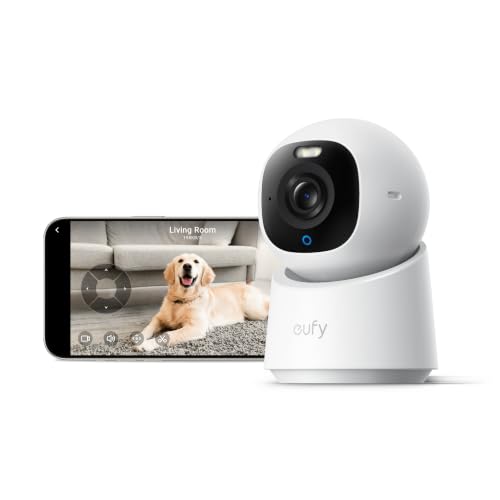
A foaling watch is a vigil, and the E30 is built like an instrument for one. Its 4K detail resolves the small print of a mare’s condition — the sweat, the restlessness, the position of a foal’s first appearance — at the range of a stall, and its pan-and-tilt lets you follow an animal that will not obligingly perform in the centre of a fixed frame. Mounted high in a corner, it covers the whole stall while staying out of reach of its occupant.
Two qualities make it a barn favourite beyond resolution. The first is local storage: recordings live on a card in the camera, so the night’s footage exists even if the farm’s broadband spent the night misbehaving, and no subscription stands between you and your own recordings. The second is discretion — it works quietly, without the theatrical lighting changes that disturb a labouring animal, and its night view is clear without flooding the stall.
It is an indoor camera, so give it the sheltered side of the barn: under the roof, away from the wash-down area, on a circuit that stays live. Within those ordinary barn conditions it is the most capable stall camera on this list, and the one we would trust with the most important night of the year.
- Resolution: 4K detail for close animal observation
- Movement: pan and tilt to follow the stall’s occupant
- Storage: local card recording, no subscription required
- Night: clear low-light view without harsh lighting
- Role: foaling and calving stalls, close animal watches
Strengths
- Detail resolves the subtle signs a foaling watch reads.
- Local recording survives rural broadband failures.
- Quiet, discreet operation around a labouring animal.
Trade-offs
- Indoor unit: needs the barn’s shelter, not an exposed post.
- Requires mains power at the stall.
- Its talents are wasted on a simple yard view.
Best for: foaling, calving and lambing watches where detail and reliability decide outcomes. Not suited for: exposed outdoor mounting in all weathers.

Blink Outdoor 4 — Best Where There Is No Power
Every farm has the building with no power: the field shelter, the far barn, the tack room in the old stable block. The Blink Outdoor 4 is the camera for those addresses. It runs on batteries that last for months stretching toward years in quiet locations, it is weatherproofed for a life outdoors, and it asks for nothing but a Wi-Fi signal and a screw to hang on. Where running cable would cost more than the camera many times over, the Blink simply declines the problem.
Its barn work is the honest security-and-checking kind: motion alerts when something moves in the shelter, a live view to confirm the yearlings are settled, a record of who visited the feed store. The picture is good, the night vision adequate for its ranges, and the app’s simplicity suits owners who want information rather than a hobby.
Understand its rhythm before buying: battery cameras sip power by sleeping, so there is a breath before a live view opens, and continuous watching is not their design. For checks and alerts at an unpowered building, nothing else on this list comes close to its convenience.
- Power: long-life replaceable batteries, no wiring
- Build: weatherproof for shelters and exposed walls
- Alerts: motion notifications to the Blink app
- Night: infrared night vision for checks after dark
- Role: unpowered outbuildings, field shelters, remote stalls
Strengths
- Installs anywhere in minutes, power or no power.
- Battery life measured in seasons, not days.
- Simple app suits occasional checking.
Trade-offs
- Live view wakes with a slight delay.
- Not designed for continuous all-night watching.
- Full features benefit from an optional subscription.
Best for: unpowered shelters and outbuildings needing checks and alerts. Not suited for: a foaling vigil that needs a constant, instant live view.

Wyze Cam v4 — Best Aisle Camera
The barn aisle is a workplace: feed is carried, horses are led, doors swing, and the light is whatever the roof allows. The Wyze Cam v4 covers that workplace with a sharpness that embarrasses its price, colour night vision that keeps the aisle readable after dark, and a built-in spotlight that doubles as a courtesy light when something needs checking. Mounted at the aisle’s end, it watches the stalls’ fronts, the feed room door and the comings and goings of the day in one frame.
Working barns appreciate its economics as much as its picture. Aisles are where cameras get knocked by hay bales and sprayed by hoses, and a camera that costs little is a camera you mount where it is useful instead of where it is safe. Several Wyze units — aisle, feed room, wash bay — still total less than one premium camera, and in a building full of hazards that redundancy is a strategy, not a compromise.
It needs mains power and decent Wi-Fi, both usually available in the main barn even when the outbuildings lack them. Give it those, keep its lens wiped against the dust, and it will out-report cameras three times its price.
- Power: mains, suited to the main barn’s circuit
- Light: built-in spotlight with colour night vision
- Storage: local card recording plus optional cloud plans
- Picture: sharp resolution well above its price class
- Role: aisles, feed rooms and working areas
Strengths
- Excellent picture and night colour for very little money.
- Cheap enough to deploy in numbers and replace without tears.
- Spotlight helps both the camera and the humans.
Trade-offs
- Tethered to power and home-range Wi-Fi.
- Not built for exposed outdoor posts.
- Dust demands regular lens cleaning in aisle duty.
Best for: main-barn aisles and work areas on a budget. Not suited for: unpowered or far-flung outbuildings.

TP-Link Tapo C210 — Best Budget Stall Camera
The Tapo C210 is the stall camera for owners who count costs and distrust subscriptions in equal measure. It pans and tilts to cover a stall from a high corner, records to its own memory card so the footage is yours without a monthly fee, and its night vision reads a bedded stall clearly enough for the standard night check — is she lying down, is she eating, is anything different from an hour ago. For the many barns that need exactly that and no more, it is the rational purchase.
Its app is straightforward, its motion detection can be tuned to the stall’s normal life, and its price invites the multi-stall deployment that actually changes management: one over each due mare, each box-rest patient, each new arrival in quarantine. Quarantine watching is an underrated use — a camera over an isolation stall reduces the foot traffic that spreads the very infections isolation exists to contain.
As a budget indoor unit it wants the same shelter as the eufy: under roof, out of the wash bay’s range, on a tidy cable run. Treat it as a consumable-grade instrument rather than an heirloom and it will serve several seasons faithfully.
- Movement: pan and tilt covering a full stall
- Storage: memory-card recording, no subscription needed
- Night: infrared view for standard night checks
- App: simple controls with tunable motion detection
- Role: individual stalls, quarantine and box-rest watches
Strengths
- Pan-tilt stall coverage at the lowest cost here.
- Card recording keeps footage local and free.
- Cheap enough for one-per-stall deployment.
Trade-offs
- Picture detail trails the 4K eufy for close foaling reads.
- Indoor build needs shelter and a power point.
- App polish is functional rather than delightful.
Best for: multi-stall coverage and quarantine watches on a budget. Not suited for: the highest-stakes foaling watch where maximum detail matters.

Arlo Essential Indoor Pan Tilt — Best App Experience
Some owners live in their phone’s notifications, and for them the software is the camera. Arlo’s Essential Indoor Pan Tilt pairs a capable pan-and-tilt stall camera with the most polished app ecosystem on this list: alerts that can be taught what matters, a live view that opens promptly, and controls that a tired person at 2 a.m. can operate without thinking. In the middle of a foaling week, that usability is a welfare feature for the human as much as the animal.
The camera itself covers a stall smoothly, tracks movement within its view, and produces a clear night picture suited to standard watches. Arlo’s platform also grows gracefully — the same app can run the yard’s outdoor Arlo cameras later, giving one pane of glass for the whole property, which owners of several buildings come to value more than any single specification.
Its model leans on Arlo’s subscription for the richest features and cloud history, so factor that ongoing cost into the comparison honestly. For owners who accept it, the Arlo is the stall camera least likely to be abandoned in a drawer, because using it is genuinely pleasant.
- Movement: pan and tilt with smooth app control
- App: polished alerts, quick live view, multi-camera platform
- Night: clear infrared picture for stall checks
- Storage: cloud-centred, with subscription tiers
- Role: stall watching for app-focused owners
Strengths
- The most refined notifications and controls here.
- Scales to a whole-property Arlo system in one app.
- Responsive live view for middle-of-the-night checks.
Trade-offs
- Best features sit behind an ongoing subscription.
- Cloud reliance suits strong broadband better than weak.
- Indoor unit needs shelter and mains power.
Best for: owners who want the smoothest app and a system that can grow. Not suited for: subscription refusers or barns with unreliable internet.
How Do the Picks Compare Around the Barn?
| Pick | Power | Movement | Storage style | Best job |
|---|---|---|---|---|
| REOLINK Argus PT Ultra | Battery + solar | Pan and tilt | Local + cloud | Yard and gate |
| eufy 4K Indoor Camera E30 | Mains | Pan and tilt | Local card | Foaling stall |
| Blink Outdoor 4 | Long-life battery | Fixed | Cloud-centred | Unpowered shelter |
| Wyze Cam v4 | Mains | Fixed | Local + cloud | Aisle and feed room |
| TP-Link Tapo C210 | Mains | Pan and tilt | Local card | Budget stalls |
| Arlo Essential Indoor Pan Tilt | Mains | Pan and tilt | Cloud-centred | App-led stall watch |
Match the power column to your buildings first — it eliminates half the table honestly — then match the job column to the animal or area you most need to see. Barns reward systems built from several modest cameras in the right places over one expensive camera in a compromise position.
How Do You Get Wi-Fi to a Barn?
More barn camera projects fail on signal than on cameras, so treat the network as the first installation. Test at the mounting point, not at the barn door: hold your phone where the camera will sit, in the stall’s far corner, and see what survives the walls. If the signal is weak, the honest fixes are an outdoor access point on the house wall aimed at the barn, a point-to-point wireless bridge for longer distances — a well-established farm technology — or a mesh node in the barn itself fed by either. Each is a one-time cost that every camera afterwards benefits from.
Design for the dropout as well as the connection. Rural links fail at the worst moments, usually weather-related and foaling-coincident by some law of the universe, which is why this list favours cameras that keep recording to a local card when the network vanishes. The live view may pause; the evidence and the timeline should not.
Keep the barn network boring: one clearly named network, the password written in the barn office, and no clever settings between the cameras and the router. The 3 a.m. troubleshooting session is not the venue for appreciating a complicated network, and the simplest setup is the one that is still working in year three.
How Should You Run a Foaling or Calving Watch With Cameras?
Install early. The camera should be part of the stall’s furniture at least two weeks before the due date, so the mare treats it as scenery and you have practised the view, the alerts and the walk to the barn in the dark before any of them matter. Frame the stall so the whole floor is visible — births happen in the corner you did not cover, with a reliability that feels personal — and check the night picture specifically, because the watch will be read in infrared, not in the daylight view you framed by.
Set alerts to serve the vigil rather than shatter it. Motion alerts tuned too keenly will fire at every shift of weight and train you to sleep through the real one; many keepers run the live view on a tablet by the bed instead, glancing at intervals, with alerts reserved for the camera’s person-detection or for a second camera on the yard that catches their own walk down. Share the app access with whoever shares the watch — a camera that only one exhausted person can see is a single point of failure wearing a lens.
And keep the camera in its place in the hierarchy: it tells you when to go to the barn. It does not attend the birth, clear the membranes or check the foal. The technology’s triumph is that you arrive in time; everything after your arrival is horsemanship, exactly as it was before cameras existed.
What Mistakes Do Barn Owners Make With Cameras?
Mounting within reach is the classic. A camera at head height is a camera rubbed by a horse, licked by a cow, perched on by a cat and knocked by the first hay bale that passes; mount high, in corners, with cables tucked into conduit or along beams where teeth and hooves cannot browse them, and where winter condensation does not drip through the housing. The second mistake is the spotlight surprise: a camera whose bright light fires at every motion turns a stall into a disco and a resting animal into a vigilant one, so prefer infrared at night in animal spaces and save spotlights for aisles and yards where humans benefit.
Third is neglecting the lens. Barn dust films a lens in weeks, softening the picture so gradually the owner blames the camera; a monthly wipe, timed with the barn’s other small rituals, keeps the image honest. Fourth is buying for the house’s Wi-Fi rather than the barn’s: a camera that was brilliant in the kitchen and useless in the back stall was never tested where it mattered. Test at the mount, in the weather, at night, before the return window closes. That single afternoon of scepticism, applied before the drill comes out, is what separates the barn systems that get recommended to neighbours from the ones that get apologised for at the feed merchant’s counter every spring.
The last mistake is letting alerts replace rounds. A camera system is a supplement to stockmanship, not a substitute — it cannot smell ketosis, hear a cast horse’s struggle through a wall, or notice the water trough’s ice. The best-run barns use cameras to aim their attention, and their attention remains the real monitoring system.
Can Barn Cameras Help With Security and Insurance?
Tack, feed, tools and trailers are among the most stolen property in rural areas, and a camera system changes the odds in two ways: visibly, as a deterrent that sends opportunist thieves to an easier yard, and evidentially, with recordings that give police and insurers something firmer than a description. The yard-facing picks here — the REOLINK on its post, the Blink on the store, the Wyze over the aisle — cover the approaches thieves actually use, and number-plate legibility at the gate is worth more than a beautiful picture of an empty yard.
Tell your insurer the system exists and ask what they value; requirements vary, but recorded coverage of entrances and high-value stores is the usual ask, and some policies price the reduced risk. Keep recordings long enough to be useful — a theft discovered after a holiday needs more history than a theft discovered in the morning — which is another quiet argument for generous local storage.
Post signage where local rules expect it, and aim cameras at your own property rather than the road and the neighbours. Good fences make good neighbours; well-mannered cameras keep them that way.
What About Lambing Sheds, Poultry and Other Livestock?
The same cameras re-sort themselves by species. Lambing sheds want width and numbers — several Tapo or Wyze units over pens beat one flagship, because the night’s drama is distributed across twenty ewes — and they want infrared discretion, since sheep spook at novelty in a bunch. Calving follows the foaling pattern at larger scale, with the REOLINK’s sweep earning its keep across a yard of pens.
Poultry houses add dust of a finer grade and a pecking hazard to low equipment; mount high, expect to clean lenses often, and value the wide fixed view that shows the flock’s distribution — a huddle in a corner tells a story about a draught or a predator that no single-bird close-up would. Pigs investigate everything with structural intent, so conduit and height are not optional. In every species the principles repeat: unreachable, unbothered, locally recording, and tested at the mount before the season starts.
How Do You Power a Whole Barn’s Worth of Cameras?
Start by respecting the building’s existing electrics. Many barns run on a single ageing circuit shared with lights, clippers and a kettle, and a camera system should sip from it, not feast. The mains picks here draw little, but their power supplies and cable runs still deserve dry, high, protected routes — adapters at ankle height in a wash-down building are an accident on a schedule. Where a socket must be added, that is a job for an electrician who understands agricultural buildings, and it is money better spent than on a seventh camera.
The battery and solar picks exist to break the wiring problem entirely, and on many properties the smart layout is hybrid: mains cameras in the main barn where power already lives, battery units in the shelters and far buildings, all reporting to the same phone. Plan the map on paper before buying, marking power, signal and sightlines together, because the three constraints negotiate with each other — the perfect viewpoint with no power and no signal is a viewpoint for a different technology.
Surge protection earns a mention it rarely gets. Rural power and lightning are old enemies, and a modest surge protector on the barn’s camera circuit is cheap insurance for every device downstream of it.
Should Barn Cameras Record Continuously or on Motion?
Continuous recording is the gold standard for animal watches, because the significant event — the mare’s first restlessness, the cow’s isolation from the herd — often precedes the dramatic one by hours, and motion detection alone may file it as uninteresting. The locally recording picks make continuous recording practical: a generous memory card in the eufy or Tapo holds days of stall footage, overwritten in a loop, there when you need to rewind the night and absent no subscription to strangle it.
Motion recording is the right economy for security positions. A yard camera that records every hour of an empty yard wastes storage and review time; event-based recording with a few seconds of pre-roll captures the visitor and the vehicle in full. Battery cameras, which must sleep to survive, are motion machines by design — one more reason they suit shelters and stores rather than vigils.
Most good barn systems therefore run both philosophies at once, assigned by job. Decide per camera, write the decision on the barn-office list, and review it after the first month, when real life has shown you which stalls you actually rewind.
What Do Barn Cameras Change About Everyday Management?
The emergencies justify the purchase, but the Tuesdays justify the habit. A camera over the stalls settles the small questions that otherwise need a walk: did the new horse eat up, is the box-rest patient actually resting, has the automatic waterer been visited, did the farrier’s visit finish. Owners who install cameras for foaling find, a season later, that the daily checks are the feature they would not surrender.
There is a management dividend in the recordings, too. Feeding disputes, gate-left-open mysteries, the dog that swears it was nowhere near the feed room — the timeline settles them without accusation. Staff and sharers coordinate better when the barn’s state is visible rather than reported, and a livery yard that can show an owner their horse settled at midnight has a service its competitors cannot copy with words.
New arrivals benefit quietly. A horse in its first nights, watched without being visited, shows its true settling behaviour rather than its behaviour-for-an-audience, and feeding and turnout decisions made from that honest picture go better. The camera’s gift to management is not surveillance; it is undisturbed truth.
Are Trail Cameras a Sensible Alternative for Barns?
For some outposts, yes. A cellular or card-based trail camera asks for no Wi-Fi, no power and no network at all, and for the remote field shelter checked weekly, its independence beats every pick here. What it gives up is the live view — the 3 a.m. glance that is the barn camera’s whole reason — and its pictures arrive on a card or a cellular plan’s schedule rather than at your tap.
Treat the two as complements in a large property’s system: networked cameras where the animals’ important nights happen, trail cameras at the far boundaries where only a record matters. The mistake is expecting either to do the other’s job — a trail camera at a foaling is a historian, not a midwife’s assistant, and a Wi-Fi camera beyond the network’s edge is a decoration.
What Does a Seasonal Barn Camera Checklist Look Like?
Before the breeding season: test every camera at its mount at night, wipe lenses, format cards in their cameras, confirm the alerts reach every phone that shares the watch, and walk the route to the barn in the dark once, torch in hand, while nothing depends on it. Replace any battery that the app has been quietly warning about since autumn.
Monthly through the year: wipe the lenses, glance at battery and card health in the apps, review one random hour of footage to confirm the picture is still honest, and check mounts and cables for the attentions of livestock and weather. After any storm, add a walk of the outdoor units to the fence check.
Annually: review the map itself. Animals, buildings and routines change; the camera over the stall of a horse you sold is watching an empty box while the new foaling stall goes unseen. A system reviewed once a year stays a system; one left to itself becomes archaeology.
How Do You Learn to Read an Animal on Camera?
A camera shows behaviour, and behaviour is a language that rewards study. The keeper who watches the same stall nightly learns its occupant’s ordinary grammar — the order of lying, standing, eating and dozing that makes up a normal night — and it is against that baseline that the significant deviations announce themselves: the restlessness that is not quite colic and not quite labour, the isolation a sick animal chooses before any other symptom, the appetite that fades by degrees across three evenings of recordings. None of these need a better camera; they need an observer who has banked the normal, night after ordinary night, until the abnormal has nowhere left to hide.
Use the recordings as a diary. When something does happen — a birth, an illness, a mystery lameness in the morning — the night’s footage, reviewed with the vet, often contains the first chapter of the story, told hours before a human was present. Owners who keep a week of history on their stall cameras are not being sentimental; they are keeping the only honest log of what their animals did while nobody watched.
Share the literacy. Everyone who does night checks should know what the normal night looks like on screen, or the system’s value halves with every change of staff. Ten minutes of orientation at the monitor is training as real as any given at the stable door.
Is Two-Way Talk Useful in a Barn?
Mostly no, and occasionally priceless. The everyday truth is that your voice arriving disembodied from a speaker is a novelty the first time and a disturbance thereafter; horses in particular do not need a ghost in their stall at midnight. Used as an intercom between humans — calling the person in the barn from the house without a phone signal’s cooperation — it has a modest practical life.
The priceless case is the intruder. A voice from the yard camera announcing that the property is recorded and the police are called has ended more thefts than any recording has solved after the fact, and for isolated yards that deterrent is a genuine feature of the outdoor picks. Judge the function as a security tool rather than an animal one, keep it silent around livestock, and it earns its place in the specification.
What If a Camera Fails During the Season?
It will, eventually, and the barns that cope are the ones whose system was never a single camera. The redundancy built into the budget picks — several modest units rather than one jewel — means a failure demotes coverage instead of ending it: the aisle camera swings to cover the critical stall for a night, the spare Tapo in the office drawer goes up in ten minutes. Keep one spare, configured and named, and the system’s worst night becomes an errand rather than a crisis.
Diagnose in the order of probability: power first, then network, then the card, then the camera. Barn failures are overwhelmingly supply and signal wearing a camera costume, and the keeper who swaps a power supply before condemning a unit saves money and dignity in equal measure. Log the failure and the fix in the barn office; the same fault will visit again, and the log turns its second visit into a two-minute job.
What About Privacy on a Livery or Shared Yard?
Where other people keep animals on your property — or you keep yours on theirs — cameras acquire a social dimension that pure technology ignores at its peril. The workable settlement is transparency: cameras declared, their positions known, their purposes stated, and their fields of view kept to animals, entrances and property rather than people’s private corners. A livery owner who shows clients the stall cameras and offers them viewing access to their own horse’s feed has turned a potential grievance into the yard’s best advertisement.
Audio deserves extra care; several of these cameras can record it, and listening to people who have not agreed to be heard is a line that varies legally and offends universally. Mute audio in shared spaces unless there is a stated reason not to. Keep recordings for a defined, sensible period and say what it is. The yards that argue about cameras are almost never arguing about the cameras — they are arguing about surprise, and surprise is entirely within the owner’s gift to avoid.
How Do You Choose the Mounting Position in a Stall?
High in the corner opposite the door is the stall camera’s natural home: it sees the whole floor, the manger and the usual lying places in one frame, it is out of the reach of the tallest horse’s investigation, and the door’s swing and the handler’s traffic pass beneath rather than through it. Frame for the floor, not the walls — the events that matter happen at ground level — and accept a view of the rafters as the price of a mount the animals cannot touch.
Check the frame at night before the season, and check it again with the stall bedded and occupied, because a view that was perfect over an empty stall can hide a lying horse behind a haynet’s shadow. If two corners compete, choose the one the light — or the infrared’s reflection off a pale wall — favours, and tape the camera’s cable run along the beam where a rubbing neck cannot find it. Ten minutes of this care in September is the difference between a watch and a guess in February.
What About the Tack Room and Feed Store?
The barn’s two most burgled rooms deserve their own sentence in the plan, because their needs differ from the stalls’. A tack room wants a camera on its door rather than in its interior — the approach and the face are the evidence — and it wants that camera obvious, since deterrence is the point. The Blink on the store’s wall and the REOLINK’s sweep across the yard both serve here without new purchases, provided their positions were planned with the doors in frame from the start.
The feed store’s camera solves smaller mysteries as faithfully as large ones: the delivery shortfall, the door left ajar, the cat with ambitions. Owners consistently report that these workaday answers, not the dramatic ones, are what the system returns month after month — a quiet audit trail over the rooms where money, in the form of leather and feed, sits waiting to walk away.
Final Recommendation
Build the system around your most important night. If that is a foaling, put the eufy 4K E30 over the stall and stop deliberating; if it is the security of a yard full of valuable tack and machinery, the REOLINK Argus PT Ultra on a post is the foundation. Add the Blink Outdoor 4 wherever power refuses to go, the Wyze Cam v4 along the working aisle, and Tapo C210s across the stalls that need watching in numbers, choosing the Arlo instead where the app’s polish will keep a whole family engaged with the watches. Then fix the network properly, mount everything out of reach, and wipe the lenses monthly. A barn camera system done this way stops being a gadget within a month and becomes what it should be: the quiet member of staff who never sleeps and never exaggerates. Buy for the buildings and animals you actually have, in the order of the nights that worry you most, and the system will repay you the first time it lets you stay in a warm bed while the barn, watched and settled, looks after itself until the morning.
Related guides
Frequently Asked Questions
Will the camera’s lights and sounds disturb my animals?
They can if you choose and set them carelessly. Prefer infrared night vision over spotlights inside stalls, turn off status lights and sounds where the settings allow, and install the camera well before it matters so the animals accept it as furniture. Most livestock ignore a quiet, high, unchanging camera within days.
How far can the barn be from the house Wi-Fi?
There is no single distance — walls, construction and interference decide — which is why testing at the exact mounting spot is the only honest answer. When the house signal falls short, an outdoor access point or a point-to-point bridge is the standard farm solution, and the locally recording picks in this guide keep working through any remaining dropouts.
Do I need a subscription for a barn camera?
Not with the locally recording picks: the eufy E30 and Tapo C210 record to memory cards with their core functions intact and no monthly fee. The Blink and Arlo ecosystems reserve some features for subscribers. On a farm with several cameras, that difference compounds, so decide your storage philosophy before you buy the first unit.
Can one camera watch several stalls?
A pan-and-tilt camera can visit several stalls, and the REOLINK’s presets make that practical for rounds and checks. But it can only look one way at a time, so for simultaneous high-stakes watches — two mares due the same week — one camera per stall remains the honest setup, which is exactly what the budget picks make affordable.
What happens to the cameras in winter and summer extremes?
The outdoor picks are built for weather and wide temperature ranges. Indoor units in an unheated barn generally cope with cold well but dislike condensation, so mount them away from wash-down steam and kettles, and let a cold camera warm up in its own time if it is ever brought inside. Dust and moisture, managed monthly, matter more than temperature for most barns.
How many cameras does a typical barn actually need?
Fewer than the catalogue suggests and more than one. A workable small-barn system is usually three to five: one over the critical stall, one on the aisle, one on the yard or gate, and a battery unit wherever power runs out. Start with the stall and the yard, live with them for a month, and let the gaps you actually notice — not the ones a salesperson predicts — decide what joins them.
Can I share the camera view with my vet or family?
Yes — every platform here supports shared access, and it is one of the system’s genuine welfare benefits. A vet who can see the mare’s behaviour live gives better advice than one working from a description, and family sharing spreads the night watch across more rested people. Use individual accounts rather than a shared password where the app offers them.
Related Guides
Barns sit at the crossing of animal care and property security, and both directions have their own guides. For the house end of the property, see our roundup of the best outdoor security cameras for farms; for the animals themselves, our guide to the best cameras for watching pets at home covers the indoor equivalents, and our explainer on extending Wi-Fi to outbuildings goes deeper on the bridges and access points this guide recommends.

