kajuandouglas.com is reader-supported. When you buy through links on our site, we may earn an affiliate commission.
Where to Buy
The best cameras for ages 7 10 sit in an awkward gap that toy makers and camera makers both handle badly. A seven-year-old needs something that survives being dropped on a patio, swung by its strap into a doorframe, and left in a sandbox overnight. A ten-year-old, meanwhile, is already embarrassed by anything that looks like a toddler toy and wants a camera that feels like the real thing — because to them, it is. The picks below are all sold through Amazon listings linked in this guide; match the model name on the listing to the pick before you buy, because several of these cameras have near-identical siblings with different features.
Buy for the child in front of you, not the child in the product photos. If your seven-to-ten-year-old already photographs everything on a borrowed phone and complains about the results, skip the novelty end of this list entirely and look at the compact and action cameras further down. If the camera is a first taste of photography — a birthday gift for a kid who has never owned one — the instant cameras at the top will teach framing, patience, and the strange joy of a picture you can hold, without a screen swallowing the experience.
One practical habit before anything goes in the basket: budget for the consumables and the case, not just the camera. Instant cameras eat film packs. Action cameras need a memory card and ideally a floaty handle. A ten-dollar case has saved more of these cameras than any warranty. The reviews below flag the running costs honestly for each pick, because a camera that becomes too expensive to feed ends up in a drawer by half term.
Key Takeaways
- The Fujifilm Instax Mini 12 is the gentlest starting point for the younger end of this age range: it exposes itself, prints on the spot, and asks almost nothing of the photographer.
- The OM SYSTEM Tough TG-7 is the one camera here you can hand over without a protective speech — it is built to be dropped, dunked, and stood on.
- A GoPro HERO12 Black suits the older, sportier child who wants to film bike rides and pool jumps rather than pose for portraits.
- The Canon PowerShot G7 X Mark III is the step-up for a nine- or ten-year-old who has outgrown toys and wants photos that genuinely look good.
- Film cost is the hidden budget line on both instant cameras; factor in a steady supply of prints before choosing one as a main gift.
- For this age group, a camera with a wrist strap, a simple menu, and a forgiving auto mode will be used ten times more than a technically better camera that frustrates.
In this guide
Quick Picks
| Badge | Pick | Why it stands out |
|---|---|---|
| Best First Camera | Fujifilm Instax Mini 12 | Point, shoot, print: automatic exposure and a selfie mirror make it nearly impossible to take a wasted shot. |
| Best Pocket Instant | Polaroid Go Generation 2 | The smallest instant camera here, with tiny film that suits small hands and small budgets for experimentation. |
| Best Drop-Proof Pick | OM SYSTEM Tough TG-7 | A genuinely rugged compact that shrugs off drops, water, and dust while taking proper photographs. |
| Best for Action Kids | GoPro HERO12 Black | Films stabilised video of rides, swims, and skate attempts, and survives the crashes that come with them. |
| Best Step-Up Compact | Canon PowerShot G7 X Mark III | A real photographer’s compact with a bright lens and flip screen that a keen ten-year-old can grow into for years. |
| Best for Young Vloggers | Sony ZV-1F | A fixed wide lens, simple video-first controls, and a screen made for talking to — ideal for first video diaries. |
How We Chose These Picks
We started from the failure modes of childhood, not from spec sheets. Cameras given to seven-to-ten-year-olds die in predictable ways: dropped from climbing frames, dunked in paddling pools, choked with sand, or abandoned because the menu needed a parent every time. So the first filter was survival — either genuine ruggedness, cheap-enough-to-replace pricing, or a shape that small hands can grip securely. Anything delicate and expensive was cut unless its photographic payoff justified supervising it.
The second filter was independence. A good camera for this age range works fully in automatic mode, starts fast, and gives feedback a child understands: a print sliding out, a screen that shows the photo instantly, a beep that means it worked. Cameras that demand an app on a parent’s phone for basic use scored badly, because a camera that needs an adult’s phone is, in practice, the adult’s camera.
Third, we weighed the cost of ownership. Film, memory cards, batteries, and cases were priced into the judgement even though we never print prices here — a cheap camera with expensive film can cost more over a year than a pricier camera that shoots to a reusable card. Finally, we checked growth room: the best picks for a seven-year-old and the best for a ten-year-old differ, and the list is ordered so you can enter at the point that matches your child and see what the next step up looks like.
What Should a Camera for a Seven-to-Ten-Year-Old Actually Do Well?
It should make a decent picture with zero decisions. Children in this age band shoot the way they talk — constantly, impulsively, and at whatever is nearest. A camera that needs the mode dial checked, the flash forced, or the focus point moved will miss the moment and teach the child that photography is fiddly. Every pick here can be lifted, pointed, and fired with a good chance of a keeper, and that hit rate is what builds the habit.
It should also give the child something back immediately. For younger kids that feedback loop is physical — a print. For older kids it is a bright screen and video playback with sound. What does not work at this age is delayed gratification: a camera whose results can only be judged later on a computer will lose to a tablet within a week. Notice that the two instant cameras top this list for exactly that reason, even though their image quality is the lowest here by any technical measure.
Finally, it should fit the hand and the life. A camera that lives in a parent’s bag gets used on holidays only. A camera small enough for a child’s own backpack, tough enough to be allowed on the school trip, and simple enough to lend to a friend without a training session — that camera produces hundreds of photos, and hundreds of photos is how a child actually learns to see.
Instant Prints or Digital Files: Which Suits Your Child Better?
Instant cameras teach composition in a way digital never will, because every frame costs something. Children slow down, frame carefully, and think about whether the shot is worth a print — then trade prints like currency and stick them on bedroom walls. The downside is arithmetic: a heavy shooter can burn through film fast, and the prints are small. Instant suits younger children, social children, and families happy to treat film as the ongoing gift — grandparents funding film packs is a time-honoured arrangement.
Digital cameras suit experimenters. A child with a memory card can shoot four hundred frames at the zoo, try every angle on the dog, and learn from the flood of mistakes at no marginal cost. Video lives here too — the GoPro and the Sony below exist because many children in this bracket would rather film than photograph. Digital also means a parent becomes the archivist, so decide whose job the downloading is before the card fills up and the camera gets blamed for being “full.”
There is no wrong answer, only a wrong match. The reflective child who makes scrapbooks will love instant. The restless child who documents every bike jump needs digital video. Some families buy the instant camera for the seventh birthday and the digital compact for the tenth, and honestly that two-step path is what this list is quietly organised around.

Fujifilm Instax Mini 12 — Best First Camera
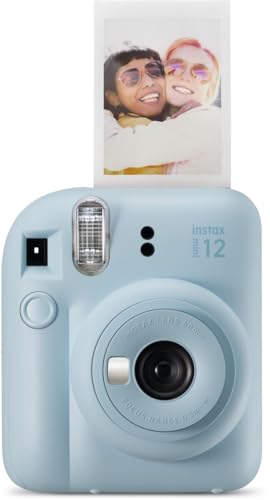
The Instax Mini 12 understands its audience perfectly: it does almost everything itself. Exposure is fully automatic, the lens twists on with a satisfying clunk that small hands manage easily, and a little mirror next to the lens lets children frame selfies without guesswork. A seven-year-old can be taking successful prints within a minute of the batteries going in, and that instant competence is the whole point — the camera disappears and the photographing starts.
What children actually do with it is revealing. They photograph friends, pets, birthday cakes, and each other pulling faces, then hand the prints over like gifts. The credit-card-sized photos end up on fridges, in school bags, and taped inside locker doors. No digital camera at this price creates that social loop. Parents should know the photos are soft and the colours pastel-bright rather than accurate; judged as photography it is modest, judged as a seven-year-old’s creative tool it is close to perfect.
- Format: instant film, credit-card-sized prints
- Exposure: fully automatic, no settings to manage
- Extras: selfie mirror, close-up mode, simple twist-on lens
- Power: AA batteries, easy to swap anywhere
Strengths
- Prints in hand within moments, which keeps younger children engaged far longer than a screen does.
- Automatic exposure means almost no wasted shots from wrong settings — the film budget goes on pictures, not mistakes.
- Light, rounded, and grippable, with colours children actually want to carry around.
Trade-offs
- Film is a permanent running cost, and an enthusiastic child can empty a pack in an afternoon.
- Prints are small and detail is gentle; this is not the camera for a child who zooms and inspects.
- No digital copy exists, so a lost print is gone for good unless someone photographs it.
Best for: six-to-eight-year-olds getting their very first camera, and any child who loves making things they can hold and give away.
Not suited for: families who will resent buying film regularly, or older children who already find instant prints babyish.

Polaroid Go Generation 2 — Best Pocket Instant
The Polaroid Go is the instant camera shrunk to the size of a child’s hand. It uses miniature film that produces little square prints with the classic Polaroid border, and the whole camera is small enough to live in a coat pocket or hang from a wrist all day at the zoo. That portability changes behaviour: cameras that come along get used, and this one always comes along.
The second generation improved the exposure reliability and added a selfie mirror and a self-timer that children use for group shots with friends — prop it on a wall, dash back, pull a face. The tiny prints are admittedly more charm than detail, but children treat them like stickers and trading cards. Film for the Go costs less per pack than full-size instant film in many bundles, though you get fewer, smaller prints; over a year the running costs land in similar territory to the Instax.
- Format: miniature instant film, small square prints
- Size: the most pocketable camera in this guide
- Extras: selfie mirror, self-timer, double-exposure mode for older kids to experiment with
- Power: rechargeable internal battery via USB
Strengths
- Genuinely pocket-sized, so it travels everywhere instead of living in a drawer.
- The small prints feel collectible to children — they swap, label, and display them.
- Double-exposure mode gives a nine- or ten-year-old a first taste of deliberate creative effects.
Trade-offs
- The tiny prints show little detail; faces at any distance become suggestions.
- Rechargeable battery means a flat camera stays flat until it has sat on a cable.
- Less rugged than it looks — the small body still dislikes drops onto concrete.
Best for: children who want a camera that is always with them, and younger kids whose hands find full-size cameras clumsy.
Not suited for: children who want to see real detail in their photos, or heavy shooters who will go through miniature film packs quickly.

OM SYSTEM Tough TG-7 — Best Drop-Proof Pick
Every other camera in this guide needs at least a little care. The Tough TG-7 needs none. It is a proper compact camera sealed and reinforced to survive drops onto hard ground, full immersion in water, dust, sand, and being frozen — the standard hazards of childhood, itemised. Parents of adventurous seven-to-ten-year-olds will recognise the relief of handing over a camera without first delivering the be-careful speech.
Underneath the armour it is a real camera: a bright lens, good close-up ability that borders on the microscopic for photographing bugs and flowers, and underwater modes that correct the blue cast at the pool or the beach. Children discover the macro mode fast — a ladybird photographed at maximum closeness fills the screen like a monster, and suddenly the garden is a safari. Image quality is a clear step above the instant cameras and entirely respectable for a compact.
- Build: waterproof, drop-proof, dustproof, freeze-proof compact
- Lens: bright zoom with strong close-up and microscope-style modes
- Modes: dedicated underwater settings, simple auto for everyday use
- Extras: GPS and sensors that log trips, fun for reviewing adventures
Strengths
- Survives the actual conditions of childhood — beach, pool, mud, frost, and the playground drop test.
- Macro ability opens a whole genre of photography (insects, leaves, textures) that children adore.
- Takes proper digital photos and video, so no film costs and everything can be saved and printed later.
Trade-offs
- The menu is a grown-up camera menu; younger children will use auto and a few modes only, which is fine but parents may need to set it up once.
- It costs more than toy cameras by a wide margin — this is a buy-it-for-years purchase.
- No flip screen, so selfies and vlogging-style filming are awkward compared with the Sony below.
Best for: outdoorsy, accident-prone, or beach-and-pool children, and families who want one camera to last from seven to twelve.
Not suited for: children whose main interest is filming themselves talking, or buyers looking for a cheap stocking-filler.

GoPro HERO12 Black — Best for Action Kids
Some children do not want to photograph the world; they want to film themselves moving through it. The HERO12 Black is the camera for the nine-year-old who has strong opinions about bike jumps, wants the pool dive filmed from the board, and fully intends to review the footage in slow motion. Its stabilisation turns shaky, bouncy, child-shot video into something watchable, which is the difference between footage that gets rewatched and footage that gets deleted.
It is waterproof out of the box for swimming and snorkelling, mounts to helmets, handlebars, and chest straps, and takes still photos perfectly well when asked. Voice control genuinely helps when the camera is mounted and hands are busy. Battery life improved meaningfully in this generation, which matters because children never, ever charge things in advance. A parent should still expect to become the unofficial keeper of the charging cable.
- Type: waterproof action camera, video-first with capable stills
- Stabilisation: advanced electronic stabilisation for running, riding, and swimming footage
- Mounts: huge accessory ecosystem — helmet, bike, chest, surf, and floaty grips
- Controls: touchscreen plus voice control for hands-busy filming
Strengths
- Stabilised video makes a child’s sports and adventures look genuinely good, which keeps them filming.
- Tough and waterproof without a case for pool and sea use; cheap mounts put it anywhere.
- Doubles as a perfectly decent stills camera for trips and family days out.
Trade-offs
- The wide, fixed view is wrong for portraits and anything far away — no zooming in on the school play.
- Small touchscreen controls can frustrate small fingers, and settings bury easily.
- Best results need the footage downloaded and watched somewhere, so a parent inherits the role of editor-in-chief.
Best for: sporty eight-to-ten-year-olds who think in video — skaters, swimmers, riders, and junior explorers.
Not suited for: children who mainly want still photographs of people, or families unwilling to manage memory cards and charging.

Canon PowerShot G7 X Mark III — Best Step-Up Compact
This is the camera for the child at the top of the age range who has started to care about how photographs look. The G7 X Mark III has a larger sensor and a brighter lens than anything else in this guide, and the difference shows immediately: indoor photos without the washed-out flash look, backgrounds that soften behind a portrait of the dog, colours that look like the day actually felt. A keen ten-year-old graduating from a phone or a toy will feel the upgrade in every frame.
The screen flips up for selfies and video diaries, the controls include a real dial and ring for the child who wants to learn what aperture means, and it can stream and upload in ways that will matter in a year or two. It is not rugged — this is the first camera on the list that comes with a responsibility conversation — but children who are ready for it tend to rise to it, precisely because it treats them as photographers rather than as hazards.
- Sensor: large 1-inch type, the best image quality in this guide
- Lens: bright zoom suited to indoor and low-light photos
- Screen: tilts up for selfies and filming yourself
- Controls: full manual options to grow into, reliable auto to start with
Strengths
- Image quality that satisfies a genuinely talented young photographer instead of capping them.
- Flip screen and good video make it a natural first camera for a child drifting toward filming and creating.
- Compact enough for a child’s bag, serious enough to still be useful at thirteen or fourteen.
Trade-offs
- Not waterproof or drop-proof; a case and a strap are mandatory, and even then it wants supervision early on.
- The most expensive kind of purchase here — hard to justify for a child whose interest might last a month.
- More settings than a seven-year-old needs; this is really a nine-and-up camera.
Best for: older children in the range who show real photographic interest and can be trusted with a proper camera.
Not suited for: younger or rough-and-tumble children, beach-and-pool use, or tentative first experiments with the hobby.

Sony ZV-1F — Best for Young Vloggers
The ZV-1F was designed for people who film themselves talking, and a surprising number of nine- and ten-year-olds are exactly those people: they narrate their Lego builds, review their own drawings, film tours of their bedrooms, and record video diaries nobody else may ever see. The camera’s fixed wide lens frames a child and their surroundings from arm’s length, the screen flips fully around, and a single button blurs the background for that grown-up creator look children are desperate to copy.
Simplicity is the design brief. There is no zoom lens to fumble — the wide view is the point — and the microphone setup is tuned for voices, with a little windscreen that makes garden filming usable. It also takes still photos, though stills are clearly the side dish here. Parents should note it is a delicate little thing compared with the TG-7 or the GoPro; it rewards a careful owner and punishes a careless one.
- Type: video-first compact with fixed ultra-wide lens
- Screen: fully flip-around screen for filming yourself
- Audio: voice-focused microphone with wind muff included
- Extras: one-button background blur, product showcase focus for showing objects to camera
Strengths
- The easiest route to video that looks and sounds like the creators children watch.
- Fixed lens means fewer decisions and fewer ways to get a shot wrong.
- Light and small, with simple menus a confident nine-year-old navigates alone.
Trade-offs
- No zoom at all — anything distant stays distant, which frustrates nature and sports filming.
- Not rugged or waterproof; it needs a case and a careful owner.
- Stills are serviceable rather than special; photo-first children should look at the Canon above.
Best for: older children in the range who want to make videos of themselves, their projects, and their world.
Not suited for: stills photographers, outdoors rough use, or younger children who need something indestructible.
How Do You Match the Camera to the Child’s Age Within the Range?
Seven and ten are further apart than the range suggests. A typical seven-year-old shoots in bursts of enthusiasm, values a camera that works instantly, and learns from results they can see or hold right now. For this end of the range, the two instant cameras and the TG-7 earn their places: they forgive rough handling, they reward immediately, and they ask for no maintenance beyond film or the occasional charge.
By nine and ten, most children have opinions, projects, and an audience in mind — even if the audience is one best friend. They compare their photos with what they see online and notice quality. This is where the GoPro, the Sony, and especially the Canon G7 X come in: each specialises (action video, talking-to-camera video, still photography) and each treats the child as a beginner creator rather than a toddler with a toy. Buying the specialised camera that matches the actual obsession in front of you beats buying a general camera that covers everything blandly.
The trap to avoid is buying for the age you wish they were. A delicate, expensive compact given to a boisterous seven-year-old becomes a source of family tension within a week; a chunky toy given to a serious ten-year-old gets politely abandoned. If you are genuinely between stages, the TG-7 is the bridge pick — tough enough for the younger years, photographic enough for the older ones.
What Mistakes Do Parents Make Buying a First Camera?
The classic error is buying the camera with the most features instead of the most use. Cartoon-character toy cameras with games, filters, and tiny screens look like bargains, but children see through them quickly: the photos are poor, the games are worse than a tablet’s, and the whole thing reads as babyish to an eight-year-old. A simpler camera that takes a real picture — even an instant print — holds attention for years longer.
Second is forgetting the ecosystem. An instant camera without a film budget, an action camera without a memory card and mount, a digital camera with no plan for where photos go — each fails quietly. Decide the full kit before buying: camera, storage or film, case, strap, and a charging routine. Third is handing over the camera without handing over permission. Children photograph more, and learn faster, when the camera is theirs to carry on ordinary Tuesdays rather than a precious object produced for occasions. If the purchase price makes you too nervous for that, the pick is too expensive for this child right now — choose the one you can afford to let them actually use.
How Do You Help a Child Actually Learn Photography With Their First Camera?
Start with permission and volume. Children learn photography the way they learn drawing: by making hundreds of unselfconscious attempts and gradually noticing which ones please them. Set the expectation early that most photos will be experiments, that deleting is allowed, and that nobody has to perform for the camera. The families whose children stick with photography are the ones where the camera comes out on ordinary walks, not only at birthdays.
Give them small missions rather than lessons. “Photograph five round things.” “Take a picture of something that makes the kitchen look huge.” “Only photograph shadows this afternoon.” A mission focuses the eye without a lecture, and reviewing the results together afterwards — letting the child pick their favourite and say why — teaches more about composition in ten minutes than any explanation of rules. With instant cameras, laying the day’s prints in a row and choosing the best one is a ready-made editing lesson they can literally hold.
Teach three habits and leave the rest alone. First: hold still for one breath before pressing. Second: take one step closer — almost every child’s photo improves by moving nearer to the subject. Third: check the edges of the frame for stray fingers, bins, and half-a-heads. A child who internalises those three things takes visibly better photos within a month, and because there are only three, they actually remember them. Resist adding aperture theory; there is time, and the cameras in this guide will still be serving them when curiosity arrives on its own.
Finally, make somewhere for the photos to live. A shoebox for prints, an album they fill themselves, a folder on the family computer with their name on it, a printed photo book at Christmas made from their year of pictures. Photography with nowhere to go quietly stops. Photography that gets printed, displayed, and given away becomes part of how a child tells the story of their own life — which is, in the end, the entire point of giving them a camera at seven, eight, nine, or ten.
Which Accessories Are Worth Adding to the Gift?
A case is not an accessory; it is part of the camera. Every pick in this guide except the TG-7 and the GoPro will live longer in a padded case, and even those two benefit from somewhere to live that is not the bottom of a rucksack. Buy the case that fits the specific camera, add a wrist strap if one is not included, and you have prevented the two most common childhood camera deaths: the drop and the crush.
For the instant cameras, film is the accessory that matters, and buying it in multi-packs with the camera avoids the heartbreak of a birthday camera that runs out by lunchtime. Consider agreeing with relatives that film packs are the standing answer to “what does she want for Christmas” — it spreads the running cost and keeps the camera fed all year. A small album sized for the prints turns loose photos into a collection the child curates, which quietly teaches editing and pride in equal measure.
For the digital picks, a memory card is essential and a second battery is close behind — children do not manage charge, they simply discover emptiness at the worst moment. The GoPro rewards one good mount matched to the child’s actual sport (a handlebar mount for the cyclist, a floaty grip for the swimmer) far more than a giant accessory bundle of pieces that will never leave the box. Buy the one mount for the hobby they have, not the forty-piece kit for hobbies they might develop.
What you can safely skip: tripods for this age group, cleaning kits beyond a microfibre cloth, camera bags styled like adult professional gear, and extended warranties sold with more enthusiasm than value. The money saved buys a lot of film, a spare card, or the photo book at the end of the year — all of which the child will actually notice.
How Do the Six Picks Compare Side by Side?
| Pick | Type | Toughness | Best at | Watch out for |
|---|---|---|---|---|
| Fujifilm Instax Mini 12 | Instant print | Light — needs normal care | Instant prints and first-camera confidence | Ongoing film cost |
| Polaroid Go Generation 2 | Mini instant print | Light — pocket-sized but delicate | Portability and collectible mini prints | Very small prints, little detail |
| OM SYSTEM Tough TG-7 | Rugged digital compact | Highest — waterproof and drop-proof | Outdoor, beach, pool, and macro exploring | Grown-up menus, higher price |
| GoPro HERO12 Black | Action camera | High — waterproof, mountable | Stabilised video of sports and adventures | Fixed wide view, no real zoom |
| Canon PowerShot G7 X Mark III | Premium compact | Low — a camera to look after | Photo quality and growing skills | Price, and not waterproof |
| Sony ZV-1F | Video-first compact | Low — a camera to look after | Talking-to-camera video and diaries | No zoom, stills are secondary |
Should a Child’s Camera Shoot Video, or Is That a Distraction?
For many children in this age range, video is not a distraction from photography — it is the main event, and fighting that is pointless. The child who will not pose a still life will happily spend an hour filming a marble run, narrating a nature documentary in the garden in a borrowed presenter voice, or recording a stop-motion story with patient, frame-by-frame care. Video teaches sequencing, patience, and storytelling; stills teach observation and the decisive moment. Both are real visual literacy, and the camera should follow the child’s instinct rather than the adult’s idea of the nobler art.
Practically, this means deciding which kind of creator you have before choosing from this list. The GoPro exists for motion through the world; the Sony exists for the face-to-camera monologue; the Canon does both well but shines at stills; the TG-7 is a stills explorer that also films competently underwater; the instant cameras opt out of video entirely, which some parents count as a feature — a camera that cannot film cannot fill with forty clips of the ceiling either.
If your child is genuinely torn, weight the decision toward stills with decent video rather than video with token stills. A child can grow from stills into filming with the same camera, as the Canon and TG-7 allow. The reverse journey, from a fixed-lens video camera into serious still photography, usually requires a second purchase. Either way, expect the first month to be ninety percent experimentation and noise; that is not misuse, that is the curriculum.
How Long Will a Camera Bought at This Age Actually Last Them?
Physically, the rugged picks can last indefinitely — a TG-7 bought at eight will still be the family’s beach camera at fifteen, and a GoPro tends to get inherited by younger siblings or repurposed for family trips long after the original owner upgrades. The delicate picks last exactly as long as the child’s care does, which is why the case and strap advice above matters more than any specification in this guide.
In terms of interest, expect the camera’s role to change rather than end. The instant camera that was a social toy at seven becomes the party and sleepover camera at eleven. The compact bought at ten becomes the travel camera of the early teens, by which point the child may be asking for a “real” interchangeable-lens camera — at which point you will be reading a different guide on this site, and this first camera will have done its job: it will have made them a photographer.
The honest exception is the child whose enthusiasm was always really about the unwrapping. If photography does not take, a camera from this list at least holds its usefulness for the family — every pick here except the most toy-like can serve as a household camera for trips and events. That is one more reason to buy a real camera over a novelty one: a real camera that misses with one child still earns its shelf space.
What Do the Pictures From Each Type of Camera Really Look Like?
Set expectations honestly and nobody is disappointed. Instant prints are small, soft, and a little dreamy, with colours that lean bright and cheerful rather than true. Children judge them by a different standard — the print is an object, a gift, a thing for the wall — and by that standard they are wonderful. Adults secretly photographing the prints with a phone “for the family album” should know the softness is the aesthetic, not a fault in their particular camera.
The TG-7 and the GoPro produce modern digital images: sharp in daylight, honest in colour, and entirely presentable printed at normal sizes or shared to the family chat. The TG-7 adds its party trick at close range, where its macro modes reveal detail — the veins of a leaf, the armour of a beetle — that no other camera in this guide can approach. The GoPro’s stills carry its wide signature look: dramatic, encompassing, and not flattering to faces at the edges, which children find hilarious and adults find less so.
The Canon G7 X Mark III is the one camera here whose photos make other parents ask what took them. The larger sensor and bright lens deliver indoor shots without the flat flash look, gentle background blur behind portraits, and dusk photos that keep their colour instead of dissolving into noise. If there is a budding photographer in the house whose eye you want to feed, that visible quality gap is what you are paying for. The Sony ZV-1F’s stills are clean and wide but unremarkable; its video, framed at arm’s length with a voice that sounds present and clear, is where it earns its keep.
A useful family exercise in the first week: print one photo from the new camera at a decent size and put it on the fridge next to a phone photo of the same subject. Children learn what their camera is for by seeing where it wins — and every pick in this guide wins somewhere, whether that is underwater, at macro range, in motion, or in the hand as a warm print sixty seconds after the moment happened.
What Should You Check on the Listing Before You Buy?
Model names in this category are a minefield of near-duplicates. Instax cameras come in several generations that look alike; GoPro recycles its design across years; Canon sells multiple PowerShot models with similar names and very different sensors. Before buying, read the listing title character by character against the pick name in this guide, and be suspicious of bundles where the headline model and the pictured camera disagree.
Check what is in the box. Instant cameras sometimes ship without film, action cameras almost always ship without a memory card, and several of these cameras charge over cables that may or may not be included. A camera that cannot be used on the day it is given is a small heartbreak that one careful listing-read prevents. Where a listing offers both a bare camera and a bundle, the bundle is worth it only when its extras match the accessory advice above — case, card or film, strap — rather than a pile of novelty mounts and pouches.
Finally, buy from the listing that makes returns painless. A first camera is a guess about a child’s interest, and even a well-chosen one occasionally misses. The ability to exchange a video-first camera for a stills-first one, or an instant camera for a digital one, turns a wrong guess into a detour rather than a sunk cost — and children, being children, will sometimes only discover what they wanted by holding what they did not.
How Do You Keep the Camera Alive Through a School Year?
The school year is the real durability test: the camera will be carried in bags with water bottles, lent to friends, taken on trips, and left in places nobody remembers. Three household systems decide whether it survives. The first is a home — one specific hook, shelf, or drawer where the camera lives, because cameras that live somewhere get returned there, and cameras that live anywhere get lost by October. The second is a charging or film routine tied to an existing habit: charge on Sunday night alongside the school bag packing, or keep the spare film in the same drawer as the batteries for everything else.
The third system is a simple rule about lending. Children will lend their camera; that is half the joy of owning one. Agree the rule in advance — strap on the wrist before it leaves your hands, no lending it onward, it comes home the same day — and the camera will survive its social life. Most childhood camera losses are not theft or breakage but a slow drift through friends’ houses, and a same-day rule stops the drift before it starts.
Expect one scare. The camera will be dropped, soaked, or left in the rain exactly once, whatever you do. The rugged picks in this guide are built to make that scare a story rather than an ending, and the instant cameras are affordable enough that even a disaster is recoverable. For the delicate picks, the scare is the tuition fee for the responsibility lesson — which is why they belong at the older end of the range, with children ready to learn it.
Is It Worth Buying a Camera for a Child Who Already Has a Tablet?
Yes, and the reason is focus. A tablet camera is one app among hundreds, competing with games and videos every time it is opened; the photograph is taken, glanced at, and buried under notifications. A dedicated camera does one thing, so the child who picks it up is, for those minutes, a photographer — walking, looking, framing, deciding. Parents consistently report that the same child who snaps carelessly on a tablet composes carefully with a camera, because the object itself declares the activity.
There is also the question of ownership and access. A tablet is often shared, supervised, or restricted; a child’s own camera is simply theirs, available for the dog’s bath, the frost on the window, and the walk to school. Photography grows out of availability. The camera that can be grabbed without permission, a passcode, or a negotiation is the camera that documents a childhood — and the child holding it learns to see the everyday as worth framing, which is a habit that outlasts any single device.
Final Recommendation
For most families buying a first camera in this age range, start at the top of the list and stop at the first pick that matches your child. The Instax Mini 12 for the young beginner who wants prints now. The Tough TG-7 if your child is adventurous, clumsy, or both — it is the safest pair of hands in this guide. The GoPro HERO12 for the child who films their life in motion, the Sony ZV-1F for the one who narrates it, and the Canon G7 X Mark III for the older child whose eye has outgrown toys. The Polaroid Go is the charming wildcard: smallest, most portable, most collectible prints.
Whichever you choose, add the boring extras to the same order — film or a memory card, a case, a strap — and then do the hardest part: hand it over and let it be theirs. The best camera for a seven-to-ten-year-old is the one covered in their fingerprints, full of their experiments, and still working at the end of the year. Every pick here can be that camera, matched to the right child.
Frequently Asked Questions
Is a seven-year-old too young for a real camera?
No — seven is a good age for a first real camera, provided “real” means simple and sturdy rather than complex. The instant cameras and the Tough TG-7 in this guide are all operated successfully by seven-year-olds because their automatic modes make the decisions. What a seven-year-old is too young for is a delicate camera with deep menus; that mismatch, not the age itself, is what fails.
How much film will an instant camera actually use?
Expect an enthusiastic child to shoot a full pack on the first day and then settle into a slower rhythm — a pack every week or two for a keen child, less once the novelty settles. It is wise to include several packs with the gift and to agree a gentle household rhythm for restocking, so the camera never sits empty long enough to be forgotten.
Can these cameras connect to a phone or tablet?
The digital picks can transfer photos to a parent’s phone or a family tablet over Wi-Fi or Bluetooth, which is how most families view and back up the pictures. The instant cameras produce physical prints only. For this age group we actually count limited connectivity as a mild advantage: the camera stays a camera, rather than becoming another screen full of distractions.
What about just giving them an old phone instead?
An old phone takes decent photos, but it comes with games, messages, browsers, and a fragile glass slab that was never built for a playground. A dedicated camera is a single-purpose tool a child can own outright, carry anywhere, and use without a parent mediating screen time. Families who have tried both routes usually report the camera gets used for photography and the phone gets used for everything except photography.
Which of these survives the beach and the pool?
The OM SYSTEM Tough TG-7 and the GoPro HERO12 Black are the two genuinely waterproof picks, and the TG-7 additionally shrugs off sand and drops. The instant cameras, the Canon, and the Sony should all stay on the towel, not in the water — a splash-proof day bag is as close to the sea as they want to be.
Should siblings share one camera, or does each child need their own?
For children close in age, one shared camera usually becomes one child’s camera and the other child’s grievance. Photography is personal — the card or the film roll holds one child’s view of the world — and the instant cameras in particular work best as individual possessions because the prints are keepsakes. If the budget stretches to only one, choose a digital pick like the TG-7, agree a simple turn-taking rhythm for trips, and make sure each child gets their own folder for their photos so their work is visibly theirs. When interest proves real, a second camera is a well-tested birthday answer the following year.
What age suits each camera on this list, in one line each?
Instax Mini 12 for seven and eight; Polaroid Go for seven to nine, especially smaller hands; Tough TG-7 for the whole range and beyond; GoPro HERO12 for eight and up, once a child has a sport or a pool habit to film; Sony ZV-1F for nine and ten, when the video-diary phase arrives; Canon G7 X Mark III for a mature nine or a ten-year-old who treats things carefully. When a child sits between two, choose the tougher camera — an under-challenged child still uses a tough camera daily, while an over-trusted delicate camera teaches its lesson exactly once.
Related Guides
Choosing for a slightly different age or a different kind of young photographer? See our guides to cameras for younger children taking their first pictures, action cameras for family adventures and holidays, and instant cameras compared for prints, parties, and scrapbooks.