kajuandouglas.com is reader-supported. When you buy through links on our site, we may earn an affiliate commission.
Where to Buy
The best action cameras for diving share one trait that spec sheets bury in footnotes: they treat water as their home environment rather than as a hazard to survive. If you are shopping for a camera to take below the surface, start with the Amazon listings linked throughout this guide, confirm the exact model name on the listing matches the pick below, and check whether a dive housing is included, sold separately, or unnecessary for the depths you actually reach. That single check matters more than resolution, because a camera rated for a snorkel session and a camera rated for a wreck dive at recreational limits are different tools wearing similar plastic.
Think about your real diving before you think about cameras. A holiday snorkeller drifting over a reef in three metres of bright water needs fast startup, simple controls with wet hands, and colours that look right without an afternoon in editing software. A certified diver descending along a wall needs depth headroom, a housing whose buttons still work under pressure, and a screen that stays readable when the light turns blue and dim. Both people type the same search into the same shop, which is why this shortlist separates them instead of crowning one universal winner.
One more buying habit is worth adopting before anything goes into a basket: price the whole system, not the camera. A bare camera, a housing, a red filter, a floating grip, a spare battery and a tray with handles can double the cost of the body alone. Several picks below earn their place precisely because they reduce that accessory bill — they go deeper without a case, or they correct colour in the camera so you are not buying filters for every depth band. Read each review with your accessory drawer in mind.
Key Takeaways
- The DJI Osmo Action 5 Pro is the deepest-diving bare camera here, rated well beyond snorkel depth without a housing, and it records depth data as you descend.
- GoPro’s HERO13 Black and HERO12 Black need a protective housing for scuba depths, but reward you with the largest mount and filter ecosystem in the category.
- The Insta360 X4 shoots everything in every direction, so a turtle crossing behind you still ends up in the edit — with its dedicated dive case fitted.
- The OM SYSTEM Tough TG-7 is not an action camera at all, but a waterproof compact with underwater modes and macro ability no action camera matches.
- Colour, not resolution, is what separates good dive footage from grey-green mush; white balance behaviour underwater decided several places on this list.
In this guide
Quick Picks
| Badge | Pick | Why it stands out |
|---|---|---|
| Best Overall for Diving | DJI Osmo Action 5 Pro | Deepest bare-camera rating here, with depth logging and strong low-light colour. |
| Best Ecosystem | GoPro HERO13 Black | The housing, filter and mount catalogue other brands still chase. |
| Best Value GoPro | GoPro HERO12 Black | Nearly the same underwater image with a simpler, cheaper kit list. |
| Best for Never Missing the Moment | Insta360 X4 | 360-degree capture means the shot is framed later, on dry land. |
| Best Low-Light Sensor | Insta360 Ace Pro 2 | A large sensor that holds colour deeper than most rivals. |
| Best for Macro and Stills | OM SYSTEM Tough TG-7 | Microscope mode and true underwater white balance in a sealed compact. |
How We Chose These Picks
Every candidate had to answer a diver’s questions before a videographer’s. How deep does it go, bare and housed? Do the controls work with gloves, under pressure, with numb fingers? Does the colour science understand that red light vanishes within the first few metres of descent, or does it faithfully record the green world and leave you to fix it later? Cameras that failed the first question outright — models sealed only against splashes — never reached the second.
We weighted housing design more heavily than most roundups do, because housings are where dive cameras actually fail. A case whose latch can be closed on a grain of sand, whose buttons bind at depth, or whose port fogs the moment warm air meets cold water will ruin more dives than a modest sensor ever will. The picks below use housings with positive, glove-friendly latches and ports that accept standard red and magenta filters, and two of them postpone the housing purchase entirely by sealing the body itself to respectable depths.
Battery behaviour in cold water also shaped the order. Lithium cells lose enthusiasm in cold currents, and a camera that promises a long runtime on a warm test bench may give a diver two short dives instead of three long ones. Models with swappable batteries scored over sealed designs, and models whose batteries can be changed without tools — on a rocking boat, with wet hands — scored highest of all. Finally, we favoured cameras whose footage a beginner can use straight from the card, because most divers would rather relive a dive than learn colour grading to rescue it.
How Deep Can an Action Camera Actually Go?
Depth ratings are the most misread numbers in this category. A camera described as waterproof to ten metres is a snorkelling and shallow-reef camera, whatever the marketing photographs show, because recreational scuba routinely passes twenty metres and a wreck or wall dive may reach the recreational limit beyond that. The rating also assumes perfect seals: every door closed on clean, hair-free gaskets, every time. One stray hair across a battery door seal can turn a ten-metre camera into a paperweight at four.
Housings change the arithmetic completely. Most action cameras in a proper dive case are rated far deeper than any recreational diver should go, which converts the housing from an optional extra into the actual product you are buying for scuba. When you compare prices, compare camera-plus-housing against camera-plus-housing. A rival that dives deeper bare may be the cheaper system even if its sticker looks higher, because it lets a snorkeller or freediver skip the case entirely and lets a scuba diver buy the case later, when the certification card arrives.
Pressure does quieter damage than flooding. Buttons that work beautifully at the surface can become stiff as the case flexes, touchscreens stop responding to anything except the housing’s mechanical controls, and some cameras lock their settings the moment the case closes. This is why experienced dive videographers set white balance, resolution and frame rate on the boat, before the case shuts, and treat in-dive adjustments as a bonus rather than a plan. Every pick below was chosen partly for how gracefully it accepts that discipline.
Why Does Underwater Colour Look So Wrong?
Water is a filter that eats the spectrum in order. Red disappears first, within the first few metres, then orange, then yellow, until at scuba depths the world is rendered in blue and green alone. A camera that simply records what reaches its sensor records that filtered world honestly — which is why unedited dive footage looks like it was shot through pond water even on a gin-clear reef. The fix is either optical, with red or magenta filters that rebalance the light before it arrives, or computational, with underwater white-balance modes that push warmth back into the image.
The picks below split along that divide, and the split should drive your choice. Filter-based systems, led by the GoPros, give natural results and an enormous choice of filter strengths for different depths and water colours, at the cost of carrying and swapping small pieces of glass. Computational systems, led by DJI and Insta360, adjust as you descend and ask nothing of your hands, but can occasionally overshoot and tint a white sandy bottom pink. Neither approach is wrong; they suit different temperaments. Tinkerers buy filters. Point-and-descend divers buy processing.
Lights rewrite the rules again. A video light restores the full spectrum within its beam, which is why macro shooters and wreck explorers treat lighting as part of the camera. If you plan to add lights, prioritise mounts and trays over sensor bragging rights: a modest camera on a stable two-handled tray with one decent light will outshoot a flagship wobbling on a selfie stick in the dark. The Tough TG-7’s macro modes, discussed below, exist precisely for that lit, close, patient style of shooting.
Which Kind of Diver Are You, Honestly?
The fastest way to the right camera is to describe your last five dives, not your dream dive. The once-a-year holiday snorkeller who dreams of a liveaboard will film ninety percent of their underwater life in bright, shallow water, and for them startup speed and forgiving colour beat depth ratings every time. Cameras earn their keep in the water you actually enter. If your logbook shows resort reefs and snorkel trips, weight this list toward the sealed compacts and the deep-rated DJI, and spend the difference on a comfortable mask — you will use both on the same afternoon, and only one of them can fog.
Newly certified scuba divers occupy the most dangerous buying position: their depth ambitions grow monthly, but their task loading underwater is still high. A camera that demands menu-diving at twenty metres competes with buoyancy, air checks and a buddy’s signals, and it usually wins the attention while the dive loses. For this group the correct camera is the one that can be set on the boat and then ignored — wide lens, automatic colour help, one button to start and stop. That logic pushes new divers toward the DJI or a housed GoPro in its simplest colour mode, and away from anything whose genius only unlocks through settings.
Experienced divers filming deliberately — the wreck explorers, the macro hunters, the instructors documenting students — can reverse every one of those priorities. They have spare attention, they plan shots on the surface, and they benefit from manual control, raw stills, lights and trays. For them the TG-7’s photographic depth or the X4’s total coverage is worth its workflow cost. The list below is ordered for the broad middle of divers, but your logbook may argue for a different order, and your logbook is right.
Do Trays, Handles and Lights Matter More Than the Camera?
Underwater videography has an open secret: stability is visible in every frame, while resolution is visible only when you pause. A camera bolted to a two-handled tray moves through the water like a steadicam, because two hands damp the small rotations that make handheld footage queasy. The same camera on a single grip, kicked along by fins, produces the familiar seasick sway. If your budget forces a choice between the next camera tier up and a basic tray with your current tier, the tray improves your footage more, and it keeps working when you eventually change cameras.
Lights rank second in that hierarchy, and for close subjects they rank first. Within a metre or two, a decent video light returns the reds and oranges that depth stole, without filters and without colour-correction guesswork, and it lets the camera lower its sensitivity and clean up its shadows. This is why the macro world belongs to lit cameras like the TG-7 on a tray, and why wreck divers carry light before they carry resolution. Beyond a few metres a light’s beam fades into the blue and stops helping landscapes, so wide reef scenes still belong to filters and processing — the honest division of labour is light for the close, correction for the far.
None of this requires buying everything at once. The sensible sequence is camera first, tray second, one light third, second light when you are sure. Every pick in this guide mounts to standard trays and arms, which is no accident: a camera that cannot join the tray-and-light system is a camera with a ceiling on its future, and divers keep their rigs far longer than they keep any single body.
Which of the Best Action Cameras for Diving Earn Their Place Below the Surface?

DJI Osmo Action 5 Pro — Best Overall for Diving
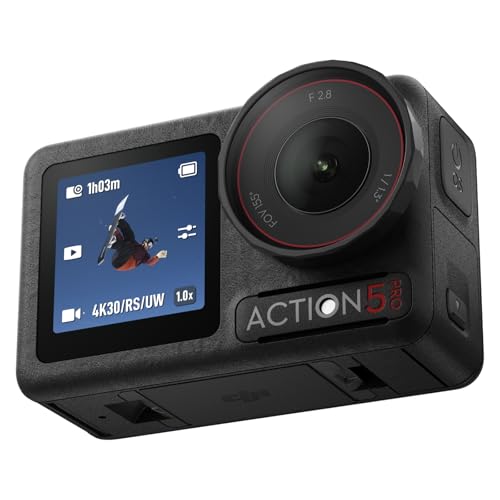
Most action cameras make you choose between a housing and your wallet before they let you near real depth. The Osmo Action 5 Pro postpones that decision further than anything else in its class: the body itself is sealed for dives far beyond snorkelling range, deep enough to cover the majority of recreational profiles without any case at all. For a new diver, that single fact simplifies everything — no housing to flood through carelessness, no port to fog, no latch to close on a hair — and it turns the camera into a grab-and-go companion for boat dives where rental gear already fills your hands.
It is also the most thoughtful diving instrument here. A built-in pressure sensor records depth through the dive, so your footage can carry the profile of the descent as data rather than as memory. Colour handling leans on a large sensor and DJI’s underwater processing, which restores warmth progressively as you go down instead of applying one flat correction. On a reef that slopes from bright shallows into a shadowed wall, that progression shows: the shallows stay natural, the wall keeps its reds and oranges far longer than footage from cameras that treat the whole dive as one white-balance guess.
Handling underwater is calm and deliberate. Both faces carry bright touch displays, though like every camera here you will drive it through physical controls once it is in a case or your fingers are gloved; the shutter and mode buttons are sized and spaced for exactly that. Stabilisation is excellent in surge and current, smoothing the gentle push-pull of a swell over a reef without the robotic stiffness that betrays electronic correction. Battery endurance is the strongest in this group, a genuine advantage on liveaboard days when the boat’s charging station is a queue and the third dive leaves at dusk.
Where does it ask compromise? The accessory ecosystem, while growing, is thinner than GoPro’s, so exotic mounts and some specialist filters take more hunting. Its optional dive housing is required for the deepest recreational profiles, and it is one more purchase to budget for honestly. And the depth-friendly sealing depends on doors closed over clean seals — the camera forgives depth, not carelessness. None of that dents its position: for most divers, most of the time, this is the least-friction path to footage that looks like the dive felt.
- Form: compact action camera, dual touch displays
- Waterproofing: deep-rated body without housing; housing extends to full recreational depths
- Video: high-resolution slow motion and 4K capture with strong stabilisation
- Sensors: pressure/depth logging built in
- Power: swappable battery, class-leading endurance
Strengths
- Deepest bare-body rating in this roundup, so snorkellers and many divers skip the housing entirely
- Depth data recorded alongside footage, useful for logs and for teaching
- Colour that adapts as you descend rather than applying one fixed correction
Trade-offs
- Smaller filter and mount catalogue than the GoPro ecosystem
- Deepest profiles still need the optional housing
- Touch controls are for the boat; underwater you rely on buttons
Best for: divers who want one camera for snorkelling, freediving and scuba without buying a case on day one. Not suited for: shooters committed to a large existing shelf of GoPro-specific filters and mounts.

GoPro HERO13 Black — Best Ecosystem
The HERO13 Black is the camera the dive industry is organised around. Walk into a dive shop on any continent and the filters, trays, arms, red-glass kits and housings on the wall will fit this camera or its close relatives. That ubiquity is a genuine feature underwater, where a cracked housing or a lost filter on a remote trip can end your filming — unless the shop at the pier stocks your system, which for GoPro it very likely does. For travelling divers, the ecosystem is not a convenience; it is insurance.
Bare, the camera is sealed for shallow water and snorkelling; the dive housing takes it to full recreational depths with margin to spare. Inside that housing it shoots the sharpest, most detailed footage in this group, with stabilisation that has been refined over more generations than any rival and a tall sensor format that crops gracefully for vertical clips without surrendering the wide master shot. Interchangeable lens options include a macro lens mod that changes what a GoPro can do at a muck-diving site, focusing close on nudibranchs and shrimp where a standard wide lens would keep its distance.
Colour underwater is a filter story here, and GoPro’s story is the deepest. Graduated red and magenta filters exist for blue water, green water, and the in-between that most real dives occupy, and because the mount is standard, third-party makers compete to fill every niche. The honest cost of that flexibility is management: filters must be swapped as depth changes, they scratch, they bubble if fitted carelessly, and they live in little cases that love to stay on the boat. Divers who enjoy dialling in a setup will thrive; divers who want to descend and forget will prefer the DJI above.
Battery swaps are tool-free through a side door, the magnetic mounting system makes tray changes fast with cold hands, and voice control — useless underwater, genuinely handy on the boat — rounds out a mature package. The HERO13 is rarely the cheapest route and never the simplest, but it remains the system a serious underwater hobbyist can grow inside for years without hitting a wall.
- Form: flagship action camera with interchangeable lens mods
- Waterproofing: shallow-rated body; dive housing for full recreational depth
- Video: highest-resolution capture in this group, advanced stabilisation
- Mounting: magnetic latch system plus the widest accessory catalogue available
- Power: swappable endurance battery
Strengths
- Unmatched choice of housings, filters, trays and lights worldwide
- Macro lens option opens up muck-diving subjects rivals cannot frame
- Footage detail and stabilisation set the benchmark for the class
Trade-offs
- Scuba use requires the housing from the first dive
- Colour correction is largely your job, via filters you must carry and swap
- Total system cost climbs quickly once the accessory list grows
Best for: committed underwater videographers who travel and want parts available anywhere divers gather. Not suited for: minimalists who want the camera itself, unadorned, to do the whole job.

GoPro HERO12 Black — Best Value GoPro
The HERO12 Black makes sense the moment you accept a simple truth about dive footage: below fifteen metres, in blue water and moving current, nobody can tell which of the last two GoPro generations shot a clip. The sensor, the stabilisation and the underwater personality are so close to its successor that the money saved by choosing the older model buys the dive housing outright — and the housing, as established above, is the purchase that actually makes a GoPro a scuba camera. Bought as a system, the HERO12 kit is the most rational GoPro on this page.
It shares the family sealing: fine for snorkelling and surface swims bare, properly deep only inside its protective housing. It shares the filter ecosystem too, every red and magenta option, every tray and arm. What it gives up sits mostly above water — no satellite positioning, a less flexible lens-mod programme, slightly less refined power management in some modes — and a diver should weigh those losses honestly rather than nostalgically. If your filming life is half topside sports, the newer camera earns its premium. If the camera lives in a dive bag, the losses shrink to footnotes.
Underwater manners are pure GoPro: dependable exposure, colours that respond predictably to the right filter, and an interface every dive buddy already knows, which matters when you need a setting changed by someone else’s hands. Battery life improved meaningfully in this generation over its own predecessor, enough for a two-dive day on one cell for most profiles, and spares are cheap and everywhere. It also records in a log-friendly flat profile for divers who do grade their footage, while the standard colour mode is punchy enough for those who never will.
The HERO12 is the pick we would hand to a newly certified diver with ambitions: new enough to be excellent, old enough to leave budget for the housing, filters and tray that turn a camera into an underwater rig. In a category addicted to annual upgrades, it is the calm, arithmetic choice.
- Form: previous-generation flagship action camera
- Waterproofing: shallow-rated body; same housing ecosystem as current models
- Video: high-resolution capture with mature stabilisation
- Compatibility: full access to GoPro filters, mounts and trays
- Power: swappable battery with improved endurance over older generations
Strengths
- Savings versus the flagship can cover the dive housing
- Underwater image quality nearly indistinguishable from the newer model
- Every accessory and spare is stocked wherever divers shop
Trade-offs
- No satellite positioning for topside logging
- Fewer lens-mod options than the current flagship
- Still a filter-dependent route to good colour
Best for: new scuba divers building a complete rig on a finite budget. Not suited for: shooters who split their time evenly between diving and topside action sports.

Insta360 X4 — Best for Never Missing the Moment
Every diver knows the clip that got away: the eagle ray that crossed behind while the camera pointed at a turtle, the shark that appeared in peripheral vision and vanished before a housing could swing around. The X4 exists to delete that regret. Its two lenses record the full sphere around you in high resolution, and the framing decision happens later, at a table, with coffee. Underwater, where you cannot check a screen, cannot hear a buddy shouting, and should be watching your depth and air rather than directing a film, that reframing workflow is not a gimmick — it is a safety feature that also saves the shot.
The bare camera handles snorkelling depths; for scuba it wears an invisible dive case rated for proper recreational depths, engineered so the stitch line between lenses disappears from the footage. The result is video where the camera itself vanishes and the view can wander: start on your buddy descending the shot line, tilt to the reef wall as a school pours over it, finish on the turtle nobody saw at the time. No other pick here can recover a moment that happened outside its frame, because for the X4 there is no outside.
The honest costs are workflow and light. Footage needs reframing in the app or desktop software before it behaves like normal video, which is five minutes for a clip and an evening for a dive day. The small sensors work harder in dim blue water than the larger-sensor picks, so deep or overcast dives show more noise, and the spherical file sizes are large enough to reorganise your card and drive habits. The case is also mandatory for scuba and its domes demand respect — a scratch across a dome port is in every frame, in every direction, forever.
Treat the X4 as a second camera or a memory machine rather than a precision instrument and it is irresistible. Divers who film to relive and share, instructors who want the whole class in frame, and anyone whose best moments keep happening off-axis will forgive its workflow tax the first time it saves a shark.
- Form: dual-lens 360-degree camera
- Waterproofing: shallow-rated body; invisible dive case for scuba depths
- Video: very high-resolution spherical capture, reframed in software
- Workflow: app or desktop reframing before export
- Power: swappable battery; large file sizes to plan storage around
Strengths
- Records every direction at once, so unplanned wildlife encounters survive
- Dive case keeps the camera invisible in its own footage
- Superb for instruction, group dives and memory-keeping
Trade-offs
- Reframing workflow adds real editing time to every dive
- Dim, deep water challenges its smaller sensors
- Dome ports must be protected obsessively against scratches
Best for: divers who film memories and groups, and who would rather reframe later than aim perfectly underwater. Not suited for: shooters who want finished footage straight from the card with no editing step.

Insta360 Ace Pro 2 — Best Low-Light Sensor
Descend past the bright shallows and every action camera starts to struggle except the ones with real light-gathering muscle. The Ace Pro 2 carries the largest sensor in this group of conventional action cameras, developed alongside a famous optics name, and it shows exactly where divers need it: inside a wreck’s shadowed doorway, under a ledge where a moray breathes, on the last dive of the day when the sun has left the reef. Where smaller sensors smear detail into noise, this one keeps texture on coral and definition on a turtle’s shell, and its noise reduction is tuned to clean shadows without waxing faces and fins into plastic.
The body seals deeper bare than most rivals — enough for confident snorkelling and freediving — and a dedicated dive case takes it to full recreational depths. A flip-up touchscreen sounds like a topside luxury until you are on the boat reviewing the morning dive in bright sun, angling the screen instead of your whole body. Underwater, the camera’s colour processing is among the most helpful here, with an aqua-aware correction that divers can leave on and largely trust, a middle path between GoPro’s bring-your-own-filters philosophy and fully automatic rivals.
It is also a strong stills camera by action standards, which matters more underwater than brands admit: many divers return with forty minutes of video they never watch and one frame they print. Low-light stills from this sensor hold up to that print test better than any other conventional action camera on this page. The trade-offs are ecosystem and habit — mounts and cases exist but the catalogue is a village next to GoPro’s city, and the flip screen is one more hinge to rinse and treat gently in salt air.
Choose the Ace Pro 2 if your diving trends deep, shaded or late in the day, or if you split your filming between the reef and the world above it and want one sensor that flatters both. It is the connoisseur’s pick in this group: less famous below the surface, more capable in the dark.
- Form: action camera with flip touchscreen and large sensor
- Waterproofing: deeper-than-average bare rating; dive case for scuba
- Video: high-resolution capture with strong low-light processing
- Optics: lens developed with a renowned optics partner
- Power: swappable battery with fast charging
Strengths
- Best shadow and low-light performance among the conventional action cameras here
- Helpful built-in underwater colour correction
- Stills quality that survives printing, not just posting
Trade-offs
- Accessory catalogue far smaller than GoPro’s
- Flip screen hinge needs careful rinsing after salt water
- Less common in dive shops, so spares while travelling are scarcer
Best for: divers who favour wrecks, walls, ledges and late-afternoon dives. Not suited for: travellers who rely on buying spares and accessories at the destination.

OM SYSTEM Tough TG-7 — Best for Macro and Stills
The TG-7 is the odd one out and proud of it: not an action camera but a rugged compact that has been the worst-kept secret of underwater photographers for generations of this model line. It is sealed for real snorkelling and shallow scuba depths without any housing, shrugs off drops and cold, and then does the one thing no action camera here can do at all — it focuses almost on top of its subject. Its microscope mode opens the reef’s small print: nudibranchs in full jewel colour, coral polyps, the eyes of a cleaner shrimp. Muck divers and macro hunters plan entire trips around subjects an action camera would render as specks.
Its underwater intelligence is photographic rather than computational trickery. Dedicated underwater white-balance settings, tuned over years of feedback from divers, handle blue water, green water and lit macro scenes with a maturity the action brands are still chasing, and it shoots raw files for those who want full control later. An optional housing extends it to full recreational depths, and the system around it — conversion lenses, lighting arms, a proper flash ecosystem including underwater strobes — is a photographer’s system, deeper in the photographic sense than anything else on this page.
Video is where it concedes. It records perfectly serviceable 4K, but stabilisation, frame-rate choice and general video polish belong to an earlier era than the action cameras above, and its screen-and-dial interface asks more learning than a shutter button and a prayer. Battery life is measured in hundreds of stills rather than hours of video, and the zoom, while genuinely useful for framing shy subjects, is modest. None of this matters if your dive album is the goal; all of it matters if a film is.
Buy the TG-7 if the word ‘photography’ in your head still means photographs. It is the camera on this page most likely to produce an image you frame, and the one experienced divers recommend to each other in the rinse-tank conversations where real reputations are made.
- Form: rugged waterproof compact with optical zoom
- Waterproofing: sealed for snorkelling and shallow dives bare; housing for full depth
- Stills: raw capture, microscope macro mode, mature underwater white balance
- Video: 4K recording, more limited stabilisation and frame rates
- System: strobes, conversion lenses and lighting accessories available
Strengths
- Macro ability no action camera can approach
- Underwater white balance refined over many model generations
- Raw stills and a real flash/strobe ecosystem for growth
Trade-offs
- Video features trail the action cameras by a generation
- Interface rewards learning; not a pure point-and-shoot
- Full-depth scuba use needs the optional housing
Best for: underwater photographers, macro hunters and stills-first divers. Not suited for: video-first shooters who want cinematic stabilised footage with no learning curve.
What Changes for Freedivers and Snorkellers?
Breath-hold diving rewrites the priorities again. A freediver’s camera must start instantly, run on one button through a gloved or bare hand, and survive repeated trips through the first ten metres where pressure changes are proportionally harshest on seals. There is no time at depth for a second take, so wide lenses and forgiving stabilisation outrank everything else, and the camera rides on a mask mount, a nose-clip-free hand grip, or a small float rather than a tray that needs two hands and a bottom to rest on. The DJI’s deep bare sealing and one-touch recording suit this world particularly well, and the TG-7’s instant stills have made it a quiet freediving favourite for reef portraits on a single breath.
Snorkellers, meanwhile, should distrust depth envy entirely. Your water is the brightest and most colourful on the reef, your subjects are close, and your biggest risks are sun, sand and a camera sinking out of sight — not pressure. Spend on a bright floating grip before a housing, choose the camera whose colours please you at the surface, and remember that a snorkeller with steady hands and a modest camera will out-film a scuba diver waving a flagship at subjects twenty metres away through blue water. The medium rewards closeness, and snorkellers live closest of all.
How Do You Keep a Dive Camera Alive for Years?
Salt water is patient and undefeated; the divers whose cameras survive a decade all perform the same unglamorous rituals. Rinse the camera or its sealed housing in fresh water after every dive day, working the buttons and dials under the tap so salt does not crystallise in the mechanisms. Never open a door or housing with wet hands over a dry interior, and never leave a sealed camera baking in tropical sun on a boat deck, where expanding air tests every seal you own. Inspect gaskets before every single dive — not most dives — and learn the small heartbreak of aborting a camera plan when a seal looks pinched or gritty; the camera you save is your own.
Storage matters as much as rinsing. Batteries travel out of the camera or at partial charge for long gaps, cards get downloaded and reformatted in-camera rather than deleted file by file, and silica gel lives in the camera bag because tropical humidity fogs lenses from the inside. Once a season, seals deserve fresh silicone grease applied sparingly — a film, not a dollop — and once in a while housings deserve a pressure test without the camera inside, on a shallow dive, before they are trusted with a wreck at depth. None of this is content anyone films. All of it is why some divers are on their third trip with one camera while others are shopping again by August.
How Do You Actually Shoot Better Dive Video?
Technique underwater is mostly subtraction. Move half as fast as feels natural, because water magnifies every pan into a sweep and every correction into a wobble; the footage that looks professional is usually the footage where the diver did less. Get closer than instinct suggests — water between lens and subject is a blue fog machine, and halving the distance does more for colour and clarity than any setting in any menu on this page. Then hold the shot. Five steady seconds on a subject beats a two-second grab, because editing needs handles of calm footage on either side of the moment, and because subjects relax into natural behaviour when a diver stops advancing and simply hovers.
Buoyancy is camera technique, whether divers admit it or not. A diver who is still trimming and adjusting cannot hold a frame, and the gentle rise-and-fall of breathing writes itself into the shot as a slow, dreamy bob that viewers feel in their stomachs. The camera rewards the same skills the reef does: settle, breathe evenly, fin gently or not at all. This is also why the best dive footage often comes from the last dive of a trip rather than the first — by then the diver’s hands are quiet, the camera’s quirks are familiar, and the whole system disappears into the experience it is recording.
Shoot for the edit in small ways. Take a wide establishing shot of the reef or wreck before the close work, film your buddy for scale against big subjects, and capture ten seconds of empty blue water at depth — it sounds like nothing, and it becomes the colour reference and the breathing space that holds a sequence together. End the dive by filming the ascent and the boat from below if conditions allow. These are the clips nobody plans and every finished video leans on, and they cost nothing but the habit of pressing record when nothing in particular is happening.
What Mistakes Ruin Dive Footage Most Often?
The classic error is descending with surface settings: a white balance tuned for the boat, a frame rate chosen for mountain biking, a lens fogged because the housing was closed in humid cabin air. Set the camera up the night before, close the housing in air-conditioned dryness with a small desiccant pack inside, and let the first dive be about diving. The second error is chasing. Footage of a turtle’s retreating tail, shot from behind at full fin-kick, convinces nobody; the divers who return with serene clips position themselves ahead, settle, and let subjects swim into the frame at their own pace — which is also, not coincidentally, the ethical way to film wildlife.
Third comes the green-filter mistake: fitting a deep-water red filter for a shallow snorkel, or none at all for a deep wall, and discovering the error at the editing desk. Match correction strength to depth, check it against your first clip at the safety stop if your housing allows review, and remember that lights make filters unnecessary at close range. Finally, divers ruin more good footage with dirty ports than with bad cameras. A water spot dried on a dome is in every frame. Rinse, dry with a clean cloth, inspect against the light, then descend.
Final Recommendation
Start where your diving actually lives. If most of your underwater time is snorkelling, freediving and the shallower half of recreational scuba, the DJI Osmo Action 5 Pro is the recommendation: it goes deepest without help, logs your depth, corrects colour as you descend, and asks the least of a new owner’s wallet and attention. If you are building a long-term underwater video hobby and travelling for it, the GoPro HERO13 Black — or the HERO12 Black with its savings spent on the housing — plugs you into the deepest support network in diving. Add the Insta360 X4 if your best moments keep happening behind you, the Ace Pro 2 if your dives run dark and deep, and the Tough TG-7 if stills and macro are the point of the trip. Any of the six will serve you well; the right one is the one whose compromises match the compromises you were already happy to make.
One last piece of advice applies whichever name ends up in your dive bag: buy it a trip early. The camera you learn at home — in a pool, on a shallow house reef, anywhere the stakes are a deleted clip rather than a lost whale shark — is the camera that performs on the expensive dive. Every pick above rewards a day of low-stakes practice, and every flooded housing story ever told begins with new gear, a rushed boat, and a seal nobody checked. Learn the camera dry, trust it wet, and let the reef provide the surprises instead of the equipment.
Frequently Asked Questions
Can I take an action camera scuba diving without a housing?
Only within its bare depth rating, and only with spotless seals. Some picks here, led by the DJI Osmo Action 5 Pro, are sealed deeply enough for much recreational diving on their own. Others, including both GoPros, are shallow-rated and need their dive housing for scuba. Read the rating for the exact model, inspect the seals before the dive, and treat the rating as a ceiling, not a target.
Do I need red filters if my camera has an underwater mode?
Not always. Built-in underwater colour correction, as on the DJI and Insta360 picks, handles many dives convincingly, especially in the shallows and mid-depths. Filters still give the most natural results on systems designed around them, particularly the GoPros, and they help most in the depth band where red has vanished but light remains strong. Many divers start with the camera’s processing and add filters once they know their typical depth.
How do I stop my housing fogging during a dive?
Fog is moisture trapped inside meeting cold water outside. Close the housing in the driest air available — an air-conditioned room rather than a humid deck — add a fresh desiccant pack, and avoid opening it between dives. Load the camera cool rather than hot from charging, and never leave the sealed housing in direct sun before descending. If fog appears, it usually clears as temperatures equalise, but prevention is far more reliable than patience.
Is 360 video worth the extra editing for diving?
For the right diver, emphatically yes. If you dive in groups, teach, or keep missing wildlife that passes outside a normal frame, the Insta360 X4’s ability to reframe afterwards converts near-misses into footage. If you want clips ready to share on the boat ride back, the reframing step will feel like a tax on every dive. Be honest about which diver you are before choosing.
Is a floating grip or a wrist lanyard better for snorkelling?
Both, ideally, because they solve different failures. A floating grip keeps a dropped camera at the surface where you can see it, which is the failure that matters in open water over deep bottom. A wrist lanyard stops the drop happening in the first place, which matters more in surge, around rocks, or when you are climbing a boat ladder with one hand committed. Many snorkellers run a short lanyard plus a bright float, accept the slight clutter, and never tell the story of the camera that sank — because for them it never does.
What memory card and battery routine works for a dive trip?
Carry more capacity than your longest day needs, download every evening, and reformat cards in the camera rather than deleting files selectively. Bring at least one spare battery per dive day, swap on the boat with dry hands, and keep batteries and cards in separate bags so a single loss never takes both the camera’s power and its footage. Label cards by day; future-you, editing in February, will be grateful.
How deep can you actually take a camera rated for ten metres?
Treat the printed depth rating as a ceiling measured in still, fresh water by a manufacturer testing a new unit — not as a working depth for your holiday. Every button press at depth pushes a small pressure wave against the seals, a surf entry or a jump off the boat adds a shock the rating never modelled, and a housing or case that has survived two seasons of sand and sunscreen is not the seal the lab certified. The working rule among divers who shoot regularly is to keep a ten-metre camera inside five or six metres for routine use, and to treat anything deeper as a job for a proper housing with a vacuum valve you can test before the dive. Rinse discipline matters as much as depth: soak the camera in fresh water after every salt session, work each button under the surface of the rinse bowl to flush grit from the shafts, and let it dry fully before opening any door. Most flooded action cameras were not pushed too deep. They were closed on a single hair, a grain of sand, or an O-ring that had quietly taken a set — failures a sixty-second inspection in good light would have caught.
Related Guides
Planning the rest of your kit? Continue with our guide to the best action cameras for low light, compare options in the best action cameras for vacations, and see what is possible at the budget end in the best action cameras under 60.