Disclosure: As an Amazon Associate, kajuandouglas.com earns from qualifying purchases. Links on this page are affiliate links; they cost you nothing extra. Prices and availability change often, so check the current Amazon listing before you buy.
Every switch family has one member that becomes its ambassador, and this gateron yellow switch guide is about the ambassador. The Gateron Yellow — a linear switch in the middle spring weights, smooth from the factory, priced for whole boards rather than for collectors — is the switch that converted a generation of keyboard owners to the idea that a budget switch could feel like a considered one. It is also, now, a family rather than a single switch: the original KS-9 Yellow, the G Pro generations, the Milky Yellow Pro that may be the most recommended switch in the hobby, the firmer Cap Gold variant, and a silent branch that trades a little feel for a lot of quiet. This guide untangles them: what makes a Yellow a Yellow, how the verified family members differ and which suits which owner, how to buy and fit them, and how to get the famous Yellow smoothness fully out of the board you put them in.
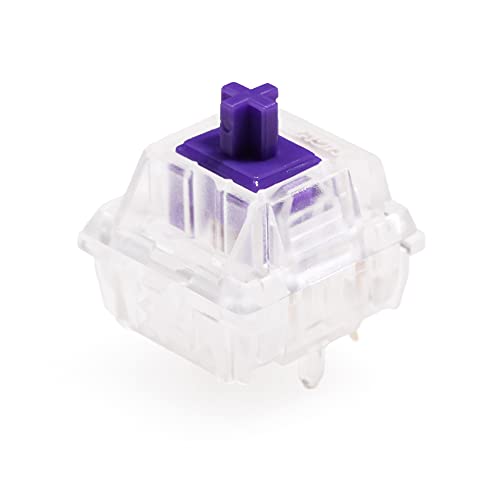
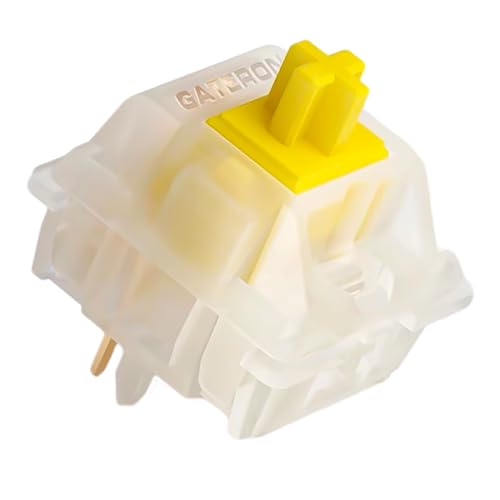
The four linked picks below are the Yellow family members whose Amazon listings were verified for this site, each shown with its official product image. One more member is discussed honestly in prose: the KS-9 Silent Yellow appeared in search results during research but could not be verified to the standard the linked picks meet, so it is described, not linked — a guide’s credibility lives in exactly that distinction.
Key Takeaways
- A Gateron Yellow is a middle-weight linear: smooth travel, no tactile bump, a spring firm enough to prevent accidental presses and light enough for all-day use.
- Milky Yellow Pro V2 is the family’s headline act — factory-lubed, deep-sounding, and the safest single recommendation.
- G Pro Yellow and G Pro 3.0 Yellow carry the original KS-9 recipe in progressively refined generations; Cap Gold V2 is the firmer, milky-housed variant.
- The Silent Yellow exists but is prose-only here because its listing could not be verified; buy silent Yellows only from listings you can check carefully.
- Sample any Yellow before filling a board: the family’s members feel closer to each other than to other switches, yet their differences are exactly the kind fingers notice.
What makes a Gateron Yellow a Yellow?
Strip away the variants and the recipe is constant. A Yellow is a linear switch — the stem travels straight down with no bump and no click — sprung in the middle weights, heavier than the light Red and lighter than the firm Black, in the zone where a resting finger does not trigger the key but a typing finger never works hard. It is manufactured to Gateron’s smoothness standard, which in practice means polished mould surfaces and, in the Pro generations, factory lubrication that leaves the travel slick from the first keystroke. And it is priced as a workhorse: Yellows are sold in board-filling quantities to people who intend to use every one of them.
That recipe explains the switch’s double life. Gamers value the Yellow because a linear with a middle spring is forgiving across genres — no bump to slow repeated presses, enough resistance to rest fingers on movement keys without accidents, a return quick enough for rhythm and strafing alike. Typists value it for the opposite reason: the same middle spring makes long documents feel cushioned rather than effortful, and the smooth travel removes the scratch that makes cheap linears tiring. A switch that serves both masters usually serves neither; the Yellow’s trick is that its compromises all land in the middle, where both masters happen to live.
In this guide
Quick Picks: the verified Yellow family
- Gateron Milky Yellow Pro V2 — the headline Yellow; deepest sound, softest light, safest buy.
- Gateron G Pro Yellow (KS-9) — the original recipe in its Pro form, in a board-filling pack.
- Gateron G Pro 3.0 Yellow — the newest generation’s refinements on the classic.
- Gateron Cap Gold V2 Milky Yellow — the firmer variant for heavier fingers.
How these were chosen: verification first, with every linked switch confirmed against its exact Amazon listing and official image; then family coverage, so the set spans the generations and the weight variants a Yellow shopper actually deliberates between; then honesty about the gap, with the unverifiable Silent Yellow kept to prose rather than promoted to a link it did not earn.
Detailed reviews: the Yellow family, member by member

Gateron Milky Yellow Pro V2 — the headline act
Badge: Best Yellow overall. If the Yellow family had a single face, this would be it. The Milky Yellow Pro takes the Yellow recipe and wraps it in a milky housing that does two things owners love: it diffuses backlight into a soft glow instead of a glare, and it deepens the switch’s sound into the muted, rounded register that modern builds chase. Factory lubrication is generous and even, the stem is stable, and the whole keystroke feels finished — the switch against which beginners are told to calibrate their expectations, and against which pricier linears are quietly judged.
- Type: Linear, 5-pin
- Operating force: around 50gf (per listing)
- Factory lube: Yes, pre-lubed
- Pack: 72 pieces (per listing)
Strengths
- Smooth, finished stock feel that needs no modification
- Deep, muted sound suits desks and shared rooms
- Milky housing flatters backlit boards with soft diffusion
Trade-offs
- Milky housing dulls shine-through keycap legends
- Its very popularity makes its feel the hobby’s baseline rather than a discovery
- Middle spring will still feel soft to devotees of firm linears
Best for: most buyers, most boards — the Yellow to buy when you want the question settled. / Not suited for: shine-through legend showcases or firm-spring loyalists.

Gateron G Pro Yellow (KS-9) — the original recipe, Pro form
Badge: The classic. This is the Yellow as the hobby first fell for it, carried into the G Pro generation: the KS-9 design with its factory pre-lubrication and plate-mount-friendly format, sold in a generous pack sized for full boards. Its character is a touch brighter and more open than the Milky’s — clearer housing, a lighter sound, the same dependable middle-weight travel underneath. Owners who built with Yellows years ago and want that exact feel again, refined rather than reinvented, are this pack’s natural audience.
- Type: Linear, plate mounted (per listing)
- Factory lube: Yes, pre-lubed
- Lineage: KS-9 G Pro generation
- Pack: 90 pieces (per listing)
Strengths
- The authentic Yellow feel with Pro-generation polish
- Large pack suits full-size boards in one purchase
- Clearer housing keeps RGB brighter than Milky variants
Trade-offs
- Brighter, thinner sound than the Milky Pro
- Plate-mount format is less firm in plateless builds
- Newer G Pro 3.0 refinements are absent
Best for: owners who want the classic Yellow, and full-size boards bought in one pack. / Not suited for: deep-sound chasers or plateless builds wanting 5-pin stability.
Gateron G Pro 3.0 Yellow — the refined generation
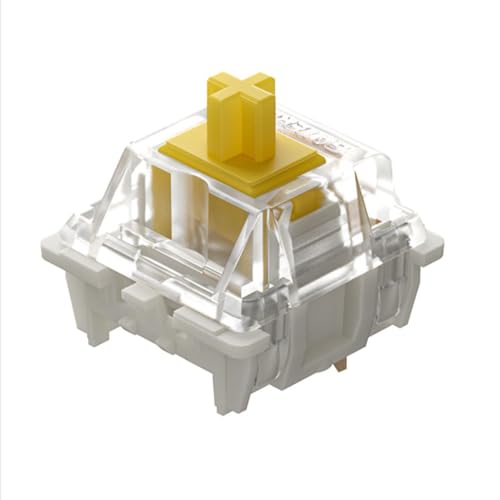
Badge: Most refined classic. The G Pro 3.0 generation is Gateron’s rolling improvement programme made visible: tightened stem tolerances for less wobble, an enhanced pin design, and factory lubrication applied with the consistency the line has been converging on. In Yellow form it is the classic recipe at its most polished while keeping the clear housing and open sound that distinguish it from the Milky branch. If your deliberation is between generations rather than between housings, this is the end of it: buy the newest generation and enjoy the accumulated small fixes.
- Type: Linear, 5-pin
- Factory lube: Yes, pre-lubricated
- Stem: pin-enhanced design (per listing)
- Pack: 70 pieces (per listing)
Strengths
- Tightest stem stability of the classic-housing Yellows
- Even factory lube across the pack
- 5-pin format seats firmly in modern boards
Trade-offs
- Sound remains brighter than the Milky branch
- Improvements are refinements, not a new character
- Pack size sits between compact and full-size needs
Best for: buyers who want the classic Yellow in its most polished current form. / Not suited for: owners specifically seeking the Milky’s depth of sound.

Gateron Cap Gold V2 Milky Yellow — the firmer variant
Badge: For heavier fingers. The Cap line is Gateron’s variant series built around a distinctive stem and spring pairing, and its Milky Yellow member runs firmer than the standard Yellow — a spring in the low-sixties gram class that gives the keystroke a more deliberate, resistant character while the milky housing keeps the family’s soft light and deeper tone. It is the Yellow for owners who tried the standard recipe and found their fingers blowing through it: typists who strike hard, gamers who rest heavy hands, anyone who experiences the middle weight as mush rather than balance.
- Type: Linear, 5-pin, RGB compatible
- Spring class: firmer, around 63g (per listing)
- Housing: milky
- Format: switch with acrylic base case (per listing)
Strengths
- Firmer spring resists accidental presses and heavy resting fingers
- Milky housing keeps the family’s soft light diffusion
- Distinct, deliberate keystroke character within the Yellow recipe
Trade-offs
- Firmness fatigues light-touch typists over long sessions
- Variant pricing and format are less standardised than the core line
- Too specialised to be a first Yellow for most buyers
Best for: heavy-handed owners who find standard Yellows too soft. / Not suited for: light-touch typists or first-time Yellow buyers unsure of their weight preference.
gateron switch guide — budget friendly and smooth
How do the Yellows compare with each other — and with the Silent Yellow?
The family’s internal differences are differences of housing, generation, and spring, in that order of audibility. Housings decide the light and much of the sound: milky members diffuse and deepen, clear members brighten both. Generations decide the polish: each G Pro step tightened wobble and evened the lubrication, so a 3.0 feels like a classic Yellow with its small annoyances filed off. Springs decide the effort: standard Yellows cluster in the middle weights, the Cap Gold stands apart at its firmer class, and that single variable is the one most likely to make a given owner love or merely like their board.
The Silent Yellow deserves its own honest paragraph. Gateron’s silent line applies damping to the stem’s travel extremes, muting bottom-out and return, and a Yellow-weighted silent linear is an obvious desire for office and night-desk owners. During this guide’s verification, the KS-9 Silent Yellow appeared in search results but no listing for it met the standard required for a link here — exact product, confirmed details, official image — so it remains prose-only in this guide. That is not a judgement on the switch, which by family logic should be a pleasant, muted middle-weight linear; it is a judgement about linking discipline. If you shop for one, verify the listing’s details against the genuine KS-9 specification with extra care, because popular switch names attract imprecise listings.
Against the wider Gateron catalogue, the Yellows’ position is the centre: Reds lighter, Blacks firmer, Browns bumped, Oil King more premium in the same linear direction, Smoothie lighter and snappier with its full-POM glide. A Yellow is what the centre of a well-drawn map looks like, and the family’s sales across a decade suggest the centre is where most fingers live.
How do you buy Yellows well?
Buy the generation first and the housing second. A current-generation Yellow at a fair price beats an old-stock Yellow at a small saving, because the refinements you are paying for in this family are precisely generational: stem stability, spring consistency, lubrication evenness. Buy the housing for your board’s lighting: shine-through legends want clear housings, underglow and soft ambience want milky, and a board without lighting frees you to choose on sound alone, where milky’s depth usually wins. Buy the quantity for your board plus spares, and reconcile pack sizes with your key count before ordering, because Yellow packs vary from compact-board counts to full-size counts and the arithmetic is easier before the parcel arrives.
Above all, sample. The family’s members are close enough that a specification sheet cannot choose between them for you, and different enough that your fingers can, within an evening, if you give them the chance: a handful of each candidate on your most-used keys, your normal typing and gaming, and an honest note about which board you stopped noticing. The Yellow legend was built by owners who did exactly this and reported back; join them rather than gambling a full board on a stranger’s adjectives, including this guide’s.
How do you fit Yellows and get the best from them?
Fitting follows the standard discipline: pull the old switches by their clips with a proper puller, inspect each Yellow’s pins and straighten any that travelled bent, align, and press straight home, testing each key as you go. Yellows reward one extra step — because they are bought in board-filling quantities, sort a sample from across the pack onto your most-used keys first and type for a day before completing the board. Factory consistency in the current generations is good, but the ritual costs nothing and converts a hundred-switch commitment into a ten-switch experiment with an obvious continuation.
Getting the best from them is mostly restraint. The Pro generations arrive lubricated to a standard that most owners should simply enjoy; if you lube further, use a light hand, because over-lubing a Yellow dulls the very crispness of return that its spring was chosen for. Films are for the minority of housings with perceptible wobble, not a blanket ritual. Sound, finally, belongs to the board: Yellows deepen in a gasket-mounted, foam-filled case and brighten on an aluminium tray, so tune the board for the register you want and let the switches do the travelling they are good at.
switch sound test guide — recording and comparing
What mistakes do Yellow buyers make?
The first is assuming every Yellow is the same switch, then ordering the cheapest listing with Yellow in its name and receiving a different generation, housing, or spring class from the one the reviews described. The second is the mirror error: agonising between family members as if they were different species, when the honest differences are housing, generation polish, and one firmer spring. The third is buying for a sound in a video, on a board nothing like yours. The fourth is dismissing the family as beginner switches and paying several times more for a linear whose real-world advantage, in your board, under your fingers, was never tested — the Yellow’s entire history is a standing rebuke to that assumption.
How do Yellows behave across different boards and keycaps?
A Yellow does not sound or feel identical in every home you give it, and owners planning a build around the family should know the main interactions. In a gasket-mounted board with case foam, the Milky members lean into their nature: the mount’s slight give cushions the bottom-out, the foam trims the higher frequencies, and the result is the deep, soft register that dominates the family’s reputation in videos. In a stiff tray-mounted aluminium board, the same switches brighten and sharpen; the travel is unchanged, but the landing is harder and the sound carries further, which some owners prefer for its clarity and others experience as the switch becoming less itself. Neither board is wrong. They are two honest readings of the same switch, and the buyer choosing between the Milky and the clear-housed members should make the choice in the context of the board they own, because the board will have the louder vote.
Keycaps vote too. Tall, thick keycaps deepen and slow the perceived keystroke; low, thin caps brighten it and make the return more audible. A Yellow under a heavy, tall set feels a fraction more deliberate than the same Yellow under a light, low set, because the finger is moving more mass through the same spring. None of this is a reason to choose a different Yellow — it is a reason to sample your chosen Yellow in your actual board with your actual caps before concluding anything about the family, which is this guide’s recurring advice arriving, as it should, at the level of the whole build.
What is the Yellow family’s history, and why did it become the standard?
The Yellow’s rise is a case study in a product meeting its moment. When custom keyboards moved from a niche of kit builders to a broad hobby, thousands of newcomers needed a first switch that was inexpensive, available in board-filling quantities, and — the rare part — good enough stock that their first build would encourage rather than punish them. The Yellow, and especially its Milky Pro form, was that switch: smooth without bench work, weighted for the middle of the population, and forgiving of the plate materials and case designs beginners actually owned. Word of mouth did the rest, because a recommendation that survives contact with a beginner’s first build is the strongest marketing a switch can earn, and the Yellow survived it thousands of times.
Its standard status now feeds itself in useful ways. Because so many owners have Yellows, comparisons against them are the hobby’s common currency — a new switch described as “like a Yellow but firmer” communicates something real to a huge audience. Because they sell in volume, stock is reliable and the listings are well documented, which is part of why this guide could verify the family as thoroughly as it did. And because the family spans generations, the Yellow has become a small history of the hobby’s own refinement: hold a KS-9 and a G Pro 3.0 side by side and you hold, in two switches, the story of tolerances tightening and factory lubrication becoming an expectation rather than a luxury.
How should you maintain Yellows over years of use?
Yellows ask for little, and the little is worth doing deliberately. Keep the board clean — dust and grit are the enemies of smooth travel, and a switch chosen for smoothness deserves an environment that does not sand it from inside. A soft brush around the stems and a periodic blow-out of the board preserves the factory feel far longer than any re-lubrication schedule. If, after years, a few switches develop scratch or spring noise, those individuals can be opened, cleaned, and lightly serviced, and the family’s availability means a tired switch can also simply be retired and replaced from a small reserve — one more argument for buying a few spares with the original pack, while the generation and batch are the same as the board’s population.
Store spare Yellows as you would any small precision part: in a closed container, out of sunlight, with their pins protected from the bending that a loose bag invites. Label the container with the generation and the purchase date. The owner who does this discovers, three years on, that a replacement switch from the reserve matches the board perfectly, while the owner who reorders discovers that generations move on and close matches are not matches. The Yellow family’s longevity in the market makes spares a low-risk kindness to your future self.
How do you tune a Yellow board for sound and feel?
Yellow owners who go further than stock follow a well-worn path, and the guide should map it with the family’s specific cautions attached. The first stop is the board, not the switch: case foam, a gasket mount’s give, and keycap choice move a Yellow board’s sound further than any switch surgery, and they do it without opening ninety housings. The second stop is the stabilisers, because a Yellow board’s letters can be perfect while its spacebar rattles the whole impression apart; tuned stabilisers are the highest-value hour in any build, this family included. Only then does switch-level work enter, and on current-generation Yellows it enters modestly: a film for the minority of housings with play, a whisper of additional lube for the minority with scratch, spring swaps for owners whose sampling revealed a weight preference the stock range brackets but does not hit.
The family’s specific caution is over-lubing. A Yellow’s appeal is a clean, quick keystroke with a lively return, and heavy-handed lubrication — especially on the stem’s legs and rails — slows that return and dulls the very character the owner bought. Work lightly, test a row, and compare against an untouched row before continuing, because the difference between a tuned Yellow and a sedated one is about twenty switches’ worth of enthusiasm. The owners whose Yellow boards are praised in community showcases are, almost without exception, the owners who stopped one step earlier than they intended to.
What should you know about Yellow pricing, packs, and availability?
The family’s popularity cuts both ways in the market. Volume keeps the core members — Milky Pro, G Pro generations — reliably stocked and competitively priced, and it also attracts imprecise listings that borrow the Yellow name for older stock, mixed stock, or near-neighbour switches. The defences are the ones this guide has practised throughout: buy identified generations from identified listings, reconcile the pack’s contents against the manufacturer’s specification for that exact product, and treat a price far below the family’s ordinary range as a question rather than a gift. Pack arithmetic deserves its moment too: Yellow packs are sold in counts tuned to common board sizes, and the cheapest route to a full-size board is sometimes two mid-size packs whose remainder becomes the spares reserve — an outcome to plan for rather than to discover.
Availability across the family’s edges is thinner, and the guide’s treatment of the Silent Yellow is the standing example: a real member, genuinely desired, whose listings could not be verified to the standard the linked picks met. The lesson generalises beyond that one switch. In a family this popular, the centre is easy to buy well and the edges require the buyer’s own verification to rise to the level the centre’s documentation provides for free. Spend your diligence where the documentation thins, and the Yellow family will treat you as well as it has treated a decade of owners before you.
How do Yellows compare with Reds, Blacks, and Browns?
Newcomers meet Gateron’s colours as a set, and the Yellow’s place in it is clearest in direct comparison. Against the Red, the Yellow is the same linear idea with a firmer spring: the Red actuates under a resting finger’s weight and rewards the lightest touch with speed, while the Yellow asks a deliberate press and repays it with control — fewer accidental inputs, a more planted feel on movement keys, and a return with more authority. Owners who game fast and type lightly often land on Red; owners who do both, or who rest heavy hands, land on Yellow, and the border between the two is the single most common sampling experiment in the hobby. Against the Black, the Yellow is the same idea again with the spring relaxed: the Black’s firmness suits deliberate, heavy-handed typists and punishes everyone else across a long day, while the Yellow keeps most of the Black’s resistance to accidents without the fatigue. The Yellow is, in the plainest sense, the compromise both neighbours point toward.
Against the Brown, the comparison changes kind rather than degree, because the Brown adds the tactile bump the Yellow lacks. The Brown’s typist gets confirmation at actuation and types by feel; the Yellow’s typist gets an uninterrupted travel and types by calibration. Neither is the upgrade of the other — they are answers to different questions about how fingers want their information — and the owner torn between them should sample both on real work, because the preference usually declares itself within days and then feels obvious in retrospect. What the Yellow holds against all three neighbours is the centre position itself: it is the colour a newcomer can be handed, blind, with the highest probability of satisfaction, and a decade of the hobby handing it over has made that probability into the family’s reputation.
What do Yellow owners most often upgrade to — and why do many come back?
The upgrade paths out of the Yellow family are well worn, and mapping them tells you what the Yellow is by showing what it is not. Owners chasing refinement go to the Oil King class — Gateron’s own premium linear — for a deeper sound and a more polished travel, and many report that the upgrade is real but smaller than its price suggests, which is the Yellow’s quality stated from the other side. Owners chasing character go to designer and collaboration switches with exotic springs and materials, and enjoy them the way one enjoys a second instrument: genuinely, and without the first becoming obsolete. Owners chasing silence go to the silent lines and accept the damped trade. And owners chasing a bump leave linears altogether for the tactile shortlists, which is not an upgrade but a change of religion.
The return journeys are the interesting data. Owners come back to Yellows when a specialised switch’s novelty fades and its costs — price, availability, a spring that tires, a sound that dates — remain; when a second board needs populating and the budget reasserts itself; and when a build’s purpose is work rather than exhibition, and the switch that disappears under the fingers is worth more than the switch that performs for them. A switch that experts return to after touring the alternatives has passed the hardest test a product can face, and the Yellow’s installed base of returnees is, in the end, the strongest evidence this guide can offer for its central recommendation.
What do Yellows feel like across a full working day?
Specifications describe a keystroke; a working day describes ten thousand of them, and the Yellow’s reputation was earned at the day’s scale rather than the keystroke’s. The first hour flatters almost any decent switch. By the third hour, the differences that matter are the ones the Yellow’s recipe was built around: a spring that has not accumulated into fatigue, because its middle weight asks a fair price per press and no more; a travel smooth enough that its friction never becomes a background irritation the fingers must continually forgive; and a return consistent enough that rhythm — the typist’s and the gamer’s shared asset — is never broken by a key that answers late. By the sixth hour, the switches still being enjoyed are the ones that have disappeared, and disappearance is the Yellow’s defining talent: it is the switch owners stop being able to describe, because nothing about it has asked for their attention all day.
That is also the honest limit of the family’s appeal, and the guide should state it in the Yellow’s own section rather than leaving it to detractors. Owners who want their switch to be an event — a bump to ride, a click to hear, a spring with a personality that announces itself — will find the Yellow’s disappearance dull, and they are not wrong about their own preferences. The Yellow is engineered contentment: the switch for owners whose attention is the scarcest resource in their setup and who would rather spend it on the work or the game than on the instrument. Judged by that purpose, across a full day, across a full board, across the years its owners keep reporting, it remains what this guide called it at the start — the ambassador, and the standard.
What does a Yellow build cost in time and steps, realistically?
For the first-time buyer, the honest schedule is worth stating because it is shorter than the hobby’s mythology suggests. Choosing takes an evening of reading — this guide and its siblings — and a decision about generation and housing. Sampling, if you follow the discipline, takes a week of calendar time and perhaps twenty minutes of hands-on work: a test row installed, typed on, and judged across real days. The full build takes an evening: old switches pulled, pins inspected, Yellows seated key by key with each tested as it lands, stabilisers checked while the caps are off, and the board’s first full passage typed before the tools are put away. Maintenance thereafter is a brush and an occasional blow-out. That is the whole commitment — two evenings and a week of patience — for a board that will serve for years, and it is worth contrasting with the schedule of the unsampled purchase: the same build evening, followed by the doubt, followed by the second purchase, followed by the second build, with the first set in a drawer as tuition. The Yellow family’s deepest budget virtue is not its price per switch. It is how rarely its owners pay for the same board twice.
How do you spot a listing that is not the Yellow you think it is?
Because the family’s name sells, its listings reward the same scrutiny this guide applied when it kept the Silent Yellow to prose. Read for the generation, stated plainly: a listing that says only “Yellow” without naming its line — KS-9, G Pro, G Pro 3.0, Milky Pro, Cap — is asking you to buy a colour rather than a switch, and the parcel may contain any member of the family or, in the worst cases, a switch that merely shares the colour. Read for the pin count and the pack count, and reconcile both against the manufacturer’s specification for the named product; listings that contradict the specification on basics are listings whose other claims deserve no trust either. Read for the housing, in the photographs as much as in the text, because milky and clear members are confused in listings often enough — innocently and otherwise — that the photograph of the actual product is evidence, not decoration.
And keep the discipline that protects every purchase in this cluster’s guides: the verified listings linked in this article were confirmed against the catalogue data for this site, with their exact titles recorded in the article’s sources, so a reader who wants certainty can start from them and a reader shopping elsewhere can use their titles as the template of what a complete, honest listing looks like. The Yellow family’s popularity means the genuine article is easy to find and easy to verify; the only buyers who end up with the wrong switch are the ones who did not spend the two minutes the verification takes.
How do Yellows pair with different keycap profiles and board sizes?
Pairing is where a good switch becomes a good board, and the Yellow’s middle character makes it an unusually forgiving partner. Under tall, sculpted keycaps, the keystroke gains leverage and ceremony, and the Yellow’s spring meets the taller caps’ momentum with enough resistance to keep the landing composed; under low, flat caps, the same switch feels quicker and more direct, its return more noticeable, its sound a fraction brighter. Neither pairing exposes a flaw, which cannot be said of every switch — very light switches feel lost under heavy tall caps, and very firm ones turn low caps into a workout. Board size interacts through the hands rather than the hardware: compact boards concentrate the most-used keys under the strongest fingers, where the Yellow’s balance is most appreciated, while full-size boards spread work to the weaker fingers at the edges, where a middle weight is again the safest citizen. Owners building a Yellow board for a specific purpose should therefore spend their deliberation on the purpose’s other variables — the caps’ profile for their typing style, the board’s layout for their desk — confident that the switch in the middle will not be the pairing that fails.
One pairing deserves a warning rather than a compliment: shine-through legends with the milky members. The milky housing’s diffusion, so flattering to underglow, sits directly in the light path of a legend lit from below the switch, and the result is a legend that glows softly where the owner wanted it to read sharply. It is a small, aesthetic, entirely predictable disappointment, and it is avoided by the clearest rule in this guide: milky for ambience, clear for legends, and the decision made before the pack is ordered rather than after the board is built and photographed in the dark.
What is the Yellow’s place in a multi-board life?
Few owners stop at one board, and the Yellow’s role in a growing collection is worth naming because it explains the family’s endurance better than any single-board review can. In the first board, the Yellow is the teacher: the calibrated baseline against which every later preference is measured. In the second board — the experiment, the split layout, the board for the other room — the Yellow is the control variable, the known switch that lets the new board’s own character be judged without a stranger in the switches confounding the verdict. In the work board, the one that must simply never be thought about, the Yellow is the incumbent, re-elected on the evidence of every deadline it has quietly served. And in the board built for someone else — the gift, the partner’s desk, the parent finally persuaded — the Yellow is the recommendation that survives being given away, because its balance forgives the recipient’s unknown hands. A switch that can be teacher, control, incumbent, and gift across one owner’s life has earned a kind of trust that specifications do not confer and marketing cannot buy. It is earned the slow way, board by board, and the Yellow has been earning it for a decade.
How do you explain the Yellow to a newcomer in one minute?
Every owner of a Yellow board eventually performs this small act of evangelism, and the guide may as well script it honestly. It is a linear switch — no bump, no click — with a spring in the middle of the range, made smoothly enough that it needs nothing done to it, and priced so a whole board is an ordinary purchase rather than a project. It suits typing and gaming for the same reason: it asks nothing unusual of the fingers and gives back a clean, quick, consistent keystroke, ten thousand times a day, for years. Its family lets you tune the choice — milky for a deeper sound and softer light, clear for bright legends, a firmer cousin for heavy hands — without leaving the recipe that works. And its reputation is not advertising: it is the accumulated verdict of the largest group of switch owners in the hobby, most of whom arrived exactly where the newcomer is standing, needing a first switch that would not punish them. Hand them one, on a tester, under a cap. The switch will finish the explanation by itself, which is what it has been doing, one newcomer at a time, for a decade.
What do you do when a Yellow board disappoints on day one?
It happens, even with the hobby’s safest switch, and the response separates a calibration problem from a wrong purchase. First, give the board its settling days: new switches, new caps, and a typist’s adapting hands all change across the first week, and a verdict delivered on the first evening condemns many boards that the seventh evening would acquit. Second, interrogate the supporting cast before the switches — the stabilisers whose rattle masquerades as switch character, the case whose hollowness the switches are being blamed for, the keycaps whose profile fights your fingers — because the Yellow’s very consistency makes it an unlikely sole culprit, and the diagnosis guides in this cluster exist for exactly this ordering of suspicion. Third, if the disappointment survives the week and the interrogation, name it precisely: too light, too firm, too loud, too quiet, too plain. A named disappointment is a shopping list for the family’s own variants or for the neighbouring families, and the Yellow board — sellable, giftable, and documented — becomes the tuition every hobbyist pays exactly once. The unnamed disappointment, by contrast, tends to be paid repeatedly. Name it, and the Yellow will have taught you what it teaches everyone, including the few it does not suit: exactly what your fingers want, stated in a form the next purchase can obey.
What is the shortest honest summary of the Yellow family?
A Yellow is the middle of the road, engineered so well that the middle became the destination: a linear switch with a fair spring, a polished travel, and a price for whole boards, refined across generations until its remaining choices are pleasant ones — milky or clear, classic or newest, standard or firm. It will not thrill the owner who wants an event in every keystroke, and it will not fail the owner who wants the keystroke to vanish so the work can happen. Between those two owners stands most of the typing and gaming world, which is why the Yellow’s sales, its installed base, and its second-hand availability all reinforce the recommendation this guide has made from its first page. Buy the newest generation you can verify, in the housing your lighting wants, sampled on your own keys first. Then type on it for years and let it bore you, beautifully.
Gateron Yellow Switch Guide — Frequently Asked Questions
Are Gateron Yellows good for gaming?
Yes — the middle-weight linear is one of the hobby’s proven gaming recipes. There is no bump to slow repeated presses, the spring is firm enough to rest fingers on movement keys without accidental inputs, and the return is quick. Players wanting the lightest possible actuation should look at Reds; everyone else is well served here.
Are Gateron Yellows loud?
They are ordinary mechanical switches: audible, with the milky members deeper and quieter in character than the clear-housed ones. They are not silent switches, and in a quiet room at night they will be heard. Owners needing true quiet should look at the silent branch of the family, with the verification caution this guide describes.
What is the difference between Milky Yellow Pro and G Pro 3.0 Yellow?
Housing and intent. The Milky Yellow Pro wraps the Yellow recipe in a milky, light-diffusing housing with a deeper sound; the G Pro 3.0 Yellow keeps a clearer housing and the classic KS-9 character with the newest generation’s tighter tolerances. Feel is close; light behaviour and sound are the real choice.
How long do Gateron Yellow switches last?
They are rated by their maker for tens of millions of keystrokes, and in ordinary ownership they outlast the board’s fashion cycle rather than the reverse. Springs and stems do not meaningfully wear within any realistic typing lifetime; the practical lifespan question is whether your taste changes, not whether the switch survives.
Can I put Gateron Yellows in any mechanical keyboard?
Any hot-swappable board with MX-style sockets accepts them, with the pin caveat: 5-pin Yellows fit 3-pin boards after clipping the two extra plastic legs. Soldered boards accept them too, with soldering as the price of admission. Boards with optical or low-profile sockets are a different ecosystem and do not take standard Yellows.
Is the Silent Yellow worth hunting for?
The concept is sound — Yellow weight with damped travel for quiet rooms — but this guide could not verify a listing for it to linking standard, so the honest advice is caution: if you find one, scrutinise the listing’s details against the genuine KS-9 specification, and consider the verified Silent Red in the family’s silent coverage as the safer route to a quiet Gateron linear.
For a first build, should I choose the Milky Yellow Pro or the KS-9 Pro Yellow?
Choose the Milky Yellow Pro if your board has south-facing or shine-through lighting ambitions and you want the softer, deeper sound straight from the pack, because its milky housing diffuses light and its factory lubrication is generally consistent enough for a beginner to install and use immediately. Choose the KS-9 Pro Yellow if you prefer a clearer housing, a slightly crisper bottom-out character, and a variant closer to the recipe that built the Yellow reputation over many years. Neither choice changes the fundamental typing feel dramatically, since the weight and linear travel remain closely related. A first builder should therefore decide on lighting, sound preference, and pack size rather than hunting for a large performance gap that is not really there. Buying a small quantity first remains sensible either way, because your own plate material and keycap choice will colour the final result more than catalogue descriptions can predict.
What cautions apply if I swap springs in a Gateron Yellow?
Treat spring swapping as a measured experiment rather than a casual upgrade, because changing only the spring alters return speed, bottom-out resistance, and the force needed to rest your fingers safely on the keys. Keep the original springs bagged and labelled by switch batch, work on a small test cluster before opening the entire board, and check carefully for coil binding or a spring seated at an angle, either of which can introduce ping or scratchiness. Avoid mixing springs from unrelated families in the same row, since inconsistent return can make familiar keys feel strangely uneven during fast typing or gaming. If a lighter spring causes accidental actuations, the answer is technique or the original spring, not lubricant used to disguise the mismatch. Finally, give any changed cluster a full day of ordinary use before judging it, since first impressions formed during deliberate slow pressing can mislead surprisingly often.
The gateron yellow switch guide ends where the hobby’s experience does: with a family of middle-weight linears so reliably smooth and fairly priced that they became the calibration point for everything else. Choose the generation newest, the housing for your light, the Cap Gold if your fingers run heavy — and know that whichever Yellow you pick, you are buying the switch a decade of owners already tested for you.