Disclosure: As an Amazon Associate, kajuandouglas.com earns from qualifying purchases. Links on this page are affiliate links; they cost you nothing extra. Prices and availability change often, so check the current Amazon listing before you buy.
Deciding what lube to use for mechanical keyboard switches comes down to matching three things: the part of the switch in front of you, the type of switch it belongs to, and the feel you are trying to create. There is no single best lubricant — there is a correct lubricant for stems, another for springs, another for stabiliser wires, and a wrong choice available for each of them, usually in a tub already open on somebody’s desk. This guide makes the matching simple. It reviews the six verified products that cover every job a keyboard presents — the standard switch grease, the spring oil, an accessible all-rounder, a complete starter kit, the stabiliser specialist and the workbench station — and then walks through the decisions switch by switch: linears, tactiles, clickies, silent switches and springs each get their own answer, because each genuinely needs a different one.
It is worth saying at the outset what this decision is not. It is not expensive, because the quantities involved are measured in films and drops and a single correct purchase serves for years. It is not irreversible, because every application in this guide can be wiped away and redone by a patient hand. And it is not a matter of taste in the way switch choice is taste — the matching of lubricant class to switch part is closer to a fact of the craft, settled by chemistry and confirmed by millions of switches. Your taste enters at exactly one point, the thickness of the film, and even there the craft has a settled opinion waiting for your hands to confirm it.
Two rules govern everything below. First, greases stay where they are put and oils travel, so greases belong on sliding surfaces and oils belong on springs. Second, quantity is a quality: a barely-visible film is the correct dose for a switch, and nearly every disappointment in this craft is a dose error rather than a product error. Prices are never the deciding factor here — a single pot of the right grease outlasts many boards — so choose by job and by switch, and let the product sections tell you which verified listing covers it. Tribosys greases are discussed honestly in prose, as the inventory holds no confident listing for them.
Key Takeaways
- For switch stems and housings, use a switch grease — Krytox 205 Grade 0 is the standard; for springs, use an oil — Krytox GPL 105; for stabiliser wires, use a thick dielectric grease.
- Linears take grease on all sliding surfaces; tactiles take the same grease everywhere except the bump legs; clickies are best left unlubed internally.
- Silent switches need restraint: thin films only, and never flood a damper.
- A starter kit plus a lube station covers a first project completely; the individual products cover every project after.
- Never judge a lube by price per pot — judge by whether it is the right class for the part in your hand.
The decision in one table
| Job | Use | Product in this guide |
|---|---|---|
| Linear stems and housings | Switch grease, thin film | Krytox GPL-205 G0 |
| Tactile stems and housings | Switch grease, legs kept dry | Krytox GPL-205 G0 |
| Springs | Oil, batch-coated | Krytox GPL 105 |
| Stabiliser wires | Thick dielectric grease | Permatex Dielectric Grease |
| First project, switches and stabs | One forgiving grease | Glorious G-Lube or the RUNJRX kit |
| Organisation for big jobs | A station, not a lubricant | Switch Lube Station 20 |

Krytox GPL-205 G0 — the answer for stems and housings
Badge: The standard switch grease, for linears and tactiles alike.
- Type: PFPE grease, grade 0
- Listing: EDC Plus Krytox GPL-205 G0 keyboard linear switch grease
- Jobs: stem rails, housing rails, linear stem faces
- Dose: a film you can barely see
- Character: the consistency the whole hobby calibrates against
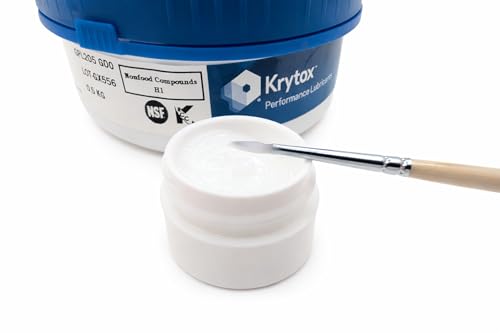
When the question is “what lube for my switches” without further detail, this is the answer the hobby gives, and this listing — a keyboard-marketed presentation of Krytox GPL-205 Grade 0 — is the convenient way to buy it. Grade 0 is the consistency that spreads into a switch’s ideal film: present enough to glide and to stay, soft enough to never feel like paste. On linears it is applied everywhere the stem slides; on tactiles it is applied everywhere except the two legs that make the bump, a distinction the switch-by-switch sections below develop. Its stability is the long-term argument — an application measured in years, on a switch that will be opened rarely if ever again.
Choose this pot if you are buying one lubricant for switches and want the reference product. Pair it with the oil below before calling the workbench complete, because springs are a separate job with a separate answer.
Strengths
- The reference switch grease — every tutorial assumes its behaviour
- Correct film behaviour for both linears and tactiles
- Years-long stability inside a closed switch
Trade-offs
- Wrong product for springs and stabilisers — it is one job’s answer
- Punishes heavy application without mercy
- Premium tier among greases
Best for: stems and housings on virtually any build. Not suited for: springs, stabiliser wires, or clicky mechanisms.

Krytox GPL 105 — the answer for springs
Badge: The spring oil that ends ping and crunch.
- Type: PFPE oil, 1oz bottle as listed
- Job: springs only
- Method: a few drops in a bag with the batch’s springs
- Character: thin, complete, permanent-feeling coverage
- Boundary: never on stems — oil migrates
Spring noise is the flaw switch grease cannot reach, because grease is never applied to the spring — and the spring, dry, sings against its seat and itself on every press. GPL 105 is the specific answer: an oil thin enough to coat every coil, applied most evenly by the bag method, after which the spring’s voice simply leaves the keyboard. If your board pings, this bottle is not an accessory to your lube choice; it is half of it. The discipline is dosage in the other direction — drops, not a drizzle — because surplus oil donates itself to the housing over the following weeks and edits your switches without asking.
Strengths
- Eliminates spring ping at the source
- Bag method coats a board’s springs in minutes
- One bottle serves a desk for years
Trade-offs
- A single-job product by design
- Over-application migrates into housings
- Useless as a stem lubricant
Best for: every spring in every switch you lube. Not suited for: any sliding surface.

Glorious G-Lube — the answer for a first, simple project
Badge: One forgiving pot for switches and stabilisers.
- Type: synthetic grease per the listing
- Stated coverage: up to 500 components
- Jobs per listing: plastics and metals — switches and stabilisers
- Character: beginner-forgiving consistency
- Audience: first projects and minimalists
G-Lube answers a different version of the title question: not “what is the reference product” but “what should I buy if I want one pot and no wrong turns.” Its listing positions it across switches and stabilisers, its consistency forgives the learning hand, and its stated coverage removes any anxiety about quantity. Specialists will graduate to the dedicated pairing — Krytox for switches, Permatex for wires — and find real if marginal gains there. First projects will not notice the margins; they will notice that one clearly-labelled pot carried the whole job, which is why this guide recommends it without condescension to exactly the readers it was made for.
Strengths
- One pot honestly covers a first project’s jobs
- Forgiving to apply while technique develops
- Generous coverage across many boards
Trade-offs
- Dedicated products edge it at each individual job
- Not the tutorial-standard chemistry
- Still demands thin films on switches
Best for: first projects, single-pot buyers, gift workbenches. Not suited for: purists optimising each component.

RUNJRX lube kit — the answer when you own nothing
Badge: The complete starter answer in one box.
- Contents per listing: 15g JRX-205 G0 lube, switch opener, tweezers
- Lube class: 205 Grade 0 equivalent
- Audience: custom keyboard builders starting out
- Character: the correct shopping list, pre-assembled
Sometimes the real question behind “what lube” is “what do I need to begin,” and this kit is that answer: a standard-class grease in a generous quantity, the opener without which no switch should be opened, and the tweezers without which no spring should be handled. Its grease behaves like the reference class, so every instruction in this guide applies to it unchanged. Buy the kit to start; buy the individual Krytox products to restock once your hands know their preferences — by then you will also know whether the station below belongs on your desk.
Strengths
- Lube, opener and tweezers — the complete minimum
- Standard-class grease; all guidance applies
- Generous quantity for learning mistakes
Trade-offs
- No brush or station included
- Equivalent-class grease rather than Krytox itself
- Redundant for already-equipped hobbyists
Best for: absolute beginners. Not suited for: restocking a working workbench.

Permatex dielectric grease — the answer for stabilisers only
Badge: The stabiliser wire specialist.
- Type: dielectric tune-up grease, 3oz tube as listed
- Job: stabiliser wires and their contact points
- Character: thick, tenacious, permanent
- Boundary: never inside a switch
Every lube decision guide must end one argument permanently: the thick grease that silences a spacebar’s rattle is a different product from the film that smooths a switch, and confusing them ruins switches. Permatex dielectric grease is the stabiliser answer — an automotive staple the hobby adopted because its thickness fills the clearance where stabiliser wires meet housings and stays there for years. Apply it visibly, at the wire ends and contact points, in the one place in keyboard work where “more” is sometimes correct. Then close the tube and put it physically away from the switch greases, because the only Permatex accident is a location accident.
Strengths
- The standard, lasting cure for stabiliser rattle
- One tube is a multi-year supply
- Forgiving, visible application
Trade-offs
- Catastrophic inside a switch — far too thick
- Excess makes long keys feel sluggish
- No keyboard instructions on an automotive tube
Best for: spacebars, enter keys, every rattly stabiliser. Not suited for: switch internals, ever.
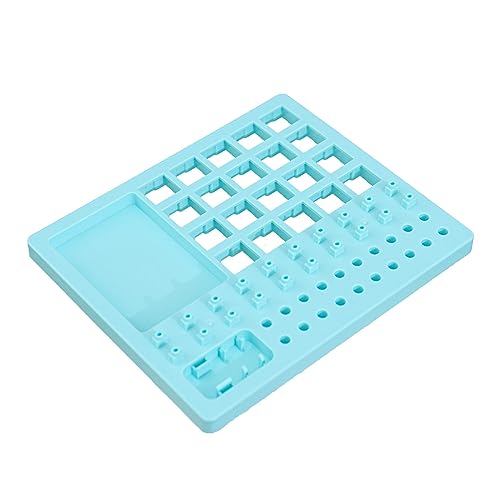
Switch lube station — the answer to “how do I organise this”
Badge: The workbench upgrade that prevents the classic disasters.
- Capacity: 20 switches in process, per the listing
- Includes: a switch opener, per the listing
- Function: ordered homes for stems, springs and housings
- Character: process furniture for batch work
Not every answer to “what lube to use” is a lubricant. Full-board projects fail organisationally — springs lost to the carpet, lubed and unlubed stems mingled, housings one short at reassembly — and the station is the product that answers those failures: twenty switches’ worth of ordered slots, worked in batches that let technique corrections land before they reach the whole board. Pair it with any grease in this guide and the project changes character, from a fiddly afternoon to a process. The companion craft — the full step-by-step of the lubing itself — lives in the ultimate guide lube your mechanical keyboard switches, which this decision guide is designed to precede.
Strengths
- Batch order prevents lost and mixed parts
- Twenty-switch rhythm paces the work well
- Included opener covers the essential tool
Trade-offs
- Takes desk space during projects
- Unnecessary for a handful of switches
- Furniture, not chemistry — it lubes nothing itself
Best for: full-board projects. Not suited for: a five-switch experiment.
In this guide
What lube for linears?
The linear is the straightforward case, and the answer is the full treatment: 205 Grade 0 on the housing’s rail channels, on the stem’s rails and faces, with GPL 105 on the spring. Nothing about a linear needs protecting — there is no bump to preserve and no mechanism to keep dry — so the goal is simply the thinnest complete film, and the result is the glide the whole craft is famous for. Factory-lubed linears complicate the decision only slightly: sample the stock switch first, because many modern linears arrive close enough to finished that your grease adds little; where the factory film is uneven, a consistent hand application unifies the board, which is the real prize.
What lube for tactiles?
The tactile answer is the linear answer with one exclusion that changes everything: the legs stay dry. The two small legs on a tactile stem are the bump’s machinery, and grease on them lubricates the bump itself into softness — sometimes a deliberate tuning choice, always a disaster as an accident. Grease the rails, the housing, the spring’s oil — then stop, with the brush kept visibly away from the legs. Thicker greases enter the tactile conversation legitimately: the Tribosys 3204 class, discussed below, is many enthusiasts’ tactile preference precisely because a slightly fuller film suits the tactile’s more complex stroke, provided the legs rule is honoured. Judge any tactile lube job by one test — the bump must feel like itself, in a smoother room — and re-do any switch that fails it. The family’s most famous patient, whose bump is its entire identity, is examined in what are holy panda switches.
What lube for clicky switches?
None inside, is the honest answer, and this guide would rather disappoint a clicky owner than ruin a clicky switch. The click mechanism — bar or jacket — must move freely and snap decisively; lubricant on it muffles the event the switch exists to produce, and the result is neither a good clicky nor a good anything else. The permitted work is peripheral: oil the spring if it pings, and leave the mechanism to its designed dryness. Clicky owners who want a smoother board should change switches, not lubricants — the tactile and linear shelves in this cluster are full of switches that want exactly the treatment clickies refuse.
What lube for silent switches?
Restraint, doubled. A silent switch’s dampers are its defining parts, and flooding them with grease changes their compression and can swell or soften materials never meant to be bathed. The correct job is the minimum: the thinnest rail film if a silent switch feels scratchy, spring oil if it pings, and nothing on the damper surfaces themselves. Many silent switches — the pre-lubed generations in silent switches guide — need nothing at all, and the wisest lube decision in the whole silent category is the decision to leave a satisfied switch closed. When in doubt with a silent switch, the answer to “what lube” is “less than that,” applied after a week of listening rather than before the first keystroke.
What about Tribosys 3203 and 3204?
The Tribosys pair is the connoisseur’s alternative to a single all-purpose grease: 3204, the fuller-bodied of the two, is the classic tactile choice; 3203, the thinner, is the classic linear choice — a matched set for owners who keep two pots and enjoy the distinction. Our inventory verification found no confident listing for either with an exact title and official image, so this guide describes them without linking rather than pointing at a doubtful substitute. If you source them from a specialist keyboard retailer, every rule in this guide applies unchanged — films thin, legs dry, oil on springs — because the craft is older than any brand’s shelf. Krytox’s pairing remains the recommendation for buyers who want the verified route; Tribosys is the connoisseur’s parallel road to the same destination.
How much lube should you actually apply?
Less than your instinct, then half of what remains after your first correction. The working image is a brush that was loaded and then wiped nearly clean, painting surfaces until they carry an even sheen with no visible accumulation anywhere. A useful calibration: a small pot of switch grease should serve board after board; if a single conversion visibly dents the pot, the films were thick and the switches are probably sluggish. Springs take drops — a few in the bag for a whole board’s worth. Stabilisers are the exception that proves the rule, taking a visible coating at their contact points because their job is to fill a gap rather than to glide. Dose by part, not by enthusiasm, and test one switch completely before the batch follows — the discipline the full process guide teaches, and the cheapest insurance in the hobby.
What mistakes do people make when choosing lube?
Buying by thickness adjectives without a job in mind is the first — “thock grease” is a mood, not a specification. Using stabiliser grease in a switch is the second and the most destructive. Oiling stems is the third: oil migrates, and a switch oiled on its rails will change its feel for months as the oil wanders. The fourth is mixing chemistries in one film, which can separate unpredictably; one switch, one grease. The fifth is lubing everything on arrival — factory-lubed switches, silent switches, clickies — without asking whether the switch wants it, which is the question this entire guide exists to make habitual. And the sixth is judging a lubricant by its price tier or its pot size, when the only honest metrics are the class of the product and the thinness of your film.
How do you apply the chosen lube? A condensed method
Step 1: Open, lay out, and keep the leaves alone
Open the switch with an opener, place stem, spring and housings in the station in a fixed order, and resolve to touch the metal leaves as little as possible — they are the switch’s electrics, not its furniture.
Step 2: Springs into oil, as a batch
Bag the batch’s springs with a few drops of GPL 105, agitate gently, and set them to drain to a sheen. This step is finished before the first stem is touched, which keeps oil and grease in their separate worlds.
Step 3: Grease the housing, then the stem
Paint the housing’s rail channels with the wiped brush, then the stem’s rails — and, for linears, its faces; for tactiles, everything except the legs. The order matters less than the thinness, which matters more than anything.
Step 4: Close, install one, and type
Reassemble a single switch, install it, and type on it beside an unlubed neighbour until you can say what changed. That switch is your standard; the batch follows it, and the board follows the batch. The uncondensed version of this method, with stabilisers and troubleshooting, is the companion guide linked from the station review above — and readers choosing switches to deserve this treatment will find them in the best switches for gaming and top 5 best tactile switches for your mechanical keyboard.
Final recommendation
Buy the pairing if you want the reference answer: Krytox 205 Grade 0 for everything that slides, GPL 105 for everything that springs, Permatex for the wires under the long keys. Buy the RUNJRX kit if your desk is empty and the project is this week; buy G-Lube if one forgiving pot suits your temperament better than a shelf of specialists; add the station when the projects grow to full boards. Then apply the only rule that outranks every product in this guide: the right lubricant, in a film you can barely see, on the part it belongs to — and nothing, anywhere, on a clicky mechanism or a tactile’s legs. Choose that way and the question in this guide’s title never needs asking again, because your hands will already know the answer.
Keep this guide’s decision table somewhere reachable — a bookmark, a note inside the workbench drawer — because the question it answers recurs with every new board, every gifted keyboard you offer to improve, every friend who types on your setup and asks what you did to it. The answer never changes: part, type, factory state, goal, test. Five questions, three product classes, one thin film. That is the whole of the craft’s shopping wisdom, and everything else — the brands, the grades, the connoisseur’s second pots — is commentary your hands will write for themselves across the boards to come.
What do grease grades and numbers actually mean?
The numbers on lubricant names frighten beginners unnecessarily, so here is the whole cipher. Greases are graded by consistency on a standard scale: the lower the grade, the softer and more spreadable the grease. Switch work lives at the soft end — Grade 0 is the community’s settled choice because it forms the thin, even film a stem wants, while thicker grades resist spreading and invite the sluggishness this guide keeps warning about, and thinner oil-like grades will not stay where a rail needs them. The numbers in product families encode related information: in the Krytox line, the grease and oil designations distinguish consistency and viscosity within one chemistry; in the Tribosys line, the pair splits the same territory by switch type. You do not need the cipher memorised. You need one rule extracted from it: for switches, soft grease, thinly; for springs, oil; for stabilisers, thick grease — and any product whose number places it outside those bands is answering a question your keyboard did not ask.
Choosing by goal: feel, sound or longevity?
Buyers arrive with different prizes in mind, and the honest guide separates them. If the goal is feel — the glide, the consistency, the disappearance of scratch — the Krytox pairing is the whole answer, applied thinly, and nothing else on the shelf will be missed. If the goal is sound, lube is a supporting actor: it removes friction’s high frequencies and the spring’s voice, deepening a board’s tone, but the board’s case, plate, caps and desk compose the music, and money spent chasing sound through lubricant grades alone is money spent at the wrong instrument. If the goal is longevity, the PFPE family’s stability is the argument: a lubricant that does not dry, migrate (in grease form) or react with plastics turns a lube job into a one-time event in a switch’s life. Most buyers want all three in some proportion, which is why the reference pairing keeps winning recommendations — it is the only shelf in this guide that serves every goal without a footnote.
Does the switch brand change the lube answer?
Less than the switch type does, with two practical footnotes. Housings differ in their rail geometry and their factory finish, so a switch that arrives dry and scratchy from one maker may want the full treatment that another maker’s pre-lubed equivalent politely declines — judge the unit in your hand, not the logo on it. Box-style switches, with their enclosed stems, take lubricant in smaller effective quantities and reward an even lighter brush. Beyond those footnotes, the matching in this guide is brand-blind by design: a linear is a linear, a tactile’s legs are sacred, a spring is a spring. That blindness is a feature of the craft’s maturity — the chemistry does not care whose mould made the plastic — and it means the workbench you build for one brand’s switches serves every brand you will ever own, which is the quiet economy underneath the whole hobby.
How should lubricants be stored, and how long do they last?
PFPE lubricants are among the most shelf-stable substances on a desk: sealed, at room temperature, away from dust, a pot of 205g0 or a bottle of 105 will outlast the keyboards it serves. The enemies are contamination rather than time — a brush that carries desk grit into the pot, a lid left off through a project, a workbench where stabiliser grease and switch grease can be confused in poor light. Label everything, keep the Permatex physically separate as this guide advised, and decant a working amount rather than brushing from the master pot during long projects. Springs of discipline aside, storage is the easiest section of the craft: these products were engineered for industrial environments beside which a desk drawer is a spa, and they will be ready, unchanged, for the board you have not bought yet.
The five-question decision, in order
When a switch is open in front of you, five questions settle its lubricant completely, and they are worth memorising in order. One: what part is this? Rail, stem, spring or wire — the part names the class, as the decision table laid out. Two: what type is the switch? Linear invites the full film, tactile excludes the legs, clicky excludes the interior, silent minimises everything. Three: what did the factory already do? A satisfied pre-lubed switch is left alone; an uneven one is unified; a dry one is treated. Four: what is my goal for this switch — glide, quiet, consistency — and does my dose serve it, or merely my enthusiasm? Five: have I tested this exact recipe on one switch and typed on it? Until the fifth answer is yes, the other four are a hypothesis. Run the five questions per batch rather than per board, because boards contain multitudes — a tactile alpha cluster, a linear spacebar switch, springs everywhere — and the questions, unlike a single product choice, scale to every combination a real keyboard presents.
The workbench roadmap: what to buy in what order
Budget and patience both appreciate a sequence. First purchase: the means to open and grease one board well — the kit, if you own nothing, or the Krytox grease plus an opener if you own tools. Second purchase: the spring oil, bought the first time a lubed board still pings at you, which will be the first evening. Third: the Permatex, bought with the first spacebar you hear rattle, which will be the same week. Fourth: the station, bought when a full-size project looms and the carpet has claimed its first spring. Fifth and last: the connoisseur’s second grease — a Tribosys pot from a specialist, or a thicker grade for a specific tuning idea — bought when your hands have opinions precise enough to spend on. That order has carried most of the hobby’s workbenches into existence, and its logic is the guide in miniature: answer the job in front of you, with the right class of product, and let the shelf grow at the speed of your questions.
Does lubing affect a keyboard’s resale or warranty?
Two practicalities worth a paragraph each in a decision guide. Warranty: lubing a removable switch modifies the switch, and a board whose switches are user-removable treats switches as consumables in most makers’ eyes — but terms vary, and a board under a warranty you value should keep its original switches unlubed and stored, as the companion process guide advises, so every option survives. Resale: a well-lubed board is generally worth more to the next enthusiast, not less, provided the work is honest — thin films, legs respected, products named accurately in the listing. What damages value is the undisclosed experiment: the over-lubed board sold as stock, the clicky sold after its mechanism was greased into silence. The craft’s ethics are simple and they are the same as its technique — do the right job, say what you did — and a guide about choosing lubricants is a fair place to insist that the choosing includes choosing to be straight about it afterwards.
Why not household lubricants? A necessary warning
Every season, a keyboard dies of a helpful household product, and a decision guide that omits the warning has failed its readers. Penetrating sprays and general-purpose oils from the garage are formulated to dissolve, creep and evaporate — the opposite of everything a switch wants — and several attack switch plastics or leave residues that turn a repairable board into a write-off. Petroleum jellies and kitchen substances migrate, degrade and collect debris. Silicone sprays coat indiscriminately, including the contact leaves a switch depends on. The products in this guide cost what they cost because their chemistry was specified for exactly this world: inert against plastics, stable for years, graded for films measured in whispers. A switch is a small sealed machine you will open rarely; the substance you seal inside it should be the one designed to be forgotten. If the right pot is not on your desk, the correct lubricant for tonight is patience — the board will wait, and it will thank you for not improvising its insides.
Three boards, three lube decisions
The office board — pre-lubed tactiles, shared room, long days — needs the least: a week of listening, a spring-oil pass if ping survives, stabiliser grease for the spacebar, and nothing else. Its owner’s restraint is the decision, and it is the most common correct one in this guide. The gaming board — linears, high wear at the movement cluster — earns the full Krytox pairing, with the movement keys’ switches treated as the priority batch and re-examined each season, because that cluster ages years ahead of the board around it. The project board — a barebones build assembled for the love of the process — is where the full shelf justifies itself: station, pairing, Permatex, a second grease for tuning experiments, and the five questions asked per batch like a liturgy. Three boards, three budgets of effort, one principle underneath: the lubricant follows the job, the job follows the board’s life, and no shelf — however complete — outranks the listening that tells you what the job is.
When should a switch be re-lubed?
Almost never on a schedule, and promptly on evidence. PFPE films do not evaporate, so a switch lubed correctly does not dry out in any timeframe a keyboard serves; re-lubing belongs to events rather than anniversaries — a switch opened for a spring change, a board deep-cleaned after a spill, a single unit whose stroke has gone scratchy while its neighbours stayed smooth, which usually indicts debris rather than lubricant and should be cleaned before it is re-greased. The habit to avoid is the prophylactic re-lube, in which a satisfied board is opened from restlessness and returned with thicker films than it needed, its feel edited by boredom. A lubed keyboard’s maintenance is listening: a minute’s attention a month, a brush-down for grit, and intervention only where a specific key files a specific complaint. That restraint is the final form of the guide’s opening rule — quantity is a quality — applied across years instead of afternoons.
Films, springs and other neighbours of the lube decision
A lube choice is often made in the same sitting as two adjacent decisions, and a complete guide should place them. Switch films — thin gaskets between housing halves — pair with lubing because the switch is already open; they answer housing play and deepen sound, and they neither need nor want lubricant themselves. Spring swaps pair with the oil step, because an oiled spring is out of the switch anyway; a new spring’s weight and length change a switch more profoundly than any grease, and the five questions should be re-asked for the new spring’s noise before it is oiled by reflex. Neither neighbour changes the lubricant matching this guide teaches; both change what the matching is applied to, and the organised workbench — station, labelled pots, one test switch — is what keeps a combined session from becoming three experiments tangled into one unrepeatable result. Change one variable per batch, note what you did, and your future self inherits a board whose tuning is knowledge rather than folklore.
What lube for older and vintage switches?
Age adds two cautions to the standard matching. Plastics in older switches can be less forgiving of chemistry, which strengthens the case for the inert PFPE family and against every improvised substitute in the warning section — a vintage switch is precisely the wrong place to discover that a household product attacks old polymer. Wear adds the second: a switch whose rails have polished themselves across decades may need the barest film of all, because its surfaces have already done half of lubrication’s work by mating to each other, and a full modern dose can turn a characterful veteran sluggish. Work one switch, type for a day, and let the veteran set its own dose. Collectors of genuinely old boards often adopt the most conservative rule in this guide — springs oiled, rails kissed, everything else left as history made it — and their boards’ survival is the argument’s evidence.
A short history of switch lubricant taste
The hobby’s lubricant shelf was not always this settled. Early modders experimented with whatever the hardware world offered — silicone greases of varying manners, industrial oils, mixtures mixed at kitchen tables — and the era’s forum threads are a museum of triumphs and dissolved housings. The PFPE family’s ascendancy came from exactly the properties the chemistry section names: inert, stable, graded, forgettable. Within that ascendancy, taste then refined itself — one all-purpose grease became a pairing, the pairing acquired the tactile-thicker and linear-thinner specialisations, and the spring acquired its own oil rather than borrowing the stem’s grease. The shelf in this guide is that history’s current chapter, and its stability is the story: the recommendations a beginner receives today are the recommendations an expert received five years ago, which almost never happens in a hobby this young. Buy the settled shelf with confidence, and let the frontier — there is always a frontier — be explored by the people who enjoy frontiers.
What lube for a board you are giving away or selling?
A board prepared for another person deserves a conservative version of every rule here. Use the reference pairing at reference thinness, because the recipient’s taste is unknown and a neutral, correct lube job offends no one; leave clickies and satisfied factory switches entirely alone, because the recipient may love exactly what you would have edited; grease the stabilisers properly, because a rattly spacebar is the flaw a new owner notices first and forgives least; and write down what you used, on a card in the box, because the next person to open those switches deserves the knowledge you had. A board given or sold in that condition carries the craft’s reputation with it — and more than one lifelong hobbyist was created by receiving a keyboard whose switches felt like someone had cared. That is a lube decision too, and possibly the best one in this guide.
The one-page version of this entire guide
For the reader who will act today and study later, the whole decision fits in a breath. Stems and housings take a thin film of a switch grease — 205 Grade 0 as the standard, G-Lube as the accessible alternative. Springs take oil — GPL 105 — never grease. Stabiliser wires take a thick dielectric grease, Permatex’s being the verified shelf item. Clicky mechanisms take nothing, tactile legs take nothing, satisfied factory-lubed switches take nothing until they disappoint. Tribosys is the connoisseur’s prose-only branch of the same tree. Kits and stations are logistics, bought when the project’s size justifies them. Dose everything as a film you can barely see, test one switch before committing a board, and write down what you used. That paragraph is the guide; everything around it is the guide earning the paragraph. Keep both, use the short one at the bench and the long one at the shelf, and the question in the title will stay answered.
What to do while the lube settles in
A freshly lubed board has a short adolescence that first-timers misread as failure. The first hour’s strokes can feel fractionally uneven as films distribute themselves across the rails; a spring oiled an hour ago may still be deciding its final voice; stabilisers greased that morning settle into their note across the first day’s typing. The craft’s rule is to judge nothing before a full day of ordinary use, because lubricant is a material that finishes applying itself. Type real work on the board, play your ordinary games, and let the films find their equilibrium — then, and only then, open the one switch that still argues. Nearly every premature redo in this hobby was a board judged during its adolescence, and nearly every veteran’s patience was learned from exactly one such mistake. Spare yourself the tuition: the week of testing this guide prescribes begins after the settling day, not instead of it.
Frequently asked questions
What is the best all-around lube for mechanical keyboard switches?
Krytox 205 Grade 0, for stems and housings — the standard the hobby calibrates against. “All-around” stops at the switch’s edge, though: springs want GPL 105 oil and stabilisers want a thick dielectric grease, and no single product honestly covers all three jobs. A buyer who internalises that one answer — one grease, one oil, one stabiliser grease, each in its place — has understood the guide entire, and can safely improvise every detail around it for the rest of their time in the hobby.
Can I use the same lube for switches and stabilisers?
A dual-positioned product like G-Lube covers a first project acceptably. The specialist answer is no: switches want a thin grease film, stabiliser wires want a thick grease that fills clearance, and Permatex inside a switch is the classic ruined afternoon. Keep the jobs separate once you own the dedicated products.
Is thicker lube better for a deeper sound?
Within a switch, thickness is a tuning dial with a cliff at the end: a fuller film deepens the stroke’s voice slightly, and the next increment makes the switch sluggish. Sound is shaped far more by the board, caps and case than by lube grade — chase depth there, and keep switch films thin. If a deeper voice is the genuine goal, the honest shopping list runs case foam, heavier keycaps and a desk mat before it ever reaches a second pot of grease.
Can I lube just the springs without opening every switch?
The springs live inside the switches, so no — spring oiling is switch-opening work, which is why it is batched and why the station earns its place. The exception is triage: if only a few keys ping, open only those switches, oil their springs, and leave the satisfied majority closed. Targeted work on evidence is this guide’s philosophy in miniature.
Do I need to lube factory-lubed switches?
Usually not immediately. Type on them for a week; lube only what disappoints — a scratchy unit, an uneven board — and let consistency, not habit, be the reason a switch is opened. Many modern switches, including most in this site’s guides, arrive finished. If you do unify a factory-lubed board by hand, work even more thinly than the standard film — your grease is joining an existing one, and the combined dose is the one the switch will feel.
What brush should I use to apply switch lube?
A fine, flat detail brush — the kind sold for miniature painting — because it loads a small, controllable amount and lays an even film. Keep it for lubricant only, wipe it rather than washing it between sessions, and replace it when the bristles stop holding their shape; a splayed brush applies unevenly, and unevenness is the flaw every section of this guide is organised against.
What happens if I use too much lube?
The switch turns sluggish, a tactile’s bump softens or vanishes, and the cure is reopening, wiping every part clean, and reapplying at half the quantity. It is fully reversible and universally experienced — treat your first over-lubed switch as tuition rather than failure.
Can lube damage a keyboard?
Correctly chosen and thinly applied, no. The damage stories trace to wrong products in wrong places — thick grease in switches, oil wandering from over-oiled springs, bent leaves from rough handling. The product-matching in this guide exists precisely to keep lubricant a pure benefit.
How do I know if my switches are already lubed?
Open one and look: a factory film shows as an even sheen on the stem’s rails, and the stroke of a lubed switch feels smooth rather than scratchy against an unlubed reference. Many listings state pre-lubrication outright, as most picks in this site’s switch guides do. When the evidence is ambiguous, type for the week this guide keeps prescribing — a satisfied switch needs no verdict faster than that.
Is expensive lube worth it over cheap lube?
Within the correct class, the differences are refinement and stability rather than category: the reference PFPE products earn their tier by lasting years without drying or reacting, and by behaving identically in every batch. A cheaper product of the right class, honestly applied, beats a premium product of the wrong class every time — which is the guide’s whole thesis in one comparison. Spend on class first, brand second, and quantity never.