Disclosure: As an Amazon Associate, kajuandouglas.com earns from qualifying purchases. Links on this page are affiliate links; they cost you nothing extra. Prices and availability change often, so check the current Amazon listing before you buy.
Pbt Vs Abs Keycaps: The Short Answer First
Anyone comparing pbt vs abs keycaps is really asking a simpler question underneath: will the caps under my fingers still feel and look good a year from now, and what do I give up either way? ABS, short for acrylonitrile butadiene styrene, is the plastic most stock keyboards ship with. It molds easily, takes vivid color, and produces crisp shine-through legends, which is why gaming brands love it. Its weakness is surface wear: the oils from your fingertips slowly polish ABS smooth, and heavily used keys such as W, A, S, and D develop a glossy shine that changes both the look and the feel of the board. PBT, short for polybutylene terephthalate, is a denser, more heat-resistant plastic. It keeps a lightly textured, dry surface for years, resists shine, and produces a deeper, more muted typing sound. Its trade-offs are manufacturing difficulty, a historically narrower color palette, and a tendency for large keys to warp slightly during cooling if a maker is careless.
The honest verdict is not that one plastic is good and the other is junk. It is that PBT wins on longevity and feel stability, while ABS wins on color freedom, shine-through backlighting, and the sheer number of boards that ship with it. If you plan to keep one keyboard for several years and type on it daily, PBT is the safer default. If your build is themed around a specific colorway, heavy RGB shine-through, or a particular smooth feel, a well-made ABS set is a legitimate choice rather than a compromise you should feel guilty about. This guide walks through every criterion that actually separates them, then links four verified PBT sets as concrete examples of what the PBT side offers at different profiles and styles. The ABS side is discussed in prose throughout, because the comparison sets verified for this page are PBT; that framing keeps every linked product honest to its listing.
In this guide
How The Two Plastics Are Actually Made
Understanding the materials explains almost every difference that follows. ABS is a thermoplastic blend prized for easy injection molding. It flows into fine mold detail at relatively low temperatures, which lets manufacturers produce sharp legend edges, thin walls, and unusual colors cheaply. That ease is also why double-shot ABS, where a second shot of plastic forms the legend, became the classic premium construction on enthusiast sets: the legend is a physical piece of plastic running through the cap, so it can never wear off, and the colors can be matched precisely to a designer’s palette.
PBT is a semi-crystalline polyester that needs higher molding temperatures and shrinks differently as it cools. Warping on spacebars and other long keys is the classic PBT defect, and early PBT sets earned a mixed reputation because of it. Modern makers control the process far better, and PBT’s advantages are substantial: the material is harder, more chemically resistant, and far less prone to the surface polishing that makes ABS shine. PBT does not take dye the same way ABS takes molded color, so PBT legends are usually dye-sublimated, printed with heat so dye sinks into the plastic, or double-shot using specialized tooling. Both legend methods are effectively permanent in normal use, which is why the legend question is mostly settled once you choose either plastic in a quality set.
Criterion By Criterion: Where Each Plastic Wins
Shine and surface wear
This is the difference owners notice most. ABS starts smooth and gets smoother; after months of heavy use the home row and gaming cluster develop a visible gloss that photographs badly and feels slightly greasy even on clean hands. You can slow it with clean hands and occasional washing of the caps, but you cannot stop it, because the wear is the plastic itself polishing. PBT’s harder surface resists that polishing for years. A PBT set that has been typed on daily for three years usually looks close to how it looked in its first month, aside from dust and the odd scuff. For anyone who dislikes the shiny-key look, this single criterion can settle the whole pbt vs abs keycaps debate.
Feel under the fingers
ABS feels slick and slightly soft at the fingertip, which some typists genuinely prefer, describing it as smooth or silky. PBT feels dry and faintly grainy, with a texture often compared to fine stone or ceramic. Neither feel is objectively better, but they are distinct enough that switching plastics changes how a familiar switch feels. Players who rest their fingers on WASD for long sessions often prefer PBT’s grip because fingers wander less. Typists who glide across keys during fast passages sometimes prefer the lower friction of ABS. If you can, borrow or buy a single tester set before committing a whole board.
Sound
Keycap plastic changes pitch. ABS caps, especially thinner ones, tend toward a brighter, higher, slightly hollow sound. PBT caps, typically a little denser and often thicker-walled, sound deeper and more muted, contributing to the low, soft profile many enthusiasts describe as thock. Sound is a system property, though: case material, plate, foam, switches, and desk surface all matter as much or more. Swapping from thin stock ABS to thick PBT is one of the most audible single changes you can make, but it will not rescue a hollow case or pingy springs on its own.
Color and design freedom
ABS still leads here. Because it molds in color easily, ABS sets offer saturated, precise colorways, gradients, and novelty keys that PBT makers struggle to match. Dye-sublimation on PBT can only print darker legends on lighter caps, which limits dark sets unless the maker uses double-shot PBT or reverse dye-sub techniques that cost more. The gap is narrowing every year as double-shot PBT tooling spreads, but a buyer chasing one exact themed colorway will still find more options in ABS. This is the strongest argument for ABS and the reason premium ABS sets continue to sell to experienced buyers who know exactly what they are trading away in shine resistance.
Shine-through legends and RGB
If you want legends that light up, ABS is the default material for shine-through caps, because translucent ABS legends over a clear or milky cap body are easy to produce. Most stock gaming keyboards use exactly this construction. Shine-through PBT exists but is specialized and less common. Buyers who care about per-key RGB readability at night should either accept ABS shine-through caps or choose opaque PBT caps with south-facing LEDs lighting the desk rather than the legends. There is no wrong answer, but it is a real fork in the road that should be decided before shopping.
Durability beyond shine
Both plastics are tough in normal use. ABS can yellow with prolonged ultraviolet exposure, a slow effect most visible on white and light sets kept near windows. PBT resists yellowing and most household chemicals better, and it tolerates the warm water used for cleaning without complaint. ABS legends formed by pad printing wear away; double-shot ABS legends do not. PBT dye-sub legends sit inside the plastic surface and effectively cannot rub off. In practice, legend method matters more than plastic for legend longevity, while plastic matters more for surface longevity.
Quick Comparison Table
| Criterion | ABS | PBT |
|---|---|---|
| Surface after a year of heavy use | Noticeable shine on busy keys | Largely unchanged texture |
| Fingertip feel | Smooth, slick, slightly soft | Dry, lightly textured, grippy |
| Typing sound tendency | Brighter, higher pitch | Deeper, more muted |
| Color range | Widest, most saturated | Growing, historically muted |
| Shine-through RGB legends | Common and crisp | Rare, specialized |
| Legend methods | Double-shot, pad print, laser | Dye-sub, double-shot |
| Heat and UV resistance | Lower; can yellow | Higher; very stable |
| Typical tier | Stock standard to premium themed sets | Mid to premium tiers |
The Verified PBT Sets Linked On This Page
The four sets below were each confirmed against Amazon’s catalog data for this guide, with an official product image and a listing title that matches the set described. They were chosen to show the range inside PBT rather than to repeat one formula four times: a mainstream doubleshot upgrade set from a major gaming brand, a tall sculpted SA profile set, a flat uniform XDA set with a retro look, and a low uniform DSA set in a compact blank format. Reading them side by side shows how much of what people call the PBT feel actually comes from profile, thickness, and legend method rather than from the plastic alone.

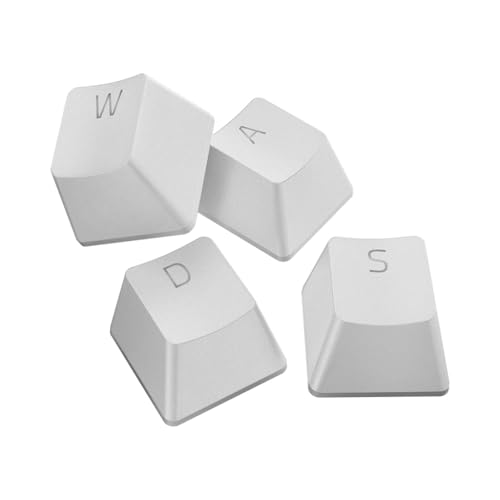
Razer Doubleshot PBT Keycap Upgrade Set (Mercury White)
Badge: The mainstream upgrade path. This is the set aimed squarely at owners of ordinary gaming keyboards who want to replace thin stock ABS caps without entering enthusiast group-buy culture. Razer molds the legends as a second shot of plastic, so the characters are part of the cap wall rather than a surface print, and the set is built for standard 104/105 US and UK layouts across mechanical and optical boards. Mercury White is the clean, bright colorway; the same set exists in other colors for darker builds.
- Material and legends: double-shot PBT
- Compatibility: standard 104/105 layouts, US and UK
- Works with: mechanical and optical switches with standard stems
- Positioning: mid-tier upgrade set from a major brand
Strengths
- Double-shot legends cannot fade, rub off, or fill in with grime the way pad prints do.
- The textured PBT surface removes the shine problem that motivates most upgrades from stock ABS.
- Broad layout coverage means most full-size and tenkeyless boards are covered without buying add-on kits.
Trade-offs
- Opaque legends do not shine through, so per-key RGB becomes ambient glow rather than lit characters.
- The profile is a conventional sculpted shape; buyers chasing a specific enthusiast profile should look at the other sets here.
- Unusual layouts, split spacebars, and non-standard bottom rows may not be fully covered.
Best for: a gaming-board owner who wants one dependable PBT upgrade from a known brand. Not suited for: shine-through RGB builds or exotic layouts. Check price on Amazon

142-Key SA Profile PBT Doubleshot Set (Black Translucent)
Badge: The tall, sculpted statement set. SA is the high, spherical-topped profile modeled on vintage terminal keyboards, and it changes a board’s sound and posture more than any other single keycap choice. This 142-key set pairs that profile with PBT double-shot construction and a black translucent finish, and its key count covers boards from 61-key compacts up through full 108-key layouts on standard Cherry MX-style stems.
- Material and legends: PBT, double-shot
- Profile: SA, tall and sculpted with spherical tops
- Coverage: 142 keys for 61/64/87/104/108 layouts
- Positioning: enthusiast-leaning profile set
Strengths
- The tall sculpt gives fingers deep, cupped landing zones that many typists find unusually comfortable.
- Thick SA walls deepen the sound of almost any switch and case combination.
- Double-shot legends stay crisp for the life of the set.
Trade-offs
- SA height raises the whole typing plane; many users need a wrist rest and a day or two of adjustment.
- The tall profile can feel slower for competitive gaming because travel to the key top is longer.
- Translucent styling suits some builds and clashes with others; check your case color before ordering.
Best for: typists and enthusiasts who want the vintage tall-profile feel in durable PBT. Not suited for: low-profile setups or players who want the shortest possible key travel. Check price on Amazon

Guffercty kred XDA Profile PBT Keycap Set (125 Keys, Ember)
Badge: The flat, wide, retro set. XDA is a uniform profile: every row sits at the same height, and each cap has a wide, slightly dished top. This 125-key set uses dye-sublimated PBT in a retro Ember colorway for ANSI US layouts. Because the rows are uniform, caps can be moved between rows freely, which makes the set friendly to unusual layouts and to users who like rearranging keys for games or alternate layouts.
- Material and legends: PBT, dye-sublimated
- Profile: XDA, uniform height, wide tops
- Coverage: 125 keys, ANSI US layout
- Positioning: accessible enthusiast set
Strengths
- Wide key tops give a forgiving landing area that suits fast, loose typing styles.
- Uniform rows make the set easy to adapt to compact and non-standard boards.
- Dye-sub legends are embedded in the surface and will not wear away.
Trade-offs
- The flat profile offers no sculpted guidance, so touch typists used to row shaping need adjustment time.
- Dye-sub limits legend contrast on darker caps in the set.
- The retro colorway is a strong aesthetic commitment, not a neutral office look.
Best for: tinkerers and retro-styled builds that want PBT durability in a flexible uniform profile. Not suited for: buyers who want sculpted rows or shine-through legends. Check price on Amazon

YMDK DSA Profile Blank PBT Keyset (61/64/68 ANSI)
Badge: The low, blank minimalist set. DSA is the low uniform cousin of SA: short, spherical-topped, and the same height on every row. This thick PBT keyset is blank, with no legends at all, and is sized for compact 61, 64, and 68-key ANSI boards such as GH60-style builds. It is the purest expression of the PBT argument: nothing to fade, nothing to shine, just texture and shape.
- Material and legends: thick PBT, blank (no legends)
- Profile: DSA, low and uniform
- Coverage: compact 61/64/68 ANSI boards
- Positioning: minimalist compact-board set
Strengths
- Blank caps eliminate legend wear from the equation entirely and look clean on any board.
- Low uniform rows keep the typing plane close to the desk, suiting low setups.
- Thick PBT walls give compact boards a deeper, less plasticky sound.
Trade-offs
- No legends means confident touch typing is mandatory, including for symbols and the number row.
- Coverage stops at compact boards; full-size owners need a different set.
- Uniform rows give no tactile row guidance beyond the key tops themselves.
Best for: touch typists with compact boards who value texture and minimalism over printed guidance. Not suited for: anyone who still looks at the keyboard while typing. Check price on Amazon
Buying Guide: Choosing Between PBT And ABS For Your Board
Start from how long you keep keyboards. A board you expect to use for three or more years rewards PBT’s surface stability; a board you swap yearly for a new theme makes ABS’s color range more valuable than longevity you will never use. Next, decide the RGB question honestly. Lit legends require shine-through construction, which usually means ABS; if you mostly type in a lit room, opaque PBT with backlight glow around the caps looks fine and lasts longer. Third, check your layout before falling in love with a set: count your keys, measure your spacebar, and look at the bottom row, because non-standard spacebar lengths and 1u modifier keys are where compatibility goes to die. Fourth, weigh thickness alongside plastic. A thick ABS set can out-sound a thin PBT set, and a thin PBT set can feel cheaper than the stock caps it replaces; wall thickness and profile shape carry as much of the experience as the material name on the box.
Budget framing helps too. Entry sets in either plastic are inexpensive experiments; mid-tier sets buy better molding, cleaner legends, and broader kits; premium sets buy design, sculpt quality, and extras such as novelties and alternate mods. Spending premium money on ABS makes sense when the design itself is the point. Spending it on PBT makes sense when the set is meant to be the last one the board wears. What rarely makes sense is paying premium prices for thin, pad-printed caps in either plastic, because that combination gives up durability on both axes at once.
How To Swap Keycaps Without Damaging Anything
A careful swap takes fifteen unhurried minutes and the right tool. Follow these steps the first time and they become habit.
- Photograph your current layout before touching anything; the photo is your map for reassembly, especially for stabilizer keys and unusual legends.
- Use a wire keycap puller, not a plastic ring puller, and pull straight up with a gentle rock. Wire pullers grip two sides evenly and are far less likely to scratch cap walls or yank a switch out of a hot-swap socket.
- Work row by row and lay the removed caps out in the same pattern on a towel, so nothing rolls away and the layout stays obvious.
- Remove stabilizer keys, the spacebar, Enter, and Shift, slowly and evenly from both ends. These sit on stabilizer stems that resent being levered from one side.
- Inspect the new set against your board before installing: spacebar length, bottom-row widths, and any extra keys your layout needs.
- Press new caps straight down until they seat fully. A cap that sits high usually just needs firmer, even pressure; never twist a cap onto a stem.
- Test every stabilizer key for rattle and binding before declaring the job done, and keep the old set stored in its tray in case you sell the board later.
Common Mistakes When Choosing Between The Plastics
The first mistake is assuming PBT automatically means quality. Thin, warped, or badly printed PBT sets exist in volume, and a warped spacebar that rocks on its stabilizers is worse than a good ABS spacebar that will shine in two years. The second mistake is buying a set for a colorway photo without checking profile: SA, XDA, DSA, and sculpted OEM-style profiles feel like four different keyboards, and a beautiful set in a profile your hands dislike will end up back in its box. The third mistake is ignoring the bottom row and spacebar until installation day. The fourth is washing caps in hot water or harsh solvents; warm water with a drop of dish soap is enough for either plastic, and ABS in particular dislikes heat. The fifth is judging sound from a single key. Caps change pitch across the board unevenly, so install a full row and type real sentences before deciding a set sounds wrong.
Final Recommendation
For most owners, the pbt vs abs keycaps question resolves to this: choose PBT for a keyboard you live on, and choose ABS when color, shine-through legends, or a specific themed design is the reason for the purchase. Among the verified sets above, the Razer doubleshot set is the straightforward upgrade for a standard gaming board, the SA set is the character choice for typists who want height and depth, the XDA set suits flexible retro builds, and the blank DSA set is the minimalist’s compact option. Whichever plastic you pick, buy the thickest, best-molded set your budget tier allows, because construction quality is the variable that decides whether either plastic shows its best side. If you remain torn after all of this, buy one mid-priced set in the plastic you have not tried and give it a full month of real work; a month of your own typing teaches more than any comparison, including this one, and the set you do not keep makes an excellent spare or gift for another keyboard owner.
How To Tell Which Plastic Your Current Keycaps Are
Many boards never state their cap material clearly, and owners often shop for an upgrade without knowing what they are replacing. A few simple checks identify the plastic with reasonable confidence. First, look at the surface under a bright light at a low angle: ABS that has been used will show polished patches on the busiest keys even when the board looks matte from above, while PBT keeps a uniform fine grain. Second, feel the underside texture and weight of a removed cap; PBT caps are usually a touch denser and their inner walls feel harder and drier. Third, read the legends: pad-printed characters that have begun to fade or feel raised under a fingernail are almost always on ABS stock caps, while dye-sublimated legends sit flat and sharp. Fourth, check the sound of a single cap dropped a short distance onto a desk; PBT lands with a duller, lower tick than ABS. None of these tests is laboratory-grade, but together they tell you whether your current set is the shiny-prone kind and whether an upgrade will actually change anything.
Thickness, Walls, And The Details Spec Sheets Skip
Two sets made from the same plastic can feel unrelated, because wall thickness and molding quality do heavy lifting. Thin caps, common on stock boards, flex slightly, sound hollow, and transmit more case resonance. Thick caps add mass at the fingertip, which deepens sound and gives each press a more solid landing. When comparing sets, look for stated thickness where sellers provide it, examine product photos of cap undersides for clean, even walls, and treat very light full sets as a warning sign regardless of material. Legend quality deserves the same scrutiny: double-shot legends should show no bleeding at character edges, dye-sub should be evenly dark rather than blotchy, and pad printing, the budget method, should be priced as the temporary finish it is.
Stems and fit matter as much as the cap body. A loose stem makes a cap wobble and can crack over time; an overly tight stem risks splitting when removed. Quality sets in either plastic hold stems to consistent tolerances. If you own a board with north-facing switches and plan to use thick sculpted caps, be aware that some profile and switch combinations can contact the switch housing at the bottom of travel; a quick community search for your exact board and profile pairing saves a return. These practicalities are unglamorous, but they decide satisfaction more often than the headline plastic does.
Scenario Guide: Matching Plastic To How You Actually Type
The competitive player
Your WASD cluster and ability keys take thousands of presses a week, often with slightly sweaty hands during long sessions. PBT’s grip and shine resistance protect both performance and looks, and its deeper sound keeps late-night sessions quieter for the household. If your team or stream setup depends on lit legends in a dark room, accept shine-through ABS on the main cluster or light the desk instead; do not sacrifice the surface you play on for a lighting effect you rarely look at mid-match.
The full-time typist
Writers, programmers, and data workers live on the home row, and the slow polish of ABS changes key feel right where their fingers rest. PBT keeps that feel constant for years, which protects muscle memory. Profile choice may matter even more than plastic here: a sculpted set that matches natural finger arcs reduces reaching, while uniform profiles such as DSA and XDA suit people who remap keys heavily. Pair PBT with the profile that fits your hands and the board disappears, which is the goal.
The shared-desk and office user
Office boards get cleaned often, borrowed occasionally, and judged by whoever sits nearby. PBT tolerates cleaning, resists the patchy shine that makes a board look tired, and softens sound. Avoid tall, loud profiles in open offices; a mid-height PBT set on quiet switches is the combination colleagues will never comment on, which is the highest praise an office keyboard earns.
The collector and theme builder
If the keyboard is a display piece as much as a tool, ABS’s color precision and the deep catalog of themed sets are the point of the hobby, and shine is a manageable cost: rotate sets, keep a daily driver for heavy work, and store display sets away from sunlight. Collectors often own both plastics for different boards, which is the honest end-state of this comparison for anyone deep enough in the hobby to care about it.
Care And Cleaning: Keeping Either Plastic At Its Best
Remove caps every few months, or sooner in dusty rooms and homes with pets. Soak them in warm water with a small amount of dish soap for half an hour, agitate gently, rinse thoroughly, and dry them completely, ideally overnight on a towel, before reinstalling; trapped moisture under caps helps no switch. Avoid hot water, bleach, and solvent cleaners, which can damage ABS and dull finishes on either plastic. For quick maintenance between deep cleans, a soft brush clears crumbs from around the switches and a microfiber cloth handles the cap tops. Store spare sets in their original trays or in compartment boxes, out of direct sunlight, because ultraviolet exposure is the one environmental factor that visibly ages ABS over time.
A Short History That Explains The Market
ABS dominance is an accident of manufacturing history: it was the cheap, moldable plastic available when mass-market keyboards standardized, and double-shot ABS on early terminal and typewriter-era boards set the visual template enthusiasts still chase. PBT entered through industrial and point-of-sale keyboards that needed legends and surfaces to survive brutal daily use, then crossed into enthusiast boards as small makers proved it could be molded into attractive sets. The modern market, where double-shot PBT ships on mainstream gaming boards and reverse dye-sub has widened PBT’s color range, is the two traditions merging. Knowing that history prevents a common error: treating ABS as the cheap option and PBT as the premium one, when in truth each is premium at what it was designed to do.
Myths About The Two Plastics, Corrected
Myth: PBT always sounds better. Plastic is one ingredient in a sound that also comes from case volume, plate material, foam, switch choice, and the desk itself. A thick, well-made ABS set on a solid case can sound deeper than thin PBT on a hollow tray-mount board. Buy PBT for surface longevity first and treat any sound improvement as a bonus that depends on the rest of the build.
Myth: ABS is the budget plastic. Some of the most expensive keycap sets ever sold are double-shot ABS, priced for design, sculpt quality, and small production runs. Conversely, the cheapest no-name sets on any marketplace are often thin PBT. Price follows design and production scale far more than polymer choice.
Myth: Shine makes ABS unusable. Shine is cosmetic and tactile, not functional; the keys keep working, and some typists even like the smoother feel that develops. It only becomes a problem when the look bothers you or when resale value matters, since buyers do discount visibly polished sets.
Myth: You can feel the plastic through any switch. Heavy tactile and clicky switches dominate a board’s feel so thoroughly that cap material becomes a minor note. On light linear switches and quiet boards, by contrast, cap texture and sound are a large share of the experience. The lighter and quieter your switches, the more this comparison matters.
Myth: One plastic is better for your health or posture. Neither plastic changes wrist angle, key spacing, or force curves; those come from layout, profile height, and switch weight. Tall profiles such as SA do raise the typing plane and pair better with a wrist rest, but that is geometry, not chemistry, and it applies to tall caps in any material.
Beyond The Big Two: POM, Polycarbonate, And Artisan Materials
A complete answer to pbt vs abs keycaps should acknowledge the smaller materials a shopper will encounter. POM, sometimes sold under trade names, is a slick, dense plastic with a deep sound that some enthusiasts rank above both big materials for feel; it appears mostly in blank or lightly legend sets because printing on it is difficult. Polycarbonate is used for translucent and clear caps that showcase RGB, trading durability for light effects. Resin and metal artisan caps are single decorative keys, usually for Escape or an arrow cluster, priced as small sculptures rather than typing surfaces. None of these displaces the main decision for a full set, but knowing they exist explains odd listings and keeps a buyer from paying full-set money for a novelty material that was never meant to cover a whole board.
Temperature, Climate, And Storage Effects
Environment quietly separates the plastics over years. PBT’s higher heat resistance makes it indifferent to a sunny desk or a warm room; ABS left in strong sun can yellow and, in extreme cases such as a hot car, warp. Humid climates change little for either plastic, though they argue for more frequent cleaning because grime builds faster on textured PBT surfaces. Cold is a non-issue for both in normal homes. If your desk sits in a bright south-facing window, that single fact is a legitimate tiebreaker toward PBT or toward storing a prized ABS set in rotation rather than in permanent service.
A Five-Minute Decision Worksheet
Answer five questions and the choice usually makes itself. One: will this board be your daily driver for more than two years? If yes, lean PBT. Two: do you need legends that light up? If yes, lean ABS shine-through or accept ambient lighting with PBT. Three: is there one exact colorway you have your heart set on? If yes, buy the set that exists, in whichever plastic it was made, and enjoy it without second-guessing. Four: do you type in a shared or quiet space? If yes, PBT’s softer sound helps. Five: is this a second or third board in a rotation? If yes, longevity matters less and design freedom matters more, which favors ABS. Three or more answers pointing one way is a decision; a split result means construction quality and profile should decide, because the plastic genuinely does not matter much for your use.
Reading A Keycap Listing Like An Expert
Listings reward a skeptical reader. Start with the legend method, because it predicts more about long-term appearance than the headline material: double-shot and dye-sub are permanent, laser etching is a surface treatment that can fade, and pad printing is the finish most likely to disappoint within a year. Next, find the kit contents and count what your board actually needs, including spacebar size and any 1u keys in the bottom row; a set that covers 104 keys may still miss the exact keys a 75 percent or split board requires. Then look for underside photographs, which reveal wall thickness and molding cleanliness better than glamour shots of the tops. Check the profile name and confirm it is a true sculpted or uniform profile rather than a vague description such as high profile, which can mean almost anything. Finally, read the compatibility notes for stem type and switch orientation, and remember that a listing silent on all of these points is telling you something about the maker’s confidence.
One more habit separates satisfied buyers from returners: search for the set name together with your keyboard’s name before ordering. Compact and enthusiast boards accumulate community knowledge about which sets clear their cases, which spacebars fit their stabilizers, and which profiles collide with north-facing switches. Ten minutes of that reading prevents the most common keycap disappointment, which is not a bad set but a good set that does not fit the board it was bought for.
The Five-Year Wear Timeline
Imagine two identical boards bought on the same day, one wearing ABS and one PBT, both typed on for work and games. In the first month they are indistinguishable in condition. By month six, the ABS board’s WASD keys and spacebar show a faint polish visible at glancing angles, while the PBT board looks unchanged. At the end of year one, the ABS shine is obvious in photographs and the spacebar feels noticeably slicker than the number row; the PBT board has needed only cleaning. In year two, pad-printed legends, if the ABS set used them, begin to thin, while double-shot or dye-sub legends on either board remain perfect. By year three, the ABS set’s most-used keys feel like different keys from its least-used ones, which is the point where many owners replace it; the PBT set still presents one consistent surface. At year five, the ABS board may be on its second set of caps, which is not a failure if the owner enjoys changing looks, while the PBT board is often still on its first. Neither timeline is wrong; they simply price the two plastics differently across time, and your own replacement habits decide which price you prefer paying.
Verdict By Budget Tier
At the entry tier, buy whichever plastic offers the thicker, better-reviewed set, because construction dominates material at low prices. At the mid tier, PBT pulls ahead for daily drivers, since mid-priced PBT sets now offer double-shot legends and profiles that used to be premium-only. At the premium tier, the plastics split by purpose: premium PBT buys a forever set for one beloved board, while premium ABS buys design and color that PBT still cannot match. Framing the purchase this way keeps the decision honest at every budget and stops the two most common regrets, which are overpaying for thin caps with a famous plastic and underbuying a themed set you actually wanted.
How Cap Plastic Interacts With Switches And Stabilizers
Keycaps are the only part of the switch system your fingers actually touch, so their interaction with the parts below them is worth understanding. Heavier caps, which thick PBT and tall SA caps tend to be, add a small amount of inertia to each press and return; on very light switches that can make the board feel marginally more deliberate, while on heavy switches the difference vanishes. Cap mass also changes stabilizer behavior: a long, heavy spacebar exposes weak or dry stabilizers mercilessly, rattling on return where a lighter bar stayed quiet, which is why a cap upgrade sometimes reveals a stabilizer tune that the board needed all along. Treat a new rattle after a cap swap as information about the stabilizers, not as a defect in the caps.
Stem fit interacts with switch type too. Hot-swap boards let caps and switches move independently, and a cap with a slightly loose stem will wobble most on switches with looser housings; soldered boards hide this because nothing moves. Optical and Hall effect boards use the same standard stems in most cases, so cap compatibility follows the same rules, with the Razer set above explicitly built for both mechanical and optical boards. The practical lesson is to change one variable at a time: swap caps on a board you know well, live with them for a week, and only then judge, because first-day impressions of any new surface are dominated by novelty rather than by the qualities that matter in month six.
Buying Second-Hand And Reselling: What The Plastic Means There
The used market prices this comparison bluntly. A used PBT set in clean condition sells close to its new value because buyers trust the surface to match the photographs. A used ABS set is discounted for shine the moment the seller’s photos show polished home-row keys, and honest sellers photograph exactly those keys to prove condition. If you buy used, ask for a close photo of WASD, the spacebar, and the Enter key under plain light; those three reveal more than any description. If you sell, cleaning the set thoroughly and disclosing shine honestly moves a listing faster than optimistic language. This resale reality is one more reason daily drivers lean PBT: the set retains value precisely because it retains its surface.
Longevity And Waste: The Quiet Argument For Buying Once
There is an unglamorous sustainability angle to this comparison. A keycap set is a small pile of plastic that will outlive several keyboards if it is made well, and the set most likely to stay in service is the one whose surface does not degrade: in practice, that is usually the PBT set on a daily driver, bought once and typed on for a decade. ABS sets that shine are rarely recycled; they are replaced, and the replaced set usually ends up stored or discarded. None of this should override a design you genuinely love, because a beloved ABS set that gets used daily for years beats a virtuous PBT set sitting in a drawer. But for the board you type on without thinking about it, buying the durable surface once is both the economical and the lower-waste choice, and it is a large part of why experienced owners default to PBT for work boards and save their ABS enthusiasm for the boards they build for joy.
Quick Answers For Common Board Types
Owners of mainstream full-size gaming boards should start with the Razer-style doubleshot PBT upgrade, because coverage is guaranteed and the improvement over stock caps is immediate. Owners of compact 60 and 65 percent boards have the widest freedom, since almost every set covers them, and can choose purely by profile and design. Tenkeyless owners sit in between: most sets fit, but check the bottom row before ordering. Mac users should confirm that the kit includes Mac modifier legends or be content with generic legends, a detail listings mention only in fine print. Laptop-style low-profile boards are the exception to everything above: their caps use different stems and heights, and standard sets in either plastic will not fit, so shop in the low-profile category specifically rather than forcing this comparison onto hardware it does not cover.
Frequently Asked Questions
Do PBT keycaps really never shine?
They resist shine far longer than ABS because the surface is harder and more wear-resistant, but never is too strong a word. After many years of heavy daily use, the busiest PBT keys can develop a slight smoothness, yet the change is minor compared with the obvious gloss ABS develops in its first year. For practical purposes, a PBT set keeps its texture for the useful life of the keyboard.
Can I mix PBT and ABS caps on one keyboard?
Yes, and many owners do it deliberately, using PBT for the main typing cluster and ABS shine-through caps where lit legends matter, or the reverse for a themed accent. Match profiles carefully, because a height mismatch between neighboring caps feels worse than a material mismatch. Sound will also vary slightly across the board, which some players enjoy and others find distracting.
Why do some PBT spacebars arrive warped?
Long PBT parts can twist slightly as they cool after molding because the material shrinks unevenly across a long span. Reputable makers control this with process tuning and quality checks, and a mildly warped bar can often be gently warmed and flattened, but the simplest protection is buying from sellers with easy returns and checking the spacebar first when the set arrives.
Are double-shot legends better than dye-sublimated legends?
Both are effectively permanent. Double-shot legends are physical plastic inlays, crisp at any color combination, including light legends on dark caps. Dye-sub legends are dye driven into the PBT surface, which allows multi-color artwork and fine detail but requires the legend to be darker than the cap. Choose double-shot for bold contrast on dark sets and dye-sub for illustrated or multi-color designs.
Is ABS safe to type on after it yellows?
Yellowing is a cosmetic surface change caused by ultraviolet exposure over time; it does not make the caps unsafe or change how they feel. It mostly affects white and light-colored sets stored near windows. If the look bothers you, replacement is the practical answer, since cleaning does not reverse the discoloration inside the plastic.
Does keycap plastic affect typing speed?
Not measurably for most people. Surface grip can change how confidently you strike and release keys at speed, and a profile change can shift your accuracy for a week, but timed tests between plastics on the same board and profile land within normal day-to-day variation. Choose for comfort and durability; speed follows familiarity.
Which plastic is better for a shared office keyboard?
PBT, for two reasons. It shrugs off the frequent cleaning a shared board needs, and its surface stays consistent across many users’ hands instead of polishing unevenly. A quiet switch under PBT caps also keeps the shared space calmer, because the caps deepen and soften the board’s overall sound.
Can I mix PBT and ABS caps on the same keyboard on purpose?
Yes, and some typists do it deliberately rather than as a compromise. A common arrangement keeps textured PBT on the letter keys where your fingers travel most, then uses smooth ABS on modifiers or the spacebar where a slightly slicker slide feels easier during repeated thumb taps. The trade-off is visual and acoustic rather than functional: the two plastics age at different rates, so a mixed set can start to look uneven after a year near a bright window, and the ABS pieces usually sound a touch higher pitched. If you try it, keep the spare caps from both sets in a labelled tray, because swapping a single shiny modifier back later is far easier when you have not scattered the originals.
How should I clean each plastic without damaging the legends?
Start dry for both materials: turn the board over, shake out crumbs, and use a soft brush around the stems before any liquid touches the caps. For a deeper wash, pull the caps and soak them in lukewarm water with a small amount of mild dish soap, then rinse and let them dry completely on a towel overnight before refitting. Avoid hot water on ABS in particular, since heat near a thin spacebar can encourage warping, and avoid abrasive pads on either plastic because scratches become permanent texture. Printed legends need the gentlest handling, while double-shot and dye-sublimated legends tolerate normal soaking well. Never reinstall a cap that still feels damp inside the stem, because trapped moisture migrates straight onto the switch and plate below it.
Related Guides
Keep exploring with keycap profiles explained in depth, Cherry vs OEM keycaps compared, and double-shot vs dye-sub keycaps explained. If shine was your deciding factor, the companion ABS vs PBT explainer covers the same ground from a different angle, and modders may enjoy advanced keyboard modding techniques plus the profiles compared in the five-profile keycap comparison.