Disclosure: As an Amazon Associate, kajuandouglas.com earns from qualifying purchases. Links on this page are affiliate links; they cost you nothing extra. Prices and availability change often, so check the current Amazon listing before you buy.
This montech mkey review a keyboard made by a pc case company has to begin with the obvious joke, because the joke is also the review’s central question: what happens when a maker of PC cases, a company whose craft is sheet metal, airflow and tempered glass, decides to build the thing your fingers touch? The MKey is Montech’s answer, a full-size mechanical keyboard with hot-swappable pre-lubed Gateron switches, premium MDA-profile PBT keycaps and an Osaka Castle theme, and it turns out that a case company’s instincts, solidity, finish, and a certain showmanship about presentation, translate to keyboards better than the joke suggests.
The review treats the full-size MKey Freedom as its subject, then examines the family around it: the tenkeyless MKey in the same Freedom theme, the tenkeyless in the darker Darkness colourway with linear switches, and the newer MKey PRO, a seventy-five percent wireless board that this review frames honestly as the line’s successor and alternative rather than as the product under review. Each was verified against listing data before earning its place here, and the distinctions among them matter more than their shared badge.
Read the verdict in layers. As a first mechanical keyboard, the MKey competes on completeness: good switches, good caps, hot-swap sockets and real build weight, out of one box. As a design object, it competes on nerve, because the Osaka Castle theme is a commitment a buyer either loves or cannot unsee. And as a case company’s debut category, it competes on credibility, which this review will argue it largely earns. Readers comparing broadly should keep how to choose first mechanical keyboard open beside it.
Key takeaways: The full-size MKey Freedom is a solid, complete, hot-swappable board whose pre-lubed Gateron Brown switches and MDA PBT caps outclass most first keyboards, wearing an Osaka Castle theme that is either its charm or its dealbreaker. The TKL versions shrink it, the Darkness changes its switch and mood, and the MKey PRO is the wireless successor, not the same board.
Montech Mkey Review A Keyboard Made By A Pc Case Company: The Premise Examined
Case makers think in a particular way: a product is a volume that must be rigid, finished, ventilated and pleasant to look at from across a room. Keyboards reward exactly that thinking more than the industry’s joke admits. A keyboard case is a case, its flex and resonance governed by the same material decisions, and its finish judged by the same eyes that judge a PC tower’s paint. Montech’s transferable skills are therefore real: metalwork discipline, surface finish, and the presentational instinct that puts a product’s best angle forward. What a case maker must learn fresh is everything above the case: switches, caps, stabilisers and the firmware that binds them.
The MKey’s specification reads like a company that did its homework before touching the tooling. Hot-swappable sockets, because the market now expects them. Gateron G Pro switches, pre-lubed, because switch feel is where debut boards are usually exposed. PBT keycaps in the sculpted MDA profile, because caps are where budget boards confess. A theme, Osaka Castle, executed as a designed colourway rather than a sticker. Each choice is the choice an enthusiast consultant would have recommended, which suggests Montech listened to the keyboard community the way it long listened to case reviewers: carefully, and before spending money.
The honest scepticism belongs to longevity rather than design. A debut keyboard’s open questions are about support across years: firmware attention, replacement parts, the maker’s commitment to a category it entered as an expansion. Those questions cannot be answered by any review at a board’s launch season; they can only be framed. This review frames them, judges everything judgable today, and flags the rest as the calculated risk inside an otherwise unusually complete debut.
In this guide
Design and Build: Osaka Castle on Your Desk
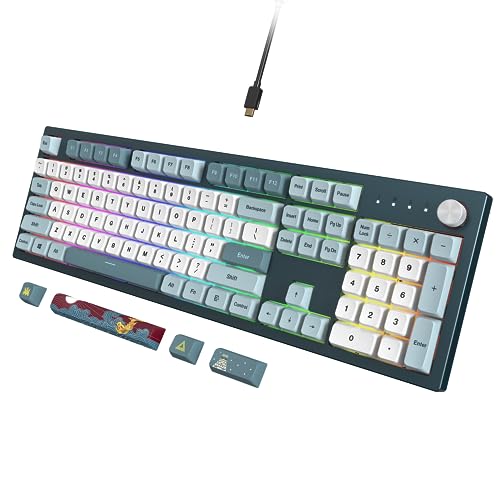
The Freedom colourway builds its identity around Osaka Castle: a palette and accent treatment inspired by the landmark, applied across the case and the keycap set so the board reads as one composed object rather than a keyboard with decorations. Themed boards live on a knife edge between character and costume, and the MKey lands, for most eyes, on the character side, because the theme is carried by colour discipline rather than by novelty caps shouting for attention. It will still dominate a minimalist desk, and buyers building a quiet workspace should look at the Darkness variant’s mood instead.
Build quality is where the case company’s accent is most audible. The board has the planted, substantial feel that flimsy debut boards lack, with a case that resists the twist test and keys that sit in a chassis tuned to sound composed rather than hollow. Weight here is a feature with the usual dual citizenship: wonderful on a fixed desk, irrelevant-to-annoying anywhere else. The full-size footprint is the other fixed fact, a board that assumes a generous desk and a user who wants the number pad’s honest utility.
Details reward inspection. The MDA profile caps, taller and more sculpted than standard OEM with a spherical top, give the board its distinctive typing topography and much of its visual softness. The legends are crisp, the accent keys carry the theme without breaking typing geography, and the overall finish standard would embarrass several established keyboard brands’ mid-range offerings. A case company was always going to get the object right; the pleasant surprise is how right it feels as an instrument, which is the subject of the next sections.
Switches and Typing Feel: Gateron Brown Pro, Pre-Lubed
The reviewed board’s Gateron G Brown Pro 2.0 switches arrive pre-lubed from the factory, and that single phrase does heavy work in the MKey’s favour. Brown switches are the classic tactile middle: a gentle bump that confirms the press without a click’s noise, suited to mixed typing and gaming in shared rooms. The Pro generation of Gateron’s line brought tighter tolerances and smoother travel than the Browns of keyboard folklore, and factory lubrication, done evenly as it is here, removes the scratch that used to be the budget tactile’s confession. The result is a board whose stock typing feel needs no apology and no immediate modification budget.
Feel across a full day is where the MDA caps join the switches in the verdict. The sculpted, spherical cap tops cup the fingertips, and the profile’s height gives the board a slightly more deliberate, typewriter-adjacent rhythm than flatter boards. Typists who live on their keyboards tend to divide into those who find MDA’s embrace comfortable and those who prefer a flatter, faster surface, and the MKey cannot be both. What can be said without fear of contradiction is that the combination is coherent: switch, cap and case were clearly chosen together, and coherence is the quality debut boards most often lack.
Gaming feel follows from the same parts. Tactile Browns will not chase the rapid-trigger flagships compared elsewhere in this series, and this review will not pretend otherwise: the MKey is a traditional mechanical board in a sensing-era market. For the broad middle of gaming, strategy, action, MMO and casual competitive play, its switches are entirely sufficient, its full layout is an asset for bindings, and its hot-swap sockets leave the door open to a linear switch set later if its owner’s games evolve toward them.
The Subject Board, Then Its Family
The review’s structure from here is deliberate: the full-size Freedom board receives the full verdict first, because it is the product the title promises. Its three relatives then receive shorter, comparative verdicts, because each is best understood as an answer to a specific objection to the subject: too big, too bright, too wired. Read the relatives as decision branches rather than as lesser boards, because for the right desk each of them is the correct MKey.

Montech MKey Freedom (Full-Size): The Reviewed Board
Review subject — full-size, tactile, Osaka Castle Freedom theme
At a glance: Full-size layout with number pad, hot-swappable Gateron G Brown Pro 2.0 pre-lubed tactile switches, MDA profile PBT keycaps, customisable RGB LED, Osaka Castle Freedom theme, wired.
As a complete package, the full-size MKey Freedom is the rare debut board with no obvious missing chapter: the switches are good and pre-lubed, the caps are PBT and characterful, the sockets accept the owner’s future experiments, the case feels like it was made by people who make cases for a living, because it was. For a first mechanical keyboard buyer who wants the number pad and likes the theme, it collapses a dozen decisions into one box, and the decisions it makes on the buyer’s behalf are, unusually, the right ones.
The reservations are structural rather than qualitative. The footprint is full-size and unapologetic. The theme is a permanent housemate. The connection is wired, the software is a debut effort beside the big brands’ mature suites, and the maker’s keyboard support story is young. None of those reservations overturns the verdict for the board’s intended buyer; all of them matter for buyers outside that intention, which is why the family below exists.
Strengths
- Pre-lubed tactile switches, smooth stock
- MDA PBT caps with real character
- Case-grade build solidity throughout
Trade-offs
- Full-size footprint needs a big desk
- Theme will not suit minimalists
- Wired only, young software ecosystem
Best for: first-board buyers who want a complete, characterful full-size keyboard. / Not suited for: small desks, minimalist setups or wireless devotees.

Montech MKey TKL Freedom: The Same Board, Tenkeyless
Family variant — for desks that objected to the size
At a glance: Tenkeyless layout, hot-swappable Gateron G Brown Pro 2.0 pre-lubed tactile switches, MDA profile PBT keycaps, customisable RGB LED, Osaka Castle Freedom theme, wired.
The TKL Freedom answers the subject board’s loudest objection by removing the number pad and nothing else that matters. The switches, caps, theme and build story carry over, and the desk gains the mouse room that gaming setups and smaller workspaces need. For most gaming-leaning buyers, this is secretly the MKey to buy: the full-size board’s completeness translated into the footprint the modern desk prefers, with the pad’s loss felt only by the genuinely number-dependent.
Judge it by the same reservations minus one: the theme remains a commitment, the wire remains a wire, and the ecosystem remains young. What changes is the audience. Where the full-size board serves the traditional desk, the TKL serves the gaming desk and the compact home office, and in those settings its combination of stock switch quality and cap quality at its tier is a genuinely competitive proposition rather than a debut’s polite excuse.
Strengths
- All the subject board’s switch quality
- Tenkeyless footprint frees the mouse
- Theme and build carried over intact
Trade-offs
- Number pad gone for data workers
- Still wired, still themed boldly
- Software ecosystem still maturing
Best for: gaming desks and compact offices that liked the MKey but not its size. / Not suited for: number-pad dependents or theme-averse minimalists.

Montech MKey TKL Darkness: The Linear, Darker Branch
Family variant — linear switches, Darkness colourway
At a glance: Tenkeyless layout, hot-swappable Gateron G Red Pro 2.0 pre-lubed linear switches, MDA profile PBT keycaps, customisable RGB LED, Osaka Castle Darkness theme, wired.
The Darkness variant changes two variables at once: the colourway turns moody, and the switches turn linear, with Gateron Red Pro switches replacing the Browns. That pairing is commercially astute, because the buyers most likely to want the darker board are also the gaming-leaning buyers most likely to want a smooth, fast, bump-free stroke for repeated presses and quiet rooms. As a branch of the family, it is the gamer’s MKey in a way the tactile Freedom boards, for all their completeness, are not quite trying to be.
The cautions mirror the changes. Linear switches punish resting fingers with accidental presses until a typist adapts, and writers who live by tactile feedback should stay with the Freedom’s Browns. The dark theme, while calmer than its sibling’s, is still a theme, with accent keys that declare the board’s identity across a room. Within those cautions, the Darkness is the family member this review would hand to a gaming-first buyer without hesitation.
Strengths
- Smooth linear switches for gaming
- Darker, calmer colourway option
- Same caps, sockets and build quality
Trade-offs
- Linear stroke divides typists
- Accidental presses while adapting
- Theme still present, just moodier
Best for: gaming-first buyers who want linear switches and a darker desk presence. / Not suited for: touch typists who rely on a tactile bump.

Montech MKey PRO: The Wireless Successor, Framed as an Alternative
Successor alternative — not the reviewed original
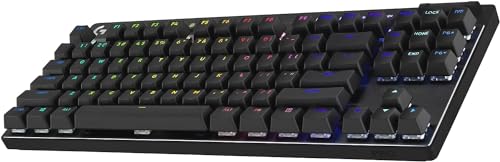
At a glance: Seventy-five percent layout, tri-mode wireless (Bluetooth 5.2, 2.4 GHz, USB-C), hot-swappable Gateron G Pro 3.0 pre-lubed switches, QMK and VIA support, Freedom Yellow colourway.
The MKey PRO is what the line became next: a seventy-five percent board with tri-mode wireless, a newer generation of Gateron Pro switches, and QMK/VIA support that moves configuration into the enthusiast mainstream. It is included in this review as the successor and the wireless alternative, explicitly not as the board under review, because a buyer reading an MKey review deserves to know the family moved, and in which direction, without the review quietly swapping its subject mid-argument.
Its existence reframes the original’s reservations as a first generation’s, several of which, the wire, the software depth, the layout choice, the PRO answers directly. Buyers choosing today should therefore decide which generation’s proposition they want: the original full-size completeness and theme, in the earlier sections, or the successor’s wireless, compact, firmware-open modernity. That is a real choice between two coherent products, and it is a credit to the case company’s second attempt that the choice is not trivial.
Strengths
- Tri-mode wireless freedom included
- QMK and VIA configuration support
- Newer switch generation fitted
Trade-offs
- A different board from the reviewed MKey
- Seventy-five percent layout density
- Theme shifts to Freedom Yellow styling
Best for: buyers who liked the MKey idea but need wireless and a compact layout. / Not suited for: buyers seeking the original full-size themed board itself.
Software, Lighting and Daily Living
The MKey’s RGB is customisable in the modern manner, per-key colour and effects under software control, and on the themed caps the lighting plays a supporting role rather than the lead, which suits the design: the board looks composed with the lights low and theatrical only when asked. Montech’s software is the honest weak point in an otherwise strong debut, functional for lighting and basic configuration but younger than the suites that Logitech, Razer and SteelSeries have refined across a decade. Buyers whose lives are lived inside macro profiles should weigh that; buyers who set a colour and type will never notice the gap.
Daily living with the board is dominated by its two fixed facts, size and wire, and by one pleasant surprise, how little it asks. There is no battery to manage, no receiver to lose, no mode to check, and the hot-swap sockets wait patiently for the owner’s first experiment, which for many MKey buyers will be a single switch swap on the arrow cluster just to prove the concept. A board that teaches its owner the hobby’s basic skills, by being safely experimentable, is worth more to a beginner than a sealed board with a longer feature list.
Buying Guide: Who Should Buy Which MKey
Start with the pad question, because it splits the family cleanly. Number-dependent work points to the full-size Freedom and ends the discussion. Everyone else should start at the TKL and choose a switch by temperament: tactile Freedom for the mixed desk and the writer-gamer, linear Darkness for the gaming-first desk and the quiet room. Then, and only then, ask the wireless question: if the answer is that a cable genuinely does not fit your life, the MKey PRO is the family’s honest answer, bought as the successor it is rather than as a variant of the original.
Budget thinking should count what the MKey includes. A buyer comparing it against cheaper boards must add the cost of the keycap upgrade and switch upgrade those boards usually need within a year, upgrades the MKey’s stock parts postpone indefinitely. Against premium boards, the MKey’s case is its software and ecosystem youth. Both comparisons are fair, and together they locate the board precisely: a completeness buy, priced in the sensible tier, whose value argument is everything in the box rather than anything in the cloud.
Setting Up and Tuning an MKey: A Short How-To
Unbox onto a desk mat, because the board’s weight and voice both prefer it. Set the lighting once, at a brightness your room respects, and configure any macros your games actually use rather than the twelve the software makes possible. Type on the stock switches for a full month before swapping anything: the pre-lubed Browns are the board’s argument for itself, and they deserve a fair hearing. When the month ends, let any experiment be small and reversible, a few switches, a cap set borrowed against the theme, and keep the original parts boxed, because a themed board’s resale and restoration value lives in its completeness.
Cleaning follows the house rules of this series: a monthly shake and brush, caps pulled and washed a few times a year, drinks at a respectful distance. The MDA caps’ sculpted tops collect the desk’s evidence more visibly than flat caps, which is the theme’s small tax, payable in thirty seconds with a brush. Owners who pay it keep a board that photographs like its first week for years, which, for a board bought partly as an object, is maintenance with a visible return.
Mistakes MKey Buyers Make
The first mistake is buying the full-size board for a gaming desk because it looks like the flagship, then discovering the number pad’s rent is paid in mouse room every evening. The second is buying any themed board, this one included, during a brief enthusiasm for its theme, because themes are marriages and the photographs that seduced you will not be the ones on your desk in month nine. The third is dismissing the board unheard because of its maker’s day job, a prejudice this review hopes the evidence has retired.
The fourth mistake is subtler: treating the PRO as an upgrade that invalidates the original. The two boards answer different desks, and the original’s full-size completeness and tactile theme remain the right answer for the buyers this review identified. Product generations in keyboards are branches more often than ladders, and the MKey family, unusually legible in its branching, is a good place to learn that lesson before it costs money elsewhere.
MDA Profile: The Keycap Decision That Shapes the Board
The MKey’s most consequential design choice may be its keycap profile, because MDA is not the safe default. It is a sculpted profile, taller than the OEM caps most boards ship with, with a spherical, dished top that centres the fingertip, closer in spirit to a typewriter’s embrace than to a gaming board’s flat urgency. On the MKey it does double duty: it carries the theme’s colours across a larger, more visible canvas, and it gives the typing a rhythm that owners tend to describe with the vocabulary of comfort rather than speed.
The trade deserves the same clarity. Tall sculpted caps raise the board’s effective height, which some wrists answer with a palm rest and others answer by choosing a different board. Gamers raised on flat profiles sometimes find the sculpting slows their lateral movement between keys until muscle memory adjusts, a week-long tax that should be budgeted honestly. And MDA sets, while increasingly available, do not enjoy the infinite aftermarket of the standard profiles, so a cap collector’s options narrow. None of this makes the choice wrong; it makes it a choice, which is what a review is for.
What redeems the gamble is coherence with the switches beneath. The Brown Pro’s gentle tactile bump and MDA’s embracing tops produce a combined feel that is more than the sum of the spec lines: deliberate, cushioned, and clearly aimed at people who type as much as they play. Boards that mix fashionable parts without that coherence feel like committees. The MKey feels like a decision, and in a debut product that coherence is the strongest available evidence that somebody at the case company actually types.
Gateron Pro Switches: Why the Choice Signals Seriousness
Switch sourcing is where debut keyboards traditionally save money and lose reviews, because a famous case and a scratchy switch produce a board nobody recommends twice. Montech instead specified Gateron’s Pro line, the generation that brought factory lubrication, tighter stem tolerances and a smoother travel to a price the mainstream could reach. The Brown and Red Pro variants across this family cover the tactile and linear temperaments with the same underlying quality, which is why the family can change switches between colourways without changing its character.
Factory lubrication deserves its own sentence of respect, because it is the invisible line item. Hand-lubing a full-size board’s switches is an evening of skilled tedium that enthusiasts perform and normal humans should never have to. A board that arrives with that evening already done, evenly, by the factory, collapses the distance between a stock board and a tuned one to nearly nothing. When reviewers call the MKey’s stock feel its headline, they are usually reporting the lube as much as the switch, and buyers comparing spec sheets should learn to read pre-lubed as the performance feature it quietly is.
The hot-swap sockets complete the switch story by making it provisional. An owner who outgrows Browns can move to a heavier tactile, a silent linear for a new job, or an exotic switch the community is excited about this season, in an afternoon, with the original switches boxed against regret. That provisionality is the modern keyboard’s core kindness, and its presence in a case company’s first board is the homework signal this review keeps returning to: the maker studied what buyers now consider non-negotiable, and negotiated nothing.
The MKey Against the Established Brands
Set the MKey beside the mainstream’s similarly tiered boards and a pattern emerges. The established brands counter with software maturity, wireless options, retail presence and support infrastructures built across decades. The MKey counters with stock part quality, caps and switches that its rivals often reserve for higher tiers or leave to the upgrade market, plus a design identity none of them would risk. Neither counter is imaginary. The choice between them is a choice about where a buyer wants their money to live: in the object on the desk, or in the organisation behind it.
For a first-board buyer, this review’s weighting favours the object, with one condition. The organisation matters most when something goes wrong, and a first board from any maker can arrive with a fault. Buy through a channel with a sane returns process, test the board comprehensively in its first week, every key, every light, the cable, the sockets with one careful switch pull, and the young-maker risk shrinks to the long-term software question, which is real but slow-moving. Due diligence is the buyer’s half of the debut-board bargain, and it is cheap.
For an enthusiast buyer, the comparison inverts in an interesting way: the MKey is not competing to be their only board but to earn a place in a rotation, and there its theme and feel are the argument, because enthusiasts buy differences, not averages. A rotation that contains three black tenkeyless boards has a gap shaped exactly like a themed full-size with sculpted caps. That is a niche, but it is a real one, and it explains why the board keeps appearing in desk photographs owned by people who demonstrably had other options.
Gaming on the MKey, Without Inflation
Gaming claims deserve the review’s coldest eye. The MKey is a traditional mechanical board: no rapid trigger, no per-key actuation, no sensing-era tricks, and its polling and switches place it in the broad competent middle where most gaming actually happens. For strategy, simulation, MMO, action and narrative games, and for the casual-competitive middle of the shooter world, it wants for nothing. Its full layout is a genuine asset in bind-heavy genres, its switches are consistent, and its weight keeps it planted during the desk’s more theatrical moments.
The honest boundary is the competitive shooter’s ceiling, where this series’ rapid-trigger guides take over the argument. A player whose matches are decided by counter-strafing precision should buy the technology built for it, and this review will not launder the MKey into that category. What the MKey offers that player instead is a second board’s virtues: a typing and general-gaming instrument for the hours outside the arena, which many serious players genuinely need and chronically underbuy, because all their budget chases the arena’s last percent.
There is also a household gaming reality the spec wars ignore: the MKey’s tactile and linear options are both civilised in shared rooms, its theme delights younger players without embarrassing adults, and its completeness means a family buying one board for a shared gaming PC will not be shopping again by spring. Versatility across a household is a performance metric no benchmark prints, and the MKey scores on it the way it scores on most unprinted metrics: by having been designed as an object for a real desk rather than as an argument in a forum.
Value, Counted Properly
The MKey’s value case is an accounting exercise. Price the board, then price the upgrades its rivals’ stock parts usually provoke within a year: a PBT keycap set to replace thin stock caps, a switch set or an evening of lubing to fix scratch, a desk mat to settle a hollow case. The MKey’s stock completeness deletes most of that second basket. Against boards that ship complete, the flagships with PBT and good switches fitted, the MKey’s case rests on tier and theme instead. Both accountings are legitimate; a buyer should simply know which one they are performing.
Themed boards carry one more accounting line, resale shape. A neutral board sells to anyone; a themed board sells to someone who shares the taste, which narrows the pool and can either slow the sale or, when the theme is beloved and the run has ended, support the price surprisingly. The MKey’s theme is distinctive enough to live on that knife edge. Buyers who rotate gear quickly should weigh it; buyers who keep boards for years can ignore it, because a decade of use pays for any resale shape several times over in the only currency that compounds, which is daily satisfaction.
Who the MKey Is Not For
Wireless-first buyers, small-desk minimalists, competitive-shooter specialists and theme-averse traditionalists should all pass, and this review has tried to give each of them their reason early rather than at the checkout. A review that cannot name its product’s wrong audiences is an advertisement with footnotes. The MKey’s wrong audiences are easy to name precisely because the board’s identity is clear, and clarity, in a debut product, is itself a form of respect for the buyer that this review is happy to reciprocate.
There is one more wrong audience worth a sentence: the buyer who needs their keyboard purchase to be a community identity. Established brands and custom makers both offer tribes to join, with forums, discords and shared vocabularies. A case company’s keyboard line offers a product, not yet a tribe. Owners who buy for the object will be content; owners who buy for belonging should buy where the belonging is, and this series’ communities guide will show them the doors.
Acoustics and Stabilisers: The Debut Board’s Hardest Test
A keyboard’s sound is its fingerprint, and debut boards usually arrive with somebody else’s: a hollow case voice borrowed from thin plastic and hope. The MKey’s case discipline shows here, because its voice is composed, a mid-toned, settled sound with the theme’s caps adding their sculpted softness, rather than the ping and rattle symphony that gives away a rushed first product. It is not a tuned custom board’s voice, and this review will not promote it into that class, but it sits comfortably in the company of established mid-tier boards, which is exactly where a debut has no right to expect to sit.
Stabilisers carry the second half of the acoustic verdict. The spacebar, shift and enter keys are where cheap engineering announces itself thousands of times a day, and the MKey’s wide keys behave with the levelness and quietude that suggest the boring work, wire balancing, housing fit, lubrication, was actually done. Owners can still tune further, because the board is hot-swappable and open, but the distance between stock and good is short here, and short distances are what separate considered products from assembled ones.
Roommates and microphones get the practical translation: the board records cleanly for calls and streams at ordinary gain, without the metallic edge that forces processing, and it will not dominate a shared room’s soundscape the way a clicky board does. In the hierarchy of household diplomacy, the MKey is a neutral neighbour, audible as a keyboard and forgettable as a noise, which for most desks is the precise ambition worth having.
The Family at a Glance
| Model | Layout | Switches in listing | Connection | Choose it when |
|---|---|---|---|---|
| MKey Freedom (reviewed) | Full-size | Gateron Brown Pro 2.0 tactile | Wired | You want the complete themed original with a number pad |
| MKey TKL Freedom | Tenkeyless | Gateron Brown Pro 2.0 tactile | Wired | You want the same board with mouse room instead of a pad |
| MKey TKL Darkness | Tenkeyless | Gateron Red Pro 2.0 linear | Wired | You game first and prefer a smooth stroke and darker theme |
| MKey PRO | 75 percent | Gateron Pro 3.0 pre-lubed | Tri-mode wireless | You need wireless and modern firmware in the line’s successor |
Tables flatten what reviews complicate, so let the complication stand beside it: the four boards share caps, sockets and build philosophy, and differ exactly where a desk differs, in size, switch temperament and connection. A buyer who has answered those three questions about their own desk can read their board off this table in one pass. A buyer who has not will find the table useless, which is the table’s honest way of restating this review’s method: the desk decides first, and the catalogue merely obeys.
The Support Watch-List: What to Monitor After Buying
Because the maker is young in this category, an MKey owner’s rational homework continues after purchase in three small ways. Watch the software’s update cadence for a season; a living suite gets attention, and attention is the support promise made visible. Register the product and keep the purchase record where the household keeps such things, because a young line’s warranty processes reward documented owners. And join whatever owner community exists, however small, because in a young category the community’s accumulated fixes are a genuine part of the support product.
None of that homework is a burden unique to Montech; it is the standard price of buying early into any maker’s new category, from boutique to conglomerate spin-off. The MKey’s distinction is that its hardware gives the homework time to pay off: a board built this solidly will still be on the desk when the software story has finished telling itself, one way or the other. Durability is a form of insurance against a maker’s uncertainty, and it may be the case company’s most transferable skill of all.
And if the worst arrives and the line is abandoned someday, the board’s open standards limit the damage in a way sealed products cannot match: standard switches, standard caps, standard cable, firmware needs that are modest because the board’s ambitions are modest. An orphaned MKey would remain a good keyboard. That is the final, unfashionable virtue of the traditional design this review has described, and it deserves to close the supplement: in a market of platforms, the MKey is an appliance, and appliances outlive platforms with a regularity the industry finds embarrassing.
Deep Dive: What a Case Company Teaches the Keyboard Industry
The case-company angle deserves one more examination, because it generalises. PC cases and keyboards are the two products a computer user touches and sees constantly while thinking about neither, and both are judged by a subconscious standard of solidity that specification sheets cannot capture. Montech’s decade of passing that judgement in cases is not irrelevant experience carried into keyboards; it is the central experience, and the MKey’s reception suggests the keyboard industry knew it, because nobody in the community seemed surprised for long that the board felt well made.
There is a risk narrative to balance the compliment: case companies diversify constantly, and not every diversification survives its second generation. The MKey family’s own development, a coherent TKL branch, a considered colourway variant, a wireless successor with enthusiast firmware, reads as commitment rather than dabbling, and commitment is the evidence available. Buyers are not asked to trust the company’s soul; they are asked to read its behaviour, and its behaviour so far is that of a maker building a line, not testing a fad.
The Osaka Castle theme, finally, is worth defending as strategy. A debut board from an unknown keyboard maker needs a memory hook, and a disciplined theme gives reviewers, photographers and owners something to say that a black rectangle does not. The risk is alienating minimalists; the reward is that everyone who has seen the board remembers it. In a market releasing competent black rectangles weekly, memorability is not vanity. It is distribution, earned at the design desk instead of the advertising budget.
Owners comparing the MKey against the established brands’ boards at similar tiers should run one specific test in a shop if they can: the spacebar. Press it at its edges, listen for rattle, feel for the wobble that betrays cheap stabilisers. Debut boards fail that test constantly, and it is the test the MKey’s homework most visibly passes. A maker that gets stabilisers right on its first keyboard has listened to the community’s complaints in the correct order, and that listening, more than any single specification, is the review’s deepest ground for confidence.
One test this review wishes every buyer could run is the week-two test: not how the board feels on the exciting first evening, but how it feels on an ordinary Tuesday when the theme is furniture, the switches are infrastructure and the only question is whether the desk works. The MKey was clearly designed by people imagining Tuesdays, its solidity, its completeness, its lack of needy features, and boards designed for Tuesdays are the ones still on desks when the exciting purchases have been resold. Judge it there, and it judges very well.
A closing observation about debut products generally: the first generation of anything is a maker’s hypothesis, and the second is its argument. Montech has already published its argument in the PRO, which means MKey buyers are not betting on a hypothesis anymore; they are choosing between two statements of intent. That is an unusually comfortable position for a young line’s customers, and it is the final reason this review’s verdict is warmer than its scepticism expected to be when the box, from a case company, first arrived.
Presentation, the unboxing and the object’s first impression, is the last case-company tell worth recording. PC case buyers judge a maker’s care by its packaging, its cable management and its finish consistency before the product is ever powered, and Montech’s keyboard arrives with that same care visible. It proves nothing about the board’s third year, and it predicts a surprising amount about its first week, because companies that sweat presentation rarely forgot the stabilisers. First impressions are data, provided they are filed as impressions and not as verdicts.
One audience has not been addressed directly: the PC builder who already owns the maker’s case and feels the pull of a matching desk. Brand coherence across a setup is a real pleasure, and there is no shame in weighing it, provided the keyboard earns its place on the object’s merits first. The MKey does earn it, which makes the matching-set pleasure an honest bonus rather than a loyalty tax. Buy the board because the review’s evidence persuaded you, and let the logo’s rhyme with your tower be the desk’s small private joke.
And the review’s last word returns to its first: the question was whether a case company could make a keyboard, and the evidence says the question was miscast. The skills were never really about cases; they were about making a metal box that a person touches daily feel considered, and keyboards are simply the most touched metal boxes in the building. Montech’s debut succeeds because its maker understood its own skill correctly. The industry should expect more such crossings, and buyers should judge each by the MKey standard: homework visible in the parts, coherence audible in the sound, and honesty about what the new maker has not yet proven.
If a single sentence must carry the recommendation to a skimming reader, it is this: the MKey is the first keyboard this reviewer could hand to a beginner, a household or a themed-desk enthusiast without a paragraph of caveats attached, and the caveats it does carry, size, wire, theme and a young maker, are all visible from across the room before money moves. Products whose flaws are visible and whose virtues are audible tend to age well in their owners’ esteem, and everything in this family’s short history suggests the MKey will be keeping that kind of company.
Buy it for the desk you have, in the size that desk can prove, and the case company’s unlikely keyboard will do the rest quietly, completely, and for a long time.
Final Verdict
The MKey earns its review’s premise: a PC case company made a keyboard, and the keyboard is good, complete, characterful and honestly priced in its tier, with a young software ecosystem as its main reservation and its maker’s youth in the category as its framed risk. Buy the full-size Freedom for the traditional desk, the TKL in your switch for the gaming desk, and consider the PRO when wireless is the requirement. The joke about the case company survives the review, but as a compliment: it turns out cases were a fine place to learn how to build the box your fingers live on.
Related Guides Worth Your Time
- the keyboard sound guide
- the mechanical keyboard buyers guide
- 75 mechanical keyboards
- gasket mount vs top mount
Montech Mkey Review A Keyboard Made By A Pc Case Company: Frequently Asked Questions
Is the Montech MKey a good first mechanical keyboard?
Yes, for buyers whose desks fit it. It arrives complete, with pre-lubed switches that need no immediate upgrade, quality PBT caps, hot-swap sockets for future experiments and a full layout that asks no compromises of work software. Its cautions are size, theme and wire, all visible before purchase. A first-time buyer who accepts those three facts gets one of the most complete starter packages in its tier, from a maker whose day job is building the boxes computers live in.
What is the difference between the MKey Freedom and Darkness versions?
Two things: the colourway and the switches. Freedom boards wear the lighter Osaka Castle presentation and, in the versions reviewed here, tactile Gateron Brown Pro switches. The Darkness TKL wears the darker presentation with linear Gateron Red Pro switches for a smoother, faster, quieter stroke. Choose by desk mood and by finger temperament together, because in this family the colour and the switch arrive as one decision.
Should I buy the original MKey or the MKey PRO?
They are different boards for different desks, and this review frames the PRO as the successor and alternative, not as the reviewed product. The original offers full-size or TKL wired completeness with the Osaka Castle themes. The PRO offers a compact seventy-five percent layout, tri-mode wireless and QMK/VIA configuration. Buy the original for its completeness and character at a fixed desk; buy the PRO when wireless and compactness are requirements rather than preferences.
Are the MKey’s switches hot-swappable, and why does it matter?
Yes, the MKey line’s boards use hot-swappable sockets, so switches can be pulled and replaced without soldering. It matters because it converts the board’s feel from a permanent factory decision into an experiment the owner controls: a failed switch is a two-minute repair, a curiosity about linear switches is a small purchase rather than a new keyboard, and the board stays relevant as its owner’s taste develops. For a debut board from a new maker, it is also a reassuring sign of homework done.
Is Montech’s lack of keyboard history a reason to avoid the MKey?
It is a reason to price the risk honestly, not to avoid the board. The hardware evidence is strong: sound switch and cap choices, case-grade build, and a family that developed coherently into a wireless successor. The open questions are about long-term software attention and category commitment, which no review can settle in a launch era. Buyers who need a decade of proven support should pay a premium brand for it; buyers who judge the object in front of them will find the object persuasive.
How loud is the MKey for a shared room or office?
The tactile Freedom versions are moderate: a defined mechanical voice softened by the board’s solid case and quality caps, audible in a quiet room without being a clicky board’s announcement. The linear Darkness is quieter still. Neither is a silent product, and a truly noise-sensitive office should consider silent-switch boards instead, several of which appear elsewhere in this series. For ordinary homes and home offices, the MKey’s volume is unremarkable in the good sense.