Affiliate disclosure: this article contains affiliate links. If you buy through a link on kajuandouglas.com, the site may earn a commission at no extra cost to you.
This keyboard sound thock clack guide maps the spectrum along which every mechanical keyboard’s voice is placed, named for the two sounds that anchor its ends. Thock is the deep, rounded, low-pitched voice — a keystroke that lands like a knuckle on a wooden door. Clack is its bright counterpart — higher, sharper, crisper, a keystroke with edges. Between them lies the whole geography of keyboard acoustics, and nearly every tuning decision in this cluster — switches, keycaps, plates, foam, tape — is a journey along this single axis, whether its maker knows it or not. Owners argue about the ends with religious feeling; the guide’s position is that the spectrum is a map, not a morality, and that knowing where your board sits and how to move it is worth more than any verdict about where it should sit.
The guide proceeds from the physics of what makes a board deep or bright, through each component’s directional pull — switches first, as the voice’s source, then keycaps, plates, cases and the damping treatments — to the practical art of steering a real board toward a chosen register without wrecking what it already does well. Verified components at both ends of the spectrum are reviewed in the middle. The closing sections give two steering recipes (toward thock, toward clack), the mistakes that push boards off both ends into mere noise or mere dullness, and the questions that arise whenever a recording starts an argument.
Key takeaways
Thock = low pitch, rounded attack, short sustain; clack = high pitch, sharp attack, lively sustain. Deepen with: softer/deeper switches, thick PBT or tall keycaps, polycarbonate or brass plates, foam and tape, a mat. Brighten with: crisp tactile or clicky switches, thinner or ABS caps, aluminium or steel plates, less damping. Every component nudges; the case and switches set the range. Aim for a register, not a recording — your room finishes the voicing.
In this guide
The Physics of Deep and Bright
A keystroke’s sound is a small percussion event with three contributors: the switch’s internal impacts (stem against housing, bottom-out and return), the assembly’s resonance (plate and PCB passing the energy to the case), and the case cavity’s colouration of everything it receives. Pitch — the spectrum’s axis — is set mostly by the sizes and stiffnesses involved: larger, softer, more massive structures speak lower; smaller, stiffer, lighter ones speak higher. This is why deepening a board so often means adding softness or mass somewhere, and brightening means removing damping or stiffening a component. The vocabulary of the keyboard sound test guide — pitch, attack, sustain, cleanliness — describes any point on the spectrum precisely, and this guide assumes it throughout.
Attack is the spectrum’s second dimension and the one that separates pleasant clack from harsh noise: a bright board with a clean, quick attack sounds crisp and alive, while the same pitch with a messy attack — stabiliser ticks, case rattle, spring ping riding on top — sounds cheap. Sustain is the third: thock’s signature is partly its brevity, the sound ending almost as it begins, while clack tolerates a livelier tail. The practical moral is that steering along the spectrum is a three-knob job disguised as a one-knob job, and boards pushed toward an end without attention to attack and sustain arrive as caricatures — mud at one end, tin at the other. The recipes later in this guide are built to move all three knobs in the right proportions.
One physical fact disciplines the whole subject: the case and the switches set the board’s available range, and everything else moves within it. A thin, hollow plastic case cannot be foamed into the deepest register a machined aluminium case reaches natively, and a clicky switch will not thock under any keycap yet made. Steering is therefore partly shopping — choosing components whose ranges overlap your target — and the guide’s component survey is organised to make those ranges legible, so the steering recipes can be honest about when they are tuning and when they are advising a different board.
The Components’ Pulls, in Order of Strength
Switches pull hardest, because they are the sound’s source. Deep-voiced switches share traits: longer stem poles that strike earlier and lower, housings in softer or fuller materials, factory lubrication that rounds the attack, and springs whose return is governed rather than ringing — the how to fix keyboard spring ping noise guide’s quiet springs are thock’s allies by construction. Bright switches invert the traits: crisp tactile events or deliberate click mechanisms, harder housing materials, lighter lubrication. The families beneath the traits matter less than the traits themselves, which is why a switch’s recording in a known board — per the test guide’s anchored method — predicts its direction in yours better than its marketing category does.
Keycaps pull second, by mass and by material: thick PBT and tall profiles (SA above all) add the mass that lowers pitch and rounds attack, while thin caps and ABS keep the voice bright and immediate — the keycap profiles explained guide in this cluster details the geometry, and the how to remove replace keyboard keys guide handles the swapping. Plates pull third, per their own guide in this cluster: polycarbonate and brass deepen and soften, aluminium holds the bright reference, steel sharpens. Cases and their cavities set the stage all of this performs on — the keyboard cases guide materials types survey — and the damping treatments (foam, tape, pads) pull consistently toward the deep and quiet end, with the over-damping cliff at their extreme that the keyboard foam types guide warns against by name.
The desk finishes the list because it is part of the instrument: a mat deepens and focuses every board placed on it, a bare resonant desk brightens and amplifies. The ordering of this survey is the steering method’s skeleton — strongest pulls first, each verified by recording before the next is bought — and its lesson is that a board’s register is a sum of perhaps six decisions, no one of which is destiny. Owners who feel trapped at the wrong end of the spectrum are usually one or two decisions away from their register, and the recipes below are written for exactly their boards.
The Ends Defended: What Each Register Is For
A guide that maps a spectrum owes both ends their honest defence, because the hobby’s discourse often treats thock as maturity and clack as a phase — a prejudice this guide declines to ratify. Thock’s case: it is the register of quiet rooms and long sessions, unobtrusive at conversational distance, kind to microphones and colleagues, and possessed of a physical, wooden satisfaction that its devotees experience as the board sounding expensive. Its failure mode is dullness — the over-governed board whose keystrokes have been padded into upholstery — and its social virtue is real: a deep board can be typed on during a call, in a shared office, beside a sleeping household, without negotiation.
Clack’s case is equally genuine: it is the register of feedback and liveliness, where every keystroke announces itself crisply and the typist’s rhythm is audible as music to exactly the ears that love it. Bright boards feel responsive in a way that has nothing to do with latency — the attack’s sharpness is information, and fast typists in solitary rooms often type better accompanied by it. Its failure mode is harshness, the messy attack and ringing sustain that turn brightness into noise, and its social cost is the mirror of thock’s virtue. Neither end is the hobby’s destination; both are its homelands, and the mature position — the one this guide is written from — is that a board should sit where its owner’s room, work and ears agree it should, and be steered there deliberately rather than apologised for.
The middle deserves its sentence too: a large population of beloved boards lives mid-spectrum, moderately deep, moderately bright, chosen by owners who optimised for neither pole and got balance instead. The spectrum is a map of possibilities, not a ladder, and the middle is not a failure to commit. Steering, in the recipes that follow, means moving toward your register — which may be an end, or may be the exact centre, defended with the same deliberateness.
Keyboard Sound Thock Clack Guide: The Shortlist
Verified components chosen as steering instruments: a deep-voiced switch set and a tall keycap set for the journey toward thock, a crisp switch option for the bright end, and the tape that fine-tunes any board’s register. The components in these recipes were checked, one at a time, against the site’s verified Amazon listings.

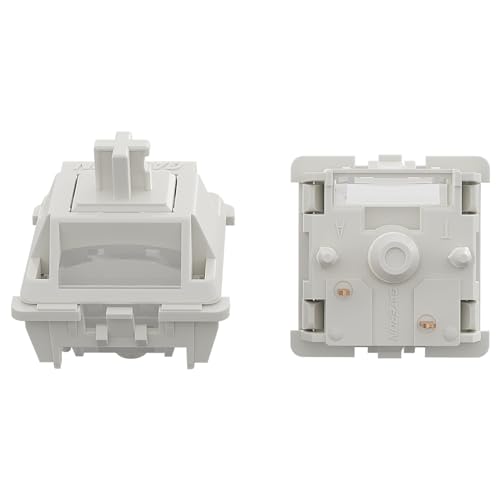
Gateron Smoothie Switches
Toward thock: the source
- Linear switches, factory pre-lubed
- Milky housings for a deeper voice
- Medium spring weight
- Full-board packs
This set is the deep end’s most accessible source component: a smooth linear whose milky housing and factory lubrication produce the rounded attack and low register that thock recipes are built on, at a price that lets a whole board change its voice’s source in one purchase. In the component ordering of this guide it is the strongest single pull most boards can buy, and its popularity in deep-voiced builds is the market agreeing with the physics: soften and deepen at the source, and every downstream component’s job gets easier.
Its direction is unambiguous, which cuts both ways: owners steering toward brightness should not buy it, and owners mid-spectrum should know it pulls with real strength. Paired with the tall caps below it can overshoot a moderate target into dullness if the board was already damped — the recipes’ one-variable discipline exists for exactly this combination. As the thock journey’s first step, though, it is the correct first step for the majority of boards.
Strengths
- Strong, reliable pull toward the deep register
- Smooth and pre-lubed from the factory
- Value price for a full board’s voice change
Trade-offs
- Linear feel is part of the purchase
- Can overshoot when stacked with other deep pulls
- Milky housing dims shine-through lighting
Best for: Boards beginning the journey toward thock.
Not suited for: Brightness seekers and tactile loyalists.
SA-Profile Keycap Set
Toward thock: the mass
- Tall, sculpted SA profile
- Thick caps, deep sound signature
- Uniform row sculpt
- Full kits for common layouts
Keycap mass is the second pull, and SA is its maximum expression: tall, thick, sculpted caps that lower a board’s pitch and round its attack more than any other cap change, while giving the fingers a cupped, deliberate typing surface. In thock recipes it is the step that makes the register change visible as well as audible — the board looks deeper, in a sense the community’s photographs understand instinctively. Its pairing with deep switches is the classic recipe’s core, and its pairing with an already-soft board is the classic overshoot, which the mistakes section itemises.
The profile’s other terms from the replacement guide apply unchanged: height that wrists must approve, a fortnight’s adjustment, kit coverage to be censused. Buyers whose target is a moderate deepening should consider the Cherry-profile PBT set as the gentler dose of the same medicine. Buyers whose target is the deep end itself will find no cap that pulls harder in the right direction.
Strengths
- The strongest keycap pull toward thock
- Sculpt and mass transform feel as well
- Uniform rows simplify fitting
Trade-offs
- Height challenges some wrists
- Premium pricing
- Overshoot risk on damped boards
Best for: Committed deep-register builds.
Not suited for: Low-profile devotees and moderate targets.
Akko Cream Yellow Pro Switches
The middle path’s switch
- Linear switches, factory lubrication
- Cream-series voicing: deep but defined
- Standard MX pins
- Multi-packs for full boards
Akko’s Cream line occupies the spectrum’s interesting middle with intent: switches voiced deeper and softer than the bright mainstream but with their attack kept defined — the recipe for owners whose target is ‘thock-leaning, not thock’ or whose board needs its source pulled one notch rather than three. Including a middle option in a two-ended guide is a deliberate editorial act: most real steering jobs are nudges, and the components that nudge reliably are worth more to most owners than the components that shove.
As with every switch here, the anchored recording is the evidence and the feel is part of the purchase — these are linears, smooth and factory-tuned, and their constituency is the owner who wants the voice changed without the typing’s character being renegotiated. In a board already brightened by a steel plate or thin caps, they are also the counterweight purchase: one strong-ish pull toward centre, restoring the balance the other components spent.
Strengths
- Calibrated middle pull
- Defined attack survives the deepening
- Factory-tuned consistency
Trade-offs
- Neither end’s full character
- Linear only
- Direction depends on the board it joins
Best for: Nudge-sized steering jobs and balance restoration.
Not suited for: Owners committed to either pole.
ScotchBlue Painter’s Tape
The fine adjustment
- Paper painter’s tape, clean-release
- Applied to the PCB’s back in layers
- Deepens and focuses any board
- Fully reversible
Tape is the spectrum’s vernier: the adjustment fine enough to land a board on its exact register after the large components have done their work. Its pull is reliably toward depth and focus — the cavity’s bright reflections absorbed, the fundamental left standing — and its dose is measured in layers, each verified by recording per its own guide in this cluster. For the owner whose board sits one notch too bright, it is the cheapest notch in the hobby; for the owner at the deep end, it is the tool that must be refused, because the vernier only turns one way.
Its inclusion among purchasable picks, in a guide whose other instruments cost real money, is the spectrum’s best economic news: the final adjustment of a board’s voice costs a roll of tape and an evening. Buy the correct tape (painter’s, fresh, per the mod guide’s specification), keep the baseline recording, and stop when the register matches the target you named before the case was opened.
Strengths
- Finest-grained steering available
- Costs almost nothing
- Completely reversible
Trade-offs
- Pulls only toward depth
- Requires opening the board
- Easy to over-apply past the target
Best for: Final register adjustments on any board.
Not suited for: Boards already at or past the deep target.

Gateron Milky Yellow Pro V2 Switches
Toward thock: the warm linear
- Linear switches, 5-pin, factory pre-lubed
- Milky housing for a softer, diffused voice
- 50 gf spring weight
- 72-piece pack
Where the Smoothie above is the polished modern route downward, the Milky Yellow family is the classic one — the switch a generation of deep-voiced builds was tuned around. Its milky housing takes the edge off the bottom-out’s report, softening the attack into the rounded knock the thock recipes chase, and the V2 revision arrives pre-lubed to a consistency earlier versions made owners achieve by hand. The medium 50 gf spring keeps the sound’s body without turning long sessions into exercise. In spectrum terms it pulls a board firmly toward the deep end at the source, which is exactly where this guide says steering should start — and its warmth pairs with tall caps and foam without the dullness that stacking too many soft components can bring.
Strengths
- A proven deep-register voice at the source
- Factory lube saves an evening of work
- Warmth without the mid-spectrum muddle
Trade-offs
- Milky housings mute RGB shine-through
- 72 pieces leaves full-size boards a few short
- Its pull is strong — mid-spectrum targets, beware
Best for: Boards steering toward thock on a sane budget.
Not suited for: Clack devotees and shine-through showcases.
Recipe One: Steering Toward Thock
Begin with the baseline recording and the desk: the mat goes down first, because it is free depth that every later judgement assumes. Then the source: a deep-voiced switch set, installed and recorded, given a day of typing — on many boards this single step lands the register, and the recipe’s discipline is to stop there if it has. If more is wanted, the keycaps pull next (thick PBT for a dose, SA for the full measure), then the cavity: case foam fitted, tape in layers, each recorded, with the over-damping cliff watched for in every take — the moment the attack starts to smear, the last layer was the cliff’s edge and it comes back off. The plate, if the platform allows, is the recipe’s final and most expensive pull, polycarbonate for softness or brass for depth-with-mass.
At each step the recipe asks the same question the sound test guide taught: is the register reached? Thock achieved is a board that sounds deep, rounds its attack, ends its notes quickly and — the check owners forget — still sounds like typing rather than like furniture. The recipe’s success rate is high because its order respects the components’ strengths and its stopping rule respects the target. Boards that overshoot are not failures of the recipe but of its final clause, and the reversal path is the recipe read backwards, one layer at a time.
Recipe Two: Steering Toward Clack
Brightening is subtraction before it is addition, because most boards carry damping they never chose. Begin by removing what the deep era added by default: case foam thinned or removed (recorded, as ever), tape absent, pads out — and many boards discover a brighter native voice under their factory padding. The source comes next: a crisp switch — a defined tactile or, for the committed, a clicky — restores the attack’s edge at its origin. Keycaps lighten the pull: thinner caps, ABS for its immediacy, lower profiles that keep the voice quick. The plate, where swappable, goes aluminium for the reference brightness or steel for the sharp end, and the desk surrenders its mat only if the owner is certain — the mat’s other virtues usually argue for keeping it and letting the board itself supply the brightness.
The bright recipe’s cliff is harshness, and its symptoms are the messy attack and the ringing sustain: stabilisers untuned, springs singing, the case’s high frequencies ungoverned. The paradox of good clack is that it needs governance as much as thock does — clean, not damped; the tick and rattle removed so the crispness can stand alone. Owners who brighten by merely stripping arrive at noise and conclude the register is cheap; owners who brighten by cleaning arrive at the bright end’s real character, which is precision. The register deserves the same craftsmanship as its opposite, and this recipe is written in that belief.
The Spectrum in Practice: Grading Your Own Board
The main guide maps the thock-clack spectrum abstractly; this expansion hands the reader the grading instrument, because a spectrum is only useful if you can place your own board on it. The grading session takes ten minutes and the sound test ritual from this cluster: record the test sentence, then listen for the four coordinates separately. Pitch first — the voice’s centre of gravity, judged by the spacebar’s note against the alphas’. Attack second — whether each keystroke begins with a tick, a thud or a rounded onset. Sustain third — how long the case speaks after the keystroke’s event, the echo that separates a governed board from a hollow one. Cleanliness last — the absence of the uninvited: ping, rattle, spring noise, the sounds that belong to no register and spoil both. A board placed on those four coordinates has been graded, and every recipe decision that follows is arithmetic on its position.
The grading’s value is that it converts taste into a vector. ‘I want it deeper’ becomes ‘lower the pitch and round the attack, keep the sustain short’ — a specification that components can be chosen against, in the order of leverage the main guide teaches. Owners who skip the grading buy ingredients for a direction they have not measured and arrive, expensively, at boards that are different without being closer. The keyboard sound test guide‘s archive doctrine applies with its full force: grade before the first change, file the recording, and let every subsequent change be graded against the baseline rather than against the memory of it, because the memory of a sound is the least reliable instrument in the entire hobby.
And the grading has a social use: it is the vocabulary in which help can be asked for and given. The owner who posts ‘my board is high-pitched with a ticky attack and a long sustain, and I want the pitch down without touching the attack’ will receive the community’s precision in return — specific switches, a plate, a foam dose — while the owner who posts ‘make it thock’ receives the recipe of the week, which was written for a different board’s coordinates. Precision is contagious in technical communities; the graded question is the one that gets the graded answer, and the ten minutes at the microphone are the tuition for a lifetime of better answers.
Recipes, Read as Vectors
The community’s famous recipes — the switch-and-foam combinations with names and followings — deserve a reading method rather than either obedience or dismissal. A recipe is a vector recorded on someone else’s board: it moved their coordinates in a direction, by an amount their system determined. Transplanted to your board, the same ingredients will move your coordinates in a similar direction and a different amount, because your starting position and your system’s other components differ. The recipe’s transferable content is therefore its direction and its ordering — which ingredient pulled hardest, which was the seasoning — and its non-transferable content is its result, which belonged to a board you do not own. Read recipes the way sailors read other ships’ logs: for the weather’s direction, never for your own position.
This reading rehabilitates the recipe genre, which deserves it: the recipes are the community’s experimental record, thousands of builds’ worth of vectors, and an owner who reads them as vectors owns a research library. The discipline is to extract, for each recipe, the board it started from (its coordinates, insofar as the author graded them), the ingredients in their order of application, and the author’s own before-and-after evidence. Recipes that report all three are science in folk dress. Recipes that report only the result — the recording, the adjective — are advertising for a direction, and should be weighted accordingly. The advanced keyboard modding techniques guide on this site treats recipe literacy as an advanced skill; this guide’s position is that it is a basic one, mispriced by its late appearance in most owners’ educations.
And the recipe’s last lesson is about your own future publications: when your build lands, report it as a vector — starting coordinates, ingredients in order, evidence — and your log becomes part of the library rather than the noise. The hobby’s knowledge compounds exactly at the rate its members report honestly, and the thock-clack spectrum, which exists only as a shared map of private experiences, is the purest example: every graded report sharpens it, every bare adjective blurs it. Contribute coordinates. The map is the community’s real product, and it is drawn one honest build at a time.
The Room, the Desk and the Mat: The Spectrum’s Silent Partners
No board sounds like itself in the abstract; it sounds like itself in a room, on a desk, over a mat — and the partners’ contributions are large enough to reorder the spectrum’s judgements if ignored. The mat is the first partner: it absorbs the desk’s drum and lowers every board’s apparent pitch by removing the surface’s bright reflection, which is why the same board sounds deeper in every recording made on a mat and why the mat is the cheapest pitch control in this entire guide — cheaper than any switch, and applied to every board the desk will ever host. The desk is the second: its material and hollowness set the resonance the board plays into, glass and hollow laminate brightening, solid wood governing. The room is the third: its size and furnishings set the sustain’s tail, bare walls lengthening what foam worked to shorten.
The partners explain the spectrum’s most common disappointment: the board bought for its recorded voice that arrives speaking a different one. The recording’s partners were the creator’s; the buyer’s partners re-voice the board on arrival, and the difference is routinely blamed on the board, the seller or the recipe — anywhere but the furniture, where it lives. The defence is the grading discipline applied at home: grade your board with your partners, tune it against your partners, and when a partner changes — a new desk, a move, the mat’s replacement — expect the voice to change with it and re-grade before re-tuning. Owners who internalise the partners stop chasing a voice across purchases, because they have learned the voice’s address: it lives in the system, and the system includes the room.
There is a strategic consequence for buyers: spend on the partners before spending on the board’s voice, when the partners are ungoverned. A mat and a governed desk will deepen and clean every board you ever own; a thock-tuned board on a glass desk in a bare room is an ingredient fighting its kitchen. The order of operations across this cluster is always the same — the environment, the platform, the components — and the spectrum’s silent partners are why. Tune the room’s contribution first; it is the only component that serves every board, every day, at no marginal cost per keystroke.
Clack’s Defence: The Bright Register Taken Seriously
A guide to the spectrum owes its bright end the respect of a real defence, because clack’s pleasures are genuine and its marginalisation is a fashion, not a finding. The bright register’s first virtue is information: a crisp attack is a confirmation the ear can grade at speed, and fast typists who navigate by sound — hearing their errors as they make them — are served by a voice that reports each keystroke distinctly rather than blending them into a murmur. Its second virtue is energy: bright boards sound awake, and the subjective effect on a working session is not nothing — the desk’s soundscape is part of its morale, and some workers think better in a bright room, acoustically as well as visually. Its third virtue is honesty about materials: the bright register is what aluminium, steel and tight tolerances naturally say, and a build culture that prizes engineering crispness will hear its own values in the voice.
The bright register also has the spectrum’s best ageing story. Deep builds depend on damping materials that compress, dry and drift — their voice is a maintained state. Bright builds depend on structure — metal, fit, the switch’s own voice — and structure holds its register across a decade with no maintenance at all. The owner who chooses clack is choosing the voice that time cannot take, and in a hobby whose deep end requires a service calendar, that is a serious argument, rarely made because the fashion has no patience for it. This guide makes it: the spectrum has two living ends, and the bright one is the more durable address.
And clack’s defence ends with the spectrum’s deepest truth: the registers are not ranks. The community’s vocabulary — thock as the compliment, clack as the apology — is a decade’s fashion crystallised into adjectives, and fashions in sound reverse like fashions in everything; the bright, snappy boards of the hobby’s early decades were its prestige objects, and their grandchildren are being rediscovered by a generation that finds the deep end’s uniformity airless. Buy the register your ears, your room and your work prefer, grade it honestly, and let the vocabulary catch up in its own time. The spectrum is a map, not a league table, and every coordinate on it is somebody’s home.
When the Voice Is the Problem: A Diagnostic Order
Most readers arrive at this guide with a board whose voice displeases them in a way they cannot yet name, and this section gives the displeasure a diagnostic order, because the unnamed complaint is the expensive one — it gets treated with purchases. First, grade the board: the four coordinates, recorded. Second, name the delta: which coordinate is wrong, and in which direction — pitch too high, attack too ticky, sustain too long, cleanliness spoiled by one named sound. Third, locate the delta’s address in the component map: the sustain lives in the case and its foam; the attack in the switches and plate; a cleanliness fault in a single component that can be named — the pinging spring, the rattling bar. Fourth, treat the address with the cheapest effective intervention, one at a time, graded by recording. The order is the whole method, and its steps are deliberately boring, because the alternative — the recipe bought whole, the board rebuilt on a hunch — is how owners spend a board’s price learning which coordinate they disliked.
The diagnostic order has a step zero that deserves emphasis: live with the board for a fortnight first. A new board’s voice is vivid partly because it is new — the ear attends, the comparisons are fresh — and a share of voice complaints are the novelty wearing off in the wrong direction, cured by the same fortnight that cures the layout’s strangeness. The how to fix keyboard spring ping noise guide builds the same delay into its ladder for the same reason. Treat the voice that survives the fortnight; forgive the one that doesn’t, and save the money for the coordinate that is still wrong when the board has become furniture and its voice has become the room’s honest background.
And the order’s final step is a stop rule: when the delta is closed — the coordinate where you wanted it, the cleanliness restored — stop. The spectrum’s pursuit has no natural terminus of its own; there is always another switch, another plate, another layer between the board and a marginally different voice, and the marginal differences shrink as the spending grows. The stop rule is the graded target, reached and recorded. Owners who define it in advance finish their builds; owners who don’t, collect them. This guide’s whole purpose is to make the target definable — four coordinates and a delta — so that finishing is possible, and the finished board can get on with its real work, which was never the sound at all, but the typing the sound accompanies.
Two Boards, Two Registers: The Household Solution
A closing pattern for the reader who loves both ends and cannot reconcile them in one build: don’t. The two-board household — the deep board for the long writing days, the bright board for the games and the energetic mornings — is the spectrum’s honest answer for a growing population of owners, and its economics are kinder than the endless tuning of one board toward a compromise that satisfies neither register. Each board is tuned purely, without the other’s tax: the deep board takes its foam and its heavy switches without apology, the bright board keeps its aluminium plate and its crisp switches unashamed. The desk’s rotation follows the work’s mood, and the keyboard accessories guide‘s case-and-storage discipline keeps both boards kept, clean and ready.
The pattern extends naturally: the quiet board for the shared evenings is often a third register that neither thock nor clack describes, and households that work in shifts or share walls discover that their collection organises itself by the room’s hours as much as by the hands’ preferences. This is specialisation again — the size guide’s pattern in the acoustic domain — and it matures the hobby’s central fiction, that one board must be the answer to every question the desk asks. Boards are cheap compared to the years they serve; registers are personalities; and a household with two or three personalities on its shelf is not indecisive but equipped.
And the two-board answer reframes the spectrum one final time: not as a line to be positioned on once, correctly, forever, but as a palette to be held. The owner with both registers at hand stops arguing with the spectrum’s vocabulary entirely — thock for the novel, clack for the sprint, silence for the call — and the guide’s map becomes what it was always meant to be: not a verdict on boards, but a description of weathers, all of which a well-equipped desk can enjoy in their seasons. Grade your board, know its coordinate, tune it toward its own best self — and if its best self has an opposite you also love, the shelf has room. It usually does.
Finding Your Board’s Current Register
Before steering anywhere, locate the board on the spectrum with the test protocol’s discipline.
- Record the baseline properly: fixed capture position, the standard full-board sentence at natural force, the board on its usual surface in its usual room. This is the coordinate measurement; everything else is commentary.
- Grade the take on the vocabulary’s axes in writing: pitch (deep/mid/bright), attack (rounded/defined/sharp, and clean or messy), sustain (short/lively/ringing), and the worst key’s contribution. Four short judgements, honestly made.
- Compare against two reference recordings you trust — ideally anchored tests of boards whose registers are community-settled — and place your board between or beyond them. The placement is now a position, not an impression.
- Name the target as a delta from the measured position (‘one notch deeper, attack unchanged’ is a steerable brief; ‘more thocky’ is a wish). The recipes above are indexed to deltas of exactly this kind.
Spectrum Mistakes Heard in Every Forum
Steering by stacking every deep component at once.
Deep switches, SA caps, foam, tape and a polycarbonate plate, installed in one weekend, produce the over-governed board whose owner then posts that thock is overrated. The register was overshot by a system with no governor — the one-variable discipline — and the verdict condemns a destination the board never actually visited. Steer in steps; stop at the target; the spectrum rewards the helmsman, not the flood.
Chasing a recording across different hardware.
A voice captured from a specific case, plate and room cannot be reproduced by buying its switches alone, and the pursuit has filled more drawers than any other in the hobby. Buy toward your board’s delta in your room, verified by your recordings. The stranger’s board is a direction, never a destination.
Confusing quiet with deep.
Thock is a pitch and an attack shape, not a volume: a board can be quiet and bright (a silenced board with crisp switches) or loud and deep. Owners who steer by loudness arrive at muffled brightness, the spectrum’s least loved neighbourhood. Grade pitch and attack on the recording; let volume be its own, separate decision, governed by switch family and room.
Neglecting the stabilisers while tuning the register.
The spacebar is the board’s loudest key and its register’s ambassador; a thock build with a rattling spacebar reads as messy, not deep, and a bright build with a ticking Enter reads as broken, not crisp. Stabiliser tuning is register-neutral and precedes both recipes — clean first, then steer.
Declaring the other end a character flaw.
The spectrum’s ends are tastes with physics attached, and the owner who treats the opposite register as a defect stops learning from half the hobby’s knowledge — the bright builders’ attack discipline improves thock boards, and the deep builders’ governance improves bright ones. Steer your own board with conviction and describe the other end with respect; the map is big enough for both, and so is the cluster of guides that charts it.
Rebuilding the whole board to chase a half-step on the spectrum.
A full recipe — switches, caps, plate, foam in one session — spends the most money for the least knowledge, and its result, good or bad, cannot be attributed to anything. The spectrum is navigated in single ingredients, graded by recording, in leverage order. The half-step you want is usually one ingredient away; the rebuild is how owners pass it, overshoot, and spend a season walking back through boards they can no longer explain.
Frequently asked questions
What does thock actually mean?
A deep-pitched, rounded, short keystroke sound — low fundamental, soft attack, minimal ring — named onomatopoeically for the sound itself. In the vocabulary this guide uses: pitch low, attack rounded and clean, sustain short. It is a description, not a certification, and boards earn it in their owners’ rooms rather than in their listings, which is why the measurement how-to precedes the recipes.
Are clicky switches the same as clack?
No — clicky is a mechanism (a deliberate click element in the switch), while clack is a register any board can occupy. A clicky board is bright by construction, but a tactile or linear board with crisp attack, light damping and bright components clacks without a click mechanism in sight. Confusing the two leads buyers to purchase a mechanism when they wanted a voicing, and the mechanism, unlike the voicing, cannot be tuned away.
Can any keyboard be made to thock?
Every board can be moved toward depth; not every board can reach the deep end, because the case and switch ranges bound the journey. A thin hollow case with bright switches can be governed into a pleasant mid-deep register — a genuine transformation — and will still not match a machined, damped flagship’s floor. The recipes are honest about this: steer first, and let the result, judged on your recordings, decide whether the remaining distance is worth a different board.
Do silent switches thock?
Silent switches remove the attack’s impact noise by cushioning the stem’s travel, which produces a very quiet, soft sound that shares thock’s low volume but not its character — the defined bottom-out note is muffled along with everything else. Owners seeking quiet depth usually prefer governed non-silent switches; owners seeking quiet itself choose the silent family and accept its softer voice as the price. The distinction matters at purchase, because the two goals buy different switches.
Why does my board sound deeper in videos than in my room?
The recording system again: close microphones emphasise the low fundamental, treated rooms remove the bright reflections your room returns, and playback equipment colours the balance. Your board in your room is the truth of ownership; the video was the truth of a different system. The sound test guide’s protocol — anchored comparisons, your own baseline library — exists to keep the two truths from being confused at the checkout.
Is one register better for recording or streaming?
Microphones forgive depth and punish mess: a deep, clean board sits under a voice without competing, while a bright board with ticks and ring draws the ear. Streamers therefore steer deep-ward and clean-ward in that order, and the recipes above serve them directly — with the addition that microphone placement relative to the board is a variable their audiences hear more than any component. For typing-ASMR purposes the calculus inverts by taste, and both registers have their channels and their devotees.
Is thock always better than clack?
No — the spectrum is a map of registers, not a ranking, and this guide’s clack defence is deliberate: the bright register offers crisper typing information, a more durable voice that needs no damping maintenance, and an energy many typists work better inside. The current fashion ranks thock first; fashions in sound reverse, and the board you keep is the one whose register your ears prefer at hour six in your room — a verdict no vocabulary can file for you.
My board sounds different from the videos of the same model. Why?
Because the recording’s silent partners — the creator’s room, desk, mat, microphone and typing style — are not yours, and together they can move a board’s apparent voice further than a component swap. The board is almost certainly honest; the comparison is not. Grade your board in your own system, against your own baseline recordings, and use internet recordings only for relative judgements within one creator’s constant setup, never as the voice your board promised to have.
Can I make a clacky board thocky with foam alone?
You can move it — foam will lower the case’s contribution and shorten the sustain, which reads as deeper — but the attack’s brightness lives in the switches and the plate, and foam cannot reach it. Owners who expect foam alone to convert registers end with a muted bright board rather than a deep one, which is the spectrum’s least happy coordinate. Work in leverage order: switches first for the register, plate second, foam as the governor of what remains — and grade each step against your baseline recording before buying the next.
Does the spacebar decide the board’s register?
It dominates the impression, because it is the loudest and most frequent voice, and a board whose spacebar is governed will be graded a full step deeper than its alphas alone would earn. That is why stabiliser tuning is the spectrum’s highest-leverage single intervention and why the recipes in this guide’s world so often begin at the spacebar. It is also why a board should never be judged by its spacebar alone — the alphas are the sentence, the spacebar is its punctuation, and both are graded by the typist who lives with the whole text.
Thock and clack are the hobby’s compass points: not destinations everyone must visit, but the directions by which every board’s voice can be located and every tuning decision explained. A board steered deliberately — its register measured, its delta named, its components pulled in order of strength and verified by recording — sounds like an intention. A board left to accumulate other people’s defaults sounds like an accident, however expensive its parts. The spectrum’s lesson is that the difference between those outcomes is knowledge, and knowledge, in this corner of the hobby, is remarkably cheap: a vocabulary, a baseline recording, and the patience to change one thing at a time.
Find your register, steer for it, and stop when the recording in your room matches the target in your head. Then type — at whichever end of the spectrum is yours — with the particular satisfaction of an owner who knows exactly why their keyboard sounds the way it does, and exactly how they would move it if their taste ever changed. That is mastery of the instrument’s voice, and it is available at both ends of the map.