Affiliate disclosure: this article contains affiliate links. If you buy through a link on kajuandouglas.com, the site may earn a commission at no extra cost to you.
This keyboard sound test guide is about the most influential and least trustworthy artefact in the keyboard hobby: the typing sound test. Every board, switch and keycap set is sold partly by recordings — videos in which a stranger’s hands type a sentence into a microphone, in a room you cannot see, on a desk you do not own — and every experienced buyer has been betrayed by one, receiving a board whose voice in their own room bears a family resemblance to the recording and no more. The sound test is not a lie; it is a measurement taken under uncontrolled conditions, and this guide exists to teach both halves of the craft: how to read other people’s tests with the scepticism their conditions deserve, and how to make your own tests honest enough to tune and buy by.
The guide proceeds through the physics of what a recording actually captures — the switch, the board, the desk, the room and the microphone as a five-part system — then the vocabulary for describing what you hear, then the controlled method for recording comparisons that can be trusted. Verified products for the home recording setup are reviewed in the middle. The closing sections give a step-by-step test protocol, the mistakes that make tests mislead their own makers, and the questions that follow every buyer who has ever typed the words ‘sounds different in person’ into a review.
Key takeaways
A sound test records a system, not a switch: microphone, placement, desk, room and typing force each outweigh most component differences. Trust tests that fix the variables — same board for switch comparisons, same position and gain, raw audio. Make your own with a phone at a fixed position, the same sentence, the same force, one variable changed at a time. Compare recordings to your own baseline of a board you know; absolute judgements from strangers’ audio are where buying mistakes are born.
In this guide
The Five-Part System Every Recording Captures
Decompose any typing video into its system and its persuasiveness evaporates into variables. The microphone comes first: its type, its distance and its height above the board shape the recording more than any single component of the keyboard — a microphone at ten centimetres hears a board’s high-frequency detail with forensic intimacy, while the same board at arm’s length, where ears actually live, presents a mellower balance. Placement is the silent co-author of every famous sound in the hobby, and a test that does not state it has withheld the recipe’s main ingredient. Gain and processing follow: automatic gain rides the volume and erases dynamics, compression flattens the difference between a gentle and a violent typist, and the platform’s own audio processing adds a final, unlisted mastering engineer.
The desk and room are the system’s second half. A board on a hollow wooden desk is amplified by a resonant cavity — the desk is, acoustically, part of the instrument — while the same board on a mat over a solid top speaks only for itself; the how to hide your keyboard and mice cables system’s mat is thus a recording variable as much as a visual one. The room contributes its reflections: hard, bare rooms add a halo of echo that flatters deep boards and exposes bright ones, and carpeted, furnished rooms swallow the same frequencies a buyer might pay foam to remove. The typist completes the system — force, speed, bottom-out habit — and the honest test states or standardises each of these, because a recording is a measurement of all five parts and a change in any one rewrites it.
The conclusion is not that sound tests are useless but that they are relative instruments: a test comparing two switches in one board, one microphone, one session, is genuinely informative about those switches’ relationship; a test presenting one board alone is a portrait, useful for character and useless for calibration. Buyers should therefore hunt for comparisons anchored to boards they know — the test that includes your current board as a control has given you a Rosetta stone — and treat unanchored solo tests as advertising with better production values. The keyboard sound thock clack guide in this cluster supplies the vocabulary for what the anchored comparisons reveal.
A Vocabulary for What You Hear
Sound judgements fail in prose before they fail in fact, because the hobby’s vocabulary is impressionistic — so this guide fixes the terms it will use. Pitch is the board’s centre of tonal gravity: deep or high, the axis the thock-clack spectrum measures. Attack is the press’s opening transient — the click, tick or thud that begins each keystroke — and its sharpness separates crisp boards from soft ones more reliably than pitch does. Sustain is how long the sound hangs after the press: the ring of an undamped case, the ping of a spring (the how to fix keyboard spring ping noise guide’s subject), the echo of a cavity the keyboard foam types guide exists to govern. Volume, lastly, is the only term buyers think they are comparing and the one recordings convey worst, since gain staging makes every board exactly as loud as the uploader’s export settings.
Two composite judgements complete the working vocabulary. Clean versus messy describes whether the keystroke’s events — press, bottom-out, return, stabiliser behaviour — arrive as one organised sound or as a small committee of rattles and ticks; stabiliser condition dominates this axis, which is why a badly tuned spacebar can poison an otherwise excellent recording. Marbly, creamy and the rest of the community’s poetry are then translatable: they describe a deep pitch, a rounded attack, a short sustain and an even, consistent register across the board — a combination, not a mystery. A buyer armed with pitch, attack, sustain, volume-scepticism and the clean-messy axis can describe any board’s voice precisely enough to shop by, which is the vocabulary’s entire purpose.
Consistency deserves its sentence as the vocabulary’s quietest term: the degree to which every key on the board shares the voice. Recordings that type only the home row flatter boards whose spacebar rattles and whose modifiers tick; the honest test sentence wanders the whole board deliberately, and the buyer’s ear should grade the worst key, not the best, because ownership is a long relationship with the worst key. Tests, like boards, are judged at their weakest point by anyone who has owned the alternative.
Reading Strangers’ Tests: a Sceptic’s Protocol
Given a video, extract its evidentiary value in a fixed order. First, the stated conditions: microphone and placement named, board and switch configuration complete, desk surface visible or described. Tests that volunteer their conditions are the tests whose makers understood the system; weight them accordingly. Second, the control structure: is anything in the video held constant against a known reference — a second board, a before-and-after of one modification, your own board appearing as a guest? A modification video (the how to tempest tape mod your keyboard genre) is often the most honest content in the category precisely because its comparison is internal: same board, same session, one variable. Third, the typing itself: full-board sentences at working speed tell the truth that slow, deliberate home-row pressing conceals.
Fourth, and most neglected: listen on the equipment you will judge with, at a volume matched to real typing as you remember it from a board you own. Headphones exaggerate the high frequencies that rooms forgive; laptop speakers erase the depths that desks provide. Neither is the truth — the truth is a board in your room — but calibrating playback against a known board’s recording, heard through the same chain, moves a stranger’s test from portrait toward evidence. The protocol’s spirit is the cluster’s standing one: a recording is a measurement, measurements have conditions, and conditions can be read. The buyer who reads them stops being betrayed by videos and starts being informed by them, which is the entire difference between the hobby’s audience and its connoisseurs.
One red flag deserves isolation because it is so common: the test recorded in a treated, silent room with the microphone suspended close above the board is the acoustic equivalent of a beauty photograph — flattering, professional, and systematically unlike your desk. Its opposite number, the test recorded at a real desk with ambient life audible, is worth more to a buyer despite its lower production value, because its conditions resemble the conditions of ownership. Prefer the honest room. The boards that sound good there are the boards that sound good.
Keyboard Sound Test Guide: The Shortlist
The home sound-test kit is modest: a small USB microphone that fixes the capture variable, the mini tripod that fixes the position variable, and the mat that fixes the desk variable. Nothing was used as an example below until it had been found in the site’s verified Amazon catalogue records.

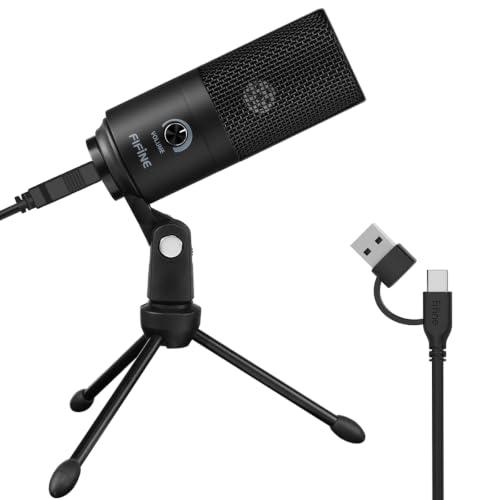
USB Condenser Microphone
The capture, fixed
- Cardioid USB condenser
- Desk-stand or boom mounting
- Manual gain control
- Headphone monitoring on common models
A dedicated microphone is the sound tester’s first upgrade because it converts the capture from an accident into an instrument: a cardioid condenser at a fixed distance hears the board’s detail consistently, session after session, which is the entire requirement for comparisons that mean anything. Manual gain is the specification that matters most — automatic gain is the enemy of honest dynamics — and a headphone jack for direct monitoring lets the tester hear what the microphone hears, which is a different and more honest thing than what the room hears.
Its constituency is owners who tune: anyone running the foam, tape and plate experiments of this cluster needs a capture chain that does not drift between the before and the after, or the experiments cannot be judged. For pure buyers, the phone remains adequate under the protocol below; for tuners, this is the laboratory glassware. Buy it once, fix its position, mark the gain, and never touch the settings again — consistency is the feature, and it is maintained by discipline more than by hardware.
Strengths
- Repeatable capture across sessions
- Manual gain preserves dynamics
- Monitoring reveals what the mic hears
Trade-offs
- Costs more than the phone you own
- Desk space and setup discipline required
- Reveals flaws your ears forgave
Best for: Tuners running before-and-after experiments.
Not suited for: Buyers making occasional comparison clips.
Mini Tripod
The position, fixed
- Tabletop tripod for phone or microphone
- Repeatable height and angle
- Folds for storage
- Suits the fixed-position protocol
The tripod’s role in a sound guide is positional honesty: the protocol demands the capture device sit in the same place for every take, and human hands cannot promise that across an afternoon of modifications, let alone across months of a board’s tuning life. A mini tripod parks the phone or microphone at a marked position — height, distance and angle recorded once and restored in seconds — which converts a pile of clips into a dataset. It is the same tool the how to take better photos of your keyboard among other things guide prescribes for the camera, moonlighting here for the microphone, because in both crafts the fixed viewpoint is what makes comparison possible.
Mark the desk position with a small tape cross and the tripod’s settings with a note in the board’s records; the laboratory is then reassembled in a minute whenever a new variable needs judging. Owners consistently report that the tripod’s discipline, more than the microphone’s quality, is what made their tests start agreeing with their ears.
Strengths
- Identical placement for every take
- Serves camera and microphone alike
- Costs very little
Trade-offs
- Tabletop height only
- One more setup step per session
- Phone clamps vary in quality
Best for: Anyone recording comparisons more than twice.
Not suited for: One-off clips for a listing.
Large Desk Mat
The desk variable, governed
- Full board-and-mouse coverage
- Dense, sound-damping surface
- Stitched edges
- Consistent across sessions and boards
The mat enters the recording chain as the desk’s governor: it decouples the board from the desk’s resonant cavity, so the recording captures the board rather than the furniture — and, equally important for comparisons, it captures the same furniture contribution (nearly none) for every board tested on it. A tester comparing boards across months on a bare desk is comparing desks as the seasons change their contents; the mat holds that variable still. It is, not coincidentally, also the surface the board should live on for its own sound’s sake, per the acoustics guides in this cluster.
For the sound-test purpose, density and consistency are the specifications: a mat with body damps repeatably, and the same mat used for every test — including the tests of boards that will later be judged against today’s — is worth more than a rotation of prettier ones. The laboratory’s surfaces, like its microphone position, are chosen once and then forgotten, which is the highest compliment a variable can be paid.
Strengths
- Removes the desk from the measurement
- Improves the board’s everyday sound
- Constant across all future tests
Trade-offs
- Changes the sound versus a bare desk — by design
- Needs washing on schedule
- Size must cover the test area
Best for: Comparison testers and everyday sound alike.
Not suited for: Owners whose desk sound is the point of the test.

Gateron Smoothie Switches
The test subject, standardised
- Linear switches, 5-pin, factory pre-lubed
- Full POM housings and stem
- 22 mm dual-stage spring, 40 gf
- 105-piece pack covers a full board
Every measurement needs a control, and for sound tests the control is a switch set whose behaviour is boringly consistent: this full-POM linear arrives factory-lubed to a uniform standard, so a pack installed across two boards removes the switch lottery from the comparison and leaves the boards, the room and the microphone as the only variables. Its voice is the deep, rounded one full-POM construction is known for, which makes it a revealing subject — plate, foam and case differences show up against it clearly rather than hiding behind a scratchy or pingy switch. Keep one pack as the laboratory set, moving it from board to board, and your archive of recordings becomes a dataset instead of a pile of anecdotes.
Strengths
- Unit-to-unit consistency suits controlled tests
- Deep POM voice reveals board differences
- A full-board pack from a single batch
Trade-offs
- Its deep voice colours every test it stars in
- Factory lube varies slightly between batches
- A reference set is a cost casual testers skip
Best for: Testers comparing boards, plates and foams methodically.
Not suited for: Buyers who only need one casual clip per board.
Your Own Test Bench: Building a Repeatable Setup
The home test bench assembles from the protocol’s demands rather than from a shopping list: a capture device (phone or microphone) at a fixed position — the community’s informal standard is roughly thirty centimetres above and behind the board, angled down, but any position held constant serves — a fixed gain with compression and automatic processing disabled where the device allows, the mat as the standard surface, and a standard performance: the same pangram-rich sentence, typed at your natural working force and speed, wandering the whole board including the spacebar and modifiers, recorded for twenty to thirty seconds. File each take with a naming discipline that records board, switches, caps, modification state and date, because a test whose configuration is forgotten is a portrait again, however carefully it was captured.
The bench’s product is the baseline library: your current board in its current state, every modification’s before and after, every new arrival’s first week. That library converts all future judgements from memory — the least reliable storage in the hobby — into comparisons, and it converts strangers’ tests into usable evidence whenever one of them happens to include a board your library holds. Owners who keep it describe the same liberation as the group buy guide’s spreadsheet keepers: the anxiety of ‘does it sound right’ dissolves into the calm of playing two files. The bench costs an afternoon to establish and repays it at every subsequent purchase, which is the definition of infrastructure.
What Tests Cannot Tell You
Honesty about the instrument’s limits closes the guide’s teaching. A recording cannot convey feel — the bottom-out’s cushion, the return’s spring, the case’s solidity under the hands — and boards are bought by hands as much as by ears; the test’s silence on feel is total and should be remembered whenever a beautiful recording tempts a purchase whose switches the buyer’s fingers have never met, which is why the keyboard accessories guide keeps a switch tester in the drawer. A recording cannot convey volume truthfully, for the gain reasons already given, so questions of office-appropriateness must be answered by specification and reputation rather than by audio. And a recording cannot convey your room, which will re-voice whatever arrives — the final argument for the guide’s recurring consolation: tuning exists, and a board whose voice is near your target can be governed the rest of the way by foam, tape and plate, in your room, by your own tests.
The tests’ proper office, then, is comparative and eliminative: they rank switches within a board, verify modifications, eliminate boards whose character is plainly wrong for you, and calibrate the vocabulary in which the community’s knowledge is stored. Used so, they are among the hobby’s most powerful tools. Used as oracles — a single solo video treated as a board’s soul — they manufacture the disappointment that fills the returns system. The instrument is honest. The reading is the skill, and the reading is what you now have.
The Microphone Question, Settled Pragmatically
Every sound-test discussion eventually becomes a microphone discussion, and this expansion settles it at the level most owners actually need. The microphone’s job in a sound test is not fidelity to some absolute — no such recording exists — but consistency: the same transducer, in the same position, through the same chain, so that the differences between recordings are the board’s differences and not the apparatus’s. A phone’s microphone, fixed in position and settings, satisfies that job description completely for the comparisons that drive decisions — before and after a mod, this switch against that one, this board against its predecessor. The dedicated microphone’s advantages are real and narrower than their price suggests: a flatter response (less of the phone’s speech-tuned processing), a lower noise floor (audible in quiet boards’ tails), and placement freedom the phone’s body denies. Owners graduate to one when their questions outgrow the phone’s answers, which is the same graduation rule as every tool in this cluster.
The processing is the phone’s hidden variable, and it must be governed: automatic gain, noise suppression and voice enhancement all rewrite the evidence between the board and the file. The recording application’s settings — the unprocessed or ‘voice memo at highest quality’ mode, gain locked where the app allows — are the test’s integrity, and a sound test recorded through a video call’s audio path is not a recording of a keyboard at all but of a codec’s opinion about one. The keyboard sound thock clack guide grades boards by recordings made across the internet; this section’s doctrine applies to them with full force: a test whose chain is unknown is a story, and a test whose chain is stated is evidence, and the community’s best archives state their chains the way scientific papers state their methods, because that is what they are.
Position is the third variable, and its doctrine is short: the microphone goes where the typist’s ears are, because the test’s purpose is to grade what the typist hears. The fashionable positions — the microphone hovering centimetres above the spacebar, the phone laid on the desk as a contact instrument — record sounds no human has ever heard from the board, in the service of a drama the platform rewards. They are not useless: the close position is a diagnostic instrument, isolating a stabiliser or a single switch the way a stethoscope isolates a valve. But the test of record, the one filed as the board’s baseline, belongs at the ears’ address, at the room’s ordinary distance, in the room’s ordinary quiet. Everything else is a special examination, and should be labelled as one.
The Test Sentence and the Test Ritual
A sound test needs a fixed text the way a scale needs a fixed weight, and the choice of text is a small science. The sentence should exercise the board’s whole geography: the home row’s letters for the alphas’ chorus, the top row for the number keys’ register, the modifiers and the spacebar for the stabilisers’ report, and a passage of real prose — because typing rhythm, the variable no metronome captures, is part of the sound being graded. Pangrams serve the geography; a paragraph of your own ordinary writing serves the rhythm; the complete ritual records both, plus ten seconds of the spacebar alone (the board’s loudest voice, isolated) and ten seconds of silence (the room’s floor, without which no recording can be interpreted). The ritual takes three minutes and converts every future comparison into a controlled experiment.
The ritual’s conditions matter as much as its text: the same desk surface and mat, the same time of day where the room’s noise has a schedule, the board in its working state — cable connected as usual, feet set as usual — because a test performed on a specially arranged board grades an arrangement, not a board. Recordings should be named and filed with the discipline the cable guide teaches labels: board, configuration, date, chain. The file that cannot be identified in six months is a sound without a source, and the archive’s value compounds exactly in proportion to its labelling, like every other record this cluster keeps.
And the ritual has a social form: the test performed for an audience — a listing, a forum, a friend considering the same board — owes that audience the ritual’s honesty, the fixed text at a natural pace, the room’s silence included, the chain stated. The performance tests that dominate the platforms, with their exaggerated slow strikes and their microphones at intimate range, are a genre of theatre that has taught a generation of buyers to expect sounds no desk produces. This guide’s tests are duller and truer, and their dullness is their credential: a board that sounds good in an honest test will sound good at your desk, which is the only promise a sound test should ever make.
Reading a Recording: What to Listen For, In Order
A recording repays structured listening, and this section gives the structure the main guide’s vocabulary implies. First pass, the whole board: the register (where the voice sits on the spectrum), the consistency (whether the rows speak as one instrument or as a committee), and the room’s contribution, judged by the silence track — a recording whose silence is loud is a recording of a room with a keyboard in it, and its board judgements must be discounted accordingly. Second pass, the worst key: every board has one, and the test’s job is to find it — the pinging switch, the stabiliser’s tick, the hollow corner — because boards are graded by their worst key in daily life, whatever their chorus’s average. Name it, locate it, and the recording has already earned its three minutes: the fix guides exist for exactly that key.
Third pass, the comparison — the recording’s real purpose, since a sound test alone grades nothing but memory. Play the before and after, the two switches, the two boards, in alternation and then, if the tools allow, blind: the owner’s preference, stripped of knowing which is which, is the only preference that should spend money. The blind step embarrasses everyone the first time — the expensive configuration loses to the cheap one, the mod’s effect inverts — and that embarrassment is the method’s proof, because it is the sound of evidence defeating expectation, which is the entire reason for recording anything. The how to fix keyboard spring ping noise ladder’s verification rung is this pass, formalised: treat, record, compare blind, and let the file arbitrate what the ear, unassisted, would have sworn to falsely.
And the reading has a humility clause: a recording cannot carry the feel, and boards are graded by hands as much as by ears. The test that crowns a board the hands dislike has measured the wrong half of the instrument. Sound tests arbitrate sound decisions — mods, materials, the voice’s direction — and they should be confined to their jurisdiction with the same discipline this cluster applies to every instrument: the census for sizes, the logger for chatter, the camera for latency, the recording for voice. Each instrument in its jurisdiction, each verdict in its file, and the owner becomes the kind of judge whose decisions survive their own later scrutiny.
The Internet’s Sound Tests: A Consumer’s Defence
The buyer researching a board meets the sound test as a genre of content, and this section collects the defences a consumer needs against its systematic distortions. Distortion one: the room. The creator’s room — its size, its furnishings, its microphone’s distance from a wall — is an unlisted component of every recording, and it can move a board’s apparent register further than a plate swap. Distortion two: the desk. A board recorded on a thick mat over solid wood and the same board on your glass desk are two instruments sharing a name. Distortion three: the typing. Creators type for microphones — slower, more deliberate, striking centre-key with a consistency no working typist maintains — and the sound of typing-for-recording is a dialect your board will never speak at your desk. Distortion four: the chain’s processing, from the microphone’s own tuning to the platform’s compression, which irons dynamics and boosts the frequencies that make small speakers flatter the board.
The defences are correspondingly systematic. Prefer tests that state their chain and show their room. Prefer the same creator’s comparisons over different creators’ absolutes, because a constant apparatus cancels itself in a comparison. Weight the tests recorded on desks like yours, at paces like yours, above the studio productions. And hold the whole genre at its correct epistemic rank: below your own hands on a borrowed board, below the returns window’s evidence, above the listing’s adjectives — a middle rank, useful for narrowing a field to finalists and useless for crowning one. The how to choose a mechanical keyboard the buyers guide assigns every evidence type its rank; the sound test’s rank, honestly assigned, saves its consumers a great deal of money and returns postage.
There is a final defence, against the subtlest distortion: the genre selects for boards that record well. A board whose voice is dramatic at the microphone’s distance and ordinary at the typist’s will be over-represented in the content economy, and a board whose virtues are consistency and quiet will be under-represented, because the platforms reward the dramatic. The market’s centre of taste has been measurably pulled by this selection — toward deeper, louder, more performative voices than most desks want at hour six. Knowing the pull exists is most of the defence; the rest is the door-closed test and the fortnight rule, applied to the board the content crowned, before the verdict is allowed to settle.
Building Your Archive: Baselines Across a Board’s Life
The sound test’s highest use is longitudinal: a board’s voice across its own life, recorded at its milestones, becomes a maintenance instrument no single test can be. The baseline is taken when the board is known-good — new, or freshly cleaned and tuned — and filed with its configuration. Every later complaint is graded against it: the stabiliser that has drifted announces itself by comparison before it announces itself to the daily ear, which adapts to gradual change the way eyes adapt to a dimming room. The archive thus converts the ear’s worst property — its accommodation — into a managed variable, and the board’s service history gains an audible dimension alongside the notebook’s written one. Owners of several boards hold an archive per board; the discipline is minutes per quarter and its returns are diagnoses that arrive early, while their cures are still cheap.
The archive also settles the disputes that memory cannot: whether the mod helped (the blind comparison), whether the new switches are really quieter or merely newer (the alternation), whether the board has changed or the room has (the silence tracks, compared across seasons). In each case the file is the witness that neither the ear nor the wallet can impeach, because it was recorded before the dispute existed. This is the same evidentiary philosophy as the keymap backup and the build notebook — the owner’s records, made in calm, arbitrating the owner’s questions in noise — and the sound archive is its most enjoyable form, because its evidence can be played aloud at the desk and argued with, in the best sense, for years.
And the archive has a terminal use that gives the practice its poignancy: the board’s keeping set, the recordings that remain when the board is sold, demoted or retired — its voice, preserved at its best, in the room where it worked. Owners who keep them discover that a board’s sound was a larger part of its companionship than they knew, and that ten seconds of its spacebar can return a whole era of evenings more vividly than any photograph. Take the baselines. File them honestly. The archive is the board’s memoir, written in its own voice, and it costs three minutes at a time.
Sound Tests for Sellers and Buyers: The Listing’s Evidence
A closing application with money attached: the sound test as the used market’s evidence, where its honesty has a price. The seller who includes a ritual test — fixed text, stated chain, the room’s silence included, the worst key not hidden — sells into the trust premium the group-buy guide prices: buyers pay more, faster, for evidence over adjectives, and a board with a test outsells its identical twin with a superlative. The test should be recorded for the listing fresh, on the board in its sale configuration, because a test from the board’s modified past is a misdescription with a play button. Sellers who keep baselines hold an advantage here that compounds: the board’s whole audible history, available to a serious buyer, is the strongest listing the platform allows.
The buyer’s reading of a listing’s test applies this guide’s defences with the stakes raised: the stated chain checked, the silence listened to, the typing pace discounted, the worst key hunted — and the absence of a test read as information too, since a seller with a good-sounding board and a phone has no innocent reason to withhold its voice. Ask for the test where none is posted; the request costs a message and its answer, or its refusal, is data of the first quality. The how to buy keyboard group buy guide’s aftermarket ladder rewards the buyer who prices evidence correctly, and in the keyboard market, evidence increasingly sounds like something.
And the market’s maturation can be measured by this section’s existence: a decade ago, keyboards were sold by specification alone, and a buyer learned a board’s voice after the money. The sound test — with all its distortions, which this guide has catalogued without mercy — has made the voice a term of the sale, inspectable in advance, arguable in public, improvable by sellers who understand it. That is progress, of the unglamorous, compounding kind this cluster documents everywhere: an instrument, honestly used, making a market more truthful one recording at a time. Make yours honestly, and read everyone else’s with the defences up, and the genre will serve you as it should — as evidence, never as theatre.
The Ethics of the Shared Recording
A sound test published to the commons makes a claim on strangers’ money, and this closing section states the ethics that follow from that fact, because the genre’s maturation depends on its practitioners treating recordings as testimony rather than as content. Testimony’s duties are three. Accuracy of conditions: the chain, the room and the board’s configuration stated, so the listener can discount what cannot transfer. Accuracy of performance: typing at a working pace, on the board as it is actually used, because a test performed for the microphone describes a performance, not a keyboard. And accuracy of selection: the takes published should be the representative ones, not the single golden take where the spacebar behaved — a duty the genre violates most casually and feels most keenly, since every owner knows their own board’s best take and worst take differ by more than two boards in a comparison do. The creator who keeps all three duties produces the archive this cluster’s buyers navigate by; the creator who keeps none produces the weather — pleasant, dramatic and useless for navigation.
The ethics have a reader’s side as well: the community’s archive is a commons, maintained by unpaid testimony, and the reader who benefits from it owes it the small taxes of participation — the correction offered where a test’s conditions mislead, the baseline contributed when a board is new, the credit given where a recording settled a purchase. Commons do not fail from malice; they fail from free-riding at scale, and the sound test’s commons is young enough that its norms are still being set by whoever shows up. Show up as the kind of witness you would want testifying about the board you are about to buy. The genre’s future evidentiary value is being decided, recording by recording, by exactly that choice.
Recording a Trustworthy Comparison, Step by Step
The protocol for a modification test or a two-board comparison; the discipline is the equipment.
- Fix the bench: capture device on the tripod at the marked position, gain set manually and noted, processing and automatic gain off, mat in place, room in its ordinary state (no special silence — ordinary is the condition of ownership).
- Record the control first: the board in its current state, the standard sentence at natural force, twenty to thirty seconds, full board including spacebar and modifiers. Label the file completely before touching anything.
- Change exactly one variable — the modification, the switch set, the board — and nothing else: same desk position for the board, same sentence, same typist, same session where possible.
- Record the variant identically and label it. If a third state is being tested, return to the control configuration and re-record it rather than trusting the first take — drift is real and the re-take is cheap.
- Compare at matched playback volume, on the same headphones or speakers, listening for the vocabulary’s axes: pitch, attack, sustain, cleanliness, consistency, and the worst key in each take. Write the verdict in a sentence and file it with the takes.
Sound-Test Mistakes, in the Making and the Reading
Moving the microphone between takes.
A few centimetres of placement outweigh most component differences, so a comparison with a moved microphone measures the move. The tripod and the marked position exist because this mistake is otherwise inevitable — hands cannot repeat a position across a disassembly. Fix the capture or forfeit the comparison; there is no third option.
Typing gently for the test and violently in life.
The test performance must be the owner’s real typing, force included, because bottom-out behaviour — the loudest part of most boards’ voices — is force-dependent. A test typed like a librarian will acquit boards that its owner, typing like themselves, will convict within the week. Be yourself into the microphone; it is the only self the board will live with.
Judging by the first three keys.
Home-row openings flatter every board; the spacebar, the modifiers and the number row are where rattles, ticks and inconsistencies live. The standard sentence must wander, and the verdict must be graded on the worst key heard. Tests that never leave the alphas are advertisements, including — especially — your own.
Comparing across channels, rooms and months from memory.
A new board’s clip against a remembered impression of the old board is not a comparison; it is a mood. The baseline library and the same-session control exist to replace memory with files. Owners who skip them re-litigate every purchase indefinitely, because nothing was ever actually measured.
Cranking the playback to hear the detail.
Detail heard at twice life volume is detail your room will never present, and boards have been returned for rings and pings that exist only at headphone-and-gain inspection levels. Match the playback to remembered real volume — calibrated against a known board — and judge what ownership will actually hear.
Recording the test with the microphone touching the desk.
A contact-position microphone turns the desk into the instrument and the board into its excitation — dramatic, deep, and entirely unlike what any typist hears. It has diagnostic uses for isolating a component, but as the test of record it grades the furniture. Place the microphone where your ears sit, at your typing distance, and let the test describe the experience it claims to describe.
Frequently asked questions
Why does my keyboard sound different from its sound test video?
Because the video recorded a five-part system — microphone, placement, desk, room, typist — of which your board was one part, and your desk supplies the other four differently. The board’s character (pitch family, attack style) usually survives the translation; the balance and polish do not. The remedy is the guide’s: judge by anchored comparisons, build your own baseline library, and tune the board in your room toward the character you bought, using the cluster’s foam, tape and plate methods.
What microphone do sound testers use?
The serious channels use small-diaphragm condensers or quality USB microphones at close, stated distances; the honest amateurs use phones at fixed positions — and the second category’s comparisons are often worth more than the first’s portraits, because protocol beats equipment in this craft. If you buy one thing, buy the consistency: a modest microphone on a tripod at a marked position out-measures a fine microphone held in a hand.
How loud is this keyboard, really?
The question recordings cannot answer, for the gain reasons this guide details. The honest proxies are specification and design: switch type (silent linears versus clickies span the category’s whole range), case construction, and the community’s textual consensus about office suitability. If volume is a hard constraint — a shared office, a sleeping household — choose from the silent end by design and verify with a return window, not with a video.
Should I trust a sound test with no talking or description?
The silent, hands-only test is a legitimate format — it withholds nothing about the audio — provided its conditions are stated in the description: board configuration, microphone, placement, surface. A test with neither narration nor stated conditions asks for trust it has not earned; treat it as a portrait. The protocol in this guide lists what to look for, and its absence is itself the finding.
Can a sound test tell me if I will like a switch?
It can rank switches against each other inside one board and eliminate those whose character you reject; it cannot tell you how the switch feels, how its force suits your hands, or how it sounds in your board and room. Pair tests with the switch tester for feel and with your baseline library for calibration, and the three instruments together approximate a shop visit — the closest the internet gets to one.
How do I make my board sound like the video I bought it from?
Reconstruct the system, not just the board: identify the video’s keycap set, desk surface and any modifications stated, match what you can, and then govern the remainder with your room’s tuning — mat first, foam and tape after, plate if your platform allows. Expect to land at the character, not the identical voice, and judge by your own protocol’s recordings. Chasing the last five percent of a stranger’s room is the hobby’s most expensive hobby; the guide’s counsel is to stop at your own desk’s best version of the board.
What phone settings should I use for a sound test?
The highest-quality audio mode your recording app offers, with processing off where the app permits — no noise suppression, no voice enhancement, no automatic gain if it can be locked. Record in the phone’s voice-recorder or a dedicated audio app rather than through a call or a social app, whose codecs rewrite the evidence. Keep the phone in the same position and orientation for every test, note the app and settings in the file’s name or its archive entry, and your phone becomes a consistent instrument — which, as this guide argues, is most of what a sound-test microphone needs to be.
How loud should my keyboard be in the recording compared to real life?
The recording’s absolute loudness is arbitrary — it depends on gain, distance and playback volume — which is why honest tests are graded on relative evidence: the board against its own silence track, against its predecessor’s recording on the same chain, against the same creator’s other boards. If a test’s board sounds thunderous, ask what it is thunderous compared to, and through what gain. Loudness without a reference is the genre’s cheapest effect, and the reference — the room’s silence, recorded in the same file — is the honest creator’s signature.
The sound test, understood, is neither gospel nor fraud but a measurement with conditions — and conditions can be read, standardised and, in your own home, controlled. The buyer who learns to decompose a recording into its five-part system stops purchasing strangers’ rooms and starts purchasing boards; the owner who builds a small, disciplined test bench gains the instrument that every tuning decision in this cluster quietly assumes. Between those two skills, the hobby’s most seductive and treacherous artefact becomes what it should always have been: evidence.
So fix the microphone’s place, type your real sentence with your real hands, change one variable at a time, and keep the files. Your library will outlast every board it describes, calibrating purchases and verifying modifications for years — and when a new video tempts you with a voice too beautiful to be true, you will know exactly which four parts of its system are doing the tempting, and exactly what the fifth part, the board, is likely to sound like on your own desk. That knowledge is the difference between watching the hobby and practising it.