Disclosure: As an Amazon Associate, kajuandouglas.com earns from qualifying purchases. Links to Amazon on this page are affiliate links; they cost you nothing extra. Listing details such as price and availability change often, so check the current Amazon listing before you buy.
Where to buy
Every linked pick in this guide to best 360 cameras for cycling can be ordered on Amazon, where you can check the current price, availability, delivery options, and the exact variant on offer before you buy. Listings in this category change often, and sellers sometimes list several variants on one page, so confirm the full model name on the listing matches the pick reviewed below. Orders are placed with and fulfilled through Amazon under its normal returns policies, and this site may earn a commission on qualifying purchases made through these links at no extra cost to you. Picks marked prose-only are covered in honest prose instead of a link, because no single listing could be verified with confidence for them.
- Insta360 X4 Air — the x4 air squeezes genuine 8k 360 capture into a 165-gram body you can mount anywhere — a helmet, a handlebar, a backpack strap — without the mount becoming the story
- Insta360 X5 — the x5 is the current benchmark for consumer 360 cameras: 8k capture from larger sensors, replaceable lenses that end the fear of a scratched dome, and low-light processing that finally makes night and indoor 360 usable rather than novel.
- GoPro MAX2 — gopro’s max2 answers insta360 with true 8k spherical capture, a six-microphone array for spatial audio, and the option to shoot as a conventional action camera
- Insta360 X3 — the x3 defined the modern 360 camera: 5.7k capture, 72mp stills, a big touchscreen, and an app that makes reframing genuinely fun
- Kandao QooCam 3 — kandao’s qoocam 3 undercuts the big names while fitting larger sensors than most: 1/1.55-inch dual sensors, 5.7k hdr video and 62mp stills
- Insta360 ONE R Twin Edition — the one r twin edition is the modular experiment that still makes sense: one core, a 360 mod and a 4k wide mod in the same box
Read the full guide ↓
Finding the best 360 cameras for cycling starts with a simple truth: the best results in this category come from matching the tool to the job, not from chasing the biggest number on a box. This guide is built for cyclists filming rides, and it narrows a crowded field to six picks that each earn their place for a clear reason. That combination is harder to shop for than it sounds, because spec sheets reward the wrong things and marketing names hide the differences that matter day to day. Below you will find the six picks with full reviews, the criteria used to choose them, a buying guide that explains the specifications in plain language, a practical how-to section, the mistakes that waste the most money in this category, and straight answers to the questions buyers ask most.
Every recommendation here is organised around cycling and bike-mounted filming. That focus changes which features matter: some picks win on raw capability, others on consistency, battery or storage behaviour, or simply on how little friction they add between seeing a moment and capturing it well. Where a pick has a weakness that matters for this angle, the review says so plainly, with a skip-if line to steer you to a better fit instead. Nothing in this guide relies on a printed price or a fixed score; listings change, so each linked pick asks you to check the current Amazon listing, where the live details live.
One more promise before the picks: if a product could not be verified with confidence, it appears as a prose-only pick rather than a guessed link. That discipline costs this guide a few easy links and buys you something better — the confidence that every Amazon link below points at the product the review actually describes. Read the Quick Picks table for the short version, the full reviews for the reasoning, and the buying guide if you want to understand the category well enough to judge the next generation of products yourself.
Key Takeaways
- For cycling and bike-mounted filming, processing and consistency matter more than headline spec numbers.
- The strongest pick overall here is the Insta360 X4 Air, with the Insta360 X5 close behind for a different kind of buyer.
- Check the exact variant, storage and condition on the Amazon listing before ordering — listings bundle options together.
- Every linked pick below was verified against the manufacturer’s own listing data before it earned a link.
- Budget framing in this guide is qualitative: listings change too often for printed prices to stay honest.
In this guide
Quick Picks
If you only read one table today, make it this one: six picks for cycling and bike-mounted filming, each with the badge it earned and the reason it stands out. The full reviews below explain every choice in detail.
| Badge | Pick | Why it stands out | Link |
|---|---|---|---|
| Best Overall | Insta360 X4 Air | The X4 Air squeezes genuine 8K 360 capture into a 165-gram body you can mount anywhere — a helmet, a handlebar, a backpack strap — without the mount becoming the story. | Check price on Amazon |
| Best Image Quality | Insta360 X5 | The X5 is the current benchmark for consumer 360 cameras: 8K capture from larger sensors, replaceable lenses that end the fear of a scratched dome, and low-light processing that finally makes night and indoor 360 usable rather than novel.. | Check price on Amazon |
| Best Mounts and Audio | GoPro MAX2 | GoPro’s MAX2 answers Insta360 with true 8K spherical capture, a six-microphone array for spatial audio, and the option to shoot as a conventional action camera. | Check price on Amazon |
| Best Value | Insta360 X3 | The X3 defined the modern 360 camera: 5.7K capture, 72MP stills, a big touchscreen, and an app that makes reframing genuinely fun. | Check price on Amazon |
| Best Battery-Swap Alternative | Kandao QooCam 3 | Kandao’s QooCam 3 undercuts the big names while fitting larger sensors than most: 1/1.55-inch dual sensors, 5.7K HDR video and 62MP stills. | Check price on Amazon |
| Best Budget Kit | Insta360 ONE R Twin Edition | The ONE R Twin Edition is the modular experiment that still makes sense: one core, a 360 mod and a 4K wide mod in the same box. | Check price on Amazon |
How These Picks Were Chosen
Each candidate for this guide to best 360 cameras for cycling was judged against the same criteria, weighted for cyclists filming rides. Products were compared on verified manufacturer specifications and listing data, cross-checked before any link was added, and anything that could not be verified confidently was demoted to a prose-only mention or dropped entirely.
- Core capability for the angle: the main hardware or feature set that decides results for cycling and bike-mounted filming, judged on verified specifications rather than marketing names.
- Consistency: how reliably the pick performs across ordinary conditions, not just its best-case demo scenario.
- Supporting system: battery or power behaviour, storage, software and accessories that decide whether the headline feature is usable every day.
- Honest limitations: every pick carries real trade-offs, and a pick whose weaknesses clash with this angle was ranked down or cut.
- Listing clarity: linked picks must be identifiable on Amazon by exact model name, so what you order is what was reviewed.
Prices and availability move constantly in this category, which is why this guide prints neither: the framing is qualitative, and the live listing is the only honest source for the number you will pay today.
The Best 360 Cameras For Cycling
Six picks, reviewed in the same order as the tables above. The first pick is the one most readers should buy; the rest exist because the best choice genuinely changes with your priorities, and each review ends with a plain choose-it or skip-it verdict to make that call easy.
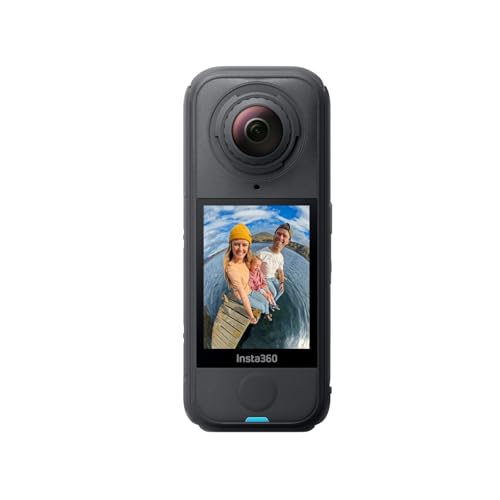
Insta360 X4 Air
Badge: Best Overall
| Video | 8K 360 recording |
| Weight | 165 g |
| Lenses | Replaceable lenses |
| Stabilisation | FlowState with horizon lock |
| Audio | Built-in wind guard |
The X4 Air squeezes genuine 8K 360 capture into a 165-gram body you can mount anywhere — a helmet, a handlebar, a backpack strap — without the mount becoming the story. It is the travel and action pick of the current Insta360 line.
For cycling and bike-mounted filming, the fit is direct: Insta360 X4 Air brings 8k 360 recording, and that shows up exactly where this use case applies pressure. Buyers comparing options for cycling and bike-mounted filming should weight this pick’s real behaviour over brochure numbers, because the gap between good and disappointing results in this category is usually about consistency under your conditions, not peak performance under a reviewer’s.
Living with Insta360 X4 Air means learning its one or two habits and then forgetting them. Its 8k 360 recording anchors the results, and after the first week the workflow becomes muscle memory: raise, frame, shoot, and only occasionally dive into settings for a deliberate effect. That ease is deliberate design, not an accident, and for cyclists filming rides it is worth more than a longer feature list used twice a year.
There is also the question of how Insta360 X4 Air behaves when the conditions stop cooperating — mixed indoor light, a subject that will not stay still, a battery already half spent on the rest of the day. Its 165 g shapes those moments more than the headline specification does, and it copes with the calm predictability that cyclists filming rides need when there is no second chance at the shot. No pick in this guide is immune to physics, but the ones ranked here fail gracefully: results degrade gently rather than collapsing, settings recover quickly, and the next attempt is one tap away instead of a menu dive. That grace under pressure rarely appears in marketing, yet it is exactly what separates a recommendation from a spec sheet with a price attached.
Strengths
- Featherweight body suits helmets, bikes and long handheld days
- Full 8K capture, not a cut-down resolution
- Replaceable lenses, rare at this size and tier
Trade-offs
- Smaller body means smaller battery than the X5
- Low-light quality sits a step below the flagship’s larger sensors
- Invisible-selfie-stick accessories are sold separately
Choose it if you are cyclists filming rides whose priorities match its badge: best overall. Skip it if you are buyers whose main priority is the one thing this pick trades away — read the trade-offs before ordering. That single distinction is the fastest way to decide whether this pick belongs on your shortlist or whether one of the neighbouring picks — which trade the same qualities in different proportions — fits your version of cycling and bike-mounted filming better.
Best for: cyclists filming rides whose priorities match its badge: best overall / Not suited for: buyers whose main priority is the one thing this pick trades away — read the trade-offs before ordering

Insta360 X5
Badge: Best Image Quality
| Video | 8K 360 recording |
| Sensors | Dual large-format sensors, triple AI chip design |
| Photo | High-resolution 360 stills |
| Lenses | Rugged and user-replaceable |
| Battery | Extended runtime, up to 3-hour class in endurance modes |
The X5 is the current benchmark for consumer 360 cameras: 8K capture from larger sensors, replaceable lenses that end the fear of a scratched dome, and low-light processing that finally makes night and indoor 360 usable rather than novel.
Judged purely on cycling and bike-mounted filming, Insta360 X5 makes a strong case. Its 8k 360 recording is the foundation, and the supporting details — how fast it is ready, how it handles mixed light or motion, how much work the results need afterwards — all lean the right way for cyclists filming rides. It is not the answer to every version of this brief, but for the mainstream version of it, this is a pick that rarely disappoints.
The honest test of Insta360 X5 is a month of unremarkable days, and it passes: the 8k 360 recording keeps everyday results steady, battery and storage behaviour stay predictable, and the shots you care about — people, places, food, documents, the dog doing something unforgivable — come out right the first time often enough that retakes feel optional.
There is also the question of how Insta360 X5 behaves when the conditions stop cooperating — mixed indoor light, a subject that will not stay still, a battery already half spent on the rest of the day. Its dual large-format sensors, triple ai chip design shapes those moments more than the headline specification does, and it copes with the calm predictability that cyclists filming rides need when there is no second chance at the shot. No pick in this guide is immune to physics, but the ones ranked here fail gracefully: results degrade gently rather than collapsing, settings recover quickly, and the next attempt is one tap away instead of a menu dive. That grace under pressure rarely appears in marketing, yet it is exactly what separates a recommendation from a spec sheet with a price attached.
Strengths
- 8K resolution leaves real reframing headroom in the edit
- Replaceable lenses protect your investment against scratches
- Low-light performance is a generation ahead of older 360 cameras
Trade-offs
- 8K files are large and demand fast cards and storage
- Premium tier pricing, and accessories add up
- Best results still need the Insta360 app or Studio in the workflow
Choose it if you are cyclists filming rides whose priorities match its badge: best image quality. Skip it if you are buyers whose main priority is the one thing this pick trades away — read the trade-offs before ordering. That single distinction is the fastest way to decide whether this pick belongs on your shortlist or whether one of the neighbouring picks — which trade the same qualities in different proportions — fits your version of cycling and bike-mounted filming better.
Best for: cyclists filming rides whose priorities match its badge: best image quality / Not suited for: buyers whose main priority is the one thing this pick trades away — read the trade-offs before ordering
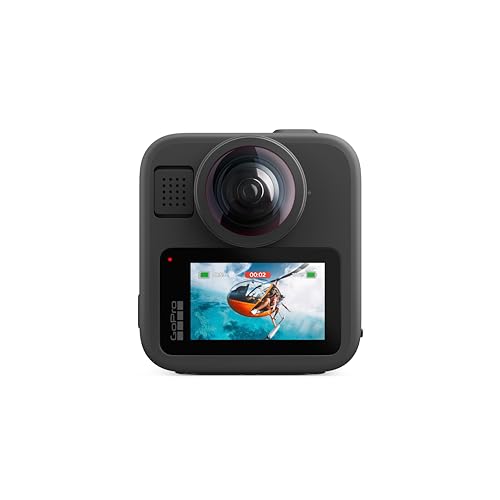
GoPro MAX2
Badge: Best Mounts and Audio
| Video | Spherical 8K 360 video |
| Photo | 29MP 360 photos |
| Audio | 6-microphone array |
| Lenses | Easy replaceable lenses |
| Modes | 360 plus traditional single-lens action camera mode |
GoPro’s MAX2 answers Insta360 with true 8K spherical capture, a six-microphone array for spatial audio, and the option to shoot as a conventional action camera. For creators already in GoPro’s mounting ecosystem it is the natural 360 flagship.
Where cycling and bike-mounted filming is concerned, GoPro MAX2 succeeds by removing friction. The spherical 8k 360 video does the heavy lifting, and the rest of the experience is arranged so that getting the shot feels like the default rather than an achievement. For cyclists filming rides, that reliability is the difference between equipment that inspires use and equipment that inspires returns.
In daily use, GoPro MAX2 earns its place through consistency rather than one spectacular trick. Results from its spherical 8k 360 video hold up across the ordinary scenes that fill a camera roll — faces at arm’s length, rooms lit by windows and lamps, and the quick grab shots you cannot stage twice. Processing is predictable, which matters more than novelty: you learn what it will do in a given light and start trusting it, and that trust is what turns a spec-sheet winner into the device you actually reach for.
There is also the question of how GoPro MAX2 behaves when the conditions stop cooperating — mixed indoor light, a subject that will not stay still, a battery already half spent on the rest of the day. Its 29mp 360 photos shapes those moments more than the headline specification does, and it copes with the calm predictability that cyclists filming rides need when there is no second chance at the shot. No pick in this guide is immune to physics, but the ones ranked here fail gracefully: results degrade gently rather than collapsing, settings recover quickly, and the next attempt is one tap away instead of a menu dive. That grace under pressure rarely appears in marketing, yet it is exactly what separates a recommendation from a spec sheet with a price attached.
Strengths
- 8K 360 video plus a proper single-lens action mode
- Six microphones capture convincing spatial audio
- Replaceable lenses and GoPro’s huge mount ecosystem
Trade-offs
- Reframing workflow is less automated than Insta360’s AI tools
- Battery life trails the longest-running rivals in 8K
- Premium pricing, with the best features tied to GoPro’s software
Choose it if you are cyclists filming rides whose priorities match its badge: best mounts and audio. Skip it if you are buyers whose main priority is the one thing this pick trades away — read the trade-offs before ordering. That single distinction is the fastest way to decide whether this pick belongs on your shortlist or whether one of the neighbouring picks — which trade the same qualities in different proportions — fits your version of cycling and bike-mounted filming better.
Best for: cyclists filming rides whose priorities match its badge: best mounts and audio / Not suited for: buyers whose main priority is the one thing this pick trades away — read the trade-offs before ordering

Insta360 X3
Badge: Best Value
| Video | 5.7K 360 Active HDR video |
| Photo | 72MP 360 photos |
| Single-lens mode | 4K wide-angle camera mode |
| Screen | 2.29-inch touchscreen |
| Waterproofing | Waterproof out of the box |
The X3 defined the modern 360 camera: 5.7K capture, 72MP stills, a big touchscreen, and an app that makes reframing genuinely fun. Newer models beat it on resolution, but as a complete, mature package it remains the value anchor of the category.
For cycling and bike-mounted filming, the fit is direct: Insta360 X3 brings 5.7k 360 active hdr video, and that shows up exactly where this use case applies pressure. Buyers comparing options for cycling and bike-mounted filming should weight this pick’s real behaviour over brochure numbers, because the gap between good and disappointing results in this category is usually about consistency under your conditions, not peak performance under a reviewer’s.
What separates Insta360 X3 in week-to-week use is how rarely it ruins a shot. The 5.7k 360 active hdr video gives it a dependable baseline, and the surrounding system — focus speed, processing, and the gallery and editing tools behind it — keeps the misses rare and recoverable. Owners tend to praise the same thing in different words: they stopped thinking about the equipment and started just taking the picture, which is the highest compliment this category offers.
There is also the question of how Insta360 X3 behaves when the conditions stop cooperating — mixed indoor light, a subject that will not stay still, a battery already half spent on the rest of the day. Its 72mp 360 photos shapes those moments more than the headline specification does, and it copes with the calm predictability that cyclists filming rides need when there is no second chance at the shot. No pick in this guide is immune to physics, but the ones ranked here fail gracefully: results degrade gently rather than collapsing, settings recover quickly, and the next attempt is one tap away instead of a menu dive. That grace under pressure rarely appears in marketing, yet it is exactly what separates a recommendation from a spec sheet with a price attached.
Strengths
- 72MP stills are superb for virtual tours and reframed photos
- Mature app ecosystem with the best AI reframing tools
- Single-lens 4K mode doubles as a regular action camera
Trade-offs
- 5.7K video shows softer reframed crops than 8K rivals
- Lenses are not user-replaceable, so guards are essential
- Low-light video is noticeably noisier than the X5 generation
Choose it if you are cyclists filming rides whose priorities match its badge: best value. Skip it if you are buyers whose main priority is the one thing this pick trades away — read the trade-offs before ordering. That single distinction is the fastest way to decide whether this pick belongs on your shortlist or whether one of the neighbouring picks — which trade the same qualities in different proportions — fits your version of cycling and bike-mounted filming better.
Best for: cyclists filming rides whose priorities match its badge: best value / Not suited for: buyers whose main priority is the one thing this pick trades away — read the trade-offs before ordering

Kandao QooCam 3
Badge: Best Battery-Swap Alternative
| Sensors | Dual 1/1.55-inch sensors |
| Video | 5.7K 360 at 30 fps, HDR video |
| Photo | 62MP panoramic photos |
| Audio | 4-microphone spatial audio class |
| Build | Action-ready waterproof design |
Kandao’s QooCam 3 undercuts the big names while fitting larger sensors than most: 1/1.55-inch dual sensors, 5.7K HDR video and 62MP stills. It is the thinking buyer’s alternative for action and travel 360 without flagship pricing.
Judged purely on cycling and bike-mounted filming, Kandao QooCam 3 makes a strong case. Its dual 1/1.55-inch sensors is the foundation, and the supporting details — how fast it is ready, how it handles mixed light or motion, how much work the results need afterwards — all lean the right way for cyclists filming rides. It is not the answer to every version of this brief, but for the mainstream version of it, this is a pick that rarely disappoints.
Living with Kandao QooCam 3 means learning its one or two habits and then forgetting them. Its dual 1/1.55-inch sensors anchors the results, and after the first week the workflow becomes muscle memory: raise, frame, shoot, and only occasionally dive into settings for a deliberate effect. That ease is deliberate design, not an accident, and for cyclists filming rides it is worth more than a longer feature list used twice a year.
There is also the question of how Kandao QooCam 3 behaves when the conditions stop cooperating — mixed indoor light, a subject that will not stay still, a battery already half spent on the rest of the day. Its 5.7k 360 at 30 fps, hdr video shapes those moments more than the headline specification does, and it copes with the calm predictability that cyclists filming rides need when there is no second chance at the shot. No pick in this guide is immune to physics, but the ones ranked here fail gracefully: results degrade gently rather than collapsing, settings recover quickly, and the next attempt is one tap away instead of a menu dive. That grace under pressure rarely appears in marketing, yet it is exactly what separates a recommendation from a spec sheet with a price attached.
Strengths
- Larger sensors than most rivals at its tier
- 62MP stills and HDR video in one body
- Strong value against the flagship brands
Trade-offs
- App and editing ecosystem is smaller than Insta360’s
- Accessory range is thinner
- Brand support network is less established in some regions
Choose it if you are cyclists filming rides whose priorities match its badge: best battery-swap alternative. Skip it if you are buyers whose main priority is the one thing this pick trades away — read the trade-offs before ordering. That single distinction is the fastest way to decide whether this pick belongs on your shortlist or whether one of the neighbouring picks — which trade the same qualities in different proportions — fits your version of cycling and bike-mounted filming better.
Best for: cyclists filming rides whose priorities match its badge: best battery-swap alternative / Not suited for: buyers whose main priority is the one thing this pick trades away — read the trade-offs before ordering

Insta360 ONE R Twin Edition
Badge: Best Budget Kit
| Design | Modular core with interchangeable lens mods |
| 360 mod | 5.7K-class 360 capture |
| 4K mod | Wide-angle 4K action mod included |
| Waterproofing | IPX8 waterproof design |
| Stabilisation | FlowState stabilisation |
The ONE R Twin Edition is the modular experiment that still makes sense: one core, a 360 mod and a 4K wide mod in the same box. As newer cameras chase 8K, the Twin has become the budget way to cover both jobs with one battery and one mount system.
Where cycling and bike-mounted filming is concerned, Insta360 ONE R Twin Edition succeeds by removing friction. The modular core with interchangeable lens mods does the heavy lifting, and the rest of the experience is arranged so that getting the shot feels like the default rather than an achievement. For cyclists filming rides, that reliability is the difference between equipment that inspires use and equipment that inspires returns.
The honest test of Insta360 ONE R Twin Edition is a month of unremarkable days, and it passes: the modular core with interchangeable lens mods keeps everyday results steady, battery and storage behaviour stay predictable, and the shots you care about — people, places, food, documents, the dog doing something unforgivable — come out right the first time often enough that retakes feel optional.
There is also the question of how Insta360 ONE R Twin Edition behaves when the conditions stop cooperating — mixed indoor light, a subject that will not stay still, a battery already half spent on the rest of the day. Its 5.7k-class 360 capture shapes those moments more than the headline specification does, and it copes with the calm predictability that cyclists filming rides need when there is no second chance at the shot. No pick in this guide is immune to physics, but the ones ranked here fail gracefully: results degrade gently rather than collapsing, settings recover quickly, and the next attempt is one tap away instead of a menu dive. That grace under pressure rarely appears in marketing, yet it is exactly what separates a recommendation from a spec sheet with a price attached.
Strengths
- Two cameras in one kit: 360 and 4K wide
- Modular design lets you replace a damaged mod, not the camera
- Deep second-hand and accessory market keeps costs down
Trade-offs
- Older platform with slower processing and app support winding down
- 5.7K 360 resolution limits aggressive reframing
- Battery life is modest by current standards
Choose it if you are cyclists filming rides whose priorities match its badge: best budget kit. Skip it if you are buyers whose main priority is the one thing this pick trades away — read the trade-offs before ordering. That single distinction is the fastest way to decide whether this pick belongs on your shortlist or whether one of the neighbouring picks — which trade the same qualities in different proportions — fits your version of cycling and bike-mounted filming better.
Best for: cyclists filming rides whose priorities match its badge: best budget kit / Not suited for: buyers whose main priority is the one thing this pick trades away — read the trade-offs before ordering
Comparison Table
The six picks side by side on the specifications that matter most for cycling and bike-mounted filming. Use it to spot the outlier — the pick whose numbers break the pattern is usually the one aimed at your exact niche.
| Pick | Video | Lenses | Badge |
|---|---|---|---|
| Insta360 X4 Air | 8K 360 recording | Replaceable lenses | Best Overall |
| Insta360 X5 | 8K 360 recording | High-resolution 360 stills | Best Image Quality |
| GoPro MAX2 | Spherical 8K 360 video | 6-microphone array | Best Mounts and Audio |
| Insta360 X3 | 5.7K 360 Active HDR video | 4K wide-angle camera mode | Best Value |
| Kandao QooCam 3 | Dual 1/1.55-inch sensors | 62MP panoramic photos | Best Battery-Swap Alternative |
| Insta360 ONE R Twin Edition | Modular core with interchangeable lens mods | Wide-angle 4K action mod included | Best Budget Kit |
Buying Guide: How to Choose a 360 Camera for Cycling And Bike-Mounted Filming
Start with resolution, because in 360 photography resolution is working room: the sphere is spread across the whole frame, so the flat image or reframed clip you publish uses only part of it. Higher capture resolution — the jump from 5.7K-class to 8K-class capture — is the single biggest quality lever for cycling and bike-mounted filming. Sensor size is the second lever: larger dual sensors gather more light, which decides whether indoor and evening work looks clean or smeared. Then judge the workflow, not the camera: stitching quality, the phone app’s reframing tools, and export options will shape your results more than a third decimal of specification. Finally, match the body to the job — replaceable lenses for risky mounting, one-shot simplicity for volume documentation, GPS for mapping work, and battery systems that survive your longest session.
The Specifications That Decide 360 Image Quality
Understand three numbers and you understand the category. Capture resolution sets your ceiling: it decides how much you can crop, reframe or zoom before softness shows. Photo resolution matters separately for stills-led work, and the gap between a 14MP-class and a 60MP-plus 360 still is obvious in tours and prints. Stabilisation quality decides whether moving footage is watchable, and modern systems from the major brands are all strong, which pushes the real differences back to resolution, sensors and software. Audio is the underrated spec for video work: multi-microphone arrays capture spatial sound that sells immersion in VR and walkthroughs. Ignore, by contrast, most branded mode names — they are software recipes you can usually reproduce in the app of any serious rival.
What to Check on the Listing Before You Order a 360 Camera
Confirm the exact model and bundle: this category is full of near-identical names, previous generations, and bundles whose headline accessory differs while the camera is the same — or the reverse. Check what is actually in the box against what your workflow needs, because the invisible-selfie-stick effect, mounts and lens guards are frequently separate purchases. Verify the memory card requirement and buy the fastest class the camera demands; an underspecified card causes the recording failures people blame on cameras. If you plan to publish to a platform — a tour service, a mapping programme, a client portal — confirm the camera’s files and workflow are accepted there before ordering, not after your first shoot day.
Budget Honesty: What the Tiers Really Buy in This Category
This guide refuses to print prices, because listings change too quickly for a printed number to stay honest — but tier logic is stable, and you deserve it plainly. At the entry tier you are buying the essentials done competently: one strong core capability, a supporting system with visible corners cut, and results that satisfy in good conditions. The mid tier is where this category gets serious: stabilisation, better sensors or glass, faster processing and screens you can judge work on, and it is where most of the picks in this guide cluster because it is where value peaks. The premium tier buys consistency — the same great result in worse light, at longer distances, for longer sessions — plus build and support that age better. None of that makes the entry tier a mistake: for cycling and bike-mounted filming, a well-chosen entry pick used within its limits beats a premium pick used carelessly. Spend first on the tier that covers your worst typical condition, not your best, and let accessories and extras wait until the core tool has proven itself in your hands for a month.
How Do You Shoot With a 360 Camera for Cycling And Bike-Mounted Filming?
- Charge fully and fit a fast, correctly specified memory card, then update the camera’s firmware before your first real shoot for cycling and bike-mounted filming.
- Mount or hold the camera so both lenses have an unobstructed view — in 360, everything is in shot, including you, the tripod and the cable you forgot.
- Set resolution to the highest your workflow can handle, and choose photo or video mode deliberately rather than extracting stills from video later.
- Shoot a ten-second test, review it in the app, and check stitching, exposure and your own position before committing to the session.
- Work the scene methodically: for documentation, one position per space with a pause; for action, secure the mount and test it at low speed first.
- Offload and back up the same day, and reframe or stitch while the shoot is fresh enough to reshoot if a lens was smudged.
When something goes wrong, work this list before blaming the equipment:
- Problem: A visible seam or warped line runs through shots → something crossed the stitch line too close to a lens — keep subjects and edges further from the camera and clean both lens domes.
- Problem: Footage looks soft everywhere → the export or reframe is downscaling — export at full resolution and check the platform is not compressing your upload a second time.
- Problem: Indoor shots are noisy and smeared → light is the limit — add light, steady the camera, or switch to stills, which expose longer and cleaner than video frames.
- Problem: The camera overheats or stops on long sessions → lower the resolution a step for long static recordings, shade the body, and swap batteries rather than running one to empty.
Common Buying Mistakes
- Buying on the headline number alone, when consistency for cycling and bike-mounted filming is decided by the supporting specifications this guide flags in each review.
- Ordering the first listing that matches the name, without confirming the exact variant, storage, condition or bundle contents on the page.
- Ignoring the supporting costs — storage, mounts, cases, chargers or subscriptions — that the real workflow requires from week one.
- Judging performance by one demo scenario instead of the ordinary conditions cyclists filming rides actually face most days.
- Skipping the test period: not shooting, recording or testing in your own conditions while returns are still simple.
- Letting files pile up without a backup habit, so the first lost device or failed card takes the whole library with it.
Field Notes: What a Month of Use Teaches That a Review Day Cannot
Short tests reward spectacle; a month rewards behaviour. After the first week with any of these picks, the pattern that emerges for cycling and bike-mounted filming is always the same: the specification you thought would matter most fades, and two or three everyday behaviours take its place — how quickly the tool is ready when a moment appears, how forgiving it is of a hurried hand or bad light, and how much effort the results demand afterwards. Owners also learn their own habits from the evidence: the focal length, mode or position they actually use ninety percent of the time is rarely the one the brochure sold them, which is why this guide weights the mainstream use case so heavily and treats exotic features as tiebreakers. If you take one habit from this section, take this one: after a month, review your own results and count the misses by cause. Almost always the misses cluster on one behaviour — and that behaviour, not a new purchase, is the cheapest upgrade available to cyclists filming rides.
Final Recommendation
For most readers, the answer to best 360 cameras for cycling is the Insta360 X4 Air: it earned the Best Overall badge by matching cycling and bike-mounted filming where it counts, with the fewest compromises that matter. The runner-up is the Insta360 X5, which overtakes it if your priorities tilt toward its particular strengths — the reviews above spell out exactly where that line falls. If neither fits, work down the order of this guide rather than sideways into unverified alternatives, and if your budget or needs sit between picks, waiting for the right variant of a higher pick beats settling for the wrong product today: listings refresh constantly, and the check-price links above always show the current picture.
Related Guides
- best digital cameras for students
- best mics for dslr cameras
- best home security cameras for elderly
- best 360 cameras under 500
- best bridge superzoom cameras for wildlife
Frequently Asked Questions
What matters most when choosing for cycling and bike-mounted filming?
Consistency under your real conditions matters more than any single specification. For cycling and bike-mounted filming, weight the core hardware first, then the supporting system — power, storage and software — because that is what decides whether the headline feature gets used daily or abandoned. The reviews in this guide rank all six picks on exactly that basis, and the comparison table shows where each one trades strength for weakness.
Is the Insta360 X4 Air worth it over the Insta360 ONE R Twin Edition?
They sit at different tiers for a reason. The Insta360 X4 Air buys you the strongest core performance and the fewest compromises for cycling and bike-mounted filming; the Insta360 ONE R Twin Edition keeps the essentials and gives up refinement, speed or supporting features. If your use is occasional, the saving is sensible. If this is a daily tool, the top pick’s consistency usually repays its tier within months of avoided frustration and reshoots.
Why does this guide not print prices?
Because listings in this category change constantly — variants, bundles and conditions shift under the same product name — and a printed price would be wrong more often than right. Instead, every linked pick carries a check-price link to the live Amazon listing, where the current price, availability and exact variant are shown before you commit. Use the qualitative tiers in the reviews to plan, and the listing to decide.
How do I avoid ordering the wrong variant?
Read the listing title in full and match it word for word against the pick’s name in this guide, then confirm the variant selectors — storage, size, colour, condition — before checkout. This category is notorious for one page hosting several models and both new and renewed units. If the listing bundles accessories, check whether the core product matches, because bundles are where substitutions hide.
What should I do in the first week with a new pick for cycling and bike-mounted filming?
Test it against your real life, not a benchmark: shoot, record or monitor the exact scenes you bought it for, review the results at full size, and check battery, storage and comfort over a full day. Weaknesses that will annoy you for years announce themselves in week one, while returns are still painless. If it passes your own scenes, set your defaults, sort your backup habit, and stop shopping.
When is a prose-only pick the right choice?
When the best answer is a service, an app, a previous generation, or a product whose listings could not be verified to the standard this guide requires for a link. Prose-only picks in this guide are genuine recommendations, covered honestly with their strengths and trade-offs; they simply ask you to search by name and verify the current listing or store page yourself, rather than trusting a link that might point at the wrong thing.


