Disclosure: As an Amazon Associate, kajuandouglas.com earns from qualifying purchases. Links to Amazon on this page are affiliate links; they cost you nothing extra. Listing details such as price and availability change often, so check the current Amazon listing before you buy.
If you are asking what is dolby atmos on a soundbar, here is the core idea: Dolby Atmos is a sound format that treats sounds as objects placed in three-dimensional space — including above you — rather than channels fixed to speaker positions, and an Atmos soundbar recreates that space, usually by bouncing ‘height’ sound off your ceiling from upward-firing drivers. When it works, rain falls around you, aircraft pass overhead, and film sound gains a vertical dimension that ordinary surround lacks.
This explainer covers how Atmos differs from older surround, how a single bar produces height effects without ceiling speakers, what you need at every link of the chain (content, TV, connection, room), and the honest limitations — because Atmos on a soundbar is real but conditional, and knowing the conditions tells you whether it is worth paying for in your room.
What is dolby atmos on a soundbar: The Short Answer
Atmos adds height to surround sound. A soundbar creates it with up-firing drivers reflecting off a flat ceiling (or, on some models, by processing alone). You need Atmos content, a TV and connection that pass it (eARC ideally), and a suitable ceiling. In the right room the effect is genuine; in vaulted or very high rooms it fades.
In this guide
Key Terms
- Dolby Atmos: An object-based audio format that places sounds in 3D space, including overhead, adapting to the speakers available.
- Height channels: The ‘.2’ or ‘.4’ in layouts like 5.1.2 — channels dedicated to sound from above.
- Up-firing drivers: Speakers angled upward in the bar (and sometimes rears) that reflect height sound off the ceiling toward you.
- eARC: Enhanced Audio Return Channel — the HDMI connection with enough bandwidth to pass full Atmos from a TV to a bar.
- Virtual Atmos: Processing that simulates height cues without up-firing drivers; a milder effect from a standard bar.
- Passthrough: A TV or device setting that forwards the audio format unchanged to the soundbar for decoding.
As you work through this guide, keep the bigger picture in mind. Our roundup of best soundbars for surround sound shows how the main options compare, and the companion piece on soundbar wattage explained covers the neighbouring decision in the same detail.
From Channels to Objects: What Atmos Actually Changes
Traditional surround assigns sounds to channels: the left surround speaker plays whatever the mixer sent to the left surround channel. Atmos instead describes sounds as objects with positions in space — a helicopter at front-left-high, moving to rear-right-high — and the playback system, knowing where its speakers are, renders those positions in real time. This makes Atmos adaptable: the same soundtrack renders on a cinema’s dozens of speakers, a component system’s height speakers, or a soundbar’s reflected beams, each doing its best with the hardware available.
For the listener, the audible difference is height and precision. Rain, aircraft, debris, ambient spaces — the sounds that live above a scene — gain a location instead of a general direction, and effects move through space more smoothly. Dialogue and music are largely unchanged; Atmos is not a general quality upgrade but a spatial one. That is why demos use helicopters, and why your judgement should also include ordinary scenes: the ambience of a forest or a city street, rendered in volume rather than from points, is Atmos at its most convincing and least gimmicky.
How a Soundbar Fakes a Ceiling Speaker (Honestly)
Most Atmos soundbars use up-firing drivers: small speakers on the bar’s top, angled so their sound reflects off the ceiling and arrives at your seat from above. Your brain, which locates sound by its arrival direction, accepts the reflection as an overhead source — the same principle as a mirror. Systems with rear speakers sometimes add up-firing drivers there too, completing the dome. The requirements follow from the physics: a flat, hard ceiling of ordinary height, a clear path upward from the bar, and a seat positioned where the reflections land.
Other bars offer virtual Atmos: processing that uses timing and tonal cues to suggest height from ordinary front drivers. It widens and heightens the impression modestly and works in any room, but it is a simulation of the simulation — worth having, not worth paying a large premium for. When comparing bars, establish which kind of Atmos you are buying: physical up-firing drivers (often stated as a channel count like 5.1.2), or virtual. The ‘.2’ in the specification is the tell — it counts real height channels.
The Chain: Content, TV, Connection, Room
Atmos reaches your ears only if every link passes it. The content must carry Atmos — many streaming films and series do, broadcast TV mostly does not. The app or player must output it, the TV must pass it through (set to Passthrough, with eARC where the full version is required), and the connection must carry it: eARC for the complete format from TV-connected sources, ARC for the compressed streaming version, optical for none of it. A single link set wrong — a TV left on PCM, an optical cable in the chain — quietly demotes the whole system to ordinary surround or stereo, usually with no warning message.
This fragility is why setup guides insist on passthrough settings and why the bar’s display or app, which shows the incoming format, is your best friend: it tells you the truth about what is playing. Check it during an Atmos film; if it reads Atmos, the chain is intact. If it reads stereo or generic surround, work backwards through TV format settings, the source’s output settings and the cable route until the chain is whole. The bar cannot invent what it never receives.
Ready to Buy? Start Here

Sonos Arc Soundbar
A premium all-in-one soundbar with Dolby Atmos, Wi-Fi streaming and voice control, designed to work with Sonos subwoofers and rear speakers if you expand later. It connects to a TV with a single HDMI eARC or ARC cable. Check price on Amazon.

Sonos Beam (Gen 2) Soundbar
A compact Atmos-capable soundbar for smaller TVs and rooms, with Wi-Fi, voice control and the option to add Sonos surrounds and a sub later. Its size suits desks, bedrooms and apartments where a wide bar will not fit. Check price on Amazon.

Bose Smart Ultra Soundbar
Bose’s flagship Atmos soundbar with AI Dialogue Mode, voice control and HDMI eARC, designed for large TVs where speech clarity and height effects both matter. It can be expanded with Bose bass modules and rear speakers. Check price on Amazon.

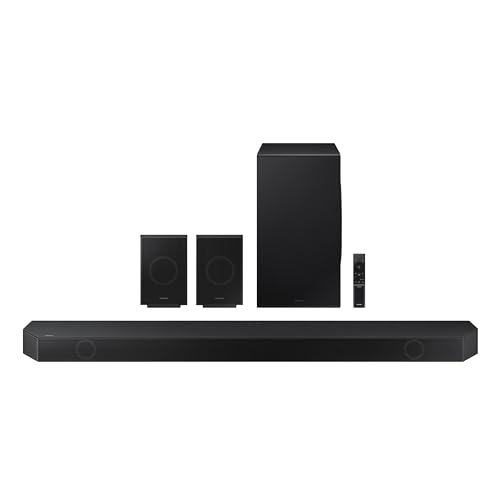
Samsung HW-Q600C 3.1.2ch Soundbar
A 3.1.2-channel soundbar with a centre channel for dialogue, up-firing drivers for Dolby Atmos, a wireless subwoofer and HDMI eARC. Samsung’s Q-Symphony lets it play together with compatible Samsung TV speakers. Check price on Amazon.
Common Misconceptions
Assuming any ‘Atmos’ bar has up-firing drivers
Some bars process Atmos virtually with no height drivers at all. The channel count (a ‘.2’ figure) and driver description separate the two designs.
Feeding Atmos through an optical cable
Optical cannot carry Atmos. If your chain includes optical, you are listening to a lesser format regardless of what the bar can do.
Blaming the bar when the TV is set to PCM
A TV outputting PCM stereo sends stereo. Atmos requires passthrough settings on the TV and the source — the most common ‘broken Atmos’ is a menu, not a product.
Expecting height effects under a vaulted ceiling
Reflections need a flat ceiling at a workable height. Architecture can defeat the method entirely, and no setting compensates.
Key Takeaways
- Verify Atmos on the bar’s display or app while a known Atmos film plays.
- eARC plus passthrough is the connection recipe for full Atmos.
- Flat ceiling, clear bar top, seat in the reflection zone — the three physical conditions.
- Judge Atmos with ambience scenes, not only helicopter demos.
Going Deeper: Context That Helps
A wireless subwoofer changes what a soundbar can do more than any other single feature. The bar handles voices and effects; the subwoofer, placed near a wall or corner, reproduces the low rumble of films and the body of music. Because low bass is hard to localise, the sub can live beside the sofa or next to the TV stand, wherever a power socket is convenient — it only needs power, since the audio link is wireless. If a bar sounds thin, first check that the subwoofer is paired, powered and not turned down in the settings before concluding the bar itself is weak.
Soundbar sizes should match the TV, mostly for looks and partly for sound. A bar much narrower than the TV looks lost and spreads sound over a smaller width; a bar wider than the TV stand risks overhang. Measure the stand, check the height of the bar against the bottom edge of the screen so it does not block the picture or the TV’s remote sensor, and leave a little clearance in front of up-firing Atmos drivers. Wall-mounting is an option on most bars, but a stand is simpler, kinder to cables and easier to reposition while you fine-tune the sound.
Room size decides how much soundbar you need. In a bedroom or small flat, a compact bar already plays far louder than you will use, and a huge flagship adds cost without benefit. In an open-plan living space with high ceilings, sound dissipates, Atmos height effects weaken because they rely on ceiling reflections, and a bar with a separate subwoofer — or the option to add rear speakers later — earns its keep. Be honest about the room you have rather than the room in the advertisement: most soundbar disappointment comes from buying for the wrong space, not from buying a bad product.
Soundbars and gaming have a specific requirement: low latency. Audio that arrives late feels as wrong in a game as late video, and some TV processing adds delay to both. Connecting a console through the TV with eARC passthrough, or into the bar itself where it has HDMI inputs, and enabling game mode on the TV keeps sound and action together. If voices in cut-scenes drift from lips, the fix is almost always a setting — the TV’s lip-sync or the bar’s audio delay adjustment — rather than a defect, and it is worth learning where that setting lives before you need it mid-game.
Firmware updates quietly fix many soundbar problems. Manufacturers patch HDMI handshake bugs, app issues and format support through updates delivered over Wi-Fi or USB, and a bar that has sat in a warehouse may ship with early software. When you set up a new bar, run its update before judging it; when an old bar develops a new quirk after a TV update, check for a bar update too, because the two devices negotiate constantly over HDMI. Keeping the maker’s app installed on your phone makes these updates painless and also unlocks EQ and level controls the remote may not offer.
A soundbar is not only for films. For music, most bars sound best in a stereo or music mode with virtual surround switched off, because surround processing smears the stereo image that music is mixed for. Bluetooth and Wi-Fi streaming make the bar the easiest speaker in the house to play music through, which is why many households end up using it daily for radio and playlists. If music matters to you, judge a bar with your own favourite tracks during the return window, at your normal volume, from your normal seat — film demos in a shop flatter almost everything.
Accessibility features deserve more attention than they get. Many bars offer dialogue modes with several levels of voice boost, some TVs can send audio to both a bar and hearing aids or headphones at once, and Bluetooth output on some models lets one listener use headphones while others use the bar. For households where one person struggles with TV sound, these features change daily life more than surround formats do. Check the manual’s accessibility section before buying if this matters to you — the information is rarely on the box but often present in the product.
Placement rules for soundbars are simple but strict. The bar belongs at ear height when seated, or as close as the TV stand allows, centred on the screen, with its front edge near the front of the stand so sound does not reflect off the stand’s surface. Never put a bar inside a closed cabinet: the doors and shelves block and colour the sound, and heat builds up. Up-firing Atmos bars additionally need a clear path to a flat ceiling — beams, ceiling fans and very high or vaulted ceilings all weaken the height effect, though the bar will still sound good as a normal surround bar.
When a soundbar system grows, it grows in a predictable order. First the bar, then — if bass feels light — a subwoofer; then, if surround effects feel front-bound, rear speakers; the rears add more immersion per step than any processing upgrade. Systems that allow these additions let you spread the cost and learn what your room actually needs. The alternative, a complete package with sub and rears in one box, costs less overall and guarantees the parts match. Neither route is wrong; the mistake is buying a sealed all-in-one bar while expecting to add rears to it later, because most cannot.
Whatever the product, the cheapest upgrade is usually time spent with the manual and the settings menu. Manufacturers bury genuinely useful options — EQ presets, dialogue modes, level trims, firmware updates — several layers deep, and most owners never find them. An hour spent exploring settings with familiar content playing will teach you more about your system than a week of reading reviews, and it costs nothing. Keep notes of what you changed so you can undo anything that makes things worse, and change one thing at a time so you know which adjustment caused which result.
Returns windows are part of the buying process for audio gear, and you should use them deliberately. Sound is personal and room-dependent, so a product that reviews well can still disappoint in your space. Buy from sellers with clear return policies, keep packaging until you are sure, and test with your own content at your own volumes in the first days — not the night before the window closes. A structured test, with the same three songs or scenes each time, reveals differences that casual listening misses and turns a vague feeling into a decision you can act on.
Hearing safety deserves a mention in any audio guide. Comfortable TV and music listening sits well below the levels that risk hearing damage, but portable speakers at parties, and headphones especially, can creep upward in noisy environments as you compete with background sound. If you have to shout to be heard over your own system, it is too loud for long sessions. Many devices offer volume limiting — worth enabling for children — and taking listening breaks during long sessions protects both your ears and your enjoyment, because tired ears judge sound poorly.
A soundbar’s biggest advantage is also its limitation: everything lives in one wide box under the TV. That makes setup simple and dialogue clear for most viewers, but the left and right channels are only as far apart as the bar is wide, so true stereo separation is narrower than two separate speakers can give. Virtual surround processing tries to widen the picture with psychoacoustic tricks, and on many films it works surprisingly well from a single seat. Understanding this trade-off helps you choose: if you mostly watch dialogue-heavy TV from one sofa, a bar is ideal; if you listen to music critically across a wide room, separate speakers still lead.
HDMI eARC is the connection that matters most on a modern soundbar. It carries full-quality audio from the TV — including Dolby Atmos from streaming apps and consoles — down a single cable, and it lets the TV remote control the bar’s volume. Optical connections are reliable but limited to older surround formats and cannot carry Atmos from most sources. When a soundbar misbehaves — no sound, wrong format, lip-sync drift — the cable and the TV’s audio output settings are responsible far more often than the bar itself, so always check the TV’s menu for eARC, passthrough and PCM settings before assuming the bar is faulty.
Frequently Asked Questions
Do I need special speakers in the ceiling for Atmos?
No — that is the point of the soundbar implementation. Up-firing drivers in the bar reflect height sound off your existing ceiling, creating the overhead impression without installed speakers. Component home theatres can use real ceiling speakers for greater precision, and some soundbar systems add up-firing rear speakers, but a soundbar alone, in a room with a suitable ceiling, delivers genuine Atmos height effects. The ceiling itself becomes part of the system, which is why its shape and height matter.
How can I tell if Atmos is actually playing?
The soundbar will tell you: most Atmos bars show the incoming format on a display, an LED indicator or their companion app when playback starts. Check while playing content you know carries Atmos, such as a recent streaming film labelled with the Atmos badge. If the bar reports stereo or standard surround instead, the chain is broken somewhere — usually the TV’s audio format (set it to Passthrough), the source’s output settings, or an optical cable somewhere in the route.
Does Netflix and streaming TV include Atmos?
Much of it does: many films and series on the major streaming services carry Atmos soundtracks, identified by a badge on the title’s page, though availability can depend on your subscription tier and the app on your device. Broadcast and catch-up TV mostly remains in standard surround or stereo. Games on current consoles also use Atmos widely. Your library is probably more Atmos-ready than you expect — which makes verifying the chain, so it actually arrives, the worthwhile exercise.
Will Atmos work in my room?
It works best with a flat, hard ceiling of roughly standard height, the bar unobstructed on top, and seating a few metres in front of the TV. Very high, vaulted, beamed or heavily treated ceilings scatter or absorb the reflections and weaken the effect — the bar still performs as a good surround bar, but the height layer fades. If your room is unsuitable, spend the Atmos premium on a better non-Atmos bar or on separate height speakers in a component system instead; the soundtrack deserves a method your architecture supports.
Is Atmos worth it on a soundbar?
In a suitable room, with a film-heavy diet, yes: the height dimension is a real addition, and ambience and effects gain a spatial quality that standard surround cannot match. For speech-led viewing, sport and casual TV, Atmos contributes almost nothing, because that content does not use it. Judge by your content and ceiling, not by the badge. And judge systems with real up-firing drivers more seriously than virtual processing, which offers a suggestion of the effect at a friendlier price.
What is the difference between Atmos and regular 5.1 surround?
5.1 surround places sound around you at ear level through five channels and a subwoofer. Atmos adds a height layer and object-based placement: sounds are positioned in a 3D space and rendered to whatever speakers exist, so effects can travel overhead and locate more precisely. An Atmos soundtrack played on a 5.1 system still works — it renders without the height — and a 5.1 soundtrack on an Atmos bar plays as 5.1, sometimes with optional upmixing. Atmos is an addition to surround, not a replacement for its foundations.
Atmos in Music, Games and Sport: Beyond the Film Demo
Most demonstrations use film rain and helicopters, but object-based audio now appears in music and games too, and it behaves differently in each. Atmos music mixes place instruments and voices in a space around and above the listener; through a soundbar, the effect is a broader, taller presentation rather than pinpoint placement, and opinions divide sharply between listeners who hear spaciousness and those who hear their favourite records rearranged without permission. A plain stereo mode remains the honest reference, and a good bar lets you switch between the two instantly so the choice stays yours, track by track.
Games and the value of height information
Games use height cues functionally: threats above, weather overhead, a structure’s vertical scale. A bar that renders even a gentle sense of above adds information, not just atmosphere, and players notice it in environments designed with verticality. The benefit depends on the whole chain agreeing — the console or computer set to output the object format, the television passing it through untouched, and the bar confirming what it receives. When any link silently substitutes plain surround, the height layer vanishes without an error message, which is why learning to read the bar’s format display is a gaming skill as much as a film one.
Sport is the modest case: crowd atmosphere gains a little height and spread, commentary stays where it belongs in the centre, and nobody’s evening is transformed. That modesty is instructive. Atmos rewards content mixed with intent to use the height layer, and much everyday television simply is not, so a buyer whose viewing is mostly sport and news should weight the feature accordingly rather than imagining every broadcast arrives with a ceiling of sound.
Ceiling Types and Room Shapes: A Practical Audit
Up-firing height drivers bounce sound off the ceiling, so the ceiling is effectively one of your speakers, and it deserves inspection. The ideal is flat, hard, unobstructed and at a moderate, even height across the listening area. Painted plaster and similar surfaces reflect predictably. Wood beams break the reflection into pieces. Acoustic tiles and heavy texture absorb it. A ceiling fan sitting in the reflection path interrupts it in a way no setting can repair, though moving the seating or the bar a short distance sometimes moves the reflection point clear of the fan entirely.
Vaulted, sloped and very high ceilings
A sloped ceiling sends the reflection away from the seating at an angle, weakening or misplacing the height effect depending on the slope’s direction. A very high ceiling stretches the reflection path until the effect is faint and late. In such rooms, honest alternatives exist: some systems offer height virtualisation that synthesises the impression without relying on a bounce, and some owners add true height speakers to a theatre instead. What does not work is turning the height channel level up and hoping; level cannot fix geometry, it can only make a misplaced effect louder.
Open-plan spaces complicate the audit further, because the ceiling above the bar may differ from the ceiling above the sofa, and side walls for reflected surround may exist on one side only. Walk the reflection path with your eyes: from the bar’s top drivers, to the ceiling point roughly midway to your seat, down to your ears. If that path crosses beams, fans, a stairwell void or a change of ceiling height, temper expectations for height effects and weight the bar’s ordinary surround and dialogue performance more heavily in your decision.
Telling Whether Atmos Is Working on Any Given Evening
Because the chain has many links, develop a verification habit rather than a suspicion habit. Choose one scene you know contains unmistakable height activity — heavy rain, an aircraft pass, a storm — and learn how it sounds when the format indicator confirms the object format is arriving. That becomes your reference. When a new app, a new source or an update enters the system, replay the scene and check the indicator first and your ears second; the indicator tells you whether the format arrived, and your ears tell you whether your room is making anything of it, and those are separate questions with separate fixes.
Per-app and per-source differences
Streaming services vary: some offer the object format only on certain subscription tiers, some only on certain devices, and some titles carry it while others in the same catalogue do not. The title’s information page usually lists its audio format, and checking there prevents blaming the bar for a stream that never contained height information. Disc players and consoles have their own output settings that can downmix at the source. Methodically, source by source, confirm each device is set to send the best format it can, and record the settings; the chain is only ever as strong as its least-configured link.
Television ARC generations matter here too. The object format in its compressed streaming form can travel over plain ARC in many implementations, while the lossless disc form requires eARC or a direct connection into the bar. Owners mystified that streaming Atmos works while disc Atmos does not are usually meeting exactly this distinction, and the cure is routing the disc player through the bar or upgrading the television link, not replacing the bar in frustration.
Height Channel Levels and Calibration Choices
Most Atmos bars let you adjust height channel level, and restraint is the skill. Raise it until height effects in your reference scene are clearly present from your seat, then stop; pushing further detaches effects from the scene, so rain sounds like it is performed by the ceiling rather than falling through the air of the film. Re-check with dialogue at normal volume afterwards, because some implementations smear a little of the front presentation when height processing works hard, and the balance you want is presence without distraction.
Automatic calibration and its limits
Room calibration systems measure distances, levels and some reflections, and they earn their keep, but they cannot know your ceiling material or that a fan blocks one path. Treat the calibrated result as a strong draft, then adjust height level by ear with your reference scene and save your preference if the bar allows per-input or per-mode memories. If calibration produces a result that sounds worse than the uncalibrated default — it happens, particularly in odd-shaped rooms — believe your ears, disable it, and set levels manually; the microphone measures the room, but you are the one who has to live in it.
Revisit the height settings after furniture changes that alter the reflection environment: a large rug will not trouble the ceiling bounce, but a new bookcase under the reflection point, a lowered ceiling light fitting or a moved sofa changes the path. A two-minute reference-scene check after such changes keeps the effect honest, and it is far quicker than wondering for a month whether films have simply become less exciting.
Is Atmos Worth It For You? A Sober Decision Framework
Weigh four things: your ceiling, your content, your sources and your seating. A cooperative ceiling, a film diet rich in modern blockbusters and prestige drama, sources and a television that can deliver the format, and a main seat in the reflection zone together make a strong case. Each missing element weakens it, and two missing elements usually reduce Atmos from a feature to a badge. In that case, the same money spent on a better non-Atmos bar — better drivers, better centre, better subwoofer — will improve every single evening rather than a subset of them.
The long view on formats
Object-based audio is now a settled part of how films and prestige television are mixed, not a passing novelty, so a bar bought with genuine height capability will not be stranded by the content. The reverse is also true: a household that buys Atmos must still feed it, through subscriptions, sources and settings, year after year. Decide whether you are buying a capability you will actively use or a logo you will occasionally remember, and spend accordingly; both decisions are respectable, but only one of them is good value for your particular home.
Atmos on Headphones and the Wider Ecosystem
Object-based audio escapes the soundbar more often than owners realise. The same mixes feed spatial audio on headphones, where the effect is rendered binaurally — computed for two ears rather than bounced off a ceiling — and can be startlingly convincing for late-night film watching that must not wake a house. Knowing this reframes ownership: a household may enjoy height-channel content through the bar on film night and through headphones on a Tuesday, from the same subscription and the same title, with the television or source doing the rendering in each case. Check what your sources offer for headphone listening before assuming the bar is your only door to the format.
Soundbars in the format’s future
Bars will keep absorbing channels and cleverness, but the format’s centre of gravity is stable: content mixed as objects, rendered by whatever the listener owns. That stability is good news for today’s buyer, because a bar that decodes the current object formats participates in an ecosystem rather than betting on one. The developments to watch are not more channels but better rendering in difficult rooms — calibration that understands ceilings, reflections used deliberately rather than hopefully — and those improvements will arrive, as they always do, first in flagship bars and then, within a generation or two, in the sensible middle of the market where most households rightly shop.
Until then, the honest summary of Atmos on a soundbar is that it is a real effect, unevenly available, room-dependent and content-dependent, which rewards the buyer who audits their ceiling, their sources and their viewing diet before paying for it. Audited and matched, it adds a dimension that owners who have it rarely volunteer to surrender. Unaudited, it is the most expensive logo in home audio. The difference is not the product; it is the ten minutes of checking this guide exists to encourage.
Common Atmos Questions From the Sofa, Answered Plainly
Owners ask whether height effects should be obvious in every scene. They should not: most scenes in most films use the height layer sparingly, for weather, space and occasional movement, and a system that advertises height constantly is exaggerating it. They ask whether older films gain anything; a classic film’s soundtrack contains no height information, and any height effect a bar synthesises from it is an interpretation, enjoyable for some, best switched off by purists. They ask whether the effect survives low volume; largely yes, because the reflection geometry does not change with level, though quiet listening naturally draws attention back to dialogue, where it belongs.
Children, guests and the demonstration temptation
Every Atmos owner knows the urge to demonstrate: the rain scene, the aircraft, the amazed visitor. Indulge it — the format’s pleasures are social — but set the system’s everyday levels for the films, not for the demonstration, because a height channel tuned to impress a guest in ninety seconds will distract the household for ninety minutes. The demonstration is the format’s party trick; the film, unbroken and unremarked, is its purpose, and the systems that serve the purpose best are the ones whose owners have stopped noticing them at all.
Atmos for the Hard of Hearing and Dialogue-First Households
An under-discussed virtue of well-implemented object audio is separation: because sounds are placed rather than merely mixed, dialogue can hold its own space against effects and music with unusual clarity, and several systems let the listener favour that centre object deliberately. For households where hearing is imperfect, this matters more than helicopters. The buying implication is practical: such households should audition Atmos bars with dialogue in a busy scene, not with the rain demonstration, and should value the centre-channel controls and speech modes that accompany the format in better implementations. Height may be the headline, but for many homes the format’s real gift arrives at ear level, in the voices, every single evening.
Subtitles, and designing for real ears
There is no shame in the combination that serves many households best: a good bar, a clear centre, and subtitles for the most demanding scenes. Technology choices should follow the listeners who actually exist rather than an idealised audience, and a system chosen to make speech effortless — by placement, by centre clarity, by the format’s separation — will be thanked nightly by the people it was bought for. Judge every feature, Atmos included, by that standard and the marketing falls away, leaving the only question that matters: what does this do for the voices in our programmes, in our room, for our ears?
Atmos in Small Rooms and Bedrooms: A Different Calculation
Small rooms change the Atmos equation in the buyer’s favour in one way and against it in another. The reflection path is short, so height effects arrive strong and clearly defined from a modest bar; but the seating is close, so the front soundstage is narrow and the height layer can dominate if its level is not set with restraint. Bedroom systems add the low-volume dimension: at the levels a sleeping household permits, height effects recede and dialogue rules, so a bedroom buyer should weight the centre channel and night performance first and treat Atmos as a welcome extra for weekend films rather than the reason for the purchase. The format scales down gracefully when it is bought for the right reasons and set up for the room it is actually in.
Renters, ceilings you cannot change and honest alternatives
Renters cannot install ceiling speakers and often cannot even paint, which makes the soundbar route the only Atmos route available — a genuine point in its favour that has nothing to do with demonstrations. Where a rented ceiling is vaulted, beamed or otherwise uncooperative, height virtualisation or a plain excellent surround bar may serve better, and the renter’s consolation is portability: the system that fits this flat’s ceiling problem leaves with you, and the next flat may have the flat, moderate ceiling this one denied you. Buy the bar whose non-Atmos virtues you love, in other words, and let Atmos be the bonus your current ceiling allows rather than the promise it cannot keep.
Reading an Atmos Product Page Without Being Hypnotised
Product pages for Atmos bars deploy a vocabulary designed to blur the distinctions this guide has drawn, so translate as you read. Decoding means the bar can understand the format; rendering with physical height drivers is a separate claim that should name the drivers. Virtual or simulated height is a third thing again, honest when labelled and misleading when dressed in the same language as the physical version. Channel counts that end in .2 or .4 refer to height channels, and their presence in a number says nothing about whether those channels have their own drivers. Read for the driver list, the connection requirements and the room assumptions, and the page becomes a specification again rather than a spell — and a bar whose maker describes its method plainly has told you something encouraging about the company behind it.
Related Guides
These guides and roundups cover the closest decisions and fixes in this category:
- best ceiling speakers for atmos
- best soundbars for home theater
- best soundbars for lg c1
- best soundbars for gaming
- how to position a soundbar
- soundbar vs home theater system
Does Atmos work with the soundbar on a stand or must it be wall-mounted?
Either works, provided the up-firing drivers have a clear path to the ceiling and are not shadowed by a shelf, the television or the edge of a deep unit. On a stand, keep the bar at the front edge with nothing above it. Wall-mounting changes the reflection angle slightly but not fundamentally; what matters is the unobstructed bounce path from the top of the bar to the ceiling and down to your seat.
Why do some films show Atmos on the box but play in plain surround?
Because the format has to survive every link: the specific stream or disc edition, the subscription tier, the source device’s output setting, the television’s passthrough setting and the connection type. Any one link set to a safer default quietly substitutes ordinary surround. Check the title’s format listing, then each device’s output setting in order from source to bar.
Can I add height speakers to a non-Atmos soundbar later?
Only within a maker’s ecosystem that explicitly offers it, and only if the bar itself can decode the object format; height speakers cannot give decoding ability to a bar that lacks it. If Atmos is a future ambition, buy a bar that already decodes it, even if you initially use it without height effects, rather than hoping to retrofit the core capability later.