The oled vs mini led tv comparison is the closest contest in modern televisions. Mini LED is the most advanced form of LCD, using thousands of tiny backlight LEDs grouped into many local dimming zones behind a liquid crystal panel, while OLED lights each pixel itself. Premium Mini LED sets have narrowed the contrast gap dramatically while keeping a clear brightness lead, so the right choice now depends on fine details: blooming, viewing angles, room light and what you watch most.
This guide compares the two across black levels, brightness, HDR, gaming and everyday ownership. If you are choosing a flagship television for a mixed use living room, this is likely your exact decision, and the honest answer is that both are excellent; the sections below help you find which excellence matches your room, your seats and your habits.
Disclosure: As an Amazon Associate, kajuandouglas.com earns from qualifying purchases. Links to Amazon on this page are affiliate links; they cost you nothing extra. Listing details such as price and availability change often, so check the current Amazon listing before you buy.
Quick answer: Quick verdict: choose OLED for the cleanest dark scenes, zero blooming and the widest viewing angles. Choose Mini LED for maximum brightness, big screen value in bright rooms and carefree long hours with static content. For a mixed living room, judge blooming in a dark scene and brightness in daylight, then decide.
OLED vs Mini LED TV: Side-by-Side Comparison
The table below summarises the contest before the detailed sections argue each criterion in full.
| Criterion | OLED | Mini LED (advanced LCD) |
|---|---|---|
| Light control | Per pixel; every pixel is its own light source | Hundreds to thousands of dimming zones behind the panel |
| Blooming around bright objects | None, because neighbouring pixels stay off | Possible faint halo in dark scenes, reduced as zone counts rise |
| Peak and full screen brightness | Moderate; highlights are strong but large bright areas are limited | High; bright highlights and bright full scenes are its signature strength |
| Viewing angles | Excellent, holds contrast and colour off axis | Improved on many models, but generally narrows sooner than OLED |
| Dark scene shadow detail | Outstanding, with precise control at every brightness step | Very good, though zone transitions can slightly lift or crush near black detail |
| Static content over long hours | Care needed with fixed elements over extreme cumulative use | No equivalent concern, suits news, dashboards and long gaming interfaces |
In this guide
Blooming, Zones and the Dark Scene Test
Blooming is the faint halo you can see around a bright object on a dark background on an LCD set, caused by a dimming zone covering an area larger than the object itself. Mini LED shrinks zones dramatically compared with older backlights, and premium models control them so well that blooming is subtle in most content. It remains most visible in extreme cases: subtitles on black, a moon in a night sky, or starfields, viewed in a dark room from an angle.
OLED simply has no zones, so those scenes are exact. The trade off is that OLED cannot match Mini LED sheer light output in a bright room. The practical test is to watch the darkest content you love, such as a space film or a night drama, on both in a dim setting. If you never notice blooming on the Mini LED set in your normal viewing, its brightness advantage may be worth more to you than OLED perfection in scenes you rarely watch.
HDR Performance in the Real World
High dynamic range rewards both technologies differently. OLED renders HDR with perfect placement: every highlight sits against true black, so city lights, candles and explosions have striking precision. Mini LED renders HDR with force: higher peak brightness and strong full screen output make daylight scenes, sport and bright film moments feel sunlit and physical. Tone mapping quality matters on both, because a set must decide how to fit very bright mastered content onto its panel.
Room light changes the verdict again. In a dark room, OLED HDR precision usually wins the evening. In a bright room, ambient light washes out the subtle near black advantages of both sets, and Mini LED brightness and reflection handling keep HDR looking vivid at midday. Many households find the deciding factor is not HDR at all, but the simple question of when the television is watched most, and how large the screen needs to be for the room.
Gaming, Size and Ownership Over Years
Gamers get high refresh panels, low input lag and variable refresh support on flagship models of both types. OLED pixel response is effectively instant, giving the cleanest motion in fast games. Mini LED counters with brightness that keeps daytime gaming punchy and no concern about static interfaces during very long sessions. For mixed gaming and film use in a controlled room, OLED has the edge; for a bright family room that games all weekend, Mini LED is the relaxed choice.
Ownership also includes size economics. Mini LED has historically offered very large screens at lower tiers than equivalent OLED models, which matters when the room demands the biggest panel. OLED ownership asks for sensible habits with static content and benefits from varied viewing. Neither technology needs special maintenance beyond that awareness, and both will outlast the streaming devices and consoles you connect to them over the years.
Who Each Option Suits
- Choose OLED if: You watch in a dark or controlled room, you notice blooming easily, your seating spreads wide, and your content is films, drama and fast paced gaming.
- Choose Mini LED if: Your room is bright, you want the largest screen your tier allows, the set runs long hours with news, sport or game interfaces, and HDR punch matters more than absolute black precision.
- Either serves you well if: You buy at the premium tier for a mixed living room; then specific model dimming quality, reflection handling and smart features should break the tie.
Final Recommendation
Final recommendation: run the two tests that separate them, a dark scene for blooming and shadow detail, and a bright scene in daylight for punch and reflections. Film focused dark room viewers should choose OLED. Bright room, big screen and long hours viewers should choose Mini LED with confidence. Both are flagship technologies; the loser in this comparison is still an excellent television.
Zone Counts, Processing and Why Numbers Only Tell Half the Story
Mini LED marketing leads with zone counts, and while more zones genuinely help, the processing that drives them matters as much. A well tuned processor anticipates scene changes, dims smoothly without visible pumping, and protects small highlights from being crushed by aggressive dimming. A poorly tuned high zone panel can look worse than a modest zone panel with excellent processing, blooming on subtitles while dimming stars out of the sky. This is why demonstrations with real content, a subtitled dark scene and a starfield, reveal more than any specification table.
OLED has no zones to tune, which makes its performance predictable: every model shows the same perfect placement, differing mainly in brightness and processing polish. That predictability is itself a buying advantage at the flagship tier, because the dark scene performance you saw in the showroom is the performance you take home. With Mini LED, audition the exact model, because the variance between a great and an ordinary implementation is the largest in the television market today.
Brightness in Detail: Peaks, Windows and Sustained Output
Brightness claims need unpacking on both sides. Peak figures are measured on a small bright window against a dark background, the easiest test for any panel. Full screen sustained brightness, what a bright sports field or a snowy scene demands, is lower on both technologies and separates them most: Mini LED sustains far more. OLED automatic brightness limiting protects the panel during long bright scenes, which dark room viewers never notice and bright room viewers always do. Ask for both figures when comparing, and weight the sustained one by how much bright content fills your viewing.
There is also a comfort dimension. In a dark room, extreme brightness is not a benefit; it is eye strain during scene changes. Flagship sets of both kinds include sensible limiting in their accurate modes for exactly this reason. The mature conclusion is that brightness is a room matching exercise, not a contest: enough to defeat your ambient light with headroom, and no purchasing credit for numbers beyond that point. Spend the surplus on size, sound or the other technology strengths instead.
Real-World Scenarios and Examples
Abstract advice lands differently in real rooms. These scenarios apply the guidance above to the situations readers describe most often.
- The mixed flagship living room: Films at night, sport on bright weekends. Audition both with a subtitled dark scene and a midday match; the one whose weakness you notice less is your answer.
- The subtitle heavy household: Foreign films with subtitles every night in a dark room. OLED, because subtitle blooming on zone based sets will be seen in every single scene.
- The biggest screen on the tier: The room demands the largest class. Mini LED usually delivers the size within tier, with dark scene performance that is excellent rather than perfect.
- The bright games room: Consoles in use all weekend with static interfaces. Mini LED brightness and static freedom suit the pattern of use precisely.
- The perfectionist cinema corner: One seat, lights out, reference discs. OLED, auditioned once, bought with confidence, because its performance is the most predictable in the market.
Gear for This Guide
These verified Mini LED examples and a flagship soundbar show the kind of short list buyers in this comparison usually audition together.

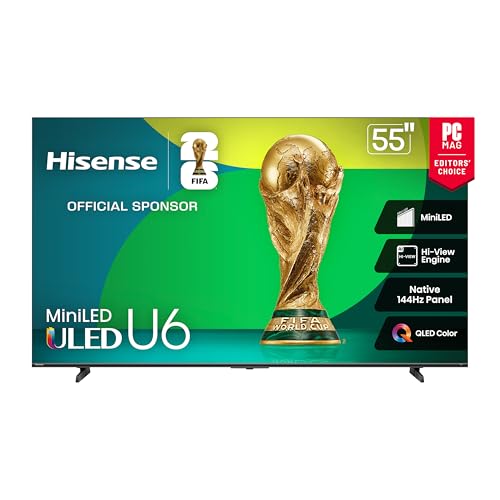
Hisense 55″ Class U6 Series Mini-LED 4K UHD Smart Fire TV (55U65QF, 2025 Model) – QLED, Native 144Hz, HDR10+, Dolby Vision IQ, Dolby Atmos, Game Mode Pro, ALLM, Alexa Built in, Black — A Mini LED set with a high native refresh rate and Dolby Vision IQ, representing the Mini LED side of this comparison in current form. Check price on Amazon.

Panasonic W95 Series (2024 Model) 55-inch Mini LED 4K Ultra HD Smart Fire TV, Local Dimming, 144Hz Refresh Rate – 55W95AP — Another Mini LED example with strong local dimming and a high refresh panel, useful for judging blooming and brightness side by side in store. Check price on Amazon.

Sonos Arc – White – Soundbar with Dolby Atmos — A Dolby Atmos soundbar that completes either flagship panel choice for film nights, connecting through HDMI eARC. Check price on Amazon.
Mini LED, Explained Without the Halo of Marketing
What the name describes and why it matters
- Mini LED is a backlight technology: thousands of very small light-emitting diodes behind the panel, grouped into dimming zones that brighten and darken with the picture. Smaller lights mean more zones, finer control, and a closer approach to the contrast of a self-lit panel, while retaining the backlit family’s virtues of high brightness and freedom from burn-in concerns. It is best understood not as a rival species to the self-lit panel but as the backlit idea refined toward it, and its performance in any given model depends on zone count, processing intelligence, and panel quality working together.
- Zone counts invite the usual number worship, and the usual correction applies: implementation decides. A well-processed model with fewer zones can outperform a poorly processed one with more, because the art lies in deciding, in real time, how each zone should behave at the edge of a bright object on a dark field. Judge with the hardest scenes, as this guide will repeat: a candlelit face, a starfield, white credits on black, a torch in a cave. Those scenes are the technology’s examination, and brochures are not admitted to the room.
Blooming: the signature compromise, assessed fairly
- Blooming, the halo of light around bright objects on dark backgrounds, is Mini LED’s characteristic compromise, the visible cost of lighting an area rather than a pixel. Modern models have reduced it impressively, and in most content, bright scenes, sport, ordinary drama, it is simply absent because the whole field is lit. It appears in the extremes, and its visibility depends on the scene, the viewing angle, and the viewer’s sensitivity. Off-axis viewing can increase it, which matters for wide seating arrangements, while the viewer square to the screen in a dark room sees the technology at its best.
- The self-lit panel has no blooming because it has no zones, and that fact should be stated as plainly as Mini LED’s brightness advantage. The comparison is a trade between two specific, describable behaviours, not a contest of virtue. Your content decides which behaviour you will meet more often: a library of dark, atmospheric cinema meets blooming’s examination weekly, while a diet of sport, bright drama, and daytime viewing may never set the examination at all.
Brightness and HDR: Where Mini LED Presses Its Case
Sustained brightness and the bright-room argument
- Mini LED’s headline virtue is brightness with control: not only peak highlights but sustained, full-screen output that fills a bright room and gives HDR its intended impact in daylight conditions. Sunlit sport, bright family viewing, and rooms where curtains are a negotiation rather than a fixture are its home ground. In those rooms, the self-lit panel’s perfect blacks are a virtue the ambient light partially masks, while Mini LED’s brightness is a virtue every hour uses. The comparison, once again, is decided by the room’s light more than by the panels’ potential.
- HDR performance follows from this: specular highlights, sunlit exteriors, and bright effects carry genuine force, while dark scenes are handled well and, in the hardest cases, with the blooming caveat already described. For the viewer whose HDR life is dominated by bright, spectacular content, sports broadcasts, nature documentaries in daylight colours, blockbuster action, Mini LED’s presentation can be the more thrilling of the two, and thrill is a legitimate criterion when the purchase is, after all, an entertainment machine.
Size and value at the largest diagonals
- At the largest screen sizes, Mini LED models frequently deliver the diagonal, the brightness, and the feature set at prices that make the self-lit alternatives a serious step up, and large screens disproportionately live in large, bright rooms where Mini LED’s virtues compound. For the household building a big-screen room around daylight viewing, gatherings, and sport, that alignment of price, size, and conditions is powerful. The household building a dedicated dark cinema at the same size faces the reverse alignment and should weigh the self-lit panel’s premium against the room’s darkness with equal honesty.
- As with every comparison in this series, count the complete installation: at these sizes, mounting, sound, seating distance, and light control are significant fractions of the experience and the budget. A Mini LED television in a room whose light has been thought about will outperform a self-lit flagship in a room that fights it, and vice versa, because rooms, in the end, are the senior partner in every viewing experience.
- Mini LED refines the backlight: many small zones, high sustained brightness, no burn-in concern, with blooming as its signature compromise in the darkest scenes.
- OLED’s pixel-level light eliminates blooming and delivers perfect blacks, with lower sustained brightness and a specific, habit-dependent burn-in risk.
- Bright rooms, sport, and the largest sizes favour Mini LED; dark-room cinema favours OLED.
- Implementation beats zone counts. Judge the exact models with the hardest scenes you own.
Gaming, Viewing Angles, and Long-Term Ownership
The gamer’s version of the choice
- Both technologies offer the modern gaming suite at their upper tiers: low lag, high refresh, variable refresh support, and the ports to use them. Mini LED brings brightness that suits gaming in lit rooms and removes any thought about static interfaces across marathon sessions, while the self-lit panel brings instantaneous response and perfect dark scenes for atmospheric games. The competitive player in a controlled room and the social player in a bright one are, once again, different customers wearing the same name, and their correct answers differ accordingly.
- Verify the exact model as always: gaming features live on specific ports, variable refresh implementations vary, and game modes interact with picture settings in ways worth discovering before the console’s first evening rather than during it. At these prices, the ten minutes of specification checking is the highest-value time in the entire purchase.
Angles, ageing, and the household’s geometry
- Viewing angle is the quiet decider in wide rooms. Self-lit panels hold contrast and colour far off to the sides; Mini LED models, depending on their panel type and any wide-angle layers, can lose contrast and gain blooming off-axis. Walk the room’s seats during your audition if you can, or weight this heavily if your seating is broad and fixed. A family spread across a wide sofa sectional experiences a different television at its ends than at its centre, and the technology choice decides how different.
- Ageing, honestly stated, favours neither dramatically: the self-lit panel asks for varied content and offers its mitigations, the Mini LED asks nothing and offers a backlight that will very gradually dim across many years. Both are decade-class purchases when matched to their rooms. The ownership risk in this comparison is not decay but mismatch, a dark-room panel in a sunroom, a bright-room panel in a cinema, and mismatch, unlike decay, is entirely preventable on purchase day by the method this guide keeps repeating: audit the room, audit the hours, audit the habits, then choose.
The Decision, Worked as a Checklist
Five questions that settle it
- Answer five questions in writing and the choice assembles itself. How dark is the room at your main viewing hours? What fraction of your viewing is dark, atmospheric content versus bright content and sport? How wide is your seating, and how much off-axis viewing really happens? Do your habits include the static-content patterns that make burn-in a live consideration? And at your size, what does each technology’s honest model cost, complete with sound and mounting? A household whose answers run dark, cinematic, narrow, varied, and budget-flexible has one answer; a household running bright, sporting, wide, static, and size-hungry has the other, and mixed answers point to whichever question describes the viewing you value most.
- Then audition the two finalists with the examination scenes: the candle, the starfield, the credits, the sunlit match, the face in mixed light. Let your own eyes, in conditions resembling your room, cast the deciding vote between two excellent technologies. That is not a cop-out but the correct epistemology for a purchase whose differences live in perception. The specifications brought you to the finalists; only seeing can crown one of them, and it should be your seeing, in your light, with your content.
Panel Care and Calibration Notes for Both Technologies
Getting the best from whichever you choose
- Both technologies reward the same ownership disciplines described across this series. Begin from the most accurate picture mode, calibrate black and white levels with patterns, disable the dynamic processing that rewrites the picture, and verify with the hardest scenes in your library. On the self-lit panel, respect its own care routines: let its pixel-refresh cycles run, vary content reasonably, and use sensible brightness for the room’s darkness rather than maximum by default. On the Mini LED, experiment with the local dimming settings, because their strength levels trade blooming against black depth, and the middle setting is frequently the one the maker tuned hardest.
- Keep notes of your settings per input, as the calibration guide advises, and revisit them when the room or the sources change. A flagship panel of either technology, casually configured, is a fraction of itself; the same panel, set up with an hour’s method, is the experience its price promised. The comparison between technologies occupies the internet, but the difference between a configured and an unconfigured television occupies the room, and it is larger. Choose well, then set up well, in that order, and the second step will repay you every evening the first one is forgotten.
Sound, Software, and the Rest of the Television
The parts of the purchase the panel debate ignores
- As in the companion comparison, the panel is only the most argued-about part of a television whose platform, remote, sound, ports, and update record will be met daily for a decade. Mini LED and self-lit models exist across makers and platforms, so the household’s ecosystem preferences can and should be satisfied within either technology. When two finalists stand close on picture, and in mixed rooms they often do, decide on the television as a whole: the interface your family will navigate, the sound system it must marry, the gaming features on the ports your console will actually use, and the maker’s support horizon counted from launch.
- Price the complete installation for each finalist as well, because at these sizes the mount, the sound, and the light control are real money and real experience. A Mini LED model whose saving funds the room’s curtains and a soundbar may deliver the better evenings against a self-lit model bought bare, while in a dark, already-equipped room the self-lit model’s premium goes entirely into the picture. Budgets are systems, and the best system wins, not the best component.
The second television and the mixed household
- The two technologies also divide a house gracefully: Mini LED’s brightness for the bright family room and sport, the self-lit panel’s darkness for the film room or the main evening screen. Households planning two screens can choose each purely, without compromise, and their experience will confirm nightly that the comparison was always about conditions. Even single-screen households benefit from seeing the choice this way, because it replaces tribal anxiety with a specification: this room, these hours, this content, this seating. Answer those four and the technology selects itself with an almost audible click.
- What remains after the click is the ownership this series describes: accurate modes set, calibration done with patterns, settings recorded, and the television left alone to do its work for years. The finest outcome of a comparison guide is a reader who stops comparing, because the decision has been made from evidence and the evenings have begun.
Calibration and Care: Getting Each Technology’s Best
Settings that flatter each panel honestly
- The accurate picture mode and pattern-set black and white levels transform both technologies, as they do every television in this series, and the differences begin after that shared foundation. On the self-lit panel, use brightness appropriate to the room’s darkness, let its care cycles run, and vary content as ordinary varied viewing naturally does. On the Mini LED, spend your experimentation on the local dimming control: its levels trade blooming visibility against black depth and highlight punch, and the right level is the one your hardest scenes approve, which is a judgement only your eyes, your room, and your library can make. Record the result per input, as always, so the television stays calibrated instead of becoming calibrated once, long ago, on one input.
- Motion settings divide viewers on both technologies and should be set by content: film left faithful, sport given the processing it needs to stay legible, and the household’s other viewers consulted before either is locked in as doctrine. Calibration is partly diplomacy, because the television serves a household, and the setting that one viewer calls pure another calls juddery. The method of this series, patterns for the thresholds, real content for the verdicts, an evening before judgement, applies to diplomacy as well as to engineering.
The audition protocol, spelled out
- Audition these two with intent, because their differences hide in specific scenes and reveal themselves nowhere else. Bring or request: a starfield or space scene, white credits rolling on black, a candlelit or torch-lit scene, a sunlit sports passage, a face half in shadow, and a slow pan across a detailed landscape. Watch each on both sets in the most accurate modes the shop will allow, from your home distance and from your widest seat’s angle, noting blooming, black depth, highlight behaviour, and off-axis changes separately rather than forming one blurred impression. The scene list is short because the differences are specific; a general demonstration reel is designed to flatter both and inform neither.
- At home, use the returns window as the second round: a week of your real viewing, in your light, with your seating, will settle what the shop’s hour suggested. Keep notes against the five questions in this guide’s checklist, and let the week’s evidence, not the first evening’s excitement, make the final call. Televisions at this level are decade purchases, and a week of evidence is a trivial premium on a decade of evenings.
Resale, second rooms, and the long game
- In the used and cascaded market, the two technologies age into different second lives. The self-lit panel’s value rides on its care history and suits dark second rooms, bedrooms with curtains, and film-loving relatives. The Mini LED’s brightness and indifference to static content suit bright kitchens, family rooms, and any room where the television works all day. Households that plan cascades can buy today’s main screen with its retirement room already in mind, a small act of foresight that doubles the useful life extracted from the purchase.
- For the buyer of a used flagship of either type, the checks mirror the new purchase with additions: hours and habits for the self-lit panel, backlight uniformity for the Mini LED, and for both, the paperwork, the remote’s condition, and a demonstration with the examination scenes rather than a cartoon. A well-kept example of either technology, bought with evidence, is among the best values in home entertainment, and the method that chooses a new television chooses a used one with only the questions reordered.
Environmental and Practical Footnotes
Power, heat, and the room’s ecology
- Power consumption follows each technology’s nature: the self-lit panel spends in proportion to the picture’s brightness, economical across dark cinema and hungrier in bright scenes, while the Mini LED spends in proportion to its backlight’s ambition, which bright rooms set high. In an ordinary household across a year, the difference is a footnote rather than a factor, and both deserve the same ventilation respect in enclosed installations that the mounting guide in this series prescribes. Let the footnote stay a footnote: households that choose panels by their electricity spend, ahead of their rooms and their content, optimise the smallest line in the ledger while the evenings, the actual purchase, go unexamined.
- Delivery and installation logistics are shared equally: at the sizes where this comparison bites hardest, both technologies arrive as fragile, two-person freight, and the prepared household, route measured, stand or mount ready, old set’s future decided, enjoys its first evening on schedule. The comparison’s last practical word is therefore identical for both finalists: whichever you choose, receive it like infrastructure, install it with the guides in this series, and calibrate it before you judge it, because an uncalibrated example of either technology is a rumour about itself.
The verdict for the undecided, restated plainly
- For the household still standing between these two excellent technologies after every audit, the tiebreakers run as follows. The darkest, most valued viewing outranks the brightest, most frequent. The hardest scenes in your library, the starfields and candlelit faces, outrank the average scene. The width of your seating outranks the centre seat’s perfection if your household truly spreads. Static-content habits outrank theoretical preferences. And when all four are exhausted and the choice remains, choose the one your eyes preferred in the audition’s hardest scene, because that preference, formed on evidence, is the one you will still agree with in the fifth year, when the specifications are forgotten and only the evenings remain.
Two More Rooms Decide: The Bedroom and the Games Room
Where each technology sleeps best
- Bedroom viewing is dark, close, and reclined: the last hour of the day at low brightness, from pillows that sit off the screen’s axis. Those are the self-lit panel’s home conditions, perfect blacks at low light and angles that forgive the pillows, and at bedroom sizes its price is rarely the obstacle. Mini LED serves the bedroom competently, but its brightness is idling and its blooming examination is set nightly by dark scenes, so the fixture favours the home team. As ever, the exception proves the method: the bedroom that doubles as a bright morning room, news with breakfast in bed and daylight streaming, reopens the question and may answer it the other way, because conditions, not room names, are what decide.
- The games room divides by its social geometry. Lit, social, spectator gaming with static interfaces across marathon sessions suits Mini LED’s brightness and indifference; solo, dark, atmospheric gaming suits the self-lit panel’s blacks and response. Most households contain one of these pictures clearly and the other faintly, and the clear picture should win. State which games room yours is, in one honest sentence, and the comparison’s work is done, leaving only the purchase, the setup, and the playing, which were the point all along.
What Reviewers Measure and What Evenings Reveal
Reading reviews of these televisions usefully
- Flagship reviews traffic in measurements taken in dark laboratories with instruments finer than any eye, and the measurements matter, but only after translation into your room. A laboratory contrast figure becomes, in a bright family room, a difference the ambient light politely erases; a zone count becomes, in your darkest film, either invisible or the only thing you can see, depending on processing the count never mentioned. Read reviews for behaviours, blooming in the examination scenes, sustained brightness across full scenes, off-axis changes at your widest seat, gaming features on your console’s ports, and treat every verdict that assumes a laboratory’s darkness or a showroom’s brightness as a verdict about those rooms, not yours.
- Then consult the owners, in aggregate, for the decade’s texture: update behaviour, support when faults appear, the remote’s and platform’s ageing, the care routines’ real burden. Manufacturers reveal themselves across years in their existing customers’ reports more honestly than in any launch. Weigh patterns over anecdotes, return to your five questions with the evidence assembled, and make the decision in your room’s name. The evenings you are buying will be spent there, not in the laboratory, and a choice that honours that fact will still look wise when the measurements are long forgotten.
Ownership, One Year On: What Each Panel Teaches Its Owner
The lessons only time delivers
- A year into ownership, the two technologies have taught their owners different literacies. The self-lit panel’s owner has learned their room’s darkness as a resource, schedules the great films for the evening without thinking about it, and barely remembers the burn-in discussion, because varied viewing made it theoretical. The Mini LED’s owner has learned their room’s brightness as a stage, watches sport at noon with the curtains open as a point of pride, and has strong opinions about local dimming settings that would baffle them a year earlier. Neither literacy is superior; each is the fluency of a tool matched to its conditions, and fluency, not specifications, is what a year of evenings actually produces.
- If you are choosing today, borrow that future fluency as your final test. Imagine yourself a year on, fluent in one panel’s character, in your room as it truly is across its seasons. Imagine the films, the matches, the games, and the ordinary Tuesdays. The panel whose fluency you can imagine with pleasure, in the room you actually have, is the one this entire comparison has been pointing at since its first section. Trust the imagination that has been fed with evidence, make the purchase, do the setup properly, and begin the year that turns a decision into a fluency of your own.
The Tiebreak of the Senses
What your eyes report at midnight
- When every audit is complete and the decision still trembles, there is one last instrument: your own eyes at midnight, in front of the hardest scene you own, on each panel in its accurate mode. One of them will make you lean forward; the other will make you reach for a setting. That difference, small in the shop and large across a decade, is the senses casting the vote the spreadsheets could not. Honour it, record your settings when you get home, and let the matter rest, because a decision your eyes made from evidence is one your evenings will keep ratifying.
Related Guides
- best tvs for living room
- best tvs under 1500
- best tvs under 2000
- best gaming tvs under 1000
- best 55 inch tvs under 1000
- how to calibrate a tv
- oled vs qled tv
Frequently Asked Questions
Does Mini LED have blooming compared with OLED?
Mini LED can show a faint halo, called blooming, around small bright objects on dark backgrounds, because each dimming zone covers many pixels. Premium models with many zones and good processing keep it subtle, and it is hardest to see head on in a lit room. OLED has no blooming at all because every pixel lights itself. Watch a subtitle heavy dark scene on both in a dim room; if the Mini LED halo does not bother you there, it will not bother you at home.
Which is brighter, OLED or Mini LED?
Mini LED is brighter, both in small HDR highlights and across full bright scenes such as sport and daylight film moments. That advantage is most valuable in bright rooms and for viewers who watch a lot during the day. OLED brightness is more than sufficient for evening and dark room viewing, where its perfect blacks matter more. Judge brightness in lighting that matches your home, because a dark showroom hides the real world difference in both directions.
Is Mini LED better than OLED for gaming?
Both are excellent for gaming, with low input lag, high refresh panels and variable refresh support on flagship models. OLED pixel response is near instant, so fast motion is exceptionally clean. Mini LED offers higher brightness for daytime play and no concern about static game interfaces over very long sessions. Competitive players in controlled rooms often lean OLED, while bright room and marathon session players often lean Mini LED. Either will serve a modern console very well.
How long do OLED and Mini LED TVs last?
Both technologies are built for many years of normal household use. Mini LED backlights are very stable over time. OLED panels include compensation routines that maintain uniformity, and for varied viewing they age gracefully. The main OLED caution is cumulative static content at high brightness, which varied film, series and sports viewing avoids. In practice, the electronics, software support and connected devices are more likely to age out before either panel type wears out in a normal home.
Why are large Mini LED TVs often cheaper than large OLED TVs?
Manufacturing economics differ. Very large OLED panels are costly to produce, while LCD panel production for large sizes is mature and scaled, and Mini LED adds its advanced backlight to that base. The result is that at the largest sizes, Mini LED models often sit in lower tiers than OLED equivalents. If your room demands a very large screen, Mini LED may deliver the size you need within your tier, while OLED may ask you to accept a smaller screen or a higher tier.
Should I wait for newer panel technology instead of choosing now?
New variants arrive every year, including brighter OLED designs and denser Mini LED backlights, but the step each year is incremental rather than revolutionary. Both current technologies are mature and excellent. If your current set is failing or far too small, buying a good model now gives you years of better viewing that waiting cannot repay. Choose based on your room and habits using the dark scene and daylight tests, and you will not regret either flagship technology.
Is Mini LED better than OLED?
Neither is better in the abstract. Mini LED offers higher sustained brightness, strong performance in bright rooms, no burn-in concern, and often better value at the largest sizes, with some blooming around bright objects in very dark scenes. OLED offers perfect blacks, no blooming, and superior viewing angles, with lower full-screen brightness and a habit-dependent burn-in risk. Your room’s light, your content, and your seating decide which set of virtues is worth more to you.
Does Mini LED suffer from burn-in like OLED?
No. Mini LED is a backlit LCD technology, and it does not carry the organic panel’s burn-in risk from static images. It is a safe choice for televisions that display the same channel, interface, or game for many hours daily. Its long-term ageing is the gradual dimming common to backlights over many years, rather than uneven wear from particular content.
Which is better for gaming, OLED or Mini LED?
Both are excellent in their upper tiers, with low input lag, high refresh rates, and variable refresh support. OLED’s instantaneous pixel response gives exceptional motion clarity and perfect dark scenes, while Mini LED’s brightness suits lit rooms and removes any concern about static game interfaces in marathon sessions. Check the exact model’s ports and gaming features for your console or computer, since implementation varies more than the technology names suggest.