Disclosure: As an Amazon Associate, kajuandouglas.com earns from qualifying purchases. Links to Amazon on this page are affiliate links; they cost you nothing extra. Listing details such as price and availability change often, so check the current Amazon listing before you buy.
Where to buy
Confirm current availability and delivery timing on Amazon for the linked amplifiers in this Focal matching guide. Entries described as prose-only outline a category with its target specification, because the right example depends on which Focal model stands in your room.
- Fosi Audio BT20A Pro Mini Stereo Amplifier — the composed all-rounder for most Focal rooms
- Full-Size Stereo Integrated Amplifier (Prose-Only Pick) — the traditional rack anchor with every input aboard
- High-Current Stereo Power Amplifier (Prose-Only Pick) — a category for flagship models with difficult loads
- Yamaha RX-V385 5.1-Channel AV Receiver — the film-friendly hub with room calibration
- Tube-Hybrid Integrated Amplifier (Prose-Only Pick) — a category pick for a gentler presentation
- Fosi Audio BT20A Mini Stereo Amplifier — the entry point for smaller pairs and budgets
The pages below set out how the shortlist was filtered, then interrogate each survivor in turn.
Focal ownership tends to begin with a demonstration nobody forgets: a familiar recording, played through a pair of the French loudspeakers, suddenly disclosing detail the listener had never suspected was on the disc. That experience explains both the devotion the brand inspires and the anxiety of the amplifier search that follows. Owners reason, correctly, that speakers this revealing will pass judgment on whatever electronics feed them — and they want the verdict to be kind.
The good news, rarely stated plainly, is that most Focal models are not electrical monsters. Sensitivity across the range is generally civilized, and many models ask no more of an amplifier than any quality loudspeaker does. The exceptions live at the flagship end, where impedance curves dip and appetites grow, and those exceptions deserve their own category rather than dictating the whole shortlist. This guide separates the two populations carefully, so the majority do not overbuy out of respect for the minority.
Expect, therefore, a shortlist with range: a compact modern mini amp that behaves impeccably, a traditional full-size integrated for the multi-source household, a receiver for the many Focal pairs that flank a television, a tube-hybrid for listeners chasing a smoother presentation, and the high-current category held in reserve for the genuinely demanding. Each is here because it passed a verification audit, not because it needed a home.
Scope, briefly: passive Focal loudspeakers in domestic stereo or front-stage service. Powered models need no amplifier at all, and distributed multi-room systems belong to a different guide, though the matching method in the choosing chapter — sensitivity, impedance, distance — will serve those owners too.
Key Takeaways
- Focal loudspeakers expose an amplifier’s manners, so clean delivery outranks raw output here.
- The BT20A Pro suits most Focal rooms and keeps a subwoofer upgrade available via its pre-out.
- Demanding flagship models are the exception — they justify the high-current category, nothing less.
In this guide
Quick Picks
Six candidates follow, each matched to a distinct Focal household. Badges here are repeated at the head of the full reviews so you can jump between summary and detail.
| Buyer type | Pick | Why it stands out | Link |
|---|---|---|---|
| Best Overall | Mini Class D stereo amp | Newer TPA3255 silicon that stays tidy when pushed | Check price on Amazon |
| Best Traditional Hi-Fi | Full-size stereo integrated amplifier | Remote control and a full input selection | Prose-only — see review |
| Best for Flagship Towers | High-current stereo power amplifier | Drives low-impedance and inefficient speakers without strain | Prose-only — see review |
| Best for Theater Systems | Full-width stereo integrated | A couch remote and a socket for every legacy source | Check price on Amazon |
| Best for a Smoother Presentation | Tube-hybrid integrated amplifier | Tube preamp stage adds a smooth, relaxed presentation | Prose-only — see review |
| Best Budget | Stereo power amplifier | Current reserves for flagships that dip and demand | Check price on Amazon |
Prices and star scores are absent from the grid deliberately. Both drift too quickly to print in good faith, and a Focal owner choosing amplification needs badges, specifications and reasoning — all supplied in the reviews.
How These Picks Were Chosen
Focal systems punish lazy shortlisting, because these loudspeakers broadcast whatever an amplifier does — including its sins. So the selection began with the electrical portrait of typical Focal ownership: sensitivity figures across the range, the impedance behavior of the harder models, and the listening distances of the rooms these speakers usually inhabit, which tend to be dedicated and deliberate rather than sprawling.
Against that portrait we tested amplifier categories, not brand names. Mini amps stayed only if their chip generation promised clean behavior at realistic levels. The receiver stayed only if its calibration genuinely served a front stage. Two categories became prose-only entries because the honest recommendation within them depends on the exact Focal model — a flagship tower and a compact bookshelf do not want the same electronics, and pretending otherwise would be a disservice dressed as decisiveness.
Every linked name below survived the same mechanical audit applied across this site’s speaker coverage: confirmation through the Creators API, the returned Amazon title matching the product under review, published figures agreeing with what is cited here. Unlinked categories carry shopping specifications instead of a model, which is the correct output of an audit, not a gap in it.
Revealing speakers, honest amplifiers: the Focal matching principle
Focal designs loudspeakers the way a good editor handles prose: nothing superfluous survives, and every flaw in the material shows. That clarity is the brand’s gift and its warning. Feed a Focal pair a clean, stable signal and they return startling immediacy — a singer’s breath, the felt of a piano hammer, the exact moment a brushed cymbal starts to shimmer. Feed them an amplifier that hardens under pressure and they will report that too, faithfully, at length, until you fix it.
The matching principle follows directly: with revealing speakers, composure beats muscle. An amplifier’s distortion behavior at the levels you actually use matters more than its heroics at levels you never will. Its stability into the impedance dips that Focal crossovers can present matters more than a wattage banner. Even its noise floor matters, because efficient, detailed speakers render hiss audible in quiet passages. Judge candidate amplifiers the way the speakers will: on manners, not biceps.
This is also why the shortlist below spans such different hardware. A small Class D box with a modern chip can behave impeccably in this company. So can a traditional full-size integrated with conservative ratings. What unites the survivors is not size, price or topology — it is the discipline of their specifications, verified before a single recommendation was written.
The second component: what Focal owners upgrade next
Ask long-term Focal owners what they changed after the amplifier and a pattern emerges. Rarely is it a bigger amplifier. More often it is the source: a streamer with a competent DAC, a turntable cartridge a class above the starter, because these speakers translate upstream quality into listening pleasure with unusual honesty. The amplifier’s job in that story is to be good enough to get out of the way — stable, quiet and possessed of the sockets the future sources will need.
That perspective should calm the buying decision. You are not choosing the system’s destiny today; you are choosing a foundation that must not embarrass better company later. Headroom, a pre-out, an input or two in reserve: these unglamorous attributes are what ‘future-proof’ actually means in a Focal system, and they are exactly what the shortlist was filtered for.
There is a corollary worth pocketing. Because the second component is so often a source, an amplifier with a spare input and a clean, quiet line stage is worth more to a Focal household than an amplifier with extra watts and nowhere to plug the future in. When two candidates otherwise tie, choose the one with the socket you will want next spring.
The Best Amplifier for Focal Speakers
Below, each candidate faces identical scrutiny: the household it fits, the verified data underneath it, three strengths, three compromises, one limitation stated plainly, and a closing verdict. Focal owners tend to read specifications closely, so the specifications are here.
Fosi Audio BT20A Pro Mini Stereo Amplifier
Badge: Best Overall
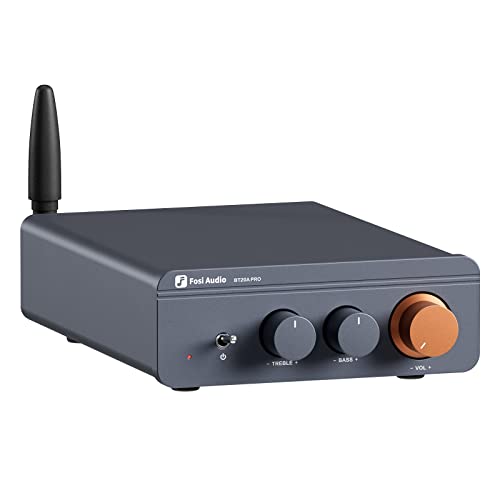
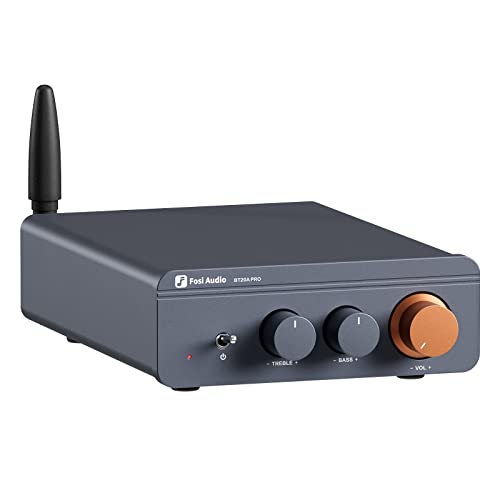
The case for the Pro with Focal speakers rests on a single idea: composure. Its TPA3255 chip represents a newer generation of Class D design, one that keeps distortion behavior civilized as output climbs, and revealing loudspeakers notice exactly that quality. Where an older budget chip turns glassy on a loud choral peak, the Pro stays tidy — and a Focal tweeter will tell you, in detail, which of those two amplifiers you bought.
On paper Fosi claims as much as 300W per channel maximum; treat that as a ceiling marker rather than a working figure. The usable truth beneath it is generous headroom for the sensitivity range most Focal models occupy, delivered from a chassis that fits on a bookshelf beside the speakers it drives. Inputs are Bluetooth 5.0 for phones and an RCA pair for a streamer or disc spinner, with bass and treble knobs on the front panel for adjustments made by hand rather than by app.
The decisive feature, though, is the pre-out. Focal bookshelf models in particular benefit from a powered subwoofer handling the lowest octave, and the pre-out integrates one correctly — or feeds a second amplifier if the system later spreads into another room. That socket is the difference between an amplifier you outgrow and one you build on.
Key specifications
| Form | Miniature stereo integrated, Class D |
| Chipset | TPA3255 |
| Claimed ceiling | 300W a side, maximum |
| Getting signal in | RCA line-in and Bluetooth 5.0 |
| Passing signal on | Pre-out — active sub or a further amp |
| On the fascia | Volume knob flanked by bass and treble |
Strengths
- Pre-out integrates an active subwoofer correctly
- Modern silicon keeps loud passages composed
- Bookshelf footprint, grown-up output class
Trade-offs
- Maximum wattage presumes ideal supply and load
- Remote control and digital inputs are absent
- Pre-out cannot drive a passive subwoofer alone
The fine print, stated once: there is no remote control, no digital input and no surround decoding anywhere in this design. Television-centered households should study the Yamaha review before committing, and vinyl households will need a phono stage upstream, since the Pro accepts line level only.
Daily ownership is the Pro’s strongest testimony. It asks for a corner of shelf and an inch of air, then recedes from attention entirely — no fans, no fuss, no heat drama. Its headroom announces itself by never announcing itself: crescendos arrive, the sound stays relaxed, and the listener stops thinking about equipment, which is the entire point.
Expansion arrives gracefully when wanted. The pre-out most often acquires a subwoofer in the first year, converting the system to a 2.1 that reaches genuinely low. Alternatively the same socket can hand signal to another amplifier in a second room, an unusually flexible trick for a box this size.
Look closer and the value concentrates where it should. The chip’s published virtues — efficiency, low distortion under load, tolerance of real-world impedances — map exactly onto what Focal crossovers demand. The tone stack is analog and immediate. Even the power supply is treated as part of the amplifier rather than an afterthought in the carton.
Allow a small accessory budget beside it: respectable speaker cable, and a subwoofer interconnect if the pre-out goes straight to work.
Best for: the broad middle of Focal ownership, especially with a subwoofer in mind. Not suited for: surround ambitions or listeners who demand a remote.
Full-Size Stereo Integrated Amplifier (Prose-Only Pick)
Badge: Best Traditional Hi-Fi
For many Focal households the destination amplifier looks like hi-fi has always looked: a full-width integrated, one chassis combining preamplification, power, a remote handset and a democratic row of inputs. This category is recommended without a linked model because the class spans a broad ladder and the right rung depends on your sources — vinyl above all. What follows is the specification that separates the worthy from the merely shiny.
Demand candor in the power figures: RMS watts into 8 ohms, both channels driven, distortion attached. This class of manufacturer traditionally understates, so a modest printed number frequently outplays a flamboyant one elsewhere. Beyond power, inventory the sockets — multiple RCA pairs for legacy sources, optical or coaxial digital inputs on many models for the television, a moving-magnet phono stage where records are played, a headphone output for the night hours.
Ergonomics close the sale. The volume knob’s feel, the remote’s logic, the display’s restraint at night: you will interact with these daily for years. Focal speakers reward good amplifiers; households reward usable ones, and this category is where the two rewards coincide.
Key specifications
| Form | Stereo integrated at full rack width |
| Hunt for | RMS figures that stay modest on paper, 8 ohms, stereo driven |
| Getting signal in | RCA pairs aplenty; coaxial or optical on many |
| Everyday kit | A handset for the remote, a socket for headphones |
| Frequently found | Phono for moving-magnet cartridges; sometimes a sub output |
Strengths
- Every source in the house finds a home
- Remote-driven ease for non-technical households
- Ratings in this class tend to underpromise
Trade-offs
- Occupies a full shelf in width and depth
- Bluetooth missing on the purist models
- Serious examples command serious budgets
Daily life with this class of amplifier has a particular texture: the remote lives on the coffee table, sources are one button apart, late-night listening happens through the headphone socket, and nobody in the household needs instructions. Focal systems in family rooms, as opposed to dedicated dens, often end up here for exactly those ergonomic reasons.
Respect its physical needs. These are ventilated, sometimes warm-running machines; open shelving, clearance above, and no stacking of streamers on the hot lid. Treated properly they measure their service in decades and their resale in respectable fractions.
Shop the class with a checklist rather than a favorite badge: rating conditions, input inventory, phono provision, subwoofer output, remote quality. Within a shortlist that passes, let an audition decide — Focal speakers make audition differences unusually legible, which is a luxury worth using.
If your Focals are compact and your room is small, the mini amps above may genuinely be all you need. This category earns its premium when sources multiply, vinyl matters, and the system is furniture as much as electronics.
Best for: multi-source stereo households and vinyl listeners. Not suited for: desktop systems, minimalists or surround plans.
High-Current Stereo Power Amplifier (Prose-Only Pick)
Badge: Best for Flagship Towers
A minority of Focal models — typically the flagship towers — combine modest sensitivity with impedance curves that plunge in the bass, and they expose amplifiers that looked adequate on paper. For those speakers this category is not an indulgence but a requirement, and since the correct unit depends on the exact load your model presents, it is described by specification rather than linked to one name.
The specification to hunt is current delivery wearing honest clothes: a rating that remains stable into 4 ohms with both channels driven, and ideally output that climbs substantially as impedance falls, betraying a power supply with real reserves. Inputs run to RCA with balanced XLR common in the class. Remember the architecture — a power amplifier has no volume control and no source selection, so a preamplifier, or a receiver with pre-outs, must precede it.
Gain structure is the detail novices miss. The power amp’s gain must suit the preamp’s output, or the volume control will travel from whisper to roar in its first quarter-turn. Competent listings publish gain; competent dealers discuss it without blinking.
Key specifications
| Form | Stereo power amp — bring your own preamp |
| Hunt for | 4-ohm stability backed by deep current |
| Getting signal in | RCA as standard, XLR balanced on many |
| Check first | Gain against your preamp’s output |
| Note well | Both channels driven behind any quoted figure |
Strengths
- Untroubled by impedance dives and hungry woofers
- Preamp and power stages upgrade independently
- Engineered for decades of service
Trade-offs
- Silent until a preamp partner joins it
- Heavy, warm and demanding of shelf space
- Frequently the priciest route on this page
Confirm the need before the expense, because the diagnosis is specific. If your present amplifier already plays your Focals cleanly at the loudest level you use, extra current purchases nothing audible. If instead the sound tightens, bass loses pitch and the whole stage seems to lean against a wall at volume, current starvation is the likely culprit and this category is the cure.
Logistics are part of the purchase. These amplifiers weigh what they weigh because transformers and heatsinks are honest materials; they warm rooms and demand stands rated for them. Measure the rack, plan the ventilation, and arrange help for the lifting before the courier arrives.
The used market deserves a mention, since simple power amplifiers age well and this class is thick with durable examples. Budget a service inspection for older units and confirm the terminals accept your cable ends; the savings can be substantial without meaningful risk.
When the match is right the effect is distinctive: difficult Focals stop sounding difficult. Low frequencies gain definition rather than volume, climaxes open instead of congesting, and quiet listening improves too — control, it turns out, is one quality at every level.
Best for: flagship Focal towers with spiteful specifications. Not suited for: the range’s easygoing majority or one-box seekers.

Yamaha RX-V385 5.1-Channel AV Receiver
Badge: Best for Theater Systems
Focal speakers in a living room usually end up flanking a screen, and a screen changes the amplifier brief entirely: decoding, switching and calibration join power on the requirements list. The RX-V385 answers as a 5.1-channel headquarters — 4K HDMI pass-through with HDCP 2.3, Dolby Audio and DTS-HD decoding, Bluetooth for casual streaming, and Yamaha’s YPAO calibration measuring the room from a supplied microphone.
Calibration is the feature to take seriously. Living rooms sabotage sound with glass, plaster and asymmetrical sofas; YPAO listens to what the room does and compensates, and the clearest beneficiary is dialogue — the element households actually complain about. Cinema DSP programs widen film soundtracks for rooms that cannot fit ideal speaker layouts, a pragmatic concession to real architecture.
Power output is mainstream receiver fare, which in practice means plenty for Focal models of ordinary sensitivity at the volumes families use. The speakers’ efficiency carries the system, and the receiver spends its budget on being the room’s control center rather than winning a wattage contest it was never entered in.
Key specifications
| Form | Five-channel AV receiver |
| Picture path | HDMI carrying 4K Ultra HD, HDCP 2.3 |
| Room correction | YPAO, using the bundled microphone |
| Decodes | DTS-HD and Dolby Audio |
| Wireless side | Streaming over Bluetooth |
| Also aboard | Cinema DSP programs |
Strengths
- Room calibration polishes the front stage
- Single hub for every HDMI source
- Surround channels ready when the room is
Trade-offs
- Layout stops at 5.1 — no height channels
- Larger and warmer-running than a mini amp
- Menus reward an evening’s patience
The daily dividend is domestic peace. A single remote commands volume for every source, the television wakes the receiver and vice versa, and visitors can watch a film without a briefing. Households underestimate this until they have lived with a two-remote stereo kludge beside a television for a month.
Setup deserves its half hour. Position the YPAO microphone at the main seat, ear height, run the routine in a quiet house, then inspect what it decided — speaker sizes, crossover, distances — before overruling anything. Skipping calibration is the most common way owners end up with a lesser receiver than the one they bought.
Acknowledge the ceiling plainly: five channels end at 5.1. If overhead effects are already in your imagination, the honest route is a larger receiver from the outset rather than this one now and a replacement later.
Give it air. Receivers of this class reject sealed cabinets and resent components stacked on their vents. A shelf with clearance above is the whole requirement, repaid in reliability.
Choose it when film nights genuinely rival music nights in your household. In a music-only room its talents idle, and the stereo picks serve better for the same money.
Best for: Focal pairs anchoring a television in a family room. Not suited for: stereo-only dens or Atmos planners.
Tube-Hybrid Integrated Amplifier (Prose-Only Pick)
Badge: Best for a Smoother Presentation
Some Focal listeners love the detail and could live with a fraction less edge. For them, this category offers a particular recipe: a tube preamplifier stage lending its harmonic character, followed by a solid-state power stage that keeps a modern grip on the woofers. No model is linked, because the recipe’s seasoning varies enormously between makers and the right amount is a matter of taste — this is the one pick on the page that should be auditioned or bought returnable.
Shop it on the fundamentals first. The RMS rating should be honest and sufficient for your model’s sensitivity; the tube type in the preamp stage should be named, and whether those tubes are user-replaceable confirmed. Inputs are typically RCA line level, with Bluetooth appearing on many current designs for casual streaming.
Understand what is being purchased: not accuracy surrendered, but presentation adjusted. The hybrid does not fix a bad room or a mispositioned pair of speakers, and it will not rescue recordings from themselves. It tilts the system’s temperament a few degrees toward forgiving, and for the right listener that tilt is worth more than another fifty watts.
Key specifications
| Form | Integrated; valves up front, transistors behind |
| Hunt for | An RMS claim you can believe; the valve type spelled out |
| Getting signal in | Line-level RCA; Bluetooth on plenty |
| Check first | Whether valves swap by hand |
| Note well | Character varies — hear it or keep returns open |
Strengths
- Softens the edge some Focal systems show
- Solid-state output keeps woofer control modern
- Tubes in preamp duty last for years
Trade-offs
- The effect is seasoning, not transformation
- One more component class to maintain
- Character differs widely between designs
Set expectations with care. The tube contribution here is seasoning, not a roast: a softening of edges, a slight rounding of aggressive recordings, a presentation some listeners find easier over long evenings. On well-recorded material the difference narrows; on harsh material it can be the difference between listening and enduring.
Practicalities intrude pleasantly little. Tubes in preamp duty run gently and last for years, replacement is typically a user task, and the solid-state output stage keeps the amplifier’s grip on the speakers modern. Heat output is modest beside a full tube design.
Because warmth claims vary so widely between designs, buy this category with a returns window or after an audition, ideally with your own records. Focal speakers will render the audition decisive within a couple of tracks, which removes much of the gamble.
Listeners whose Focals already lean smooth may find the hybrid a step too far into comfort. Listeners whose rooms are bright and whose tweeters feel forward often find it exactly right. The room, as ever, casts the deciding vote.
Best for: listeners who find their Focal system a touch forward. Not suited for: accuracy absolutists or the return-averse.
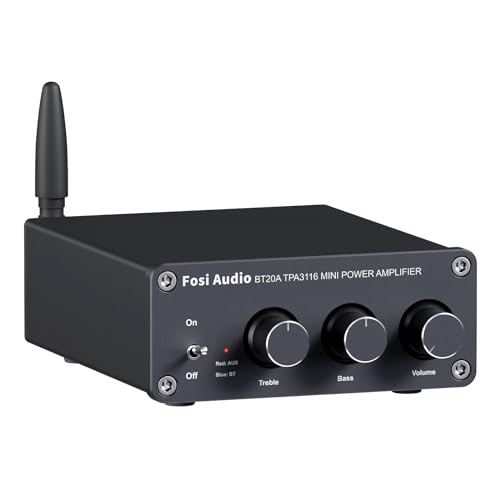
Fosi Audio BT20A Mini Stereo Amplifier
Badge: Best Budget
Every category needs its honest minimum, and for Focal systems the standard BT20A marks it. The recipe is unadorned: TPA3116 amplification rated at 100W per channel, Bluetooth 5.0 and an RCA input, tone knobs on the fascia, the power supply in the carton. It suits the owner whose funds went — reasonably — into the speakers, and who needs competent amplification now rather than perfect amplification eventually.
The pleasant surprise is how far competence stretches. Focal’s mainstream models are not the divas of reputation; many are reasonably sensitive, and in a small room at civilized levels the BT20A drives them without audible complaint. What you surrender versus the Pro is refinement under pressure and the pre-out: the subwoofer path is closed, and loud passages with demanding material expose the older silicon sooner.
Buy it as a starting point with open eyes and it will not disappoint. Buy it expecting flagship behavior and the speakers will file their report within the first evening.
Key specifications
| Form | Miniature stereo integrated, Class D |
| Chipset | TPA3116 pair |
| Claimed ceiling | 100W a side |
| Getting signal in | RCA line-in and Bluetooth 5.0 |
| On the fascia | Volume knob flanked by bass and treble |
| In the shipping carton | The power supply |
Strengths
- Least expensive respectable seat at the Focal table
- Footprint small enough for a crowded desk
- Physical knobs, zero menu archaeology
Trade-offs
- No pre-out for a properly integrated subwoofer
- Composure fades earlier than the Pro at volume
- Neither remote control nor digital input
Its limits define its role honestly. There is no pre-out, so a powered subwoofer cannot be integrated with proper control. There is no remote, no digital input, and its composure runs out earlier than the Pro’s when speakers or volumes get ambitious. Within a modest brief, none of that matters; outside it, the Pro is waiting one rung up.
Consider it also as diagnostic equipment. A season with the BT20A teaches a new Focal owner their room’s voice, their speakers’ true appetite and their own listening habits — intelligence that makes the eventual step up, if any, precise instead of speculative.
Wiring discipline matters doubly at this scale. Short, tidy runs, polarity verified, the little chassis given air: mini amps are blamed for many faults that belong to installation, and Focals will broadcast installation faults without mercy.
If the hobby deepens, the BT20A does not become waste. It migrates — a study system, a bedroom pair, a workshop — and keeps earning. That second career is built into its value from the start.
Best for: smaller Focal pairs, smaller rooms, patient budgets. Not suited for: subwoofer roadmaps or listeners who play loud in big spaces.
Comparison Table
Treat this grid as a compass, not a contest. Each line serves a different Focal household, and the middle column names the specification that earns the line its place. Read the corresponding review before committing to any row.
| Pick | Type | Key specification | Link |
|---|---|---|---|
| Fosi Audio BT20A Pro | Mini Class D stereo amp | Built around the TPA3255 device | Check price on Amazon |
| Full-size stereo integrated amplifier | Full-width stereo integrated | Sober RMS into 8 ohms, stereo pair both working | Prose-only |
| High-current stereo power amplifier | Stereo power amplifier | Holds a 4-ohm rating steady on serious current | Prose-only |
| Yamaha RX-V385 | 5.1 AV receiver | Passes 4K Ultra HD pictures, HDCP 2.3 aboard | Check price on Amazon |
| Tube-hybrid integrated amplifier | Tube-hybrid integrated | Honest RMS figure; check which tubes the preamp uses | Prose-only |
| Fosi Audio BT20A | Mini Class D stereo amp | Built around the TPA3116 device | Check price on Amazon |
How do you choose the right amplifier for these speakers?
Focal ownership rewards a particular sequence. Open the manual for your exact model and extract two numbers: sensitivity, and impedance — nominal plus any stated minimum. Those figures locate your speakers on the easy-to-demanding spectrum, and the amplifier tier follows almost mechanically. High sensitivity with a benign minimum means the compact picks suffice; a low minimum with modest sensitivity sends you toward current-rich designs.
Next, confess your listening habits. Nearfield at a desk, evening volumes in a flat, full-throated sessions in a detached house — each habit multiplies or divides the power requirement more than any specification does. Multiply habit by speaker demand and the shortlist narrows to one or two names.
Finish with infrastructure. Vinyl requires a phono stage somewhere. A television requires digital input or a receiver. A planned subwoofer requires a pre-out. The amplifier still standing after all three filters is not merely a good choice; for your system it is close to the only one.
Before you order: the listing checks that matter
Begin where listings prefer you not to linger: the small print beneath the wattage banner. A serious figure declares its test conditions — load impedance, both channels working, distortion stated alongside. Silence on any of those points converts the number from information into decoration, and decoration should be priced accordingly.
Proceed to the physical audit. Socket inventory against your sources, one by one, aloud. Terminal style against your cable ends. Shelf width against the chassis, ventilation against its top panel, supply included against your spares drawer. Then the paperwork: returns window, warranty terms, and whether the seller is the sort who answers messages. Focal owners keep equipment for years; buy from people who behave likewise.
How to connect and dial in a new amplifier, step by step
Clear an unhurried hour and work in silence first. Place the amplifier where air can reach its top surface, set the Focals on their stands or spikes with tweeters level with your ears at the listening chair, and arrange the classic triangle — speakers and seat as its corners, the pair slightly angled toward you.
Cabling comes second, power still disconnected. Strip or terminate the speaker wire neatly, observe the color discipline at both ends of both runs, and tug each connection gently to prove it. Reversed polarity on one channel is the classic silent saboteur of a Focal system: the speakers will play, politely, while the stereo image evaporates. Connect sources afterward, digital before analog, phone pairing last.
Switch on quietly, with the volume low and a recording you know by heart. Listen for image focus before anything else — a voice should hang in the center air. Then give the system days, not minutes. Run any calibration the amplifier offers, re-seat yourself, and adjust placement in small increments. Focals report every change you make, which makes methodical setup unusually rewarding.
Reading the numbers like an engineer, briefly
Four numbers carry nearly all the truth on an amplifier’s specification page. Sensitivity belongs to the speaker, not the amplifier, but it frames everything: the loudness bought by one watt at one meter. Impedance describes the load’s appetite across frequency, and its minimum matters more than its average. Power is meaningful only as a complete sentence — RMS, both channels driven, into a stated load, distortion attached. Damping factor, slew rate and the rest of the supporting cast refine a decision; they should never be allowed to make one.
Read in that order — speaker sensitivity, speaker impedance, amplifier power under stated conditions — the page stops being a fog of competing claims and becomes a short story with a conclusion. Focal publishes the first two numbers for every model it sells. The amplifier listings in this guide were checked for the third. Your room supplies the rest.
The order in which good systems actually grow
Mature Focal systems tend to evolve in a recognizable order, and the amplifier you buy now should leave that order intact. Source quality usually improves first — a better streamer, a cartridge upgrade — because revealing speakers convert source improvements into audible gains with unusual efficiency. A subwoofer follows for owners whose speakers stop short of the bottom octave, integrated through the pre-out this guide keeps insisting upon.
Room treatment arrives third, unfashionable and transformative: softening the first reflection points does more for a Focal pair than any cable. Electronics beyond the amplifier — separates, dedicated DACs — belong last, when everything upstream and around the speakers already deserves them. Buy amplification that survives this sequence rather than restarting it, and the system compounds instead of churning.
Common Buying Mistakes
Judging amplifiers by headline wattage
A wattage banner is advertising copy until its conditions are printed beside it. Manufacturers measure under wildly different loads and distortion limits, so two amplifiers wearing identical numbers may be separated by an audible gulf. Seek the RMS figure, both channels driven, into a named impedance. Where a listing hides those conditions, assume the hiding is the information.
Matching by brand folklore
Every marque accumulates mythology, and Focal’s includes the claim that only certain nationalities of amplifier may approach. It is nonsense with good marketing. Current delivery, stability and treble composure decide the marriage, and those qualities are published in specifications rather than inherited from a flag. Buy the electrical match; send the mythology back to the forums.
Ignoring sensitivity entirely
Skipping the sensitivity figure is the costliest reading omission in hi-fi. It is the exchange rate between watts and loudness; ignore it and you will buy amplification blind, usually overbuying by a tier or underbuying into distortion. Focal publishes the number for every model. Thirty seconds with it outperforms hours of forum archaeology.
Reversed polarity on one speaker
Few faults are as cheap to cause or as expensive to chase. Swap one speaker’s connections and the pair still plays, but bass thins, voices lose their anchor, and owners begin pricing new amplifiers to cure a wiring error. Before any other troubleshooting on a Focal system, trace both runs end to end and confirm the colors agree. The fix takes four minutes and has rescued more systems than any component swap.
Strangling the amplifier’s ventilation
Heat is the slow tax on electronics, collected in shortened component life and the occasional protective shutdown during a climax. Receivers and Class AB integrateds need open air above their vents; even efficient Class D designs prefer not to bake inside sealed furniture. Focal systems often live in dedicated racks — build the rack around airflow and the amplifiers will outlast several generations of speakers.
Expecting a subwoofer to fix placement
A subwoofer cannot repeal room acoustics. Parked in a corner at the mercy of a bass null, it will faithfully reproduce the room’s worst behavior at greater expense. Position the Focals with care first — they reward the effort audibly — then introduce the subwoofer to extend what is already working, crossing over where the main speakers naturally fade.
Setting tone controls on day one
A revealing speaker tempts its owner into immediate correction — a touch less treble, a little more bass — usually in response to one recording’s mastering rather than the system’s character. Resist for a week. Play widely, at your normal volumes, and note what recurs. Correct only the recurring problems, in half-steps, and your tone controls will encode the room instead of a mood.
Buying inputs for a fantasy system
Catalogues seduce with sockets. Before long a buyer is budgeting for a reel-to-reel deck they sold in 2009 and a laserdisc player that exists only in memory, while the subwoofer output they will genuinely want by spring goes missing. Inventory the sources within arm’s reach of the rack, permit yourself one realistic addition, and close the catalogue.
What each tier is really buying you
At the entry tier you are purchasing competence: clean stereo power, wireless convenience, and nothing extraneous. It satisfies more Focal owners than pride admits. The middle tier purchases infrastructure — remote control, digital inputs, calibration, channel count — the machinery of a system serving a whole household across music and film. The upper tier purchases current delivery and longevity: transformers, heatsinking and build that shrug at difficult loads for decades.
What no tier purchases is a different loudspeaker. Focals will sound like Focals on all of them; the tiers decide how completely, how loudly and how conveniently. Spend upward when a concrete demand — a flagship’s impedance curve, a phono stage, a theater — names itself. Otherwise the middle of the range is not a compromise. It is the design center of the market.
Final Recommendation
For most Focal households the BT20A Pro is the quietly correct answer: revealing speakers expose its clean headroom as a virtue, and the pre-out keeps the subwoofer chapter available. Traditionalists with record collections and several wired sources belong in the full-size category. Theater households take the Yamaha and run its calibration before judging anything. Choose by your room and your sources, and the speakers will handle the rest.
What to check before you order
Measure the destination before the box ships. Shelf depth and height, the ventilation path, the distance from amplifier to each speaker for cable length, the socket situation behind the rack. Then imagine the system’s daily choreography: whose hand reaches for volume, from where, holding what. An amplifier that fits the furniture and the choreography is halfway to being loved; one that fits neither becomes a return label.
One more consideration
Live with the pairing before judging it. Revealing speakers make a new amplifier sound startling for a week — partly the electronics, partly your attention sharpening — and hasty returns often discard combinations that would have settled beautifully. Give the system a fortnight of normal listening, vary the material, and only then decide whether anything is actually missing.
Frequently Asked Questions
How much power do my speakers actually need?
Less than Focal folklore implies, provided the watts arrive cleanly. Work from your model’s sensitivity: each 3 dB step doubles or halves the power needed for a given loudness, so a sensitive Focal reaches satisfying levels on output that would leave a duller design breathless. The linked picks cover the range’s broad middle; the choosing chapter shows the arithmetic for your exact pair.
Do I need a subwoofer output on the amplifier?
Bookshelf Focals and smaller floorstanders answer this for you: their low-frequency reach is honest but finite, and a well-integrated powered subwoofer completes the picture for film and electronic music. That integration needs a pre-out or sub output on the amplifier. Pure two-channel listeners with full-range towers may never miss the socket, but buying it in advance costs almost nothing.
What does impedance mean when matching an amp and speakers?
Think of impedance as the terrain an amplifier must cross, measured in ohms and varying with frequency. A speaker’s nominal figure is the brochure summary; its minimum, often lurking in the upper bass, is the steep section where amplifiers earn their keep. Focal models vary, so read your own manual. The amplifier’s rating should remain valid at that minimum, not merely at the friendly average.
Why does my system sound quieter than the wattage promised?
Suspect the chain’s quiet links first. A television outputting at a fixed low level, a streamer whose app volume sits at sixty percent, a phone throttled by its own limiter — any of these starves the amplifier’s input while its knob claims otherwise. Raise the source to a healthy level, let the amplifier govern loudness alone, and the missing volume generally returns unaccompanied by new purchases.
Can an amplifier be too powerful for a speaker?
Damage in domestic systems rarely arrives from surplus clean power. It arrives from a small amplifier begging for mercy, clipping its waveform into the harsh square-edged distortion that cooks tweeters — components Focal owners have particular reason to protect. A stronger amplifier operating far inside its limits is the safer tenant; your own restraint at the volume control completes the arrangement.
Is Bluetooth sound quality good enough for a main system?
On a revealing system the honest answer splits. For radio, podcasts, playlists and the musical wallpaper of daily life, modern Bluetooth is entirely respectable and its convenience is real. For the attentive listening Focals invite — lights low, album start to finish — a wired source through the RCA input keeps the last layer of detail the speakers are capable of showing you. Use both, for different moods.
Do Focal speakers need a French amplifier to match?
Nationality is not an electrical parameter. Focal loudspeakers respond to current capability, stability into their impedance curve and an amplifier’s composure in the treble, none of which carry a passport. Excellent matches are built on several continents; poor ones likewise. Shop the specifications in this guide and let geography handle the wine instead.
Are Focal speakers hard to drive?
Some are easier than their price suggests and a few flagships are genuinely demanding, which is why the range needs reading model by model rather than by reputation. Check sensitivity, then check the impedance minimum, then match the amplifier tier to those two figures. The choosing chapter walks the method; the high-current category exists for the exceptions it uncovers.