Disclosure: As an Amazon Associate, kajuandouglas.com earns from qualifying purchases. Links to Amazon on this page are affiliate links; they cost you nothing extra. Listing details such as price and availability change often, so check the current Amazon listing before you buy.
Where to buy
Use Amazon to verify current stock and delivery timing for the linked models in this Klipsch Reference amplifier guide. Entries marked prose-only describe a category to shop by its specification, because the right unit depends on your exact Reference model and room.
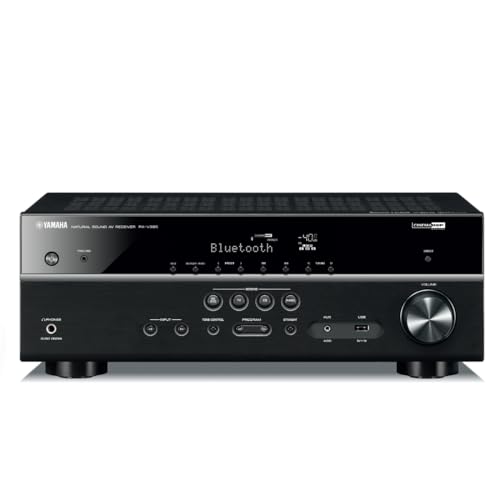
- Yamaha RX-V385 5.1-Channel AV Receiver — the film-room default with calibration aboard
- Fosi Audio BT20A Mini Stereo Amplifier — the entry route into clean stereo sound
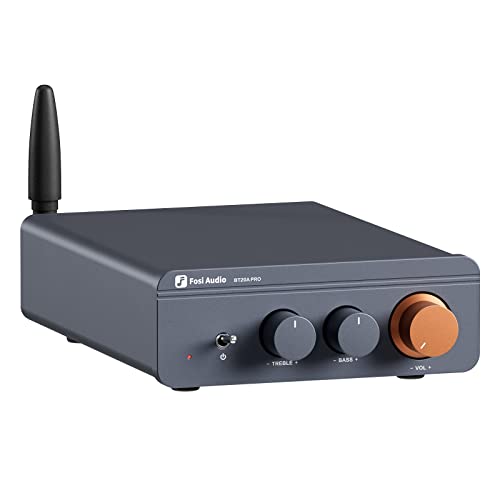
- Fosi Audio BT20A Pro Mini Stereo Amplifier — compact power with a subwoofer path included
- Tube-Hybrid Integrated Amplifier (Prose-Only Pick) — a category pick for softening the presentation
- Full-Size Stereo Integrated Amplifier (Prose-Only Pick) — the traditional multi-source stereo anchor
- Atmos-Capable AV Receiver (Prose-Only Pick) — a category pick for theaters still growing
The shortlist’s reasoning comes next, followed by the same examination applied to every candidate.
Klipsch Reference owners begin their amplifier search holding an asset most buyers lack: loudspeakers so efficient that power, the commodity amplifiers are usually sold by, is nearly free. The line’s horn-loaded tweeters and high sensitivity figures mean a handful of clean watts fills a room. Everything in this guide follows from that fact, including its central warning — with these speakers, the wrong amplifier is rarely the weak one. It is the noisy one, the coarse one, the one whose volume control does all its work in the first eighth of its travel.
Picture the typical installation. Reference towers stand in a media room or living room, flanking a screen, with a center channel either present or planned. Movies dominate the calendar, music fills the gaps, and the household wants dialogue to survive action scenes without a hand permanently on the remote. That brief points at calibration and switching as much as at amplification, which is why a receiver leads this shortlist while wearing the overall badge.
Alongside it stand the stereo alternatives for the households — real, if fewer — where the Reference pair serves music alone: two compact modern mini amps, a traditional full-size integrated, and a tube-hybrid category that exists because horn speakers make tube character a practical option rather than a romantic one. An Atmos-capable category waits for the theater still under construction. Every linked name passed this site’s verification audit; categories that depend on the buyer’s exact model stayed prose-only by design.
The guide’s scope is passive Reference speakers in domestic rooms. Powered monitors, commercial cinema installations and whole-house distribution live elsewhere, though the efficiency arithmetic in the choosing chapter will serve any Klipsch owner anywhere.
Key Takeaways
- Horn loading makes Reference speakers so efficient that amplifier quality outranks quantity.
- The RX-V385 is the default for film-first rooms; its calibration serves dialogue daily.
- Tube and hybrid designs are a legitimate flavor choice here, not a power necessity.
In this guide
Quick Picks
Six candidates follow, each assigned the household it serves best. The badge printed beside a name here returns at the head of that pick’s full review.
| Buyer type | Pick | Why it stands out | Link |
|---|---|---|---|
| Best Overall | 5.1 AV receiver | The film-room headquarters with calibration aboard | Check price on Amazon |
| Best Budget | Mini Class D stereo amp | The least costly route to clean stereo sound | Check price on Amazon |
| Best Compact Power | Mini Class D stereo amp | Compact silicon with a subwoofer path included | Check price on Amazon |
| Best for Taming the Edge | Tube-hybrid integrated amplifier | Tube preamp stage adds a smooth, relaxed presentation | Prose-only — see review |
| Best Traditional Hi-Fi | Full-size stereo integrated amplifier | Remote control and a full input selection | Prose-only — see review |
| Best for a Growing Theater | Atmos-capable AV receiver | Powers height channels for Atmos and DTS:X layouts | Prose-only — see review |
Prices and star scores are omitted from the grid on principle. Both change faster than a guide can responsibly republish, and neither would help match amplification to speakers whose needs are this distinctive. Badges, specifications and the reviews below do the work.
How These Picks Were Chosen
Reference speakers collapse the usual amplifier problem into a smaller, more interesting one. When a loudspeaker needs so little power, the selection criteria migrate: away from wattage, toward noise, control at low levels, and the infrastructure around the sound — calibration for film rooms, inputs for music rooms, and behavior in the first degrees of the volume knob where these speakers spend their lives.
We therefore fixed the population by use rather than by model. The film-first household, which owns most Reference towers. The stereo household, often smaller and more deliberate. The tube-curious listener, a real constituency with horn speakers. And the growing theater, whose amplifier must not become obsolete at the next speaker purchase. Categories were admitted only if they served one of those households distinctly; several respectable amplifier types were cut for duplicating a job already covered.
Linked models cleared the verification audit applied across this site’s speaker coverage — Creators API confirmation of the Amazon listing, returned title matching the reviewed product, published figures agreeing with the ones cited. Where the right answer depended on the buyer’s exact model or trajectory, the slot stayed prose-only with its shopping specification attached, because a category honestly described beats a model falsely precise.
Efficiency first: reading Klipsch power needs correctly
Klipsch publishes sensitivity figures that make other brands look sleepy, and the horn is the reason. A horn couples a small, efficient driver to the room’s air the way a megaphone couples a voice to a field: the driver barely moves, yet the sound arrives in force. Reference models commonly quote figures in the mid-to-high nineties in decibels, territory where a single watt produces loudness that would leave conventional speakers clearing their throats.
Translate that into shopping. At such sensitivity, the amplifier’s first watt matters more than its fiftieth. Noise floor, distortion at low output, the smoothness of the volume control’s first quarter-turn — the qualities of the small-signal region — become the audible specification. This is why flea-powered tube amplifiers have a genuine, if niche, following with these speakers, and why a modest modern receiver can fill a room without its meters ever looking busy.
One caution about the figures themselves: measurement methods vary, and Klipsch’s in-room style of quoting has historically flattered its numbers beside anechoic rivals. Even discounted for method, the efficiency is real and large. Your amplifier budget should shrink accordingly — and the savings belong in the center channel, the subwoofer, or the record shelf.
There is a second dividend to efficiency that rarely gets mentioned: thermal calm. An amplifier asked for three watts instead of thirty runs cool, and cool electronics live longer, drift less and behave more consistently across a long film or a long evening. The Reference owner’s modest amplifier is not merely cheaper to buy. It is cheaper to own, quieter in every sense, and easier to house — a cascade of small mercies that begins with a horn and a published number.
Room, distance and the horn: placement before electronics
A horn loudspeaker is a directional instrument. Where a conventional tweeter sprays high frequencies generously around the room, the horn aims them, which makes the Reference pair unusually sensitive to geometry — and unusually rewarding when the geometry is right. Toe-in is the governing adjustment: angle the cabinets so their axes cross a little in front of the main seat for a wider, softer image, or directly at the ears for maximum focus, and expect the sound to change more from ten degrees of toe than from any amplifier swap in this guide’s price territory.
Distance works the same lever from the other side. Near a horn speaker, its direct sound dominates and detail is forensic; across a long room, the room’s reflections join in and the presentation broadens. Neither is wrong, but they are different systems wearing the same cabinets, and the amplifier virtues that matter shift slightly between them — control and quiet up close, headroom and calibration across the distance.
All of which is a long way of issuing one instruction: set the speakers’ positions before judging any amplifier through them. Owners routinely audition electronics through a placement fault and return the wrong component. Geometry first, electronics second, in that order, every time.
A tape measure settles most arguments here. Note the distance from each tower to the main seat and make the two distances equal within a few inches; asymmetry between channels is the quiet saboteur of center images, and horns report it instantly. Note also the distance to the side walls, because a tower hugging one wall while its partner breathes in open space will sound like two different speakers. Symmetry is the cheapest calibration ever sold, and it is not sold at all — it is measured.
The Best Amp for Klipsch Reference Speakers
Each review below follows one protocol — the household served, the verified data, three strengths, three compromises, one limitation in plain words, and a verdict — because speakers this revealing deserve reviewing with nothing hidden.

Yamaha RX-V385 5.1-Channel AV Receiver
Badge: Best Overall
Most Reference speakers are bought for a room with a screen in it, and a screen changes what an amplifier is for. Decoding, switching, calibration and channel count join the brief — and the RX-V385, as this guide’s overall pick for the line, is the mainstream receiver that covers the brief without excess. Five channels of amplification, 4K HDMI pass-through with HDCP 2.3, Dolby Audio and DTS-HD decoding, Bluetooth for casual streaming, and Yamaha’s YPAO room calibration through a supplied microphone.
Calibration is the argument that matters most with horn speakers. Their directness exposes room problems — a hard wall flanking one tower, a sofa swallowing the center’s output — and YPAO measures and compensates, with dialogue clarity the household benefit everyone notices. Cinema DSP programs widen soundtracks for rooms whose geometry refuses textbook placement, a pragmatic mercy.
Power is the least interesting thing about it, by design. Mainstream receiver output, multiplied by Reference sensitivity, yields theater levels at the sofa with the dial nowhere near its end. The budget went into being the room’s headquarters rather than into wattage the speakers would never request.
Key specifications
| Build | AV receiver across five channels |
| Video side | HDMI carrying 4K Ultra HD, HDCP 2.3 |
| Room tuning | YPAO automatic setup, mic included |
| Formats decoded | Dolby Audio, DTS-HD |
| Wireless side | Bluetooth streaming |
| Extras list | Cinema DSP programs |
Strengths
- Calibration polishes dialogue and the front stage
- One hub for every HDMI source owned
- Center and surrounds ready when added
Trade-offs
- Five channels only; heights impossible
- Bulkier and warmer than a mini amp
- Menus ask an evening’s patience
The ownership dividend is domestic: one remote rules volume for every source, the television and receiver wake each other, and the system can be operated by anyone in the house without a seminar. Film households consistently rank this above specifications they cannot name.
Spend the setup half hour properly. The YPAO microphone belongs at the main seat, at ear height, in a quiet house; run the routine, inspect the speaker sizes and crossover it selected, and live with its judgment for a week before overruling it. Skipped calibration is the leading cause of receivers being blamed for rooms.
Name the ceiling without flinching: five channels, a 5.1 layout, no height speakers ever. If Atmos is a genuine plan rather than a daydream, the prose-only Atmos category is the honest purchase. If it is a daydream, this receiver’s ceiling will never be touched.
Ventilation is the only housekeeping: open air above the unit, no sealed cabinet, nothing stacked on the vents. Given air, this class of receiver serves for years without incident.
For the film-first Reference household — statistically, most of them — this is the amplifier decision. The speakers make it loud; the Yamaha makes it coherent.
Best for: film-first Reference households. Not suited for: stereo purists or committed Atmos planners.

Fosi Audio BT20A Mini Stereo Amplifier
Badge: Best Budget
The budget pick makes its case on the speakers’ own physics. When a pair of speakers converts a trickle of power into room-filling sound, an amplifier rated at 100W per channel is not a brave minimum — it is a surplus. The BT20A builds that surplus from TPA3116 silicon, adds Bluetooth 5.0 and an RCA input, puts bass and treble knobs on its front, and includes its power supply in the box. For the Reference owner whose money went into the speakers, it is the rational remainder.
The honest comparison is with its Pro sibling. The Pro’s newer chip stays composed longer under load and its pre-out admits a subwoofer properly; the standard model is simpler, cheaper and entirely sufficient for stereo listening at domestic levels through speakers this efficient. What you are buying here is not a compromise to endure but a match to enjoy.
Treat it as a destination for a small stereo system, or as the least expensive education in what your speakers actually need. Either way, it will embarrass the assumption that horn speakers require heroic amplification.
Key specifications
| Build | Class D stereo mini, integrated |
| Chip inside | TPA3116 |
| Top figure | 100W a channel |
| Inputs offered | Bluetooth 5.0 and an RCA pair |
| Controls offered | Volume, bass and treble as front knobs |
| Box contents | Power supply, ready to run |
Strengths
- Efficiency makes its output feel twice its size
- Fits a shelf, a desk, a life with no rack
- Leaves the budget for the center channel
Trade-offs
- No pre-out for a proper subwoofer path
- No remote and no digital input
- Composure ends sooner than the Pro’s
Its omissions are plain: no remote, no digital input, no pre-out for a subwoofer, and an older chip whose composure ends sooner than the Pro’s. In a bedroom, study or small den with a Reference pair, those omissions may simply never be encountered.
Wire it with the care efficient speakers demand of everything: tidy runs, polarity verified twice, a breath of air around the little case. Mini amps inherit blame for installation faults, and horns broadcast installation faults with enthusiasm.
As reconnaissance it is superb. A season at this level teaches an owner their true listening levels, their room’s character and whether the hobby’s next chapter is a source, a subwoofer or nothing at all. That knowledge is worth more than the box costs.
And if the system graduates, the BT20A retires sideways — a workshop, a spare room — and keeps working. Few components offer so painless a succession.
Best for: stereo Reference pairs in modest rooms. Not suited for: subwoofer plans or television-centered systems.
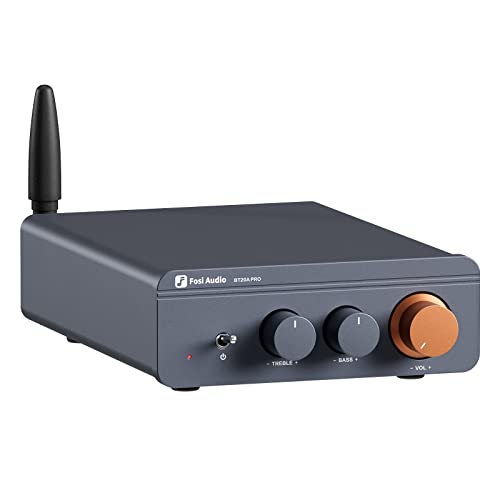
Fosi Audio BT20A Pro Mini Stereo Amplifier
Badge: Best Compact Power
The compact-power pick argues that with speakers this efficient, refinement is the only power worth buying. The BT20A Pro’s TPA3255 chip belongs to the newer Class D generation whose distortion stays civilized as output rises and whose behavior at low levels — the region where Reference speakers spend their evenings — is notably tidy. Fosi’s ceiling claim of up to 300W per channel maximum is best read as headroom theatre; the usable truth beneath it is clean output far beyond what these speakers will ever request.
Connections suit a music-first system: Bluetooth 5.0 for the household’s phones, RCA for a streamer or disc player, and physical bass and treble knobs for adjustments made by hand. The feature that lifts the Pro above its sibling is the pre-out, which integrates a powered subwoofer correctly or feeds a second amplifier — the socket that turns a finished purchase into a foundation.
For the stereo household, this is the sweet spot of the entire guide: modern silicon, a growth path, and nothing to learn, update or configure. The speakers supply the drama; the amplifier supplies the discipline.
Key specifications
| Build | Class D stereo mini, integrated |
| Chip inside | TPA3255 |
| Top figure | 300W a channel at most |
| Inputs offered | Bluetooth 5.0 and an RCA pair |
| Output onward | Pre-out — powered sub or second amp |
| Controls offered | Volume, bass and treble as front knobs |
Strengths
- Clean low-level behavior horns appreciate
- Pre-out keeps the subwoofer chapter open
- Nothing to configure, update or learn
Trade-offs
- Ceiling wattage presumes ideal conditions
- No remote control, no digital sockets
- Pre-out is line level only
State the absences once: no remote, no HDMI, no decoding, no phono stage. Television households should finish the Yamaha review before deciding, and vinyl households must budget a phono stage upstream. Within a music-first brief, the absences read as focus rather than lack.
Ownership is uneventful in the best sense. The box asks for air and a socket, then vanishes from attention; its headroom surfaces only as the absence of strain on the loud chorus, and its pre-out typically finds a subwoofer within the year, stepping the system up without a heart transplant.
The chip’s engineering deserves its due. The TPA3255’s datasheet virtues — efficiency, distortion discipline under load, tolerance of real speaker impedances — are the precise virtues a revealing horn tweeter audits. The Pro passes that audit at a price that leaves the rest of the system well fed.
Add speaker cable to the order, and a subwoofer lead if the pre-out starts work immediately. The accessory list ends there, which suits the system’s whole philosophy.
Best for: music-first Reference systems with subwoofer potential. Not suited for: film rooms or remote-dependent households.
Tube-Hybrid Integrated Amplifier (Prose-Only Pick)
Badge: Best for Taming the Edge
No category in this guide exists for a more specific reason. Horn-loaded tweeters project detail with a directness some listeners adore and others find fatiguing over long sessions, particularly in bright rooms. The tube-hybrid answers with a recipe: a tube preamplifier stage contributing its harmonic temperament, followed by a solid-state power stage that keeps modern control of the woofers. It is described without a linked model because the seasoning varies enormously by maker, and taste — for once — is the specification.
Shop the fundamentals before the flavor. The RMS rating should be honest and, given these speakers, need not be large. The tube type in the preamp stage should be named in the listing, and whether owners can replace tubes themselves confirmed. Inputs are typically RCA line level, with Bluetooth appearing on many current examples.
What is being bought is presentation, not correction. A hybrid will not fix placement, tame a genuinely harsh room or rescue bad recordings from themselves. It adjusts the system’s temperament at the margin where temperament lives, and for the right listener that margin is the whole enjoyment.
Key specifications
| Build | Integrated; valves up front, transistors behind |
| Hunt for | An RMS claim you can believe; the valve type spelled out |
| Inputs offered | Line-level RCA; Bluetooth on plenty |
| Check first | Whether valves swap by hand |
| Note well | Character varies — hear it or keep returns open |
Strengths
- Takes the edge off forward presentations
- Solid-state output keeps bass control modern
- Efficient speakers make its output ample
Trade-offs
- A tilt, not a transformation
- Tubes eventually need replacing
- Character varies widely between makers
Calibrate expectations honestly. The hybrid’s contribution is a tilt — a few degrees toward forgiving — not a personality transplant. Bright rooms and forward recordings benefit most; already-mellow systems may find the tilt unnecessary. That is a judgment only your room and your records can make.
Practically, the design is gentle to own. Preamp tubes in this duty last for years and are typically user-replaceable; the solid-state output stage keeps heat and maintenance at modern levels. The amplifier asks little beyond ventilation and the occasional tube, years apart.
Buy it auditioned or returnable, because descriptions of warmth vary wildly between designs and no review — this one included — can hear through your speakers in your room. The good news is that horn speakers render the verdict quickly: a couple of familiar tracks will tell you whether the tilt is yours.
For listeners who love everything about their Reference system except a certain gleam at the top, this category is frequently the end of the search. For listeners who prize that gleam, it is a pleasant detour to skip.
Best for: listeners who find their Reference pair a touch bright. Not suited for: those who prize the gleam or dislike auditioning.
Full-Size Stereo Integrated Amplifier (Prose-Only Pick)
Badge: Best Traditional Hi-Fi
The traditional integrated remains the connoisseur’s stereo answer: a full-width chassis where preamplification, power, remote control and a generous input row share one power supply and one design philosophy. For the Reference owner with a record collection, a disc library and no interest in surround sound, this category — described by specification, since its ladder is long — is where the search properly ends.
Read its power figures for their manners. This class quotes RMS output into 8 ohms, both channels driven, distortion attached, and habitually understates what the amplifier will do. With speakers of this sensitivity the numbers will look almost comically sufficient, which is the point: the purchase is not power but refinement, inputs and build. Multiple RCA pairs serve legacy sources, digital inputs on many models take the television, and a moving-magnet phono stage is frequently aboard.
Ergonomics finish the argument. A volume control with sensible travel — precious with efficient speakers — a remote that works from the sofa, a display that dims at night. These are the specifications of daily happiness, and this class has had decades to perfect them.
Key specifications
| Build | Stereo integrated at full rack width |
| Hunt for | RMS figures that stay modest on paper, 8 ohms, stereo driven |
| Inputs offered | RCA pairs aplenty; coaxial or optical on many |
| Everyday kit | A handset for the remote, a socket for headphones |
| Frequently found | Phono for moving-magnet cartridges; sometimes a sub output |
Strengths
- Every source in the house accommodated
- Volume travel suited to efficient speakers
- Build and ratings that underpromise honestly
Trade-offs
- A full shelf of width and depth required
- Bluetooth missing on purist examples
- The refined end costs refined money
Living with the category is a study in low friction: one remote, sources a button apart, headphones for the late hours, and an amplifier whose presence reads as furniture rather than apparatus. Family rooms choose it for those reasons as often as for sonics.
Mind the physical contract. Ventilation above the chassis, a shelf that takes its depth, no streamer baked on its warm lid. Honored, those terms return a decade or more of service.
Shop the checklist — rating conditions, inputs, phono, subwoofer output — and audition close calls with your own recordings. Horn speakers make audition differences strikingly legible, a luxury this readership should exploit.
If your Reference pair lives in a small stereo den, the mini amps remain the value answer. This category earns its place when sources multiply and the system must serve a whole household gracefully.
Best for: multi-source stereo traditionalists and vinyl households. Not suited for: surround plans or minimal shelving.
Atmos-Capable AV Receiver (Prose-Only Pick)
Badge: Best for a Growing Theater
For the household whose Reference system is visibly becoming a theater — center channel already installed or ordered, surrounds discussed, a ceiling that could accept height speakers — this category is the amplifier decision made once. A receiver of seven channels or more, decoding Dolby Atmos and DTS:X, supporting 5.1.2 layouts and beyond, powers today’s front stage and tomorrow’s full layout from a single chassis.
Shop by the layout you genuinely intend. Confirm the configuration in the listing’s own words, check that calibration handles the height channels, and verify per-channel output into your speakers’ impedance — though with Reference efficiency, that last check is a formality the speakers pass on the amplifier’s behalf. Current-standard 4K HDMI with up-to-date HDCP keeps the video chain from aging prematurely.
The category is described rather than linked because channel counts, calibration systems and ambitions spread too widely for one model to represent them. Bring the layout plan to the listings and let it filter; the right receiver identifies itself quickly.
Key specifications
| Build | AV receiver, seven channels upward |
| Hunt for | Atmos with DTS:X; 5.1.2 supported and beyond |
| Room tuning | Automatic calibration, microphone in the box |
| Video side | 4K switching over HDMI, current HDCP |
| Check first | Output per channel into your speakers’ ohms |
Strengths
- One purchase spans the theater’s whole growth
- Height channels unlock modern soundtracks
- Calibration adapts as speakers are added
Trade-offs
- Channels sit idle while the theater grows
- Setup complexity compounds per speaker
- Oversized for a settled stereo household
Budget the whole staircase, not just the receiver. Center, surrounds, subwoofer and heights each arrive with a bill, and the owners who thrive are those who saw the total at the start. The receiver is the one component bought once; everything else can arrive by birthday and holiday for years.
Calibration scales with the plan — re-run it at every stage, because each added speaker changes the room’s equation. The receiver’s willingness to re-measure is part of what you are buying.
If the theater future is honestly uncertain, there is no shame in the 5.1 pick and a clear conscience. Buy this category for a plan, not for a possibility; possibilities are how spare channels gather dust.
Best for: Reference owners with a staged theater plan. Not suited for: stereo households or the setup-averse.
Comparison Table
Read this grid the way you would read a seating chart: every row places a different household in its proper seat, and the middle column gives the specification that justifies the placement. Cross-check the row against its review before ordering.
| Pick | Type | Key specification | Link |
|---|---|---|---|
| Yamaha RX-V385 | 5.1 AV receiver | Passes 4K Ultra HD pictures, HDCP 2.3 aboard | Check price on Amazon |
| Fosi Audio BT20A | Mini Class D stereo amp | Built on TPA3116 silicon | Check price on Amazon |
| Fosi Audio BT20A Pro | Mini Class D stereo amp | Built on the TPA3255 device | Check price on Amazon |
| Tube-hybrid integrated amplifier | Tube-hybrid integrated | Truthful RMS figure; check which tubes the preamp uses | Prose-only |
| Full-size stereo integrated amplifier | Full-width stereo integrated | Sober RMS into 8 ohms with both channels driven | Prose-only |
| Atmos-capable AV receiver | 7-channel AV receiver | Decodes Atmos and DTS:X; runs 5.1.2 or more | Prose-only |
How do you choose the right amplifier for these speakers?
Start by discarding the instinct this brand punishes: shopping by wattage. With sensitivity in the high nineties, the power requirement for any domestic loudness is small, and it shrinks further after you account for your seating distance. What remains is a quality question — how clean is the first watt, how quiet is the noise floor, how gracefully does the volume control behave where you will actually use it?
Then declare the system’s allegiance. Film-first households need decoding, switching and calibration, which is receiver territory. Music-first households need simplicity and sockets for their sources. Households in transition need channels in reserve. The allegiance, honestly declared, does most of the choosing; the shortlist merely ratifies it.
Finish with the physical inventory: sources counted, subwoofer intentions settled, the center channel’s future decided. The amplifier that fits the allegiance and the inventory is the answer, and with these speakers it is almost never the most powerful one on the shelf.
The listing, read as a contract
A product listing is a contract written by the seller’s marketing department, and it should be read with a lawyer’s habits. The wattage clause: into what load, how many channels, RMS or maximum, distortion stated or silent? The connectivity clause: every input named, or a photograph expected to testify? The fulfillment clause: supply included, dimensions published, returns policy stated in words?
Listings that answer plainly are telling you about the company as much as the product. Listings that gesture at photographs and superlatives are also telling you something. Reference owners, who will hear the difference between a kept promise and a broken one with unusual clarity, should weight the plain answers heavily and the superlatives not at all.
How to connect everything in the right order, step by step
Order matters because each stage is easier to verify before the next begins. First, position: towers pulled from the wall, the pair and the main seat forming a triangle, toe-in set so the horns aim near — not directly at — the listeners’ ears. Second, the center channel if present, level with the towers’ tweeters as nearly as the furniture allows. Third, cable runs, cut to length with a service loop, polarity observed at both ends of every channel.
Fourth, sources: disc player and streamer into the receiver’s HDMI inputs, the television on the ARC-capable socket, analog sources on RCA, Bluetooth pairing after everything wired behaves. Fifth, power — receiver first at low volume — and then calibration, microphone at the main seat at ear height, household quiet, results inspected before being accepted.
Sixth, the human audit. Play a film scene you know and a record you know, from the main seat and from the room’s edges. Adjust toe-in in small degrees, nudge the center level if dialogue hides, and leave the tone controls alone for the first week. A Reference system reveals setup errors immediately and rewards their correction just as immediately, which makes this hour unusually satisfying.
Terms worth knowing before the audition
Sensitivity: loudness per watt, the number that governs this entire guide. Impedance: the load’s appetite, in ohms, worst at its minimum. Headroom: the clean distance between your loudest habit and the amplifier’s limit. Noise floor: the silence underneath the music, audible through efficient speakers if it is not truly silent. Calibration: the receiver’s measurement of your room and its compensation for what it hears.
Damping factor and distortion percentages refine decisions at the margin; gain structure decides whether a separates pairing behaves at all. Learn the five terms above and specification pages lose their power to intimidate. You will read listings the way engineers skim them — quickly, and straight to the sentences that matter.
Two more terms complete the working vocabulary. Crossover: the frequency where a receiver hands bass from the main speakers to the subwoofer, and the setting most often misjudged in film rooms. Room gain: the free low-frequency reinforcement walls provide, welcome in moderation and boomy in excess. Neither requires mathematics — only the willingness to change one setting at a time and listen for a week before changing another.
Growth, planned like the system depends on it
Reference systems have a natural biography. They begin as a stereo pair or a front stage, discover a center channel the first time dialogue loses a fight with a soundtrack, acquire a subwoofer the first time a film asks the floor to move, and contemplate height channels once the room allows. Amplification bought with that biography in mind — channels in reserve, a pre-out, current calibration — survives every chapter. Amplification bought for chapter one alone gets replaced at chapter two.
Plan the biography on paper before spending. Which additions are likely, in which years, funded how? The exercise takes ten minutes and routinely saves an entire amplifier. It also clarifies the present purchase: the household certain of its theater future buys the Atmos category now, while the household honest about its stereo soul buys the simple box and never looks back.
Common Buying Mistakes
Matching by brand folklore
Klipsch folklore is richer than most: tubes are mandatory, receivers are forbidden, certain brands are blessed. Strip the romance away and the electrical facts remain — high sensitivity, benign loads, a premium on low-level cleanliness. Amplifiers of several topologies and nations satisfy those facts. The folklore survives because it is fun; your purchasing should survive on the specifications instead.
Ignoring sensitivity entirely
Ignoring sensitivity with most speakers wastes money; with these speakers it wastes the entire point of owning them. The efficiency is the product. A buyer who shops as if these were ordinary towers will purchase several times the necessary amplifier and may still miss the qualities — quiet, control, low-level grace — that actually determine how the system sounds. The figure is on the specification page. Begin there.
Judging amplifiers by headline wattage
Beside a sensitivity figure in the high nineties, a wattage banner is nearly a category error — like advertising a ladder by its weight. What the number omits (load, channels driven, distortion) matters more than the number itself, and what the system needs (a clean first watt) appears in none of the banners. Read the conditions, or read nothing.
Setting tone controls on day one
Horn speakers in a reflective room can greet a new owner with more brilliance than expected, and the treble knob looks like mercy. Give the system a week first. Toe-in adjustments, a rug, curtains drawn for evening listening — the room usually explains the brilliance, and correcting the room beats correcting every recording forever. Touch the tone controls only for what survives a week of varied listening.
Strangling the amplifier’s ventilation
Receivers earn their living in furniture, and furniture is where ventilation goes to die. A receiver sealed into a cabinet or wearing a stack of warm components will shorten its own life and may protect itself mid-film by shutting down — an unforgettable party trick. Open-backed shelving, clearance above the vents, nothing parked on the lid: the whole prescription, and cheaper than any repair.
Reversed polarity on one speaker
Horn systems make this fault oddly theatrical: the music still arrives with force, but voices lose their single address and drift, and the bass thins as if a window had opened. Owners suspect the room, the recording, the amplifier — in that order — before suspecting a ten-cent wiring error. Invert the suspicion. Check both channels’ polarity before any other diagnosis; the correction takes minutes and the restored image feels like a new component.
Expecting a subwoofer to fix placement
A subwoofer placed by convenience will faithfully reproduce the room’s worst bass behavior at greater expense. Reference towers already deliver substantial low end; position them well first — the horn chapter’s toe-in discipline included — and then let a subwoofer extend a system that already works, rather than rescue one that was never set up.
Buying inputs for a fantasy system
Amplifier rear panels are where budgets go to be flattered. Sockets for sources you might someday own feel like foresight and bill like foresight, while the input your household needs this month goes missing. Reference systems are at their best when they are simple. Count the sources on the rack today, grant one realistic arrival, and stop counting.
Pricing the intangibles, honestly
Beyond the measurable, amplifier money buys things worth naming. It buys silence — a noise floor low enough that efficient speakers reveal nothing between notes. It buys control feel: a volume knob whose travel maps sensibly onto loudness. It buys the household’s confidence, the property that lets guests and partners operate the system without ceremony. And at the upper tiers it buys longevity, the amplifier as furniture-grade infrastructure.
None of those intangibles appear in a wattage table, and all of them are audible or livable within a week of ownership. When two candidates tie on specifications, let the intangibles decide — with horn speakers, they usually should have decided earlier.
Final Recommendation
The Yamaha is the recommendation for the majority, because most Reference speakers live in front of a screen and the receiver’s calibration and switching serve that life daily. Stereo households take the BT20A Pro and enjoy the silence of a system with nothing left to prove. The tube-curious should audition the hybrid category with their own discs. In every branch, the speakers’ efficiency means the modest option is not the cheap option — it is the matched one.
What to check before you order
Settle the center channel’s future before the amplifier, because it decides the category. A center is coming? Receiver. Stereo forever? The simpler picks. Then audit the physical world: rack ventilation, cable lengths, the subwoofer’s eventual corner, and who in the household will drive the system daily. An amplifier that fits the room, the plan and the people is rarely returned; one that fits only the specification page often is.
Finally, rehearse the first evening in your head: unboxing, placement, the calibration run, the first film. If any step lacks a cable, a shelf or an hour, solve it now while it is still a shopping problem rather than a Friday-night problem.
Frequently Asked Questions
What does impedance mean when matching an amp and speakers?
Impedance is the load a speaker presents, expressed in ohms and varying with frequency like terrain. The nominal rating is the map’s summary; the minimum is the steep section where the amplifier works hardest. Reference models are generally kind loads, but kind is not the same as weightless — confirm the amplifier’s rating covers your model’s minimum and the pairing will behave from whisper to shout.
How much power do my speakers actually need?
Do the small arithmetic the efficiency chapter demonstrates and the answer surprises most shoppers: single-digit watts for spirited listening at typical distances, with headroom multiplying that into the modest figures the linked picks provide. The need is not power but cleanliness — an amplifier whose low-level behavior is tidy, since that is the region where horn speakers live.
Is Bluetooth sound quality good enough for a main system?
For the system’s second life — radio at breakfast, playlists while cooking, a guest’s phone — modern Bluetooth is more than adequate and its convenience keeps the system in daily use. For the system’s first life, the attentive evening listen, horn speakers repay a wired source: the detail they exist to reveal is exactly what a better source path preserves. The same amplifier serves both lives; choose per occasion.
Can an amplifier be too powerful for a speaker?
With horn-loaded speakers the danger inverts in an instructive way. Surplus clean power is harmless at any sane setting — but the level arrives so quickly on the dial that a careless hand can reach painful loudness before judgment intervenes. The real tweeter threat remains the small amplifier driven into clipping. Choose adequate clean power, and let the volume control be operated like the precision instrument it is.
Why does my system sound quieter than the wattage promised?
Horn speakers expose this fault mercifully fast. A source loafing at half output — a phone’s volume, a streamer’s buried slider, a television’s fixed low setting — starves the amplifier while its dial insists otherwise, and efficient speakers report the discrepancy immediately. Restore every source to a healthy level, let a single control govern loudness, and the system’s voice returns without a purchase.
Do I need a subwoofer output on the amplifier?
Reference towers reach low enough that many owners never ask. Owners of the line’s bookshelf models, and anyone chasing film effects below the music range, will ask within the year. A pre-out or sub output is what makes that addition graceful rather than improvised. If the amplifier you favor lacks one, decide now whether the subwoofer chapter is truly closed — because reopening it later means replacing the amplifier.
Is a tube amplifier a good idea with Klipsch Reference speakers?
It is one of the few combinations where the idea is electrically sensible, because the speakers’ efficiency lets small tube amplifiers reach real loudness. Expect a presentation change rather than a revelation: edges soften, the sound relaxes, absolute control in the bass loosens slightly. The tube-hybrid category in this guide captures much of that character with solid-state practicality. Audition with familiar recordings, ideally at home, and let your own ears arbitrate a debate the internet has failed to settle for decades.
How many watts do Reference towers need for movies?
Fewer than the film industry’s marketing suggests. Dialogue lives at modest levels, effects peaks are brief, and high sensitivity converts modest receiver power into theater loudness at the sofa. A mainstream receiver like the RX-V385 pick handles Reference front stages in ordinary rooms without strain. Spend the surplus on the center channel and the subwoofer, which carry more of a soundtrack than the towers’ amplifier ever will.