Where to buy
The best active speakers for lp 120 owners all begin at the same place, the deck’s line output, and this guide ranks the verified pairs that deserve the other end of that cable.
Every linked pick is sold on Amazon, where you can check price on Amazon and confirm the current listing, inputs and finish before ordering. Orders are placed on Amazon, and we may earn a commission from qualifying purchases. The LP120 check that matters: its built-in phono preamp must be switched to LINE when feeding active speakers, so confirm your deck’s switch position before the first record.
- Edifier R1280T Powered Bookshelf Speakers (Pair) – best overall choice; check price on Amazon.
- Edifier R1700BT Bluetooth Bookshelf Speakers (Pair) – best with bluetooth choice; check price on Amazon.
- PreSonus Eris 3.5 Studio Monitors (Pair) – best flat near-field pair choice; check price on Amazon.
- PreSonus Eris E3.5 BT Studio Monitors (Pair) – best flat pair with bluetooth choice; check price on Amazon.
- JBL Professional 305P MkII Powered Studio Monitor (Single) – best for imaging choice; check price on Amazon.
- Powered subwoofer addition (prose-only pick, no single model linked) – best second step for big rooms choice.
Read the full guide below.
Disclosure: As an Amazon Associate, kajuandouglas.com earns from qualifying purchases. Links to Amazon on this page are affiliate links; they cost you nothing extra. Listing details such as price and availability change often, so check the current Amazon listing before you buy.
The best active speakers for lp 120 owners start from a happy fact: Audio-Technica’s LP120 was designed for exactly this pairing. The deck carries a built-in phono preamplifier with a switchable output, which means it can feed powered speakers directly at line level, with no receiver and no external preamp in between. A turntable, a pair of active speakers, one RCA cable: that is a complete, honest vinyl system, and the LP120’s popularity rests largely on how well it anchors one. The question this guide answers is which active pair deserves the other end of that cable.
The shortlist spans the sensible range of answers. Edifier’s R1280T is the classic starter pairing, warm and simple; the R1700BT adds power and Bluetooth for rooms that also stream. PreSonus offers the studio view with the Eris 3.5 and its Bluetooth sibling, flat and revealing. JBL’s 305P MkII is the imaging specialist for listeners building a serious near-field rig. A powered subwoofer route closes the list as a prose-only pick, because the right sub depends on your room. Every linked model is a verified listing from our editorial research, with specifications taken from the makers.
One discipline runs through the whole guide: the LP120’s phono switch. Set to LINE, its internal preamp raises the cartridge signal to the level active speakers expect. Set to PHONO into a powered speaker’s line input, the result is a whisper; through a second phono stage, a distorted roar. Half the disappointed LP120 owners on the internet are one switch away from happiness, and this guide will keep reminding you, because the best speakers in the world cannot fix a signal that arrives wrong.
It is also worth saying what this guide is not. It is not a ranking of active speakers in general, of which the market has hundreds, nor a promise that the LP120 needs rescuing by exotic partnering. The deck is a known quantity with a known output, and the list is deliberately short: five verified pairs that cover the honest range of answers, from first system to serious rig. A short list, each entry defensible, serves a turntable owner better than a long list padded with maybes, because the decision that matters is between characters, not between catalogue pages.
Key Takeaways
- Set the LP120’s output switch to LINE for active speakers; its built-in phono preamp does the rest.
- The Edifier R1280T is the classic starter pairing; the R1700BT adds power and Bluetooth.
- The PreSonus Eris pairs give a flatter, studio view of your records; the JBL 305P MkII gives the widest stereo image.
- All linked picks are active, so no receiver or amplifier purchase hides behind them.
- A subwoofer is a room-dependent second step, covered as a prose-only route, not a first purchase.
In this guide
Quick Picks
Five verified active pairs ranked for one specific turntable, from the classic starter pairing to the studio imaging rig, plus the subwoofer route.
| Buyer type | Pick | Why it stands out | Link |
|---|---|---|---|
| Best Overall | Edifier R1280T | Two simultaneous RCA inputs end cable swapping | Check price on Amazon |
| Best With Bluetooth | Edifier R1700BT | 66W RMS with DSP headroom for busier recordings | Check price on Amazon |
| Best Flat Near-Field Pair | PreSonus Eris 3.5 | Flat studio voicing reveals the record honestly | Check price on Amazon |
| Best Flat Pair With Bluetooth | PreSonus Eris E3.5 BT | Bluetooth 5.0 plus full studio connections | Check price on Amazon |
| Best for Imaging | JBL 305P MkII | Waveguide gives a wide, stable stereo image | Check price on Amazon |
| Best Second Step for Big Rooms | Powered subwoofer addition (Prose-Only Pick) | Extends the system into true low bass | Prose-only – see review |
How These Picks Were Chosen
Every linked pick passed the verification standard used across this site: a confirmed Amazon listing, with the manufacturer’s own specifications behind each figure quoted in the spec boxes. Active speakers were then judged specifically as LP120 partners: they needed a line-level RCA input the deck can feed directly, enough power for near-field and small-room listening, controls reachable in daily use, and a voicing a vinyl listener can choose deliberately, warm or flat, rather than accept blindly.
The LP120 itself set two further filters. Its output is a single stereo RCA pair, so speakers needing exotic connections were marked down unless an adapter path was simple. And because LP120 owners span first-system buyers and returning vinyl listeners, the list had to include an honest starter pair and a genuine step-up, not six versions of the same idea. The subwoofer route is prose-only because room size and placement decide that purchase, and a single linked model would pretend otherwise.
- Verified Amazon listing and manufacturer specifications
- Line-level RCA input the LP120 can feed directly in LINE mode
- Built-in amplification honestly rated in RMS watts
- Controls and inputs suited to daily turntable use
- A voicing the buyer can choose on purpose: warm, flat or imaging-led
- Size and finish that live comfortably beside a turntable in a real room
The Best Active Speakers For LP 120
The picks run from the simplest credible pairing to the most revealing one. Each review states plainly who the pair suits, what its honest limitation is, and how it behaves with the LP120 specifically. Badges match the Quick Picks table.

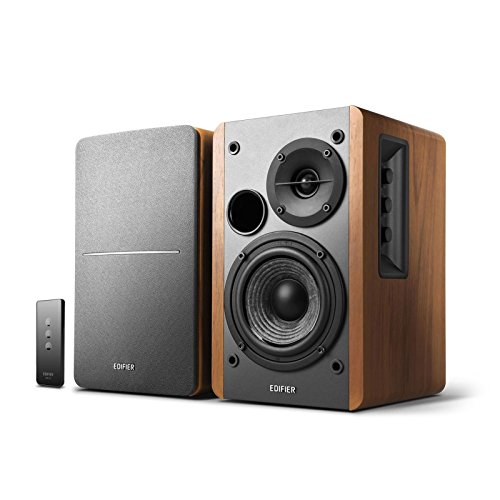
Edifier R1280T Powered Bookshelf Speakers (Pair)
Badge: Best Overall
Powered 2.0 bookshelf pair; 42W RMS total output; 4-inch woofer and 13 mm silk dome tweeter per speaker; two sets of RCA inputs that work simultaneously; side bass and treble controls; remote control; wood-finish MDF enclosure
For the LP120, the R1280T is the pairing that defines the category: the deck’s LINE output into the Edifier’s dual RCA inputs, tone controls at hand, and a warm presentation that suits the records most people actually own. It asks nothing of its owner beyond the phono switch, and it gives back the complete vinyl experience. Most LP120 owners should buy this pair and spend the savings on records.
The R1280T also teaches its owners what they like. Because its presentation is warm and its controls are honest, listeners learn their own taste in bass and treble balance within a few weeks, knowledge that informs every later audio decision. Its dual inputs quietly encourage the turntable habit, since the deck is always connected and ready; systems that require cable-swapping get used less, and used less is the enemy of a record collection. For a component at its tier, the Edifier’s real specification is behavioural: it makes playing records easy, and easy gets played.
Key specs: Powered 2.0 bookshelf pair; 42W RMS total output; 4-inch woofer and 13 mm silk dome tweeter per speaker; two sets of RCA inputs that work simultaneously; side bass and treble controls; remote control; wood-finish MDF enclosure.
Strengths
- Two simultaneous RCA inputs end cable swapping
- Physical tone controls and a remote for daily ease
- Warm, furniture-friendly presentation for small rooms
Trade-offs
- No Bluetooth at all
- 42W RMS is small-room power, not party power
- Bass is tuneful rather than deep
Best for: first-system LP120 owners wanting the classic simple pairing / Not suited for: listeners needing Bluetooth or large-room volume
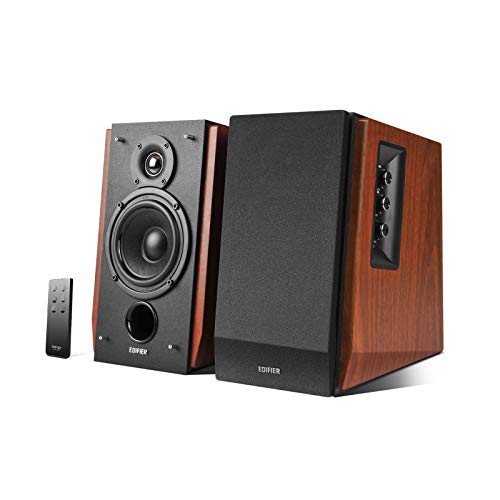
Edifier R1700BT Bluetooth Bookshelf Speakers (Pair)
Badge: Best With Bluetooth
Powered 2.0 bookshelf pair; 66W RMS total output; 4-inch woofer and 19 mm silk dome tweeter per speaker; Bluetooth streaming; digital signal processing and dynamic range control; front-panel volume, bass and treble controls; remote control; wood enclosure
The R1700BT answers the modern LP120 household, where the turntable shares the room with phones and laptops. Its extra power suits larger spaces, its DSP keeps the presentation composed, and Bluetooth means the speakers earn their shelf space every day, not only on record nights. If your system must serve two eras of listening, this is the pair that does it without compromise on either side.
The R1700BT settles into a home the way a good appliance does: used daily, for everything, without ceremony. Records in the evening, a phone’s playlist while cooking, a film at the weekend; the Bluetooth input means the speakers are never bypassed for convenience, and the front controls mean adjustment never requires finding the remote first. Its extra power over the smaller Edifier shows as ease rather than volume: busy passages stay composed, and the DSP keeps the bass disciplined when the speakers sit on a sideboard rather than stands. Owners describe the pair as the room’s sound system, full stop, which is exactly the role it was designed to fill.
Key specs: Powered 2.0 bookshelf pair; 66W RMS total output; 4-inch woofer and 19 mm silk dome tweeter per speaker; Bluetooth streaming; digital signal processing and dynamic range control; front-panel volume, bass and treble controls; remote control; wood enclosure.
Strengths
- 66W RMS with DSP headroom for busier recordings
- Bluetooth joins vinyl and streaming in one pair
- Front-panel volume, bass and treble controls
Trade-offs
- Still needs a phono stage for a turntable
- Wood finish only; no black studio look
- Larger footprint than entry powered pairs
Best for: LP120 owners whose rooms also stream from phones / Not suited for: purists wanting the flattest possible response

PreSonus Eris 3.5 Studio Monitors (Pair)
Badge: Best Flat Near-Field Pair
Powered near-field monitor pair; 3.5-inch woven-composite woofer and 1-inch silk-dome tweeter per speaker; 50W Class AB amplification (25W per side); acoustic tuning controls for high and low frequencies; front headphone output and aux input; balanced TRS and unbalanced RCA inputs
The Eris 3.5 gives the LP120 a studio window: flat, tidy and honest, with tuning controls to correct the desk it sits on. Through it, the deck sounds precise and uncoloured, which flatters good pressings and exposes ordinary ones. Desk-based listeners who value truth over warmth, and who may later record or produce, should put this pair at the top of their list.
The Eris 3.5 changes its owner’s relationship with recordings, which is what studio equipment is for. Through it, a familiar album’s mix decisions become audible: where the voice sits, how the bass was shaped, which pressing flatters the music. For turntable owners who also make music, or who simply listen analytically, that window is addictive. The tuning controls mean the window stays clear wherever the speakers must live, and the front headphone socket extends sessions into the night. Ownership is otherwise spare and professional: no remote to lose, no wireless to pair, just a tool that does its one job with unusual honesty for its size and price.
Key specs: Powered near-field monitor pair; 3.5-inch woven-composite woofer and 1-inch silk-dome tweeter per speaker; 50W Class AB amplification (25W per side); acoustic tuning controls for high and low frequencies; front headphone output and aux input; balanced TRS and unbalanced RCA inputs.
Strengths
- Flat studio voicing reveals the record honestly
- Acoustic tuning controls counter desk and wall effects
- Balanced, RCA and aux inputs plus front headphone socket
Trade-offs
- 3.5-inch woofers limit deep bass
- Near-field design; not a whole-room speaker
- No Bluetooth on this version
Best for: near-field listeners wanting studio honesty at a desk / Not suited for: listeners wanting a warm, forgiving presentation

PreSonus Eris E3.5 BT Studio Monitors (Pair)
Badge: Best Flat Pair With Bluetooth
Powered near-field monitor pair with Bluetooth 5.0; 3.5-inch woven-composite woofer and 1-inch silk-dome tweeter per speaker; 50W Class AB amplification; acoustic tuning controls; balanced TRS and unbalanced RCA inputs; front headphone output
The E3.5 BT is the Eris for households: the same honest near-field voicing and studio connections, plus Bluetooth 5.0 for the phone. For an LP120 owner whose listening splits between deliberate vinyl sessions and casual streaming, it removes the need for two systems. Its latency rules it out for critical video use, but for music in both its forms it is the most flexible pair here.
As months pass, the Eris BT’s dual nature resolves into a single habit: music, from everywhere, all the time. The turntable gets played more because the speakers are already on and trusted; the streaming sounds better because the speakers are honest. Its small woofers remain its honest limit, and owners in larger rooms eventually pair it with a subwoofer or move it to the desk it was born for. Either way, it tends to stay in the house. Equipment that serves two eras of listening rarely gets sold; it gets inherited by another room.
Key specs: Powered near-field monitor pair with Bluetooth 5.0; 3.5-inch woven-composite woofer and 1-inch silk-dome tweeter per speaker; 50W Class AB amplification; acoustic tuning controls; balanced TRS and unbalanced RCA inputs; front headphone output.
Strengths
- Bluetooth 5.0 plus full studio connections
- Tuning controls keep shelf placement sounding right
- Front headphone output for late sessions
Trade-offs
- Bluetooth latency rules it out for critical video use
- Small woofers cap bass and room-filling volume
- Flat voicing is less forgiving of poor pressings
Best for: owners splitting listening between vinyl and Bluetooth / Not suited for: video-focused users sensitive to Bluetooth latency

JBL Professional 305P MkII Powered Studio Monitor (Single)
Badge: Best for Imaging
Powered 5-inch 2-way studio monitor, sold individually; 5-inch woofer and 1-inch tweeter; Image Control Waveguide for a wide sweet spot; balanced XLR and TRS inputs; Boundary EQ and HF Trim switches for placement tuning
Two 305P MkIIs on stands are the connoisseur’s LP120 rig in this guide: a wide, stable stereo image, placement controls that respect real rooms, and resolution that makes familiar records disclose new detail. It demands balanced connections, a pair purchase and thoughtful placement, and repays all three. Listeners building toward a serious record collection should consider this their destination pair.
Owning the 305P MkII is a small apprenticeship in listening. Its waveguide makes the stereo image a physical thing in the room, and owners find themselves arranging furniture around it, sitting in the picture it paints. The placement switches stop being features and become tools, revisited whenever the system moves. Its resolution rewards the best records in a collection so clearly that owners report their buying habits changing toward better pressings, which is the surest sign a speaker has raised a system’s ceiling. It is not the easiest pair here to live with casually, and for its intended listener that is precisely the point.
Key specs: Powered 5-inch 2-way studio monitor, sold individually; 5-inch woofer and 1-inch tweeter; Image Control Waveguide for a wide sweet spot; balanced XLR and TRS inputs; Boundary EQ and HF Trim switches for placement tuning.
Strengths
- Waveguide gives a wide, stable stereo image
- Boundary EQ and HF Trim for real-world placement
- 5-inch woofer reaches lower than smaller rivals
Trade-offs
- Sold individually; a pair is the real purchase
- Balanced inputs only; no remote or Bluetooth
- Needs stands or careful shelf placement to shine
Best for: serious near-field listeners building an imaging-led rig / Not suited for: buyers wanting a remote, tone controls or Bluetooth
Powered subwoofer addition (Prose-Only Pick)
Badge: Best Second Step for Big Rooms
A powered subwoofer extends an active system below the bookshelf pair’s natural reach. Judge by room size, the sub’s low-frequency extension, and a crossover that blends with your specific main pair.
A subwoofer is this guide’s only prose-only pick because its correct size and placement belong to your room, not to a list. In a large space, or with bass-led music, it completes what small active pairs physically cannot. Add it after the main pair has settled, set its crossover where the pair naturally fades, and keep its level honest; a sub you can locate by ear is a sub turned up too far.
It is worth saying plainly why guides like this one leave the Powered subwoofer addition unlinked: the category is real, the need is real, but the correct example depends on measurements and equipment that only you can supply. The checks in this review are the recommendation. Apply them in order, refuse the listings that fail them, and the category will serve you as reliably as any linked pick on this page.
Key specs: A powered subwoofer extends an active system below the bookshelf pair’s natural reach. Judge by room size, the sub’s low-frequency extension, and a crossover that blends with your specific main pair..
Strengths
- Extends the system into true low bass
- Relieves the main pair for cleaner midrange
- Placement flexibility the main pair never has
Trade-offs
- Overkill and boom in small rooms
- Needs careful crossover and level setting
- One more box, cable and mains socket
Best for: large rooms and bass-led listening after the main pair settles / Not suited for: small rooms, where a sub usually overwhelms
Comparison Table
Compare these pairs on the columns that change daily life: how they connect, where their controls live, and what their amplification is honestly rated at. The standout column names the one virtue each pair was chosen for; if that virtue is not yours, the pair is not yours, whatever its other merits.
| Pick | Type | Connection / fit | Power | Standout |
|---|---|---|---|---|
| Edifier R1280T | Powered bookshelf pair | RCA x2 (simultaneous) | Built-in amplifier, mains powered | 42W RMS; dual RCA inputs; remote |
| Edifier R1700BT | Powered bookshelf pair | Bluetooth, RCA | Built-in amplifier, mains powered | 66W RMS; DSP tuning; Bluetooth |
| PreSonus Eris 3.5 | Powered monitor pair | TRS, RCA, 3.5 mm aux | Built-in amplifier, mains powered | 50W Class AB; acoustic tuning controls |
| PreSonus Eris E3.5 BT | Powered monitor pair | Bluetooth 5.0, TRS, RCA | Built-in amplifier, mains powered | Bluetooth 5.0; tuning controls |
| JBL 305P MkII | Powered monitor (single) | XLR, TRS balanced | Built-in amplifier, mains powered | Boundary EQ; HF Trim; sold singly |
| Powered subwoofer addition (Prose-Only Pick) | Powered subwoofer | Speaker wire / factory harness | Passive – head unit or amplifier | Completes the low end in larger rooms |
The LP120’s Phono Switch: The Setting That Decides Everything
A phono cartridge produces a tiny signal that needs two things before any amplifier can use it: a large amount of gain, and RIAA equalisation to reverse the bass-cut and treble-boost applied when the record was cut. The LP120 performs both jobs internally when its rear switch is set to LINE, delivering a standard line-level signal that any active speaker’s RCA input accepts. Set the switch to PHONO and the deck outputs the raw cartridge signal instead, intended for an external phono stage or an amplifier’s phono input, which active speakers do not have.
The symptoms of the wrong setting are diagnostic. LINE-mode speakers fed a PHONO-mode signal sound desperately quiet and thin even at full volume, because they are receiving a fraction of the expected level with no equalisation. A signal double-processed through two phono stages sounds loud, boomy and distorted. Neither indicates a faulty deck or faulty speakers, and both are cured by one switch. Check it before the first listening session, and check it again after the deck has been moved, because the switch is small, rear-mounted and easy to knock.
Owners who later add an external phono preamp reverse the logic: switch to PHONO, run the deck into the preamp, and feed the speakers from there. The active pairs in this guide accept either arrangement without complaint, because their job begins at line level. Everything upstream of that is the LP120’s world, and its switch is the border crossing.
Warm or Flat? Choosing a Voicing for Vinyl
Active speakers divide into two philosophical camps, and the LP120 sounds different through each. The domestic camp, represented here by the Edifier pairs, voices for pleasure: a little warmth in the lower midrange, a treble that flatters older pressings, and tone controls that invite adjustment. The studio camp, represented by PreSonus and JBL, voices for accuracy: a flat response that presents the recording as it is, with surface noise, pressing faults and mastering choices all audible. Neither camp is correct. They answer different questions about why you listen to records.
Think about your collection. A shelf of charity-shop originals and seventies pressings will sound more forgiving and more fun through a warm pair; the same records through studio monitors become an education in pressing quality you may not want. A collection of modern reissues and audiophile pressings rewards the flat pairs, whose honesty reveals what good vinyl can do. New listeners usually start warm and some later migrate; experienced listeners often keep one of each in different rooms.
Placement interacts with the choice. Studio pairs are designed for near-field listening at a desk or across a small room, tweeters at ear height, and their imaging rewards that discipline. Domestic pairs are more forgiving of shelves and sideboards. Decide where the LP120 lives first, then choose the camp that suits the room and the records, and the shortlist above sorts itself into a first choice and a runner-up.
Cables, Grounding and the Small Noises of Vinyl Systems
Active speakers remove the amplifier from a vinyl system, but they do not remove the need for tidy signal practice. The RCA run from deck to speakers should be as short as the furniture allows and routed away from power cables, because a turntable’s cabling carries a delicate signal in an electrically noisy world. Keep the deck and speakers on the same mains circuit where possible, which reduces the hum loops that appear when grounds disagree, and if a hum does appear, change one thing at a time until it leaves; hum hunting by random reconnection wastes evenings.
The LP120’s grounding deserves a specific note. In LINE mode, using its internal preamp, the system usually runs quietly without separate ground arrangements. Owners who switch to an external phono stage should connect the deck’s ground wire to the preamp’s ground terminal as a matter of routine. Either way, a faint hum that rises with volume is a cabling or grounding issue, never a speaker fault, and the active pairs in this guide are blameless messengers for it.
Finally, give the speakers air and the deck isolation. Powered speakers contain amplifiers that warm up; do not seal them into a closed cabinet. The turntable, meanwhile, should sit on a stable surface away from the speakers’ direct vibration, because a deck that hears its own speakers through the furniture adds a muddiness no tone control can remove. Small physical kindnesses, consistently applied, are the difference between a system that impresses and one that merely plays.
The First Ten Records: What a New LP120 System Teaches You
A new vinyl system has a curriculum, and it is worth following deliberately. Play first the records you know best, because they are your measuring instruments: their familiar passages will tell you what the speakers do well and what the room does badly, more honestly than any test track. Play second the records you bought the system for, the ones whose sound in your memory justified the purchase. If the system is right, those records will not merely match the memory; they will correct it, usually kindly. Play third something you have never heard on vinyl at all, because discovery is the point of the whole enterprise and a system that only replays nostalgia is a museum with a volume knob.
During those ten records, resist the settings. New owners fiddle: tone controls up and down, speakers toed in and out, volume chasing an impression that keeps moving because ears and speakers are both settling. Choose one placement, flat-ish controls, and live there for the whole ten. The adjustments that still seem necessary afterwards are the real ones, and there are usually only one or two: a shelf’s bass lift to tame, a tweeter axis to aim. Systems tuned by patience sound like it for years.
Keep a note, even a phone note, of what surprised you. Which record sounded better than expected, which worse, which revealed a pressing fault you had blamed on your old setup. That small diary becomes the evidence base for the next decision, a cartridge, a subwoofer, a better pressing of a favourite, and it is the beginning of the connoisseurship that makes vinyl a hobby rather than a format.
Growing the System: Cartridges, Preamps and the Order of Upgrades
The LP120 invites growth, and the active system in this guide grows gracefully if the order is respected. The first upgrade most systems want is not electronic at all: placement, isolation and room arrangement, which cost little and change much. The second is the cartridge or its stylus, the component that touches the record and therefore the one whose quality ceiling is set at the groove itself; the LP120’s arm accepts a wide range, and a stylus upgrade is the classic first spend for a reason. The speakers in this guide, honestly chosen, will reveal that upgrade clearly rather than masking it.
An external phono preamp comes third for most owners: it replaces the deck’s internal stage, the switch moves to PHONO, and a good unit lowers noise and refines detail in ways the active pairs here can resolve. Amplification never enters the list, which is the active architecture’s quiet triumph: the amplifier budget was spent once, inside the speakers, matched by their maker. A subwoofer, the prose-only route in the picks, slots in where the room demands it, usually fourth, and by then the owner knows the system’s voice well enough to integrate one properly.
What should not happen is the sideways churn: swapping one competent active pair for another at the same tier, hunting a character difference that placement would have given free. This guide’s list is tiered deliberately so that a move within it is a move upward, in power, honesty or imaging. Buy the tier your listening deserves, grow the source components around it, and the LP120 system becomes a long story rather than a series of purchases.
A Note on Records Themselves: The Other Half of the System
It would be a poor turntable guide that ended without mentioning the software, because an LP120 system reveals, sometimes rudely, that records are not interchangeable black discs. A worn charity-shop pressing through the honest pairs in this guide will sound like what it is; a clean modern reissue of the same album can sound like a different recording altogether. New owners often blame the speakers for the first discovery and credit them for the second, when both verdicts belong to the vinyl. Part of growing with this system is learning to hear the difference, and to spend accordingly: fewer, better records usually satisfy more than shelves of maybes.
Care compounds the lesson. A basic cleaning routine, a carbon brush before each side and a proper wash for new acquisitions, removes more noise than any component upgrade at this level, and it protects the stylus that traces the grooves. Storage upright, inner sleeves sound, the deck’s lid treated kindly: the small liturgy of vinyl housekeeping. The active pairs here will repay that housekeeping audibly, because they hide nothing. In the end, that is the LP120 system’s charm and its demand: it shows you your records as they are, and invites you to make them worth showing.
Room, Shelf and Stand: Placing Active Speakers for Records
Placement is the cheapest component in this entire guide and the one most often bought badly, which is to say not bought at all. Active speakers for a turntable live on shelves, sideboards and desks, each with a signature fault. A shelf against a wall adds bass the speaker never made, flattering some records and bloating others; the tuning controls on the studio pairs exist largely to forgive this. A sideboard shared with the deck invites vibration feedback at volume. A desk places the speakers gloriously close and the listener in the near field the studio pairs were born for, at the cost of reflections off the surface itself, which a pair of isolation pads or angled stands cures for the price of a record.
The geometry that matters is a triangle: speakers and listener at its corners, tweeters at ear height, the whole arranged symmetrically in the room as far as domestic diplomacy allows. Asymmetry is the silent killer of stereo: a speaker in a corner and its partner in open space will never image honestly, whatever their pedigree. Owners who spend one hour with a tape measure and a favourite record, moving the pair in small increments and listening for the centre image to lock, routinely gain more than owners who spend the same hour shopping for the next tier. The pairs in this guide are good enough to reward that hour extravagantly. Spend it before you spend anything else.
The Quiet Virtues: What Active Speakers Remove From Life
An active system for an LP120 is partly a subtraction, and the subtractions deserve their own appreciation. There is no amplifier to house, heat or dust; no speaker cable to route, trip over or upgrade in a fit of midnight enthusiasm; no impedance matching to research, because each speaker’s amplifier was matched to its drivers by the people who designed both. The system’s entire failure surface is two boxes, a deck and a cable, which makes diagnosis a pleasure: if something sounds wrong, the suspects can be interrogated in minutes. For listeners whose hobby is records rather than equipment, that smallness of the machine is not a compromise. It is the point.
There is an aesthetic subtraction too. A turntable and two speakers compose a room the way a piano does: as furniture with a purpose everyone understands. Visitors do not ask what it is; they ask what you have been playing. Systems that sprawl across racks of separates invite a different conversation, about the equipment itself, and some owners love that conversation. The LP120 owner who chose the active route has usually voted, consciously or not, for the first kind of room. This guide’s shortlist was built to serve that vote with no loss of musical honour, and its best pairs prove daily that a system can be small in the room and large in the ear at the same time.
Listening Alone, Listening Together: The Social Life of a Vinyl System
A turntable system has two social modes, and the active pairs in this guide serve them differently enough to be worth a section. Alone, the listener sits in the sweet spot, at near-field distance, and the system’s imaging and honesty are for an audience of one; this is the studio pairs’ home ground, and the JBL and PreSonus entries exist for these hours. Together, the system fills a room for people who move, talk and listen at angles no sweet spot survives; here the domestic Edifier pairs, with their forgiving dispersion and warmth, hold the room better than accuracy does. Most LP120 owners live in both modes across a week, and the honest question is which mode the favourite hours belong to.
That question, answered truthfully, is a better buying guide than any specification in this article. The listener whose sacred time is a solitary side after midnight should buy the revealing pair and arrange the chair. The listener whose records soundtrack dinners, friends and a household in motion should buy the warm pair and place them for the room. Regret in audio usually traces to buying for the listener one wishes to be; satisfaction traces to buying for the listener one is. The LP120 itself is gloriously neutral in this argument, because it feeds either philosophy with equal fidelity.
There is also the matter of the second listener who matters most: the future one. Systems like these recruit. A friend who hears a beloved album properly for the first time on your LP120 goes home infected, and a partner who finds the system easy, always connected, one switch from playing, becomes a co-owner rather than a tolerator. The active architecture’s simplicity is a recruiting tool: no rack of warm amplifiers to explain, no ritual to learn, just a record, a needle and music. Many collections owe their second decade to a household that voted to keep the system because using it was a pleasure rather than a procedure.
Choose, then, for your real rooms and your real hours, and let the guide’s badges argue within that frame. The best active speakers for an LP120 are finally the ones that get its records played most often, in the company they were bought for. By that measure, every pair on this shortlist has won somewhere, and the reader’s task is only to identify where their own listening life is lived. The deck will do the rest, as it has done for a generation of owners who discovered that the simplest system in the house became its most loved.
How Much Power Do Active Speakers Need for an LP120?
Less than instinct suggests, because the listening distances are short. The LP120 usually anchors a desk, a sideboard or a small listening corner, where the listener sits one to three metres from the speakers. At those distances, the 42 to 66 watts RMS of the Edifier and PreSonus pairs in this guide produce more clean volume than the room can use, with headroom to spare. The JBL’s per-speaker amplification serves the same spaces with studio composure. Power becomes a genuine question only in large rooms, where the honest answer is usually a subwoofer or a different system architecture, not a bigger bookshelf pair.
Judge power by RMS figures from the maker, distrust any total printed without them, and remember what the watts are for: not loudness records, but the headroom that lets a drum hit or a choral peak pass without strain. Every linked pair here clears that bar for its intended space, which is why the guide ranks them by voicing, inputs and imaging rather than by a wattage league table.
How to Connect an LP120 to Active Speakers, Step by Step
One RCA cable and ten unhurried minutes separate a boxed system from a playing one. Work through the steps in order and play a familiar record at the end.
- Set the deck’s switch to LINE. Find the phono preamp switch on the LP120 and set it to LINE before connecting anything. This is the step the whole system depends on, and it is easier with the deck unplugged and turned toward you.
- Position the speakers. Place the pair either side of the deck, tweeters near ear height for your listening position, angled slightly inward. Keep them off the same surface as the turntable if you can, to reduce vibration feedback.
- Connect the RCA cable. Run the LP120’s RCA output to the speakers’ RCA input, left to left and right to right. Connect the speaker-to-speaker link cable that joins the powered pair, and seat every plug fully.
- Power and volume discipline. Connect mains power, set the speakers’ volume to a low level, power the deck, and lower the needle onto a familiar record. Raise the volume gradually to listening level.
- Balance the picture. Sit in your listening position and confirm voices sit in the centre. If the image pulls to one side, check cable seating and speaker symmetry before touching any controls.
- Fine-tune with tone controls. After a few records, adjust bass and treble in small steps to suit the room. Then leave the controls alone; a vinyl system’s charm is that it rewards listening rather than fiddling.
Keep the deck’s manual page for the phono switch with the speakers’ paperwork, and note your final tone settings there too. Systems get moved, switches get knocked and memories fade; the page you keep is the difference between a five-minute restoration and an evening of puzzled forum posts.
Common Mistakes
Leaving the phono switch on PHONO. The single most common LP120 mistake: a whisper-quiet, thin sound that gets blamed on the speakers. The switch belongs on LINE for any active pair in this guide.
Putting speakers and deck on one wobbly surface. Vibration travels from speaker to cartridge and muddies everything. Separate, stable surfaces, or isolation pads, cure what sounds like a pressing fault.
Judging a pair in the first five minutes. New speakers and familiar records need a few sides to agree. Live with a voicing for a week before deciding it is wrong; first impressions in audio are notoriously unreliable.
Buying studio monitors for a forgiving sound. Flat pairs reveal pressing faults and surface noise faithfully. Owners of worn collections who want warmth should choose the domestic pairs on purpose, not discover the difference afterwards.
Skipping the centre-image check. A reversed or badly seated RCA swaps or smears the stereo picture. The two-minute check in the setup steps protects every listening session that follows.
Final Recommendation
For most LP120 owners the answer is the Edifier R1280T: it is the pairing this deck made famous, warm, simple and complete, and it will be playing records happily a decade from now. Owners whose rooms also live on streaming should step directly to the R1700BT and its Bluetooth, gaining power and convenience in one move.
Listeners who want the records themselves, unvarnished, should choose between the PreSonus pairs for near-field honesty and the JBL 305P MkII for imaging, according to budget and placement. Whichever pair you take home, set the switch to LINE, place them with care, and the LP120 will do the rest. It has been waiting to.
Related Guides
- Best active speakers for turntable
- Best powered speakers for turntable
- Best speakers for vinyl
- Best speakers for turntable
Frequently Asked Questions
Do I need a receiver or amplifier with these speakers?
No. Every linked pick is active, with its amplifier built in, and the LP120’s LINE output feeds them directly through an RCA cable. That two-box simplicity is the entire appeal of this system architecture, and nothing else needs to be bought for the system to play.
What does the LP120’s LINE and PHONO switch do?
LINE engages the deck’s built-in phono preamp, raising the cartridge signal to line level with RIAA equalisation, which is what active speakers need. PHONO bypasses it for use with an external phono stage. Feeding active speakers in PHONO mode produces a very quiet, thin sound, the most common LP120 setup error.
Can I also play my phone through these speakers?
Through the R1700BT and the Eris E3.5 BT, yes, by Bluetooth, which makes them the picks for rooms that split time between vinyl and streaming. The R1280T, Eris 3.5 and JBL are wired designs; a phone reaches them by cable or through a separate streamer into a spare input where fitted.
Are studio monitors a good idea for vinyl?
For the right listener, they are the best idea: flat, honest and revealing of good pressings. For owners of worn or noisy collections, that honesty can be tiring, and the warmer domestic pairs flatter the records more. The guide presents both camps deliberately; choose by your collection, not by fashion.
Will I need a subwoofer?
Not at first, and perhaps never in a small room. The pairs here are balanced for near-field and small-room listening, where their bass is tuneful and sufficient for most music. Large rooms and bass-led genres are the honest cases for the prose-only subwoofer route, added after the main pair has settled in.
Why is the JBL sold as a single speaker?
Studio monitors are priced and sold individually because studios buy them in various counts. For an LP120 stereo system you need two, and the budget should be read as a pair. The guide flags it at every appearance so the arithmetic is never a surprise at checkout.
Can I connect the LP120 to these speakers with Bluetooth?
The deck itself is a wired source; it has no Bluetooth output. The Bluetooth in the R1700BT and Eris E3.5 BT serves phones and computers, while the turntable always arrives by RCA cable. That division is normal for vinyl systems and no limitation in practice, since the deck never moves.
Where should the speakers sit relative to the turntable?
Either side of it, tweeters near ear height, angled slightly toward the listening position, and ideally on a different surface or on isolation pads so vibration does not travel back into the cartridge. A metre or so of separation each side gives the stereo image room to form in most domestic setups.