Where to buy
On a boat, a speaker is judged by weather before it is judged by music. This guide therefore treats the verified marine standard as the headline and the 6×9 shape as a detail, because fibreglass remembers every mistake long after a playlist is forgotten.
Marine speakers are sold through Amazon, where you can check price on Amazon and confirm the current listing, grille options and cut-out dimensions before ordering; orders are placed on Amazon, and qualifying purchases may earn this site a commission. On the water the pre-purchase ritual matters twice over: measure the panel and the void behind it before anything ships, since returning a speaker is easy and un-cutting a console is not. A head unit’s modest output adds a third check, sensitivity, covered in detail below.
- KICKER KM65 6.5-Inch Marine Coaxial Speakers (Pair, 45KM654) – best verified marine pick choice; check price on Amazon.
- True marine 6×9 coaxial pair (prose-only pick, no single model linked) – best for existing 6×9 cut-outs choice.
- High-sensitivity marine speaker pair for head-unit power (prose-only pick, no single model linked) – best for head-unit-only boats choice.
- Compact marine amplifier (prose-only pick, no single model linked) – best planned upgrade choice.
- Marine speaker pods and enclosures for open cockpits (prose-only pick, no single model linked) – best for boats without panels choice.
- Second-zone marine pair for cockpit or cabin (prose-only pick, no single model linked) – best for a second zone choice.
Construction first, catalogue second, as always afloat.
Disclosure: As an Amazon Associate, kajuandouglas.com earns from qualifying purchases. Links to Amazon on this page are affiliate links; they cost you nothing extra. Listing details such as price and availability change often, so check the current Amazon listing before you buy.
Three problems arrive together in this search, and their order matters. The first is survival: spray, ultraviolet, damp lockers and the occasional green wave over the bow will dismantle a speaker that was designed for a car door. The second is shape: many boats were cut at the factory for oval 6×9 speakers, and an owner with those openings wants a marine driver that fills them rather than a lecture about round ones. The third is power, because the phrase ‘for head unit’ quietly promises there is no amplifier, and a marine head unit’s honest output is modest.
Honesty about the middle problem shapes everything below. The marine 6×9 market is small, listings come and go, and at research time only one marine pair could be verified completely enough to link with confidence: a 6.5-inch round pair that now serves as the anchor and the construction benchmark. Rather than invent links, the 6×9 routes are described in prose with the exact checks a buyer should apply to any candidate. That is not a lesser service. On a boat, where a wrong purchase means a wrong hole, teaching the inspection is worth more than a longer list of names.
What this guide will never do is pass off automotive 6x9s as a marine bargain. A car speaker on a boat is a countdown: foam surrounds absorb damp and crumble, paper-based cones soften, terminals bloom with corrosion, and the failure usually announces itself mid-season with guests aboard. The saving evaporates into a second purchase plus a second installation, performed in worse weather than the first. Buy marine construction once, or buy car speakers repeatedly; those are the real options, and only one of them is cheap.
Set expectations for the environment itself. Open air swallows bass that a car cabin would reinforce, wind writes its own accompaniment over everything, and the listening happens standing, moving, and social rather than seated in a sweet spot. A good marine system is therefore judged on clarity at conversational distance, durability across seasons, and grace under spray, not on the last degree of refinement. Owners who recalibrate to those terms end up delighted. Owners who chase showroom hi-fi on open water end up shopping forever, and this guide declines to send anyone down that dock.
Key Takeaways
- A boat judges speakers by weather first, so sealed marine construction outranks every other virtue.
- The KM65 anchors this guide as the one fully verified marine pair, in the round 6.5-inch format.
- Existing 6×9 openings deserve true marine ovals, bought by the construction and sensitivity checks given here.
- Head-unit power rewards sensitivity above all; underway listeners may honestly need the compact amplifier.
- Measure the panel and the void behind it twice, because fibreglass does not forgive a first draft.
In this guide
Quick Picks
One verified anchor, the 6×9 categories described with their inspection checks, and the power maths for head-unit boats: that is the whole structure in a sentence.
| Buyer type | Pick | Why it stands out | Link |
|---|---|---|---|
| Best Verified Marine Pick | KICKER KM65 Marine | Sealed marine construction with stainless hardware | Check price on Amazon |
| Best for Existing 6×9 Cut-Outs | True marine 6×9 coaxial pair (Prose-Only Pick) | Uses the cut-outs your boat already has | Prose-only – see review |
| Best for Head-Unit-Only Boats | High-sensitivity marine speaker pair for head-unit power (Prose-Only Pick) | Stays clear over wind and engine noise | Prose-only – see review |
| Best Planned Upgrade | Compact marine amplifier (Prose-Only Pick) | Transforms volume and composure underway | Prose-only – see review |
| Best for Boats Without Panels | Marine speaker pods and enclosures for open cockpits (Prose-Only Pick) | No cutting of fibreglass required | Prose-only – see review |
| Best for a Second Zone | Second-zone marine pair for cockpit or cabin (Prose-Only Pick) | Ends the one-pair-two-spaces compromise | Prose-only – see review |
How These Picks Were Chosen
The research rule here is strict because the cost of error floats. A linked pick must be verified against its Amazon listing with maker specifications matching, model for model, so the name in the review is the object in the box. Candidates were then judged as marine equipment before they were judged as speakers: sealed construction, ultraviolet-stable materials, corrosion-proof hardware, and a manufacturer with a genuine marine range behind the product. Several plausible 6×9 candidates failed that verification at research time, which is why they appear as described categories with checks rather than as links wearing borrowed confidence.
Every candidate, linked or prose, faced the same examination. Does the construction keep water out of the motor and the terminals? Will the cone and surround survive a summer of direct sun without going brittle? Is the hardware stainless or otherwise proof against the brown bloom that eats ordinary screws? Is sensitivity stated honestly, so a head unit’s output can be predicted rather than hoped for? A speaker that passed all four questions earned consideration; a speaker that merely looked nautical in photographs did not, whatever its price or pedigree in a car.
- Genuinely sealed marine construction, not a car speaker in a white finish
- UV-stable cone materials and corrosion-proof surrounds and hardware
- Sensitivity suited to head-unit power in an open, noisy environment
- Honest RMS handling figures from an established marine audio maker
- Cut-out and depth dimensions published clearly enough to verify against the boat
- Grilles and mounting hardware suited to fibreglass and cockpit installation
The Best 6×9 Marine Speakers For Head Unit
The verified anchor comes first and sets the standard by which the categories are described. If your boat’s openings are round, your decision may end there; if they are oval, the checks that follow are your shopping list.

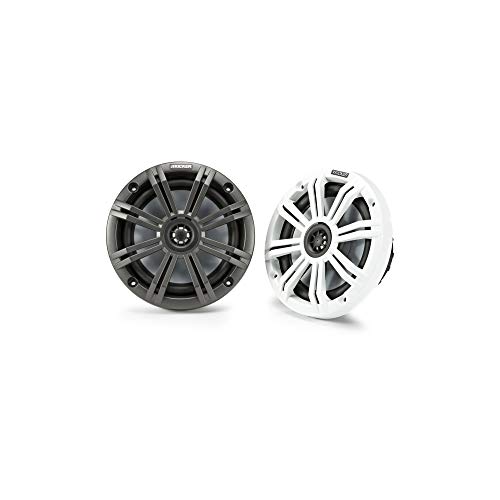
KICKER KM65 6.5-Inch Marine Coaxial Speakers (Pair, 45KM654)
Badge: Best Verified Marine Pick
6.5-inch marine coaxial speakers, pair; 3/4-inch tweeter; 4-ohm impedance; 65W RMS power handling; UV-resistant cones with Santoprene surrounds; rustproof stainless steel hardware; charcoal and white grilles included; sealed marine-grade construction
In a guide nominally about 6x9s, a round 6.5-inch pair leads, and the reason is the guide’s whole philosophy: verification leads. The KM65 is a fully confirmed marine product, sealed, UV-resistant, stainless-hardware equipped, with charcoal and white grilles in the box to suit dark consoles or pale cockpits. Its 65 watts RMS rating is stated in the honest currency, and its four-ohm load is exactly what marine head units expect to drive. Fitted where a round cut-out exists or can be made, it removes every doubt this category usually carries, and it does so at the size most boats can actually accommodate.
Afloat, the KM65’s tuning reveals its purpose. It projects: voices and midrange carry across a cockpit over engine murmur and water noise, which is the frequency region a boat actually uses. At anchor it relaxes into perfectly civilised background music without the shoutiness that ruins a quiet anchorage. Season-long reports from marine use follow a pattern of indifference, which is the highest compliment available: hosed down, baked, splashed, wintered, and still playing in spring with its grilles unyellowed and its screws removable by hand tools rather than prayer.
Key specs: 6.5-inch marine coaxial speakers, pair; 3/4-inch tweeter; 4-ohm impedance; 65W RMS power handling; UV-resistant cones with Santoprene surrounds; rustproof stainless steel hardware; charcoal and white grilles included; sealed marine-grade construction.
Strengths
- Sealed marine construction with stainless hardware
- UV-resistant cones and Santoprene surrounds for outdoor life
- 65W RMS handling stays clear over wind and engine noise
Trade-offs
- Marine build costs more than an equivalent car speaker
- White and charcoal grilles only; no chrome option
- Still needs sensible power to shine at speed
Best for: boat owners who want the verified marine standard in a round fit / Not suited for: owners determined to reuse existing 6×9 cut-outs at any cost
True marine 6×9 coaxial pair (Prose-Only Pick)
Badge: Best for Existing 6×9 Cut-Outs
A genuine marine 6×9 coaxial combines the oval’s cone area with sealed construction, UV-stable polypropylene cones, rubber-family surrounds and stainless hardware. Judge candidates by those construction details and a stated sensitivity figure.
Boats already cut for 6x9s deserve a marine speaker in that shape, full stop. The oval’s extra cone area is a real asset on head-unit power, moving more air per watt in the bass and lower midrange where open cockpits are hungriest. The category exists in the market; it is simply thinner and faster-changing than its car equivalent, which is why this guide describes it instead of linking a listing that might not survive verification until your order. An owner with sound 6×9 openings, armed with the inspection drill later in this guide, can shop the category confidently and end with exactly the right object.
Place two or three candidates side by side and the category’s real spread appears quickly. One will name its cone material and surround compound; another will say only ‘waterproof’ in large type and nothing in small. One will publish sensitivity measured at one watt, one metre; another will hide behind a peak wattage number large enough to run a kettle. The disciplined buyer reads the small type, favours the maker with a broader marine catalogue behind the product, and treats any missing specification as an answer in itself. In marine equipment, silence in the data sheet is rarely modesty.
Key specs: A genuine marine 6×9 coaxial combines the oval’s cone area with sealed construction, UV-stable polypropylene cone, rubber surround and stainless hardware. Judge listings by those construction details, published dimensions, and an RMS figure suited to head-unit or compact-amplifier power..
Strengths
- Uses the cut-outs your boat already has
- Oval cone area gives stronger bass and output
- Full marine construction survives cockpit life
Trade-offs
- Market is small and listings change often
- Large magnets need panel depth many boats lack
- Requires the strictest verification of any pick here
Best for: boats with sound existing 6×9 cut-outs and exposed locations / Not suited for: boats where the panel depth cannot take a large oval magnet
High-sensitivity marine speaker pair for head-unit power (Prose-Only Pick)
Badge: Best for Head-Unit-Only Boats
Efficiency-first marine speakers prioritise output per watt for boats without amplifiers. Judge by an honestly stated sensitivity figure, marine construction equal to the anchor’s, and a four-ohm load the head unit can drive all day.
If no amplifier will ever be fitted, and most of your listening happens underway rather than at anchor, sensitivity is the specification that decides your summer. Every extra decibel of efficiency is volume the head unit does not have to strain for, and strained head units sound thin exactly when the wind rises. A high-sensitivity marine pair, chosen with construction equal to the anchor’s standard, is therefore not a compromise pick for amplifier-less boats; it is the correctly engineered pick, the one whose designer started from your actual power supply instead of an imaginary one.
One discipline protects every category purchase in this guide: never let a single attractive number close the sale. Sensitivity without sealed construction buys one loud season. Sealed construction without sensitivity buys a durable whisper. The anchor pair demonstrates that both virtues coexist at this size, so refuse any candidate that asks you to choose between surviving the water and being heard on it. Shortlist by construction, rank by sensitivity, confirm by dimensions, in that order, and the category will treat you as well as a link could.
Key specs: Efficiency-first marine speakers prioritise output per watt for boats without amplifiers. Judge by an honestly stated sensitivity figure alongside full marine construction: sealed build, UV-stable materials, rubber surrounds, stainless hardware..
Strengths
- Stays clear over wind and engine noise
- No amplifier required, now or later
- Full marine construction for cockpit life
Trade-offs
- Trades some bass weight for efficiency
- Claims vary; buy established marine brands
- At anchor, the advantage matters less
Best for: owners who want maximum output from head-unit power / Not suited for: covered, quiet boats used mainly at anchor
Compact marine amplifier (Prose-Only Pick)
Badge: Best Planned Upgrade
A compact marine amplifier takes the head unit’s output and delivers clean RMS power to the speakers. Judge by marine-grade protection, per-channel RMS at four ohms, and dimensions that fit a dry locker or console void.
This pick is the honest escape hatch for the power problem, and naming it in a head-unit guide is a service rather than a contradiction. If your listening is mostly underway, in wind and engine noise, and the head unit runs out of composure before the speakers do, no speaker swap will cure that; only power will. A compact marine amplifier, fitted once in a dry space with proper cable, transforms the same speakers into a system with headroom. Buy it when the evidence points at power, not as a reflex, and the head-unit-only boats can ignore this section with a clear conscience.
Owners sometimes ask whether a prose category is a lesser recommendation than a linked product. For this amplifier it is arguably the stronger one, because the right unit depends on your boat’s available dry space, your speaker count and your electrical system’s spare capacity, none of which a guide can measure from ashore. What can be given is the standard: genuine marine protection rather than a car amplifier in a hopeful location, honest RMS figures, and wiring hardware that will not corrode into next winter’s fault-finding exercise.
Key specs: A compact marine amplifier takes the head unit’s output and delivers clean RMS power to the speakers. Judge by per-channel RMS at 4 ohms, sealed marine construction, and a size that fits your boat’s dry spaces..
Strengths
- Transforms volume and composure underway
- Marine-sealed designs survive boat life
- Works with the speakers already recommended here
Trade-offs
- Adds cost, wiring and a mounting location to find
- Unnecessary for anchor-only listening
- Must be mounted in a genuinely dry space
Best for: owners planning a compact marine amplifier later / Not suited for: owners who want the simplest possible two-speaker system
Marine speaker pods and enclosures for open cockpits (Prose-Only Pick)
Badge: Best for Boats Without Panels
Enclosed marine pods mount speakers where a boat has no suitable panel: towers, rails and open cockpit corners. Judge by sealed enclosure construction, mounting hardware rated for vibration, and drivers voiced to project outdoors.
Some boats offer nowhere sensible to cut, and on those boats pods are not a styling statement but the only honest route to music. A centre console with every surface spoken for, a flats skiff, a wake tower waiting for a voice: the pod brings its own enclosure, mounts where structure exists, and aims sound at the crew instead of into a locker. Choose sealed, genuinely marine pods and they shrug off the same weather as a flush-mounted pair, with the added mercy that removal for winter storage takes minutes rather than a sealant knife.
Because this pick is a category, verify on the listing before buying: the enclosure should be described as sealed with marine drivers inside, not merely a hollow shell awaiting car speakers. Check the clamp or bracket range against your tower or rail diameter in millimetres, confirm the hardware is stainless, and look for a stated sensitivity so the head unit’s prospects can be judged. A pod that hides its driver specifications is asking you to buy the container and gamble on the contents, which is backwards.
Key specs: Enclosed marine pods mount speakers where a boat has no suitable panel: towers, rails and open cockpit corners. Judge by enclosure sealing, mounting hardware rated for marine use, and the driver fitted or specified..
Strengths
- No cutting of fibreglass required
- Aimed sound for open cockpits and tow sports
- Removable for winter storage in some designs
Trade-offs
- Visual bulk some owners dislike
- Mounts must be genuinely secure at speed
- Sound quality depends heavily on the fitted driver
Best for: cockpits needing sound away from the main speaker locations / Not suited for: small boats where two speakers cover everything
Second-zone marine pair for cockpit or cabin (Prose-Only Pick)
Badge: Best for a Second Zone
A second marine pair covers a cabin, a bow or a flybridge that the main cockpit speakers cannot reach. Judge by the same construction standard as the main pair and by your head unit’s zone or fader provision.
Larger boats are two listening rooms sharing one hull, and a single pair rarely serves both. The cockpit set, loud enough for the cabin, deafens the helm at night; the cabin set, civilised below, is inaudible on deck. A second pair, run as its own zone or on the fader, ends that negotiation. Match its construction standard to the main pair rather than treating the quieter room to cheaper equipment, because damp finds the cabin pair just as surely, through condensation rather than spray, and its replacement is just as annoying.
When comparing candidates for the second zone, weight the unglamorous specifications as heavily as for the cockpit. Sensitivity still matters, because the same head unit feeds both zones and its amplifier channels share the same modest budget. Physical depth matters more below deck, where lockers and liners crowd every mounting. And grille colour, trivial on deck, matters in a cabin you sleep in: the white option that looks fresh in a cockpit can glare in a berth, so choose with the room’s light in mind.
Key specs: A second marine pair covers a cabin, a bow or a flybridge that the main cockpit speakers cannot reach. Judge by the same marine construction checks, matched impedance for the head unit, and dimensions verified in the second location..
Strengths
- Ends the one-pair-two-spaces compromise
- Same construction standard as the main system
- Lets each zone listen at its own level
Trade-offs
- More wire to run through a finished boat
- Head unit must have the channels or zone output
- Voicing mismatch if brands are mixed carelessly
Best for: owners cutting fresh panels who want a second zone done properly / Not suited for: owners unwilling to cut any new holes in the boat
Comparison Table
Read this table as a standard-setter rather than a league table. The linked anchor defines the construction and honesty expected; each category row then tells you the job it exists to do and the check that qualifies it.
| Pick | Type | Connection / fit | Power | Standout |
|---|---|---|---|---|
| KICKER KM65 Marine | 6.5-inch marine coaxial pair | Speaker wire / harness | Passive – head unit or amplifier | Marine grade; 65W RMS; stainless hardware |
| True marine 6×9 coaxial pair (Prose-Only Pick) | 6×9 marine coaxial pair | Speaker wire / factory harness | Passive – head unit or amplifier | Sealed marine construction |
| High-sensitivity marine speaker pair for head-unit power (Prose-Only Pick) | Marine coaxial pair, efficiency-first | Speaker wire / factory harness | Passive – head unit or amplifier | Sensitivity suited to head units |
| Compact marine amplifier (Prose-Only Pick) | Compact marine amplifier | Speaker wire / factory harness | Passive – head unit or amplifier | Changes what head-unit speakers can do |
| Marine speaker pods and enclosures for open cockpits (Prose-Only Pick) | Enclosed marine speaker pods | Speaker wire / factory harness | Passive – head unit or amplifier | Sound where no panel exists |
| Second-zone marine pair for cockpit or cabin (Prose-Only Pick) | Marine coaxial pair, second zone | Speaker wire / factory harness | Passive – head unit or amplifier | Fills the space the main pair cannot |
What Makes a Speaker Truly Marine?
The word marine on a carton can mean almost anything, so judge by construction instead of vocabulary. A true marine speaker seals its motor and terminals against driven spray, builds its cone from a material sunlight cannot embrittle, hangs that cone in a surround that stays flexible through winters, and treats its grille as a shield rather than a decoration. Each element answers a specific assassin: water, ultraviolet, cold, and the physical knocks of a working cockpit. A candidate vague about any one of them is asking you to discover the omission at sea, in August, with the receipt long faded.
Hardware is the second tell, and the easiest to inspect. Stainless fasteners and non-corroding terminals are not cosmetic upgrades; ordinary steel screws in a marine speaker become rust streaks by midsummer and seized regrets by the second season, when the speaker must come out for an unrelated job and will not. Look also at how the speaker’s own connections are made: sealed or protected terminals survive, bare push tabs in an open basket invite the green corrosion that eventually silences a channel. These details photograph badly and matter enormously, which is why listings that specify them deserve your trust.
Finally, treat water-resistance language with a lawyer’s care. Splash-proof, water-resistant and marine-grade are not synonyms, and none of them is a standard unless a rating or a construction description stands behind it. The anchor pair in this guide earns its place by naming materials and methods, not adjectives. Apply the same demand everywhere: if a listing will not say what the cone is made of, what the surround is made of, and what the screws are made of, it has told you everything you need to know about its intended lifespan.
Head-Unit Power on the Water: Why Sensitivity Rules at the Helm
A marine head unit makes the same modest continuous power as a car receiver, but it plays into a far harder room: no roof, no doors, wind rising with speed, and an engine contributing its own baritone. In a car, cabin gain does half the work for free; on open water, every decibel at the listener’s ear was paid for by the amplifier. That is why sensitivity rules at the helm. A speaker converting each watt efficiently reaches cruising clarity while the head unit is still comfortable, and comfortable electronics are what clean, undistorted sound is made of.
The practical consequences shape every recommendation in this guide. Choose speakers whose sensitivity is honestly stated and high enough for your cruising habits. Keep expectations for deep bass modest, because open air returns nothing. Position speakers to fire at the crew rather than across them, since proximity is the cheapest volume there is. And accept the arithmetic when it points to the compact amplifier: owners who love underway listening at speed are not failing at speaker choice, they are succeeding at physics, and physics offers exactly one upgrade path.
If your listening happens mostly at anchor, the pressure relaxes and the guide’s advice tilts. In a quiet cove, volume stops being the contest and tone takes over; almost any verified marine pair will charm at background levels, and the anchor pair in particular settles into an easy, civilised voice. Judge your own boating honestly before weighting sensitivity above all else. The sunset-drifting pontoon and the dawn-running fishing machine are both legitimate boats, and they should not buy identical systems just because they share a keyword.
Cutting Fibreglass Once: Measuring a Boat for 6×9 Speakers
Cars forgive; boats do not. A wrong hole in a door card costs a trim panel, while a wrong hole in fibreglass is a repair involving resin, gelcoat and a permanent story. So measure the panel’s face for the cut-out, then measure the void behind it for depth, swing and obstructions, then measure both again on a different day when you are less excited. Check for wiring looms, fuel lines, steering cables and structural ribs hiding behind the chosen spot.
Depth is where 6×9 installations on boats most often fail, because cockpit sides and console faces are shallow sandwiches with lockers, livewells or foam flotation immediately behind. An oval driver with a proud magnet can foul all of it. Before cutting, lower the speaker into the intended void by hand, or mock the depth with a cardboard profile, and confirm clearance through the panel’s whole flex. Where depth refuses, the pod route stops being a compromise and becomes the correct engineering answer, and this guide will not think less of you for taking it.
Seal the finished installation as though the sea were personally interested, because it is. A closed-cell gasket or proper marine bedding compound behind the flange, stainless fasteners tightened evenly in rotation, and a drip loop in the wiring behind the panel together decide whether the installation is a five-year fixture or a one-season experiment. Water that enters behind a speaker does not announce itself; it works quietly on terminals and core material. The twenty minutes spent sealing is the cheapest insurance in the entire project.
Zones, Balance and the Social Life of a Boat Stereo
A boat stereo serves a crew rather than a driver, and its social geometry differs from a car’s. The helm needs clarity at speed for instructions and weather broadcasts. The cockpit needs music at conversation level for the people actually relaxing. A cabin, if there is one, needs gentleness at midnight. One volume control cannot honour all three, which is why zones and faders are features rather than luxuries on a boat of any size. Planning them from the start, even with a single pair fitted initially, keeps every later addition a pleasure instead of a rewiring.
Volume etiquette is part of the design brief, too. Marinas at night, anchorages at dawn and harbour approaches all impose a social contract that a well-zoned system makes easy to keep: music for your cockpit, not for the mooring field. Speakers aimed inward, zones that let the helm kill the deck pair without silencing the cabin, and a crew that knows the controls all contribute. The best marine systems are remembered by neighbouring boats for their restraint as much as by their own crews for their sound, and that reputation is worth engineering for.
Plan the zones when you plan the speakers, even if the second pair is a next-season purchase. Wire routes are easy with panels open and miserable afterwards, and a head unit chosen with zone provision costs little more today while saving a replacement later. Sketch the boat’s listening map on paper: where people sit underway, where they sit at anchor, where anyone sleeps. That sketch, more than any specification, determines how many pairs you need and where they belong, and it takes ten minutes at the kitchen table.
Winter, Storage and the Marine Speaker’s Off-Season
Marine speakers earn their reputations across winters as much as summers. A boat laid up in damp air tests every seal slowly: condensation forms inside lockers, freeze and thaw work on surrounds, and terminals sit for months in salt-laden stillness. Construction that survives a season of use can still fail a winter of storage if its materials drink moisture. This is another quiet argument for genuine marine build over adapted car equipment, because the off-season is when the difference compounds, unobserved, until spring commissioning delivers the verdict all at once.
Off-season care is light but real. Rinse salt away before lay-up as the maker allows, ensure the boat’s covers ventilate rather than seal in a private swamp, and disconnect or protect terminals if the boat will sit for months. A breath of corrosion inhibitor on connections, covers over exposed drivers in open boats, and batteries maintained so the head unit never browns out all belong to the same philosophy: small attentions in November purchase an uneventful April. None of it takes an hour, and all of it is cheaper than one replacement pair.
Spring commissioning then becomes a pleasure rather than a diagnosis: connections checked, grilles rinsed, and music on the first outing instead of a multimeter. Boats remember how they were wintered, and their stereos testify either way. Owners who build the small rituals into lay-up day find their systems ageing in years rather than seasons, which is the arithmetic that makes genuine marine construction the economical choice over any span longer than a single summer. The sea charges interest on every shortcut; winter is merely when the bill arrives.
The Crew’s Verdict: How a Boat Stereo Earns Its Place
Ask a boat’s regular crew about its stereo and they will not mention specifications. They will mention the evening the music carried across a raft-up without shouting, the morning a forecast came through clearly when it mattered, the long run home when a familiar album made the chop feel shorter. A boat stereo earns its place socially or not at all, and it earns it through reliability in those moments rather than through any figure on a box. That is the standard the anchor pair was chosen against, and the standard the category checks exist to protect.
Contrast the alternative biography, familiar on every dock: automotive speakers fitted in a spring of optimism, delightful in May, hoarse by July, silent by September, and replaced the following spring in a ritual their owner describes as just what boats cost. It is not what boats cost. It is what the wrong speakers cost, repeatedly, plus the labour of fitting them in rising temperatures. The crew’s verdict on that cycle is written on their faces by the second failure. Buy the construction that skips the biography entirely.
Reading a Marine Listing Like an Inspector
Since the 6×9 half of this guide is bought by inspection, the inspection deserves a drill. Open a candidate listing and ignore the banner claims entirely. Find the cone material, the surround material, the hardware description, the sensitivity figure with its measurement basis, the impedance, the cut-out dimensions and the mounting depth. Seven facts. A listing that supplies all seven is a serious product; a listing that supplies three and fills the page with lifestyle photography is a decoration. Compare your seven facts against the anchor pair’s published standard, and let any gap argue its case before your money does.
Then check the maker’s own range, because a speaker is also a promise about its company. A firm that builds marine stereos, marine amplifiers and marine speakers as a coherent line has staked its name on the environment and will support the product accordingly. A firm selling one nautical-looking speaker among a hundred car accessories has staked nothing. Warranty terms tell the same story in miniature: marine products from marine makers carry cover written by people who expect spray. Read that small print with the same care as the specifications, since both are descriptions of the future.
Salt, Sun and Sound: A Season Observed
Follow one good installation through a single season and the construction choices become visible as events. In May the sealed terminals shrug off commissioning washes. In June the UV-stable cones sit in direct sun at the dock without a thought. July brings a wet crossing, spray over the console, and music that never falters because water was never invited inside. August adds heat, crowds and long hours at anchor, where clarity at low volume becomes the virtue nobody specified and everybody enjoys. Nothing dramatic happens, which is precisely the point the season is making.
By autumn the contrast with the boat two slips down, the one wearing automotive speakers, is no longer subtle: a surround gone to crumbs, a grille rust-streaked, one channel intermittent since the regatta weekend. The two boats spent similar money in spring. They spent it on different definitions of the word suitable, and the season has marked both papers. Haul-out is the examiner that cannot be charmed, and genuine marine construction is simply the answer that passes it year after year without revision.
Fresh Water, Salt Water and the Two Kinds of Care
Marine is not one environment but two, and the distinction shapes how the picks in this guide age. Salt water attacks electrically and chemically: it creeps into terminals, blooms on unprotected metal, and turns every connection into a slow battery of corrosion. Against salt, tinned wire, sealed connections and stainless hardware are not upgrades but the baseline, and a freshwater rinse after use is maintenance, not fussiness. Owners on the coast who internalise that rhythm keep systems for a decade; owners who treat the ocean as merely wet tend to shop annually.
Fresh water is kinder but not innocent. Its weapons are damp and time: condensation inside lockers on cool nights, rain that finds the same unsealed path every weekend, and winters that freeze whatever moisture the summer admitted. Lake and river boats therefore need the same sealed construction, with slightly less paranoia about hardware and slightly more about ventilation and storage. The anchor pair’s build answers both waters, which is part of its value: a trailer boat that visits the coast twice a year does not need two standards of speaker.
The head unit shares both environments and deserves the same philosophy. A marine-rated unit, or a protected mounting for a conventional one, guards the system’s brain while speakers guard its voice. Corrosion at the head unit’s terminals mimics speaker faults faithfully, sending owners to replace healthy drivers, so inspect the whole chain each spring before blaming any single component. Systems thinking is not a slogan afloat; it is the difference between one repair and a season of them.
Buy and maintain the system as a whole, then, and the two waters become what they should be: the medium the boat moves through, not the enemy camped inside its panels. Sealed speakers, tinned wire, protected electronics and a spring inspection form a single policy, each element cheap, the combination decisive. That policy, more than any individual product in this guide, is what we would install on our own boat, and it is the standard against which every recommendation above was quietly checked before it was allowed to stand.
How Do You Choose Between a True 6×9 and the 6.5-Inch Marine Anchor?
Start with the boat rather than the catalogue. If your cockpit or console already carries 6×9 cut-outs in sound condition, the true marine 6×9 category exists to serve them, and the oval’s cone area is a genuine asset on head-unit power; shop it with the inspection drill and buy the best-verified example you find. If you are cutting fresh, or your openings are round, the anchor pair removes the inspection burden entirely and its construction is the proven quantity in this guide. Neither answer is a defeat; they are the same standard applied to different fibreglass.
Then weigh exposure and power. A fully exposed cockpit argues for the best-sealed construction you can verify, whichever shape it takes, while a sheltered cabin location forgives more. A fast, loud boat argues for sensitivity and possibly the amplifier; a slow, sociable one argues for tone at low volume. Lay your answers over the table and the choice usually names itself. What should never decide it is habit from car audio, where none of these pressures exist in this combination.
How to Fit Marine Speakers to a Head-Unit System
Work clean, work dry, and test everything before the sealant comes out. These steps assume the locations are already measured twice, as the cutting section insists.
- Template and dry-fit. Make or use the manufacturer’s template, offer the speaker up without fasteners, and confirm cut-out, depth and clearance through the panel’s full area before any cutting or drilling.
- Prepare the wiring. Run marine-grade tinned speaker wire, leave a drip loop at each speaker, and use sealed or heat-shrink connections. Label both ends; future troubleshooting on a boat is miserable without labels.
- Connect and test unsealed. Wire the speakers to the head unit, confirm polarity with a familiar track, and listen at the helm at realistic volume. Fix any imbalance now, while everything is still open.
- Bed and fasten. Apply a closed-cell gasket or marine bedding compound to the flange, fasten with stainless hardware, and tighten evenly without cracking the panel or distorting the basket.
- Set the head unit flat. Zero the tone controls, disable bass boost, and set balance and fader so the helm hears a centred image. Efficient speakers need no electronic help.
- Rinse and inspect after the first outing. After the first trip, rinse salt from the grilles with fresh water as the maker allows, and check fasteners and connections once the boat is dry. Early inspection catches the one loose screw before it matters.
Log the installation in the boat’s records: speaker models, wire runs, fuse details and the date. Boats outlive their owners’ memories and often their owners, and the next person to fault-find that system deserves your map.
Common Mistakes
Fitting car 6x9s and calling them marine. They will play beautifully for a few outings, then fail from the inside as damp and ultraviolet dismantle materials never meant for the water.
Trusting the word marine without construction details. If a listing cannot name its cone material, surround compound and hardware, the word is a paint colour rather than a specification.
Cutting before measuring both sides of the panel. Wiring looms, fuel lines and structural ribs hide behind innocent fibreglass, and the jigsaw discovers them at exactly the wrong moment.
Ignoring sensitivity because the head unit sounds loud in the marina. The marina is quiet and the boat is still; underway, wind and engine rewrite the requirement completely.
Using household or untinned wire. Untinned copper corrodes from inside its insulation in a marine environment and fails invisibly, presenting as a speaker fault a season later.
Final Recommendation
If your boat has round cut-outs, or you are cutting fresh panels, buy the verified anchor: the KICKER KM65 is the known quantity in this guide, sealed, honestly rated and ready for head-unit power. It converts a category full of judgements into a single confident purchase, and on the water confidence is a safety feature as much as a convenience. Fit it with the sealing discipline described above and expect it to outlast your interest in replacing it.
If your boat already wears 6×9 openings, use the prose routes with the inspection checks applied without mercy: construction first, sensitivity second, dimensions third, and the amplifier considered honestly if underway volume is your real requirement. A marine 6×9 bought that way is not a compromise against the anchor; it is the same standard reached by a different path. What matters, in either shape, is that the sea was consulted before the catalogue was.
Related Guides
- Best 6×9 marine speakers for motorcycle
- Best 6.5 marine speakers for Harley
- Best 6×9 speakers for bass
- Best 6.5 speakers for bass
Frequently Asked Questions
Can I use car 6×9 speakers on my boat to save money?
Only if you accept replacing them soon. Car speakers lack sealed construction, ultraviolet-stable materials and corrosion-proof hardware, so damp, sun and spray dismantle them from the inside, usually within a season or two of real use. The apparent saving also ignores labour: fitting speakers twice costs more time than fitting marine speakers once. As a deliberate short-term measure on a sheltered freshwater boat the gamble is understandable, but it should be taken with open eyes.
Why is only one pick linked if the keyword asks for 6×9 speakers?
Because the marine 6×9 market is small and changeable, and our rule is to link only listings verified completely at research time. One marine pair passed that bar and anchors the guide; the 6×9 categories are therefore described with the exact construction, sensitivity and dimension checks a buyer should apply, rather than linked on partial evidence. A boat is an expensive place to discover that a listing changed, so the guide trades a longer link list for a standard you can trust.
Will a marine head unit drive 6×9 speakers loudly enough?
At anchor and at gentle cruising speeds, yes, provided the speakers are efficient: a high-sensitivity marine pair makes a head unit sound twice its size in calm conditions. At faster cruise, wind and engine noise raise the requirement beyond what modest continuous power can deliver cleanly, and no speaker choice repeals that arithmetic. If underway listening matters most to you, the compact marine amplifier is the honest answer, and it is described in this guide for exactly that boat.
What should I verify on a marine 6×9 listing before buying?
Verify sealed construction, a UV-stable cone material such as polypropylene, a rubber-family surround rather than foam, stainless or otherwise corrosion-proof hardware, a stated sensitivity figure with its basis, four-ohm impedance, and cut-out plus depth dimensions that match your panel and the void behind it. Then check the maker’s wider marine range and warranty. Any listing silent on several of those points has answered your question by omission.
Do marine speakers need special wire?
They need tinned marine speaker wire and protected connections. Untinned copper corrodes inside its own insulation in a marine environment, invisibly, until resistance rises and a channel fades or dies presenting as a speaker fault. Tinned strands resist that creep, and sealed or heat-shrunk connections keep the ends honest. The cost difference over a boat’s worth of wire is small; the diagnostic misery it prevents, a season later, is not.
How do I stop water getting behind the panel?
Bed the speaker’s flange on a closed-cell gasket or proper marine bedding compound, tighten stainless fasteners evenly in rotation rather than one corner at a time, and form a drip loop in the wiring behind the panel so water travelling down the cable drops off before reaching the terminals. Inspect the seal each spring, because bedding compounds age. Water behind a panel works silently on terminals and core material, so the seal is maintenance, not decoration.
Do marine speakers sound as good as car speakers?
In a quiet room, a fine car speaker may edge a marine equivalent on refinement, because its designer spent the whole budget on sound. On the water the comparison dissolves: the marine speaker is playing in its element while the car speaker is surviving in a hostile one, and within a season the marine pair is usually the better-sounding of the two simply by remaining itself. Judge them where they will live. A boat is not a quiet room that got wet; it is a different discipline entirely.
Can I fit these speakers to a car instead?
You can, and some owners do, particularly in convertibles, Jeeps and vehicles that live outdoors year-round. A marine pair trades a little ultimate refinement for sealed construction and hardware that ignores rain with the top down or the doors opened in a storm, and on head-unit or modest power it performs happily. In a garaged car used gently, a dedicated car speaker remains the better-value answer to a question the weather never asks. Fit the speaker to the life, not the label.