The best pocket camera better than phones is a compact camera with a larger sensor and a real optical zoom, and the reason is simple: a phone squeezes a tiny sensor behind a tiny lens and relies on software to fix the result, while a pocket camera starts with more light and more detail, so the photo needs less fixing and looks more natural. A 1 inch sensor gathers far more light than any phone sensor, which gives photos cleaner detail in low light and a natural background blur that phones can only fake, and a real zoom lens brings distant subjects closer without the digital blur that ruins phone photos. The six cameras in this guide are all genuine pocket cameras, from the Sony RX100 with its 1 inch sensor to the Canon PowerShot SX740 HS with its 40x zoom, and each one beats a phone in a different way.
Many buyers only think about a pocket camera when the phone lets them down. A phone photo of a distant animal, a dim restaurant, or a fast moving child often comes out blurry, grainy, or flat, while a pocket camera with a larger sensor and a real zoom handles the same shot with ease. The cameras below are current models with exact brand and model names, so buyers can find the same camera again, and each one is a real compact camera with an optical zoom, not a toy camera or a phone accessory.
This guide judges pocket cameras by the sensor first, then by the zoom, the lens, and the size. A camera with a tiny sensor and a short zoom is barely better than a phone, while a camera with a 1 inch sensor and a bright lens is clearly better in every light. The picks below balance sensor size, zoom range, and pocketability, and each one fits a different buyer, from the still photographer who wants the RX100 to the vlogger who wants the PowerShot V10.
In this guide
Quick picks: best pocket camera better than phones
| # | Product | Where to buy |
|---|---|---|
| 1 | Sony RX100 premium compact digital camera | Check on Amazon |
| 2 | Sony RX100 III premium compact digital camera | Check on Amazon |
| 3 | Canon PowerShot SX740 HS digital camera bundle | Check on Amazon |
| 4 | Canon PowerShot V10 compact vlogging camera | Check on Amazon |
| 5 | KODAK PIXPRO FZ55 compact digital camera | Check on Amazon |
| 6 | Canon PowerShot ELPH 360 HS digital camera bundle silver | Check on Amazon |
How the picks were chosen for best pocket camera better than phones
A camera earns a place in this guide when it is a current pocket camera that beats a phone camera, judged by the sensor, the zoom, and the size. First, the camera must be a genuine compact camera with a real optical zoom and a sensor larger than a typical phone sensor, and it must fit in a jacket pocket or a small bag, so it is actually carried. Second, it must take still photos or video that a phone cannot match, whether through a larger sensor, a longer zoom, or a brighter lens.
Lens, video, and value were checked next. Every pick here has a lens that is sharp across its range, a video mode that suits its use, and a cost that reflects its features, from the affordable KODAK FZ55 to the premium Sony RX100 models. Cameras with no optical zoom, with a toy sensor, or with a size that needs a camera bag were left out. The result is a shortlist of six pocket cameras that genuinely beat a phone camera.
The six best pocket camera better than phones

Sony RX100 20.2MP Premium Compact Digital Camera
The Sony RX100 is the pocket camera that started the whole idea of a compact camera better than a phone, and it still earns its place here with a 1 inch sensor that is far larger than any phone sensor, a 20.2 megapixel resolution, and a 28-100mm ZEISS zoom lens in a body that fits in a jacket pocket. The larger sensor gathers more light than a phone, which gives photos cleaner detail in low light and a natural background blur that phones can only fake with software, and the real optical zoom brings distant subjects closer without the digital zoom blur that ruins phone photos. The 3 inch LCD makes composing and reviewing shots easy, and the camera slips into a pocket or a small bag, so it is there when the phone would be the lazy choice.
What makes the RX100 better than a phone is the sensor and the lens working together: a phone squeezes a tiny sensor behind a tiny lens and relies on software to fix the result, while the RX100 starts with more light and more detail, so the photo needs less fixing and looks more natural. The ZEISS lens is sharp across its range, and the 28mm wide end handles landscapes and group shots while the 100mm end handles portraits and details. Buyers should know the RX100 is an older model, so it lacks the newest autofocus and video features, but for still photos in a pocket camera, it remains a strong buy, and it proves the point of this guide: a real camera with a real sensor beats a phone.
Key specs: 20.2MP; 1 inch sensor; 28-100mm ZEISS zoom lens; 3 inch LCD; premium compact
Strengths:
- 1 inch sensor gathers far more light than any phone sensor
- Real optical zoom brings distant subjects closer without digital blur
- Fits in a jacket pocket, so it is there when the phone is the lazy choice
Trade-offs:
- Older model, so it lacks the newest autofocus and video features
- No touchscreen or flip screen for selfies and vlogging
- Costs more than a basic compact camera for the larger sensor
Best for: Photographers who want a pocket camera with a large sensor for still photos.
Not suited for: Vloggers who need a flip screen and the newest autofocus, who should choose a newer model.
Check price on Amazon: Sony RX100 premium compact digital camera

Sony RX100 III 20.1MP Premium Compact Digital Camera
The Sony RX100 III is the refined version of the original RX100 in this guide, with the same 1 inch sensor and 20.1 megapixel resolution, plus a brighter 24-70mm F1.8-2.8 ZEISS zoom lens that opens wider than the original, which gives it better low light performance and a stronger background blur for portraits. The brighter lens is the key upgrade: at F1.8, it lets in far more light than a phone lens, so indoor and evening shots stay clean and sharp, and the 24mm wide end is broader than the original, which helps with landscapes and tight indoor spaces. The camera also adds a pop up electronic viewfinder, which helps in bright sunlight when the LCD is hard to see, and it keeps the same pocket size that makes the RX100 line so easy to carry.
For buyers who want the best still photos from a pocket camera, the RX100 III is the stronger pick than the original RX100, because the brighter lens matters in exactly the situations where phones struggle: indoors, at dusk, and in restaurants and museums where the light is low and the flash is not welcome. The viewfinder is a useful extra for bright days, and the 1 inch sensor still beats any phone sensor for detail and low light. The zoom range is shorter than the original, topping out at 70mm instead of 100mm, so buyers who need a longer reach should choose a different camera here, but for most everyday shooting, the brighter lens is worth more than the extra zoom.
Key specs: 20.1MP; 1 inch sensor; 24-70mm F1.8-2.8 ZEISS zoom lens; pop up electronic viewfinder; model DSCRX100M3/B; Black
Strengths:
- Brighter F1.8-2.8 lens for better low light shots and stronger background blur
- Pop up viewfinder helps in bright sunlight when the LCD is hard to see
- Same 1 inch sensor that beats any phone sensor for detail and low light
Trade-offs:
- Shorter zoom range than the original RX100, topping out at 70mm
- Older model, so it lacks the newest autofocus and video features
- Costs more than the original RX100 for the brighter lens
Best for: Photographers who shoot indoors and at dusk and want the brightest pocket lens.
Not suited for: Buyers who need a long zoom, who should choose the SX740 HS in this guide.
Check price on Amazon: Sony RX100 III premium compact digital camera

Canon PowerShot SX740 HS 20.3MP Digital Camera Bundle
The Canon PowerShot SX740 HS is the long zoom pocket camera in this guide, with a 20.3 megapixel sensor, a 40x optical zoom, 4K video, Wi-Fi and Bluetooth, and a bundle that adds a 64GB card and a bag, and it suits buyers who want a pocket camera that reaches far beyond any phone. The 40x zoom is the headline: it brings distant wildlife, sports, and landmarks close enough to fill the frame, while a phone at the same distance would show a tiny subject lost in the scene. The camera records 4K video, which keeps footage sharp on a large screen, and the Wi-Fi and Bluetooth let the buyer send photos to a phone for sharing, so the camera works with the phone instead of replacing it.
The bundle adds real value, since the 64GB card holds thousands of photos and hours of video, and the bag protects the camera in a pocket or a day pack, so the buyer can start shooting the day it arrives. The SX740 HS is a compact point and shoot, so it is easy to use, with automatic modes that handle the settings and a manual mode for buyers who want control. The sensor is smaller than the 1 inch sensors in the Sony models here, so low light shots are not quite as clean, but the zoom range more than makes up for it for travel and wildlife, where reach matters more than low light.
Key specs: 20.3MP; 40x optical zoom; 4K UHD video; Wi-Fi and Bluetooth; bundle with 64GB card and bag; compact point and shoot
Strengths:
- 40x optical zoom reaches far beyond any phone camera
- 4K video keeps footage sharp on a large screen
- Bundle includes a 64GB card and a bag, so it is ready to shoot at once
Trade-offs:
- Smaller sensor than the Sony 1 inch models, so low light is less clean
- No viewfinder, so bright sunlight can make the LCD hard to see
- Bundle adds cost over the camera alone, for buyers who already own a card and bag
Best for: Travelers and wildlife watchers who want a huge zoom in a pocket camera.
Not suited for: Low light photographers who need the largest sensor, who should choose the RX100 models.
Check price on Amazon: Canon PowerShot SX740 HS digital camera bundle

Canon PowerShot V10 Compact Vlogging Camera
The Canon PowerShot V10 is the vlogging pocket camera in this guide, with a 1 inch CMOS sensor, 4K video streaming, a built in wide angle zoom lens, a flip LCD, and a stereo mic, and it suits buyers who want a pocket camera that records video far better than a phone. The 1 inch sensor gathers more light than a phone sensor, which gives video cleaner detail in low light, and the wide angle lens fits the vlogger and the scene in the frame without a selfie stick, while the flip LCD lets the buyer see themselves while recording. The stereo mic captures clear sound without an external mic, and the image stabilization smooths out the shake of walking and talking, which is the hardest part of vlogging with a phone.
Video is where the V10 beats a phone most clearly: a phone can record 4K video, but it does so with a small sensor and a lens that is not built for long recording, while the V10 is built for it, with a sensor and lens that stay cool and sharp through long takes, and a mic that captures voice clearly. The camera also streams 4K video, which suits live streaming and video calls, and it is small enough to fit in a pocket or a small bag, so it is there whenever an idea strikes. Buyers who only take still photos should choose a different camera here, since the V10 is built for video first, but for vloggers and streamers, it is the strongest pick in this guide.
Key specs: 1 inch CMOS sensor; 4K video streaming; built in wide angle zoom lens; flip LCD; stereo mic; image stabilization; Black
Strengths:
- 1 inch sensor gives video cleaner detail in low light than a phone
- Flip LCD and wide angle lens make self recording easy without a stick
- Stereo mic and stabilization give smooth clear video while walking
Trade-offs:
- Built for video first, so still photographers should choose another model here
- No long optical zoom, since the lens is wide angle for vlogging
- Costs more than a basic compact camera for the video features
Best for: Vloggers and streamers who want pocket video far better than a phone.
Not suited for: Still photographers who need a long zoom or a viewfinder, who should choose another model.
Check price on Amazon: Canon PowerShot V10 compact vlogging camera
KODAK PIXPRO FZ55 16MP Compact Digital Camera
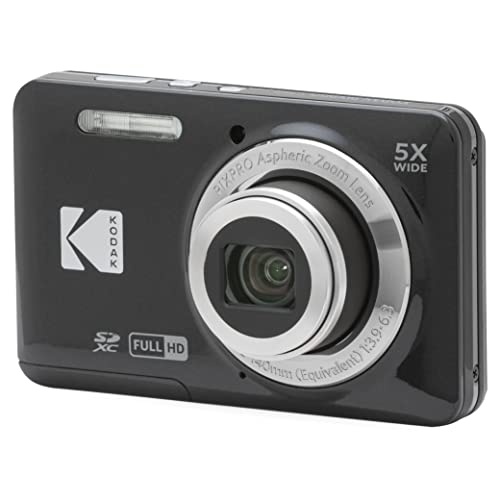
The KODAK PIXPRO FZ55 is the affordable pocket camera in this guide, with a 16 megapixel sensor, a 5x optical zoom, 1080p Full HD video, a 28mm wide angle lens, and a 2.7 inch LCD, and it suits buyers who want a real camera better than a phone without paying for a premium model. The 5x zoom brings subjects closer than a phone, the 28mm wide end handles landscapes and group shots, and the 1080p video records clear footage for sharing and for family memories. The camera runs on a Li-Ion battery, which lasts longer than AA batteries and recharges easily, and it is small and light enough to fit in a pocket or a small bag, so it is there for birthdays, holidays, and days out.
Affordability is the reason to choose the FZ55: it gives the buyer a real optical zoom, a real camera sensor, and a simple point and shoot experience for far less than the premium models here, and it is easy enough for a child or a grandparent to use, with automatic modes that handle the settings. The sensor is smaller than the 1 inch sensors in the Sony and Canon V10 models, so low light shots are not as clean, and the video tops out at 1080p rather than 4K, but for everyday photos in good light, the FZ55 takes shots that look better than a phone, with real zoom and natural color. It is the best first pocket camera in this guide.
Key specs: 16MP; 5x optical zoom; 1080p Full HD video; 28mm wide angle lens; 2.7 inch LCD; Li-Ion battery; point and shoot; Black
Strengths:
- Affordable pocket camera with a real optical zoom and a simple design
- 5x zoom and 28mm wide angle cover landscapes, groups, and details
- Light and easy to use, so it suits a first camera or a gift
Trade-offs:
- Smaller sensor than the 1 inch models, so low light is less clean
- Video tops out at 1080p rather than 4K
- No Wi-Fi or Bluetooth stated, so sharing needs a cable or card reader
Best for: Buyers who want a cheap simple pocket camera better than a phone.
Not suited for: Low light and 4K video shooters, who should choose a Sony or Canon model here.
Check price on Amazon: KODAK PIXPRO FZ55 compact digital camera

Canon PowerShot ELPH 360 HS 20.2MP Digital Camera Bundle Silver
The Canon PowerShot ELPH 360 HS in silver is the slim pocket camera in this guide, with a 20.2 megapixel sensor, a 12x optical zoom, Wi-Fi, and a bundle that adds a 64GB memory card and a case, and it suits buyers who want a camera that disappears into a pocket and still beats a phone. The 12x zoom is the sweet spot for a pocket camera: it reaches far enough for travel and portraits, while the camera stays slim enough to fit in a jeans pocket, and the Wi-Fi sends photos to a phone for sharing without a cable. The silver finish looks clean and classic, and the bundle means the buyer can start shooting at once, with a card that holds thousands of photos and a case that protects the camera in a bag.
Slimness is the reason to choose the ELPH 360 HS: it is the camera for buyers who will not carry a camera that feels like a brick, and it still gives them a real zoom, a real sensor, and Wi-Fi sharing that a phone cannot match for reach. The 20.2 megapixel sensor captures plenty of detail for prints and sharing, and the 12x zoom covers the range most people actually use, from wide landscapes to close portraits. The camera is easy to use, with automatic modes for most shots and a manual mode for buyers who want control, and it is the best pocket camera here for a traveler who wants the smallest camera that still beats a phone.
Key specs: 20.2MP; 12x optical zoom; Wi-Fi; bundle with 64GB memory card and case; compact point and shoot; Silver; model 7283C001
Strengths:
- Slim pocket size that disappears into a jeans pocket, with a real 12x zoom
- Wi-Fi sends photos to a phone for sharing without a cable
- Bundle includes a 64GB card and a case, so it is ready to shoot at once
Trade-offs:
- Shorter zoom than the SX740 HS, at 12x instead of 40x
- No viewfinder, so bright sunlight can make the LCD hard to see
- Bundle adds cost for buyers who already own a card and a case
Best for: Travelers who want the smallest pocket camera that still beats a phone.
Not suited for: Wildlife watchers who need a huge zoom, who should choose the SX740 HS.
Check price on Amazon: Canon PowerShot ELPH 360 HS digital camera bundle silver
Comparison table
| Camera | Sensor | Zoom | Best for |
|---|---|---|---|
| Sony RX100 | 1 inch, 20.2MP | 28-100mm | Still photos, low light |
| Sony RX100 III | 1 inch, 20.1MP | 24-70mm F1.8-2.8 | Low light, portraits |
| Canon PowerShot SX740 HS | 20.3MP | 40x optical | Travel, wildlife |
| Canon PowerShot V10 | 1 inch CMOS | Wide angle | Vlogging, streaming |
| KODAK PIXPRO FZ55 | 16MP | 5x optical | Budget, first camera |
| Canon PowerShot ELPH 360 HS | 20.2MP | 12x optical | Slim travel camera |
Best pocket camera better than phones: how to choose
Start with the sensor, because it decides how much better than a phone the camera really is. A 1 inch sensor gathers far more light than a phone sensor, which gives photos cleaner detail in low light and a natural background blur, while a smaller sensor still beats a phone through its zoom lens, but less clearly in dim light. Buyers who shoot indoors, at dusk, or in restaurants should choose a 1 inch sensor model like the Sony RX100 or the Canon PowerShot V10, while buyers who shoot mostly outdoors in good light can be happy with a smaller sensor and a longer zoom.
Next, think about the zoom. A long zoom like the 40x on the Canon SX740 HS brings distant wildlife and landmarks close, while a short bright zoom like the 24-70mm on the RX100 III gives better low light shots and stronger portraits. Choose the zoom for the subjects the buyer actually shoots: wildlife and travel need reach, while portraits and indoor shots need a bright lens. A camera with a zoom that is too short for the subject is no better than a phone, no matter how good its sensor is.
Finally, check the size and the sharing. A pocket camera only beats a phone if it is carried, so it must fit in a pocket or a small bag without a second thought, and it should have Wi-Fi or Bluetooth to send photos to a phone for sharing, since a camera that cannot share is a camera that stays at home. The best pocket camera is the one the buyer actually carries every day.
Using and caring for a pocket camera
When a new pocket camera arrives, charge the battery fully, insert a memory card, and take a few test shots in different light before the first real outing, so the buyer knows how the camera behaves and which mode suits each scene. Set the camera to save photos at the highest quality, and learn the zoom and the focus controls, since a pocket camera rewards a buyer who knows where the buttons are. Keep the camera in a case or a soft pouch in the pocket, since keys and coins scratch the lens and the screen.
For care, clean the lens with a soft cloth before important shots, since a smudged lens softens every photo, and keep a spare battery charged for long days out, since a dead battery ends the shooting. Back up photos to a computer or cloud storage regularly, since a memory card is small and easy to lose, and check for firmware updates, since updates improve autofocus and fix bugs. A pocket camera that is carried, charged, and backed up will take better photos than a phone for years.
Common mistakes when buying a pocket camera
The most common mistake is buying a pocket camera with a tiny sensor and a short zoom, which is barely better than a phone and leaves the buyer wondering why they bothered. Another common mistake is choosing a camera by megapixels alone, without checking the sensor size or the lens brightness, since a high megapixel count on a tiny sensor takes worse photos than a lower count on a large sensor. A third mistake is buying a camera that is too big to carry, so it stays at home and the phone takes every photo anyway.
Buyers also forget to check whether the camera has Wi-Fi for sharing, and they are stuck with a cable and a card reader when they want to post a photo. Finally, many buyers forget to buy a memory card and a spare battery, and they find the camera unusable on the first day out. Check the sensor, the zoom, the size, and the sharing before ordering.
Our final recommendation
For most buyers, the best pocket camera better than phones in this guide is the Sony RX100 III, because its 1 inch sensor and bright F1.8-2.8 lens take the best still photos here, especially in low light, and it still fits in a jacket pocket. Travelers who need reach should choose the Canon PowerShot SX740 HS for its 40x zoom, vloggers should choose the Canon PowerShot V10 for its video features, and budget buyers should choose the KODAK PIXPRO FZ55 for a simple cheap pocket camera that still beats a phone.
Whatever the choice, buy the exact model in this guide, carry it every day for a week, and compare its photos with the phone side by side. A good pocket camera should take sharper, cleaner photos with real zoom, and it should earn its place in the pocket. For more camera options, see our guides to pocket cameras under 200, pocket cameras for travel under 200, compact cameras under 200, and point and shoot cameras under 300.
Why a larger sensor beats a phone every time
A camera sensor works by collecting light, and a larger sensor collects more of it, which is the whole reason a pocket camera beats a phone. A phone sensor is tiny, often less than a tenth the area of a 1 inch sensor, so it gathers little light and the photo needs heavy software processing to look acceptable, which smooths away detail and creates a flat artificial look. A 1 inch sensor gathers far more light, so the photo has more detail in shadows and highlights, less grain in low light, and a natural background blur that comes from the lens itself rather than from software guessing which parts of the photo are near and which are far. The lens matters too: a real zoom lens moves glass to bring subjects closer, while a phone uses digital zoom, which is just cropping the photo and blowing it up, losing detail with every step. That is why a pocket camera with a 1 inch sensor and a real zoom takes photos that look better on a large screen and in a print, while a phone photo that looks fine on a small screen falls apart when it is enlarged. The practical rule is simple: if the photo will be printed, cropped, or viewed large, a pocket camera is the right tool, and a phone is the backup.
Frequently asked questions
Is a pocket camera really better than a phone camera?
Yes, for photos that need detail, low light, or zoom. A pocket camera with a larger sensor gathers more light and a real zoom lens brings subjects closer without digital blur, so photos look better on a large screen and in a print than a phone photo, and the difference grows larger the more the photo is enlarged or cropped.
What is the most important feature in a pocket camera?
The sensor size. A 1 inch sensor gathers far more light than a phone sensor, which gives cleaner low light photos and a natural background blur. The zoom range matters next, since a long zoom reaches subjects a phone cannot, and the lens brightness matters after that, since a bright lens helps most in dim light.
Do pocket cameras have Wi-Fi for sharing photos?
Most modern ones do, including the Canon models in this guide, which send photos to a phone for sharing. Some budget models need a cable or a card reader, so check the listing before buying if sharing matters, and look for Bluetooth too, since it keeps the phone connected for quick transfers.
Can a pocket camera record video as well as a phone?
Yes, and often better. The Canon PowerShot V10 in this guide records 4K video with a 1 inch sensor and a stereo mic, which gives cleaner low light video and better sound than a phone, and the SX740 HS records 4K video too.
Should I buy a pocket camera or just use my phone?
Buy a pocket camera if the buyer prints photos, shoots in low light, or needs a real zoom for travel and wildlife. A phone is fine for quick snaps in good light, but a pocket camera takes better photos whenever the light is low or the subject is far away, and it keeps getting better the more the buyer learns its controls.