The best UHF antennas are the ones that carry a two-way radio signal clearly, and that is a different job from pulling in television. UHF is the band where GMRS radios, ham radios, and repeaters live, from 400 to 470 MHz, and a UHF antenna is judged by whether it can reach a distant repeater, a vehicle across the property, or a handheld on a trail. The six antennas in this guide are all UHF radio antennas, from tall GMRS base antennas to a compact mobile mount, and each one suits a different kind of station.
Many buyers come to UHF antennas after discovering that a handheld radio alone does not reach far enough. A handheld with a short antenna talks across a campsite, but it cannot reach a repeater on a hill or a base station across the county, and the step from handheld to base is mostly about the antenna, not the radio. A good UHF antenna with a modest radio will make contacts that a great radio with a poor antenna never will, because the antenna is where the signal is gathered and sent. The antennas below are current models from known brands, with exact brand and model names, so buyers can find the same antenna again.
This guide judges UHF antennas by radio performance first, then by mounting and practicality, and it is written for radio use, not television. A UHF television antenna is a different product for a different job, and the antennas here are for two-way radio: GMRS base stations, ham repeaters, and mobile radios. The picks below balance gain, frequency coverage, and a realistic install, and each one fits a different buyer, from the GMRS base station owner to the ham operator who wants a mobile antenna without drilling.
In this guide
Quick picks: best uhf antennas
| # | Product | Where to buy |
|---|---|---|
| 1 | Comet CA-GMRS base antenna | Check on Amazon |
| 2 | HYSHIKRA GMRS outdoor base antenna | Check on Amazon |
| 3 | GMRS UHF base station Yagi antenna | Check on Amazon |
| 4 | GMRS base antenna with 32ft cable | Check on Amazon |
| 5 | Anina GMRS antenna NMO mount | Check on Amazon |
| 6 | Nagoya UT-72 ham magnetic mount antenna | Check on Amazon |
How the picks were chosen for best uhf antennas
An antenna earns a place in this guide when it is a current UHF radio antenna for two-way radio use, judged by frequency, gain, and build. First, the antenna must be a genuine UHF antenna for GMRS or amateur radio, with a clear brand and model, and it must cover the UHF band, from 400 to 470 MHz, with the GMRS channels at 462 and 467 MHz where the design is GMRS specific. Second, the gain must be honest and suited to the use, with high gain base antennas for fixed stations and modest gain mobile antennas for vehicles.
Mounting and build were checked next. Every pick here is built for its place of use, with weatherproof fiberglass for base antennas, a sturdy Yagi for directional work, and a magnetic mount for mobile use, and each one states its connector clearly. Television antennas, indoor antennas, and antennas with no stated UHF frequency were left out, since this guide is for radio use. The result is a shortlist of six UHF antennas that genuinely carry a two-way radio signal.
The six best uhf antennas

Comet CA-GMRS Base Antenna, 462-467 MHz
The Comet CA-GMRS Base Antenna is the GMRS base antenna that leads this guide, a dual section fiberglass antenna for 462 and 467 MHz, built for GMRS base stations and repeaters. GMRS is the two-way radio service that families, farms, and off road groups use to stay in touch, and a base antenna is what turns a handheld radio into a station that covers miles. The CA-GMRS is 42 inches long with 5.5 dBi gain, which gives it real reach from a rooftop or a mast, and it uses a UHF connector, so it fits standard GMRS base station setups. Comet is a known name in amateur and GMRS antennas, and this model is built for permanent outdoor use.
A base antenna needs a mast and a clear view to perform, and buyers should plan for that: a GMRS base antenna mounted low behind a building will not reach far, while the same antenna on a rooftop with a clear horizon covers the neighbourhood and beyond. The fiberglass build handles weather well, and the dual section design gives it gain without making it unwieldy. The trade is that it is a single service antenna, built for GMRS frequencies only, so it will not serve ham bands or other services. For GMRS users who want a permanent base station, it is the strongest pick here.
Key specs: GMRS base; 462 and 467 MHz; dual-section fiberglass; 5.5 dBi gain; 42 inches; UHF connector
Strengths:
- Known Comet brand built for GMRS base stations
- 5.5 dBi gain from a 42 inch fiberglass design
- Dual-section build handles weather and stays stable
Trade-offs:
- GMRS frequencies only, so it does not serve ham bands
- Needs a mast and a clear view to perform at its best
- Permanent install, so it does not suit portable use
Best for: GMRS users who want a permanent base station with real range.
Not suited for: Ham operators who need an antenna for amateur bands, not GMRS.
Check price on Amazon: Comet CA-GMRS base antenna

HYSHIKRA GMRS Outdoor Base Antenna, 462-467MHz
The HYSHIKRA GMRS Outdoor Base Antenna is the long GMRS base antenna in this guide, an 86 inch fiberglass antenna for 462 to 467 MHz, built for GMRS base stations and repeaters that need maximum range. At 200 watts power handling and 86 inches long, it is a serious base antenna, made to mount on a mast or a rooftop and to cover a wide area with a strong signal. The UHF female SO239 connector fits standard GMRS base setups, and the fiberglass build handles weather, sun, and wind without corroding. For farms, rural properties, and off road groups who need a GMRS base station that reaches every vehicle and every handheld in the area, this is the antenna to mount.
Length is the advantage here, and it comes with a real install demand: an 86 inch antenna needs a sturdy mast and a solid mount, since wind load on a long fiberglass antenna is significant, and a weak mount will flex and lose aim. The 200 watt rating is far more than most GMRS stations use, which means the antenna will never be the limit, and the long design gives it gain that shorter antennas cannot match. The trade is size and the need for a proper mast, plus the fact that it is GMRS only. For owners with the mast to support it, it is the highest gain GMRS base antenna here.
Key specs: GMRS base; 462-467 MHz; 200 watts; 86 inch fiberglass; UHF female SO239 connector
Strengths:
- Long 86 inch design gives high gain for maximum GMRS range
- 200 watt rating means the antenna is never the limit
- Fiberglass build handles weather without corroding
Trade-offs:
- Needs a sturdy mast and solid mount for its wind load
- GMRS frequencies only, so it does not serve ham bands
- Large size is overkill for a small property or a short range need
Best for: Farms and rural properties that need a long range GMRS base station.
Not suited for: Small properties and portable users who need a compact antenna.
Check price on Amazon: HYSHIKRA GMRS outdoor base antenna
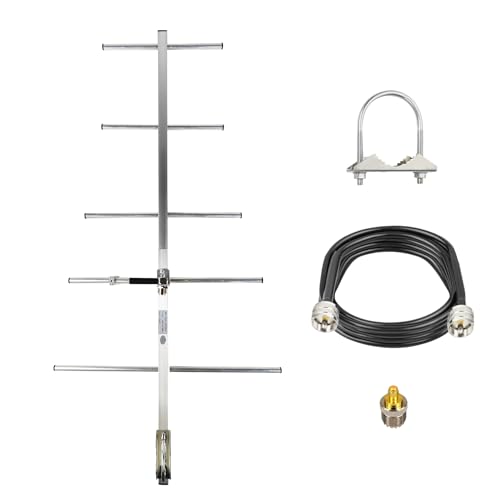
GMRS UHF Base Station Antenna, 400-470MHz, 5-Element Yagi
The GMRS UHF Base Station Antenna is the Yagi in this guide, a 5 element Yagi for 400 to 470 MHz with 9 dBi gain, built for ham radio repeaters and GMRS base stations that need a focused signal in one direction. A Yagi works differently from the fiberglass verticals in this guide: its five elements focus the signal in one direction, which gives it very high gain toward the stations that matter and strong rejection of signals from other directions. It includes a 32 foot coaxial cable with a PL259 connector, so it is ready to connect to a base station radio, and it is built for repeater and base use where the target is in a known direction.
The Yagi design is the right choice when the stations to reach all sit in one direction, such as a repeater on a hill or a distant group in one valley, and it is the wrong choice when stations are spread in every direction, since a Yagi aimed wrong hears almost nothing. The 9 dBi gain is the highest in this guide, and the 32 foot cable means the antenna can sit high on a mast while the radio stays indoors. The trade is aiming: a Yagi must point at the target accurately, and it needs a rotator or a careful fixed aim. For repeater and directional base work, it is the strongest tool here.
Key specs: Yagi; 5 elements; 400-470 MHz; 9 dBi gain; 32 foot cable with PL259; repeater and base use
Strengths:
- Highest gain in this guide at 9 dBi for directional work
- 32 foot cable included, so the radio can stay indoors
- Focused design rejects interference from other directions
Trade-offs:
- Must be aimed accurately, or it hears almost nothing
- Poor for stations spread in every direction
- Needs a sturdy mast and a careful fixed aim or a rotator
Best for: Repeater and base operators who need a focused signal in one direction.
Not suited for: Operators with stations in every direction, who need an omnidirectional antenna.
Check price on Amazon: GMRS UHF base station Yagi antenna

GMRS Base Antenna 462-467MHz with 32ft Cable, 7.5dBi Fiberglass
The GMRS Base Antenna 462-467 MHz with 32 foot cable is the ready to install GMRS base antenna in this guide, a high gain 7.5 dBi fiberglass antenna for GMRS repeaters and mobile base use, with a 32 foot cable included. It is a fiberglass base station antenna, built to mount on a mast or a rooftop and to cover a wide area, and the included cable means the buyer does not need to hunt for a separate low loss cable or worry about connector matching. The 7.5 dBi gain is strong for a fiberglass vertical, and the design suits GMRS base stations that need to reach handhelds and mobiles across a property or a neighbourhood.
The included cable is the practical advantage here, since a long cable run loses signal and a cheap cable loses more, and this antenna ships with a cable that is matched to the job. The fiberglass build handles weather well, and the high gain design gives it range that shorter antennas cannot match. The trade is that it is GMRS only, and it needs a mast and a clear view to perform, since a base antenna mounted low behind a building will not reach far. For GMRS users who want a complete base antenna with cable in one box, it is the simplest choice here.
Key specs: GMRS base; 462-467 MHz; 7.5 dBi; fiberglass; 32 foot cable included; repeater and mobile use
Strengths:
- 7.5 dBi gain from a fiberglass vertical design
- 32 foot cable included, so no separate cable hunt
- Ready to install for GMRS repeaters and base stations
Trade-offs:
- GMRS frequencies only, so it does not serve ham bands
- Needs a mast and a clear view to perform at its best
- Fixed base design, so it does not suit portable use
Best for: GMRS users who want a complete base antenna with cable in one box.
Not suited for: Ham operators who need an antenna for amateur bands, not GMRS.
Check price on Amazon: GMRS base antenna with 32ft cable
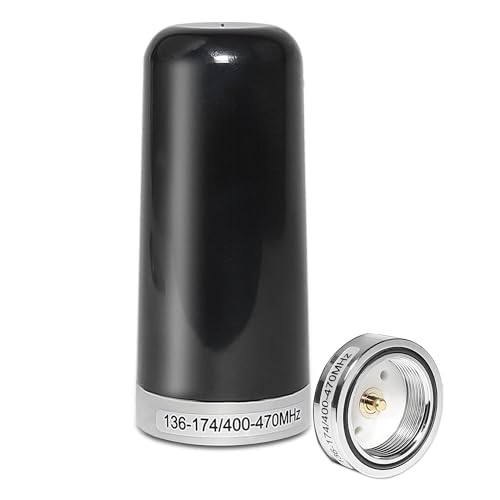
Anina 3DB Gain GMRS Antenna NMO Mount, Dual-Band UHF VHF
The Anina 3DB Gain GMRS Antenna is the mobile antenna in this guide, a 3.5 inch NMO mount antenna for GMRS and dual band UHF and VHF use, built for Midland and other GMRS mobile radios. It is a small antenna for a vehicle, using an NMO mount that fits a standard NMO base on a roof, a trunk, or a magnetic mount, and it covers 136 to 174 MHz and 400 to 470 MHz, which means it serves both VHF and UHF, including GMRS. The 3 dB gain is modest, which suits a mobile antenna that must work in every direction as the vehicle moves, and the short 3.5 inch length keeps it clear of garage doors and low branches.
A mobile antenna is a compromise by design: it must be short enough to survive daily driving, omnidirectional enough to work as the vehicle turns, and tough enough for weather and car washes. The Anina does that with a compact NMO design that fits a standard mount, and it is a good pick for GMRS users who want a mobile antenna that simply works. The trade is gain: a 3.5 inch mobile antenna cannot match a base antenna for range, and buyers should not expect base station performance from a vehicle. For mobile GMRS use, it is the right size and the right mount.
Key specs: Mobile; NMO mount; dual-band UHF VHF 136-174 and 400-470 MHz; 3 dB gain; 3.5 inch; GMRS
Strengths:
- Compact 3.5 inch design clears garage doors and branches
- Standard NMO mount fits common mobile bases
- Dual band UHF and VHF, including GMRS, in one antenna
Trade-offs:
- Modest 3 dB gain, so range is far less than a base antenna
- Needs an NMO mount base, which is not included in every kit
- Mobile design, so it does not suit a base station
Best for: GMRS mobile users who want a compact NMO antenna for a vehicle.
Not suited for: Base station operators who need maximum range from a fixed antenna.
Check price on Amazon: Anina GMRS antenna NMO mount

Nagoya UT-72 Ham Magnetic Mount Antenna, 20.27 in
The Nagoya UT-72 is the magnetic mount ham antenna in this guide, a 20.27 inch dual band antenna for amateur radio, built for mobile use on a vehicle roof. Nagoya is a known name in amateur antennas, and the UT-72 is its magnetic mount model, with a strong magnet base that sticks to a steel roof, a 4 metre cable, and a PL-259 connector with an SMA adapter, so it fits a wide range of handheld and mobile radios. It covers the 2 metre and 70 centimetre bands, which are the VHF and UHF bands that ham operators use for local and repeater contacts, and its 20 inch length gives it far more gain than a handheld antenna.
A magnetic mount antenna is the easiest way to turn a handheld radio into a mobile station, since it needs no drilling and no permanent install: set it on the roof, run the cable through a door or a window, and drive. The UT-72 is long enough to hold repeater signals well on the highway, and the magnetic base holds at speed when it is placed on a clean flat steel surface. The trade is that it needs a steel roof, since a magnet will not stick to aluminum or glass, and it must be removed before a car wash. For ham operators who want a mobile antenna without drilling, it is the most proven pick here.
Key specs: Magnetic mount; 20.27 inch; dual band 2m and 70cm; PL-259 with SMA adapter; 4 metre cable
Strengths:
- Known Nagoya brand with a proven magnetic mount design
- 20 inch length gives far more gain than a handheld antenna
- No drilling needed, so it suits any steel roof vehicle
Trade-offs:
- Needs a steel roof, since a magnet will not stick to aluminum
- Must be removed before a car wash
- Cable routing through a door can let in wind noise and water
Best for: Ham operators who want a mobile antenna without drilling holes.
Not suited for: Owners of aluminum or glass roof vehicles, where a magnet will not stick.
Check price on Amazon: Nagoya UT-72 ham magnetic mount antenna
Comparison table
| Antenna | Type | Frequency | Gain |
|---|---|---|---|
| Comet CA-GMRS | Base, fiberglass | 462-467 MHz | 5.5 dBi |
| HYSHIKRA GMRS Base | Base, fiberglass | 462-467 MHz | High |
| GMRS UHF Yagi | Base, Yagi | 400-470 MHz | 9 dBi |
| GMRS Base with cable | Base, fiberglass | 462-467 MHz | 7.5 dBi |
| Anina GMRS NMO | Mobile, NMO | 136-174, 400-470 MHz | 3 dB |
| Nagoya UT-72 | Mobile, magnetic | 2m and 70cm | Mobile |
Best uhf antennas: how to choose
Start with the service, because a UHF antenna must match the radio service in use. GMRS users need an antenna for 462 and 467 MHz, ham operators need an antenna for the 70 centimetre band and often the 2 metre band as well, and repeater operators need an antenna that covers the repeater frequencies exactly. Check the frequencies before ordering, since an antenna built for one service may not work well on another, even when the bands are close.
Next, decide between base and mobile. A base antenna mounts on a mast or a rooftop with a clear view, and it gives the most range, while a mobile antenna mounts on a vehicle and gives less range but travels everywhere. A base antenna needs a mast, a cable, and a clear horizon, while a mobile antenna needs a mount that fits the vehicle, whether that is an NMO base or a magnetic mount. Choose the antenna that fits where the radio will actually be used.
Finally, check the gain and the connector. Higher gain helps a base station reach farther, while a directional Yagi helps when the target is in one known direction. Check that the connector matches the radio and the cable, since a UHF, NMO, PL259, or SMA mismatch will stop the install. Avoid antennas with no stated frequency, with a purely decorative design, or with a connector that does not match the radio.
Installing and caring for a UHF antenna
When a new UHF antenna arrives, check the parts against the listing, including the mount, the cable, and the connector adapters, and connect everything at home before a permanent install, so any problem is found on the ground and not on a roof. For a base antenna, mount it as high as practical with a clear view, use a sturdy mast that handles the wind load, and keep the cable run short with a low loss cable. For a mobile antenna, place the mount on a clean flat steel surface, and route the cable through a door or a window without pinching it.
For care, check the mount, the cables, and the connections twice a year, and after every major storm, since wind and ice loosen hardware over time. Keep the antenna clear of branches, check fiberglass antennas for cracks and chips, and check magnetic mounts for rust on the base. A UHF antenna that is mounted well and kept clean will carry a clear signal for years.
Common mistakes when buying a UHF antenna
The most common mistake is buying a television UHF antenna for a radio, which leaves the buyer with an antenna that cannot transmit and that is tuned for the wrong frequencies. Another common mistake is mounting a base antenna low behind a building and wondering why the range is short, since height and a clear horizon matter more than the antenna itself. A third mistake is using a cheap thin cable that loses more signal than the antenna gains.
Buyers also forget to check the connector, and they order an antenna with a UHF connector for a radio that needs SMA, or the other way around. Finally, many buyers forget that a magnetic mount needs a steel roof, and they order one for an aluminum vehicle where it will not stick. Check the roof material before ordering a magnetic mount.
Our final recommendation
For most buyers, the best UHF antenna in this guide is a base antenna matched to the service, mounted high with a clear view, with a low loss cable and the right connector. That combination gives the most range and the clearest signal. GMRS base station owners should choose the Comet CA-GMRS or the HYSHIKRA for maximum range, while repeater operators who need a focused signal should choose the Yagi, and mobile operators should choose the Anina NMO or the Nagoya magnetic mount for the vehicle.
Whatever the choice, buy the exact model in this guide, confirm the frequencies and the connector before ordering, and keep the receipt until the antenna has made contacts at real distances. A good UHF antenna should carry a clear signal to a repeater, a vehicle, or a handheld, and the six antennas here all do that when they are installed well. For more antenna options, see our guides to Baofeng antennas, 5G antennas, all band antennas, and amplified antennas.
Base versus mobile UHF antennas: which one suits the station
The two big UHF antenna families in this guide work in different ways, and the choice between them comes down to whether the radio moves. A base antenna mounts on a mast or a rooftop, stays in one place, and gives the most range, since it can be tall, high, and aimed well, with a clear horizon in every direction. A mobile antenna mounts on a vehicle, travels everywhere, and gives less range, since it must be short enough to survive driving and omnidirectional enough to work as the vehicle turns. The practical rule is simple: if the radio stays in one place, install a base antenna and enjoy the range, and if the radio moves, use a mobile antenna and enjoy the freedom. Many radio users own both, with a base antenna at home and a mobile antenna in the vehicle, and that is the best answer when budget allows, since the two antennas serve different jobs and neither one replaces the other. Either way, height and a clear view matter more than the antenna model, and a good UHF antenna mounted low will always lose to a modest antenna mounted high.
A quick check before ordering a UHF antenna
Before ordering a UHF antenna, run through a short check that takes a few minutes and prevents most mistakes. First, note the service in use, whether that is GMRS or ham radio, and the exact frequencies, since the antenna must be tuned for them. Second, decide between a base station and a mobile install, since that decides the mount and the size. Third, check the connector on the radio and the cable, since a mismatch stops the install. With those three answers, the choice in this guide becomes clear, and the antenna that arrives will match the radio, the mount, and the frequencies.
Planning a UHF base station from scratch
Setting up a UHF base station from nothing is a straightforward job when it is planned in order, and the antenna is only one part of it. First, choose the service, GMRS for family use or ham for hobby use, and get the licence, since transmitting without one is not allowed. Second, choose the radio, and check its power, its connector, and its frequency range, since the antenna and the cable must match it. Third, choose the antenna, with a base vertical for omnidirectional coverage or a Yagi for a single direction, and check its frequency range and its connector. Fourth, choose the cable, with a low loss type and the shortest run that reaches from the antenna to the radio, and check that the connectors match at both ends. Fifth, choose the mast, with a sturdy mount that handles the wind load of the antenna, and a clear view in the directions that matter. Finally, install everything, check the connections, and make a first contact on a local repeater to confirm the station works. With that order, the station comes together without surprises, and each part is bought once, correctly, instead of being bought twice after a mismatch is found.
GMRS versus ham radio: which service suits the user
GMRS and ham radio are the two main services that use UHF antennas, and they suit different people. GMRS is a family radio service, with a simple licence that covers the whole family, no exam, and channels that are easy to use, which makes it the right choice for families, farms, and off road groups who want to stay in touch without learning radio theory. Ham radio needs an exam and a licence, but it offers far more frequencies, more power, and a worldwide community of operators, which makes it the right choice for people who want radio as a hobby and who enjoy learning how it works. A GMRS antenna is tuned for 462 and 467 MHz, while a ham UHF antenna works on the 70 centimetre band nearby, and some antennas cover both, but the buyer should check the frequency range before using an antenna on a different service. The practical answer is to choose the service first and the antenna second: a family that wants simple communication should choose GMRS and a GMRS antenna, while a hobbyist who wants to learn radio should choose ham and a ham antenna. Either way, a licence is needed to transmit, and the local rules should be checked before the first transmission, since the antenna itself is only part of the station.
Cable and connector choices for UHF base stations
The cable between a UHF antenna and the radio matters as much as the antenna itself, and a cheap cable can waste more signal than a good antenna gains. UHF signals lose strength quickly in a long cable, so the cable should be as short as practical, and it should be a low loss type, since a thin cable loses far more signal than a thick low loss cable over the same distance. The connector must match the antenna and the radio, with common UHF connectors including UHF, SO239, PL259, NMO, and SMA, and the buyer should check all three parts, antenna, cable, and radio, before ordering, since a mismatch in any one of them stops the install. Adapters can fix a mismatch, but every adapter loses a little signal, so a direct match is better than an adapted one. Keep the cable away from power lines and sharp bends, since interference and damage both weaken the signal, and use a drip loop where the cable enters the building, so rain runs off instead of following the cable indoors. Check the cable and the connectors twice a year, since corrosion at a connector is a common cause of weak signals, and a clean tight connection is worth more than a new antenna on a corroded cable.
Frequently asked questions
What is the difference between a UHF TV antenna and a UHF radio antenna?
A UHF TV antenna receives television broadcasts and cannot transmit, while a UHF radio antenna is built for two-way radio, including GMRS and ham use, and can transmit and receive on radio frequencies. They are different products for different jobs.
Do I need a licence to use a UHF radio antenna?
It depends on the service. GMRS needs a licence in the United States, and amateur ham radio needs a licence as well. Check the local rules for the service before transmitting, since the antenna itself is only part of the station.
Why does a UHF base antenna need to be mounted high?
Height gives a clear horizon, and UHF signals travel mostly in a straight line, so a base antenna mounted low behind buildings cannot reach far. The same antenna on a rooftop with a clear view covers a much wider area.
Can I use a GMRS antenna for ham radio?
Not always. A GMRS antenna is tuned for 462 and 467 MHz, while ham UHF work is on the 70 centimetre band nearby, and some antennas cover both. Check the frequency range in the listing before using an antenna on a different service.
What connector do I need for a UHF antenna?
It depends on the radio and the cable. Common UHF antenna connectors include UHF, SO239, PL259, NMO, and SMA, and the buyer should match the antenna connector to the radio and the cable before ordering.


