The best attic antennas give a home the reception of a rooftop antenna without the roof work, the ladders, and the weather. An attic antenna sits under the roof, protected from rain, wind, and sun, and pulls in broadcast signals through the roof material. The six antennas in this guide are all built for attic installs, from compact panels that fit between rafters to long range units that reach distant towers, and each one suits a slightly different kind of home.
Many buyers choose an attic antenna after ruling out both indoor and rooftop options. An indoor antenna is too weak for a home far from the towers, while a rooftop antenna needs a ladder, a drill, and a tolerance for storms. An attic antenna splits the difference: it sits high enough to catch a strong signal, stays dry and safe inside, and needs only a simple mount and a cable run to the television. The antennas below are current models from known brands, with exact brand and model names, so buyers can find the same antenna again.
This guide judges attic antennas by reception through a roof first, then by the rest of the hardware. An antenna that works well outdoors but loses too much signal through roofing will still disappoint, and an antenna with great reception but a size that does not fit between rafters is useless in a real attic. The picks below balance range, size, build, and ease of install, and each one fits a different buyer, from the suburban homeowner to the rural viewer far from the towers.
In this guide
Quick picks: best attic antennas
| # | Product | Where to buy |
|---|---|---|
| 1 | RCA Compact Yagi antenna | Check on Amazon |
| 2 | RCA ANT705Z | Check on Amazon |
| 3 | Five Star Yagi antenna | Check on Amazon |
| 4 | Antennas Direct ClearStream 2V | Check on Amazon |
| 5 | Antennas Direct ClearStream 4V | Check on Amazon |
| 6 | Winegard HD7694P | Check on Amazon |
How the picks were chosen for best attic antennas
An antenna earns a place in this guide when it is a current television antenna suited to attic installs, judged by range, band coverage, size, and build. First, the antenna must cover the broadcast bands in use, including VHF and UHF, because a channel on a band the antenna misses will never appear. Second, the antenna must offer enough gain to overcome the signal lost passing through the roof, with a directional design for distant towers or a wide design for areas with towers in several directions.
Size and mounting were checked next. Every pick here fits a typical attic, mounts to a rafter or a mast, and includes the hardware the install needs. Antennas that are too large for a standard attic, that cover only one band, that need a separate amplifier not included in the box, or that are refurbished were left out. The result is a shortlist of six attic antennas that genuinely deliver clear channels from under the roof.
The six best attic antennas

RCA Compact Outdoor or Attic Yagi HD TV Antenna
The RCA Compact Outdoor or Attic Yagi HD TV Antenna is a compact Yagi built for attics where space is tight. It receives VHF and UHF broadcasts with a range of up to 75 miles from the towers, supports 4K, 8K, and 1080 HDTV, and is NexGenTV compatible, so it covers the channels buyers want today and the broadcasts coming next. The compact Yagi design fits between rafters more easily than a full size outdoor antenna, and the durable construction withstands tough outdoor conditions as well as attic heat. It is a dependable backup when storms knock out cable or satellite, and it works as a complement to streaming players.
For attic installs, this RCA is a practical first choice. It mounts in the attic or outdoors, aims toward the towers, and pulls in local channels for free with no monthly fee. The Yagi design focuses on one direction, so buyers should check a broadcast map and aim carefully. It is compact enough for most attics, and its 75 mile range handles suburban and rural homes. Buyers with a metal roof or radiant barrier should check signal carefully, since those materials block more signal than shingles, but for a standard attic it is a solid pick.
Installing the RCA Compact Yagi in an attic starts with measuring. Confirm the antenna fits between the rafters, mount it as high as practical, and aim the Yagi toward the towers using a broadcast map and a compass. Run the cable down to the television, keeping it away from power lines to avoid interference, and scan for channels. The compact size helps in tight attics, and the 75 mile range covers suburban and rural homes. Check the roofing material first, since metal roofing and radiant barrier foil block far more signal than asphalt shingles. Rescan every few months, and keep the antenna clear of stored boxes and insulation. For a standard attic, this compact Yagi is a solid first choice.
Key specs: Compact outdoor or attic Yagi HD TV antenna; up to 75 mile range; VHF and UHF; 4K, 8K, and 1080 HDTV; NexGenTV compatible; durable construction
Strengths:
- Compact Yagi fits between rafters easily
- 75 mile range covers suburban and rural homes
- 4K, 8K, and NexGenTV ready
Trade-offs:
- Directional design needs careful aiming
- Metal roofs and radiant barrier block more signal
- Needs a mount and cable run in the attic
Best for: Suburban and rural homes with a standard attic
Not suited for: Homes with metal roofing or radiant barrier foil
Check price on Amazon: RCA Compact Yagi antenna

RCA ANT705Z Attic Heavy Duty Antenna
The RCA ANT705Z, sold under the Audiovox brand, is a heavy duty attic antenna built for a permanent install. It is designed for indoor attic mounting to receive TV signals, with a sturdy build that holds its aim and shape for years. At 3.0 pounds and 9.5 inches long by 2.6 inches wide by 19.0 inches high, it is compact enough to fit a typical attic while still offering the element size needed for solid reception. The heavy duty construction suits buyers who want to install once and forget about it, with no roof work and no weather exposure.
For attic use, the ANT705Z is a straightforward pick. It mounts to a rafter or a mast in the attic, aims toward the broadcast towers, and feeds the television with free over the air channels. Its compact size helps in attics with limited space, and its sturdy build resists the heat and dust of an attic environment. Buyers should measure the attic before ordering and confirm the antenna fits the planned mount point. It is a no frills antenna, so it has no amplifier or signal meter, but for homes near to mid range from the towers it delivers clear channels reliably.
The RCA ANT705Z is a set and forget attic antenna, and install is simple. Measure the attic, confirm the 9.5 by 2.6 by 19.0 inch body fits the planned mount point, and attach it to a rafter or a mast. Aim it toward the broadcast towers, run the cable to the television, and scan for channels. The heavy duty build holds its aim for years, and the compact size suits attics with limited space. Keep it away from metal ductwork, wiring, and foil insulation, since those block and reflect signal. Check the mount twice a year, and keep stored boxes clear of the antenna. For buyers who want a sturdy permanent install with no amplifier and no fuss, this antenna delivers.
Key specs: Heavy duty attic antenna; indoor attic mounting; 3.0 lb; 9.5 x 2.6 x 19.0 inches; Audiovox brand; RCA ANT705Z
Strengths:
- Heavy duty build for a permanent attic install
- Compact size fits a typical attic
- Sturdy construction resists attic heat and dust
Trade-offs:
- No amplifier for homes far from the towers
- No signal meter for aiming help
- Needs measuring before ordering to confirm fit
Best for: Buyers who want a sturdy permanent attic install
Not suited for: Homes far from the towers needing amplification
Check price on Amazon: RCA ANT705Z
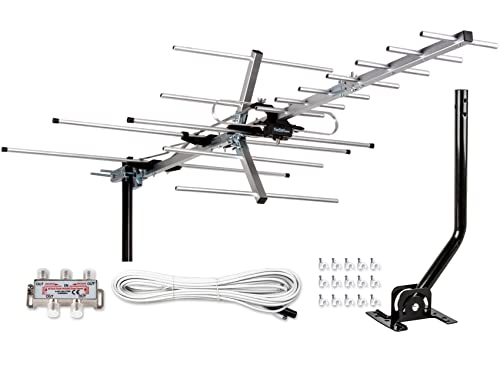
Five Star Yagi Satellite HD TV Antenna
The Five Star Yagi Satellite HD TV Antenna is the long range pick in this guide, with a claimed reach of up to 200 miles depending on distance from the tower and obstacles between the house and the signal. It picks up VHF and UHF channels with booster technology, receives 4K, 1080P, 1080i, and 720p HD channels, and comes with an installation kit and a mounting pole. The attic or roof mount design suits buyers who want maximum range from an attic install, and it supports up to 4 TVs from one antenna, which helps larger homes.
For attic installs, the Five Star Yagi is a strong choice when the towers are far away. The Yagi design focuses on the tower direction, and the included booster helps overcome the signal lost through the roof. Buyers should treat the 200 mile figure as a best case claim and check a broadcast map for their real distance, since hills, trees, and building materials all reduce range. The antenna is larger than the compact picks here, so measuring the attic is essential, but for far homes it offers the most reach in this guide.
The Five Star Yagi is the long range pick, and its size demands careful planning. Measure the attic before ordering, since the antenna is larger than the compact picks here, and confirm it fits between the rafters with room to aim. Mount it as high as practical, aim toward the towers, and use the included booster to overcome signal lost through the roof. The installation kit and mounting pole help, and the antenna supports up to 4 TVs from one install. Treat the 200 mile figure as a best case claim and check a broadcast map for the real distance. Rescan every few months, and keep the antenna clear of insulation and stored boxes. For far homes, it offers the most reach here.
Key specs: Yagi satellite HD TV antenna; up to 200 mile range; VHF and UHF; 4K, 1080P, 1080i, and 720p HD; attic or roof mount; installation kit and mounting pole; supports 4 TVs
Strengths:
- Longest claimed range here, up to 200 miles
- Supports up to 4 TVs from one antenna
- Installation kit and pole included
Trade-offs:
- 200 mile figure is a best case claim, real range varies
- Larger size needs attic measuring before ordering
- Directional design needs careful aiming
Best for: Far homes that need maximum range from an attic
Not suited for: Small attics with limited space
Check price on Amazon: Five Star Yagi antenna

Antennas Direct ClearStream 2V Outdoor TV Antenna
The Antennas Direct ClearStream 2V is a versatile antenna that works indoors, in an attic, or outdoors, and that flexibility is its main strength. The double loop design with multi directional UHF and Hi-VHF elements plus a signal reflector focuses reception for clear free TV channels in HD, and it is compatible with NEXTGEN TV, 4K, 8K UHD, and Full HD 1080p, with no internet required. It measures 18 inches high by 31.4 inches wide by 6.5 inches deep, and the 20 inch mast with a pivoting base allows installation on vertical or horizontal surfaces, which suits attics with awkward mounting points.
For attic use, the ClearStream 2V is a flexible and proven pick. The multi directional reception handles areas with towers in several directions, and the reflector adds forward gain to protect the signal from interference that causes pixelation. It suits suburban and rural areas, and its durable build handles attic heat. Buyers should check the size against their attic space, since the 31.4 inch width needs room between rafters, and aim the reflector toward the strongest towers. For a reliable attic antenna from a known brand, it is a solid choice.
The ClearStream 2V is flexible about where it lives, and that helps in tricky attics. Mount it indoors, in the attic, or outdoors, using the 20 inch mast with a pivoting base on a vertical or horizontal surface. The multi directional design handles towers in several directions, and the reflector adds forward gain to fight pixelation. Measure the 31.4 inch width against the rafter spacing before carrying it up, and aim the reflector toward the strongest towers. Run a channel scan, try a small move, and scan again, since a little adjustment can add channels. Keep it clear of metal ductwork and foil. For suburban and rural homes with towers spread around, this is a reliable pick.
Key specs: Double-loop TV antenna; multi-directional UHF and Hi-VHF; signal reflector; 18 x 31.4 x 6.5 inches; 20 inch mast with pivoting base; NEXTGEN TV, 4K, 8K UHD, and Full HD 1080p; indoor, attic, or outdoor install
Strengths:
- Works indoors, in an attic, or outdoors
- Reflector adds gain and fights pixelation
- Pivoting mast fits vertical or horizontal mounts
Trade-offs:
- 31.4 inch width needs room between rafters
- No amplifier included for very far homes
- Multi directional design is weaker than a focused Yagi
Best for: Suburban and rural homes with towers in several directions
Not suited for: Small attics with tight rafter spacing
Check price on Amazon: Antennas Direct ClearStream 2V
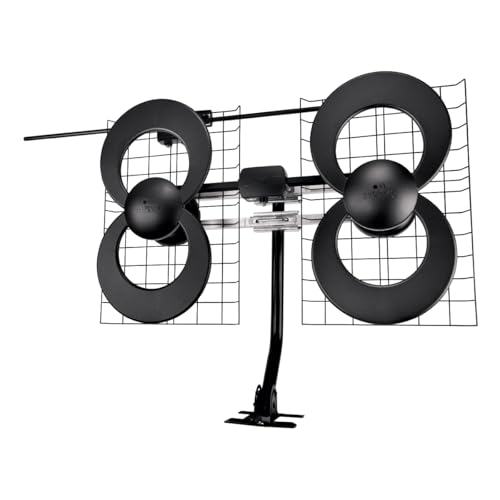
Antennas Direct ClearStream 4V Outdoor TV Antenna
The Antennas Direct ClearStream 4V is the bigger sibling of the 2V, and it is built for homes that need more gain from an attic install. It uses four patented loops with Hi-VHF elements and reflectors to receive free TV signals over the air from broadcast towers, with long range reception for suburban and rural areas. It measures 17.4 inches high by 27.8 inches wide by 6 inches deep, and it is compatible with NEXTGEN TV, 4K, 8K UHD, and Full HD 1080p, with no internet required to watch over the air TV. The durable materials suit installation indoors, in an attic, or outdoors.
For attic use, the ClearStream 4V offers more reception than the 2V in a similar footprint. The four loops and reflectors pull in weaker signals, which helps when the roof itself costs signal, and the multi directional design handles towers spread around the area. Buyers should measure the attic for the 27.8 inch width and plan the mount before carrying it up. It has no amplifier, so very far homes may need one added, but for suburban and rural attics it is a strong and proven pick.
The ClearStream 4V gives attic installs more gain than the 2V, and it needs the same careful measuring. Confirm the 27.8 inch width fits between the rafters, mount it as high as practical, and aim it toward the towers. The four loops and reflectors pull in weaker signals, which helps when the roof itself costs signal, and the multi directional design handles towers spread around the area. Run the cable down to the television away from power lines, scan for channels, and rescan every few months for new channels. It has no amplifier, so very far homes may need one added later. For suburban and rural attics that need more gain, this is a strong and proven pick.
Key specs: Four patented loops; Hi-VHF elements and reflectors; long-range reception; 17.4 x 27.8 x 6 inches; NEXTGEN TV, 4K, 8K UHD, and Full HD 1080p; indoor, attic, or outdoor install
Strengths:
- Four loops give more gain than the 2V
- Multi directional design for towers spread around
- Durable build for attic or outdoor use
Trade-offs:
- 27.8 inch width needs attic measuring first
- No amplifier included for very far homes
- Larger and heavier than the compact picks here
Best for: Suburban and rural attics that need more gain
Not suited for: Small attics or homes needing an amplifier
Check price on Amazon: Antennas Direct ClearStream 4V

Winegard HD7694P Heavy-Duty Outdoor Yagi TV Antenna
The Winegard HD7694P is a heavy duty outdoor Yagi that works well in an attic, and its steel build is the reason to choose it. Engineered with high quality zinc plated steel for maximum corrosion resistance, it withstands harsh weather and strong winds outdoors, and in an attic that toughness means it holds its shape and aim for years. It provides reliable over the air signal acquisition from up to 45 miles or more away, making it ideal for rural or suburban areas, and it picks up High-VHF and UHF signals in crystal clear high definition, with 4K Ultra HD and NextGen TV support.
For attic installs, the HD7694P is a durable and focused pick. The directional Yagi design aims at the towers for the strongest link, and the steel construction resists the heat and dust of an attic. It is non amplified, so buyers should add a low noise amplifier only when the distance calls for it, and the 45 mile range suits most suburban and rural homes. It needs a sturdy mount and careful aiming, but for buyers who want a tough antenna that lasts, it is a reliable choice.
The Winegard HD7694P is a tough antenna that rewards a solid mount. Attach it to a rafter or a mast in the attic with a sturdy bracket, aim the directional Yagi at the towers, and run the cable to the television. The zinc plated steel build resists attic heat and dust, and it holds its aim for years without sagging. The 45 mile range suits most suburban and rural homes, and the High-VHF and UHF coverage picks up the local channels. Add a low noise amplifier only when the distance calls for it, since the antenna itself is non amplified. Rescan every few months, and check the mount twice a year. For buyers who want a durable antenna that lasts, it is a reliable choice.
Key specs: Heavy-duty outdoor Yagi TV antenna; up to 45 mile range; High-VHF and UHF; zinc-plated steel; corrosion resistant; directional; non-amplified; 4K Ultra-HD and NextGen TV
Strengths:
- Zinc plated steel build lasts for years
- Directional Yagi aims precisely at the towers
- 45 mile range suits suburban and rural homes
Trade-offs:
- Non-amplified, very far homes need an amplifier added
- Needs a sturdy mount and careful aiming
- Directional design misses towers in other directions
Best for: Buyers who want a tough long lasting attic antenna
Not suited for: Homes with towers spread in several directions
Check price on Amazon: Winegard HD7694P
Comparison table
| Product | Design | Range | Install |
|---|---|---|---|
| RCA Compact Yagi | Compact Yagi | Up to 75 miles | Attic or outdoor |
| RCA ANT705Z | Heavy duty attic | Mid range | Attic mount |
| Five Star Yagi | Long range Yagi | Up to 200 miles | Attic or roof |
| ClearStream 2V | Double loop | Long range | Indoor, attic, outdoor |
| ClearStream 4V | Four loops | Long range | Indoor, attic, outdoor |
| Winegard HD7694P | Heavy duty Yagi | 45 miles | Attic or outdoor |
Best attic antennas: how to choose
Start with the roof, because roofing material decides how much signal reaches the attic. Asphalt shingles pass signal well, while metal roofing, radiant barrier foil, and solar panels block far more, and a home with those materials may need a larger antenna or an outdoor mount instead. Check a broadcast map for the area, and note the distance to the towers and which channels sit on VHF and which sit on UHF.
Next, look at size and range. Measure the attic space before ordering, because a long range antenna needs room between rafters, and a compact panel suits a small attic with nearby towers. A directional antenna suits a home with towers in one direction, while a multi directional antenna suits an area with towers spread around. Cable length matters too: keep the run to the television short, because long cables lose signal.
Finally, check the mounting and the amplifier. Look for a mount that attaches to a rafter without drilling through the roof, and consider a low noise amplifier for homes far from the towers, since the roof itself costs signal. Avoid antennas that are too large for the attic, that cover only one band, or that need parts not included in the box.
Installing and caring for an attic antenna
When a new attic antenna arrives, measure the attic and confirm the antenna fits between the rafters before carrying it up. Mount the antenna as high as practical, away from metal ductwork, wiring, and foil insulation, and aim a directional antenna toward the towers using the signal bars or a compass. Run the cable down to the television, keeping it away from power lines to avoid interference, and scan for channels.
After install, rescan for channels every few months, because broadcast lineups change, and a fresh scan picks up new channels. Check the mount twice a year, and keep the antenna clear of stored boxes and insulation that can shift onto it. In summer, remember the attic gets very hot, so keep the antenna away from heat sources and check that cables have not softened or sagged.
For long term care, keep spare cables on hand, and replace a cable that shows wear. An attic antenna that is mounted well and kept clear will deliver clear channels for years without ever seeing rain.
Common mistakes when buying an attic antenna
The most common mistake is ignoring the roofing material, which leaves the buyer with an antenna that cannot pull enough signal through a metal roof or radiant barrier. Another common mistake is buying an antenna that is too large for the attic, which forces a cramped install that hurts reception. A third mistake is mounting the antenna next to metal ductwork or foil, which blocks and reflects the signal.
Buyers also forget to check the exact model code and the band coverage. Similar names can hide different bands, different gain, and different sizes, and the wrong variant can miss the channels that matter most. Finally, many buyers forget to rescan: an antenna cannot show a channel the television has never scanned for.
Our final recommendation
For most buyers, the best attic antenna in this guide is a model that covers both VHF and UHF, fits the attic space, and offers enough gain to overcome the roof, directional for one tower direction and multi directional for towers spread around. That combination turns an attic into a strong reception spot without roof work. Near tower buyers should choose the compact model, while far buyers should choose the long range model with a low noise amplifier.
Whatever the choice, buy the exact model code in this guide, measure the attic before ordering, and keep the receipt until the antenna has been mounted and the channels scanned. An attic antenna should make local channels clear, stable, and free to watch, all from the safety of the attic. For more antenna options, see our guides to TV antennas, antennas for TVs, attic TV antenna for multiple TVs, and 4K indoor TV antennas.
Measuring and safety for attic installs
An attic install starts with measuring, and skipping that step causes most of the problems buyers report. Measure the attic space before ordering, and confirm the antenna fits between the rafters with room to aim, since a long range antenna needs space that a small attic may not have. Check the roofing material as well, because asphalt shingles pass signal well, while metal roofing, radiant barrier foil, and solar panels block far more, and a home with those materials may need a larger antenna or an outdoor mount instead. Work safely in the attic: wear a mask against dust and insulation, use a headlamp, step only on joists, and never lean on the ceiling below. Mount the antenna as high as practical, away from metal ductwork, wiring, and foil insulation, and keep the cable run away from power lines to avoid interference. Check the mount twice a year, keep stored boxes and insulation clear of the antenna, and remember that the attic gets very hot in summer, so keep cables away from heat sources. A careful measure and a safe install turn an attic into a strong reception spot without roof work.
Attic versus outdoor mounting
Many buyers wonder whether an attic antenna is enough or whether a rooftop mount is needed, and the answer depends on the roof and the distance. An attic antenna suits homes with asphalt shingle roofs and towers within its range, since it stays protected from weather, needs no ladder or roof drilling, and still sits high enough to catch a strong signal. A rooftop antenna suits homes with metal roofing, radiant barrier foil, or solar panels, since those materials block far more signal than shingles, and homes far from the towers where every bit of signal matters. When an attic antenna gives too few channels, try moving it higher in the attic and aiming it again before giving up, since a small move can add channels. When the attic still fails, an outdoor mount of the same antenna often fixes it. The attic is the easier install, so it is worth trying first.
Keeping an attic antenna working for years
An attic antenna needs little care, but a few habits keep it working well. Check the mount twice a year, since attic heat can loosen brackets over time, and keep the antenna clear of stored boxes and insulation that can shift onto it. Rescan for channels every few months, because broadcast lineups change and a fresh scan picks up new channels. Keep spare cables on hand, and replace a cable that shows wear, since a damaged cable loses more signal than a weak antenna can add. In summer, remember the attic gets very hot, so keep the antenna away from heat sources and check that cables have not softened or sagged. A little attention twice a year keeps the channels clear.
Frequently asked questions
Why choose an attic antenna over a rooftop antenna?
An attic antenna stays protected from rain, wind, and sun, needs no ladder or roof drilling, and still sits high enough to catch a strong signal. It suits homes where a rooftop install is impractical or unwanted.
Does roofing material affect an attic antenna?
Yes. Asphalt shingles pass signal well, while metal roofing, radiant barrier foil, and solar panels block far more. A home with those materials may need a larger antenna or an outdoor mount instead.
How big should an attic antenna be?
It depends on the distance to the towers and the attic space. Measure the attic before ordering, and choose a compact panel for nearby towers or a long range antenna for distant towers, as long as it fits between the rafters.
Do attic antennas need an amplifier?
Not always. A home near the towers may need none, while a home far from the towers benefits from a low noise amplifier, because the roof itself costs signal. Choose an amplifier only when the distance calls for it.
Where should I mount an attic antenna?
As high as practical, away from metal ductwork, wiring, and foil insulation, aimed toward the broadcast towers. Keep the antenna clear of stored boxes and insulation that can shift onto it.


