The best amplified antennas add a small powered booster to a television antenna, and that booster makes the difference between a channel that freezes and a channel that plays cleanly. An amplified antenna strengthens weak broadcast signals before they travel down the cable to the television, which helps homes that sit far from broadcast towers, or behind hills and tall buildings. The six antennas in this guide are all amplified models, from slim indoor leaves to sturdy outdoor units, and each one suits a slightly different kind of home.
Many buyers only learn how much amplification matters after trying a passive antenna and finding half the channels missing. A passive antenna receives what reaches it, while an amplified antenna boosts the faint signals that a passive antenna lets slip away. The antennas below are current models from known brands, with exact brand and model names, so buyers can find the same antenna again. They cover the range of what an amplified antenna can be, from a flat indoor panel to a rooftop unit with a built in amplifier.
This guide judges amplified antennas by reception first, then by the rest of the hardware. An antenna that boosts signal but also boosts noise will still disappoint, and an antenna with a great amplifier but a flimsy build will fail in the first storm. The picks below balance range, signal quality, build, and ease of install, and each one fits a different buyer, from the apartment renter to the rural homeowner.
In this guide
Quick picks: best amplified antennas
| # | Product | Where to buy |
|---|---|---|
| 1 | Mohu Leaf Ultimate | Check on Amazon |
| 2 | Winegard FlatWave FL5500A | Check on Amazon |
| 3 | GE Hover Amplified HD Digital TV Antenna | Check on Amazon |
| 4 | Philips Hover Amplified HD TV Antenna | Check on Amazon |
| 5 | Winegard Elite Pro BW-2000 | Check on Amazon |
| 6 | GE Ultra-Thin Amplified TV Antenna | Check on Amazon |
How the picks were chosen for best amplified antennas
An antenna earns a place in this guide when it is a current amplified television antenna that improves real reception, judged by range, amplifier quality, build, and ease of use. First, the antenna must cover the broadcast bands in use, including VHF and UHF, because a channel on a band the antenna misses will never appear. Second, the amplifier must add clean gain without overloading the tuner, with an adjustable gain or a low noise design where available, because too much gain near a tower causes more harm than good.
Build and setup were checked next. Every pick here is built for its place of use, with weatherproof housings for outdoor models and slim discreet designs for indoor models, and includes the power adapter or USB power the amplifier needs. Antennas with no amplifier, that cover only one band, that need parts not included in the box, or that are refurbished were left out. The result is a shortlist of six amplified antennas that genuinely clear up television reception.
The six best amplified antennas

Mohu Leaf Ultimate Amplified Indoor HDTV Antenna
The Mohu Leaf Ultimate is the smartest indoor amplified antenna in this guide, and its signal indicator is the feature that sets it apart. The ultra thin flat antenna combines FirstStage amplification with an integrated LED signal indicator that lights up where TV signals are strongest, so buyers can adjust placement in real time and find the best spot without guessing. It measures 12 inches high by 11 inches wide by 0.04 inches deep, receives UHF and Hi-VHF from both sides, and supports 4K, 8K UHD, and NEXTGEN TV. The reversible black or white design blends into any room.
For indoor reception, the Leaf Ultimate is easy to live with. The multi directional elements pick up signals without precise aiming, the 12 foot coaxial cable reaches a nearby television, and the flat panel mounts on a wall or a window with no tools. It suits apartments and town homes where an outdoor antenna is not an option, and the amplifier boosts weak signals without adding clutter. Buyers near strong towers should watch for overload and adjust placement, but for most indoor setups it is the most user friendly pick here.
Placing the Mohu Leaf Ultimate well is easy thanks to the signal indicator. Mount the flat panel on a wall or a window, watch the LED indicator, and move the antenna until the lights show the strongest signal. Run a channel scan, then try a nearby spot and scan again, since a small move can add several channels. The 12 foot coaxial cable reaches a nearby television, and the reversible black or white finish blends into the room. Rescan for channels every few months, because broadcast lineups change, and keep the amplifier powered, since an unpowered amplifier blocks the signal. For apartment buyers who want the easiest indoor setup, the indicator removes the guesswork.
Key specs: Amplified indoor HDTV antenna; ultra-thin flat design; FirstStage amplification; integrated LED signal indicator; UHF and Hi-VHF multi-directional; 4K 8K UHD and NEXTGEN TV; 12 ft coaxial cable; 12 x 11 x 0.04 inches; reversible black or white
Strengths:
- LED signal indicator shows the best placement in real time
- Ultra thin panel blends into any room
- Multi directional reception with no precise aiming
Trade-offs:
- Indoor range is shorter than outdoor antennas
- Amplifier can overload very near strong towers
- Needs a power source for the amplifier
Best for: Apartment and town home buyers who want easy indoor setup
Not suited for: Rural homes far from broadcast towers
Check price on Amazon: Mohu Leaf Ultimate
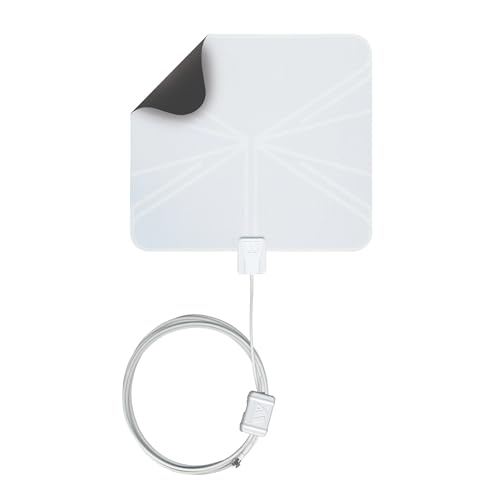
Winegard FlatWave FL5500A Amplified Indoor TV Antenna
The Winegard FlatWave FL5500A is a proven amplified indoor antenna built for city and suburban homes. It picks up VHF and UHF over the air signals at a range of up to 60 miles, which covers most metro and suburban areas, and the amplified design boosts weak signals for consistent access to local channels. The ultra thin panel construction has a low profile dual color look that blends into most home interiors without complex mounting hardware, and it connects directly to most televisions through a coax input with no tools required. A channel scan then finds the available over the air stations.
For indoor use, the FlatWave is straightforward and reliable. The Winegard app guides buyers through setup, and the antenna works with 4K Ultra HD televisions and NEXTGEN TV broadcasts. It suits renters and homeowners who want a clean install with no roof work, and the 60 mile range handles suburbs well. It will not match an outdoor antenna for a home far from the towers, and it needs a window facing the towers for best results, but for city and suburban reception it is a trusted pick.
The FlatWave FL5500A is a simple indoor antenna for city and suburban homes. Connect it directly to the television through the coax input, place it near a window facing the towers, and run a channel scan. The Winegard app guides the setup, and the ultra thin dual color panel blends into the room with no tools required. Try a few spots near different windows and keep the one with the most channels, since placement matters more than any other factor indoors. Rescan every few months for new channels, and keep the amplifier powered. For renters and homeowners who want a clean install with no roof work, this antenna delivers local channels reliably within 60 miles.
Key specs: Amplified indoor TV antenna; up to 60 mile range; VHF and UHF; ultra-thin dual-color panel; metro and suburban areas; 4K Ultra-HD and NextGen TV; app guided setup
Strengths:
- 60 mile range covers most metro and suburban homes
- Ultra thin panel blends into home interiors
- App guided setup with no tools required
Trade-offs:
- Indoor range is shorter than outdoor antennas
- Needs a window facing the towers for best results
- Not suited to homes far from the towers
Best for: City and suburban buyers who want a clean indoor install
Not suited for: Rural homes far from broadcast towers
Check price on Amazon: Winegard FlatWave FL5500A

GE Hover Amplified HD Digital TV Antenna
The GE Hover Amplified HD Digital TV Antenna is built to sit on top of the television, and that placement is its main advantage. By mounting on top of the TV, it gets height and a clear view without wall hardware, and the swivel design lets buyers turn it toward the towers. It receives VHF and UHF broadcast channels from up to 55 plus miles away using PureAmp Technology, with a built in 4G and 5G LTE filter that reduces cell phone interference and improves reception quality. It supports 4K and 1080P HDTV, and the 5 foot coax cable connects to the television easily.
For living rooms, the Hover is a neat and effective pick. The amplifier boosts weak signals, the LTE filter keeps nearby cell signals from muddying the picture, and the top of TV mount keeps the antenna out of the way. It works on a wall or a tabletop too, so buyers can try several spots and keep the one with the most channels. It is an indoor antenna, so it will not match an outdoor unit for distant towers, but for homes within 55 miles of the towers it delivers clear free local channels with a tidy install.
The GE Hover is at its best on top of the television, where the height helps reception. Set it on top of a flat screen TV, swivel it toward the towers, and run a channel scan. The PureAmp Technology boosts weak signals, and the built in 4G and 5G LTE filter keeps cell interference out of the picture. If the top of the TV does not work, try a wall or a tabletop near a window, since a small move can add channels. Keep the amplifier powered, rescan every few months, and keep the 5 foot coax cable short and tidy. For living rooms within 55 miles of the towers, this antenna gives clear free local channels with a neat install.
Key specs: Amplified HD digital TV antenna; up to 55 plus mile range; PureAmp Technology; built-in 4G and 5G LTE filter; top of TV mount with swivel; VHF and UHF; 4K and 1080P HDTV; 5 foot coax cable
Strengths:
- Top of TV mount gives height with no wall hardware
- PureAmp boost with LTE filter for clearer picture
- Swivel design aims easily toward the towers
Trade-offs:
- Indoor range is shorter than outdoor antennas
- Needs a clear spot on top of the television
- Amplifier needs power to work
Best for: Living room buyers who want a tidy top of TV install
Not suited for: Rural homes far from broadcast towers
Check price on Amazon: GE Hover Amplified HD Digital TV Antenna

Philips Hover Amplified HD TV Antenna
The Philips Hover Amplified HD TV Antenna takes the same top of TV idea as the GE Hover and adds Philips TruAmp Technology. The built in amplifier boosts signals and includes a 4G and 5G LTE filter to help reduce cell signal interference for clearer picture quality, and the antenna receives HDTV, VHF, and UHF broadcast channels from up to 50 miles. The top of TV mounting design sits securely on flat screen televisions for elevated placement that helps reception while keeping entertainment spaces clean and clutter free, and it supports 4K and 8K Ultra HD resolutions.
For living rooms, the Philips Hover is a clean and capable pick. The elevated placement helps the antenna catch signals that a low shelf antenna would miss, and the amplifier with TruAmp Technology keeps the picture stable. It connects with a coax HDTV cable and an AC adapter for the amplifier, so buyers should keep a power outlet nearby. It is an indoor antenna for homes within 50 miles of the towers, and for that range it delivers free local news, sports, and entertainment with a simple install.
The Philips Hover suits living rooms where a tidy install matters. Mount it on top of the television for elevated placement, aim it toward the towers, and run a channel scan. The TruAmp Technology boosts signals, and the LTE filter reduces cell interference for a clearer picture. Keep a power outlet nearby for the AC adapter, since the amplifier needs power to work, and try a wall spot near a window when the top of the TV gives fewer channels. Rescan every few months for new channels, and keep the antenna away from metal objects that block signal. For homes within 50 miles of the towers, this antenna delivers free local channels with a clean look.
Key specs: Amplified HD TV antenna; TruAmp Technology; built-in 4G and 5G LTE filter; up to 50 mile range; top of TV mounting design; VHF and UHF; 4K and 8K Ultra HD ready; coax HDTV cable and AC adapter
Strengths:
- Top of TV mount gives elevated placement
- TruAmp boost with LTE filter for clearer picture
- 4K and 8K ready for modern televisions
Trade-offs:
- Indoor range is shorter than outdoor antennas
- Needs a power outlet near the television
- 50 mile range is shorter than the 60 mile picks here
Best for: Living room buyers who want a clean top of TV install
Not suited for: Homes more than 50 miles from the towers
Check price on Amazon: Philips Hover Amplified HD TV Antenna
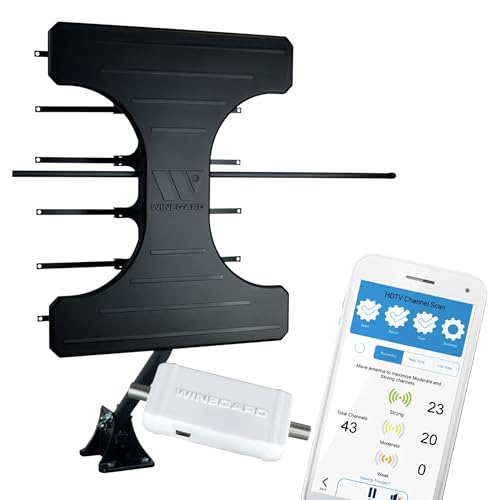
Winegard Elite Pro BW-2000 Amplified Outdoor TV Antenna
The Winegard Elite Pro BW-2000 is the most powerful amplified antenna in this guide, and it is built for rural homes far from the towers. The amplified directional outdoor design captures VHF and UHF broadcasts from 70 plus miles away, using a 10x TwinAmp amplifier with Clear Circuit Technology that holds a typical ultra low noise figure of 1.0 dB, so the signal stays clean even at long range. A built in smart signal meter with Bluetooth pairs with the Winegard mobile app to show real time signal strength and guided placement tips, which takes the guesswork out of aiming. It is outdoor rated and NEXTGEN TV ready.
For rural reception, the BW-2000 is the flagship pick. The directional design focuses on the towers, the low noise amplifier boosts weak signals without adding noise, and the app guided setup helps buyers aim precisely. It needs an outdoor mount with a clear view toward the towers, and it costs more than the indoor picks here, but for homes 70 miles from the towers it is the antenna most likely to deliver a full channel list. Buyers should check that their mount and cable run suit an outdoor install before ordering.
The Winegard Elite Pro BW-2000 is a serious outdoor antenna, and its smart signal meter makes aiming far easier than guessing. Mount it outdoors with a clear view toward the towers, pair the built in Bluetooth with the Winegard mobile app, and follow the real time signal strength and guided placement tips while aiming. The 10x TwinAmp amplifier with Clear Circuit Technology keeps the noise figure at a typical 1.0 dB, so weak signals stay clean at 70 plus miles. Seal outdoor connections against rain, check mounts after storms, and rescan for channels every few months. For rural homes far from the towers, this is the antenna most likely to deliver a full channel list.
Key specs: Amplified directional outdoor TV antenna; 70 plus mile range; 10x TwinAmp VHF and UHF amplifier; Clear Circuit Technology; 1dB low noise figure; smart signal meter with Bluetooth app; outdoor rated; NextGen TV
Strengths:
- 70 plus mile range for rural homes
- Smart signal meter with app guided aiming
- Ultra low 1dB noise figure keeps the signal clean
Trade-offs:
- Needs an outdoor mount with a clear view
- Directional design needs careful aiming
- Costs more than the indoor picks here
Best for: Rural homes far from broadcast towers
Not suited for: Apartment buyers who cannot mount outdoors
Check price on Amazon: Winegard Elite Pro BW-2000

GE Ultra-Thin Amplified TV Antenna
The GE Ultra-Thin Amplified TV Antenna is a slim indoor antenna that hides in plain sight. The ultra thin and lightweight panel mounts on a wall or a window, receives 1080P and 4K reception up to 55 miles from the broadcast signal, and includes an amplifier with a built in 4G and 5G LTE filter. The reversible black and white finish suits any room, and the paintable surface blends into the wall or the entertainment setup, so the antenna disappears into the decor. It is a simple way to get free local news, severe weather, and sports broadcasts along with HD channels, without a monthly cable or satellite bill.
For renters and apartment buyers, this antenna is the discreet pick. It mounts with no tools, the amplifier boosts weak signals, and the LTE filter keeps cell interference out of the picture. It suits homes within 55 miles of the towers, and it works best on a window facing the towers. It will not match an outdoor antenna for distant reception, and it needs power for the amplifier, but for a clean indoor install that blends into the room, it is one of the easiest picks here.
The GE Ultra-Thin antenna is made for renters who want an antenna that disappears into the room. Mount the ultra thin panel on a wall or a window, choose the black or white side to match the decor, or paint the surface to blend in completely. Place it near a window facing the towers, run a channel scan, and try a second spot when the first gives few channels. The amplifier with a built in LTE filter boosts weak signals and keeps cell interference out, and it needs power to work. Rescan every few months for new channels, and keep the cable tidy. For apartments within 55 miles of the towers, this is one of the easiest and most discreet installs here.
Key specs: Ultra-thin amplified indoor TV antenna; up to 55 mile range; 4K ready 1080P digital HDTV; VHF and UHF; amplifier with built-in 4G and 5G LTE filter; reversible black and white finish; paintable surface; wall or window mount
Strengths:
- Ultra thin panel blends into any room
- Reversible and paintable finish for a discreet install
- LTE filter keeps cell interference out of the picture
Trade-offs:
- Indoor range is shorter than outdoor antennas
- Needs power for the amplifier
- Needs a window facing the towers for best results
Best for: Renters and apartment buyers who want a discreet install
Not suited for: Rural homes far from broadcast towers
Check price on Amazon: GE Ultra-Thin Amplified TV Antenna
Comparison table
| Product | Type | Range | Key feature |
|---|---|---|---|
| Mohu Leaf Ultimate | Indoor amplified | Indoor | LED signal indicator |
| Winegard FlatWave FL5500A | Indoor amplified | Up to 60 miles | Ultra thin panel |
| GE Hover Amplified | Indoor amplified | Up to 55 miles | Top of TV mount |
| Philips Hover Amplified | Indoor amplified | Up to 50 miles | TruAmp, top of TV |
| Winegard Elite Pro BW-2000 | Outdoor amplified | 70 plus miles | Smart signal meter |
| GE Ultra-Thin Amplified | Indoor amplified | Up to 55 miles | Reversible, paintable |
Best amplified antennas: how to choose
Start with distance and obstacles, because they decide how much amplification helps. A home within a few miles of the towers with a clear view often needs only a small indoor amplified antenna, while a home far from the towers, or behind hills and tall buildings, needs a larger outdoor amplified antenna with higher gain. Check a broadcast map for the area first, and note which channels sit on VHF and which sit on UHF, because the antenna must cover both.
Next, look at the amplifier. A good amplifier adds clean gain with low noise, and an adjustable gain control helps near strong towers, where too much gain overloads the tuner and kills channels instead of adding them. Some amplifiers plug into a wall outlet, while others draw power from the television USB port, which is simpler but needs a USB port that stays powered. Cable length matters too: keep the cable short, because long cables lose signal.
Finally, check the mounting and the placement. Indoor antennas work best near a window facing the towers, while outdoor antennas work best on a roof or a high mast with a clear view. Avoid antennas that cover only one band, that have no gain control near strong towers, or that need a separate power supply not included in the box.
Installing and caring for an amplified antenna
When a new amplified antenna arrives, connect the amplifier power before scanning for channels, and place the antenna near a window facing the towers for an indoor model, or on a roof or mast for an outdoor model. Run a channel scan on the television, then move the antenna a little and scan again, because a small move can add several channels. Adjust the gain down when the home sits near the towers, and up when the home sits far away.
After install, rescan for channels every few months, because broadcast lineups change, and a fresh scan picks up new channels. Clean the antenna surface every few months, and check outdoor mounts and cables after storms, because wind loosens brackets and water creeps into unsealed joints. Keep the amplifier powered, because an unpowered amplifier blocks the signal instead of boosting it.
For long term care, keep spare cables on hand, and replace a cable that shows wear, because a damaged cable loses more signal than a weak amplifier can add. An amplified antenna that is placed well and kept clean will deliver clear channels for years.
Common mistakes when buying an amplified antenna
The most common mistake is adding amplification where the signal is already strong, which overloads the tuner and removes channels instead of adding them. Another common mistake is buying an antenna that covers only UHF when local channels sit on VHF, which leaves those channels missing no matter how much gain is added. A third mistake is placing the antenna behind a television or inside a metal cabinet, which blocks the signal before the amplifier ever sees it.
Buyers also forget to check the exact model code and the band coverage. Similar names can hide different bands, different gain, and different power needs, and the wrong variant can miss the channels that matter most. Finally, many buyers forget to rescan: an antenna cannot show a channel the television has never scanned for.
Our final recommendation
For most buyers, the best amplified antenna in this guide is a model that covers both VHF and UHF, adds clean gain without overloading the tuner, and suits the distance to the towers, indoor for near homes and outdoor for far homes. That combination turns frozen channels into clear ones. Near tower buyers should choose the indoor model with adjustable gain, while far buyers should choose the outdoor model with the highest practical range.
Whatever the choice, buy the exact model code in this guide, check the band coverage before ordering, and keep the receipt until the antenna has been placed and the channels scanned. An amplified antenna should make local channels clear, stable, and free to watch. For more antenna options, see our guides to TV antennas, antennas for TVs, antennas for smart TVs, and 4K indoor TV antennas.
Placement and rescanning for amplified antennas
An amplified antenna lives or dies by placement, and a few simple habits make the difference between a full channel list and a frustrating one. Start by placing an indoor antenna near a window facing the broadcast towers, since walls and metal objects block signal before the amplifier ever sees it, and avoid placing it behind the television or inside a metal cabinet. Run a channel scan, then move the antenna a little and scan again, because a small move can add several channels. Adjust the gain down when the home sits near the towers, since too much gain overloads the tuner and removes channels, and up when the home sits far away. Rescan for channels every few months, because broadcast lineups change and a fresh scan picks up new channels. Keep the amplifier powered at all times, since an unpowered amplifier blocks the signal instead of boosting it. Clean the antenna surface every few months, check outdoor mounts and cables after storms, and keep spare cables on hand, since a damaged cable loses more signal than a weak amplifier can add. An amplified antenna placed well and kept clean will deliver clear channels for years.
Choosing between indoor and outdoor amplified antennas
The choice between an indoor and an outdoor amplified antenna comes down to distance and the home itself. Homes within a few miles of the towers with a clear view usually do well with a small indoor amplified antenna, especially one with a signal indicator or a top of TV mount that makes placement easy. Homes far from the towers, or behind hills and tall buildings, need a larger outdoor amplified antenna with higher gain, since the extra height and the bigger elements pull in signals an indoor panel cannot reach. Renters and apartment buyers should choose indoor models, since outdoor mounting is often not allowed, while homeowners with a roof or a mast should consider outdoor models for the best channel list. Check a broadcast map for the area first, note the distance and the bands, and choose the antenna that matches the distance rather than the biggest one on the shelf.
Frequently asked questions
What does an amplified antenna do differently?
An amplified antenna adds a powered booster that strengthens weak broadcast signals before they reach the television. It helps homes far from towers or behind obstacles, while a passive antenna only receives what reaches it.
Can an amplified antenna hurt reception?
Yes, when the signal is already strong. Too much gain overloads the tuner and can remove channels. Choose an antenna with adjustable gain, or a model suited to the distance, and turn the gain down near strong towers.
Do amplified antennas need power?
Yes. The amplifier needs power from a wall outlet or a television USB port. An unpowered amplifier blocks the signal, so keep it plugged in whenever the antenna is in use.
What bands should an amplified antenna cover?
Both VHF and UHF, because local channels sit on both bands. Check a broadcast map for the area, and choose an antenna that covers every band the local channels use.
Where should I place an amplified antenna?
Indoor antennas work best near a window facing the broadcast towers. Outdoor antennas work best on a roof or a high mast with a clear view. Keep the antenna away from metal objects and thick walls that block signal.


