The best cameras to learn photography are not the most expensive cameras, and they are not the most powerful ones. They are the cameras that make learning enjoyable: simple enough to use on the first day, capable enough to reward the effort, and forgiving enough that a beginner's mistakes still produce a photo worth keeping. A camera that frustrates a beginner gets left on a shelf, while a camera that rewards the first attempts gets carried everywhere.
The six cameras below were chosen for exactly that balance. They range from the Canon EOS R50 and the Nikon Z30 to the Sony ZV-E10, the Fujifilm X-T30 II, the Canon EOS R100, and the OM System OM-5 Mark II. Each one is a mirrorless camera with a kit lens or a simple lens, an automatic mode for the first weeks, and manual controls for the months that follow. Each listing was checked in full before it earned a link, and any listing marked as renewed or used was set aside.
What changes across the list is the character of each camera: the Canon models are the most straightforward, the Nikon is the most compact, the Sony is the most video-friendly, the Fujifilm is the most tactile, and the OM System is the most rugged. The sections below lay out those differences, so the choice is made on the camera that fits the learner, not on the specification alone.
In this guide
Quick picks: best cameras to learn photography
| # | Product | Where to buy |
|---|---|---|
| 1 | Canon EOS R50 | Check on Amazon |
| 2 | Nikon Z 30 | Check on Amazon |
| 3 | Sony ZV-E10 | Check on Amazon |
| 4 | Fujifilm X-T30 II | Check on Amazon |
| 5 | Canon EOS R100 | Check on Amazon |
| 6 | OM System OM-5 Mark II | Check on Amazon |
How the picks were chosen
Ease of use came first. A camera earned a place here when its listing described a beginner-friendly mirrorless camera with a kit lens, an automatic mode, and controls that a new photographer can learn step by step. Professional bodies with complex menus and no automatic mode were not considered, because they teach frustration before they teach photography.
Guidance and forgiveness were weighed next. A camera that helps the learner, through a vari-angle screen, a clear menu, or a beginner mode stated in the listing, is worth more to a beginner than a camera with more resolution. The Canon R100 listing states that it is for beginners plainly, and the R50 listing names vlogging and content creation alongside photography.
Every listing was verified in full before linking. The brand and the complete model name in the listing had to match the camera described, including the kit lens where stated. Listings marked as renewed or used were dropped, and any listing whose title described a different model was set aside.
Quick comparison
| Product | Standout feature | Best for |
|---|---|---|
| Canon EOS R50 | Clearest menu with a 24.2 MP sensor | the simplest path from automatic to manual |
| Nikon Z 30 | Most compact and lightweight for daily carry | the smallest, lightest camera for everyday learning |
| Sony ZV-E10 | 425-point AF with a flip-out screen | learning photography and video together |
| Fujifilm X-T30 II | Tactile dials that teach the craft | learning through physical dials and direct control |
| Canon EOS R100 | Beginner camera with easy phone sharing | the most affordable Canon with a clear beginner promise |
| OM System OM-5 Mark II | Weather-sealed with 5-axis stabilisation | a rugged weather-sealed camera for outdoor learning |

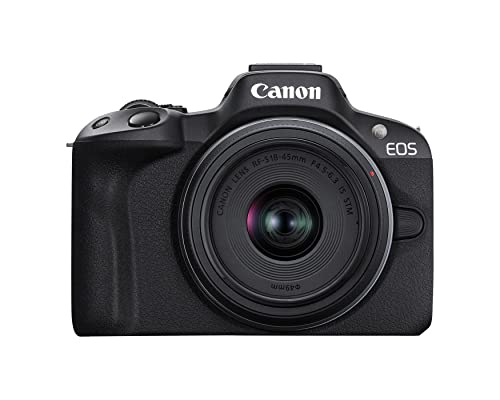
Canon EOS R50 Mirrorless Camera
The Canon EOS R50 is the most straightforward camera on this list, and its listing states the case plainly: a mirrorless camera with an RF-S18-45mm lens kit, a 24.2 megapixel APS-C sensor, 4K video, and vlogging, content creation, photography, and digital camera use, in black. It is a camera that does everything a beginner needs, and nothing that will confuse one.
The 24.2 megapixel APS-C sensor is the right size for learning: large enough to produce clean, detailed photos, small enough that the camera stays light and the files stay manageable. The RF-S18-45mm kit lens covers the wide to short telephoto range, which is the range most beginners use most of the time, and the 4K video means the camera also works for the video a beginner will soon want to try.
For a learner who wants the simplest path from automatic to manual, the R50 is the natural first pick. It starts in automatic, it grows into manual, and its Canon menu system is the clearest of any camera here. It is the camera to buy when the goal is to learn photography, not to learn a camera.
Key specifications: 24.2 megapixel CMOS APS-C sensor; RF-S18-45mm F4.5-6.3 IS STM lens kit; 4K video; vlogging; content creation; photography; black.
This camera fits a beginner who wants the simplest path from automatic to manual, with a clear menu and a capable kit lens.
Strengths
- The Canon menu system is the clearest for a beginner.
- The 24.2 MP APS-C sensor produces clean, detailed photos.
- The kit lens covers the most-used focal range.
Trade-offs
- The kit lens is a variable-aperture zoom, not a fast prime.
- The APS-C sensor is smaller than a full-frame sensor.
- It has no weather sealing stated in the listing.
The Canon EOS R50 suits first-time photographers. It fits a student, a hobbyist, or anyone who wants to learn photography on a camera that gets out of the way.
Best for: the simplest path from automatic to manual / Not suited for: a buyer who wants a full-frame sensor or weather sealing
Check price on Amazon: Canon EOS R50

Nikon Z 30
The Nikon Z 30 is the most compact camera on this list, and its listing states the reason plainly: Nikon's most compact, lightweight mirrorless stills and video camera, with a 16-50mm zoom lens, as a Nikon USA model. A camera that is small and light gets carried more, and a camera that is carried more teaches more, because the learning happens in the taking, not in the reading.
The 16-50mm zoom lens in the listing is a collapsible kit lens, which keeps the camera small when it is packed away and ready when it is needed. The Z 30 is built for both stills and video, which suits a beginner who will soon want to try both, and the Nikon USA model status means it is the version made for this market.
For a learner who wants the smallest, lightest camera that still takes proper photographs, the Z 30 is the pick. It is the camera to carry every day, and a camera carried every day is a camera that teaches photography faster than any book.
Key specifications: Most compact, lightweight mirrorless stills and video camera; 16-50mm zoom lens; Nikon USA model.
This camera fits a beginner who wants the smallest, lightest camera for everyday carrying and learning.
Strengths
- The compact, lightweight body gets carried every day.
- It handles both stills and video for a beginner who tries both.
- The collapsible kit lens keeps the camera small when packed.
Trade-offs
- The listing states no resolution figure for the sensor.
- The small body has fewer direct controls than larger cameras.
- It has no viewfinder stated in the listing.
The Nikon Z 30 suits learners who carry a camera everywhere. It fits a student, a traveller, or anyone who learns by shooting daily rather than by studying.
Best for: the smallest, lightest camera for everyday learning / Not suited for: a buyer who wants a viewfinder or the most direct controls
Check price on Amazon: Nikon Z 30

Sony ZV-E10
The Sony ZV-E10 is the most video-friendly camera on this list, and its listing states the details plainly: an APS-C mirrorless camera with a 16-50mm lens, 24.2 MP, UHD 4K30p video, a 3.0-inch side flip-out touchscreen, and 425-point autofocus. The flip-out screen is the detail that matters for a learner, because it shows the shot when the camera is pointed at the learner, which is how most beginners first learn to frame.
The 425-point autofocus stated in the listing is the most detailed autofocus figure on this list, and it means the camera finds and holds focus across almost the whole frame. That forgiveness is valuable for a beginner, because a photo that is out of focus teaches nothing. The 24.2 MP APS-C sensor produces clean photos, and the 4K30p video means the camera grows into video work as the learner does.
For a learner who wants to learn photography and video together, the ZV-E10 is the pick. It is the camera for a beginner who will film themselves, shoot friends, and learn both crafts at once, and its autofocus does the hardest part while the learner does the rest.
Key specifications: 24.2 MP APS-C sensor; 16-50mm lens; UHD 4K30p video; 3.0-inch side flip-out touchscreen; 425-point autofocus.
This camera fits a beginner who wants to learn photography and video together, with strong autofocus and a flip-out screen.
Strengths
- The 425-point autofocus finds and holds focus reliably.
- The flip-out screen helps a beginner frame self-portraits.
- It handles both photography and video well.
Trade-offs
- It is built for video first, so stills controls are simpler.
- The listing states no viewfinder.
- It has no weather sealing stated in the listing.
The Sony ZV-E10 suits learners who film as well as photograph. It fits a creator, a vlogger, or anyone who wants to learn both crafts on one camera.
Best for: learning photography and video together / Not suited for: a buyer who wants a viewfinder or a stills-first camera
Check price on Amazon: Sony ZV-E10

Fujifilm X-T30 II
The Fujifilm X-T30 II is the most tactile camera on this list, and its listing describes a mirrorless digital camera with an XC 15-45mm lens kit, in silver. The X-T30 II is known for its physical dials, and those dials are the reason it teaches photography so well: aperture, shutter speed, and exposure compensation are set by turning a dial, not by digging through a menu, so the learner sees the cause and the effect directly.
The XC 15-45mm kit lens covers the wide to short telephoto range, and the silver finish gives the camera a classic look that suits its classic controls. Fujifilm's colour science is the other reason photographers love this line, and it means the photos look good straight out of the camera, which is encouraging for a beginner who is still learning to edit.
For a learner who wants to understand photography by handling it, the X-T30 II is the pick. It is the camera for a beginner who wants to learn the craft through dials and direct control, and whose photos should look good before any editing begins.
Key specifications: Mirrorless digital camera; XC 15-45mm lens kit; silver.
This camera fits a beginner who wants to learn photography through physical dials and direct control.
Strengths
- Physical dials teach aperture and shutter speed directly.
- Fujifilm colour science makes photos look good unedited.
- The classic silver design suits a tactile camera.
Trade-offs
- The listing states no resolution or sensor details.
- The small body has fewer direct controls than larger cameras.
- It has no weather sealing stated in the listing.
The Fujifilm X-T30 II suits hands-on learners. It fits a hobbyist, a film lover, or anyone who wants to understand the craft by turning dials rather than tapping menus.
Best for: learning through physical dials and direct control / Not suited for: a buyer who wants a modern menu system or weather sealing
Check price on Amazon: Fujifilm X-T30 II

Canon EOS R100
The Canon EOS R100 is the most explicitly beginner camera on this list, and its listing says so: a mirrorless camera with an RF-S18-45mm lens kit, a 24.1 megapixel APS-C sensor, 4K video, Wi-Fi and Bluetooth, for beginner photographers and creators, in black. When a listing names beginners directly, it is a promise about the camera's design, and the R100 keeps it.
The 24.1 megapixel APS-C sensor is close to the R50's, and it produces the same clean, detailed photos for learning. The RF-S18-45mm kit lens covers the most-used range, and the Wi-Fi and Bluetooth stated in the listing make it easy to send photos to a phone, which is how most beginners share their first work.
For a learner who wants the most affordable Canon on this list and the clearest beginner promise, the R100 is the pick. It is the camera to buy when the budget is tight and the goal is to learn, because it gives up nothing a beginner needs and keeps the price where a first camera should be.
Key specifications: 24.1 megapixel CMOS APS-C sensor; RF-S18-45mm F4.5-6.3 IS STM lens kit; 4K video; Wi-Fi and Bluetooth; for beginner photographers and creators; black.
This camera fits a beginner who wants the most affordable Canon with a clear beginner promise and easy photo sharing.
Strengths
- The listing names beginners directly, so the design suits them.
- Wi-Fi and Bluetooth make sharing photos to a phone easy.
- The 24.1 MP sensor produces clean photos for learning.
Trade-offs
- The kit lens is a variable-aperture zoom, not a fast prime.
- The APS-C sensor is smaller than a full-frame sensor.
- It has no weather sealing stated in the listing.
The Canon EOS R100 suits budget-conscious beginners. It fits a student, a first-time buyer, or anyone who wants to start learning photography without a large spend.
Best for: the most affordable Canon with a clear beginner promise / Not suited for: a buyer who wants a full-frame sensor or weather sealing
Check price on Amazon: Canon EOS R100

OM System OM-5 Mark II
The OM System OM-5 Mark II is the most rugged camera on this list, and its listing states the details plainly: a silver mirrorless camera body with a 20.4 MP Four Thirds sensor, 4K video, 5-axis image stabilisation, and IP53 weather sealing, in a compact, lightweight design. The weather sealing is the detail that matters for a learner, because a camera that survives rain gets used in weather that teaches the most.
The 5-axis image stabilisation stated in the listing steadies the image, which helps a beginner whose hands are still learning to hold a camera still, and the 20.4 MP Four Thirds sensor produces clean photos in a body that stays small. The compact, lightweight design means the camera is carried often, and the IP53 sealing means it is carried in weather that would keep other cameras in the bag.
For a learner who wants a camera that can be taken anywhere in any weather, the OM-5 Mark II is the pick. It is a body-only listing, so a lens must be bought separately, but the camera it buys is the toughest and most forgiving on this list.
Key specifications: 20.4 MP Four Thirds sensor; 4K video; 5-axis image stabilisation; IP53 weather sealing; compact lightweight design; silver; body only.
This camera fits a beginner who wants a rugged, weather-sealed camera for learning outdoors in any weather.
Strengths
- IP53 weather sealing survives rain that stops other cameras.
- 5-axis stabilisation steadies a beginner's hands.
- The compact, lightweight design gets carried often.
Trade-offs
- The body-only listing means a lens must be bought separately.
- The Four Thirds sensor is smaller than an APS-C sensor.
- 20.4 MP is the lowest resolution on this list.
The OM System OM-5 Mark II suits outdoor learners. It fits a hiker, a traveller, or anyone who wants to learn photography in rain and rough weather.
Best for: a rugged weather-sealed camera for outdoor learning / Not suited for: a buyer who wants a lens included or the largest sensor
Check price on Amazon: OM System OM-5 Mark II
Best cameras to learn photography: what matters most: what matters most
Ease of use is the first filter, and it is judged by the menu, the controls, and the automatic mode. A camera with a clear menu and a good automatic mode lets a beginner take good photos on the first day, and the manual controls are there when the learner is ready. A camera that hides its settings behind layers of menus teaches frustration first.
The kit lens is the second filter, because it is the lens a beginner will use for months. A lens that covers the wide to short telephoto range, like the 18-45mm and 16-50mm kits here, handles landscapes, portraits, and everyday scenes without a change. A camera sold body-only, like the OM-5 Mark II, needs a lens budget planned at the same time.
Guidance features are the third filter. A flip-out screen, like the one on the ZV-E10, helps a beginner frame self-portraits, and physical dials, like those on the X-T30 II, teach the relationship between aperture, shutter speed, and exposure directly. The right guidance depends on how the learner learns.
Size and weight are the last filter, because a camera that is carried teaches more than a camera that stays home. The Z 30 is the smallest and lightest here, and the OM-5 Mark II is compact and rugged, and both suit a learner who carries a camera every day. A heavy camera stays in the bag, and a camera in the bag teaches nothing.
Buying guide: choosing cameras to learn photography
Start with the learner. A beginner who wants the simplest path should buy the Canon R50 or R100, a beginner who wants to learn by handling should buy the Fujifilm X-T30 II, and a beginner who wants to film as well as photograph should buy the Sony ZV-E10. The camera should fit the learner, not the other way around.
Then check whether the listing includes a lens. Most cameras here are sold as kits with a lens in the box, which is the right way to buy a first camera. The OM-5 Mark II is the exception, sold as a body only, so a lens must be budgeted at the same time.
Check the sensor size and the resolution in the listing. The APS-C cameras here, with 24.1 or 24.2 megapixels, are the standard for learning, and they produce clean photos with manageable file sizes. The Four Thirds sensor in the OM-5 Mark II is smaller but still capable, especially with its stabilisation.
Finally, think about where the camera will be used. A learner who shoots outdoors in all weather needs the weather sealing of the OM-5 Mark II, while a learner who shoots indoors needs only a clear menu and a good kit lens. Buy the camera for the places it will go, not for the specification alone.
Using and caring for your cameras to learn photography
Start in automatic and learn one control at a time. A beginner should shoot in automatic for the first weeks, then learn aperture, then shutter speed, then ISO, one at a time. Trying to learn everything at once teaches nothing, and a camera that starts simple rewards the patience.
Review every photo. A digital camera shows the result immediately, and that is the fastest teacher in photography. Look at each photo, ask what worked and what did not, and change one thing for the next shot. A beginner who reviews every photo learns faster than one who shoots a hundred and looks at none.
Carry the camera everywhere. The cameras here are small and light for a reason, and a camera carried every day teaches more than a camera used only on weekends. The best practice is a photo a day, taken with attention, rather than a hundred photos taken in a hurry.
Common mistakes to avoid
The most common mistake is buying too much camera. A professional body with a complex menu and no automatic mode will frustrate a beginner, and a camera that frustrates gets left on a shelf. Buy the camera that fits the learner today, and upgrade when the learner has outgrown it.
Another frequent error is never leaving automatic mode. Automatic is the right place to start, but a beginner who never tries manual controls never learns photography. Move to aperture priority after a few weeks, then to manual, one step at a time.
A third mistake is buying a body-only camera without a lens. The OM-5 Mark II is sold as a body only, and a camera with no lens takes no photos. Budget for a lens at the same time as the body, and choose a kit lens that covers the wide to short telephoto range.
Budget and value
A first camera should cost as little as will do the job well. The Canon R100 is the most affordable camera here, and it gives a beginner everything needed to learn, while the R50 adds a little more for a little more money. Spending more than that buys features a beginner will not use for a year.
Value here means matching the camera to the learner. A beginner who wants to learn by handling should spend on the Fujifilm X-T30 II, a beginner who wants to film should spend on the Sony ZV-E10, and a beginner who shoots outdoors should spend on the OM-5 Mark II. Spending on the wrong strength buys a camera that does not fit.
Final recommendation
If one camera has to win, it is the Canon EOS R50 for the clearest path from automatic to manual. For the most affordable start, the Canon EOS R100 is the pick, and for learning by handling, the Fujifilm X-T30 II is the one. The Sony ZV-E10 is the choice for video as well as photography, the Nikon Z 30 is the choice for everyday carrying, and the OM-5 Mark II is the choice for outdoor learning.
Whichever camera suits the learner, the rule is the same: start in automatic, learn one control at a time, review every photo, and carry the camera everywhere. Do that, and any of the six cameras on this list will teach photography well.
Frequently asked questions
Do I need a full-frame camera to learn photography?
No. The APS-C cameras on this list, with 24.1 or 24.2 megapixels, are the standard for learning, and they produce clean photos with manageable file sizes. Full-frame matters most for low light and large prints, which a beginner does not need yet.
Should I start in automatic mode?
Yes. Automatic is the right place to start, because it lets a beginner take good photos on the first day. Move to aperture priority after a few weeks, then to manual, one step at a time. A beginner who never leaves automatic never learns, but one who starts in manual learns frustration first.
Which camera here is best for video as well as photography?
The Sony ZV-E10, with UHD 4K30p video, a flip-out screen, and 425-point autofocus stated in its listing, is the most video-friendly camera here. The Canon R50 and R100 also record 4K video, and the OM-5 Mark II records 4K with 5-axis stabilisation.
Do I need to buy a lens separately?
Most cameras here are sold as kits with a lens in the box, which is the right way to buy a first camera. The OM-5 Mark II is the exception, sold as a body only, so a lens must be budgeted at the same time.
How much should I spend on a first camera?
As little as will do the job well. The Canon R100 is the most affordable camera here, and it gives a beginner everything needed to learn. Spend more only for a specific strength, such as the Fujifilm dials or the OM-5 weather sealing.
What is the best way to learn quickly?
Carry the camera everywhere, shoot every day, and review every photo. A photo a day, taken with attention and reviewed honestly, teaches faster than a hundred photos taken in a hurry and never looked at.
Learning aperture first
Aperture is the first control a beginner should learn, because it is the most visible. A wide aperture blurs the background and isolates a subject, while a narrow aperture keeps everything sharp from near to far. The physical dials on the Fujifilm X-T30 II make this relationship obvious, because turning the dial changes the picture directly.
The exercise is simple: photograph the same subject at the widest aperture, then at the narrowest, and compare the two. The difference is immediate, and it teaches more about aperture than any explanation. A beginner who does this once understands aperture for good.
Learning shutter speed next
Shutter speed is the second control to learn, because it decides whether motion is frozen or blurred. A fast shutter freezes a running child or a moving car, while a slow shutter blurs water into silk and light into trails. The cameras here all offer shutter priority mode, which lets the beginner set the speed and the camera choose the rest.
The exercise is the same as for aperture: photograph a moving subject at a fast speed, then at a slow speed, and compare. The two photos look entirely different, and the difference is the lesson. A beginner who tries this once understands shutter speed.
Understanding ISO
ISO is the third control, and it is the simplest to understand: a higher ISO makes the camera more sensitive to light, which helps in dim rooms, but it also adds noise to the photo. A lower ISO gives a cleaner photo but needs more light or a slower shutter.
The beginner's rule is to keep ISO as low as the light allows, and to raise it only when the photo would otherwise be blurred or too dark. The APS-C sensors on the cameras here handle moderate ISO well, which gives a beginner room to learn without worrying about noise.
Composing a better photo
Composition is the skill that separates a snapshot from a photograph, and it costs nothing to learn. The rule of thirds, placing the subject off-centre rather than in the middle, is the first rule to try, and the grid display on these cameras makes it easy to see.
The second rule is to fill the frame. A beginner's photos are usually taken from too far away, and the subject fills too little of the frame. Move closer, or zoom in, until the subject dominates the photo, and the result will look far more deliberate.
Editing your first photos
Editing is part of photography, not an afterthought, and a beginner should learn it early. The cameras here produce files that respond well to simple adjustments: a little more contrast, a little warmer colour, and a small crop to improve the composition. The free editing apps on a phone are enough to start.
The rule is to edit lightly. A photo that needs heavy editing was probably not a good photo to begin with, and a beginner who edits heavily learns to rely on the edit rather than the shot. Edit to finish a good photo, not to rescue a bad one.
Finding subjects to practise on
A beginner does not need exotic subjects to learn photography. A street, a park, a kitchen table, and a friend are all enough, and the best practice is a photo a day, taken with attention, rather than a hundred photos taken in a hurry. The cameras here are small and light for exactly this reason: they are meant to be carried every day.
The subjects that teach the most are the ones that move and the ones that change with light. A child playing, a dog running, and a street at sunset all demand quick decisions, and those decisions are the practice that builds skill.
When to upgrade your camera
A beginner will eventually outgrow a first camera, and that is a good sign, not a failure. The moment to upgrade is when the camera, not the photographer, is the limit: when the autofocus cannot keep up, when the low-light performance is not enough, or when the controls get in the way.
Until then, the money is better spent on a lens or a tripod than on a new body. A fast prime lens teaches more about photography than a new camera does, and a tripod teaches patience. Upgrade the glass before the body, and the photos will improve faster.
The exposure triangle in practice
Aperture, shutter speed, and ISO form the exposure triangle, and learning it is the core of photography. Aperture controls depth of field, shutter speed controls motion, and ISO controls sensitivity, and every photo is a balance of the three. A beginner who understands the triangle can take any photo, because every setting is a choice among the three.
The way to learn the triangle is to change one control at a time. Set the camera to aperture priority, change only the aperture, and watch the depth of field change. Then set it to shutter priority, change only the speed, and watch motion freeze or blur. Then change only ISO, and watch the noise appear. One control at a time is the fastest way to learn all three.
The cameras here make this easy. The Canon models have a clear mode dial, the Fujifilm has physical dials for aperture and shutter speed, and the Sony has a simple menu. The learner should pick the camera whose controls feel clearest, because the clearest controls teach fastest.
Learning to see light
Light is the subject of every photograph, and learning to see it is the most important skill a beginner can build. The same scene looks entirely different in morning light, in midday sun, and in evening shade, and a photographer who notices the light will take better photos than one who only notices the subject.
The exercise is to photograph the same place at different times of day. A street corner at dawn, at noon, and at dusk will produce three different photographs, and comparing them teaches what light does. A beginner who does this once will never look at light the same way again.
Soft light is the beginner's friend. An overcast day, a shaded spot, or a window with indirect light all give soft, even illumination that flatters a subject, while direct sun creates harsh shadows. A beginner should seek soft light first, and learn hard light later.
Critiquing your own work
Reviewing photos honestly is the fastest way to improve, and the habit is simple: after every shoot, look at each photo and ask three questions. What works in this photo, what does not work, and what would I change next time. A beginner who asks these questions after every shoot will improve visibly within weeks.
The questions matter more than the answers. A photo that is sharp but boring teaches composition, a photo that is well composed but blurry teaches technique, and a photo that is both teaches confidence. The review is where the learning happens, not in the taking.
Keep the best photos and delete the rest. A portfolio of ten good photos teaches more than a hard drive of ten thousand unreviewed ones, and the act of choosing the best forces the photographer to decide what good means.
Joining a photography community
Photography is learned faster with others, and a beginner should find a community, online or in person. A local camera club, an online group, or a class all provide feedback, assignments, and the simple motivation of shooting alongside others who are learning too.
The value of a community is in the assignments and the critique. A weekly theme forces the photographer to shoot something new, and a critique from another photographer shows what the photographer cannot see alone. A beginner who shoots alone learns slowly, while one who shoots with others learns fast.
Sharing work is the other half. The cameras here make sharing easy, and a beginner who shares one good photo a week will build a body of work and a habit of finishing, which is the skill that separates a photographer from someone who only takes pictures.
More guides from KajuanDouglas
digital cameras for beginners under 100 cameras for beginners under 200 beginner mirrorless cameras DSLR cameras for a beginner