A TV antenna for an RV is a small investment that pays for itself quickly. Free over-the-air channels mean no streaming subscription, no data usage, and no dependence on a campsite Wi-Fi connection that may or may not work. The best TV antennas for RV use are built for the road: they mount on the roof, survive wind and rain, and pull in local channels from miles away, so the evening news and the big game are available wherever the RV stops.
This guide compares eight RV TV antennas, led by Winegard, the maker that has defined the category for decades. The Winegard Air 360 models are omnidirectional antennas that receive signals from every direction without aiming, which suits an RV that moves daily. The Sensar models are crank-up antennas with longer range for rural stops, and the Rayzar rotates automatically to find the strongest signal. An amplified antenna from Continu.us rounds out the guide for buyers who want a budget option with a built-in amplifier.
The first decision is omnidirectional or directional. An omnidirectional antenna receives from every direction at once, which means no aiming and no adjustment when the RV moves. A directional antenna receives further in one direction, which helps in rural areas, but it must be aimed at the broadcast towers. Most RV owners should choose omnidirectional for convenience, and only buyers who camp far from towns should consider a directional crank-up model. The sections below explain which type each antenna is, so the choice matches the travel rather than the marketing.
One practical note before the details: free channels depend on location. An antenna receives the channels that broadcast near the campsite, and a rural site far from any town will have fewer channels than a site near a city, however good the antenna. Check the local broadcast towers before a trip, and treat the antenna as a way to get the local channels for free, not as a replacement for every channel. The comparison table below lines the eight antennas up by type and range, and the sections that follow explain what each one does best.
In this guide
Quick picks: best tv antennas for rv
| # | Product | Where to buy |
|---|---|---|
| 1 | Winegard Air 360 A3-2000 | Check on Amazon |
| 2 | Winegard Air 360 A3-2035 | Check on Amazon |
| 3 | Winegard Air 360 LP A3-LPB1 | Check on Amazon |
| 4 | Winegard Air 360 LP A3-LPW1 | Check on Amazon |
| 5 | Winegard Sensar IV RVW-395 | Check on Amazon |
| 6 | Winegard Sensar III RV-3095 | Check on Amazon |
| 7 | Winegard Rayzar Automatic RZ-8535 | Check on Amazon |
| 8 | Amplified RV Antenna by Continu.us CA1500 | Check on Amazon |
Quick Comparison
| Product | Key spec | Best for |
|---|---|---|
| Winegard Air 360 A3-2000 | Omni RV HDTV antenna, 360-degree reception, white | Best overall RV TV antenna |
| Winegard Air 360 A3-2035 | Omni RV HDTV antenna, 360-degree reception, black | Best black RV TV antenna |
| Winegard Air 360 LP A3-LPB1 | Low-profile omni RV HDTV antenna, black | Best low-profile RV TV antenna |
| Winegard Air 360 LP A3-LPW1 | Low-profile omni RV HDTV antenna, white | Best white low-profile RV TV antenna |
| Winegard Sensar IV RVW-395 | Crank-up batwing, amplified, 65-mile range | Best long-range RV TV antenna |
| Winegard Sensar III RV-3095 | Crank-up batwing, amplified, 65-mile range | Best classic RV TV antenna |
| Winegard Rayzar Automatic RZ-8535 | Automatic rotation, amplified, long-range, black | Best automatic RV TV antenna |
| Amplified RV Antenna by Continu.us CA1500 | Amplified RV antenna, 360-degree reception, 55-mile range | Best budget amplified RV TV antenna |
Range figures are the manufacturer figures for ideal conditions; real range depends on terrain, buildings, and weather. Omnidirectional antennas need no aiming; directional antennas must be pointed at the broadcast towers. Check the roof space and the mount type before buying.
Quick Picks
The short list: the Winegard Air 360 A3-2000 for the best overall RV antenna, the Air 360 LP for low profile, the Sensar IV for the longest range, and the Rayzar for automatic aiming.

1. Winegard Air 360 A3-2000
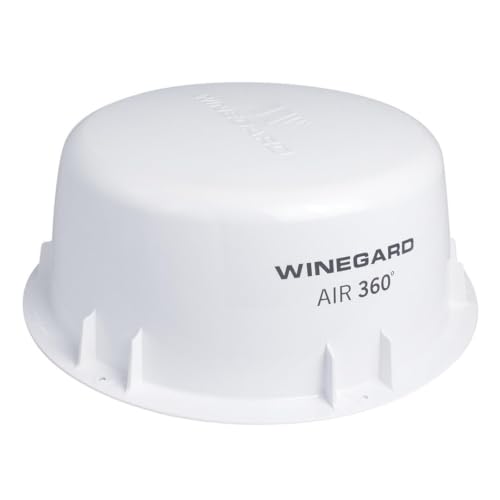
The Winegard Air 360 A3-2000 is the best overall RV TV antenna in this guide. It is an omnidirectional HDTV antenna for RVs that receives signals from 360 degrees, with long-range reception and a white housing that suits most RV roofs. It needs no aiming, no cranking, and no adjustment: it works wherever the RV stops, which is exactly what an RV antenna should do.
The Air 360 earns the top spot through simplicity. It mounts on the roof, connects to the TV, and receives local channels from every direction at once, so there is nothing to aim when the RV arrives at a new site. The long-range reception pulls in channels from miles away, and the omnidirectional design means the RV can park facing any direction without losing the signal. The white housing blends with most RV roofs, and the build is made to survive wind, rain, and road vibration. It is the antenna for RV owners who want television to work without thinking about it.
The Air 360 A3-2000 also connects easily to the existing RV wiring, which means installation is a matter of mounting it and connecting the cable. Most RVs already have a television connection on the roof, and the Air 360 uses it without modification. It is an antenna that an owner can install in an afternoon, which is part of why it is the best overall choice here.
What stands out:
- No aiming needed: omnidirectional 360-degree reception works from every direction at once.
- Long-range reception: pulls in local channels from miles away, even at rural stops.
- Roof-ready build: made to survive wind, rain, and road vibration on an RV roof.
Trade-offs to weigh: It is an omnidirectional antenna, so its range is shorter than a directional crank-up model in very rural areas, and it needs roof space for mounting.
Who it fits: RV owners who move often and want television to work at every stop without aiming or adjustment.
Lower a crank-up antenna before driving. A raised antenna can hit a branch or a bridge, and the damage is expensive, so make lowering it part of the departure routine.
A signal meter helps with directional antennas. A cheap meter shows signal strength while aiming, which is faster and more accurate than guessing from the picture, so it is worth carrying for Sensar owners.
Check price on Amazon: Winegard Air 360 A3-2000
2. Winegard Air 360 A3-2035
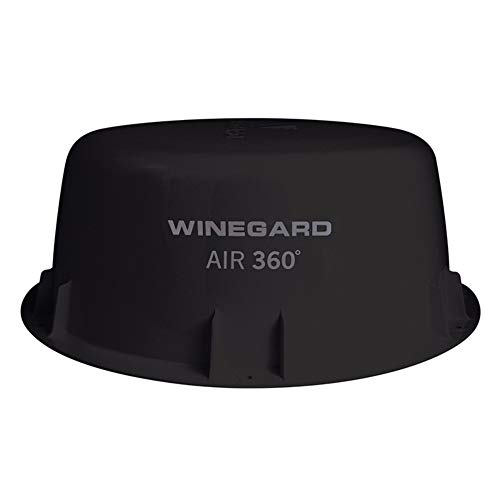
The Winegard Air 360 A3-2035 is the black version of the best overall pick. It is the same omnidirectional HDTV antenna for RVs, with 360-degree reception and long-range performance, in a black housing that suits dark RV roofs. For RV owners whose roof is black or dark, it is the better-looking choice with the same performance.
The A3-2035 is identical to the A3-2000 in performance: omnidirectional reception from every direction, long-range pull for local channels, and a roof-ready build that survives the road. The only difference is the colour. A black housing suits RVs with dark roofs and dark trim, where a white antenna would stand out, and it absorbs less attention on the roofline. The choice between the white and black models is purely cosmetic, so buyers should choose the colour that matches the RV and enjoy the same reception either way.
The Air 360 A3-2035 also suits RVs with dark roofs and dark trim, where a white antenna would stand out against the roofline. The black housing blends with solar panels and roof vents, so the roof looks tidy rather than cluttered. It is the same antenna as the white model in every other respect, so the choice is purely about the look of the roof.
What stands out:
- Same performance as the A3-2000: omnidirectional long-range reception with no aiming.
- Black housing: suits dark RV roofs and trim, where white would stand out.
- Roof-ready build: made for wind, rain, and road vibration.
Trade-offs to weigh: It is the same price as the white model for the same performance, so buyers who do not care about colour gain nothing from the black housing.
Who it fits: RV owners with dark roofs who want the best omnidirectional antenna in a colour that blends in.
Check the antenna after a storm. High wind can loosen a roof mount, and a loose mount leaks water into the roof, so inspect the mount and the seal after severe weather.
Clean the antenna housing once a season. Dirt and insects on the housing do not block the signal much, but a clean antenna lasts longer, and the inspection catches loose fittings early.
Check price on Amazon: Winegard Air 360 A3-2035

3. Winegard Air 360 LP A3-LPB1
The Winegard Air 360 LP A3-LPB1 is the low-profile version of the Air 360. It is a low-profile omnidirectional HDTV antenna for RVs, in black, that sits closer to the roof than the standard model. For RV owners who worry about height, clearance, and wind resistance, the low profile is a real advantage.
Height matters on an RV. A tall antenna adds wind resistance, risks low branches, and counts against clearance under bridges and in storage. The Air 360 LP sits low on the roof, which reduces all three concerns while keeping the omnidirectional reception that makes the Air 360 easy to use. It receives from every direction without aiming, with long-range performance for local channels, and the black housing suits dark roofs. The trade is a small reduction in range beside the taller models, but for most campsites and towns, the reception is more than enough, and the lower profile is worth it.
The Air 360 LP also helps with fuel economy in a small way, because a low-profile antenna creates less wind resistance than a tall one. The saving is modest, but over thousands of miles it adds up, and the lower profile also means fewer worries about low branches on campsite roads. It is an antenna that suits RVs where every inch of height matters.
What stands out:
- Low profile: sits close to the roof, reducing wind resistance and clearance worries.
- Omnidirectional reception: receives from every direction with no aiming.
- Black housing: blends with dark roofs and trim.
Trade-offs to weigh: The lower profile gives slightly less range than the taller Air 360 models, so very rural stops may need a directional antenna instead.
Who it fits: RV owners who worry about height, clearance, and wind resistance and want a low antenna that still receives well.
Keep the cable run short. A long cable loses signal, so route the cable from the roof to the TV by the shortest practical path, and replace a damaged cable rather than living with it.
Store the RV with the antenna lowered. A raised antenna in storage catches wind and weather for no reason, so lower it whenever the RV is parked for a long period.
Check price on Amazon: Winegard Air 360 LP A3-LPB1

4. Winegard Air 360 LP A3-LPW1
The Winegard Air 360 LP A3-LPW1 is the white version of the low-profile Air 360. It is a low-profile omnidirectional HDTV antenna for RVs, in white, that sits close to the roof and receives from every direction. For RV owners with white roofs who want the low profile, it is the matching choice.
The A3-LPW1 is the same low-profile antenna as the A3-LPB1, in white rather than black. It sits close to the roof, reducing wind resistance and clearance concerns, and it receives local channels from every direction without aiming. The white housing blends with the white roofs that most RVs have, so it disappears on the roofline. The performance is the same as the black model, and the choice is purely cosmetic. Buyers with a white roof should choose this one, and buyers with a dark roof should choose the black one, and either way the reception is the same.
The Air 360 LP white model also blends with the white roofs that most RVs have, so it disappears on the roofline and the RV looks uncluttered. A white antenna on a white roof is almost invisible from the ground, which suits owners who prefer a tidy appearance. The performance is the same as the black model, so the colour is the only decision to make.
What stands out:
- Low profile: sits close to the roof for less wind resistance and better clearance.
- Omnidirectional reception: receives from every direction with no aiming.
- White housing: blends with the white roofs most RVs have.
Trade-offs to weigh: Like the black low-profile model, it gives slightly less range than the taller Air 360 models in very rural areas.
Who it fits: RV owners with white roofs who want a low-profile omnidirectional antenna that blends in.
Lower a crank-up antenna before driving. A raised antenna can hit a branch or a bridge, and the damage is expensive, so make lowering it part of the departure routine.
A signal meter helps with directional antennas. A cheap meter shows signal strength while aiming, which is faster and more accurate than guessing from the picture, so it is worth carrying for Sensar owners.
Check price on Amazon: Winegard Air 360 LP A3-LPW1
5. Winegard Sensar IV RVW-395
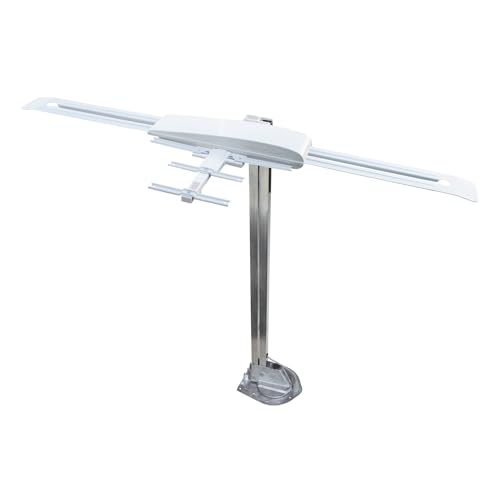
The Winegard Sensar IV RVW-395 is the long-range RV TV antenna in this guide. It is a crank-up batwing antenna with an amplifier, a 65-mile range, and a 48-inch wingspan that pulls in distant signals. For RV owners who camp far from towns, where omnidirectional antennas struggle, the Sensar IV is the antenna that still finds channels.
The Sensar IV is a different kind of antenna from the Air 360 models. It is a directional batwing antenna that cranks up from the roof and aims at the broadcast towers, which gives it a 65-mile range that omnidirectional antennas cannot match. The amplifier boosts weak signals, and the 48-inch wingspan gathers more signal than a compact antenna. The trade is effort: it must be cranked up on arrival and aimed at the towers, then cranked down before driving. For RV owners who camp in rural areas and want television there, the effort is worth it, because the Sensar IV finds channels where other antennas find nothing.
The Sensar IV also has a Wingman accessory that improves UHF reception, which helps in areas where the UHF channels are weak. The Sensar IV head in this listing already includes the Wingman, which is why it is the complete model to buy. It is a detail that matters for rural reception, where every bit of signal helps, and it is one of the reasons the Sensar IV remains the long-range standard.
What stands out:
- 65-mile range: the longest range here, for rural campsites far from towns.
- Amplified signal: a built-in amplifier that boosts weak distant signals.
- Proven batwing design: a design that has served RV owners for decades.
Trade-offs to weigh: It must be cranked up and aimed on arrival, and cranked down before driving, so it needs more effort than an omnidirectional antenna.
Who it fits: Rural campers who stay far from towns and need the longest range to pull in distant local channels.
Check the antenna after a storm. High wind can loosen a roof mount, and a loose mount leaks water into the roof, so inspect the mount and the seal after severe weather.
Clean the antenna housing once a season. Dirt and insects on the housing do not block the signal much, but a clean antenna lasts longer, and the inspection catches loose fittings early.
Check price on Amazon: Winegard Sensar IV RVW-395

6. Winegard Sensar III RV-3095
The Winegard Sensar III RV-3095 is the classic RV TV antenna. It is a crank-up batwing antenna with an amplifier, a 65-mile range, and a 48-inch wingspan, built for RV owners who want proven long-range reception. It has served RVs for years, and it remains a reliable choice for rural camping.
The Sensar III is the predecessor of the Sensar IV, and it shares the same strengths: a 65-mile range, an amplifier for weak signals, and a 48-inch batwing that gathers signal well. It cranks up from the roof, aims at the broadcast towers, and pulls in channels from far away. The design is proven over decades of RV use, and parts and knowledge are widely available. The trade is the same as with the Sensar IV: it needs cranking and aiming, and it must be lowered before driving. For buyers who want a proven classic at a lower price than the Sensar IV, the Sensar III is the sensible choice.
The Sensar III also has a long history of RV use, which means parts, advice, and experience are widely available. An RV owner with a Sensar III can find help at almost any campsite, and the design is familiar to every RV technician. It is an antenna that benefits from decades of shared knowledge, which is a comfort that newer designs cannot offer.
What stands out:
- 65-mile range: long-range reception for rural campsites.
- Amplified batwing design: an amplifier and a 48-inch wingspan for weak signals.
- Proven classic: a design with decades of RV use behind it.
Trade-offs to weigh: It needs cranking and aiming on arrival, and it is an older design than the Sensar IV, so it lacks the latest refinements.
Who it fits: RV owners who want a proven long-range antenna at a lower price and do not mind cranking and aiming.
Keep the cable run short. A long cable loses signal, so route the cable from the roof to the TV by the shortest practical path, and replace a damaged cable rather than living with it.
Store the RV with the antenna lowered. A raised antenna in storage catches wind and weather for no reason, so lower it whenever the RV is parked for a long period.
Check price on Amazon: Winegard Sensar III RV-3095

7. Winegard Rayzar Automatic RZ-8535
The Winegard Rayzar Automatic RZ-8535 is the automatic RV TV antenna in this guide. It rotates automatically to find the strongest signal, with an amplifier and long-range reception, in a black housing. For RV owners who want the range of a directional antenna without the work of aiming it, the Rayzar does the aiming itself.
The Rayzar solves the main drawback of directional antennas: aiming. It rotates automatically, scanning for the strongest signal and stopping there, so the owner does not need to know where the broadcast towers are or climb on the roof to aim. The amplifier boosts weak signals, and the long-range reception pulls in channels from miles away. The black housing suits dark roofs. The trade is complexity: an automatic antenna has moving parts and electronics that a fixed omnidirectional antenna does not, so it needs more care. But for buyers who want directional range without manual aiming, it is the only antenna here that does the work itself.
The Rayzar also has a compact design that takes up less roof space than a crank-up antenna, which matters on a crowded RV roof. Air conditioning units, vents, and solar panels compete for space, and the Rayzar fits where a batwing cannot. It is an antenna that suits modern RVs with busy roofs, and the automatic rotation means it still finds the signal without a large footprint.
What stands out:
- Automatic rotation: finds the strongest signal by itself, with no manual aiming.
- Amplified long-range reception: pulls in distant channels with a built-in amplifier.
- No roof climbing: aiming happens automatically, so nobody needs to climb up to adjust it.
Trade-offs to weigh: It has moving parts and electronics, so it needs more care than a fixed antenna, and it costs more than the Air 360 models.
Who it fits: RV owners who want directional range without the work of aiming, and who value convenience over simplicity.
Lower a crank-up antenna before driving. A raised antenna can hit a branch or a bridge, and the damage is expensive, so make lowering it part of the departure routine.
A signal meter helps with directional antennas. A cheap meter shows signal strength while aiming, which is faster and more accurate than guessing from the picture, so it is worth carrying for Sensar owners.
Check price on Amazon: Winegard Rayzar Automatic RZ-8535

8. Amplified RV Antenna by Continu.us CA1500
The Amplified RV Antenna by Continu.us, model CA1500, is the budget amplified antenna in this guide. It is a digital TV antenna with 360-degree reception, a 55-mile range, and a power amplifier, built for recreational vehicles. For buyers who want an amplified omnidirectional antenna at a lower price than the Winegard models, it is the affordable alternative.
The Continu.us CA1500 covers the same ground as the Winegard Air 360 models at a lower price. It receives from 360 degrees, so it needs no aiming, and the power amplifier boosts the signal to a 55-mile range, which is close to the Winegard figures. The build is made for RV use, with a design that mounts on the roof and survives the road. The trade is brand and support: Continu.us is a smaller maker than Winegard, with less dealer support and a shorter track record. But for buyers who want amplified omnidirectional reception at a budget price, the CA1500 delivers the essentials well.
The Continu.us CA1500 also comes with a power amplifier that boosts the signal, which is the feature that makes a budget antenna perform like a premium one. The amplifier is built in, so there is nothing extra to buy or install, and the 55-mile range is close to the Winegard figures. It is a budget antenna that does not feel like a compromise in daily use.
What stands out:
- Amplified 55-mile range: a power amplifier that boosts reception to 55 miles.
- 360-degree reception: receives from every direction with no aiming.
- Budget price: amplified omnidirectional reception for less than the Winegard models.
Trade-offs to weigh: It comes from a smaller maker with less dealer support than Winegard, and the build quality is good rather than premium.
Who it fits: Budget buyers who want an amplified omnidirectional RV antenna without paying the Winegard price.
Check the antenna after a storm. High wind can loosen a roof mount, and a loose mount leaks water into the roof, so inspect the mount and the seal after severe weather.
Clean the antenna housing once a season. Dirt and insects on the housing do not block the signal much, but a clean antenna lasts longer, and the inspection catches loose fittings early.
Check price on Amazon: Amplified RV Antenna by Continu.us CA1500
Buying Guide
Omnidirectional or directional
An omnidirectional antenna receives from every direction and needs no aiming, which suits RVs that move daily. A directional antenna receives further in one direction but must be aimed at the towers, which suits rural camping. Most RV owners should choose omnidirectional; only rural campers need directional.
Range: what the figures mean
Range figures assume ideal conditions: flat ground, no buildings, and clear weather. Hills, trees, and buildings all reduce range, so a 65-mile antenna may receive 30 miles in hilly country. Treat the range figure as a maximum, not a promise, and choose more range than the distance to the nearest town suggests.
Mounting and roof space
Check the roof space before buying. A crank-up antenna needs room to raise and lower, a low-profile antenna needs less, and every antenna needs a solid mount that survives road vibration. Measure the roof, check for vents and air conditioning units, and confirm the mount fits before ordering.
Amplifier: when it helps
An amplifier boosts weak signals, which helps in rural areas and with long cable runs. It does not create a signal where none exists, and in strong-signal areas it can overload the tuner. An amplified antenna suits rural camping; a non-amplified antenna suits towns and cities.
Cables and connections
A good antenna needs a good cable. Check the cable run from the roof to the TV, keep it as short as practical, and use the connections the antenna ships with. A long or damaged cable loses more signal than a better antenna gains, so the cable deserves as much attention as the antenna.
Indoor antennas in an RV
An indoor antenna can work in an RV parked near a town, but it receives less than a roof antenna and suffers from the metal body of the RV. A roof antenna is always better for an RV, and an indoor antenna should only be a backup, not the main antenna.
Signal scanning after arrival
After parking at a new site, rescan for channels on the television before settling in. Broadcast towers differ by area, and a rescan finds the local channels for that site, which may be completely different from the last stop. The scan takes a few minutes, and it should be part of the arrival routine, like levelling the RV and connecting the water. A television that is not rescanned may show no channels even though the antenna works perfectly. The scan also finds channels that moved or changed since the last visit, because broadcast lineups change over time and a channel that was available last year may have moved. A fresh scan at every stop is the simplest way to be sure the television finds everything available.
Frequently Asked Questions
Do I need to aim an RV TV antenna?
It depends on the type. Omnidirectional antennas like the Winegard Air 360 receive from every direction and need no aiming. Directional antennas like the Sensar models must be aimed at the broadcast towers, while the Rayzar aims itself automatically.
How far can an RV TV antenna receive?
It depends on the antenna and the terrain. The Sensar models claim a 65-mile range, the Continu.us claims 55 miles, and the Air 360 models are long-range omnidirectional antennas. Hills, trees, and buildings all reduce real range below the claimed figure.
Can I get free TV channels with an RV antenna?
Yes. An RV TV antenna receives free over-the-air local channels, including the major networks where they broadcast. No subscription and no data are needed, which is the main advantage over streaming on the road.
What is the difference between the Air 360 and the Sensar?
The Air 360 is omnidirectional and needs no aiming, which suits frequent movers. The Sensar is a directional crank-up antenna with longer range, which suits rural camping. Choose the Air 360 for convenience and the Sensar for range.
Do RV TV antennas work while driving?
No, not for watching. A roof antenna receives while the RV is parked, and a crank-up antenna must be lowered before driving. The antenna is for use at the campsite, not on the road.
Can I use a home TV antenna on an RV?
A home antenna can work on a parked RV, but it is not built for the road: it is not weatherproof, it is not made to mount on a roof, and it will not survive vibration. An RV antenna is built for all three, so it is the right tool for the job.
How do I know which channels I can receive?
The channels depend on the broadcast towers near the campsite. A television rescan finds the available channels, and the number varies by area: a site near a city may receive dozens, while a rural site may receive only a few. The antenna determines how far the signal reaches, but it cannot create channels where no tower broadcasts, so the location decides the count. A site near a city usually receives the major networks and several local channels, while a rural site may receive only one or two, so the count is a property of the place rather than the antenna. The antenna decides how far the signal reaches, not how many channels exist to receive.
Aiming and caring for an RV antenna
A few habits keep an RV antenna working well. For omnidirectional models, there is nothing to aim, but the mount should be checked after a long drive, because vibration loosens fittings over time. For crank-up models, lower the antenna before driving, every time, without exception, because a raised antenna is the most common cause of roof damage on an RV. Clean the housing once a season, inspect the seal around the mount, and replace a damaged cable rather than living with a weak signal. These habits take minutes and keep the television working at every stop, which is the whole point of the antenna. Check the mount and the seal once a season, because a loose mount leaks water into the roof and a leaking roof costs far more than an antenna. A quick inspection in spring and autumn catches loose fittings early, and a tube of sealant is cheap insurance against the most expensive repair an RV owner faces.
Conclusion
The best TV antenna for an RV is the one that matches the travel. The Winegard Air 360 A3-2000 is the best overall, with omnidirectional reception that works at every stop without aiming. The low-profile Air 360 models suit RVs where height matters, the Sensar IV and Sensar III offer the longest range for rural camping, and the Rayzar aims itself for buyers who want directional range without the work. The Continu.us CA1500 is the budget amplified alternative. Choose omnidirectional for convenience, directional for range, and the TV will work wherever the road stops.