There is a particular kind of television problem that no indoor antenna can solve, and it begins with geography. The broadcast towers are forty, sixty, sometimes eighty miles away, clustered on a ridge or a tall mast outside a city you can barely see from your roof. Between those towers and your house sit hills, tree lines, water towers and weather. An indoor antenna pressed against a window is working through walls, insulation and low elevation before the signal even reaches it, and at that distance there simply is not enough signal left to rescue. This guide is about the antennas built for that situation: full-size outdoor models, mounted high, designed to pull a weak signal out of the air and deliver it down a cable in usable shape.
As an Amazon Associate, kajuandouglas.com may earn an affiliate commission from qualifying purchases made through links on this page.
Here is the short version. Six outdoor antennas follow, and they divide along one honest fault line: how your towers are arranged. If your stations sit in two or three different directions, a large multi-directional bowtie such as the Channel Master EXTREMEtenna 80 or the Antennas Direct ClearStream 4V gathers signal from a wide arc without moving parts. If every tower you care about stands in one direction, a compact directional antenna such as the Channel Master STEALTHtenna Elite 60 aims at that cluster without a large structure on the roof, while the Winegard HD8200U reaches furthest for the deepest fringe. The Televes DAT BOSS LR adds intelligent amplification for signals that fluctuate, and a motorised budget Yagi rounds out the list for buyers who want a rotor to do the aiming. Everything here is judged on the physics that actually decides reception at range: gain where it counts, height, amplification placed correctly, and cable losses kept small.
In this guide
Quick picks: best long range outdoor hdtv antennas
| # | Product | Where to buy |
|---|---|---|
| 1 | Antennas Direct ClearStream 4V Outdoor TV Antenna | Check on Amazon |
| 2 | Winegard HD8200U Platinum Heavy-Duty Outdoor Yagi TV Antenna | Check on Amazon |
| 3 | Channel Master STEALTHtenna Elite 60 Outdoor TV Antenna | Check on Amazon |
| 4 | Televes DAT BOSS Mix LR 149884 HDTV Antenna | Check on Amazon |
| 5 | Five Star Outdoor Antenna HD TV 200 Miles Range with Motorized 360-Degree Rotation | Check on Amazon |
Why distance is a different problem, not just a harder one
Buyers often assume a weak picture means they need a "stronger" antenna in the way a dim room needs a brighter bulb. Distance does not work like that. A television signal travelling fifty miles is not merely fainter than one travelling ten; it has also been bent, scattered and partially blocked along the way. The earth itself curves away beneath the path, so a tower that is technically within range may sit below your horizon line, reachable only because the atmosphere refracts the signal slightly downward. Trees absorb and scatter UHF energy, wet foliage more than dry. A ridge between you and the tower can cost more signal than thirty extra miles of flat farmland. This is why two houses the same distance from the same tower can have completely different results, and why the honest answer to "how far will this antenna reach" is always "it depends on what is in the way."
It is also why the mileage figures printed on antenna boxes deserve a sceptical read. Those numbers are measured, if they are measured at all, under ideal conditions: flat terrain, a clear line of sight, a high mast and a sensitive tuner. Treat a published range as a rough size class rather than a promise — a way of telling a genuinely large, high-gain antenna apart from a compact one — and then plan around the variables you control. You control height, and height is the single most powerful tool in long-range reception: raising an antenna from a porch rail to a roof mast can matter more than any difference between the models in this guide, because it lifts the antenna over the clutter that eats signal near the ground. You control amplification and where it sits. You control cable length and quality. The picks below are the starting point; the installation decides how much of their capability you actually get.
One more piece of context matters before the shopping starts. Over the past several years, many stations changed frequencies as part of the broadcast repack, and some moved from UHF down into the VHF bands. A market that looks simple on a channel map may hide one or two stations broadcasting on low-VHF, which need physically long antenna elements to receive well. That single fact explains why some of the antennas below are very large, and why a compact UHF-only model that performs beautifully for a neighbour can miss the one channel you bought it for. Checking the real channel frequencies for your market — not the virtual channel numbers shown on the television — is the cheapest research in this entire purchase, and several sections below return to it.
What to look for in a long-range outdoor antenna
Published range, translated honestly
Every antenna in this category advertises a distance, and the numbers are not comparable between brands because there is no enforced standard behind them. A more useful way to shop is by physical evidence of gain: a long boom with many elements, a large bowtie array, or a deep reflector all indicate an antenna that genuinely concentrates signal, while a flat panel claiming extreme range is asking you to believe that shape does not matter. Gain figures in dB, when a manufacturer publishes them by band, are the honest specification — and they should be read per band, because an antenna can be strong on UHF and mediocre on VHF. Expect real-world long-range performance to mean reliable reception somewhere in the forty-to-seventy-mile band under average terrain, with the largest models doing better when the path is clear and worse when it is not. Any purchase plan that requires the advertised maximum to be true is a plan that will disappoint.
Directional Yagi or large multi-directional: the shape of your market
A Yagi is a beam antenna: a long spine of elements that accepts signal from a narrow wedge in front of it and rejects signal from the sides and back. That rejection is a feature twice over — it multiplies effective gain toward the tower and it refuses interference and reflected signals arriving from other angles, which are a common cause of pixelation even when signal strength looks adequate. The cost is aim. A Yagi must be pointed accurately, and it serves one tower cluster at a time unless a rotor turns it. A large multi-directional antenna, usually a bowtie array over a reflector screen, accepts a much wider arc — sixty degrees or more — with somewhat less peak gain. For the many households whose towers sit in two cities at an angle to each other, that trade is the right one. The first research task, before any product comparison, is plotting your towers: if they fit inside one narrow wedge, buy the beam; if they sprawl, buy the array.
VHF and UHF: the bands decide the size
Television broadcasts in this market span three bands with very different wavelengths, and wavelength dictates antenna size. UHF stations, the majority in most markets, have short wavelengths and suit compact elements. High-VHF needs longer elements. Low-VHF — real channels 2 through 6 — needs elements measured in feet, which is why true deep-fringe antennas look like the rooftop fixtures of the 1970s. If even one station you care about broadcasts on low-VHF, the antenna must be physically long, and no amount of amplification fixes an antenna that is the wrong shape for the wavelength. Amplification raises the level of whatever the elements capture; it cannot create a signal the elements never received. Match the antenna to the lowest band in your market first, then compare everything else.
Amplification: at the mast, in moderation
A preamplifier belongs at the antenna, not at the television. Its job is to lift the weak signal above the losses of the long cable run down from the roof before those losses bury it, and it can only do that job if it amplifies the signal before the cable attenuates it — which is why mast-mounted preamps, powered through the coax itself, exist. An amplifier at the TV end of a long run amplifies a signal that has already lost its weakest parts, along with the noise picked up on the way. Moderation matters as much as placement. Households between tower clusters can have one strong station and several weak ones, and too much gain overloads the tuner on the strong station, producing break-up that looks exactly like weak signal and sends buyers troubleshooting in the wrong direction. The right amount of amplification is the least that stabilises your weakest wanted channel, and adjustable or switchable gain is genuinely useful in mixed markets.
Height, mast and grounding
An outdoor antenna is a small structure exposed to weather for a decade, and its mounting deserves the same seriousness as its electronics. A proper mast — chimney-mounted, eave-mounted or a telescoping pole — gets the antenna above the roofline and away from the signal shadow of the house itself. Every fitting should be stainless or galvanised, guys should stabilise tall masts against wind load, and the antenna's wind rating matters because a large array is a sail. Grounding is not optional decoration: a ground block where the coax enters the house, bonded to the home's grounding system, gives static and lightning-induced surges a path that is not through your television, and local electrical codes typically require it. This is unglamorous work compared with unboxing, and it is the difference between an installation that lasts fifteen years and one that becomes a leaning hazard by the third winter.
Coax and the quiet arithmetic of loss
Signal that survives fifty miles of air can still die in fifty feet of cheap cable. Coaxial cable loses more signal at UHF frequencies than at VHF, and loss rises with length, so the run from a roof mast to a basement distribution point deserves decent RG6 cable, compression fittings rather than crimped ones, and as few splitters as the household can manage — every splitter divides the signal, costing several dB per split whether the extra outputs are used or not. A distribution amplifier can compensate where many rooms must be fed, but it compensates for splitting loss, not for a starved antenna. Weatherproofing the outdoor connector, with a proper boot or self-sealing tape, prevents the slow corrosion that degrades an installation so gradually the owner blames the stations.
Rotors and second antennas: serving two skies
When towers sit in genuinely different directions, three architectures compete, and choosing between them early saves the cost of choosing twice. A rotor turns one directional antenna between clusters; it preserves maximum gain in each direction but adds a motor outdoors, a control routine indoors, and a wait of several seconds at every turn — tolerable for channel surfers with patience, irritating for households recording programmes from two markets at once, since the antenna can only face one way during a recording. A wide-arc array sacrifices peak gain to watch both directions permanently, which suits live viewing and recording alike. Two fixed antennas, one per cluster, combined into a single feed, give the best of both but demand care: signals arriving at both antennas can interfere where their coverage overlaps, and combining works cleanest when each antenna is strongly directional and the clusters are well separated. The right answer follows the household's habits — recordists should avoid rotors; grazers should avoid narrow beams — more than it follows any specification sheet.
Weatherproofing and service life
Outdoor antennas live hard lives: ultraviolet light embrittles plastic housings, ice loads elements, and wind works every fastener loose over seasons. Construction quality — aluminium elements rather than thin stamped steel, sealed electronics housings, stainless hardware — is what separates an antenna that serves for a decade from one that needs replacing after a few storm seasons. Warranty length is a partial signal here, and so is the availability of replacement parts such as baluns and preamp modules. A slightly heavier, better-built antenna is usually the cheaper purchase across its life, and the picks below weight build accordingly.
The six long-range outdoor antennas worth mounting
Channel Master EXTREMEtenna 80: the wide-arc workhorse
The EXTREMEtenna 80 is an eight-bay bowtie array — two columns of bowtie elements over a reflector screen — and its defining virtue is the width of its acceptance. Where a Yagi stares at one cluster of towers, this antenna takes in a broad arc, which makes it the natural answer for the common geography of long-range reception: one city forty miles northeast, another fifty miles southeast, and no willingness to motorise. Its published range sits in the sixty-mile class, and unusually for this category the design earns the claim physically, with a large capture area and gain figures published per band rather than a single marketing number. It receives UHF strongly and high-VHF respectably, which covers most post-repack markets.
The array's other practical virtue is that its two halves can be aimed independently. Each four-bay panel can be angled toward a different tower cluster and combined, a configuration no single Yagi can imitate, and in split markets that trick alone justifies the model. The reflector screen behind the elements rejects signal arriving from behind — passing traffic's reflections, a second market at your back — which stabilises reception in cluttered environments. The compromises are size and wind: this is a wide, flat sail of an antenna that wants a sturdy mast and honest mounting hardware, and on low-VHF it is merely adequate, so a market with a must-have station on real channel 4 should look at the Winegard below instead. Assembly is more involved than a one-piece Yagi, though nothing about it is fragile.
It is worth understanding why the bowtie shape suits distance work at all, because it looks less purposeful than a long boom. Each bowtie element is a broadband device, capturing a wide swath of the UHF band evenly rather than peaking at one frequency, and stacking eight of them sums their capture while the reflector throws away the half of the world behind the antenna. The result is gain that stays honest across every UHF channel rather than starring on a few, which matters in markets where your weakest station sits at the band's edge. Owners should also know the array can be mounted vertically polarised only in its intended orientation — turning it sideways to fit a gap is a false economy that costs the design its pattern. Given a proper mast and a correct band check, it is the closest thing in this list to a fit-and-forget answer for complicated maps.
Strengths: very wide acceptance arc with independently aimable panels; strong published per-band gain; reflector rejects rear interference; no rotor or moving parts; solid Channel Master build and parts support. Trade-offs: large wind load needs a serious mast; low-VHF performance only adequate; assembly takes longer than a boom antenna; premium price within this list. Who it suits: households whose towers sprawl across two directions at genuine distance and who want one fixed antenna to hold both, so measure your mast's wind exposure before you check price on Amazon.
Antennas Direct ClearStream 4V: the bowtie with VHF manners
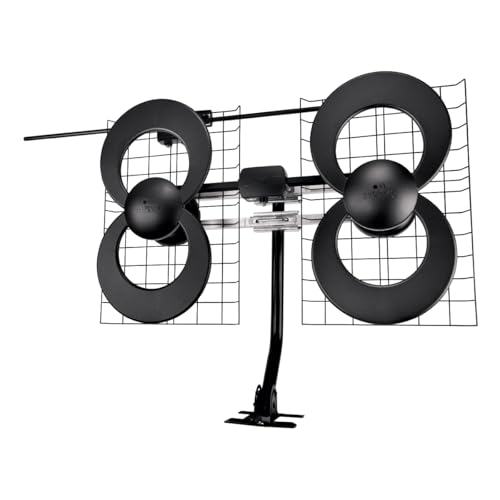
The ClearStream 4V takes the proven four-bay bowtie layout and adds what the UHF-only bowtie designs leave out: dedicated high-VHF elements, a reflector screen behind the array, and a 20-inch mast in the box, so the antenna arrives ready to mount rather than as a set of parts to complete. The bowtie elements handle UHF across a wide arc, the VHF elements cover the high-VHF stations that many markets still carry, and the reflector rejects signal arriving from behind, which steadies reception where reflections off buildings and terrain would otherwise smear the picture. For a household whose towers sit in more than one direction at genuine distance, that combination — wide acceptance plus real VHF coverage in one compact assembly — is the practical middle of this list.
Because the assembly is light and modest in size, it is also one of the easiest antennas here to raise high, and height, as the opening sections argued, is worth real gain. A 4V at the top of a tall mast will frequently outperform a larger antenna mounted low, which makes this model the thinking buyer's shortcut: spend the effort on the mast rather than the array. Its broad pattern is relatively forgiving of imperfect aim, tolerating the approximate pointing that a first-time installer working from a compass app will realistically achieve, and it tolerates the slow seasonal shift of reflected paths better than a narrow beam does. Pair it with a mast preamp only when the cable run or splitting demands it; in many mid-distance installations the antenna performs best with fewer components exposed to weather and nothing in the chain able to overload.
The limits are the limits of its size. Its peak gain sits below the big eight-bay bowtie and the long Yagis, so at the true fringe — weak signals, obstructed paths — it runs out of headroom sooner, and its low-VHF reception is not its brief: a market with a must-have station on real channels 2 through 6 should look at the Winegard below instead. Listings for this model also vary in configuration, with mast and amplifier bundles differing between offers, so the listing deserves a careful read before purchase. Within its brief, though, the 4V is the antenna most likely to be installed correctly by a homeowner working alone from a ladder — a virtue that never appears in a specification table but decides real outcomes on real roofs.
Strengths: four-bay bowtie plus dedicated high-VHF elements; reflector rejects rear interference; wide acceptance without a rotor; light enough to mount high easily; 20-inch mast included. Trade-offs: peak gain below the largest arrays and Yagis; low-VHF is not its brief; bundle configurations vary between listings; not the pick for the deepest fringe. Who it suits: buyers at forty-to-sixty-mile distances with towers in more than one direction and a mounting spot that favours a lighter antenna, so confirm which bundle configuration you are looking at when you check price on Amazon.
Check price on Amazon: Antennas Direct ClearStream 4V Outdoor TV Antenna

Winegard HD8200U: the deep-fringe traditionalist
The HD8200U is what long-range reception looked like before antennas became lifestyle products: a very long boom carrying dozens of elements, including the extended elements that low-VHF reception physically requires. If your market includes a station on real channels 2 through 6 at serious distance — and rural markets across the country still have them — this is the antenna class that receives it, full stop. Its published range reaches into the hundred-mile class under ideal conditions, and while that number deserves the scepticism this guide applies to all such claims, the hardware underneath it is real: maximum capture area, maximum directionality, and a front-to-back ratio that shrugs off interference from behind. This is the antenna for the farmhouse at the edge of two markets where nothing smaller has worked.
Ownership demands commitment. The antenna is big enough that shipping, assembly and raising it are two-person jobs, its wind load is the highest here, and it wants a mast and guys chosen accordingly. It is also resolutely single-direction: pointed at one cluster, everything outside its beam is refused, so a second market means a rotor or a second antenna. None of that is a flaw; it is the honest price of the deepest reach in this list. Buyers should also plan the preamp question carefully, because an antenna this capable in a mixed market can deliver one very strong station alongside the weak ones, and overload management becomes a real consideration rather than a theoretical one.
There is a secondary benefit to the traditional design that rarely appears in listings: repairability. A boom antenna is an assembly of elements, a balun and hardware, and individual parts can be replaced after storm damage with parts the maker still stocks, because the pattern has been in production for decades. Owners in lightning country should treat the balun and any preamp as sacrificial components and keep the ground block's connections clean, since at these signal levels a fraction of a dB lost to corrosion is a channel. The HD8200U also rewards a proper rotor more than any other pick here if a second cluster matters — its beam is too narrow to compromise, so turning it is the honest solution rather than splitting the difference on a heading that serves neither market well.
Strengths: the strongest low-VHF reception available in a consumer antenna; maximum gain and directionality; superb interference rejection; built for decades outdoors. Trade-offs: very large, heavy and demanding to install; strictly one direction at a time; highest wind load in the list; overkill for moderate distances. Who it suits: deep-fringe households with distant low-VHF stations and the roof, mast and patience to mount a serious structure, so price the mast and guy hardware into the project when you check price on Amazon.
Check price on Amazon: Winegard HD8200U Platinum Heavy-Duty Outdoor Yagi TV Antenna

Channel Master STEALTHtenna Elite 60: the discreet directional
The STEALTHtenna Elite 60 is Channel Master's answer to a different constraint: the household that needs a genuine outdoor antenna for a distant tower cluster but cannot, or will not, put a large structure on the roof. It is a compact, low-profile outdoor antenna covering UHF and VHF, built in the USA, with a shape designed to sit discreetly on an eave, a fascia or a short mast where a long-boom Yagi or a wide bowtie array would dominate the roofline. The 60 in its name marks its range class, and its design trades the peak gain of the largest antennas for a profile that mounting restrictions, a modest roof and a cautious household can all accept. For the buyer whose problem is one distant cluster in one direction, that trade is often the right one.
A compact directional antenna earns its keep by aiming well rather than by being large. Pointed at the tower cluster, the STEALTHtenna concentrates its reception forward and refuses much of what arrives from the sides and behind, which steadies the picture where a wide, unfocused antenna would collect interference along with the wanted signal. It rewards the same careful installation as any directional model — a compass heading from the tower locations, refined by watching the signal quality readout while a helper turns the antenna slowly — and it pairs naturally with a mast preamp when the cable run down from the roof is long. Its small size also makes it the easiest antenna in this list to raise to the very top of a mast, and at distance that extra height is frequently worth more than a larger antenna mounted lower.
The honest limits follow from the same compactness. A low-profile antenna cannot match the capture area of a long Yagi or an eight-bay array, so at the true fringe, where signals are weak and paths obstructed, it runs out of headroom sooner than the biggest picks here. Its low-VHF reach is limited by its element size, so a market with a must-have station on real channels 2 through 6 needs the Winegard instead, and the band check must happen before purchase, not after mounting. Within its brief, though — one distant cluster, a need for discretion, a mounting spot that punishes bulk — it is the most rational antenna here: no size wasted on a structure the roof cannot carry, and no performance wasted on directions nobody is watching.
Strengths: compact, low-profile outdoor design; covers UHF and VHF; discreet mounting suits restricted roofs; made in the USA; easy to raise high on a mast. Trade-offs: peak gain below the long Yagis and large arrays; low-VHF reach limited by element size; serves one direction; not the pick for the deepest fringe. Who it suits: households with one distant tower cluster and a mounting spot that favours a small, discreet antenna, so verify every station's real channel is covered before you check price on Amazon.
Check price on Amazon: Channel Master STEALTHtenna Elite 60 Outdoor TV Antenna

Televes DAT BOSS LR Mix: the self-adjusting option
Televes approaches long range as an electronics problem as much as an antenna problem. The DAT BOSS LR Mix is a long Yagi-style array whose built-in amplifier does not apply a fixed amount of gain; it measures the incoming signals and adjusts, boosting weak stations while restraining strong ones, which directly addresses the overload trap described earlier in this guide. It also filters aggressively above the television band, rejecting the LTE and 5G mobile signals that sit adjacent to modern UHF allocations and are a growing source of mysterious interference — a station that breaks up only when a phone is used nearby is a classic symptom. For markets where signal levels swing with weather and season, that self-regulation is worth more than a few extra elements.
The design covers UHF and high-VHF, which fits most mixed markets, though low-VHF remains outside its brief. The electronics that make it clever also make it dependent: the amplifier needs power supplied through the coax from an indoor unit, and a failure in that chain silences the antenna entirely, where a passive antenna degrades gracefully. It is the most expensive approach in this list relative to its physical size, and buyers in simple, stable, single-cluster markets will get the same pictures from a passive Yagi and a basic preamp for less money. Where it earns its place is the complicated installation — mixed strong and weak stations, mobile-signal interference, levels that drift — where its automation solves problems that otherwise need a professional's filter kit.
One detail separates this antenna's filtering from the cheap inline filters sold as cures: the filtering sits ahead of the amplification in the signal chain, so strong mobile signals are rejected before they can be amplified into the television band rather than after. That ordering is the technically correct one and a large part of why the model succeeds in suburbs where a new mobile mast has quietly degraded a previously stable installation. The housing and mount also reflect its broadcast-industry origins — sealed, rigid and indifferent to weather — which suits an antenna whose electronics cannot simply be swapped at the masthead by a casual owner. Buyers should confirm the power supply's placement in the coax run during planning, since it needs an indoor point between the antenna and any distribution splitting.
Strengths: automatic gain control balances strong and weak stations; strong built-in filtering of LTE and 5G interference; high published range class; covers UHF and high-VHF; respected European broadcast engineering. Trade-offs: no low-VHF; powered electronics add a failure point; premium pricing; less benefit in simple, stable markets. Who it suits: households with fluctuating signals, mixed station strengths or mobile-signal interference that a passive setup has not cured, so factor the power supply unit into the installation plan when you check price on Amazon.
Check price on Amazon: Televes DAT BOSS Mix LR 149884 HDTV Antenna
Five Star motorised rotating Yagi: range on a budget, with a rotor
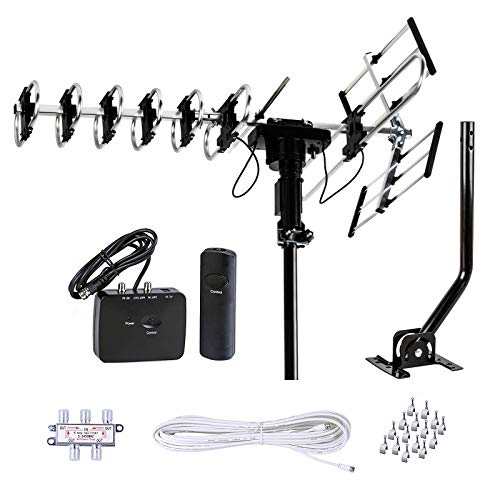
The budget end of long-range reception is dominated by one recurring design: a medium Yagi on a small motorised rotator, sold with an inline amplifier and advertised with the largest mileage numbers in the entire category. Judged by this guide's honest translation — treat the claim as a size class, not a promise — the hardware is a mid-size directional antenna that genuinely benefits from its one real advantage: it can turn. For a household between two tower clusters in opposite directions, a rotor converts one antenna into two, and the included remote makes the turn a couch-level operation rather than a roof-level one. As a first experiment in long-range reception, before committing to a premium array and mast, it has a legitimate role.
The cautions are equally concrete. The bundled amplifier applies generous fixed gain with no adjustment, which can overload tuners in mixed markets — the exact failure this guide warned about — and some owners end up removing it. The rotator is a small motor exposed to weather, and it is the component most likely to fail first; the elements and hardware are lighter than the premium picks and will not shrug off a decade of storms the same way. Published range figures for this class are the least conservative in the category. None of this makes it a bad purchase at its tier; it makes it a purchase to enter with calibrated expectations, ideally as a proof of concept that tells you your market's true difficulty before serious money goes onto the roof.
Used that way, the experiment is genuinely informative. If this antenna, raised as high as you can manage, locks every station you want from both directions, your market is easier than its distance suggests and a mid-priced fixed array will serve you for years. If it locks most stations but frays on the weakest, you have learned that your path needs real gain, and the Yagis above stop being luxuries and become the correct specification. Either way the lesson costs less than guessing wrong at the premium tier first, which is the most defensible reason this class of antenna continues to sell.
Strengths: motorised rotor serves towers in opposite directions; lowest cost of entry in this list; complete kit with amplifier and remote; reasonable mid-size directional hardware. Trade-offs: fixed high-gain amplifier can overload; rotator and hardware durability below premium picks; advertised range is optimistic; lighter build in storms. Who it suits: experimenters between two tower clusters who want to learn their market's difficulty before investing in a premium installation, so keep expectations set to the hardware rather than the box when you check price on Amazon.
Side by side: the six at a glance
The table below compares the six qualitatively, on the axes this guide has argued decide long-range reception: antenna type, the bands covered, how wide an arc each accepts, and the situation each is built for. It is a map of trades, not a ranking — the Winegard reaches furthest and forgives least; the bowtie reaches slightly less far and forgives almost everything about your geography.
| Antenna | Type | Bands | Arc | Built for |
|---|---|---|---|---|
| Channel Master EXTREMEtenna 80 | Eight-bay bowtie array | UHF + high-VHF | Very wide, splittable | Towers in two directions |
| Antennas Direct ClearStream 4V | Four-bay bowtie + VHF elements | UHF + high-VHF | Wide | Range with modest mounting |
| Winegard HD8200U | Long-boom Yagi | UHF + high/low-VHF | Narrow | Deepest fringe, low-VHF |
| Channel Master STEALTHtenna Elite 60 | Compact outdoor antenna | UHF + VHF | Moderate | One distant cluster, discreet mount |
| Televes DAT BOSS LR Mix | Amplified Yagi array | UHF + high-VHF | Narrow | Mixed, fluctuating signals |
| Five Star motorised Yagi | Yagi on rotator | UHF + high-VHF | Narrow, rotating | Two clusters, budget entry |
Read the bands column before any other. It eliminates more wrong purchases than every other specification combined: an antenna that does not cover your market's lowest band cannot be rescued by gain, amplification or optimism. If your towers are close enough that a smaller antenna is on your mind as well, the companion guide to antennas for local channels covers the indoor and compact end of the same decision.
Installation: where long-range reception is actually won
Ask antenna installers what separates success from failure at distance and most will say the same thing: the mast, not the antenna. Height buys clearance over the clutter layer — roofs, trees, neighbouring houses — that scatters and absorbs signal, and the improvement from raising an antenna ten feet routinely exceeds the difference between a mid-priced antenna and a premium one. Plan the highest practical mounting first, then choose the antenna the mounting can support. A telescoping mast or a chimney mount with proper straps will serve any pick in this list; the Winegard and the EXTREMEtenna additionally deserve guy wires or a tripod mount sized for their wind load.
Aiming deserves method rather than guesswork. Start from a compass heading calculated from your address and the tower locations, then refine by watching the signal quality readout — most televisions bury one in their settings menu — while a helper turns the antenna slowly. Quality, which reflects how clean the signal is, matters more than raw strength, and at the fringe the best heading is often a few degrees away from the map's prediction because reflections off terrain can favour a slightly offset aim. Tighten everything only after a full channel scan confirms every wanted station, in the evening if possible, since reception conditions shift across the day and a marginal station that locks at noon may vanish at night.
Grounding and weatherproofing close the job. Bond the mast and a coax ground block to the house ground, fit a drip loop where the cable enters, and seal the outdoor connector. Then write down what you installed — antenna heading, preamp setting, splitter arrangement — because the note will save an afternoon of rediscovery the first time anything changes, which, over a decade outdoors, it will.
The preamp decision, settled
Because amplification causes as many problems as it solves in this category, it deserves a direct summary. Add a mast preamp when the cable run is long — beyond roughly fifty feet — or when splitters divide the signal among several televisions, or when your weakest wanted station hovers at the edge of locking. Choose the least gain that stabilises that station, and prefer adjustable models in markets with mixed strengths. Skip the preamp, or switch it off, when a strong local station shares the sky with your distant targets and pictures break up in a pattern that worsens with amplification; that pattern is overload, and more gain is the opposite of the cure. And never stack a mast preamp and an indoor amplifier casually together — combined gain is the most common self-inflicted wound in home antenna systems. If your situation is rural in the broader sense rather than purely distant — mixed terrain, outbuildings, several households' worth of sets — the site's guide to antennas for rural areas works through those layouts in full.
A final diagnostic habit separates a well-judged preamp from a guessed one: change one variable at a time and write down the result. Fit the preamp, rescan, and note which stations improved, which degraded and which did not move; then, if a station degraded, try the lower gain setting or the filter before concluding anything. Ten minutes of notes at installation replaces hours of speculation later, because signal problems at distance are almost never caused by the component you suspect first — they are caused by the interaction you did not record.
Mistakes that undo good antennas
Believing the box. Planning an installation around an advertised maximum range guarantees disappointment; plan around terrain, height and the weakest station instead.
Skipping the band check. Mounting a UHF-only antenna in a market with a VHF station is the most expensive avoidable error in the category, and it is discovered, every time, after the ladder comes down.
Amplifying at the wrong end. A booster behind the television cannot recover signal already lost in the cable; amplification belongs at the mast or nowhere.
Mounting low to save effort. An antenna at gutter height works through the clutter the roof exists to clear. The mast is not an accessory; at distance it is half the system.
Ignoring the rotor question until later. If your towers genuinely sit in opposed directions, decide between a wide-arc array, a rotor and two antennas before buying, because retrofitting any of the three costs more than choosing correctly once.
Reading your terrain before you read a catalogue
The same antenna earns its keep or fails depending on the land between the roof and the tower, and a few minutes spent characterising that land is worth more than any single specification. Four terrain profiles cover most long-range households, and each one shifts the recommendation in this list in a different direction.
Flat and open. Farmland, plains and flat coastal plain are the kindest paths a signal can travel, and the only ones where published range figures approach honesty. Here the largest antennas genuinely deliver at the top of their class, a rotor rarely earns its complexity because towers tend to cluster in one city, and the main risk is the opposite of weakness — a strong signal that overloads an over-amplified system. A passive Yagi or the ClearStream 4V, mounted as high as practical, is usually the whole answer.
Rolling hills. Broken terrain is where long-range reception becomes an aiming exercise. A ridge directly in the path can block a signal entirely while a neighbour half a mile away, with a slightly different sight line, receives everything. Height matters more here than anywhere else, because a few extra feet of mast can clear a local rise that no gain figure can penetrate. Directional antennas earn their keep by rejecting the reflected signals that bounce off hillsides and arrive a fraction late, smearing the picture. Expect to experiment with heading in small increments, and expect one or two marginal stations to remain weather-dependent whatever you mount.
Forested. Trees are signal absorbers, and a mature tree line between house and tower costs more at UHF than at VHF, which is one reason VHF stations sometimes arrive more reliably through woods. An antenna that can be raised above the local canopy, or aimed through a genuine gap, transforms results; one buried below the tree line fights physics with one hand tied. Seasonal change is real in forested country — reception that is solid in winter, when the leaves are down, can fray in summer — and the honest plan is to size the installation for the worst season, with gain and height in reserve rather than at their limit.
Over water. A path across a lake or bay behaves unlike any other: signals can arrive startlingly well, sometimes from distances that would be impossible over land, and then fade with temperature and humidity shifts over the water. Households on shorelines often receive a second market across the water as a bonus and lose it on certain evenings as a frustration. A wide-arc antenna or a rotor suits this profile, because the prize stations may sit in genuinely different directions, and a degree of patience with marginal channels is part of the geography rather than a defect of the equipment.
Matching the antenna to your tower map
One cluster, fifty-plus miles. This is the cleanest problem in the category and the STEALTHtenna Elite 60's home ground: aim it precisely at the cluster, add a modest mast preamp for the cable run, and expect stable distant reception from a compact mount. The Televes joins the conversation only if interference or fluctuating levels complicate the picture.
Two clusters at an angle. Reach for the bowties. The EXTREMEtenna 80 with its panels split between the two headings is the strongest answer; the ClearStream 4V covers narrower angles with less hardware. A single Yagi, however good, will serve one cluster and refuse the other, and discovering that after installation is the classic long-range disappointment.
A low-VHF station you refuse to lose. The decision is made for you: a full-size antenna with genuine low-VHF elements, which in this list means the Winegard HD8200U and the mast to carry it. No amplifier, filter or clever electronics substitutes for element length at those wavelengths.
Mixed strengths — one strong local, several weak distant. This is the overload profile, and it punishes generous amplification. Either choose the Televes and let its automatic gain balance the sky, or run a passive antenna with the least preamp gain that stabilises the weak stations, accepting that the strong one needs no help and resents it.
Opposed clusters and a tight budget. The motorised Five Star exists for this map: one antenna, two directions, a remote on the coffee table. Enter it as an experiment, learn what your market truly delivers in each direction, and let that knowledge govern any later upgrade to fixed premium hardware.
Ownership across a decade: drift, weather and small maintenance
A long-range installation is not finished when the first scan succeeds; it is merely proven. Reception at distance lives close to the edge by definition, so small degradations that a city viewer would never notice — a corroding connector adding loss, a splitter swapped during a furniture rearrangement, a tree that has grown six feet into the path — announce themselves as one channel quietly becoming unreliable. An annual habit covers most of it: a walk-around look at the mast and guys each spring, a check that the outdoor connector's seal is intact, and a fresh channel scan after any storm violent enough to move things. Antennas rarely fail outright outdoors; they fade, and fading is correctable when it is caught as a maintenance item rather than misdiagnosed as a reason to buy a different antenna.
Troubleshooting drift follows a fixed order that saves money. First, confirm the problem is reception at all — swap in a different television or tuner on the same cable before touching the roof. Second, inspect the cheap links: connectors, splitters, the preamp's power supply, which fails more often than any antenna. Third, check aim, because a mast that has twisted a few degrees in a gale mimics a dying antenna exactly. Only after those three should the antenna itself be suspected, and by then the written installation notes — heading, gain setting, splitter layout — turn the roof work from archaeology into adjustment. The households that keep distant stations for a decade are not the ones with the most expensive arrays; they are the ones who treat the installation as a small system worth an hour a year.
Frequently asked questions
How far can an outdoor antenna really reach?
Under average terrain, a full-size outdoor antenna mounted high delivers reliable reception in the forty-to-seventy-mile range, and the largest deep-fringe models do better where the path is flat and clear. Advertised figures beyond that assume ideal conditions. Hills, dense tree cover and a tower below your horizon shorten real range far more than antenna choice lengthens it, which is why height and aim usually matter more than the model.
Do I need a rotor?
Only if your wanted towers sit in directions too far apart for one fixed antenna's arc and a wide bowtie array cannot cover both. Many markets cluster their towers on one site, making a rotor unnecessary. Where two clusters genuinely oppose each other, the choices are a rotor, a splittable array such as the EXTREMEtenna 80 aimed in halves, or two antennas combined — in roughly that order of simplicity.
Will a bigger amplifier fix my weakest channel?
Not if the antenna is not capturing the signal in the first place, and not if the problem is overload from a strong station nearby — in that case more gain makes the break-up worse. Amplification compensates for cable and splitter losses after the antenna has done its work. If a channel is absent rather than weak, the fixes are height, aim, or an antenna shaped for that station's band.
What is the difference between real and virtual channels, and why does it matter?
The number on your television screen is a virtual label; the station actually broadcasts on a real channel frequency, often a completely different number, and the real channel decides which band — and therefore what size of antenna — you need. A station displaying as channel 8 might broadcast on real channel 8 (high-VHF) or on a UHF frequency. Look up real channels for your market before choosing an antenna.
Can one antenna feed every television in the house?
Yes, with attention to splitting losses. Each split divides the signal, so a house feeding four sets from a distant antenna typically pairs a mast preamp with a distribution amplifier and good cable. The antenna and its aim stay the same; the distribution hardware is sized to the number of sets, and unused splitter outputs should be terminated rather than left open.
The last word
Distance rewards the buyer who respects it: check your bands, plot your towers, mount as high as the roof allows, amplify sparingly and at the mast, and the far stations stop being a rumour and become part of the evening.


