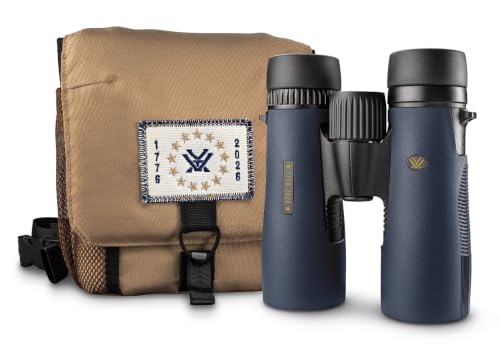
A binocular that lives on a boat works a harder shift than almost any other piece of glass. It gets used one-handed at a pitching helm, in spray that would send a land instrument back into its case, at dawn and dusk when the light over the water is at its weakest and the channel markers matter most. It has to read a buoy number from a deck that will not hold still, pick a harbour entrance out of a grey shoreline, and survive being dropped on fibreglass, soaked in salt water, and left in a cockpit locker between outings. Ordinary binoculars, however good their optics, are not built around those jobs, and the differences are structural rather than cosmetic.
Kaju and Douglas may earn an affiliate commission when you buy through links on this page. That commission funds the research behind guides like this one and never changes the price you pay. Every pick below was selected from the manufacturer’s own marine catalogue and documentation, and every specification quoted here — magnification, sealing, focus system, compass fitting, flotation behaviour — is a documented figure or feature from the maker rather than a claim copied from a retail listing.
That is why all six picks in this guide share the same basic shape: 7×50, waterproof, and built for the marine environment. Seven-power magnification with a 50 mm objective is not a tradition the industry keeps out of habit; it is the configuration that the physics of a moving deck rewards, and the first section below explains why in detail. Within that shared shape, though, the six models divide along lines that matter. Some carry a compass with a rangefinding reticle and some are plain glass. Some focus with a centre wheel, some focus at each eyepiece, and two of them use Steiner’s focus-once system. And they divide most honestly on the question nobody asks until it is too late: what happens when the binocular goes over the side. One of these six floats on its own. One floats with the strap it ships with. The other four sink, and need a floating strap bought and fitted before the day they are dropped.
Readers who know this site from its land-based optics coverage will notice what this guide deliberately leaves out. There is no discussion of camouflage finishes, of dawn performance in woodland, of carrying weight over a full day on foot — the criteria that drive a hunting shortlist answer a different set of problems. Aboard a boat, weight carried all day is a minor concern next to weight that steadies the view; a finish that disappears against bark is worthless next to armour that survives a knock against a winch. The marine criteria below — sealing against salt water, stability at low magnification, compass work, flotation, and eye relief behind sunglasses — are the whole basis of the ranking.
What to look for in binoculars for boating
Why 7×50 is the marine standard
Every pick in this guide is a 7×50, and that uniformity is the first buying lesson. Magnification multiplies everything, including movement: at ten power, the roll of a small boat is magnified ten times in the eyepiece, and the image swims so much that reading a distant marker becomes a fight against the glass itself. At seven power the same roll is present but manageable, and a braced elbow or a hand on the companionway steadies the view enough to actually use it. The trade is reach, and on the water reach matters less than landlubbers expect — the targets are buoys, headlands, harbour entrances and other vessels, all of them large, most of them charted, and all of them approached rather than stalked.
The 50 mm objective earns its size at the ends of the day. Dividing objective diameter by magnification gives the exit pupil, the width of the light beam that reaches the eye, and 50 divided by 7 gives roughly 7.1 mm — about as wide as a dark-adapted human pupil opens. That is why a 7×50 feels bright at first light and in the last grey half-hour before dark, the exact hours when boats are leaving and entering harbour and when an unlit marker is hardest to find. A 7×42, the common land configuration, delivers a 6 mm exit pupil and a visibly dimmer dawn image; a 10×50 keeps the glass but loses the stability. The 7×50 sits at the intersection, and the marine market has standardised on it for good reason.
Sealing, nitrogen and salt
Waterproof on a marine binocular means more than surviving rain. Spray on an open boat arrives driven, salty and repeated, and it works into every seam over a season. The construction that answers it is a sealed body purged and filled with dry nitrogen: the gas fill keeps internal moisture out, which is what stops the inside of the lenses fogging when cold glass meets warm, wet air below deck. Every pick here is sealed and nitrogen-filled or equivalently purged to that standard, because a binocular that fogs internally on a boat is not an inconvenience — it is finished until it can be serviced, and there is no servicing halfway across an estuary.
The outside of the instrument needs the same seriousness. Salt is corrosive and abrasive, and it attacks focus mechanisms, hinge barrels and exposed metalwork across a season of use. Rubber armouring, standard across this shortlist, does three jobs at once: it seals the body against knocks on deck hardware, it gives wet hands something to hold, and it keeps salt water off the structure underneath. The ownership habit that follows from all of this is simple and appears again in the care section below: rinse the salt off under a tap after a wet day, because no sealing system was designed to store salt against the body indefinitely.
Compass and rangefinding reticle
Four of the six picks carry a built-in compass, and it is worth understanding what that compass is actually for before deciding whether to pay for one. A marine compass binocular projects the bearing into the field of view, so the user reads the compass heading of the object in the centre of the image without lowering the glass. That turns the binocular into a position-fixing tool: take bearings on two charted landmarks, plot the lines, and the boat’s position sits where they cross. It is equally useful defensively — the bearing of an approaching vessel that stays constant while its size grows is the classic sign of a collision course, and a compass binocular is the fastest way to check it.
Most compass models pair the compass with a rangefinding reticle, a graduated scale in the view that measures the angular height of an object. If the height of a lighthouse, a masthead or a headland feature is known from the chart, the angle it subtends converts to distance off — a genuinely useful number when judging an approach in poor visibility. Two practical notes apply across the compass picks. The compass needs illumination for night bearings, which on these models is a battery-powered light, so the battery is a consumable to check before a passage. And Nikon’s entry below uses a global compass, compensated to read correctly in both northern and southern hemispheres, where standard compasses are balanced for one hemisphere and drag or misread in the other — a detail that only matters to sailors who cross the equator, and matters a great deal to them.
Distance off: putting the reticle to work
The reticle deserves a worked example, because it is the feature buyers most often pay for without ever learning. The scale in the eyepiece is graduated in mils, and the relationship it exploits is simple: an object one unit tall at a thousand units of distance subtends one mil. Charts and light lists publish the heights of the things a sailor actually looks at — a lighthouse’s focal height, the air draught of a bridge, the masthead height classes of shipping. Read the number of mils the object fills on the reticle, divide its known height by that figure, and the quotient, scaled by a thousand, is the distance off in the same units as the height. A light structure listed at thirty metres that fills ten mils on the scale is three thousand metres away; filling fifteen mils, it is two thousand.
Used once, that is a curiosity. Used as a habit, it changes how an approach feels: the distance to a harbour entrance stops being guesswork and becomes a number that shrinks at a measurable rate, cross-checked against the plotter rather than believed instead of it. The same reticle, held vertically against a vessel, gives a rough check on whether a ship is showing its side or its bow. None of this requires the top-priced instrument — the Bushnell and Fujinon below carry reticles alongside the Steiner and Nikon — but it does require the user to learn the one division sum, and a compass binocular bought by a skipper who never learns it is a plain binocular carrying extra weight.
Flotation: the honest three tiers
Binoculars go overboard. It happens at every level of sailing, usually during the busiest moment of the day, and the difference between an expensive loss and an embarrassing recovery is decided entirely by buoyancy. This guide separates the six picks into three tiers and keeps them separate, because the marine market blurs them in ways that cost people instruments. The first tier floats by itself: the body is buoyant, and dropped in the water it rides on the surface waiting to be retrieved. Exactly one pick here, the Barska Floatmaster, is built that way. The second tier floats with its strap: the Fujinon below is supplied with a flotation strap that keeps the instrument at the surface, and it only earns that description with the strap fitted.
The third tier is everything else, and it includes the other four picks, among them the most expensive instruments in this guide. A premium sealed binocular is dense — glass, prisms and a filled body — and it sinks promptly and permanently. The answer is a floating strap, a wide buoyant neck strap sold as an accessory by Steiner, Nikon and others, fitted before the first outing rather than after the first loss. It is the cheapest insurance in this entire category and the most commonly skipped. However a binocular is carried, the working rule is the same: on deck, the strap is around a neck or the instrument is in a hand or a locker, because a binocular resting loose on a cockpit seat is a binocular already halfway over the side.
Focus systems: centre, individual, and focus-once
Three different focusing philosophies appear in this shortlist, and choosing between them is the most personal decision in the guide. Centre focus, on the Nikon and the Bushnell, uses a single wheel between the barrels plus a diopter adjustment on one eyepiece. It is the system most people already know: fast to refocus from a nearby buoy to the horizon and back, easy to share between crew members with different eyes, and the natural choice when the glass passes from hand to hand. Its weakness on a boat is that the wheel invites constant small adjustments, and a wet glove on a focus wheel at the moment the boat rolls is a good way to lose the target entirely.
Individual focus, on the Fujinon and the Barska, sets each eyepiece separately and then leaves it. Once dialled in for one user’s eyes, everything from a few dozen metres to the horizon is acceptably sharp with no further touching, which makes it the traditional marine system: pick it up, look, put it down. The cost is speed at close range and shareability — handing an individually focused binocular to a crew member with different eyesight means handing them a blur until they set both eyepieces themselves. Steiner’s Sports-Auto-Focus, on both Steiner picks, is the refined version of the same idea: the user sets each eyepiece once for their own eyes, and the optics are designed to hold focus from roughly twenty yards to infinity without further adjustment. For a helm binocular that lives at distance work, it is arguably the most practical system of the three; for a family boat where four people share one glass, centre focus earns its keep.
Eye relief and glasses at the helm
Eye relief is the distance behind the eyepiece at which the full field of view is visible, and on a boat it matters more than on land because so many helmsmen wear sunglasses. Short eye relief forces a glasses wearer to press the eyecups against their lenses or accept a tunnel view with the edges cut off; generous eye relief lets the full picture sit comfortably behind sunglasses or prescription frames. The Nikon below makes this its headline virtue, with the longest eye relief in the group, documented by Nikon at over twenty millimetres, and fold-down or twist-up eyecups across the shortlist let each user set the distance their eyewear needs.
The practical check is simple. A buyer who wears glasses or sunglasses at the helm should treat eye relief as a first-order specification, on the same level as sealing, because a binocular that cannot be used behind sunglasses will be left below deck on the bright, hazy days when glare makes it most necessary. A buyer who never wears eyewear can deprioritise it and choose on compass, focus and flotation instead. Either way, eyecups that stay where they are set — rather than collapsing under the pressure of a face braced against the boat’s motion — are worth more than their modest billing in a specification table.
Field of view, prisms and coatings
Three quieter specifications shape what the view through a marine binocular actually feels like. The first is field of view: the width of water visible at a standard distance. A wide field is a working feature at sea, not a luxury, because the commonest binocular task is not examining a known object but finding one — sweeping for a small buoy in a chop, or picking a returning tender out of a crowded anchorage. Every extra degree of field is water that does not have to be searched twice, and the 7×50 format is generous here by nature, with the picks below offering broad, easily searched views rather than the narrow tunnels of high-magnification land glass.
The second is the prism system. All six picks use porro prisms, the traditional offset design, and the marine category keeps it for practical reasons: porro construction delivers strong depth perception — the separation of the objective lenses makes near and far traffic easier to sort by eye — in a wide body that gives two hands a secure hold. The better instruments specify BaK-4 prism glass, which keeps the edges of the field cleaner and brighter; where a maker does not specify it, that silence is itself information about the instrument’s position in its range. The third is coatings. Sun glitter off water is the harshest light any binocular faces, and the multi-coatings on the better picks exist to keep contrast alive when the whole scene is glare: a buoy’s colour, a hull’s movement, a swimmer’s head. This is the area where the guide’s price ladder is most honestly visible — the flagship coatings hold a picture together at noon in a glitter field that visibly flattens the view through the simplest glass here.
Handling on a moving deck
The last criterion is the least specifiable and, underway, one of the most felt. A marine binocular is used braced: elbows on knees in the cockpit, a shoulder against the mast, one hand for the boat and one for the glass. Weight cuts both ways — a heavier instrument damps its own shake and feels steadier in a seaway, up to the point where holding it up through a long look at a distant mark becomes tiring. The picks here cluster in the broad band the category has settled on, roughly nine hundred grams to a little over a kilogram, with the lightest being the polycarbonate-bodied Fujinon and the heaviest the big armoured Steiners. Grip matters as much as grams: deep rubber armouring, a shape that fills cold or wet hands, and controls that can be found by feel, because nobody looks down at a binocular to operate it.
In this guide
The six picks at a glance
The table below compresses the differences that decide this category. Every row is a 7×50 waterproof marine binocular; what separates them is the focus system, the compass, and what happens in the water.
| Model | Focus system | Compass | In the water | Best for |
|---|---|---|---|---|
| Steiner Navigator 7×50 with Compass | Sports-Auto-Focus, set once | Yes, illuminated, with reticle | Sinks — needs a floating strap | Serious navigation from the helm |
| Steiner Marine 7×50 | Sports-Auto-Focus, set once | No | Sinks — needs a floating strap | Steiner sealing without the compass cost |
| Nikon OceanPro 7×50 CF WP Global Compass | Centre focus | Yes, global, with reticle | Sinks — needs a floating strap | Glasses wearers; ocean-crossing compass work |
| Fujinon Mariner 7×50 WPC-XL | Individual focus | Yes, with reticle | Floats with its supplied strap | Light weight plus compass plus recovery |
| Bushnell Marine 7×50 with Compass | Centre focus | Yes, illuminated, with reticle | Sinks — needs a floating strap | Compass features at the friendlier end |
| Barska Floatmaster 7×50 | Individual focus | No | Floats by itself | A second glass that can be fished back |
The best binoculars for boating

Top pick
1. Steiner Navigator 7×50 with Compass: the helm instrument
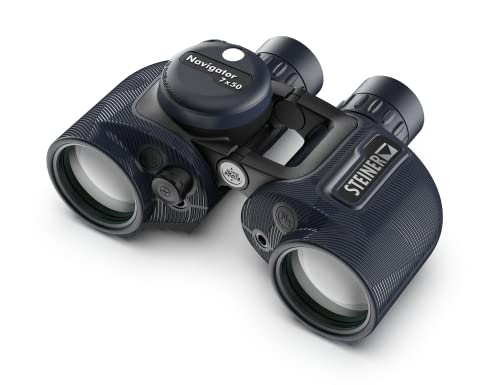
The Navigator is the binocular Steiner builds specifically for navigation work, and it sits at the top of this guide because it combines the two features a helm instrument most needs: a proper illuminated compass with a rangefinding reticle, and a focus system that removes focusing from the user’s workload entirely. Steiner’s Sports-Auto-Focus asks the user to set each eyepiece once, for their own eyes, after which the view stays sharp from about twenty yards to the horizon with nothing further to touch. On a moving deck that is a profound practical advantage. There is no wheel to hunt for with a wet hand, no refocusing as a buoy approaches, and nothing to knock out of adjustment when the glass is grabbed quickly. The compass sits in the view with its bearing readable against whatever the binocular is pointed at, lit for night work, and the reticle scale beside it turns charted heights into distances off.
Two pieces of Steiner construction deserve naming because they explain the instrument’s reputation for surviving boats. The prisms are mounted in a floating prism system, suspended so that shock travels around the optical train rather than through it, which is why these instruments tolerate drops onto hard decks that would knock lesser binoculars out of collimation. And the body is sealed and nitrogen-filled, with the maker’s high-contrast optical coatings tuned for the flat, glare-heavy light that comes off water. What the Navigator is not is buoyant: it is a dense, armoured instrument, and it sinks. A floating strap is not an optional garnish for this binocular; it is part of the purchase.
In practice, the Navigator changes the rhythm of a watch. Bearings become something taken in the same motion as looking: raise the glass, centre the mark, read the number off the compass card in the view, note it, lower the glass. There is no second instrument to fetch and no transferring a hand bearing compass’s reading from a lubber line to a landmark after the fact. On a night approach, with the compass lit and the reticle available, the instrument covers the full traditional workflow — identify the light, take its bearing, estimate the distance off from its charted height — without the navigator leaving the helm position or asking for a torch. That completeness, more than any single specification, is what the flagship position in the range is buying.
Strengths: focus-once operation that suits distance work at the helm; illuminated compass with rangefinding reticle for bearings and distance-off; floating prism mount built to absorb deck shocks; sealed, nitrogen-filled body with marine armouring. Trade-offs: the most expensive instrument in this guide; heavy in the hand on a long watch; individual eye settings make it slower to share between crew with different eyesight; sinks if dropped overboard, so the floating strap is a mandatory extra. Who it suits: skippers and navigators who actually take bearings, run in poor visibility, and want one serious instrument that lives at the helm and asks nothing of them underway. If the boat gets navigated rather than merely driven, this is the glass to build the habit around, so it is worth taking a moment to check price on Amazon.

2. Steiner Marine 7×50: the same discipline without the compass
The Steiner Marine is the Navigator’s plainer sibling, and understanding it is mostly a matter of understanding what has been left off. There is no compass and no reticle. What remains is the core of the design: the same 7×50 configuration, the same Sports-Auto-Focus system set once per eyepiece and then forgotten, the same sealed and nitrogen-filled construction, and deep rubber armouring over a body built to be knocked about. Steiner positions this model as the entry point to its marine line, and that framing is accurate — it is the instrument for a buyer who has decided the compass is not a tool they will use and would rather not pay for it, carry its battery, or have its housing in the optical path.
That decision deserves a fair hearing rather than a sales pitch for the dearer model. A great deal of real boating — daysailing in home waters, harbour-hopping along a familiar coast, fishing grounds the skipper has known for years — involves almost no bearing-taking, because the navigation is done by eye, by chart plotter, and by local knowledge. For that use, the compass in the Navigator is an instrument that will be carried for seasons without being switched on, while the qualities that get used every outing are the sealing, the focus-free view, and the toughness, all of which this model keeps. The honest counterweight is resale of attention: a skipper whose ambitions grow into night passages or unfamiliar coasts will start wanting bearings, and at that point the plainer glass becomes the boat’s second binocular rather than its first.
There is also an ownership argument that suits this model particularly well. With nothing electronic aboard — no compass, no illuminator, no battery — there is nothing to check, nothing to corrode at a contact, and nothing to discover dead at the start of a night passage. The instrument asks for a rinse, a dry locker and its strap, and repays that minimal care with the longest plausible service life in this guide. It is the version of the design most often found in charter fleets and sailing school boats for exactly that reason: it tolerates being everyone’s binocular, set to no one in particular’s eyes, grabbed by whoever is on watch. A private owner who is the boat’s only real helm gets the same durability with the focus set once, properly, for their own eyes.
Strengths: the same focus-once Sports-Auto-Focus and sealed construction as the flagship at a lower position in the range; tough, deeply armoured body; nothing electronic to maintain, no compass battery to find dead before a passage. Trade-offs: no compass and no reticle, so no bearing or distance-off work; sinks without a floating strap, which remains a necessary accessory; like its sibling, the per-eye settings make quick sharing between crew less seamless than a centre wheel. Who it suits: daysailors, anglers and home-water cruisers who want Steiner build and focus-free glass and know their navigation does not call for a compass. For that buyer, the simpler instrument is not the lesser one — it is the one to check price on Amazon.

3. Nikon OceanPro 7×50 CF WP Global Compass: the glasses wearer’s compass glass
The OceanPro is Nikon’s dedicated marine binocular, and it makes two claims none of the other compass picks can match. The first is in the name: the compass is global, compensated to give true readings in both the northern and southern hemispheres. A conventional marine compass is balanced for one hemisphere and will drag, stick or misread in the other, which is a footnote for most sailors and a genuine problem for the ones delivering boats across the equator or chartering in the southern oceans. The second claim is eye relief. Nikon documents this model with the longest eye relief in the group, and the difference is not marginal on the water: behind sunglasses, the full field of view stays visible without pressing the eyecups into the lenses, which is precisely the condition a helm binocular spends its life in.
Against the Steiners, the OceanPro takes the opposite side of the focus argument. It is a centre-focus instrument — the CF in its name — with a single wheel that runs the focus for both eyes and a diopter correction for the difference between them. For a shared boat glass that is the pragmatic choice: anyone can pick it up, roll the wheel, and see clearly within seconds, and refocusing between the bow and the horizon is instant. The compass carries a rangefinding reticle and an illuminator for night bearings, the body is waterproof and fogproof with a rubber-armoured shell, and the whole instrument has the slightly more conventional, less military feel of Nikon’s sporting optics rather than Steiner’s deck-equipment character. It sinks, like the Steiners; Nikon’s floating strap exists for exactly this instrument class and should be fitted from day one.
The eye relief point deserves one more paragraph, because it decides more real purchases than the compass does. A helm watch in bright weather is worked in sunglasses, and a binocular with short eye relief presents the glasses wearer with a choice between pressing eyecups against expensive lenses or accepting a keyholed view with the edges — often including the compass card — cut off. The OceanPro’s documented relief is long enough that neither compromise is necessary, and its eyecups set the distance positively rather than collapsing under the pressure of a braced face. For a buyer who wears prescription glasses full-time, this is not a comfort feature; it is the difference between a binocular that gets used on every watch and one that migrates below deck by midsummer.
Strengths: global compass that reads in both hemispheres; longest documented eye relief here, a real advantage behind sunglasses; centre focus that any crew member can use instantly; compass with reticle and illumination for night and poor-visibility work. Trade-offs: centre focus means a wheel to manage with wet hands where the focus-once designs ask for nothing; the compass illumination depends on a battery; it sinks without a floating strap; the global compass is wasted money for a sailor who will never leave their home hemisphere. Who it suits: glasses and sunglasses wearers first of all, shared-crew boats second, and the small band of sailors whose water crosses the equator third. If that long eye relief sounds like the answer to a familiar frustration, it is worth a moment to check price on Amazon.

4. Fujinon Mariner 7×50 WPC-XL: compass, light weight, and a way back
Fujinon comes to marine optics from the professional end of the binocular world, and the Mariner WPC-XL is the company’s working boat glass: a 7×50 with a built-in compass and rangefinding reticle, individual focus at each eyepiece, and a polycarbonate body that makes it the lightest instrument in this guide at a little over nine hundred grams. That weight matters more than a specification table suggests. A binocular held up through a long, careful look at a distant entrance mark is a binocular whose shake grows with the user’s fatigue, and the Mariner’s lighter body buys steadiness late in the look that heavier glass spends early. The individual focus system suits the same philosophy: set each eyepiece once, and the instrument is ready at any distance every time it is lifted, with no wheel to touch.
The Mariner also holds the middle position in this guide’s flotation tiers, and its position needs stating exactly. The binocular is supplied with a flotation strap, and with that strap fitted it floats — dropped over the side, it stays at the surface to be recovered. Without the strap, it does not; the buoyancy lives in the strap, not the body. That is a better arrangement than the four picks here that sink in all configurations, and a less foolproof one than a body that floats bare, because it depends on the strap being attached, which on a well-run boat it always is. Fujinon’s version codes deserve care at buying time, and the note in the sources file matters: the WPC-XL is the compass model, while the similarly named WP-XL is the same glass without the compass.
The polycarbonate body behind the light weight deserves a word in its own defence, because it is sometimes read as a economy measure. On a working boat it behaves more like a considered material choice: it does not corrode, it shrugs off the knocks that would dent a metal shell, and it keeps the instrument’s mass low enough that a smaller or older crew member can hold it steady through a long look. Fujinon’s marine line has supplied professional and military users for decades on the strength of its optical quality, and the Mariner carries that heritage into the pleasure-boat market at the weight of a hardback book. For a singlehander who steers with one hand and looks with the other, that combination of lightness and set-once focus is the most usable arrangement in this guide.
Strengths: compass with reticle in the lightest body here; individual focus that stays set; floats with its supplied strap, a tier of protection only one other pick betters; Fujinon’s coatings and build have a strong reputation in working marine use. Trade-offs: flotation depends on the strap being fitted; individual focus is slow to hand to a crew member with different eyes; the lighter body gives up some of the shake-damping mass of the heaviest picks in a rough seaway; the compass is a standard single-hemisphere unit. Who it suits: smaller-boat sailors, singlehanders and anyone who has already watched something valuable sink — the combination of compass, low weight and recoverability is unique in this list, so it is a natural one to check price on Amazon.

5. Bushnell Marine 7×50 with Compass: the compass features at a friendlier position
Bushnell’s Marine takes the full compass-binocular feature set — compass with rangefinding reticle, illumination for night bearings, centre focus, waterproof and fogproof construction — and delivers it at the most accessible position in this guide’s compass group. That positioning defines the pick. The skipper who wants to take bearings, check a closing vessel’s heading, and estimate distance off a headland, but who cannot justify the Steiner or Nikon end of the shelf for a boat used a dozen weekends a year, is exactly the buyer this model is built for. The optics are honest marine glass: BaK-4 porro prisms, multi-coated lenses, and a rubber-armoured body sealed against spray and purged against fogging.
The compromises sit where the positioning predicts. The build is sturdy rather than heirloom; the armouring, hinge and focus mechanism do their jobs without the over-engineered feel of the German and Japanese flagships, and the optical refinement — edge clarity, coating sophistication — is a step behind the leaders rather than level with them. None of that prevents the instrument doing every job in the criteria section: it seals, it focuses quickly at the centre wheel, its compass reads and lights, and its reticle measures. It sinks, as all but two of these picks do, and Bushnell’s own floating strap or any equivalent is the standard answer. Buyers should note the range also includes a plain version without the compass; the pick here is specifically the compass model, and the distinction is the entire point of the recommendation.
One practical detail separates a compass binocular that gets used at night from one that does not, and the Bushnell handles it properly: the compass illumination is there for the hours when bearings matter most, on the approach to an unfamiliar harbour after dark. A buyer new to the feature should know its housekeeping — the light runs on a small battery, the battery is a consumable, and the check belongs on the pre-season list next to torch batteries and flare dates. None of that diminishes the value on offer; it simply means the friendliest-priced compass in the guide asks for the same small discipline as the dearest one, and rewards it with the same capability.
Strengths: the complete compass and reticle feature set at the friendliest position in the group; centre focus that suits shared use; sealed, fogproof, armoured construction that covers the marine fundamentals without qualification. Trade-offs: optical refinement and build finish sit a step below the Steiner and Nikon flagships; the compass illumination runs on a battery; it sinks without a floating strap; the non-compass sibling in the same range is easy to buy by mistake. Who it suits: weekend sailors and fishing crews who want real compass capability without flagship money, and families equipping a boat where the glass will be shared and occasionally mistreated. For a compass binocular at this end of the shelf, this is the obvious place to check price on Amazon.

6. Barska Floatmaster 7×50: the one that comes back
The Floatmaster is built around a single idea, executed without apology: it floats. Not with a strap, not with an accessory — the binocular itself is buoyant, sealed inside a bright yellow rubber-armoured body that is close to impossible to lose sight of against grey water. Every other quality of the instrument is subordinate to that one, and the pick only makes sense once that is understood. The optics are the simplest in this guide, the focus is set at each eyepiece in the traditional marine manner, there is no compass, and the whole instrument is aimed at the jobs where survival matters more than refinement: the tender, the fishing skiff, the charter boat, the grab-and-go glass that lives by the companionway of a bigger boat whose crew would rather recover a dropped binocular than fill in an insurance form.
Judged as a primary navigation instrument, the Floatmaster would be the wrong recommendation, and this guide does not make it. Judged as a second binocular, it has no rival here, because the scenario it answers — glass overboard, in the water, visible, recoverable — is the single most common way marine binoculars actually die. There is also a training argument in its favour: it is the binocular to hand to children, guests and new crew, the people most likely to drop one and least likely to be handed the Steiner. Its yellow shell is easy to spot in a locker, easy to spot in the water, and easy to spot in the hands of the person who was supposed to put it back. Sometimes the most seaworthy feature an instrument can have is being findable.
Its honest limitations belong in the open. The view is the least refined here: at the edges of a bright, glittering scene the image gives up the contrast and crispness the flagship coatings preserve, and at dawn the simpler glass gathers a visibly plainer picture than the big Steiners. A skipper doing serious pilotage should not make it their only instrument. But that framing undersells what the Floatmaster is for. Most binocular use on most boats is not pilotage; it is looking — at the anchorage, at the weather coming, at the dinghy, at the interesting boat two moorings over — and for that daily work a tough, floating, always-at-hand glass gets used ten times as often as the fine instrument its owner is afraid to hand out.
Strengths: floats by itself, the only pick here that does; bright yellow body that stays visible on deck and on the water; sealed waterproof construction; simple individual focus with nothing electronic to fail; the least expensive instrument in the guide. Trade-offs: no compass or reticle; optical quality is the most basic here and does not reward long, careful looking the way the flagships do; individual focus slows sharing; the styling is purely functional. Who it suits: anyone equipping a tender or a small open boat, charter and training fleets, and owners of a fine primary glass who want a loaner that can survive its borrowers. As the binocular that gets fished back out of the harbour instead of written off, it earns its place — check price on Amazon.
Keeping marine glass alive
Marine binoculars rarely die in dramatic moments; they die by accumulation, and the habits that prevent it are cheap. Salt is the main agent. After a wet day, rinse the instrument under a gentle tap of fresh water — every pick here is sealed well enough for that to be safe — and let it dry before it goes back in its case, because a sealed case around a damp, salty binocular is a corrosion chamber. Lens cleaning on a boat means blowing or rinsing grit away before any cloth touches the glass: salt crystals dragged across a coating by a well-meaning sleeve will mark it permanently. Below deck, store the glass out of direct sun and away from the heat of an engine space; cockpit lockers in summer reach temperatures that age seals and lubricants faster than any use at sea.
Two consumables deserve a place on the boat’s checklist alongside the flares and the impeller. The compass illumination battery, on the four compass picks, should be checked before any passage where night bearings might be needed and replaced on suspicion rather than on failure. And the strap — floating where the design calls for it — should be inspected like any other piece of safety equipment: a perished strap that parts as the binocular goes over the side converts a recoverable accident into a total loss. None of this is onerous. It is the same standard of care the boat itself gets, applied to the one instrument that spends its life in the worst of the weather.
One binocular or two?
The shortlist above quietly argues for a strategy many experienced skippers adopt: a primary instrument chosen for optical and navigational quality, and a cheap, buoyant second glass for the tender, the guests and the grab-and-go moments. The Floatmaster exists in this guide largely to fill the second role, and pairing it with any of the other five is a more seaworthy arrangement than owning one mid-priced binocular and using it for everything. Readers whose time afield splits between the water and the woods should note the criteria genuinely do not transfer — the qualities that make a binocular right for a boat make it heavy, plain and over-sealed for a day on foot, and our guide to best binoculars for hunting binoculars for hunting works through the land-based side of that divide. And for readers fitting out a chart table rather than a cockpit, the same site’s guide to best gaming keyboards for pc Corsair PC cases covers the compact shore-side machines that run routing and weather software.
Frequently asked questions
Why do marine binoculars use 7×50 instead of higher magnification?
Because a boat moves. Magnification multiplies the apparent motion of the boat along with the size of the target, and at ten power or above the image through a handheld binocular on a small vessel swims too much to read a buoy number or a name board. Seven power keeps the view usable from an unsteady deck, and the 50 mm objective returns an exit pupil of about 7.1 mm, matching a dark-adapted eye and keeping the image bright at dawn and dusk. The combination is a settled standard because the physics has not changed.
Do I really need the compass version?
Only if the navigation will use it. A compass binocular earns its price when bearings are actually taken: fixing a position from two landmarks, checking whether an approaching vessel’s bearing is steady, or picking a transit in poor visibility. A skipper whose sailing is pilotage in familiar water, in daylight, with a plotter doing the formal navigation, will carry the compass for years without switching it on, and the plain versions of these instruments — the Steiner Marine is the clearest example — keep everything else that matters. Buy the compass for a kind of sailing, not for a specification sheet.
What is the difference between floating and a floating strap?
It is the difference between the instrument and an accessory doing the work. A floating binocular, represented here only by the Barska Floatmaster, is buoyant in its own body and rides on the surface bare. A floating strap is a wide, buoyant neck strap that keeps an ordinary binocular afloat — effective, but only when it is fitted and in good condition. The Fujinon in this guide ships with its flotation strap as part of the package; the Steiner, Nikon and Bushnell picks need one bought separately, and fitting it on the day the binocular is bought is the habit that makes the system work.
Can I use my hunting or general-purpose binoculars on the boat?
They will work, in the sense that any binocular shows a magnified image, and many boaters start exactly there. The mismatches accumulate rather than announce themselves: magnification chosen for land is usually too high for a moving deck, sealing on a sporting instrument is built for rain rather than driven salt spray, there is no compass for bearing work, and if the glass goes over the side it sinks without discussion. A waterproof 7×50 kept for occasional fair-weather use is a reasonable compromise; a non-waterproof instrument, or one that represents real money, is being risked in an environment it was not built for.
How should binoculars be cleaned after a day in salt spray?
Rinse first, wipe second, and never reverse the order. Hold the instrument under a gentle stream of fresh water to float salt and grit off the lenses and body, shake off the excess, and let it air-dry or pat it with a clean, soft cloth. Only then, if a lens still needs attention, use a proper lens cloth with the lightest possible pressure. Salt is abrasive, and the single most common way marine binoculars are damaged at home is a dry wipe that drags crystals across the coatings. Store the glass dry, uncased or in a ventilated case, out of direct heat.
The bottom line
Six instruments, one configuration, and a ranking that turns on three questions: whether the sailing involves real bearing work, whose eyes and hands the glass must fit, and what happens on the worst day rather than the average one. The Steiner Navigator is the complete helm instrument for a skipper who navigates; the Nikon OceanPro answers it with a global compass and the friendliest eye relief here; the Fujinon Mariner adds recoverability and low weight; the Bushnell Marine brings the compass feature set within reach of ordinary weekends; the Steiner Marine strips the formula back to sealing and focus-free glass; and the Barska Floatmaster guarantees the one outcome no other pick can. Choose by the sailing, fit the floating strap before the first outing, and the binocular bought this season should still be at the helm when the boat’s electronics have been replaced twice over.