As an Amazon Associate, this site may earn an affiliate commission from qualifying purchases made through links on this page, at no extra cost to you.
The best rechargeable AAA batteries, at a glance
A drawer full of dead alkaline AAA batteries is a quiet tax on modern life. Remotes, wireless mice, wall clocks, bathroom scales, flashlights, game controllers, and half the toys in a family home all run on the same small cylinder, and the alkaline habit means buying the same cells again and again, throwing them away, and discovering the one device you actually need is blinking its low-battery warning at the worst possible moment. Rechargeable AAA batteries change that arithmetic completely. A good set can be charged hundreds of times, holds its charge on the shelf for months, and over its life replaces a small mountain of disposables. The catch is that not all rechargeables behave the same way: a low self-discharge nickel-metal hydride cell, a high-capacity NiMH, and a lithium cell with a built-in voltage regulator are three different tools that happen to share a size, and choosing the wrong one for the job is how people conclude that rechargeables are disappointing.
This guide compares six real options across the two main chemistries, tested against the way people actually use AAA cells: in remotes that sip power for a year, in toys and flashlights that drain a set in an afternoon, in clocks and sensors that punish any battery that self-discharges, and in households where the charger matters almost as much as the cells. Every pick below is presented in prose only, with no printed prices — prices for batteries move constantly, so each review ends with a prompt to check the current listing — and no fixed ratings, because a battery’s value is in how it holds up over hundreds of cycles, not in a score. What follows is the practical detail: which chemistry fits which device, what capacity figures actually mean, how many cycles you can reasonably expect, and which cells to buy first if you are replacing a whole drawer of disposables.
In this guide
Quick comparison: the six picks at a glance
| Pick | Chemistry | Best for | Standout trait |
|---|---|---|---|
| Panasonic eneloop AAA | NiMH, low self-discharge | Everyday devices, remotes, clocks | Holds charge for years on the shelf; the most charge cycles |
| Amazon Basics AAA Rechargeable | NiMH, low self-discharge | Budget households replacing many cells | Low cost per cell with honest, steady performance |
| EBL AAA Rechargeable | NiMH, high capacity | Toys, flashlights, high-drain gadgets | Highest capacity of the NiMH picks for long runtimes |
| Energizer Recharge AAA | NiMH, low self-discharge | Mixed households, first-time switchers | Widely available, easy to find everywhere |
| Duracell Rechargeable AAA | NiMH, low self-discharge | Low-drain devices left in place for months | Very long shelf life between charges |
| Paleblue AAA USB-C | Lithium 1.5V, USB-C charging | Devices that need a full 1.5 volts | Constant 1.5V output and charges from any USB-C cable |
What to look for in rechargeable AAA batteries
NiMH or lithium: the chemistry decision comes first
Most rechargeable AAA batteries are nickel-metal hydride, or NiMH. A NiMH cell delivers about 1.2 volts under load, slightly less than the 1.5 volts of an alkaline, and in practice almost every modern device is designed around that difference — remotes, clocks, mice, and toys all work fine at 1.2 volts. NiMH cells are cheap, proven, and can be recharged hundreds or even thousands of times. The newer alternative is a lithium AAA with a small circuit inside that steps its native voltage down to a steady 1.5 volts. That constant voltage matters in a handful of devices: some blood pressure monitors, older cameras, and certain toys with motors check the voltage and refuse to start if it reads low, and a few gadgets behave erratically as a NiMH cell’s voltage slowly falls. Lithium cells also charge over USB-C in many designs, which removes the need for a separate charger entirely. The trade-off is cost per cell, typically several times higher than NiMH, and a lower total energy in some designs because part of the cell’s volume is taken up by the regulator circuit. For most households, NiMH is the right default, and lithium is the specialist pick for the one or two devices that are fussy about voltage.
Low self-discharge matters more than the headline capacity
Two numbers compete for attention on a battery package, and only one of them predicts daily satisfaction. The first is capacity, printed in milliamp-hours, or mAh: a higher number means more energy in the cell. The second is self-discharge — how fast the battery empties itself while sitting unused — and for the way AAA batteries are actually used, it is usually the more important of the two. An old-style NiMH cell could lose a large share of its charge within weeks on a shelf, which is why early rechargeables earned a reputation for being dead when you needed them. Modern low self-discharge NiMH cells, the category Panasonic’s eneloop line made famous, retain most of their charge for a year or longer. That single property is what makes rechargeables practical for remotes and clocks: the battery you charged in January is still ready in June. A high-capacity cell that self-discharges quickly is a poor choice for a remote, however impressive its mAh figure looks, while a moderate-capacity low self-discharge cell is the right one. Pay attention to whether a product describes itself as pre-charged, ready to use, or low self-discharge — those phrases signal the modern chemistry you want.
What capacity figures really mean
AAA NiMH cells typically fall between about 750 and 1,100 mAh. A remote control might draw so little current that even a 750 mAh cell lasts a year, while a bright flashlight or a motorised toy can drain the highest-capacity cell in an afternoon. Capacity also interacts with the device: a high-drain device benefits from a high-capacity cell, but only if the cell can deliver its energy at that drain rate without its voltage sagging. There is also a quiet trade-off between capacity and cycle life — the highest-capacity NiMH cells often survive fewer charge cycles than moderate-capacity ones, because packing more active material into the same small cylinder leaves less margin. For a household, the practical approach is to keep two groups: moderate-capacity, long-life cells for remotes, clocks, and sensors, and high-capacity cells for toys, flashlights, and anything with a motor. Buying one type for everything is a false economy either way.
Charge cycles and the real cost per use
A rechargeable battery’s price only makes sense when divided by the number of times you will charge it. A NiMH cell that survives 500 cycles costs a fraction of a cent per use even at a premium price, while a disposable that costs a few dozen cents is spent forever after one use. Manufacturers quote cycle counts that assume gentle, partial discharges and careful charging, so treat the headline number as an upper bound rather than a promise. In practice, a good NiMH cell in household use will give years of service before its capacity fades noticeably, and the decline is gradual — the cell simply holds a little less each year, rather than failing suddenly. The practical habits that extend life are simple: do not leave cells in a hot car, do not mix old and new cells in the same device, and use a charger that stops when the cell is full rather than one that keeps trickling current indefinitely. A smart charger that charges each slot independently and shows when a cell is done is one of the best companion purchases in this category.
The charger matters as much as the cells
Batteries are only half the system. A basic charger that charges cells in pairs, with a fixed timer, will overcharge a half-full cell and undercharge a nearly empty one, and over time that uneven treatment shortens the life of the whole set. A better charger monitors each slot independently, charges at a sensible rate, and cuts off when the cell is full. Some chargers also offer a refresh or discharge mode that can revive cells that have sat unused for a long time. Lithium USB-C cells sidestep the question entirely, since each cell has its own charging port and can be topped up from a phone charger or a laptop, but they need a USB-C cable per cell or a shared cable and a little patience. Whichever route you take, label your sets — a simple rotation of two sets per device, one in use and one charged and waiting, is the system that keeps a household running without ever buying disposables again.
The best rechargeable AAA batteries, reviewed

Top pick
1. Panasonic eneloop AAA: the low self-discharge benchmark for everyday devices
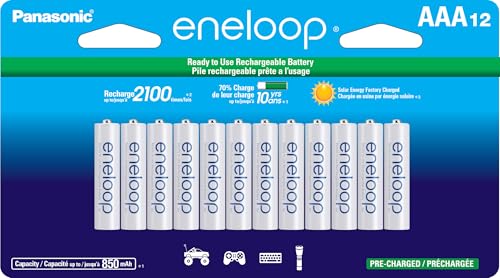
If there is a single battery that defines what a modern rechargeable AAA should be, it is the Panasonic eneloop. The eneloop line was built around one idea: a rechargeable cell that behaves like a disposable on the shelf, holding its charge for years instead of weeks, while still surviving hundreds of charge cycles. In a remote control, a wall clock, a wireless mouse, or a bathroom scale, that combination is exactly what you want — the device works the first time you pick it up, months after you last thought about it, and when the cell finally runs down you recharge it instead of throwing it away. The capacity is moderate rather than headline-grabbing, and that is a deliberate trade: eneloop cells trade a little capacity for a very long cycle life and the best shelf retention in the category.
Strengths: The shelf life is the headline. A charged eneloop kept in a drawer still has most of its charge a year later, and a meaningful share even after several years, which makes it the cell to buy for low-drain devices that sit untouched for months. Cycle life is equally strong: these are the cells most often quoted as surviving well over a thousand gentle cycles, and in household use they tend to outlast the devices they power. They arrive pre-charged and ready to use, work in ordinary NiMH chargers, and perform consistently in cold conditions better than many rivals, which matters for the torch in a car glovebox or the sensor in a cold hallway. The quality control is also a real, if unglamorous, advantage: eneloop cells in a pack behave alike, so a set of four drains evenly and no single weak cell drags the group down.
Trade-offs: Capacity is the compromise. At roughly 750 mAh in the standard version, an eneloop holds less energy than the highest-capacity NiMH cells, so in a high-drain toy or a bright flashlight it will need recharging sooner. There is a higher-capacity Pro variant, but it trades away some cycle life and shelf retention to get there, so the standard cell is the better default for most people. The price per cell is also higher than budget brands, and the premium is real if you are buying twenty or thirty cells at once to convert a whole household. Counterfeits are a known nuisance with popular brands, so buying from a reputable listing matters more here than with an obscure brand nobody bothers to copy.
Who it suits: Households replacing disposables across many low-drain devices, anyone who wants to charge a set and forget it for months, and buyers who would rather pay more once than replace cells often. It is the right first purchase for someone switching to rechargeables, and the right cell for the remote, the clock, and the mouse. If your main use is a single high-drain toy that eats batteries in an afternoon, pair it with a high-capacity pick from this list instead. To see the current listing and available pack sizes, check price on Amazon.

2. Amazon Basics AAA Rechargeable: the budget workhorse for whole-household switching
Switching a household to rechargeables is a bulk purchase — a dozen or two dozen cells at once, not a single four-pack — and that is where the Amazon Basics rechargeable AAA earns its place. It is a low self-discharge NiMH cell with a moderate capacity, built to the same practical formula as the premium options: charged and ready to use, holding its charge on the shelf, and rechargeable hundreds of times. The difference is the price per cell, which is low enough that outfitting every remote, clock, and toy in the house stops feeling like a project and starts feeling like a single shopping trip. For the buyer whose goal is to stop buying disposables entirely, that low unit cost is the feature that matters.
Strengths: The value is straightforward: you get modern low self-discharge behaviour at a fraction of the cost of the premium brands, and in low-drain devices the day-to-day experience is nearly indistinguishable — the remote works, the clock keeps time, and the cell is still charged months later. The cells are widely stocked and easy to reorder, which matters when you want to expand a set later and keep everything the same brand for consistent behaviour. They charge in any standard NiMH charger, and the packaging is practical, with cells sold in the larger packs a household conversion actually needs. For toys and other medium-drain uses they are perfectly competent, and the money saved against premium cells can go towards a better charger, which improves the whole system more than a fancier cell would.
Trade-offs: Capacity sits at the moderate end of the range, so high-drain devices will drain these sooner than a high-capacity cell. Cycle life is respectable but not class-leading, and the cells tend to show their age a little earlier than the premium options after a few years of heavy use. Quality control is good but not quite as tight as the benchmark brands, so in a set of four you may occasionally find one cell that fades faster than its siblings — a minor nuisance that a smart charger with individual slots will reveal early. They are also, plainly, unglamorous: there is no high-capacity variant and no special cold-weather claim, just a solid, ordinary cell.
Who it suits: Anyone converting a whole house at once, families with many battery-powered toys, renters and students who want the savings without the premium price, and buyers who need a large stock of cells for low-drain devices. It is the best pick if the budget is the deciding factor and the devices are mostly remotes, clocks, and mice. If you need maximum runtime in a flashlight or a motorised toy, look at the high-capacity pick below. For current availability and pack sizes, check price on Amazon.

3. EBL AAA Rechargeable: the high-capacity choice for toys and flashlights
Some devices do not sip power; they gulp it. A motorised toy, a bright LED flashlight, a handheld game controller, or a remote-controlled car will drain a moderate-capacity cell in an afternoon, and in those devices the number that matters most is capacity. EBL’s AAA rechargeable is the high-capacity NiMH pick in this guide, offering roughly 1,100 mAh — around half as much energy again as a standard low self-discharge cell — and that extra energy translates directly into longer play sessions and longer runtimes before the next charge. EBL has built its reputation in this category on value: high-capacity cells sold in large packs, often bundled with a charger, aimed squarely at households with children and their battery-hungry toys.
Strengths: Runtime is the point, and it delivers: in high-drain use, the gap between this cell and a moderate-capacity one is immediately obvious, and fewer mid-afternoon battery swaps is a genuine quality-of-life improvement for parents. The price per unit of energy is excellent, especially in the larger packs, and the cells are sold in the quantities a toy-heavy household actually needs. They work in standard NiMH chargers, and EBL’s own bundled chargers are serviceable for a first setup. For flashlights, the higher capacity also means a longer stretch at full brightness before the light starts to dim.
Trade-offs: The capacity comes with the usual trade: higher-capacity NiMH cells tend to have shorter cycle lives and faster self-discharge than moderate-capacity low self-discharge cells, so these are a poor choice for a remote that sits untouched for months — they may be flat when you finally need them. The quality control is less consistent than the premium brands, so it pays to check a new pack in a smart charger and mark any cell that behaves differently from its siblings. The branding and packaging are utilitarian, and the claimed capacity should be treated as an approximate figure; real-world runtime varies with the device and the charger. These are workhorse cells, not precision instruments.
Who it suits: Families with battery-hungry toys, flashlight users, anyone with a high-drain gadget that eats cells quickly, and buyers who want maximum runtime per charge and accept recharging more often. It is the right cell for the toy box and the torch drawer. For low-drain devices like remotes and clocks, pair it with a low self-discharge pick instead. To confirm the latest pack options and charger bundles, check price on Amazon.

4. Energizer Recharge AAA: the easy-to-find pick for first-time switchers
For many households, the best rechargeable battery is the one they can actually buy without thinking about it — on the shelf at the supermarket, at the pharmacy, or in the same order as everything else. Energizer’s Recharge AAA is that cell: a low self-discharge NiMH from the most widely distributed battery brand in the world, available almost everywhere batteries are sold, in sensible pack sizes, with a charger often sold alongside. That ubiquity is a genuine feature. When you need four more cells on a Sunday evening, or you want to buy the same cells again in two years and have them behave identically, a brand that is everywhere has an advantage that a niche specialist cannot match.
Strengths: Availability is the headline, and it is backed by solid fundamentals: the cells are low self-discharge, pre-charged and ready to use, and hold their charge well on the shelf. Capacity is moderate and honest, suited to the low- and medium-drain devices that make up most of a household’s AAA use. The brand’s chargers are straightforward and widely sold, which makes the first switch simple — buy the cells and the charger together, charge once, and the system is running. Because the cells are so common, replacing a lost or damaged cell with an identical one is trivial, and mixed-age sets are less of a problem than with a brand that disappears from shelves.
Trade-offs: There is nothing here that leads the category on any single measure. Capacity is moderate, cycle life is good rather than exceptional, and the price per cell sits in the middle — more than the budget brands, less than the premium ones. The range of pack sizes is narrower than the specialists, and there is no high-capacity variant aimed at heavy toy use. In a high-drain device, these cells will need recharging noticeably sooner than the high-capacity pick above. None of that is a flaw; it is the profile of a generalist, and a generalist is exactly what a first-time switcher needs.
Who it suits: First-time switchers who want a no-fuss start, households that buy batteries in the same weekly shop, anyone who values being able to replace a cell quickly, and mixed households where one cell type has to cover remotes, clocks, mice, and the odd toy. It is the safe default when you do not want to research the category. If you later find one device that drains cells unusually fast, add a high-capacity set for that device alone. To see current pack sizes and charger bundles, check price on Amazon.

5. Duracell Rechargeable AAA: the long-shelf-life pick for devices left in place
Some batteries live in devices you almost never think about: the wall clock in the hallway, the remote for the guest-room television, the weather station sensor, the bathroom scale, the emergency flashlight in the drawer. For those devices, the most important property of a battery is not how much energy it holds but how long it holds it — and Duracell’s rechargeable AAA is built around that priority, with a low self-discharge design that keeps a charged cell ready for years. It is the cell for the device you install and then ignore, confident that when you finally reach for it, it will still work.
Strengths: Shelf retention is the standout: these cells are designed to stay charged for a very long time, and in low-drain devices they deliver the closest experience to a disposable that you simply replace once a year — except that you recharge them instead. Capacity is moderate and adequate for the low-drain role, and the cells are pre-charged, so they work straight out of the pack. Duracell’s distribution is as broad as Energizer’s, so replacements are easy to find, and the cells are consistent from pack to pack. In cold conditions they hold up reasonably well, which suits the sensor in a garage or the torch in a car.
Trade-offs: Like other low self-discharge cells, capacity is moderate, so high-drain devices will drain these quickly. The price per cell is at the higher end for a NiMH, and the brand charges for its name; the budget picks deliver similar everyday performance for less. There is no high-capacity variant, and the cells are not the best choice for a household that wants one type for everything — they are specialists in patience, not in power. Cycle life is good but not the longest in this guide.
Who it suits: Devices that sit unused for months, second homes and guest rooms, emergency kits, clocks, sensors, and anyone whose main complaint about rechargeables has always been that they are flat when needed. It is also a good choice for older relatives’ devices, where the priority is that things simply work. For toys and flashlights, use a high-capacity cell instead. For the latest listing and pack configurations, check price on Amazon.

6. Paleblue AAA USB-C: the lithium pick for devices that need a full 1.5 volts
Every so often, a device refuses to cooperate with NiMH. A blood pressure monitor flashes a low-battery warning on fresh rechargeables; a toy’s motor runs sluggishly; an older camera complains before it has taken a single picture. The cause is voltage: NiMH cells deliver about 1.2 volts, and a few devices are designed around the 1.5 volts of an alkaline and check for it. The Paleblue AAA is the lithium answer. Inside each cell is a small regulator that holds the output at a steady 1.5 volts from full to nearly empty, so the device sees exactly what it expects — and, as a bonus, the cell charges through a USB-C port built into its side, so any phone charger, laptop, or power bank becomes the charger. No separate charging dock is needed at all.
Strengths: The constant 1.5-volt output is the reason to buy these, and it solves a real class of problems that NiMH cannot: fussy monitors, voltage-sensitive toys, and devices that report low battery prematurely. The USB-C charging is genuinely convenient — plug the cell into a cable for an hour or two and it is full, with a small indicator light showing when charging is done. Because the voltage stays flat until the cell is nearly empty, devices behave consistently throughout the discharge instead of gradually slowing down. The cells are also light, perform well in the cold, and hold their charge on the shelf for a long time.
Trade-offs: Cost per cell is several times higher than NiMH, so these are not the cells to buy by the dozen for every remote in the house. Total energy can be lower than a high-capacity NiMH in some designs, because part of the cell’s volume is taken up by the regulator circuit, so in a high-drain toy a lithium cell may actually run for less time than a big NiMH. The voltage also drops off a cliff at the end — the device works perfectly and then stops suddenly, with little warning. And the USB-C port means charging one cell at a time per cable, which is slower to manage for a large set than dropping four cells into a dock. Finally, these cells must not be charged in an ordinary NiMH charger; the USB-C port is the only way in.
Who it suits: The one or two devices in a home that misbehave on NiMH, travellers who want to charge from a laptop or power bank without carrying a dock, and anyone whose blood pressure monitor or camera insists on full voltage. It is a specialist, not a generalist — buy a small set for the fussy devices and use NiMH everywhere else. To check current availability and pack options, check price on Amazon.
NiMH versus lithium: choosing the right chemistry for each device
The chemistry question confuses people because both types are sold as “rechargeable AAA” and look identical, yet they behave differently in ways that matter. A NiMH cell starts near 1.4 volts fresh off the charger and settles to about 1.2 volts for most of its discharge, declining gradually. Most devices are designed for that curve — they were built in a world where rechargeables existed, and their low-battery warnings are calibrated accordingly. A lithium cell with a regulator holds 1.5 volts flat, then cuts out. The flat line is better for devices that check voltage, and worse for devices that rely on a gradual voltage decline to warn you before the battery dies: a lithium-powered device can go from working perfectly to dead with no warning at all.
Energy is the other axis. A high-capacity NiMH AAA holds roughly 1,100 mAh at 1.2 volts, which is about 1.3 watt-hours of energy. A lithium AAA typically holds less total energy, because the regulator circuit and the protection electronics take up space inside the same small cylinder, and because a lithium cell’s energy is partly spent running its own electronics. In a high-drain device, that means the NiMH cell may run longer despite its lower voltage. In a low-drain device, the lithium cell’s shelf life and steady voltage can make it the better experience even with less total energy. There is no single winner; there is a right tool for each device.
The practical household answer is a mixed system. Use NiMH for the great majority of devices — remotes, clocks, mice, scales, toys, flashlights — and keep a small set of lithium cells for the one or two devices that are fussy about voltage. Mark the lithium cells clearly, perhaps with a coloured dot or a separate small case, so nobody drops them into an ordinary NiMH charger by mistake. The cost works out well this way: the expensive cells go only where their advantage is real, and the cheap, long-lived NiMH cells do everything else. If you are starting from scratch, buy NiMH first and add lithium only if a specific device complains — most households never need the lithium set at all, and those that do usually discover it through a single misbehaving gadget.
Charging, storage, and the habits that make rechargeables last
The difference between a rechargeable set that lasts three years and one that lasts ten is mostly habit. The first habit is the charger. A smart charger that monitors each slot separately, charges at a moderate rate, and stops when the cell is full will treat your cells well; a cheap timer-based charger that charges in pairs will overcharge some cells and undercharge others, and over time that uneven treatment is what kills sets. Look for a charger that shows the state of each slot, and if it offers a discharge or refresh mode, use it occasionally on cells that have sat unused for a long time — it can recover capacity that looks lost.
The second habit is rotation. Keep two sets for the devices you use most: one in the device, one charged and waiting. When the first set runs down, swap and recharge at your leisure, rather than waiting for a device to die at an inconvenient moment. Label the sets with the month you started using them, or with a simple number, so you can tell at a glance which set is older and retire it when its runtime has clearly faded. Mixing old and new cells in the same device is the one mistake to avoid: the weakest cell in the group limits the whole set, and a weak cell can even be driven into reverse by its stronger siblings, which damages it permanently.
The third habit is storage. Rechargeables prefer a cool, dry place, partly charged rather than fully flat or fully charged, and away from heat — the glovebox of a car in summer is the worst place in a house for a battery. If you are storing cells for months, charge them to about half and check them every few months. A cell that has sat for a year may need a full charge and a discharge cycle before it shows its true capacity again; that is normal and not a sign of failure. Finally, keep a small number of disposable alkalines in the house as a backup for the rare emergency — a power cut, a charger left at a hotel, a device that needs batteries right now — but treat them as the exception, not the routine.
Which battery for which device
Remotes and clocks are the easiest win. They draw almost nothing, so even a moderate-capacity low self-discharge NiMH will last a year or more, and the cell’s shelf life matters far more than its capacity. This is eneloop and Duracell territory, and a single set per device, swapped once a year, is the entire maintenance routine. Wireless mice and keyboards are similar, though a mouse used eight hours a day drains faster; a low self-discharge cell is still the right choice, and keeping a charged spare in the desk drawer removes the only real annoyance.
Toys and flashlights are the opposite: they drain quickly and reward capacity. This is where the high-capacity EBL cells earn their keep, and where a smart charger with a refresh mode pays for itself, because toy batteries get charged often and unevenly. Game controllers sit in the middle — a controller drains steadily during play but rests for days between sessions, so a low self-discharge cell with moderate capacity is usually the best compromise, and the ability to swap in a charged set mid-game is worth more than a little extra capacity.
Health devices deserve care. Blood pressure monitors, thermometers, and some medical devices are the most likely to be fussy about voltage, and they are also the devices where a false low-battery reading is more than an annoyance. If a monitor complains on fresh NiMH cells, try the lithium pick before assuming the device is faulty — and if the device’s manual specifies alkaline or lithium cells only, follow the manual. Wall clocks, sensors, and weather stations are the long-shelf-life case: a cell that holds its charge for years is worth more than a cell with a bigger capacity number.
Mistakes that shorten a rechargeable battery’s life
Most rechargeable batteries die young because of avoidable habits, not because the chemistry is flawed. The first mistake is the charger. A timer-based charger that charges cells in pairs, for a fixed number of hours regardless of how full they were, is the single most common killer of rechargeable sets. It overcharges the half-full cell and undercharges the nearly empty one, and over months the overcharged cell loses capacity while the undercharged one never reaches its full potential. A smart charger that monitors each slot independently costs little more and pays for itself in the first year simply by keeping cells alive longer. If your charger has no display and no per-slot indicator, it is worth replacing before you blame the batteries.
The second mistake is mixing. Mixing old and new cells in the same device means the oldest, weakest cell limits the whole set, and in a device that draws hard it can be driven into reverse polarity by its stronger siblings, which damages it permanently. Mixing brands in one device is nearly as bad, because different brands have different capacities and discharge curves even when they claim the same mAh. The rule is simple and absolute: buy sets together, use them together, charge them together, and retire them together. Marking each set with a number or a coloured dot makes this easy, and a small storage case that holds sets in groups of four is one of the cheapest accessories in this category.
The third mistake is heat. Batteries age faster when hot, and the worst places in a house for a battery are the ones people actually put them: on top of a radiator, in a car glovebox in summer, next to a sunny window, or in a drawer above the oven. A cell stored at high temperature loses capacity permanently, and a cell charged while hot — for example, immediately after heavy use in a flashlight — degrades faster than one allowed to cool first. The fix is undramatic: store cells at room temperature, let hot cells cool before charging, and keep the charger somewhere ventilated rather than buried under a pile of cables.
The fourth mistake is the opposite of the first three: neglecting cells that sit unused. A NiMH cell left flat for a year may not recover fully, and a cell left in a device that slowly drains it — a clock with a failing movement, a toy with a stuck button — can be discharged so deeply that a smart charger refuses to recognise it. The remedy is a routine: once a month, check the devices you rarely use, and once every few months, top up the spare set in the drawer. A charger with a refresh or discharge mode can often revive a cell that looks dead, running it through a full discharge and recharge cycle that breaks down the crystal growth inside an aged cell. Not every neglected cell comes back, but many do, and the attempt costs nothing but time.
The fifth mistake is buying the wrong chemistry for the job and then concluding that rechargeables do not work. A high-capacity cell in a remote will self-discharge before the remote needs it; a low-capacity cell in a toy will need recharging every afternoon; a NiMH cell in a voltage-fussy monitor will trigger false low-battery warnings. None of these is a failure of the battery — each is a mismatch between the tool and the task. The six picks in this guide exist precisely because there is no single best cell, only the best cell for a particular device, and matching them deliberately is what turns a drawer of disappointing batteries into a system that quietly works for years.
Building your first rechargeable kit: a practical shopping list
Starting from zero, the kit that covers a typical household is smaller than people expect. Begin with the cells themselves: two four-packs of a low self-discharge NiMH for the remotes, clocks, and mice — eight cells covers most homes, with a spare set in rotation — plus one four-pack of high-capacity NiMH for the toys and the flashlight. That is twelve cells, and it is enough to convert the devices you touch every day. Add a four-pack of lithium USB-C cells only if you already know of a device that misbehaves on NiMH; otherwise, wait until one complains, because many households never need them at all.
The charger is the second purchase and the one that matters most. Choose a smart charger with four independent slots, a display or indicator per slot, and a refresh mode. Avoid chargers that charge only in pairs or that have a single light for all four slots — they cannot tell you when an individual cell is done, and they cannot reveal the weak cell in a set. If the charger also handles AA cells, so much the better: most households use both sizes, and one good charger for both is more useful than two mediocre ones. A charger with a USB power input is convenient for travel, since it can run from a laptop or a power bank, but a mains-powered charger is fine for a home that never moves it.
The third part of the kit is organisation, and it costs almost nothing: a small case or box with labelled compartments for each set, a marker to date the sets when you buy them, and a place for the charged spares that everyone in the house knows about. The system fails when the charged spares are scattered through drawers and nobody knows which cells are full. A single labelled box — “charged”, “to charge”, “retired” — turns battery management from a chore into a thirty-second habit, and it is what keeps the system running after the novelty of the first month wears off.
Finally, decide what to do with the disposables you already own. Use them up in the devices that genuinely need them — the smoke alarm backup, the rarely used emergency radio — and do not buy more. As each disposable dies, replace it with a rechargeable from your kit rather than buying another pack of alkalines. Within a few months, the conversion is complete without a single large purchase, and the money you would have spent on disposables stays in your pocket. The environmental benefit is real, but for most people the practical benefit matters more: the batteries are always there, always charged, and the drawer full of dead alkalines is gone for good. One last piece of advice for new buyers: resist the urge to buy the cheapest cells in the largest pack on the first day. Start with the two sets described above, live with them for a month, and let the devices you actually own tell you what to buy next. The remote that never needs attention confirms the low self-discharge choice; the toy that drains its set by lunchtime tells you to add capacity; the monitor that flashes a warning on fresh cells tells you to buy lithium. A kit built from that evidence, rather than from a single bulk order, is the one that still works well three years later.
best d link router for cameras
the best usb c keyboards
Frequently asked questions
Can rechargeable AAA batteries really replace alkaline in every device?
Almost every device, yes, with two exceptions. The first is a device that specifically requires 1.5 volts and misbehaves on a NiMH cell’s 1.2 volts — a small number of monitors, older cameras, and some motorised toys. For those, a lithium 1.5V cell is the answer. The second is a device that will sit unused for years, such as a smoke alarm backup or a rarely used emergency radio, where a disposable alkaline or a primary lithium cell with a decade of shelf life is the safer choice. Everything else — remotes, clocks, mice, toys, flashlights, controllers — runs happily on rechargeables, and the savings over the life of a set are large.
How many times can I really recharge a NiMH AAA battery?
Manufacturers quote figures from a few hundred to over two thousand cycles, and the honest answer is that it depends on how you treat them. Gentle use — partial discharges, a good charger that stops when full, storage at room temperature — gets you towards the upper end. Heavy use, a cheap timer charger, and heat will shorten life noticeably. In practice, most households get several years from a set before the capacity has faded enough to notice, and the decline is gradual rather than sudden. The practical test is runtime: when a set that used to last a month in a device now lasts a week, it is time to retire it to low-drain duty or recycle it.
Why does one battery in a set always seem to die first?
Because no two cells are perfectly identical, and the weakest cell in a set reaches empty first — and then, if the device keeps drawing current, its stronger siblings can push current backwards through it, damaging it. This is why sets should be bought together, used together, charged together, and retired together, and why a smart charger that shows each slot separately is so useful: it reveals the weak cell before it causes trouble. Marking sets and keeping them together from the day you buy them is the simplest habit in this whole guide, and the one most people skip.
Is it safe to leave rechargeable batteries in the charger?
With a modern smart charger that stops when the cell is full, leaving cells in for a few extra hours is harmless. With an old timer-based charger, or a charger that keeps a trickle current flowing indefinitely, leaving cells in for days will shorten their life and can make them warm. The safest rule is simple: take cells out when the charger says they are done. Lithium USB-C cells stop charging themselves when full, so leaving one plugged into a cable is not a concern, though unplugging it when the indicator says done is still good practice.
Do rechargeable AAA batteries work in the cold?
NiMH cells lose some capacity in the cold, and a flashlight left in a car on a winter night will run for less time than the same cell at room temperature. The effect is temporary — the capacity returns as the cell warms up — and it is much less severe than with alkaline cells, which suffer badly in the cold. Lithium cells handle the cold better than either, which is another reason they suit the torch in a glovebox or the sensor in an unheated room. If a device lives outside in winter, lithium is worth considering even if voltage is not the issue.
The bottom line
The best rechargeable AAA battery is not a single product but a small system: a low self-discharge NiMH set for the remotes, clocks, and mice that make up most of a household’s battery use, a high-capacity set for the toys and flashlights that drain cells quickly, and — only if a specific device demands it — a small set of lithium cells for the fussy few. Buy a good charger, keep two sets in rotation, and label them. Do that, and the drawer full of dead alkalines becomes a memory, replaced by a handful of cells that quietly do their job for years, charged again and again, costing almost nothing per use and keeping a small mountain of disposables out of the bin. The first pack you buy is the one that changes the habit; after that, the system runs itself, and the only thing you will wonder is why you waited so long to make the switch.