kajuandouglas.com is reader-supported. When you buy through links on our site, we may earn an affiliate commission.
Where to Buy a Street Camera, and What Professionals Actually Carry
The best cameras for professional street photographers break every rule the rest of this site teaches. Resolution is a footnote. Lens interchangeability can be a liability. The professional street camera is judged by disappearance: how completely it lets the photographer become furniture in a scene that has not agreed to be photographed, how fast it wakes, how honestly it handles the light of a city at 7 a.m. and midnight, and how its files behave when the decisive moment arrives unposed, unrepeatable and badly lit. The six below are ranked by that professional street standard — the standard of people whose exhibitions and books are made on pavements.
Understand the genre’s paradox first, because it explains the picks. Street photography is the most technically forgiving genre and the most humanly demanding one. The camera can be almost anything; the seeing cannot. Professionals therefore choose cameras that remove decisions — fixed lenses that make composition a matter of feet, zone focus that turns the camera into a pointing instinct, files that need so little rescue that the evening belongs to editing pictures rather than repairing them. The six below each remove a different set of decisions, and the ranking is by how completely each serves a working street practice.
Ethics and law walk beside this genre everywhere, and a professional guide should say so plainly. Street photography’s tradition — public places, public life, published with a documentary conscience — is lawful in many places and contested in some, and the professional’s craft includes knowing the local ground rules, respecting the refusal written on a face, and understanding that a camera carried openly, by a photographer behaving like a citizen rather than a hunter, produces both better pictures and fewer confrontations. The small, honest cameras in this list are partly an ethical choice: they declare themselves.
Who should read on? The working photojournalist’s second body, the documentary photographer between assignments, the serious street practitioner whose phone files stopped surviving the print. If your pictures are made in public, at walking pace, in available light, this ranking is organised around your day: carry, wake, frame, focus, file. Choose the camera whose removal of friction matches the friction you actually meet.
Key Takeaways
- Street professionals buy disappearance, wake speed and focus instinct — not resolution.
- The Fujifilm X100VI is the genre’s defining modern tool: fixed lens, leaf-quiet, film-bred files.
- The Sony RX100 VII is the pocket professional — a full practice in a coat.
- The Canon PowerShot G7 X Mark III serves the street shooter who also films the city.
- The Fujifilm X-T5 and OM SYSTEM OM-5 Mark II are the system answers for working versatility.
- The Canon EOS R10 is the professional pathway at a starter’s cost of entry.
In this guide
Quick Picks
| Camera | Badge | Why street professionals carry it |
|---|---|---|
| Fujifilm X100VI | Best street camera overall | Fixed lens discipline, film simulations and a presence subjects forgive. |
| Sony RX100 VII | Best pocket professional | A zoom, an eye-tracking brain and a viewfinder in a camera that vanishes. |
| Canon PowerShot G7 X Mark III | Best for street plus video | Bright zoom and social camouflage for the photographer who also films. |
| Fujifilm X-T5 | Best system street camera | High-resolution files and a prime shelf built for pavements. |
| OM SYSTEM OM-5 Mark II | Best all-weather walker | Small, sealed and stabilised for cities in every season. |
| Canon EOS R10 | Best professional pathway | Detection and speed that teach the genre at an honest price. |
How Did We Choose These Cameras for Professional Street Work?
We walked them, in imagination and in method, through a professional’s week: the dawn market, the noon glare, the rain-slick evening, the night bus. At each hour the questions were the street’s questions. Does the camera wake before the moment closes? Can it be operated by touch — aperture by ring, focus by zone — while the eyes stay on the scene? Does its size read as a tourist’s toy rather than a professional’s threat? Cameras that answered with friction were marked down regardless of their files.
Focus philosophy divided the field more than focus speed. Street work runs on pre-commitment: the zone set, the distance guessed by the feet, the shutter fired from the hip or the eye with equal confidence. We favoured cameras whose manual focus is a pleasure — real rings, useful scales, snap behaviours — alongside autofocus that finds a face in a crowd without negotiating. The professional uses both, sometimes in the same minute, and the camera must not punish the switching.
Files were judged by the evening’s edit. Street photography produces volume — hundreds of frames for a handful of keepers — and the professional’s camera owes them files that sort fast, grade in batches, and hold their character at print sizes. In-camera colour that finishes the picture, as Fujifilm’s does, is a workflow feature in this genre, not a toy; so is a raw file that forgives the exposure a split second allowed.
Finally, carry was scored as a professional specification. The street camera works ten-hour days on a strap, in weather, in crowds that brush and bump. Weather sealing, a body that shrugs a knock, a battery that lasts the walk, a strap that disappears under a coat — these decide whether the camera is present for the year’s best frame. Presence is the genre’s first commandment, and the six below all keep it.
What Makes Street Photography Different From Every Other Genre?
Consent arrives afterwards, or never, and that single fact shapes everything: the small camera, the quick frame, the photographer’s reading of a scene’s temperature. The street professional is a guest in other people’s moments, and the craft’s manners — shoot openly, move on, publish with a conscience — are not etiquette decoration. They are what keeps the genre lawful, welcome and possible. The cameras in this guide were partly chosen because their size and honesty suit those manners.
Light is found, never made. The street photographer is a connoisseur of other people’s lighting: the shop window’s spill, the underpass’s gloom, the hour when the office towers turn gold and every face is lit like a confession. Cameras for this work are judged by high-ISO grace and highlight behaviour in mixed sources, because the genre’s palette is whatever the city is burning that night. A camera that makes neon and sodium and dusk agree in one frame is worth more here than a studio champion.
Composition is locomotion. With a fixed lens — the genre’s classic discipline — the frame is built by walking: two steps for the tighter shot, a crouch for the lower world, a doorway for the frame within the frame. This is why the fixed-lens picks rank so high for professionals despite their apparent limitation. The limitation is the method. Photographers who have served the fixed-lens apprenticeship see faster with any camera they later pick up, because the seeing was never in the zoom.
And failure is the genre’s tuition, paid daily. The professional’s contact sheets are deserts with oases, and the camera’s job in that economy is to make the deserts cheap: fast operation, files that cost nothing to discard, a shooting rhythm that encourages the hundredth frame as warmly as the first. Cameras that make each frame feel expensive — slow, precious, deliberate — fight the genre’s mathematics. The six below all encourage abundance, which is why professionals, who can afford anything, so often carry something small.
How Do Professionals Set Up a Street Camera?
The classic setup is a small liturgy: aperture set for the light and the depth the street needs, shutter fast enough to freeze a walker’s stride, ISO riding automatically within a ceiling the files can afford, focus either zoned to the distance the day keeps offering or given to eye detection with a back-button discipline. The point of the liturgy is its invisibility — the camera disappears into the hand, and the photographer’s whole attention is free for the only irreplaceable instrument, the eye.
Zone focusing deserves its paragraph because it remains the professional’s open secret. Set the lens to a distance, stop down until the depth of field covers the street’s working range, and the camera becomes a pointing device: raise, frame, fire, with no focus event between intention and exposure. The fixed-lens and prime-friendly picks here serve the technique beautifully, and their focus scales and rings were weighed accordingly. In fast, close, crowded work, the zoned camera is not a compromise — it is the fastest focusing system ever made, because it never focuses at all.
Colour is decided before the day begins. Many professionals shoot a single film simulation or profile for a whole project, so the archive coheres and the editing is selection rather than correction. Others shoot raw and apply one house grade to everything. Either way, the discipline is sameness: the city’s chaos supplies variety enough, and a project whose frames share a palette reads as an argument rather than a pile. The cameras below were noted for how gracefully they hold one look across a day’s wild light.
The last setup is behavioural, and it outranks the menus: a route walked until it is known, a pace that matches the city’s, a camera carried in the hand rather than the bag. Professionals are made by streets they have walked a hundred times, because familiarity is what lets the eye spend itself entirely on the anomaly — the gesture, the collision of colours, the story assembling itself for three seconds. The camera’s whole job is to be ready inside those three seconds. Everything in this guide was scored against that window.

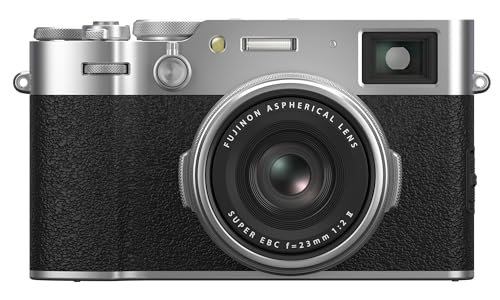
Fujifilm X100VI — Best street camera overall
The X100VI is the rare camera that defines its genre’s era. Its fixed lens — the classic street focal length, chosen so the photographer composes with feet — is paired with a sensor and processor that make its files professional in every measurable way, while its body keeps the size, silence and retro innocence that let it work unnoticed in a crowd. Street photographers waited for this generation through years of scarcity pricing, and the camera justifies the wait: it is the complete street instrument, considered from the strap lugs inward.
The film simulations are its working soul. A street day shot in one simulation returns home already speaking its palette — the editing becomes curation, the project coheres, the photographer’s evening belongs to the pictures rather than the sliders. Add a leaf-shutter’s near-silence, a hybrid viewfinder that offers the rangefinder’s framelines or the electronic truth as the scene demands, and in-body stabilisation for the dusk hours, and the specification reads like the genre’s own wish list transcribed.
Its disciplines are the genre’s disciplines, which professionals count as features and tourists count as flaws: the lens does not change and does not zoom, the battery asks for a spare on the longest days, and demand has historically made the camera easier to admire than to buy. None of that troubles the practitioner it was built for. A fixed lens is a vow the street respects.
For the professional whose work is the pavement — the book, the exhibition, the long project on one city — the X100VI is not a recommendation so much as a recognition. It is the camera the genre would design for itself, and in this generation, it did.
- Lens: fixed classic street focal length
- Files: film simulations, high-resolution sensor
- Finder: hybrid optical and electronic
- Shutter: leaf-quiet for close work
Strengths
- The complete street instrument in one body.
- Files finished in-camera, projects cohere.
- Presence that subjects forgive instantly.
Trade-offs
- Fixed lens — the discipline is mandatory.
- Battery life wants a spare on long days.
- Demand can make it hard to buy.
Best for: dedicated street professionals and long city projects. Not suited for: shooters who need focal-length variety in one body.

Sony RX100 VII — Best pocket professional
The RX100 VII is the professional’s alibi camera: the one that is present at the family lunch, the assignment’s off-hours, the walk where carrying a “real” camera would change the room — and that produces files no editor can dismiss. Its zoom covers the street’s working range from wide scene to compressed candid, its autofocus inherits Sony’s eye-tracking flagship brain, and a pop-up viewfinder preserves the eye-level discipline in a body that otherwise vanishes into a jacket.
Its street method is different from the fixed-lens school and equally legitimate: the zoom as a framing instrument for the photographer who works from a bench, a café window, a position the scene has already accepted. Burst speed that borders on the absurd serves the gesture that lasts a blink. And because it is always carried, its archive grows on days the system cameras stay home — which, across a career, is where a surprising share of the portfolio comes from.
The compromises are the pocket’s compromises: a small sensor whose low-light grace ends where the larger bodies begin, controls that reward familiarity over gloved improvisation, and a battery sized for its body rather than for a festival day. Professionals treat it as the always-camera rather than the only camera, and in that role nothing in this pool touches it.
There is also a professional courtesy in its size worth naming: subjects relax around it. The RX100 VII reads as a holiday camera to everyone it photographs, and the candids it gathers have the ease that only that misreading produces. In a genre built on unposed truth, being underestimated is a specification.
- Lens: versatile zoom in a pocket body
- Autofocus: flagship eye tracking
- Finder: pop-up electronic viewfinder
- Speed: very fast bursts for gestures
Strengths
- Professional files from an invisible camera.
- Always carried — the portfolio grows daily.
- Subjects relax around its toy-like presence.
Trade-offs
- Low-light ceiling below the larger sensors.
- Small controls reward practice.
- Battery sized for its body, not a festival.
Best for: the always-carried second camera of a working professional. Not suited for: night-led projects as the only body.

Canon PowerShot G7 X Mark III — Best for street plus video
The G7 X Mark III is the street camera for the photographer whose city work now includes motion: the documentary short, the photographer’s own channel, the assignment that wants stills and clips from the same walk. Its bright zoom gathers the evening light that defeats lesser compacts, its Canon colour flatters the faces the street offers, and its social camouflage is total — it is, to every eye it meets, a tourist’s camera, which in this genre is a professional asset of the first rank.
Its stills are honest professional work at compact scale: a one-inch sensor with the dynamic manners to hold a shop-window scene, autofocus that serves a moving crowd, and raw files for the evenings the light cheated. The flip screen serves the low and high angles street composition loves, and — uniquely in this list’s compacts — the whole package was designed with the filming creator in mind, so the street film and the street frame come from one pocket.
The trade-offs are known compact ones: no viewfinder, so bright noon work is screen work; a lens that is bright but not a prime’s equal for the shallowest candid depth; battery life that asks for the spare’s company. Professionals file it as the hybrid street tool — the camera for the practitioner whose practice has genuinely become two media.
Its deepest virtue may be generational. The G7 X is the camera many young street photographers already own from their creator years, and its presence in this guide is a recognition: the professional street kit does not always begin with a professional purchase. Sometimes it begins by taking the camera in the drawer seriously, walking it daily, and letting its files argue for what the next body must add.
- Lens: bright zoom for evening streets
- Sensor: 1-inch with raw files
- Video: creator-grade filming built in
- Presence: total tourist camouflage
Strengths
- Stills and street films from one pocket.
- Bright lens for the city’s evening palette.
- Colour that flatters found faces.
Trade-offs
- No viewfinder for bright-day work.
- Depth of field shallower wishes unmet.
- Battery wants a spare’s company.
Best for: street photographers who also film their city. Not suited for: viewfinder purists or prime-lens devotees.

Fujifilm X-T5 — Best system street camera
When the street assignment broadens — the festival that needs a longer lens by afternoon, the documentary project that crosses into portraiture, the professional who simply refuses the fixed-lens vow — the X-T5 is the system answer with the street’s soul. Its high-resolution sensor produces files that print at exhibition scale, its film simulations carry the Fujifilm palette across a whole prime shelf, and its dials put aperture and shutter under the fingers where street work wants them: adjustable without a glance, at a walk, in the rain.
The lens shelf is its professional argument. Fujifilm’s compact fast primes are practically a street photographer’s guild kit — small, quick, characterful — and the X-T5 lets a practitioner carry two bodies’ worth of focal lengths in a coat’s pockets. In-body stabilisation extends the dusk; weather resistance extends the season; the tilting screen serves the hip-level shot that has been the genre’s discreet classic since the waist-level finder.
Its costs are a system’s costs: bigger than the fixed-lens picks, more conspicuous in a crowd, and priced with its lenses like the professional tool it is. Autofocus, while capable, asks a touch more of the photographer than Sony’s set-and-forget tracking in chaotic motion. None of that dents its role for the professional whose street work is one department of a larger practice.
Think of it as the project camera: the body for the year-long documentation of one neighbourhood, where the archive must print large, cohere in palette, and flex across portraits, scenes and details. The X100VI is the daily companion; the X-T5 is the expedition — and many professionals, sensibly, own the pair.
- Sensor: high-resolution for exhibition prints
- Lenses: compact fast prime shelf
- Handling: dials for eyes-free adjustment
- Build: weather-resistant, stabilised
Strengths
- System versatility with a street palette.
- Files that print at gallery scale.
- Prime lenses sized for coat pockets.
Trade-offs
- Larger and more conspicuous than fixed-lens picks.
- Tracking a step behind Sony’s best.
- Full kit cost is professional-level.
Best for: documentary street projects and mixed practices. Not suited for: minimalists who want one lens and no decisions.

OM SYSTEM OM-5 Mark II — Best all-weather walker
Cities are weather with buildings in it, and the OM-5 Mark II is the street camera built for the whole forecast. Its Micro Four Thirds body and lenses are the smallest system combination in this guide — a full kit that rides in a jacket rather than a bag — while its weather sealing is the kind photographers trust through a wet November assignment without a plastic bag’s indignity. For the professional whose beat is a northern city, that pairing of small and sealed is not a compromise; it is the entire brief.
Its stabilisation is the walker’s friend: handheld frames at dusk shutter speeds that would smear on lesser bodies, keeping ISO — and therefore the little sensor’s noise — in check as the light leaves. The system’s deep depth of field, sometimes filed as a limitation, is a street technique in itself: zone focus with a generous zone, scenes sharp from the foreground gesture to the background’s answering one, the layered composition the genre loves made easier by physics.
The sensor’s size sets its honest boundaries: the night work at the extremes belongs to the larger formats, and the shallowest subject isolation needs the system’s fastest primes to approach. Its brand, the successor to Olympus’s long line, carries a smaller rental and resale world than the giants’. Working street professionals weigh those against a kit they will actually carry through February — and carrying, in this genre, is destiny.
For the photographer whose city is wet, cold and walked at length — the documentary walker, the travel professional, the flâneur with an exhibition habit — the OM-5 Mark II makes the professional argument that the best street camera is the one still on your shoulder at hour nine, in the rain, awake. That is a very hard argument to beat.
- Build: weather-sealed, compact system
- Stabilisation: strong in-body system
- Lenses: the smallest interchangeable shelf here
- Depth: deep natural focus for zone work
Strengths
- Works through weather that benches rivals.
- A whole system in a jacket’s carry.
- Zone focusing made generous by physics.
Trade-offs
- Extreme low light trails larger sensors.
- Smaller rental and resale ecosystem.
- Shallow-focus looks need its fastest glass.
Best for: all-weather, all-day street walking. Not suited for: night-only projects or shallow-focus portraiture.

Canon EOS R10 — Best professional pathway
Every professional in this guide began somewhere, and the R10 is the honest somewhere of this generation: a small, fast APS-C body whose subject detection — faces, eyes, the works — lets a developing street photographer concentrate on the seeing while the camera handles the focusing apprenticeship. Canon’s colour flatters the street’s faces, its burst speed serves the gesture, and the RF system’s affordable primes give the fixed-lens discipline a try before the vow is sworn to a dedicated body.
Its professional credentials are pathway credentials. The same mount carries the pro bodies the practitioner may graduate to; the files teach raw discipline; the handling teaches the custom-setup liturgy this guide described. Street schools and young documentary photographers standardise on bodies like this because the learning transfers completely — nothing practised on the R10 is unlearned later.
The boundaries are a starter’s boundaries worn openly: no in-body stabilisation, a single card slot that paid work must plan around, and an APS-C ceiling the night city will find. Its viewfinder and build are honest rather than luxurious. None of that matters at the stage it serves, and all of it defines the upgrade conversation when the work outgrows it — which is exactly what a pathway camera is for.
Buy it with the fast prime rather than the zoom if the street is truly the ambition: the discipline starts on day one, the files gain the separation that makes a young portfolio look professional early, and the body-plus-prime remains, years later, the second camera a working professional still throws in the bag. Pathways that end as trusted tools were well chosen.
- Detection: people, animals and vehicles
- Speed: fast bursts for street gestures
- System: RF primes shared with pro bodies
- Size: small enough for daily carry
Strengths
- Professional habits taught at a starter price.
- Detection that frees the eye for seeing.
- Graduates into the full RF system.
Trade-offs
- Stabilisation lives in the lenses, not the body.
- Single card slot for paid assignments.
- Night ceiling below the premium picks.
Best for: developing professionals and street students. Not suited for: established pros needing dual slots and sealing.
How Do Professionals Carry, Dress and Behave?
The street photographer’s wardrobe is equipment. A coat with the camera’s pocket where the hand expects it, shoes chosen for the tenth kilometre, nothing that swings, glitters or announces a professional on the hunt — the working uniform is anonymity with good pockets. The strap is adjusted so the camera rides at the hip under the hand’s rest, present without being brandished. Photographers who dress for the street’s invisibility take pictures the dressed-up never see, because the scene did not reorganise itself around a person who looked like a photographer.
Behaviour is the second uniform. A pace matched to the city’s, stops that look like a citizen’s stops, the phone-checker’s slouch at the corner where the light is interesting — the professional’s camouflage is ordinariness performed well. The camera rises and falls inside that ordinariness, and the small bodies in this guide are chosen to fit the performance: nothing about an X100VI or an RX100 in a citizen’s hand contradicts the story that this is simply a person, walking, who sometimes takes a picture.
There is a discipline of the eyes that completes it: look at the scene before the camera does, and keep looking after it falls. The photographers whose viewfinders are their only windows produce a recognisable poverty — frames without context, moments without the before and after that make them legible. The professional’s eye does the composing in the world; the camera merely signs the result. Every setup liturgy in this guide exists to buy back the attention that eye requires.
And when the day is done, the uniform comes off in a ritual worth keeping: cards out, batteries on charge, the camera cleaned of the city’s weather, tomorrow’s route turned over once in the mind. The street professional’s kit is small enough for that ritual to take four minutes, which is precisely why it survives decades of daily use. Complexity is the enemy of the daily practice; these six cameras are, above all, simple enough to be a practice.
How Do Professionals Work Different Cities and Different Light?
Every city has a native distance — the space its citizens keep, the closeness a camera may assume — and the professional reads it in the first hour’s walk. Some cities perform for the lens; some ignore it with a completeness that is its own gift; some meet it with a suspicion the photographer must earn their way out of, slowly, in the open. The camera kit adapts quietly: the pocket compact where attention is dangerous, the declared Fujifilm where the culture rewards honesty, the zoom where the native distance is a café’s width. Technique follows anthropology in this genre, always.
Light, too, has local dialects. The northern city’s low, silvered sun rewards the high-ISO grace and the highlight manners this guide weighed; the desert city’s noon is a contrast examination that punishes sensors and rewards the photographer’s patience for shade; the rainy capitals belong to the sealed OM-5 and the hooded lens. Professionals scout light the way they scout routes — by the hour, by the season — and the camera that flatters their home light may not be the one they fly with. The ranking here is written from the temperate, mixed-light city most readers walk; adjust its verdicts by your own sky.
Night redraws the map entirely. The street after dark is a different genre wearing the same name: fewer people, stronger light sources, faces lit like stage actors by shops and signs. The cameras divide honestly at night — the larger sensors and bright fixed lenses inherit the earth, the little compacts retire to the lit zones — and the professional’s night kit is often a different body from the day kit, which is another argument for the two-compact households this guide keeps recommending. Own the day camera and the night camera, and the city is yours around the clock.
Travel compresses all of this into a discipline: arrive, read the distance, walk the light, behave like a guest who intends to be welcome at breakfast tomorrow. The cameras that travel best are the ones in this list’s top half — small, sealed against the journey, innocent at a glance — because the travelling professional’s first asset is not being noticed as one. The portfolio that results, cities compared in one palette, is among the genre’s great pleasures, and it is built on exactly that discretion.
What Is the Professional’s Relationship With Failure and Volume?
It is a marriage, solemnised daily. Street photography’s keeper rate would bankrupt any other genre’s confidence, and the professionals who survive it have made a philosophy of the arithmetic: the misses are not the opposite of the work, they are the work’s prospecting. A camera for this life must therefore make failure cheap — in shutter wear, in card space, in the photographer’s morale — and the six here were all chosen partly for that cheapness. The expensive-feeling camera, the precious frame, is a tax on the exact behaviour the genre requires.
Volume is also a seeing exercise disguised as waste. The hundredth frame of a corner teaches the eye the corner’s grammar — who crosses, who waits, where the light lands at this hour — and the keeper, when it comes, is the grammar used fluently. Photographers who shoot sparingly to protect their ratio protect themselves out of the fluency entirely. The professional’s contact sheets are mostly tuition receipts, and they frame the receipts without embarrassment, because the one frame on the wall is visibly built from them.
There is a discipline that keeps volume honest, and it is the edit’s cruelty. Shoot like an optimist, edit like an enemy: the professional’s weekly cull deletes with a clear conscience everything the project cannot use, because an archive that keeps everything teaches nothing. The cameras’ coherent files — one palette, one signature — exist to make that cull a reading rather than an archaeology. Keep the gold, melt the rest, and let the ratio be whatever the city charged that week.
And when the drought comes — it comes to every street photographer, usually in the third month of a project — the answer is embarrassingly consistent in the memoirs: walk more, carry less, change the hour, keep the camera ready. The drought is the eye recalibrating, not the city emptying. The small cameras in this guide are drought equipment as much as anything: light enough that the recalibrating walks still happen, patient enough to be present when the street, without warning, performs again.
How Does a Professional Build a Street Project Over Months?
The difference between a street photographer and a street professional is the project: a question walked daily until the city answers it. The camera choices in this guide serve that duration — one palette held for a year, one route learned to the paving stones, a body that never becomes the reason a day was skipped. Professionals speak of their projects the way gardeners speak of seasons, and the equipment’s whole job is to disappear into the rhythm until the work accumulates into an argument no single afternoon could have made.
Routine is the project’s engine. The same streets at the same hours teach the eye what ordinary looks like, which is the tuition for recognising the extraordinary in the three seconds it performs itself. The small cameras here are routine machines: charged on the same hook, carried in the same coat, set to the same liturgy, so that the photographer’s only variable is attention. Projects die of friction long before they die of talent, and every pick in this list is a friction-removal device wearing a lens.
Editing is the project’s second engine, and it runs weekly, not at the end. The professional culls ruthlessly and often, because a project’s shape is discovered in the contact sheets — the recurring gesture, the corner that keeps giving, the theme assembling itself out of what the eye chose without permission. Cameras whose files arrive coherent — one simulation, one grade, one signature — make that weekly reading legible. The archive should argue back; a pile of unrelated frames cannot.
And the project ends by being shown: sequenced, printed, hung or bound. Print size and file quality, so irrelevant to the daily walk, become the final exam the camera choice must pass — which is why this guide kept one eye on resolution and print behaviour even while preaching disappearance. The X-T5’s gallery files and the X100VI’s prints pass that exam at the scales street work is shown. Choose for the walk, verify for the wall, and the project can grow to whatever the city intends.
What Do Professionals Do About the Ethics of the Unposed?
They think about it more than their critics suppose, and their answers are practices rather than slogans. Shoot in the open, with a camera that declares itself. Stay for the conversation when one begins. Honour the gesture that says no — it is as much a part of the street’s language as the moment that said yes. Publish with a documentary conscience that asks what the picture does to the person in it, not only what it does for the portfolio. Those practices are not restrictions on the work; over a career, they are what makes the work possible, because a city’s trust is the street photographer’s true permit.
Children, grief, vulnerability and private pain in public places are the genre’s examination questions, and professionals answer them conservatively: the picture that requires someone’s worst moment to be interesting is usually a confession that the photographer was not. The street offers a thousand generous moments for every cruel one. A body of work built on the generous ones ages into honour; the other kind ages into an apology tour. The small, honest cameras in this guide suit the generous practice — they are instruments of participation, not of extraction.
There is also the craft of the return: showing the subject their picture, sending the print, becoming a known face on the route. Neighbourhoods adopt their photographers, and the adopted photographer’s access deepens into something no lens buys — the wave, the saved seat, the story told because the camera has become furniture of the street’s own life. Professionals who work one territory for years describe this adoption as the real credential. It cannot be purchased, but it can be carried — lightly, daily, on a strap — and every camera in this list was chosen to be carryable in exactly that long, neighbourly way.
None of this softens the work. The great street frames are unsparing about life; they are simply made by people who understood that being unsparing and being cruel are different crafts. The camera is neutral. The practice is the ethics, and the practice is chosen fresh every morning, one walk at a time.
How Do the Six Compare Side by Side?
| Camera | Street method | Carry | Signature strength |
|---|---|---|---|
| Fujifilm X100VI | Fixed-lens discipline | Strap, all day | Finished files, quiet presence |
| Sony RX100 VII | Pocket zoom candids | Jacket pocket | Always present |
| Canon PowerShot G7 X Mark III | Stills plus street film | Bright lens, camouflage | |
| Fujifilm X-T5 | System project work | Small bag | Print-scale files |
| OM SYSTEM OM-5 Mark II | All-weather walking | Jacket system | Sealing and stabilisation |
| Canon EOS R10 | Learning the profession | Small bag | Detection and pathway |
What Mistakes Do Street Photographers Make When Buying?
Buying for the portfolio they admire rather than the streets they walk is the classic error: the flagship system that photographs beautifully from a bag it never leaves. Street work is a carrying practice before it is a shooting one, and the camera that attends a thousand walks out-produces the masterpiece that attends twelve. Weigh every candidate in the hand, on a strap, under your own coat — the audition is physical, and the genre is unforgiving of theoretical purchases.
The second mistake is chasing shallow depth of field as a street aesthetic. The genre’s great frames are usually deep — layers of gesture answering each other across a scene — and the little sensors and stopped-down zones in this guide serve that depth by design. The beginner who buys the fastest lens to blur the street away has purchased an exit from the genre’s conversation. Buy for the layers; let the blur be an occasional spice.
Last comes the neglected manners of the project itself: no route knowledge, no local ground rules, no feel for when a raised camera is a welcome document and when it is an intrusion to retire from. Professionals invest in those manners as deliberately as in glass, because access — to neighbourhoods, to festivals, to ordinary Tuesdays — is the street photographer’s true lens shelf, and it is earned on foot, over months, with a small camera and a citizen’s behaviour.
What a Professional’s Camera Bag Actually Contains?
Less than the internet imagines. The working street photographer’s bag — often literally a coat — holds the body, one spare battery, one card wallet, a cloth for the lens, and the route’s small necessities: water, a notebook, the transit card. The spareness is not minimalism as fashion; it is the recognition that every object carried is a decision the street did not ask for, and that the photographer’s readiness lives in the hand, not in the inventory. The six cameras in this guide were all chosen to thrive inside that spareness — none requires a supporting cast of accessories to be itself.
The notebook deserves its sentence, because professionals keep one even in the phone era: routes and their hours, the corners that gave and the corners that owe, the names of the regulars who have become the project’s citizens, the light’s timetable across the seasons. Street photography’s memory is geographic, and the notebook is where the geography is studied between walks. A camera records the city; the notebook records the photographer’s education in it, and the second record is the one that compounds.
And the bag holds one deliberate absence: the second lens, the backup body, the just-in-case apparatus of other genres. Street professionals insure differently — with a camera cheap enough in conscience to risk daily, a practice robust enough to survive its loss, and a project that lives in the walking rather than in the equipment. When a body dies, as bodies eventually do on pavements, the practice buys its successor from this same shortlist and is back on the route by Friday. That resilience, more than any specification, is what makes a kit professional.
Why Do Professionals Keep Returning to Small Cameras?
Because the genre keeps teaching the same lesson at every level of fame: the picture is in the walking, not in the wearing. Each generation of street photographers begins, if it can afford to, with the impressive system — and each generation’s mature work is shot on something smaller, quieter and more honest, carried daily and forgiven by strangers. The cameras at the top of this guide are where that lesson lands in the current market. The system bodies below them serve the work that genuinely needs a system; the compacts and the fixed-lens classic serve the work that only needs a witness. Knowing which work is yours — this month, this project, this city — is the entire professional skill the purchase can express. The rest is walking.
Tomorrow Morning: A Small Exercise in Readiness?
Charge the camera tonight, set its liturgy before bed, and put it by the door with the coat. Tomorrow, take the long way to wherever you are going, at the hour when your city’s light is still deciding what it will be, and shoot the route you know best as if it were a foreign capital. That single walk — camera ready, eye unhurried, no agenda beyond attention — is the whole professional method in miniature, and it is available to every owner of every camera in this guide, starting tomorrow. The equipment decision ends tonight. The practice, which was always the point, begins with the door.
Final Recommendation
For the dedicated street professional, the Fujifilm X100VI is the instrument the genre designed for itself — buy it, set one simulation, and walk. For the professional who must always be armed, the RX100 VII rides in the pocket the X100 cannot. The G7 X Mark III serves the practitioner whose street work films as much as it frames; the X-T5 carries the projects that print large and range wide; the OM-5 Mark II walks through the weather that benches the rest; and the R10 starts the professional life honestly for the photographer still becoming one.
Whichever you choose, spend the next money on the genre’s true equipment: shoe leather, a transit pass, a second battery, and time on one route until the route knows you. Street photography’s professionals are not the owners of its finest cameras. They are the walkers its finest cameras were lucky enough to be carried by. Be the walker; the camera in this guide will keep up.
Related guides
Frequently Asked Questions
Is street photography legal?
Photographing in public places is lawful in many jurisdictions, with important local variations — some places restrict commercial use, some protect certain subjects, and private property open to the public has its own rules. Professionals learn their local ground rules, behave openly, and respect a refusal. This guide’s advice is craft guidance, not legal counsel.
Fixed lens or zoom for professional street work?
Both are professional, with different methods: the fixed lens builds composition with the feet and disappears into a scene; the zoom frames from a position the scene has accepted. Many professionals own one of each — a fixed-lens body for the daily walk, a compact zoom for the pocket — as this guide’s top two picks reflect.
How do professionals handle being confronted?
Calmly, openly, and with the camera lowered: a smile, an explanation, an offered look at the frame, and deletion when the situation asks for it. The small, honest cameras in this guide help — they read as a citizen’s tool rather than a surveillance device — but behaviour, not hardware, is what resolves the moment.
What settings do street professionals actually use?
A prepared liturgy: aperture for the light and depth the scene needs, shutter fast enough for a stride, auto ISO within a ceiling the files afford, and focus either zoned to the day’s working distance or on eye detection with a disciplined trigger. The setup’s purpose is invisibility — the photographer’s attention belongs to the scene.
Do professionals shoot colour or black and white?
Both, usually as a project decision made in advance: one palette, held across the whole body of work, so the archive coheres. The film-simulation picks here make that discipline easy in colour or monochrome; raw shooters apply one house grade. Sameness of palette is what turns walks into a project.
Can a compact really be a professional’s main camera?
For street work, yes — professionals judge by presence and files, and the premium compacts here deliver both for this genre’s subjects and print sizes. The system bodies earn their place when assignments broaden beyond the street; on the pavement itself, small is a professional specification.
How many frames does a professional shoot for one keeper?
Hundreds, on a good day, and the ratio is the genre’s tuition rather than its shame. The cameras here are chosen to make volume cheap — fast, forgiving, always present — because the keeper hides inside the hundredth frame of a scene a lesser work-rate would have abandoned. Edit ruthlessly; shoot generously.
Should I shoot the same route repeatedly?
Yes — familiarity is the professional’s lens. A known route frees the whole of your attention for the anomaly, and anomalies are the genre’s entire subject. Vary the hour before you vary the street; the same corner at dawn and midnight is two assignments.
Related Guides
Keep walking: the best cameras for professional movie making, compact cameras for everyday carry, and the best cameras for portraits and video.


