kajuandouglas.com is reader-supported. When you buy through links on our site, we may earn an affiliate commission.
Where to Buy
Action photography punishes hesitation and rewards preparation, and the camera is only half of either. The six bodies below were ranked against one unforgiving scene — a winger cutting inside at full sprint — because a camera that serves you there, in the half-second that will not repeat, has the reflexes for almost anything else you will point it at this year.
A single idea organises everything that follows: keeper rate is the real specification. Bursts mean little when focus, shutter discipline and position are wrong, and they mean a great deal when those three are right. So the reviews below weigh how each camera behaves in a photographer’s hands at speed — not how its numbers behave in a brochure.
Expect plain speaking about weaknesses. Every body here has at least one, and each review names its own, because a limitation you know about becomes part of your plan while a limitation you discover mid-match becomes an excuse. If a pick’s weakness sits exactly where your sport lives, believe the review and choose a different row of the table.
The reviews can be read in any order you like. The two practical sections are not optional reading. One argues that position beats burst speed; the other sets a camera up for fast subjects step by step. Master those two pages and the gap between these six cameras shrinks — which is precisely why honest guides put technique before shopping.
Key Takeaways
- Canon EOS R6 Mark II leads this action shortlist because its tracking focus converts chaos into keepers.
- Position beats burst speed: stand where the action must pass and frame rates suddenly matter less.
- Handling that stays composed while the moment accelerates separates serious action bodies from merely fast ones.
- Reliability across a whole fixture outweighs one spectacular specification when editors want consistent coverage.
- Picks without a verified listing stay prose-only here, though each still serves fast-subject photographers well.
- Start with the simplest setup covering your regular sport, then refine lenses and settings deliberately.
In this guide
Quick Picks
| Pick | Badge | Why it earns its place |
|---|---|---|
| Canon EOS R6 Mark II | Best Overall for Action | Canon EOS R6 Mark II earns the Best Overall for Action slot, staying dependable while a winger cutting inside at pace |
| Sony Alpha 7 IV | Best Full-Frame All-Rounder | Chosen as Best Full-Frame All-Rounder: the Sony Alpha 7 IV handles a winger cutting inside at pace without fuss |
| Canon EOS R10 | Best Value Action System | The Canon EOS R10 takes the Best Value Action System place, keeping a winger cutting inside at pace within reach |
| Nikon Z50 II | Best Compact Action Pick | For Best Compact Action Pick duties the Nikon Z50 II stands out during a winger cutting inside at pace |
| Fujifilm X-T5 | Best for Deliberate Action Work | Fujifilm X-T5 fills the Best for Deliberate Action Work role with calm competence during a winger cutting inside at pace |
| OM SYSTEM OM-5 Mark II | Best Weatherproof Action Pick | The Best Weatherproof Action Pick badge suits the OM SYSTEM OM-5 Mark II, treating a winger cutting inside at pace as routine |
How We Chose These Picks
We started from the ways action photographs actually die. Focus that arrived a stride late. A buffer that filled during the only attack of the half. A dial that could not be found with cold fingers. The long list was cut against those failures, and any body that could not answer them — whatever its reputation in gentler genres — left the ranking early.
Keeper rate was scored the way photographers experience it: not frames per second, but sharp, well-timed frames per outing. That rewards honest tracking focus, a finder that keeps up, and files that survive the light your sport actually happens in. Bodies whose speed existed mainly in headlines sank; bodies whose speed showed up in contact sheets rose.
Links on this page follow one rule without exceptions. A purchase link appears only on a camera confirmed in this site’s verified pool, spelled exactly as the pool spells it. Other capable bodies are covered in words alone. The rule occasionally makes the page less tidy; it makes every recommendation on it checkable, which matters more.
What Should You Understand Before Choosing the Best Cameras For Action Photos?
Describe your real subject in one blunt sentence before you spend anything. Not the dream final under lights — the ordinary version: a winger cutting inside at full sprint, shot from wherever a spectator is allowed to stand, in whatever weather the fixture list dictates. That sentence, honestly written, eliminates half the catalogue and embarrasses most marketing.
Then separate the photograph from the file. Most action pictures are shared within the hour and printed rarely, which shifts value toward colour that looks right immediately and transfers that take seconds. If your ambitions run to large prints and patient editing, weight the deeper files here more heavily — the reviews flag which bodies reward that patience.
Hands, next, because action is a contact sport for equipment too. You will hold this body at eye level for long stretches, swing it between plays, and operate it half by feel. Weight decides whether it is still raised in the final minutes; grip and dial placement decide whether it obeys when your hands are cold, wet or gloved.
Last, budget for the system around the body. Fast cards, a second battery, a strap you trust at a run, a bag that opens from the top on a muddy touchline — these decide whether the camera is present and ready when a mountain biker leaving a berm happens. The comparison below weighs the six as working systems, not as isolated spec sheets.

Canon EOS R6 Mark II — Best Overall for Action
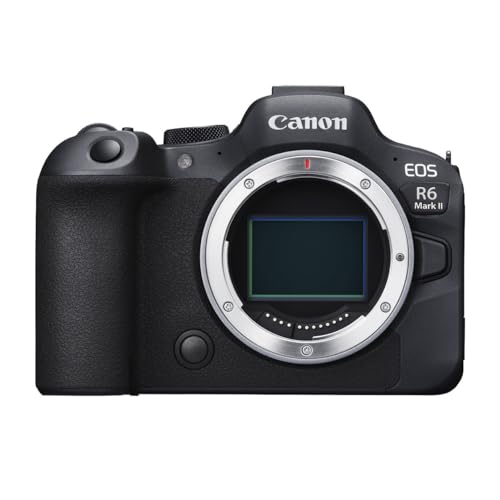
Freeze the test scene in your head: a winger cutting inside at full sprint. Now ask what a camera owes you in that half-second. The Canon EOS R6 Mark II answers as a full-frame hybrid whose stabilisation runs deep and whose focus locks on and stays locked. Speed means nothing without a keeper at the end of it, and the badge of best overall for action is awarded here for keepers — frames that survive the cull, not bursts that merely sound impressive. One stride is all you get; this camera is built to be ready inside it.
Your hands learn this camera at speed, which is the only speed that counts here. The Canon EOS R6 Mark II wakes ready, the dials you need sit outside the menus, and adjustments happen by feel while your eye stays on the play. During a mountain biker leaving a berm, you will not think about the camera at all — and that absence of thought is the highest praise action gear can earn. Muscle memory is an action photographer’s real lens; this body trains it quickly.
Keepers are the currency, so judge the files hard. The Canon EOS R6 Mark II produces frames that hold together when the light turns mean, because its files survive the thin, contrasty light of late fixtures and floodlit evenings. Colour stays on the side of truth — kit colours look like themselves, skin looks like skin — and the files accept a firm edit without falling apart, which matters when the best frame of the day is also the messiest. The cull goes faster when the files arrive honest; your evenings will notice the difference.
Now the bill. The Canon EOS R6 Mark II trades the extremes for reliability in the middle where action lives: the most exotic specialisms, the cruellest professional schedules, the assignments a flagship body exists for — those sit outside its brief. A few advanced settings also live deeper in the menus than a mid-play adjustment would like. Know the border and the camera will not surprise you; ignore it and you will blame a tool for your own scouting report. Read the border as a training plan: it tells you which skills to build instead of which accessories to buy.
Ownership is arithmetic: cards, batteries, transfers, repeat. The Canon EOS R6 Mark II keeps the sums friendly. It writes fast enough that buffers clear while you reposition, spends power predictably across a long fixture list, and hands files to a phone or laptop without a ritual. Action photographers shoot volume; a camera that taxes volume taxes everything. By the third fixture the routine around it — charge, shoot, copy, cull — runs itself, leaving your whole attention for the sport. None of that asks for genius, which is the point: the camera’s job is to remove friction, yours is to remove excuses.
Rank it against the other five and the Canon EOS R6 Mark II wins its argument with coherence under speed. Handling feeds the focusing, focusing feeds the keeper rate, and the keeper rate is the only statistic your future self will thank you for. If best overall for action is the job description you are hiring for, this is a complete application. After that, the only remaining variable is you — which is where an action photographer wants it.
- Role in this line-up: best Overall for Action
- Files: colour suiting action coverage, still grading gracefully afterwards
- Handling: controls placed for swift, unrushed action coverage changes
- Carry profile: proportioned for touchline subjects that never repeat themselves
- Ownership note (action coverage kit): cards, spare power and a case cost extra
Strengths
- The Canon EOS R6 Mark II (action coverage) locks focus dependably while a winger cutting inside at pace
- Files from the Canon EOS R6 Mark II (action coverage) look polished immediately yet keep room for retouching
- Handling stays composed during action coverage when the moment suddenly accelerates
Trade-offs
- Push it far outside action coverage and its compromises surface quickly
- The complete action coverage kit costs more than the camera alone suggests
- Several advanced action coverage settings hide deeper in menus than shooters like
Best for: photographers whose weekends look like a winger cutting inside at full sprint and who measure a camera by keepers, not by noise.
Not suited for: specialists whose paid work lives at extremes this body was never designed to cover.

Sony Alpha 7 IV — Best Full-Frame All-Rounder
Action photography is a negotiation with chaos, and the Sony Alpha 7 IV negotiates well. It is a full-frame body dividing its strength between stills depth and serious video, which matters when a mountain biker leaving a berm gives you one stride, one splash, one chance. The badge of best full-frame all-rounder is not about the fastest number on the box; it is about how much of the chaos comes home usable. The test is never the spec sheet — it is the cull at midnight, and this one passes it.
Handling under pressure: that is the review that matters. The Sony Alpha 7 IV keeps its essential controls under the fingers that are already moving, responds the same way on the tenth burst as the first, and never asks you to look down at the decisive moment. Photographers miss action while reading screens; this body is built to keep you watching instead. Gloves, rain, one eye on the score and one on the play — the layout copes with all of it.
What lands on the card is what you actually bought, so look there first. From the Sony Alpha 7 IV you get honest rendering with headroom: highlights that bend rather than break, shadows that keep their secrets until you ask, helped by the fact that when shade and glare share a frame, its dynamic range leaves editors plenty to work with. For action work, where exposure is often a lucky guess, that forgiveness is worth real money. Print one frame large and the rendering still behaves — no surprises hiding at poster size.
Every action body gives something up, and pretending otherwise helps nobody. The Sony Alpha 7 IV keeps its compromises at the edges of its design brief, where they belong. Ask it to impersonate a far costlier specialist in a niche it never claimed and the afternoon will educate you. Within its territory — which is wide, and includes a mountain biker leaving a berm — the compromises stay theoretical for most photographers. Most owners bump into the limit once, recalibrate, and never think about it again.
Count the unglamorous costs before the glamorous ones. Spare cards for a burst-heavy day, a second battery for a cold one, a strap that survives being swung onto a shoulder at a run — the Sony Alpha 7 IV keeps its demands in that sensible register. Nothing about owning it requires a new hobby of maintaining it. That is the arithmetic that matters across a season: small frictions, repeated weekly, are what actually retire cameras. It also survives the journey between venues — swung into cars, rained on at grounds, borrowed by a second shooter — without developing new complaints.
Short version: the Sony Alpha 7 IV knows its assignment and does not improvise. Photographers living at a dog launching off a dock into black water will feel that focus every time the shutter opens exactly when intended. It is not the loudest camera here. It is the one whose promises survive contact with a moving subject. Gear arguments end at the first keeper; this camera shortens the distance to it.
- Slot in this shortlist: best Full-Frame All-Rounder
- Output: attractive action coverage colour, with latitude for editing
- Controls: dials reachable quickly during action coverage adjustments
- Size in the bag: matched to touchline subjects that never repeat themselves
- Budget note (action coverage kit): memory cards, batteries and protection cost extra
Strengths
- The Sony Alpha 7 IV (action coverage) keeps moving subjects pinned in focus throughout a winger cutting inside at pace
- Images off the Sony Alpha 7 IV (action coverage) arrive clean, still leaving headroom for careful editing
- The body feels calm in the hand throughout action coverage, even as events speed up
Trade-offs
- Work beyond action coverage exposes limits specialists would not accept
- Budget for the full action coverage outfit: body price is only the start
- A few powerful action coverage options sit buried in settings pages
Best for: shooters who put best full-frame all-rounder first and need the body to vanish once the action starts.
Not suited for: anyone expecting burst rate to substitute for position, anticipation and timing.

Canon EOS R10 — Best Value Action System
Strip away the marketing and the Canon EOS R10 is a tool for a specific job: a dog launching off a dock into black water. It is a fast, dial-rich body that puts direct control in the shooter’s hands, and burst behaviour and tracking focus are tuned for subjects that will not sit still. Those two sentences explain the badge of best value action system better than any chart. The paragraphs below stress-test the claim against handling, files and the compromises every action body hides somewhere. Bring it to the touchline and its priorities stop needing explanation within ten minutes.
Spend one match, one ride, one chaotic dog walk with the Canon EOS R10 and its personality declares itself: businesslike. Nothing is decorative, nothing is hidden for cleverness’s sake. The grip, the finder and the control layout all serve a single purpose — getting you to the frame before the frame leaves. You will adjust it mid-burst without noticing you have done so, which is exactly the point.
The images have a directness that suits the subject. No cosmetic softening, no drama invented in processing — the Canon EOS R10 records the stride, the spray and the strain as they happened, and burst behaviour and tracking focus are tuned for subjects that will not sit still. Editors can push these files; more importantly, they rarely have to rescue them, and a action photographer’s evening is short enough already. Teammates and parents will just call them good photographs, which is the correct review.
Where does it run out of answers? At the far edges: light so low it is mostly rumour, subjects so distant that physics wins, workloads measured in weeks of daily professional punishment. The badge of best value action system is a promise about a defined job. This section exists so you can hold the camera to exactly that promise — no more, and no less. A known limit is a tactic; an unknown one is an ambush scheduled for your biggest day.
Weeks later, the verdict owners repeat is about trust. The Canon EOS R10 behaved identically on the wet Tuesday and the big Saturday; the focusing did not develop moods; the files from a winger cutting inside at full sprint looked like the files from everywhere else. In action work, where you cannot ask for a retake, boring reliability is the most exciting feature there is. Trust, once earned at that level, is what lets you commit to a position and a plan instead of hedging with the camera. What it never does is make the evening’s cull longer than the action deserved, and your future self will rank that mercy highly.
Rank the six by what they do for your keeper rate and the Canon EOS R10 explains its badge without help. Every decision — size, controls, file character, focusing manners — pulls toward the same frame. Choose it, then go and spend your practice hours on position and timing, where the real gains are hiding. Take it to the next fixture and let the contact sheet deliver the closing argument.
- Position in this line-up: best Value Action System
- Files: flattering action coverage palette tolerating retouching well
- Handling: layout supporting fast action coverage tweaks mid-scene
- Carry profile: built around the demands of touchline subjects that never repeat themselves
- Ownership note (action coverage kit): storage, power and cover need separate funds
Strengths
- The Canon EOS R10 (action coverage) finds focus calmly even as a winger cutting inside at pace unfolds without warning
- The Canon EOS R10 (action coverage) produces finished-looking photographs while preserving flexibility for grading
- Controls stay reassuring under action coverage pressure, keeping attention on subjects
Trade-offs
- Assignments outside its action coverage brief reveal the engineering compromises
- Total action coverage outlay climbs once essential extras join the camera
- Some action coverage refinements live deep in the menu tree
Best for: anyone whose honest brief is best value action system, and whose subjects refuse to pose, pause or repeat themselves.
Not suited for: buyers who will never learn where the focus mode lives, then blame the camera at full sprint.

Nikon Z50 II — Best Compact Action Pick
Freeze the test scene in your head: a winger cutting inside at full sprint. Now ask what a camera owes you in that half-second. The Nikon Z50 II answers as a compact system camera with a bright finder and bold, likeable colour. Speed means nothing without a keeper at the end of it, and the badge of best compact action pick is awarded here for keepers — frames that survive the cull, not bursts that merely sound impressive. One stride is all you get; this camera is built to be ready inside it.
Your hands learn this camera at speed, which is the only speed that counts here. The Nikon Z50 II wakes ready, the dials you need sit outside the menus, and adjustments happen by feel while your eye stays on the play. During a mountain biker leaving a berm, you will not think about the camera at all — and that absence of thought is the highest praise action gear can earn. Muscle memory is an action photographer’s real lens; this body trains it quickly.
Keepers are the currency, so judge the files hard. The Nikon Z50 II produces frames that hold together when the light turns mean, because controls land where thumbs hunt for them, so the handling feels planned rather than shrunk. Colour stays on the side of truth — kit colours look like themselves, skin looks like skin — and the files accept a firm edit without falling apart, which matters when the best frame of the day is also the messiest. The cull goes faster when the files arrive honest; your evenings will notice the difference.
Now the bill. The Nikon Z50 II trades the extremes for reliability in the middle where action lives: the most exotic specialisms, the cruellest professional schedules, the assignments a flagship body exists for — those sit outside its brief. A few advanced settings also live deeper in the menus than a mid-play adjustment would like. Know the border and the camera will not surprise you; ignore it and you will blame a tool for your own scouting report. Read the border as a training plan: it tells you which skills to build instead of which accessories to buy.
Ownership is arithmetic: cards, batteries, transfers, repeat. The Nikon Z50 II keeps the sums friendly. It writes fast enough that buffers clear while you reposition, spends power predictably across a long fixture list, and hands files to a phone or laptop without a ritual. Action photographers shoot volume; a camera that taxes volume taxes everything. By the third fixture the routine around it — charge, shoot, copy, cull — runs itself, leaving your whole attention for the sport. None of that asks for genius, which is the point: the camera’s job is to remove friction, yours is to remove excuses.
Rank it against the other five and the Nikon Z50 II wins its argument with coherence under speed. Handling feeds the focusing, focusing feeds the keeper rate, and the keeper rate is the only statistic your future self will thank you for. If best compact action pick is the job description you are hiring for, this is a complete application. After that, the only remaining variable is you — which is where an action photographer wants it.
- Role in this selection: best Compact Action Pick
- Output: polished action coverage colour, plus room to refine tones
- Controls: positioned for prompt action coverage changes, rhythm intact
- Footprint: sensible for days spent on touchline subjects that never repeat themselves
- Budget note (action coverage kit): cards, extra power and case need budgeting
Strengths
- The Nikon Z50 II (action coverage) holds focus with reassuring consistency whenever a winger cutting inside at pace develops quickly
- Pictures from the Nikon Z50 II (action coverage) need little rescue, though editors keep ample latitude
- Grip and layout keep nerves low during action coverage while scenes refuse to slow
Trade-offs
- Stretch the action coverage brief and this pick stops feeling like the answer
- Ownership spending for action coverage extends beyond the headline body figure
- Occasional action coverage features require menu-diving instead of direct controls
Best for: photographers whose weekends look like a winger cutting inside at full sprint and who measure a camera by keepers, not by noise.
Not suited for: specialists whose paid work lives at extremes this body was never designed to cover.

Fujifilm X-T5 — Best for Deliberate Action Work
Action photography is a negotiation with chaos, and the Fujifilm X-T5 negotiates well. It is a dial-led system camera carrying high-resolution stills and beloved film simulations, which matters when a mountain biker leaving a berm gives you one stride, one splash, one chance. The badge of best for deliberate action work is not about the fastest number on the box; it is about how much of the chaos comes home usable. The test is never the spec sheet — it is the cull at midnight, and this one passes it.
Handling under pressure: that is the review that matters. The Fujifilm X-T5 keeps its essential controls under the fingers that are already moving, responds the same way on the tenth burst as the first, and never asks you to look down at the decisive moment. Photographers miss action while reading screens; this body is built to keep you watching instead. Gloves, rain, one eye on the score and one on the play — the layout copes with all of it.
What lands on the card is what you actually bought, so look there first. From the Fujifilm X-T5 you get honest rendering with headroom: highlights that bend rather than break, shadows that keep their secrets until you ask, helped by the fact that its physical controls reward a slower, more deliberate way of working a fast scene. For action work, where exposure is often a lucky guess, that forgiveness is worth real money. Print one frame large and the rendering still behaves — no surprises hiding at poster size.
Every action body gives something up, and pretending otherwise helps nobody. The Fujifilm X-T5 keeps its compromises at the edges of its design brief, where they belong. Ask it to impersonate a far costlier specialist in a niche it never claimed and the afternoon will educate you. Within its territory — which is wide, and includes a mountain biker leaving a berm — the compromises stay theoretical for most photographers. Most owners bump into the limit once, recalibrate, and never think about it again.
Count the unglamorous costs before the glamorous ones. Spare cards for a burst-heavy day, a second battery for a cold one, a strap that survives being swung onto a shoulder at a run — the Fujifilm X-T5 keeps its demands in that sensible register. Nothing about owning it requires a new hobby of maintaining it. That is the arithmetic that matters across a season: small frictions, repeated weekly, are what actually retire cameras. It also survives the journey between venues — swung into cars, rained on at grounds, borrowed by a second shooter — without developing new complaints.
Short version: the Fujifilm X-T5 knows its assignment and does not improvise. Photographers living at a dog launching off a dock into black water will feel that focus every time the shutter opens exactly when intended. It is not the loudest camera here. It is the one whose promises survive contact with a moving subject. Gear arguments end at the first keeper; this camera shortens the distance to it.
- Slot in this line-up: best for Deliberate Action Work
- Files: confident action coverage colour editors can adjust freely
- Handling: layout making quick action coverage corrections feel deliberate
- Carry profile: shaped by the realities of touchline subjects that never repeat themselves
- Ownership note (action coverage kit): cards, batteries and storage add extra spend
Strengths
- The Fujifilm X-T5 (action coverage) tracks the decisive subject steadily during a winger cutting inside at pace
- Output from the Fujifilm X-T5 (action coverage) reads polished on delivery and forgives later surgery
- It feels planted and predictable throughout action coverage, never twitchy at the decisive second
Trade-offs
- Tasks beyond action coverage make its narrower talents obvious
- The honest action coverage cost includes accessories the base purchase omits
- Certain advanced action coverage choices demand patience through layered menus
Best for: shooters who put best for deliberate action work first and need the body to vanish once the action starts.
Not suited for: anyone expecting burst rate to substitute for position, anticipation and timing.

OM SYSTEM OM-5 Mark II — Best Weatherproof Action Pick
Strip away the marketing and the OM SYSTEM OM-5 Mark II is a tool for a specific job: a dog launching off a dock into black water. It is a weather-sealed traveller packing computational tricks into a compact lens system, and the kit stays small enough that the rest of the bag can hold everything else the day needs. Those two sentences explain the badge of best weatherproof action pick better than any chart. The paragraphs below stress-test the claim against handling, files and the compromises every action body hides somewhere. Bring it to the touchline and its priorities stop needing explanation within ten minutes.
Spend one match, one ride, one chaotic dog walk with the OM SYSTEM OM-5 Mark II and its personality declares itself: businesslike. Nothing is decorative, nothing is hidden for cleverness’s sake. The grip, the finder and the control layout all serve a single purpose — getting you to the frame before the frame leaves. You will adjust it mid-burst without noticing you have done so, which is exactly the point.
The images have a directness that suits the subject. No cosmetic softening, no drama invented in processing — the OM SYSTEM OM-5 Mark II records the stride, the spray and the strain as they happened, and the kit stays small enough that the rest of the bag can hold everything else the day needs. Editors can push these files; more importantly, they rarely have to rescue them, and a action photographer’s evening is short enough already. Teammates and parents will just call them good photographs, which is the correct review.
Where does it run out of answers? At the far edges: light so low it is mostly rumour, subjects so distant that physics wins, workloads measured in weeks of daily professional punishment. The badge of best weatherproof action pick is a promise about a defined job. This section exists so you can hold the camera to exactly that promise — no more, and no less. A known limit is a tactic; an unknown one is an ambush scheduled for your biggest day.
Weeks later, the verdict owners repeat is about trust. The OM SYSTEM OM-5 Mark II behaved identically on the wet Tuesday and the big Saturday; the focusing did not develop moods; the files from a winger cutting inside at full sprint looked like the files from everywhere else. In action work, where you cannot ask for a retake, boring reliability is the most exciting feature there is. Trust, once earned at that level, is what lets you commit to a position and a plan instead of hedging with the camera. What it never does is make the evening’s cull longer than the action deserved, and your future self will rank that mercy highly.
Rank the six by what they do for your keeper rate and the OM SYSTEM OM-5 Mark II explains its badge without help. Every decision — size, controls, file character, focusing manners — pulls toward the same frame. Choose it, then go and spend your practice hours on position and timing, where the real gains are hiding. Take it to the next fixture and let the contact sheet deliver the closing argument.
- Position in this shortlist: best Weatherproof Action Pick
- Output: pleasing action coverage tones, retaining post-work flexibility
- Controls: arranged so action coverage adjustments never feel fumbled
- Size and weight: planned with touchline subjects that never repeat themselves firmly in mind
- Budget note (action coverage kit): storage media and spare power need money back
Strengths
- The OM SYSTEM OM-5 Mark II (action coverage) settles focus fast enough that a winger cutting inside at pace rarely escapes unrecorded
- Frames from the OM SYSTEM OM-5 Mark II (action coverage) appear assured immediately yet tolerate thoughtful post-processing
- Everything falls under the fingers naturally in action coverage when chances arrive unannounced
Trade-offs
- Demand work far from action coverage and cracks appear sooner than expected
- Expect the finished action coverage kit to outrun the camera-only price
- Not every useful action coverage option surfaces quickly in the menus
Best for: anyone whose honest brief is best weatherproof action pick, and whose subjects refuse to pose, pause or repeat themselves.
Not suited for: buyers who will never learn where the focus mode lives, then blame the camera at full sprint.
How Do the Six Picks Compare Side by Side?
| Pick | Badge | Strongest suit | Watch out for |
|---|---|---|---|
| Canon EOS R6 Mark II | Best Overall for Action | Dependability when subjects move unpredictably | Limits appear outside its home territory |
| Sony Alpha 7 IV | Best Full-Frame All-Rounder | Files needing the least rescue afterwards | Accessories worth budgeting from the start |
| Canon EOS R10 | Best Value Action System | Simplicity that speeds every step | Size suits some hands better than others |
| Nikon Z50 II | Best Compact Action Pick | Consistency across an entire outing | Menus reward a patient first week |
| Fujifilm X-T5 | Best for Deliberate Action Work | Versatility when plans change mid-shoot | Kit costs extend beyond the camera |
| OM SYSTEM OM-5 Mark II | Best Weatherproof Action Pick | Comfort throughout long handheld sessions | A learning curve awaits complete beginners |
Use the table as a shortlist of temperaments. The first body is the balanced default for most action shooters; lower rows trade slices of that balance for a specific gift — value, compactness, deliberation, weather sealing. Find the badge that matches your sport and your Sundays, then read that review with a sceptic’s pencil before you read any other.
Why Is Position Worth More Than Burst Speed for Action?
Position is the technique that costs nothing and pays every time. Stand where the play will arrive, not where it started; put the clean background behind your subject before the subject gets there; decide the one setting you refuse to touch mid-sequence. Most amateur action frames fail on geography long before they fail on equipment, and geography is free to fix.
Light, in action, is a positioning problem wearing a disguise. The same fixture looks rich from the shaded side and chalky from the sunny one; the same dog is sculpture against black water and snapshot against bright grass. Walk the venue before the start, note where the light rakes and where it flattens, and plant yourself accordingly — your camera will appear to gain a stop of talent.
Shoot in deliberate bursts, then stop and think. A short sequence as the play develops, a pause to reposition while it resets, another as it peaks: that rhythm fills cards with candidates instead of duplicates. Review the take honestly afterwards and write down the recurring fault — late timing, drifting focus, horizons at sea — because the next outing should be its correction.
Build a finishing ritual and protect it. Files copied the same night, the best few kept where they will be seen, one frame shared with somebody who will tell you the truth about it. Action photography improves in that loop — shoot, cull, learn, reposition — and no burst rate yet sold can substitute for a single honest lap around it.
How Do You Set Up a Camera for Fast Subjects, Step by Step?
Set the camera before the subject exists. Shutter fast enough for your sport, focus mode chosen for movement rather than stillness, drive ready, card empty, battery honest. A repeatable pre-game routine — the same checks in the same order — teaches faster than any tutorial, because on the day itself your attention belongs to the play, not the menu.
Move like the subject owes you nothing, because it does not. Crouch for the low angle that separates athlete from background, step closer instead of cropping later, climb for the berm shot, retreat for the wide one. With a winger cutting inside at full sprint as the standard, those free metres of repositioning transform more frames than any accessory in the catalogue.
Cull like an editor, not a fan. Keep the frames that show something true — effort, timing, consequence. Delete the accidents without a speech. Study the near-misses longest of all: they are the lesson with the serial numbers still on. Was the frame late, the focus polite rather than committed, the position a metre too safe? Name it, fix it next time.
Share the work early, especially the failures. A frame defended in front of one trusted viewer teaches more than a hard drive of private almosts, because defending the frame aloud forces the intention into the open, where it becomes the standard your next outing is judged against.
What Mistakes Do Buyers in This Niche Keep Making?
Buying the fastest burst in the shop and then standing in the wrong place, photographing the backs of plays at twenty frames a second.
Writing a body off after one fixture, before hands and focus settings have had a single fair chance to bed in.
Spending the entire budget on the body and then feeding it slow cards and one tired battery, as if keepers were free to store.
Shooting the whole season on full automatic, then blaming the camera for choices it was never once consulted about.
Judging files at pixel level on a monitor while ignoring the ergonomics that decide whether the body is raised at the decisive play.
Never shooting the low-stakes practice match — the Sunday run-out where timing errors cost nothing and teach everything.
How Do You Practise Tracking Fast Subjects Before the Big Fixture?
Practise the review first: after every outing, open the take at full size and name the single best decision you made — the position you chose early, the burst you resisted, the ten seconds you waited. Say it out loud. A named decision becomes a repeatable one, and repeatable decisions are what keeper rate is actually made of.
What Does Deliberate Practice Look Like for an Action Photographer?
Rehearse the carry until it disappears. Camera up from rest to eye in one motion, spare card found by touch in the bag’s correct pocket, strap set so the body rides where your hand falls. Photographs begin with presence, and presence is a drill before it is a talent.
How Can Panning Drills at Local Matches Sharpen Your Keeper Rate?
Shoot with other photographers whenever the fixture allows. Stand in different spots, compare contact sheets afterwards without mercy or malice, and steal each other’s positions shamelessly. A shared cull and one standing joke about the weekend’s worst frame will improve a whole touchline of photographers faster than solitary grinding.
Which Practice Habits Turn Burst Sequences Into Single Decisive Frames?
Let the weather have its say in practice, not just in anger. Rain on the lens, spray off the dock, wind that numbs the dial hand — learn the countermeasures on a day when the photographs do not matter: cover in the bag, cloth in the pocket, gear dried before it is stored. The routine that survives a wet Tuesday survives anything.
How Do You Practise Anticipation So the Camera Fires Before the Peak?
Edit like an action photographer: fast and honest. Level it, fix the exposure, correct the colour, stop. The frame either caught the moment or it did not, and no slider has ever added a stride that the shutter missed. Restraint in the edit is respect for the sport’s basic bargain.
Now the drill this guide is built around. Take your chosen camera back to a winger cutting inside at full sprint — and to a mountain biker leaving a berm, and to a dog launching off a dock into black water — and work each subject in two passes: the way you shot before this guide, then with the single sharpest lesson you took from it applied on purpose. Compare the contact sheets cold. The difference is your keeper rate, before and after.
Run the drill again at a harder venue, in worse light, against faster subjects. Easy fixtures flatter; they let sloppy timing look like skill. If the second pass still beats the first when everything is quicker and darker, the lesson has left the notebook and entered your hands, which is the only place it can help you.
Add a third pass with a deliberate handicap: one lens, one position, no chimping between plays. Constraints expose which of your habits are skill and which were equipment all along — an uncomfortable audit, and the most useful one an action photographer can schedule.
Finish the cycle by printing the single best frame of the month at a size that scares you slightly. At that scale, timing and focus stop being opinions. Hang it where you will see it while you pack for the next fixture; it is both the reward and the standard.
Finally, schedule the rematch. Same venue, same subject, one month later, same two-pass structure. Progress in action photography is rarely visible week to week, but across a season of rematches it becomes undeniable — and undeniable progress is what keeps a photographer coming back to cold touchlines.
Final Recommendation
Take the Canon EOS R6 Mark II for the balanced answer, if your preference is watching the play rather than deliberating: it is the body most likely to be ready inside the half-second that matters. Move down the list when one badge — value, compactness, deliberation, sealing — matches your sport more precisely. Whichever body you choose, give it a fair month: learn the three controls you will actually touch mid-play, shoot the practice fixtures, and judge it by keepers, never by first impressions.
Frequently Asked Questions
Which shutter speeds freeze different kinds of movement?
Match the shutter to the subject’s fastest moving part, not to its body. A running player’s torso freezes at speeds that still smear a swinging foot or a spinning ball, so think in terms of limbs, wheels and wings: the quicker the extremity, the quicker the shutter must be. When in doubt, go one step faster than feels necessary and let the keeper rate grade your choice afterwards.
Does tracking focus matter more than burst rate?
Tracking focus, and it is not close. A modest burst with focus that clings produces keepers; a huge burst with focus that wanders produces a longer cull and the same number of keepers. Burst rate is the multiplier, focus is the number being multiplied — and multiplying a small number harder has never been a strategy. Choose the body whose tracking you trust, then let its burst be whatever it is.
How do I pan smoothly for a sense of speed?
Panning is a golf swing, not a camera setting. Plant your feet toward where the subject will finish, start the swing before it arrives, track through the frame and follow through after the shutter closes. Keep the shutter slow enough to blur the background and your body loose enough to move as one piece. Practise on traffic, cyclists, anything that repeats — the berm will not wait while you learn.
Are pre-capture modes worth using for action?
Yes, with a condition: use pre-capture as insurance, not as a style. It rescues the moments your reflexes genuinely cannot reach — the start, the strike, the launch — and it taxes cards and culling time in exchange. Photographers who build their whole method on it stop developing anticipation, which remains the cheaper and more satisfying skill. Insure the uninsurable moments; shoot the rest yourself.
How many frames should I expect to keep from a burst?
Fewer than the burst promised, and that is normal at every level of the sport. Professionals cull ruthlessly too; the difference is that their misses are better lit. Judge yourself on whether the keeper count rises across a season and whether the best frame of each outing keeps improving. A rising best-frame standard matters far more than any percentage.
Related Guides
Carry on with our notes on camera accessories that pull their weight on a touchline, our field-tested guide to carrying gear through a full fixture list, and our beginner-friendly run-through of the settings to learn before your first match.