kajuandouglas.com is reader-supported. When you buy through links on our site, we may earn an affiliate commission.
Where to Buy
Seven is the in-between year, and it deserves better than hand-me-down advice from the six-year-old list or a premature borrow from the eight-year-old one. A seven-year-old has outgrown pure toy cameras — the novelty buttons, the cartoon frames — yet is not quite ready for delicate equipment or complicated menus. The six picks below were assembled for that exact middle: filming a wobbly tour of a blanket fort, photographing grandparents at a birthday tea, printing a picture for a best friend.
Some guides start with sensors; this one starts with that blanket fort, because the best camera for a seven-year-old is the one that survives contact with the life actually being lived at seven. Attention is longer than last year, friendships matter enormously, stories are being invented and performed — and the right camera channels all of that rather than merely enduring it.
The thread running through all six picks is the middle year’s own balance: simple enough for independence, capable enough to feel like a real photographer’s tool, and rewarding in the currencies seven-year-olds value — a print to give away, a film to narrate, a picture of grandparents that genuinely pleases them. Cameras that failed any leg of that triangle left the shortlist.
Adults reading along should expect a supporting role rather than a starring one. At seven, the pattern that works is a short joint setup, a few skills taught as games, and then long stretches of unsupervised creating. The assessments below note honestly which picks need an adult nearby and which happily disappear into the child’s own world.
Key Takeaways
- Fujifilm Instax Mini 12 leads for seven-year-olds because instant prints keep motivation high between longer projects.
- Seven sits between toy and tool: children this age handle real features when adults introduce them gradually.
- Storytelling emerges now, so a camera encouraging sequences and short clips earns its keep quickly.
- Comfort in a growing child’s hands and honest durability outweigh specification bragging at this age entirely.
- Picks without a verified listing stay prose-only in this guide, though each still deserves consideration.
- Start with the simplest camera covering home movies and garden portraits, then introduce settings deliberately.
In this guide
Quick Picks
| Pick | Badge | Why it earns its place |
|---|---|---|
| Fujifilm Instax Mini 12 | Best Overall for Seven | Fujifilm Instax Mini 12 earns the Best Overall for Seven slot, staying dependable while a fort tour filmed for grandparents |
| OM SYSTEM Tough TG-7 | Best Adventure-Proof Pick | Chosen as Best Adventure-Proof Pick: the OM SYSTEM Tough TG-7 handles a fort tour filmed for grandparents without fuss |
| Polaroid Go Generation 2 | Best Pocket Instant | The Polaroid Go Generation 2 takes the Best Pocket Instant place, keeping a fort tour filmed for grandparents within reach |
| VTech Kidizoom Twist | Best Guided-Play Starter | For Best Guided-Play Starter duties the VTech Kidizoom Twist stands out during a fort tour filmed for grandparents |
| AKASO Brave 7 LE | Best for First Videos | AKASO Brave 7 LE fills the Best for First Videos role with calm competence during a fort tour filmed for grandparents |
| DJI Osmo Pocket 3 | Best Shared Family Filming Pick | The Best Shared Family Filming Pick badge suits the DJI Osmo Pocket 3, treating a fort tour filmed for grandparents as routine |
How We Chose These Picks
The judging began with the middle year’s characteristic disasters: toy cameras whose novelty expired within a fortnight, fragile adult compacts one drop from retirement, and capable cameras whose menus stranded a seven-year-old in settings nobody could undo. Any model leaning toward those failures was cut, whatever its other charms.
We also scored the boring merits, because boring virtues decide ownership happiness in this niche: battery behaviour an adult can manage on a weekly rhythm, transfers simple enough for a child to request and receive their pictures, and controls that stay put between outings so last week’s lesson still applies this week. Consistency is a kindness at seven.
House rule for links, stated once and applied throughout: only cameras verified in this site’s pool receive an Amazon link, under the exact name the pool lists, and everything else is recommended in plain prose, with no listing invented to fill the gap.
What Should You Understand Before Choosing the Best Cameras For A 7 Year Old?
Name the child’s real subjects before naming any camera. For most seven-year-olds the list writes itself: a blanket fort that deserves a filmed tour, grandparents who deserve a proper portrait at the birthday tea, a best friend who deserves a print of the two of them. A camera chosen against that list will be used weekly; one chosen against an imaginary prodigy will be admired and abandoned.
Stills and film both matter at seven, so weigh them as separate purchases sharing one body. Stills capture the tea, the tower and the cat; video captures the fort tour, the performed story, the song with actions. Picks that treat video as an afterthought short-change the age — narration is half the creative output of a seven-year-old, and the camera should honour it.
Hands, at seven, are in transition, and the transition deserves its own honest look. Grips that were perfect at six can feel babyish now, while full adult compacts still slip. The sweet spot is a body with substance that small hands can wrap around confidently, controls chunky enough to find without looking, and a strap habit an adult installs once and the child keeps.
Close the decision by counting the small system around the camera: the case, the strap, the film or card supply, and — just as important at seven — the destination for results, be it the fridge door, a friend’s birthday card or the family screen on Sunday. Cameras whose pictures have somewhere to go get used; cameras whose pictures vanish get forgotten.

Fujifilm Instax Mini 12 — Best Overall for Seven
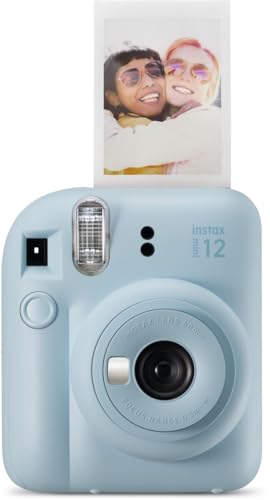
Every camera in this guide was auditioned against the same scene — a seven-year-old filming a wobbly tour of a blanket fort — and the Fujifilm Instax Mini 12 passed with its identity intact: it is an instant camera that measures the scene for you and produces a print you can hold. A selfie mirror and twist-to-start lens keep operation almost foolproof, a gift in a year when the photograph is so often a present, a proof or an episode in an ongoing saga. The badge of best overall for seven recognises that fit between tool and year. Inside the blanket fort, where the light is dim and the tour is wobbly, the Fujifilm Instax Mini 12 does its best work, because a selfie mirror and twist-to-start lens keep operation almost foolproof.
Seven-year-olds forgive many things in a camera, but not being made to wait, and the Fujifilm Instax Mini 12 rarely makes them. Its few essential controls are learned inside one afternoon’s play, after which the young director is touring forts and framing grandparents without a single appeal to the adult technical department. Early independence like that compounds into confidence remarkably fast. At the birthday tea the Fujifilm Instax Mini 12 photographs grandparents with a directness adults rarely manage, and the results are treasured accordingly.
Judge the Fujifilm Instax Mini 12 by its output in the wild: a birthday tea, a fort interior, a friend mid-laugh. A selfie mirror and twist-to-start lens keep operation almost foolproof, so the pictures please the people in them, which at seven is the entire point of taking them. Colour stays honest, the files tolerate a gentle tidy-up, and the results look like the day they record — the highest praise a family archive can pay. A print from the Fujifilm Instax Mini 12 handed to a best friend mid-visit completes a circuit — made, given, kept — that defines photography at seven.
The shortcomings, itemised for the adult holding the purse. The Fujifilm Instax Mini 12 is built for the middle year’s work, and ambitions far outside that territory — serious sport, demanding low-light productions — find its limits quickly. Ownership also costs more than the ticket: film or cards, batteries, and the case this camera will certainly need all queue behind the purchase, and a household should budget for the queue. The badge of best overall for seven promises a camera pitched exactly at the middle year, and the Fujifilm Instax Mini 12 honours it by never feeling babyish or baffling.
Households report the same pattern with the Fujifilm Instax Mini 12: the adult’s job shrinks weekly. Charging or film-checking becomes a shared Sunday habit, results reach the family screen without negotiation, and the camera takes its place among the fort-building equipment as a permanent fixture. Tools that integrate into a seven-year-old’s world get used; tools that demand ceremony get commemorated in a drawer. Stories accumulate around the Fujifilm Instax Mini 12: fort tours, tea parties, expeditions to the end of the garden, each one documented by its own director.
Of the six, the Fujifilm Instax Mini 12 stands apart for how completely it serves the storytelling year. Size fits the hands, the surface fits the age, and the results fit the audience of friends and grandparents waiting for them. That three-way fit, not any specification, is what earns it the best overall for seven badge. By the school holidays the Fujifilm Instax Mini 12 has a history in the household, which is another way of saying it has been loved into usefulness.
- Role in this line-up: best Overall for Seven
- Files: colour suiting seven-year-old storytelling, still grading gracefully afterwards
- Handling: controls placed for swift, unrushed seven-year-old storytelling changes
- Carry profile: proportioned for a seven-year-old moving toward first short films
- Ownership note (seven-year-old storytelling kit): cards, spare power and a case cost extra
Strengths
- The Fujifilm Instax Mini 12 (seven-year-old storytelling) locks focus dependably while a fort tour filmed for grandparents
- Files from the Fujifilm Instax Mini 12 (seven-year-old storytelling) look polished immediately yet keep room for retouching
- Handling stays composed during seven-year-old storytelling when the moment suddenly accelerates
Trade-offs
- Push it far outside seven-year-old storytelling and its compromises surface quickly
- The complete seven-year-old storytelling kit costs more than the camera alone suggests
- Several advanced seven-year-old storytelling settings hide deeper in menus than shooters like
Best for: the seven-year-old whose stories match its badge — best overall for seven — and whose subjects resemble a seven-year-old filming a wobbly tour of a blanket fort.
Not suited for: anyone expecting wonders far outside the work this pick was designed to do.

OM SYSTEM Tough TG-7 — Best Adventure-Proof Pick
Ask what the OM SYSTEM Tough TG-7 is for and the answer arrives in seven-year-old terms: forts, teas, friends and films. Underneath the answer sits the design — a waterproof compact armoured against the knocks of rough handling — and the daily detail that macro settings uncover miniature subjects that ordinary travel cameras overlook. It earns best adventure-proof pick by being grown-up enough to respect its owner and simple enough to vanish into the story being told. Inside the blanket fort, where the light is dim and the tour is wobbly, the OM SYSTEM Tough TG-7 does its best work, because macro settings uncover miniature subjects that ordinary travel cameras overlook.
The OM SYSTEM Tough TG-7’s layout respects the middle year’s hands and head alike. Controls sit on the surface where they can be found by looking, settings survive being left alone between weekends, and experimentation is punished with nothing worse than a retake. A camera that forgives curiosity will be experimented with — and experimentation is the curriculum at seven. At the birthday tea the OM SYSTEM Tough TG-7 photographs grandparents with a directness adults rarely manage, and the results are treasured accordingly.
What comes out of the OM SYSTEM Tough TG-7 has a directness adults should envy. Because macro settings uncover miniature subjects that ordinary travel cameras overlook, even a frame snatched from celebration chaos lands with its subject readable and its moment intact. For stories told, prints given and grandparents documented, that reliability outranks any laboratory virtue. A print from the OM SYSTEM Tough TG-7 handed to a best friend mid-visit completes a circuit — made, given, kept — that defines photography at seven.
Nothing here is perfect, and the OM SYSTEM Tough TG-7’s flaws at least have the decency to be predictable. Treat it as a specialist instrument or a fragile adult compact and it will disappoint on schedule. Treat it as what it is — a storyteller’s first real tool — and the compromises retire to the margins where they belong. The badge of best adventure-proof pick promises a camera pitched exactly at the middle year, and the OM SYSTEM Tough TG-7 honours it by never feeling babyish or baffling.
The running of the OM SYSTEM Tough TG-7 asks little and asks it kindly. Power lasts the expedition, transfers behave, and upkeep can be handed over gradually — each small responsibility transferred reads to a seven-year-old as a promotion. By the holidays, the camera is less a possession than a post held by its young operator. Stories accumulate around the OM SYSTEM Tough TG-7: fort tours, tea parties, expeditions to the end of the garden, each one documented by its own director.
Put the verdict in the owner’s terms: the OM SYSTEM Tough TG-7 helps a seven-year-old make things. Not merely take pictures — make gifts, evidence, tours and premieres, the artefacts of a year lived imaginatively. Choose it for best adventure-proof pick, and clear a shelf for the fort archives by the weekend. By the school holidays the OM SYSTEM Tough TG-7 has a history in the household, which is another way of saying it has been loved into usefulness.
- Slot in this shortlist: best Adventure-Proof Pick
- Output: attractive seven-year-old storytelling colour, with latitude for editing
- Controls: dials reachable quickly during seven-year-old storytelling adjustments
- Size in the bag: matched to a seven-year-old moving toward first short films
- Budget note (seven-year-old storytelling kit): memory cards, batteries and protection cost extra
Strengths
- The OM SYSTEM Tough TG-7 (seven-year-old storytelling) keeps moving subjects pinned in focus throughout a fort tour filmed for grandparents
- Images off the OM SYSTEM Tough TG-7 (seven-year-old storytelling) arrive clean, still leaving headroom for careful editing
- The body feels calm in the hand throughout seven-year-old storytelling, even as events speed up
Trade-offs
- Work beyond seven-year-old storytelling exposes limits specialists would not accept
- Budget for the full seven-year-old storytelling outfit: body price is only the start
- A few powerful seven-year-old storytelling options sit buried in settings pages
Best for: the seven-year-old whose stories match its badge — best adventure-proof pick — and whose subjects resemble a seven-year-old filming a wobbly tour of a blanket fort.
Not suited for: readers whose real scenes bear no resemblance to a seven-year-old filming a wobbly tour of a blanket fort, no matter how accomplished it may be in its own field.

Polaroid Go Generation 2 — Best Pocket Instant
Every camera in this guide was auditioned against the same scene — a seven-year-old filming a wobbly tour of a blanket fort — and the Polaroid Go Generation 2 passed with its identity intact: it is a pocket instant camera whose little prints arrive full of character the moment they are taken. A rechargeable body plus double-exposure modes invite playful experimentation, a gift in a year when the photograph is so often a present, a proof or an episode in an ongoing saga. The badge of best pocket instant recognises that fit between tool and year. Inside the blanket fort, where the light is dim and the tour is wobbly, the Polaroid Go Generation 2 does its best work, because a rechargeable body plus double-exposure modes invite playful experimentation.
Seven-year-olds forgive many things in a camera, but not being made to wait, and the Polaroid Go Generation 2 rarely makes them. Its few essential controls are learned inside one afternoon’s play, after which the young director is touring forts and framing grandparents without a single appeal to the adult technical department. Early independence like that compounds into confidence remarkably fast. At the birthday tea the Polaroid Go Generation 2 photographs grandparents with a directness adults rarely manage, and the results are treasured accordingly.
Judge the Polaroid Go Generation 2 by its output in the wild: a birthday tea, a fort interior, a friend mid-laugh. A rechargeable body plus double-exposure modes invite playful experimentation, so the pictures please the people in them, which at seven is the entire point of taking them. Colour stays honest, the files tolerate a gentle tidy-up, and the results look like the day they record — the highest praise a family archive can pay. A print from the Polaroid Go Generation 2 handed to a best friend mid-visit completes a circuit — made, given, kept — that defines photography at seven.
The shortcomings, itemised for the adult holding the purse. The Polaroid Go Generation 2 is built for the middle year’s work, and ambitions far outside that territory — serious sport, demanding low-light productions — find its limits quickly. Ownership also costs more than the ticket: film or cards, batteries, and the case this camera will certainly need all queue behind the purchase, and a household should budget for the queue. The badge of best pocket instant promises a camera pitched exactly at the middle year, and the Polaroid Go Generation 2 honours it by never feeling babyish or baffling.
Households report the same pattern with the Polaroid Go Generation 2: the adult’s job shrinks weekly. Charging or film-checking becomes a shared Sunday habit, results reach the family screen without negotiation, and the camera takes its place among the fort-building equipment as a permanent fixture. Tools that integrate into a seven-year-old’s world get used; tools that demand ceremony get commemorated in a drawer. Stories accumulate around the Polaroid Go Generation 2: fort tours, tea parties, expeditions to the end of the garden, each one documented by its own director.
Of the six, the Polaroid Go Generation 2 stands apart for how completely it serves the storytelling year. Size fits the hands, the surface fits the age, and the results fit the audience of friends and grandparents waiting for them. That three-way fit, not any specification, is what earns it the best pocket instant badge. By the school holidays the Polaroid Go Generation 2 has a history in the household, which is another way of saying it has been loved into usefulness.
- Position in this line-up: best Pocket Instant
- Files: flattering seven-year-old storytelling palette tolerating retouching well
- Handling: layout supporting fast seven-year-old storytelling tweaks mid-scene
- Carry profile: built around the demands of a seven-year-old moving toward first short films
- Ownership note (seven-year-old storytelling kit): storage, power and cover need separate funds
Strengths
- The Polaroid Go Generation 2 (seven-year-old storytelling) finds focus calmly even as a fort tour filmed for grandparents unfolds without warning
- The Polaroid Go Generation 2 (seven-year-old storytelling) produces finished-looking photographs while preserving flexibility for grading
- Controls stay reassuring under seven-year-old storytelling pressure, keeping attention on subjects
Trade-offs
- Assignments outside its seven-year-old storytelling brief reveal the engineering compromises
- Total seven-year-old storytelling outlay climbs once essential extras join the camera
- Some seven-year-old storytelling refinements live deep in the menu tree
Best for: the seven-year-old whose stories match its badge — best pocket instant — and whose subjects resemble a seven-year-old filming a wobbly tour of a blanket fort.
Not suited for: anyone who expects a camera to find the light, choose the position and wait patiently in its owner’s stead.
VTech Kidizoom Twist — Best Guided-Play Starter
Ask what the VTech Kidizoom Twist is for and the answer arrives in seven-year-old terms: forts, teas, friends and films. Underneath the answer sits the design — a carefully made camera with an unmistakable sense of fun — and the daily detail that pictures that aim for natural colour rather than attention-seeking effects. It earns best guided-play starter by being grown-up enough to respect its owner and simple enough to vanish into the story being told. Inside the blanket fort, where the light is dim and the tour is wobbly, the VTech Kidizoom Twist does its best work, because pictures that aim for natural colour rather than attention-seeking effects.
The VTech Kidizoom Twist’s layout respects the middle year’s hands and head alike. Controls sit on the surface where they can be found by looking, settings survive being left alone between weekends, and experimentation is punished with nothing worse than a retake. A camera that forgives curiosity will be experimented with — and experimentation is the curriculum at seven. At the birthday tea the VTech Kidizoom Twist photographs grandparents with a directness adults rarely manage, and the results are treasured accordingly.
What comes out of the VTech Kidizoom Twist has a directness adults should envy. Because pictures that aim for natural colour rather than attention-seeking effects, even a frame snatched from celebration chaos lands with its subject readable and its moment intact. For stories told, prints given and grandparents documented, that reliability outranks any laboratory virtue. A print from the VTech Kidizoom Twist handed to a best friend mid-visit completes a circuit — made, given, kept — that defines photography at seven.
Nothing here is perfect, and the VTech Kidizoom Twist’s flaws at least have the decency to be predictable. Treat it as a specialist instrument or a fragile adult compact and it will disappoint on schedule. Treat it as what it is — a storyteller’s first real tool — and the compromises retire to the margins where they belong. The badge of best guided-play starter promises a camera pitched exactly at the middle year, and the VTech Kidizoom Twist honours it by never feeling babyish or baffling.
The running of the VTech Kidizoom Twist asks little and asks it kindly. Power lasts the expedition, transfers behave, and upkeep can be handed over gradually — each small responsibility transferred reads to a seven-year-old as a promotion. By the holidays, the camera is less a possession than a post held by its young operator. Stories accumulate around the VTech Kidizoom Twist: fort tours, tea parties, expeditions to the end of the garden, each one documented by its own director.
Put the verdict in the owner’s terms: the VTech Kidizoom Twist helps a seven-year-old make things. Not merely take pictures — make gifts, evidence, tours and premieres, the artefacts of a year lived imaginatively. Choose it for best guided-play starter, and clear a shelf for the fort archives by the weekend. By the school holidays the VTech Kidizoom Twist has a history in the household, which is another way of saying it has been loved into usefulness.
- Role in this selection: best Guided-Play Starter
- Output: polished seven-year-old storytelling colour, plus room to refine tones
- Controls: positioned for prompt seven-year-old storytelling changes, rhythm intact
- Footprint: sensible for days spent on a seven-year-old moving toward first short films
- Budget note (seven-year-old storytelling kit): cards, extra power and case need budgeting
Strengths
- The VTech Kidizoom Twist (seven-year-old storytelling) holds focus with reassuring consistency whenever a fort tour filmed for grandparents develops quickly
- Pictures from the VTech Kidizoom Twist (seven-year-old storytelling) need little rescue, though editors keep ample latitude
- Grip and layout keep nerves low during seven-year-old storytelling while scenes refuse to slow
Trade-offs
- Stretch the seven-year-old storytelling brief and this pick stops feeling like the answer
- Ownership spending for seven-year-old storytelling extends beyond the headline body figure
- Occasional seven-year-old storytelling features require menu-diving instead of direct controls
Best for: the seven-year-old whose stories match its badge — best guided-play starter — and whose subjects resemble a seven-year-old filming a wobbly tour of a blanket fort.
Not suited for: anyone expecting wonders far outside the work this pick was designed to do.

AKASO Brave 7 LE — Best for First Videos
Every camera in this guide was auditioned against the same scene — a seven-year-old filming a wobbly tour of a blanket fort — and the AKASO Brave 7 LE passed with its identity intact: it is a budget-friendly action camera bundled with a generous spread of accessories. Its dual screens help with framing whichever way it faces — action or presenter, a gift in a year when the photograph is so often a present, a proof or an episode in an ongoing saga. The badge of best for first videos recognises that fit between tool and year. Inside the blanket fort, where the light is dim and the tour is wobbly, the AKASO Brave 7 LE does its best work, because its dual screens help with framing whichever way it faces — action or presenter.
Seven-year-olds forgive many things in a camera, but not being made to wait, and the AKASO Brave 7 LE rarely makes them. Its few essential controls are learned inside one afternoon’s play, after which the young director is touring forts and framing grandparents without a single appeal to the adult technical department. Early independence like that compounds into confidence remarkably fast.
Judge the AKASO Brave 7 LE by its output in the wild: a birthday tea, a fort interior, a friend mid-laugh. Its dual screens help with framing whichever way it faces — action or presenter, so the pictures please the people in them, which at seven is the entire point of taking them. Colour stays honest, the files tolerate a gentle tidy-up, and the results look like the day they record — the highest praise a family archive can pay.
The shortcomings, itemised for the adult holding the purse. The AKASO Brave 7 LE is built for the middle year’s work, and ambitions far outside that territory — serious sport, demanding low-light productions — find its limits quickly. Ownership also costs more than the ticket: film or cards, batteries, and the case this camera will certainly need all queue behind the purchase, and a household should budget for the queue.
Households report the same pattern with the AKASO Brave 7 LE: the adult’s job shrinks weekly. Charging or film-checking becomes a shared Sunday habit, results reach the family screen without negotiation, and the camera takes its place among the fort-building equipment as a permanent fixture. Tools that integrate into a seven-year-old’s world get used; tools that demand ceremony get commemorated in a drawer.
Of the six, the AKASO Brave 7 LE stands apart for how completely it serves the storytelling year. Size fits the hands, the surface fits the age, and the results fit the audience of friends and grandparents waiting for them. That three-way fit, not any specification, is what earns it the best for first videos badge.
- Slot in this line-up: best for First Videos
- Files: confident seven-year-old storytelling colour editors can adjust freely
- Handling: layout making quick seven-year-old storytelling corrections feel deliberate
- Carry profile: shaped by the realities of a seven-year-old moving toward first short films
- Ownership note (seven-year-old storytelling kit): cards, batteries and storage add extra spend
Strengths
- The AKASO Brave 7 LE (seven-year-old storytelling) tracks the decisive subject steadily during a fort tour filmed for grandparents
- Output from the AKASO Brave 7 LE (seven-year-old storytelling) reads polished on delivery and forgives later surgery
- It feels planted and predictable throughout seven-year-old storytelling, never twitchy at the decisive second
Trade-offs
- Tasks beyond seven-year-old storytelling make its narrower talents obvious
- The honest seven-year-old storytelling cost includes accessories the base purchase omits
- Certain advanced seven-year-old storytelling choices demand patience through layered menus
Best for: the seven-year-old whose stories match its badge — best for first videos — and whose subjects resemble a seven-year-old filming a wobbly tour of a blanket fort.
Not suited for: readers whose real scenes bear no resemblance to a seven-year-old filming a wobbly tour of a blanket fort, no matter how accomplished it may be in its own field.

DJI Osmo Pocket 3 — Best Shared Family Filming Pick
Ask what the DJI Osmo Pocket 3 is for and the answer arrives in seven-year-old terms: forts, teas, friends and films. Underneath the answer sits the design — a pocket camera on a gimbal whose footage stays eerily level — and the daily detail that a rotating screen that turns from filming others to filming yourself. It earns best shared family filming pick by being grown-up enough to respect its owner and simple enough to vanish into the story being told.
The DJI Osmo Pocket 3’s layout respects the middle year’s hands and head alike. Controls sit on the surface where they can be found by looking, settings survive being left alone between weekends, and experimentation is punished with nothing worse than a retake. A camera that forgives curiosity will be experimented with — and experimentation is the curriculum at seven.
What comes out of the DJI Osmo Pocket 3 has a directness adults should envy. Because a rotating screen that turns from filming others to filming yourself, even a frame snatched from celebration chaos lands with its subject readable and its moment intact. For stories told, prints given and grandparents documented, that reliability outranks any laboratory virtue.
Nothing here is perfect, and the DJI Osmo Pocket 3’s flaws at least have the decency to be predictable. Treat it as a specialist instrument or a fragile adult compact and it will disappoint on schedule. Treat it as what it is — a storyteller’s first real tool — and the compromises retire to the margins where they belong.
The running of the DJI Osmo Pocket 3 asks little and asks it kindly. Power lasts the expedition, transfers behave, and upkeep can be handed over gradually — each small responsibility transferred reads to a seven-year-old as a promotion. By the holidays, the camera is less a possession than a post held by its young operator.
Put the verdict in the owner’s terms: the DJI Osmo Pocket 3 helps a seven-year-old make things. Not merely take pictures — make gifts, evidence, tours and premieres, the artefacts of a year lived imaginatively. Choose it for best shared family filming pick, and clear a shelf for the fort archives by the weekend.
- Position in this shortlist: best Shared Family Filming Pick
- Output: pleasing seven-year-old storytelling tones, retaining post-work flexibility
- Controls: arranged so seven-year-old storytelling adjustments never feel fumbled
- Size and weight: planned with a seven-year-old moving toward first short films firmly in mind
- Budget note (seven-year-old storytelling kit): storage media and spare power need money back
Strengths
- The DJI Osmo Pocket 3 (seven-year-old storytelling) settles focus fast enough that a fort tour filmed for grandparents rarely escapes unrecorded
- Frames from the DJI Osmo Pocket 3 (seven-year-old storytelling) appear assured immediately yet tolerate thoughtful post-processing
- Everything falls under the fingers naturally in seven-year-old storytelling when chances arrive unannounced
Trade-offs
- Demand work far from seven-year-old storytelling and cracks appear sooner than expected
- Expect the finished seven-year-old storytelling kit to outrun the camera-only price
- Not every useful seven-year-old storytelling option surfaces quickly in the menus
Best for: the seven-year-old whose stories match its badge — best shared family filming pick — and whose subjects resemble a seven-year-old filming a wobbly tour of a blanket fort.
Not suited for: anyone who expects a camera to find the light, choose the position and wait patiently in its owner’s stead.
How Do the Six Picks Compare Side by Side?
| Pick | Badge | Strongest suit | Watch out for |
|---|---|---|---|
| Fujifilm Instax Mini 12 | Best Overall for Seven | Dependability when subjects move unpredictably | Limits appear outside its home territory |
| OM SYSTEM Tough TG-7 | Best Adventure-Proof Pick | Files needing the least rescue afterwards | Accessories worth budgeting from the start |
| Polaroid Go Generation 2 | Best Pocket Instant | Simplicity that speeds every step | Size suits some hands better than others |
| VTech Kidizoom Twist | Best Guided-Play Starter | Consistency across an entire outing | Menus reward a patient first week |
| AKASO Brave 7 LE | Best for First Videos | Versatility when plans change mid-shoot | Kit costs extend beyond the camera |
| DJI Osmo Pocket 3 | Best Shared Family Filming Pick | Comfort throughout long handheld sessions | A learning curve awaits complete beginners |
S
Why Does Seven Deserve Its Own Shortlist?
Seven deserves its own shortlist because the year itself is distinct, and understanding how prevents two expensive mistakes. Buy down — a toy camera aimed at younger children — and the seven-year-old reads it instantly as babyish, however kindly it was chosen. Buy up — a real enthusiast’s compact — and its fragility and menu depth turn every outing into adult supervision. The middle year needs its own answer because the child is genuinely in the middle.
Physically, seven brings steadier hands and longer arms than six, but not yet the reliability of eight. A first real zoom becomes usable this year precisely because the child can now hold still through it, wait for a subject to settle, and half-press to focus before committing — three small skills that together transform what a camera can be asked to do.
Socially, photography changes its purpose at seven. Pictures become gifts, evidence and currency among friends: a print for a best friend, a photograph of the fort before it is demolished, proof of the tower’s height. Cameras that make sharing easy — instant prints, simple transfers, films that play back on the spot — plug directly into that social engine.
Imaginatively, seven is the storytelling year, and the camera becomes a prop in the best sense: the tool that documents invented worlds and performs them back. A pick that supports sequences, simple video and playful review feeds that imagination, while a purely dutiful camera gets left behind when the stories start. Choose for the storyteller and the photographer comes along free.
How Do You Introduce Simple Video to a Seven-Year-Old?
Introducing simple video to a seven-year-old works best when it is framed as storytelling rather than technology. Begin with the blanket-fort tour: one slow walk, camera held at the child’s own eye height, narration supplied live and unscripted. The wobbles are not flaws to apologise for; they are the signature of a seven-year-old’s point of view, and families treasure these films precisely because no adult could have shot them.
Teach three habits and no more, at first. Start recording before the action begins, so the story has a doorway. Keep walking slowly and turning gently, because the audience’s stomach is part of the craft. Stop after the ending rather than drifting on, so every film has a shape. A seven-year-old can hold three rules joyfully; ten rules produce no films at all.
Playback is where the learning hides. Watch each film together the same day, let the child narrate what they intended, and notice aloud the moment that worked — the reveal of the fort’s interior, the grandparent laughing on cue. Intention compared with result is the whole curriculum of film-making, and at seven it arrives disguised as showing off one’s work.
Build a tiny cinema ritual around the results: films premiered after tea, one photograph printed for the friend who starred in it, a fort rebuilt next weekend specifically so it can be filmed better. Ritual turns a camera feature into a family culture, and a seven-year-old with an audience becomes a director with standards remarkably quickly.
What Mistakes Do Buyers in This Niche Keep Making?
Equipping the camera and starving its supplies, until the film, the card or the battery gives out mid-story on the one afternoon that mattered.
Leaving a storyteller on automatic for a year while an adult keeps every interesting control locked away ‘for later’, then wondering where the enthusiasm went.
Magnifying sample images to judge a camera whose real examination happens in a blanket fort, at a birthday tea, in the hands of a director with a schedule.
Skipping the rehearsal tour — the cheap practice film where wobbles, whispers and framing lessons cost nothing but an afternoon.
Importing another family’s decision whole, compromises and all, although those compromises were chosen for somebody else’s child and somebody else’s stories.
Replacing last year’s beloved toy with this year’s identical toy in a new colour, and watching it be read — correctly — as babyish.
How Can a Seven-Year-Old Practise Telling Stories With a Camera?
Hold a premiere, not a review. Films get screened after tea with the lights low and the director introducing the work; photographs get passed hand to hand. A seven-year-old whose output has an audience develops standards voluntarily, because pleasing an audience you love is the most natural quality control ever devised.
What Does Deliberate Practice Look Like Halfway Between Toy and Tool?
Decide where the camera travels before the day decides for you. The rule that works in most households: if the fort, the grandparents or the best friend are involved, the camera comes, in its case, on its strap. Presence arranged in advance beats presence remembered in the driveway, every single time.
How Do Small Filming Projects Build a Seven-Year-Old’s Confidence Behind the Lens?
Make relatives into cast members with jobs. Grandparents hold the story’s props, friends star in the fort documentary, a parent operates the kettle on cue. A young director with a cooperating cast learns framing, timing and tact simultaneously — and the family’s willingness grows because being in the films is fun.
Which Practice Games Teach Sequencing, Framing and Patience at Seven?
After wet, sandy or sticky expeditions, stage the drying ceremony on a towel by the door: camera wiped, case opened, everything left to air before it is put away. Seven-year-olds honour rituals they helped invent, and a camera with a ceremony survives childhoods that kill lesser equipment.
How Can Adults Keep Practice Sessions Fresh for a Curious Seven-Year-Old?
Finishing, at seven, means choosing and presenting. Trim a film’s ragged ends together, pick the one print that earns a frame, and let the rest be learning material rather than failures. A child who practises finishing — selecting, titling, giving — is learning the editor’s art in its most honest form.
End with a commission the young author will take seriously: one story, told in three photographs — a beginning, a middle and an end — shot on whichever camera you chose. Let them explain the plot before anyone comments on the pictures, because the explanation reveals what the camera is really teaching: not button-pressing, but seeing in sequences.
Repeat the exercise as a film the following week: the same story, told in one slow tour with narration. Comparing the two versions teaches what stills do best and what only moving pictures can carry, a lesson professional film-makers still rehearse — learned here at seven, in a fort, for free.
After a month, print the single best frame and give it away — to the friend, the grandparent, the fort’s co-builder. A photograph given is a photograph completed, and a seven-year-old who experiences their work being received and kept understands the entire purpose of the craft in one gesture. A blanket fort filmed at a seven-year-old’s eye height is a documentary no adult could shoot.
Final Recommendation
S
Frequently Asked Questions
What changes between a camera for six and one for seven?
Less in the hardware than in the child, which is why the shortlists differ. At seven, hands are steadier, so a first real zoom becomes practical; attention lasts longer, so sequences and short films become satisfying rather than frustrating; and friends matter more, so prints and films made to be given away carry new weight. The camera can therefore be a step more capable and a step less toy-like than at six, while still needing the toughness and simplicity the age has not outgrown. Buy for the child in front of you: one who directs stories now, not merely presses buttons.
Is instant film wasteful or wonderfully motivating?
Wonderfully motivating, with a wastefulness problem that adults can manage honestly. The motivation is real: a print that exists in the hand a minute later teaches framing like nothing else, because the cost of each frame is visible and the reward is immediate — children compose more carefully when every press counts. The waste arrives with unsupervised trigger-happiness, and the fix is rhythm rather than rationing: a film pack for the outing, prints reviewed together, favourites given away or displayed. Treated as a craft material rather than a toy consumable, instant film at seven earns its keep.
Can a seven-year-old manage a touchscreen or menus?
A touchscreen, usually yes; deep menus, kindly no. Seven-year-olds raised around family phones handle tapping, swiping and reviewing with complete fluency, and a simple touchscreen camera feels natural to them. What defeats them is the nested settings menu, where one experimental press buries a mode three levels deep. The picks in this guide favour cameras whose everyday operation lives on the surface — point, press, review — with anything complicated either absent or safely ignorable. Set the few buried options as an adult, once, and the surface is all the child ever needs.
How do I encourage storytelling with photographs?
Give the photographs a plot, an audience and a destination. The plot can be as small as three frames — the fort empty, the fort occupied, the fort demolished — because sequence is what turns snapshots into story. The audience should be real: grandparents at the tea, the friend who receives the print, the family screening after dinner. And the destination gives the work a home, whether that is a bedroom wall, an album the child curates, or a film folder with their name on it. Children rise to being authors remarkably fast once adults treat the work as authored.
When should we upgrade to a more advanced camera?
When the current camera starts refusing the child’s ideas, rather than when a birthday or a catalogue suggests it. The signs are specific: stories that need a longer zoom than the camera owns, films defeated by shake the child cannot control, prints that disappoint a now-discerning eye, frustration at settings that cannot be reached. An upgrade bought to answer named frustrations lands perfectly; one bought by age alone often duplicates what already worked. Many families find the picks in this guide serve well into the eighth year precisely because the middle year’s balance — simple surface, real capability — has growing room built in.
Is seven a good age for a first camera with a real zoom?
Seven is often exactly the right moment. Hands are steadier than a year earlier, patience lasts long enough to wait for a bird to settle, and a zoom lens quietly teaches the most useful lesson in photography: cropping a scene by moving the lens instead of wandering closer and scaring the subject away. Start with whatever zoom the camera offers built in, show them how half-pressing settles the focus before the full press takes the picture, and let the wrist strap become a non-negotiable habit from the very first outing. The child who learns framing at seven stops pointing the camera at everything and starts choosing — and choosing is the whole craft.
Related Guides
Next steps: our accessory selection for photographers who travel lighting covers what to add initial, our plain-language settings walkthrough removes the mystery from the dials, and our essay on seeing images before you take them sharpens the eye behind the camera.


