Disclosure: As an Amazon Associate, kajuandouglas.com earns from qualifying purchases. Links to Amazon on this page are affiliate links; they cost you nothing extra. Listing details such as price and availability change often, so check the current Amazon listing before you buy.
Where to buy
Verify current availability and delivery timing on Amazon for the linked amplifiers in this 8-ohm bookshelf guide. Entries described as prose-only outline a category with its shopping specification, since the right example depends on the rest of your system.
- Fosi Audio BT20A Pro Mini Stereo Amplifier — the default for desks and small rooms alike
- Fosi Audio BT20A Mini Stereo Amplifier — the budget route that needs no apology
- Yamaha RX-V385 5.1-Channel AV Receiver — the television partner with calibration aboard
- Full-Size Stereo Integrated Amplifier (Prose-Only Pick) — the traditional rack anchor, remote included
- Stereo Receiver with Phono Stage (Prose-Only Pick) — a category pick built around a phono stage
- Tube-Hybrid Integrated Amplifier (Prose-Only Pick) — a category pick for a gentler close-range sound
Next, the reasoning behind the shortlist — then the same examination given to every candidate on it.
An 8-ohm bookshelf speaker is the most agreeable electrical citizen in home audio. Eight ohms is the load the industry designs for, the figure printed at the top of every amplifier’s specification page, and the pairing question it raises is therefore not whether an amplifier can drive your speakers — nearly all of them can — but which amplifier’s shape, sockets and temperament belong in the room where those speakers live. That is a happier question, and this guide is organized around it.
Imagine the two habitats where these speakers actually live. In the first, they flank a monitor on a desk, tweeters at ear height, the listener close enough to touch the volume knob, the sources a computer and a phone. In the second, they stand on shelves or stands in a small living room, the listener across the space with a remote, the sources a television and a streamer. Both habitats are electrically identical and domestically opposite — which is why the shortlist below is sorted by habitat rather than by power.
The candidates divide accordingly: two compact mini amps for the desk and the small room, a receiver for the television partnership, a full-size integrated for the traditional rack, a phono-equipped receiver for the vinyl household, and a tube-hybrid for the listener chasing a gentler presentation at close range. Every linked model passed this site’s verification audit; the categories whose right example depends on your other equipment are described by specification instead.
Scope, briefly: passive 8-ohm bookshelf speakers in domestic stereo or television service. Powered monitors need no amplifier, and multi-room distribution belongs to another guide — though the fit-first logic of the choosing chapter transfers to both.
Key Takeaways
- Eight ohms is the friendliest load in audio — nearly every amplifier here is electrically safe.
- Fit decides instead: desk reach versus sofa distance, sources, and the subwoofer question.
- The BT20A Pro covers most bookshelf systems and keeps a subwoofer upgrade properly wired.
In this guide
Quick Picks
Six candidates, each the best answer to a different bookshelf household. The badge beside a name here reappears at the top of its full review further down the page.
| Buyer type | Pick | Why it stands out | Link |
|---|---|---|---|
| Best Overall | Mini Class D stereo amp | Newer silicon that stays clean near a desk or a sofa | Check price on Amazon |
| Best Budget | Mini Class D stereo amp | The essential amplifier at the gentlest cost | Check price on Amazon |
| Best for TV as Well | 5.1 AV receiver | A 5.1 hub for speakers that moonlight with a TV | Check price on Amazon |
| Best Traditional Hi-Fi | Full-size stereo integrated amplifier | Remote control and a full input selection | Prose-only — see review |
| Best for Vinyl Listeners | Stereo receiver with phono stage | Phono stage built in for a turntable | Prose-only — see review |
| Best for a Relaxed Sound | Tube-hybrid integrated amplifier | Tube preamp stage adds a smooth, relaxed presentation | Prose-only — see review |
Two things are deliberately absent from the grid: prices and star scores. Both move too quickly to print in good faith, and neither answers the questions this category actually asks. Badges, specifications and reviews do.
How These Picks Were Chosen
This keyword names an electrical specification rather than a lifestyle, so the selection began by translating it. Eight ohms is the friendly end of the loudspeaker world: the load nearly every amplifier is designed around, quoted on nearly every specification page, and stable territory for everything from mini amps to receivers. The interesting questions were therefore never about survival. They were about fit — physical fit on desks and shelves, functional fit with computers and televisions, and the subwoofer question that bookshelf speakers always eventually ask.
Categories were admitted for covering a distinct bookshelf household. The desk system, within arm’s reach of its amplifier. The small-room stereo, ruled from a sofa. The television partnership, where the speakers moonlight as a soundbar replacement. The vinyl corner, where a phono stage is not optional. Anything that duplicated a covered household, or solved a problem 8-ohm speakers do not have, was cut.
Linked models passed the same audit used across this site’s speaker coverage: Amazon listing confirmed through the Creators API, returned title matching the product under review, and the specifications quoted here agreeing with the published ones. Categories whose right example depends on the buyer’s other equipment stayed prose-only with shopping specifications — the honest format when the variable is your furniture rather than the amplifier.
What does 8 ohms actually ask of an amplifier?
Less than almost any other number in audio. An 8-ohm nominal load is the reference condition the industry designs for: the impedance at which power ratings are quoted, heat calculations are made and stability is proven. Your speakers are, electrically speaking, the guests every amplifier was built to receive. The fine print is gentle — real speakers dip below their nominal figure, particularly in the bass — but dips from 8 ohms land in territory any competent amplifier handles without comment.
That friendliness reframes the purchase. You are not shopping for an amplifier that can survive your speakers; you are shopping for one whose shape, sockets and control style suit your room. It also explains the mini amps’ presence here without apology: a small Class D amplifier driving an 8-ohm bookshelf pair at desk or small-room distances is not straining at a compromise. It is doing the job it was designed for, in the conditions it was designed under.
A practical corollary follows for shoppers comparing listings. Because every manufacturer quotes power at 8 ohms, this is the one category of speaker where competing amplifiers can be compared figure against figure without conversion or suspicion about the test load. The bookshelf buyer holds the industry’s reference condition in their hands. Use it: line the candidates’ 8-ohm RMS numbers up side by side, and the honest manufacturers will identify themselves by printing the conditions beside them.
Do you need a remote, a screen, or neither?
Amplifier control is a lifestyle question disguised as a feature list. The desk listener sits within arm’s reach of the volume knob, and for that listener a remote is litter and a display is a distraction. The sofa listener across the room has the opposite geometry: a knob on the amplifier might as well be in another postcode, and the remote becomes the system’s primary interface, with the television’s remote often deputized through a receiver.
Screens divide households too. A receiver’s display and on-screen menus make setup legible for the whole family; a mini amp’s three knobs make it legible to exactly one person, instantly, forever. Neither philosophy is superior — but buying the wrong one for your seating geometry guarantees a daily irritation that no sound quality can outvote. Decide where your hand will be when the volume changes, and let that hand choose the amplifier’s control style.
There is a hybrid worth naming for households that cannot decide: the television as the control surface. A receiver — or any amplifier the TV remote can govern through the HDMI chain — lets the screen’s familiar handset run the system, which is why television-sharing rooms so often end at the receiver pick regardless of their musical ambitions. The remote question, properly understood, is really a question about which object your household already reaches for without thinking.
The Best Amp for 8 Ohm Bookshelf Speakers
Every candidate below receives the same examination: the household it fits, the verified figures underneath, three strengths, three compromises, one plainly stated limitation, and a verdict. With the electrical question settled by your speakers, the examination concentrates on fit.
Fosi Audio BT20A Pro Mini Stereo Amplifier
Badge: Best Overall
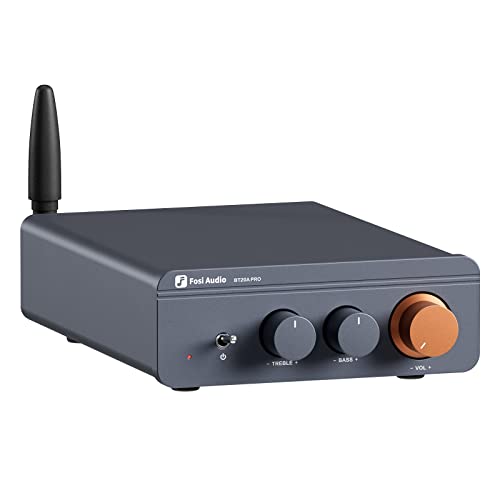
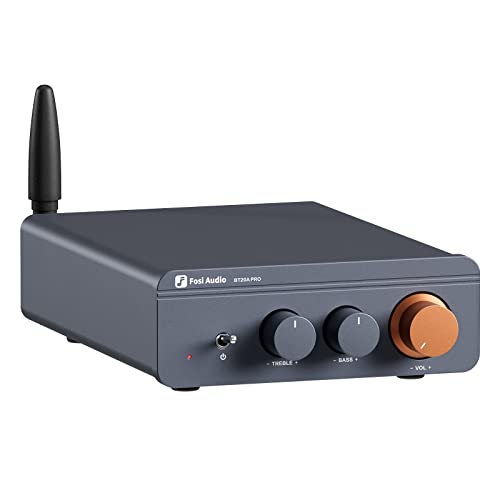
The Pro is what happens when the mini-amp idea grows up without growing large. Its TPA3255 chip is a generation ahead of entry-level silicon — cleaner when pushed, calmer with real speaker loads — and Fosi quotes up to 300W per channel maximum, a ceiling figure whose honest underside is ample headroom for 8-ohm bookshelf speakers in any domestic room. Bluetooth 5.0 and RCA cover the sources such systems actually have, and the front-panel bass and treble knobs adjust the sound faster than any app pairing ritual.
The socket that decides its badge is the pre-out. Bookshelf speakers are the category most likely to gain a powered subwoofer, and the pre-out integrates one correctly — or feeds a second amplifier in another room, should the system spread. That single output is why the Pro, rather than the standard model, is the recommendation for any bookshelf system with a future.
For the desk listener it adds a subtler virtue: composure at low levels. Nearfield listening lives in the amplifier’s first watts, and the Pro’s modern silicon behaves there with a tidiness older budget designs do not match.
Key specifications
| Description | Stereo mini amp built on Class D |
| Chipset | TPA3255 |
| Advertised maximum | 300W per side |
| How sources arrive | Bluetooth 5.0 wirelessly, RCA by wire |
| How signal leaves | Pre-out aimed at powered subs or another amp |
| Handling | Three knobs across the front: volume, bass, treble |
Strengths
- Pre-out integrates a subwoofer the right way
- Tidy behavior at nearfield listening levels
- Small footprint, grown-up headroom
Trade-offs
- Maximum wattage presumes ideal conditions
- Neither remote nor digital input aboard
- Pre-out cannot power a passive subwoofer
The absences deserve one plain sentence: no remote, no digital input, no surround decoding, and vinyl will need a phono stage upstream. Television-first households should finish the Yamaha review before the Pro’s simplicity closes the sale.
Ownership is the Pro’s quiet argument. It occupies a shelf corner, asks for air, and disappears from attention; its headroom is experienced as the absence of strain on loud passages, and its pre-out typically gains a subwoofer within the year, at which point the little system stops being little in every way that matters.
Underneath sits a genuine chip argument. The TPA3255’s published virtues — efficiency, distortion discipline at power, composure into real loads — are exactly what a bookshelf pair’s crossover presents. Nothing on the chassis is decoration; the budget went into amplification and a small metal coat.
Order speaker cable with it, and a subwoofer lead if the pre-out goes straight to work. The accessory list is mercifully complete at that.
Best for: most 8-ohm bookshelf systems, desk or room. Not suited for: remote-dependent sofas or surround ambitions.

Fosi Audio BT20A Mini Stereo Amplifier
Badge: Best Budget
The standard BT20A is the category’s baseline done right. TPA3116 amplification rated at 100W per channel, Bluetooth 5.0 beside an RCA input, bass and treble knobs on the fascia, power supply included. For an 8-ohm bookshelf pair at desk or small-room distances, that recipe is not a brave minimum — it is a comfortable sufficiency, and its price leaves the budget where bookshelf owners usually want it: in the speakers and the music.
The comparison with the Pro is one of ceiling and doors. The Pro’s newer silicon stays composed longer, and its pre-out admits a subwoofer properly. The standard model asks you to accept a lower ceiling and a closed subwoofer path in exchange for the gentlest cost in the guide. Systems with no subwoofer ambitions and no large rooms will never cash the Pro’s advantages.
Buy it as a destination for a compact setup, or as the least expensive reconnaissance in audio. Either way it outperforms the assumption — still common — that real speakers require a full-size amplifier before they may be taken seriously.
Key specifications
| Description | Stereo mini amp built on Class D |
| Chipset | TPA3116 |
| Advertised maximum | 100W per side |
| How sources arrive | Bluetooth 5.0 wirelessly, RCA by wire |
| Handling | Three knobs across the front: volume, bass, treble |
| In the carton | A power supply, so it runs immediately |
Strengths
- The gentlest cost in the guide
- Desk footprint, zero setup ceremony
- Knobs instead of menus, forever
Trade-offs
- No pre-out for a proper subwoofer
- Ceiling arrives before the Pro’s
- No remote control at all
Its limits are the honest kind: no pre-out, so a subwoofer cannot be integrated with proper control; no remote; an older chip whose ceiling arrives sooner than the Pro’s. For a desk or bedroom system with no subwoofer in its future, those limits may never be met in practice.
Install it with the usual mini-amp discipline — tidy short runs, polarity double-checked, air around the case — and it will be blamed for nothing. Most faults attributed to this class belong to installation, and bookshelf speakers report installation faults faithfully.
As an experiment it is unmatched value: a month of listening teaches your speakers’ appetite, your room’s voice and your own habits, intelligence that makes every later decision cheaper. Few purchases in audio return that much knowledge per unit of currency.
And the succession is painless. Graduated-from BT20As populate studies, kitchens and workshops for years. Buy it as a first amplifier and it remains an employed one.
Best for: desks, bedrooms and budgets minding themselves. Not suited for: subwoofer roadmaps or cross-room listening.

Yamaha RX-V385 5.1-Channel AV Receiver
Badge: Best for TV as Well
A large share of bookshelf speakers lead double lives: music system by day, television sound by night, in rooms where a soundbar was considered and rejected on merit. That second job rewrites the amplifier brief — decoding, HDMI switching and room calibration join power on the list — and the RX-V385 is the mainstream receiver that covers the brief: 5.1 channels, 4K HDMI pass-through with HDCP 2.3, Dolby Audio and DTS-HD decoding, Bluetooth for casual streaming, and Yamaha’s YPAO calibration measuring the room through a supplied microphone.
Calibration is the feature bookshelf owners underestimate. Compact speakers in real rooms sit on shelves, in corners, at asymmetric distances — placement anarchy that YPAO measurably tames, with dialogue clarity the prize households notice first. Cinema DSP programs widen film sound for rooms that cannot host textbook layouts.
Power is mainstream receiver output, which at bookshelf distances through 8-ohm loads is comfortably more than the job requires. The receiver’s budget went into being the room’s headquarters, and for the television-sharing household that is the correct allocation.
Key specifications
| What it is | A five-channel receiver for AV duty |
| Screens | 4K Ultra HD pictures via HDMI, HDCP 2.3 |
| Setup help | YPAO measures the room; microphone bundled |
| Sound formats | DTS-HD alongside Dolby Audio |
| Going wireless | Streaming by Bluetooth |
| Added value | Cinema DSP processing |
Strengths
- Calibration civilizes shelf-and-corner placement
- One hub for every HDMI source in the room
- Surround channels ready if the room grows
Trade-offs
- Layout stops at 5.1 — no height channels
- Much larger than the desk picks
- Menus reward an evening’s patience
The domestic dividend is control: one remote for volume across every source, television and receiver waking together, and a system guests can operate. Households that have endured a stereo amplifier beside a television — two remotes, three rituals — understand immediately what the receiver is selling.
Setup deserves its half hour. YPAO’s microphone at the main seat, the routine run in a quiet house, its speaker-size and crossover decisions inspected before being overruled. Calibration skipped is how good receivers acquire bad reputations they did nothing to earn.
The ceiling is plain and should be faced before purchase: five channels end the layout at 5.1, with no height speakers in any future. If overhead effects are a genuine plan, buy a larger receiver once. If they are not, the ceiling will never be felt.
Give the unit air — an open shelf, clearance above, nothing stacked on its vents. Receivers repay the courtesy in years.
Choose it when the bookshelf pair’s second job is real. In a music-only room the stereo picks spend the same money with better focus.
Best for: bookshelf pairs that share duty with a television. Not suited for: desks or music-only rooms.
Full-Size Stereo Integrated Amplifier (Prose-Only Pick)
Badge: Best Traditional Hi-Fi
For the bookshelf system that lives in a room rather than on a desk, the full-size integrated remains the complete answer in one chassis: preamplifier, power stage, remote control, a democratic row of inputs and, on many models, a moving-magnet phono stage. It is described as a category because its ladder is long and the right rung depends on your sources — vinyl above all — but the specification that separates the worthy is consistent.
Insist on rating candor: RMS output into 8 ohms, both channels driven, distortion stated. This class habitually understates, so modest printed figures routinely outplay flamboyant ones from lighter boxes. Multiple RCA inputs gather legacy sources, optical or coaxial digital inputs on many models serve the television properly, and a headphone output covers the hours when the room belongs to someone else’s sleep.
Ergonomics close the argument. With speakers across a room, the remote is the interface and its quality is a daily specification. Buy the amplifier whose handset and menus your household will enjoy, because that — more than any decimal — decides whether the system gets used.
Key specifications
| Description | Stereo integrated at full rack width |
| Hunt for | RMS figures that stay modest on paper, 8 ohms, stereo driven |
| How sources arrive | RCA pairs aplenty; coaxial or optical on many |
| Everyday kit | A handset for the remote, a socket for headphones |
| Frequently found | Phono for moving-magnet cartridges; sometimes a sub output |
Strengths
- Every source in the house finds a socket
- Sofa-friendly remote and ergonomics
- Ratings that habitually underpromise
Trade-offs
- Wrong shape entirely for a desk
- Bluetooth absent on purist models
- Serious examples carry serious prices
Daily life with the category is low-friction: sources a button apart, a remote that rules from the sofa, headphones for the household’s night owls, and an amplifier that reads as furniture. Systems assembled this way tend to stay assembled for a decade.
Respect the physical terms: air above the vents, no components stacked on the warm lid, a shelf that accommodates its depth. Honored, the terms are repaid in years of uneventful service.
Shop by checklist — rating conditions, input inventory, phono stage, subwoofer output — and audition close decisions with your own records. Bookshelf speakers of quality make audition differences plain, which is a luxury worth spending an afternoon on.
For a desk system, this category is simply the wrong shape, and the mini amps win by geometry. Choose the full-size route when the system lives in a room, serves several sources, and is bought for the long term.
Best for: room-based systems with several wired sources. Not suited for: desks, minimalists or surround plans.
Stereo Receiver with Phono Stage (Prose-Only Pick)
Badge: Best for Vinyl Listeners
One bookshelf household has a non-negotiable requirement the other picks treat as optional: records. A turntable’s signal is too quiet and too equalized to plug into a line input, so vinyl households need a moving-magnet phono stage somewhere — and the stereo receiver with phono is the category that builds it in, alongside the tuner and the traditional input row, in a single full-size chassis.
Shop the category on its headline: a genuine moving-magnet phono input, not a line input wearing a label. Beyond it, look for the modern concessions that keep the format current — digital inputs on many models, streaming via an outboard box on the rest — plus speaker A/B switching where a second pair of speakers is part of the household’s geography. Output figures in this class are quoted honestly into 8 ohms, which your speakers make the easiest of comparisons.
The category is described without a linked model because phono implementations and tuner provisions vary enough that the right example follows your record player and your radio habits. The checklist is the recommendation.
Key specifications
| Description | Stereo receiver, two channels |
| Hunt for | A phono input for moving-magnet cartridges; FM or streaming |
| How sources arrive | Phono plus RCA line pairs; digital on many |
| How signal leaves | A/B speaker switching on many |
| Check first | A sub output, if a subwoofer is coming |
Strengths
- Vinyl handled properly, no outboard box
- Radio and legacy sources equally welcome
- A/B switching serves a second pair
Trade-offs
- Full-size chassis for a small speaker’s system
- Streaming often needs an outboard helper
- Phono quality varies between models
Living with it has a particular pleasure: the ritual of the record, the radio at breakfast, the streaming box on an auxiliary input — three eras of source sharing one pair of speakers without adapters or apology. For households whose music collection is substantially vinyl, no other category fits the day so naturally.
Check the subwoofer question before ordering within the category, because implementations vary: some models offer a proper sub output, others expect speaker-level connections. If a subwoofer is planned, let that detail choose the model.
Speaker A/B switching, where fitted, deserves its sentence: it lets one receiver serve the listening room and a second pair elsewhere, a modest feature that households use far more than they predicted.
If vinyl is a rumor rather than a collection, the category’s premium buys you a tuner you will not use — the other picks spend the same money closer to your life. Buy it for the records you own, not the ones you admire in shops.
Best for: record-led bookshelf systems. Not suited for: vinyl-free households or desk setups.
Tube-Hybrid Integrated Amplifier (Prose-Only Pick)
Badge: Best for a Relaxed Sound
Bookshelf systems are often listened to closely and for long stretches — at a desk through a working day, in a reading chair through an evening — and that intimacy is where the tube-hybrid makes its case. A tube preamplifier stage lends its harmonic temperament; a solid-state power stage keeps a modern grip on the woofers. The result aims at listeners who love their speakers’ clarity and would trade a degree of it for ease.
The category is described without a linked model because its defining trait — how much warmth, of what kind — varies more between makers than any specification captures. Audition it, or buy it returnable. Shop the fundamentals meanwhile: an honest RMS figure sufficient for your speakers’ sensitivity, the preamp’s tube type named in the listing, and whether those tubes are user-replaceable. Inputs are typically RCA line level, with Bluetooth aboard many current designs.
Be clear about what is not being bought. A hybrid will not repair placement, civilize a genuinely harsh room or improve a bad recording’s mastering. It adjusts the system’s temperament at exactly the margin where long listening sessions are won and lost.
Key specifications
| Description | Integrated; valves up front, transistors behind |
| Hunt for | An RMS claim you can believe; the valve type spelled out |
| How sources arrive | Line-level RCA; Bluetooth on plenty |
| Check first | Whether valves swap by hand |
| Note well | Character varies — hear it or keep returns open |
Strengths
- Eases long listening at close range
- Modern woofer control from the solid-state stage
- Tubes in preamp duty last for years
Trade-offs
- A tilt in presentation, not a cure-all
- Character differs widely between designs
- One more consumable to replace eventually
Expect seasoning, not salvation. The tube stage tilts the presentation toward forgiving — a softening of glare, a relaxation on long evenings — and on well-recorded material the difference narrows to a preference. On harsh recordings it can be the difference between listening and enduring, which is why its devotees are loyal.
Ownership is undemanding. Preamp-duty tubes run gently and last years, replacements are typically a hand task, and the solid-state output stage keeps heat and woofer control modern. Ventilation is the only standing requirement.
Buy it auditioned or returnable, because the degree of warmth varies more between designs than any other trait in this guide, and descriptions — including this one — cannot hear your room. Bookshelf speakers of quality will render the verdict within a couple of familiar tracks.
Listeners whose speakers already lean mellow may find the tilt too much. Listeners fighting a bright room or a forward tweeter often find it precisely enough. The room votes last, as it always does.
Best for: close listeners who find their system a touch forward. Not suited for: accuracy absolutists or the audition-averse.
Comparison Table
Consider the grid a set of job descriptions. Each row fills a different vacancy in a bookshelf system, and the specification column names the qualification that matters for that vacancy. Read the full review behind any row before appointing it.
| Pick | Type | Key specification | Link |
|---|---|---|---|
| Fosi Audio BT20A Pro | Mini Class D stereo amp | Built on the TPA3255 device | Check price on Amazon |
| Fosi Audio BT20A | Mini Class D stereo amp | Built on TPA3116 silicon | Check price on Amazon |
| Yamaha RX-V385 | 5.1 AV receiver | Passes 4K Ultra HD pictures, HDCP 2.3 aboard | Check price on Amazon |
| Full-size stereo integrated amplifier | Full-width stereo integrated | Sober RMS into 8 ohms with both channels driven | Prose-only |
| Stereo receiver with phono stage | Stereo receiver with phono | A moving-magnet phono input headlines the feature list | Prose-only |
| Tube-hybrid integrated amplifier | Tube-hybrid integrated | Truthful RMS figure; check which tubes the preamp uses | Prose-only |
How do you choose the right amplifier for these speakers?
With the electrical question pre-answered by the 8-ohm rating, choosing becomes an exercise in honesty about three other things. First, distance: will you listen across a desk or across a room, because that decides whether a remote is a necessity or a ornament. Second, company: which sources must the amplifier host — computer, phone, television, turntable — because each source claims an input and one of them, the turntable, claims a phono stage. Third, bass: whether a subwoofer is present, planned or proudly refused, because that decides the pre-out question.
Power enters last and briefly. Your speakers’ sensitivity, found in their manual, converts any candidate’s honest RMS figure into expected loudness at your seat; for typical bookshelf sensitivity at typical distances, the linked picks all clear the bar, which is why this guide spends its length on fit instead. An amplifier that fits the distance, the company and the bass plan is the right one — and the shortlist is arranged so that exactly one pick fits each combination.
What should you check on the listing before you order an amplifier?
Start with the wattage’s conditions, because they separate the honest listings from the theatrical ones. RMS or maximum? Into 8 ohms — your speakers’ load — or into a friendlier 4? Both channels driven, or one? A listing that answers all three in its specifications is a listing from a company that expects to be believed, and in this category the answers are easy to find because 8-ohm figures are the headline standard.
Then audit the fit. Dimensions against the desk or shelf, with air above. Inputs against your source list, counted aloud. Speaker terminals against your cable ends. The power supply’s presence in the box. And the returns policy, because the final test of any amplifier happens in your room, at your desk or sofa, with your speakers — or it does not happen at all.
How to set up a stereo amplifier and speakers, step by step
Begin with the speakers’ altitude. Bookshelf models are designed for their tweeters to sit at ear height when you are seated — on stands in a room, on isolation pads or small risers on a desk — and a few inches of error here costs more clarity than any amplifier upgrade buys. Give rear-ported cabinets space from the wall behind them; a hand’s breadth is a start, more is better, and a speaker shoved against plaster will boom regardless of electronics.
Wire second, power off, with the discipline of someone who will not enjoy troubleshooting: amplifier terminals to speaker terminals, red to red on both channels, each run traced by finger and given a confirming tug. Reversed polarity on one speaker is the classic bookshelf fault — bass evaporates, voices smear — and it hides for months in systems whose owners blame the room. Connect sources afterward: computer by wire if the desk allows, television by its digital route or through the receiver, phone pairing last.
Power up quietly and listen from the actual seat, not from beside the rack. Play a voice recording first; it should hang between the speakers. Then live with the system for a week before touching tone controls, and let placement — inches of movement, degrees of angle — do the adjusting that knobs cannot.
The specifications that matter, in plain language
Impedance you already know — 8 ohms, the standard load — but read it as a promise with fine print: the figure is an average, and your speakers will dip below it somewhere in the bass. Amplifiers rated for 8-ohm duty are built expecting exactly that dip, which is why this category is so forgiving. Sensitivity is the second number and the more useful one day to day: the loudness your speakers return for one watt at one meter, governing how much amplifier you need far more than impedance does.
Power, third, in its honest form: RMS watts into 8 ohms, both channels driven. Your speakers make that figure easy to compare because 8 ohms is the load every manufacturer quotes first. After the electrical trio, the specifications turn domestic — dimensions, input count, a subwoofer output’s presence — and those decide whether the amplifier suits the room it will actually live in.
Where does this system go next? A sane upgrade path
Bookshelf systems grow in a predictable and pleasant order. The subwoofer usually arrives first, through the pre-out this guide keeps recommending, completing the bottom octave the cabinets cannot reach. Stands or better isolation arrive around the same season, because owners who hear what placement does start treating it as a component. The source improves next — a proper streamer or a better cartridge — lifting everything the system plays.
Amplifier replacement belongs late in that story, if it belongs at all, because the first amplifier was chosen to leave these doors open. Owners who climb in this order hear each step. Owners who begin by re-buying amplification are usually treating a placement or bass problem with the wrong tool, at the highest available price.
Common Buying Mistakes
Judging amplifiers by headline wattage
The wattage banner is the least informative sentence on the listing, because it omits its own conditions: the load, the channel count, whether the figure is RMS or a maximum imagined under laboratory duress. Honest amplifiers print the conditions; the comparison that matters is RMS output into 8 ohms — conveniently, the exact load your speakers present — with both channels driven. Compare those figures and the fog lifts.
Ignoring sensitivity entirely
Eight ohms tells you the load is friendly; it says nothing about how much power your speakers convert into sound. That is sensitivity’s job, and skipping it leaves buyers choosing amplifiers by cabinet size and hope. Two bookshelf speakers of identical impedance can differ by a factor of four in the power they need for the same loudness. The figure sits in every manual, one page from the impedance you already read.
Reversed polarity on one speaker
On a desk this fault is almost poignant: the system plays, the owner leans in, and the music refuses to focus — bass thinned, the center image smeared — while every component is individually blameless. One speaker is wired backwards. It happens in a third of first setups by some technicians’ estimates and it costs four minutes to exclude: trace both runs, match the colors, listen for the voice to take its seat between the speakers.
Setting tone controls on day one
A new bookshelf system sounds different from whatever it replaced, and the first instinct is to correct it into familiarity with the tone knobs. Wait a week. Play the breadth of your library at your real volumes and note only what recurs — a persistent boom from a wall, a persistent glare. Correct the recurring items in small steps; the rest was adjustment, and it adjusts itself.
Buying inputs for a fantasy system
Desktop systems suffer this fault in miniature: an amplifier bought for a hypothetical reel-to-reel and a second turntable, while the computer, the phone and the console — the sources that actually exist — queue for two inputs. Shelf space beside a monitor is the scarcest real estate in audio. Inventory the devices on the desk today, allow one guest, and buy accordingly.
Matching by brand folklore
Bookshelf speakers attract a particular mythology: that they must be matched to amplifiers by nationality, era or reputation for warmth. The electrical facts are duller and more useful — an 8-ohm load, a sensitivity figure, a room. Any amplifier in this guide that satisfies those facts will satisfy the speakers, whatever badge it wears. Save the folklore for the listening session’s conversation.
Strangling the amplifier’s ventilation
Small systems get tucked into small places: inside desk cabinets, under monitors, beneath a stack of consoles. Amplifiers — even efficient Class D designs, and certainly receivers — repay that tucking with heat, and heat collects its payment in shortened life and occasional protective shutdowns. A shelf with air above the unit is the entire prescription. The smallest system in the house deserves the same courtesy as the largest.
Expecting a subwoofer to fix placement
Under a desk, a subwoofer mostly amplifies the desk. Bookshelf speakers parked against a wall, flanking a monitor at odd heights, will hand any subwoofer a confused signal to extend. Place the speakers properly first — stands or isolation pads, tweeters at ear level, a little space from the wall — and then let the subwoofer do the one job it is good at: the bottom octave.
Value, tiers and where the money actually goes
In this category the tiers buy shape more than power. The entry tier buys the essentials in miniature: clean stereo watts and a Bluetooth door, sized for a desk. The middle tier buys distance and infrastructure — a remote for the sofa, digital inputs for the television, calibration if the receiver route is taken. The upper tiers buy specialization: a phono stage done properly, a tube stage’s temperament, the build of an amplifier bought for a decade.
What the tiers do not buy is electrical safety, because 8-ohm speakers provide that free of charge. Spend upward only when a named feature — vinyl, television, remote geography — requests it. Otherwise the honest middle of this market is not a compromise position; it is where the category’s engineering effort concentrates.
Final Recommendation
The BT20A Pro is where most 8-ohm bookshelf systems should land: clean modern power, a subwoofer path, and a footprint the desk forgives. The standard BT20A serves the tighter budget without apology. Vinyl households should look hard at the phono receiver category, and television-centered rooms at the Yamaha. The speakers themselves asked for very little — the right amplifier is the one whose shape fits your room and your hand.
What to check before you order
Measure the habitat before the hardware ships: the shelf’s depth, the clearance above it, the cable distance to each speaker, the socket situation behind the desk. Then rehearse the daily choreography — where your hand rests when volume changes, which remote already rules the room, whether a subwoofer’s corner is spoken for. Amplifiers are returned for failures of geography more often than for failures of sound, and geography is checkable in advance with a tape measure.
Frequently Asked Questions
How much power do my speakers actually need?
At bookshelf distances, startlingly little. Sensitivity converts watts to loudness, and a meter or two of air taxes the result far less than a living room does. Most owners use single-digit watts for spirited listening and need the rest only as headroom for peaks — which the honest RMS figures of the linked picks supply. The choosing chapter walks the arithmetic with your own speakers’ number.
Can an amplifier be too powerful for a speaker?
Bookshelf speakers have small drivers with honest limits, and the protection is behavioral rather than electrical. A larger amplifier run gently is harmless; a small amplifier run into clipping is the tweeter’s enemy, because distortion concentrates where small drivers are fragile. Adequate clean power plus a sensible hand beats minimal power plus optimism, in this category as in every other.
What does impedance mean when matching an amp and speakers?
Impedance is the load the speaker offers the amplifier, measured in ohms and wandering with frequency. The nominal figure is the average weather; the minimum is the storm patch, usually in the bass. An amplifier must stay stable and composed into that minimum. Starting from 8 ohms nominal, your speakers’ storms are mild — which is precisely why this guide can spend its length on fit, features and sound rather than on survival.
Do I need a subwoofer output on the amplifier?
For bookshelf speakers the answer leans yes more strongly than anywhere else in audio, because a compact cabinet’s bass reach is physically limited and a small powered subwoofer completes the system beautifully — under a desk, it doubles as a footrest with opinions. The integration needs a pre-out or sub output. If your chosen amplifier lacks one, be certain the subwoofer chapter is closed before the order, not after the first film.
Is Bluetooth sound quality good enough for a main system?
At a desk, where the alternative is often a laptop’s fan noise and a headphone jack, Bluetooth is liberation and its modern quality is entirely respectable. In a quiet room with attentive listening, the same system’s wired path — computer or streamer into the RCA input — preserves the last detail the speakers can show. Most owners use both daily without ever framing it as a compromise.
Why does my system sound quieter than the wattage promised?
Interrogate the chain’s volume controls, all of them. A computer’s output slider, a phone’s media volume, a television’s fixed setting — any link loafing at half level starves the amplifier’s input while its own knob protests innocence. Set each source to a healthy output, let the amplifier alone govern loudness, and the missing volume generally returns without spending anything.
Will a mini amp damage 8-ohm speakers by being too small?
Not by being small — by being driven past its composure. A mini amp played within its limits is a gentle partner for 8-ohm bookshelf speakers, especially at desk distances where little power is used. Damage enters when a small amplifier is forced into clipping at party volumes it was never sized for. Respect the ceiling, or choose the Pro’s larger headroom, and the pairing is safe indefinitely.
Should I bi-wire my bookshelf speakers from one amplifier?
Bi-wiring — two cable runs from one amplifier channel to a speaker’s split terminals — changes the cable bill more reliably than the sound. The amplifier sees the same load and delivers the same power; any benefit is marginal and contested. Owners seeking an audible improvement should spend the second run’s cost on stands, placement or a subwoofer fund instead. Single-wire your speakers well and put the money where physics notices it.