Disclosure: As an Amazon Associate, kajuandouglas.com earns from qualifying purchases. Links to Amazon on this page are affiliate links; they cost you nothing extra. Listing details such as price and availability change often, so check the current Amazon listing before you buy.
If you want soundbar wattage explained without the sales pitch, start here: the watt figure on a soundbar’s box describes the total electrical power its amplifiers can deliver across all its drivers, usually quoted at the most flattering measurement the rules allow — and it tells you almost nothing about how loud the bar will play in your room, and even less about how good it will sound. Soundbars are where wattage marketing reaches its most creative, because a single number is asked to summarise five or more speakers and a subwoofer at once.
This explainer separates total system power from per-channel reality, peak from continuous ratings, and explains the factors that genuinely decide loudness and quality in a soundbar: driver size and count, the subwoofer’s amplifier, sensitivity and room size. It closes with worked guidance for small, medium and large rooms, so you can look at any soundbar’s specifications and translate them into what your evenings will actually sound like.
Soundbar wattage explained: The Short Answer
Ignore headline watts. A soundbar’s loudness depends on its drivers, subwoofer and your room far more than its total power figure, which sums every channel at peak. Judge by room size, whether a real subwoofer is included, and the bar’s performance with dialogue at your normal volume — the things watts cannot tell you.
In this guide
Key Terms
- Total system power: The sum of every amplifier channel’s rating in the bar (and sometimes the subwoofer) — the big box number. It adds channels you may rarely use at once.
- Peak power: A momentary maximum under test conditions, often at high distortion. The flattering figure; not comparable between brands.
- RMS / continuous power: Sustained power output — the honest measure, where manufacturers state it.
- Driver: The individual speaker units inside the bar. Their size and number shape loudness and quality more than amplifier watts.
- Sensitivity / efficiency: How effectively a speaker turns power into sound. Soundbar makers rarely publish it, which is one reason watts mislead here.
- THD (total harmonic distortion): The distortion level at which a power figure was measured. High THD allowances inflate watt claims.
As you work through this guide, keep the bigger picture in mind. Our roundup of best soundbars for bass shows how the main options compare, and the companion piece on speaker wattage explained covers the neighbouring decision in the same detail.
Why Soundbar Watts Are Doubly Misleading
Speaker wattage is already a weak guide; soundbar wattage compounds the problem. The headline figure typically sums every channel — left, right, centre, surrounds, heights — at peak, sometimes including the subwoofer’s amplifier, measured at distortion levels no one would tolerate in listening. Two bars with identical headline watts can differ enormously in real output because one uses larger drivers and an honest subwoofer while the other spreads thin power across many small drivers. The number is not a lie exactly; it is a sum of best cases that never occur simultaneously in your living room.
There is also no standard the industry enforces for these claims, so cross-brand comparisons of watt figures are meaningless arithmetic. The defences are the same as with speakers, applied harder: look for continuous ratings if given, treat any lone huge number as decoration, and shift your attention to the physical facts — how many drivers, how large, whether a separate subwoofer with its own amplifier is included, and how big your room is. Those four facts predict your experience; the watt sum does not.
What Actually Decides How Loud and Good a Soundbar Is
Driver complement comes first: a bar with larger, more capable drivers moves more air and plays cleaner at any given volume, and a dedicated centre driver (or centre channel) does more for dialogue than any power increase. The subwoofer comes second: bass consumes the most power in any soundtrack, and a system with a separately amplified subwoofer relieves the bar of that burden, so the bar’s modest watts go further on voices and effects. This is why a moderate-wattage 3.1 system routinely outplays a high-wattage bar-only design on films.
Room size is the third factor, and it is yours, not the product’s. Sound dissipates with distance: a bar that overwhelms a bedroom merely fills a large open-plan room. Ceiling height, soft furnishings and how far you sit all shift the requirement. The honest shopping question is never ‘how many watts?’ but ‘is this system sized for my room?’ — answered by driver and subwoofer complement, by the manufacturer’s room guidance, and by testing at home at your real listening volume during the returns window.
How Much Power Do Rooms Actually Need?
In a small room or bedroom, any competent soundbar has power to spare; dialogue clarity and a tidy footprint are the real criteria, and chasing watts buys nothing. In a typical living room, a mid-range bar with a subwoofer covers film volumes comfortably — the subwoofer’s contribution matters more than the bar’s rating. In large or open-plan spaces, look for systems with substantial subwoofers, more drivers and the option of rear speakers, because filling volume is about moving air in several places, not about a bigger number feeding one bar.
Everyday listening levels are lower than people assume. Most viewing happens at volumes where the system uses a fraction of its capacity; the reserves exist for film peaks — explosions, crescendos — which is why headroom matters but headline figures do not measure it honestly. If a bar sounds strained, distorted or compressed at your loudest realistic volume in your room, it is undersized for you whatever its box claims; if it plays cleanly there with something in reserve, its wattage — whatever it is — is sufficient by definition.
Ready to Buy? Start Here

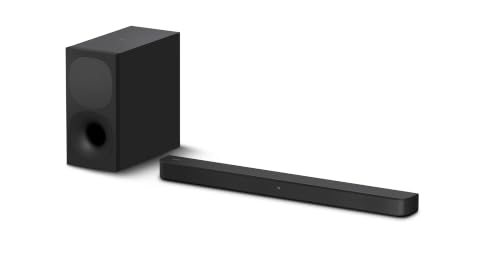
Sony HT-S400 2.1ch Soundbar
A 2.1-channel soundbar with a separate wireless subwoofer, Dolby Digital decoding and Bluetooth. The separate sub is the classic 2.1 advantage: deeper bass for films and games than a slim bar alone can manage. Check price on Amazon.
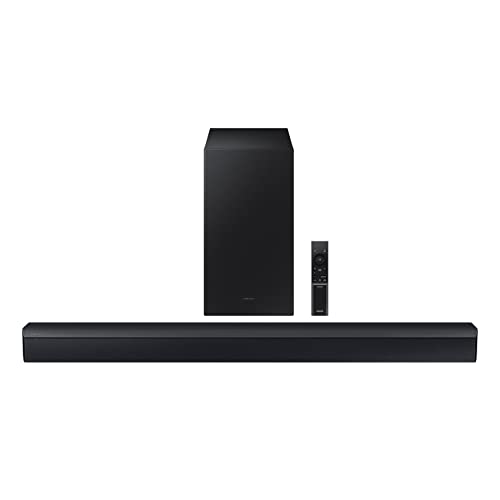
Samsung HW-C450 2.1ch Soundbar
A 2.1-channel soundbar with a wireless subwoofer, DTS Virtual:X surround processing, Bass Boost and Bluetooth. It is a straightforward example of the entry 2.1 layout most first-time soundbar buyers start with. Check price on Amazon.

Bose Smart Soundbar
An all-in-one Dolby Atmos soundbar with voice control, Bluetooth and AirPlay, sized for mid-sized TVs. It sits between simple TV speakers and full flagship bars in the Bose line. Check price on Amazon.

LG S40T 2.1ch Soundbar
A 2.1-channel soundbar with a wireless subwoofer and AI Sound Pro processing, designed to pair neatly with LG TVs, including control through the TV interface on compatible models. Check price on Amazon.
Common Misconceptions
Choosing the bar with the biggest watt number
That number sums every channel at peak under flattering conditions. It is the least comparable figure in the entire specification list.
Comparing watts between brands
Without a shared measurement standard, one brand’s figure and another’s describe different tests. Compare drivers, subwoofers and in-room performance instead.
Assuming more watts means clearer dialogue
Dialogue clarity comes from the centre channel and processing. A modest 3.1 bar will out-speak a powerful 2.0 bar every night of the week.
Overbuying power for a small room
Excess capacity in a small room buys nothing audible and often costs features that matter — a centre channel, better processing, a subwoofer — within the same budget.
Key Takeaways
- Ask ‘what drivers and what subwoofer?’ before ‘how many watts?’
- A separately amplified subwoofer is worth more than headline bar watts.
- Size the system to the room; test at your loudest realistic volume at home.
- If a continuous (RMS) figure is published, it is the only watt number worth comparing.
Going Deeper: Context That Helps
Placement rules for soundbars are simple but strict. The bar belongs at ear height when seated, or as close as the TV stand allows, centred on the screen, with its front edge near the front of the stand so sound does not reflect off the stand’s surface. Never put a bar inside a closed cabinet: the doors and shelves block and colour the sound, and heat builds up. Up-firing Atmos bars additionally need a clear path to a flat ceiling — beams, ceiling fans and very high or vaulted ceilings all weaken the height effect, though the bar will still sound good as a normal surround bar.
When a soundbar system grows, it grows in a predictable order. First the bar, then — if bass feels light — a subwoofer; then, if surround effects feel front-bound, rear speakers; the rears add more immersion per step than any processing upgrade. Systems that allow these additions let you spread the cost and learn what your room actually needs. The alternative, a complete package with sub and rears in one box, costs less overall and guarantees the parts match. Neither route is wrong; the mistake is buying a sealed all-in-one bar while expecting to add rears to it later, because most cannot.
Whatever the product, the cheapest upgrade is usually time spent with the manual and the settings menu. Manufacturers bury genuinely useful options — EQ presets, dialogue modes, level trims, firmware updates — several layers deep, and most owners never find them. An hour spent exploring settings with familiar content playing will teach you more about your system than a week of reading reviews, and it costs nothing. Keep notes of what you changed so you can undo anything that makes things worse, and change one thing at a time so you know which adjustment caused which result.
Returns windows are part of the buying process for audio gear, and you should use them deliberately. Sound is personal and room-dependent, so a product that reviews well can still disappoint in your space. Buy from sellers with clear return policies, keep packaging until you are sure, and test with your own content at your own volumes in the first days — not the night before the window closes. A structured test, with the same three songs or scenes each time, reveals differences that casual listening misses and turns a vague feeling into a decision you can act on.
Hearing safety deserves a mention in any audio guide. Comfortable TV and music listening sits well below the levels that risk hearing damage, but portable speakers at parties, and headphones especially, can creep upward in noisy environments as you compete with background sound. If you have to shout to be heard over your own system, it is too loud for long sessions. Many devices offer volume limiting — worth enabling for children — and taking listening breaks during long sessions protects both your ears and your enjoyment, because tired ears judge sound poorly.
A soundbar’s biggest advantage is also its limitation: everything lives in one wide box under the TV. That makes setup simple and dialogue clear for most viewers, but the left and right channels are only as far apart as the bar is wide, so true stereo separation is narrower than two separate speakers can give. Virtual surround processing tries to widen the picture with psychoacoustic tricks, and on many films it works surprisingly well from a single seat. Understanding this trade-off helps you choose: if you mostly watch dialogue-heavy TV from one sofa, a bar is ideal; if you listen to music critically across a wide room, separate speakers still lead.
HDMI eARC is the connection that matters most on a modern soundbar. It carries full-quality audio from the TV — including Dolby Atmos from streaming apps and consoles — down a single cable, and it lets the TV remote control the bar’s volume. Optical connections are reliable but limited to older surround formats and cannot carry Atmos from most sources. When a soundbar misbehaves — no sound, wrong format, lip-sync drift — the cable and the TV’s audio output settings are responsible far more often than the bar itself, so always check the TV’s menu for eARC, passthrough and PCM settings before assuming the bar is faulty.
Dialogue clarity is the reason most people buy a soundbar, and it depends on the centre channel and on processing, not raw power. Film mixes bury speech under music and effects, and TV speakers point that sound at the wall or the floor. A bar with a dedicated centre channel, or a dialogue enhancement mode that lifts the vocal frequency range, fixes the nightly ‘what did they say?’ problem better than simply turning the volume up. If you watch late at night, look for a night mode that compresses loud effects while keeping speech level — your household will thank you more than for any surround effect.
A wireless subwoofer changes what a soundbar can do more than any other single feature. The bar handles voices and effects; the subwoofer, placed near a wall or corner, reproduces the low rumble of films and the body of music. Because low bass is hard to localise, the sub can live beside the sofa or next to the TV stand, wherever a power socket is convenient — it only needs power, since the audio link is wireless. If a bar sounds thin, first check that the subwoofer is paired, powered and not turned down in the settings before concluding the bar itself is weak.
Soundbar sizes should match the TV, mostly for looks and partly for sound. A bar much narrower than the TV looks lost and spreads sound over a smaller width; a bar wider than the TV stand risks overhang. Measure the stand, check the height of the bar against the bottom edge of the screen so it does not block the picture or the TV’s remote sensor, and leave a little clearance in front of up-firing Atmos drivers. Wall-mounting is an option on most bars, but a stand is simpler, kinder to cables and easier to reposition while you fine-tune the sound.
Room size decides how much soundbar you need. In a bedroom or small flat, a compact bar already plays far louder than you will use, and a huge flagship adds cost without benefit. In an open-plan living space with high ceilings, sound dissipates, Atmos height effects weaken because they rely on ceiling reflections, and a bar with a separate subwoofer — or the option to add rear speakers later — earns its keep. Be honest about the room you have rather than the room in the advertisement: most soundbar disappointment comes from buying for the wrong space, not from buying a bad product.
Soundbars and gaming have a specific requirement: low latency. Audio that arrives late feels as wrong in a game as late video, and some TV processing adds delay to both. Connecting a console through the TV with eARC passthrough, or into the bar itself where it has HDMI inputs, and enabling game mode on the TV keeps sound and action together. If voices in cut-scenes drift from lips, the fix is almost always a setting — the TV’s lip-sync or the bar’s audio delay adjustment — rather than a defect, and it is worth learning where that setting lives before you need it mid-game.
Firmware updates quietly fix many soundbar problems. Manufacturers patch HDMI handshake bugs, app issues and format support through updates delivered over Wi-Fi or USB, and a bar that has sat in a warehouse may ship with early software. When you set up a new bar, run its update before judging it; when an old bar develops a new quirk after a TV update, check for a bar update too, because the two devices negotiate constantly over HDMI. Keeping the maker’s app installed on your phone makes these updates painless and also unlocks EQ and level controls the remote may not offer.
A soundbar is not only for films. For music, most bars sound best in a stereo or music mode with virtual surround switched off, because surround processing smears the stereo image that music is mixed for. Bluetooth and Wi-Fi streaming make the bar the easiest speaker in the house to play music through, which is why many households end up using it daily for radio and playlists. If music matters to you, judge a bar with your own favourite tracks during the return window, at your normal volume, from your normal seat — film demos in a shop flatter almost everything.
Frequently Asked Questions
Is a higher-watt soundbar louder?
Not reliably. The headline wattage sums all channels at peak under conditions that differ between brands, while loudness in your room depends on driver size and efficiency, the subwoofer, and the room itself. A bar with fewer claimed watts but larger drivers and a real subwoofer will often play louder and cleaner than a high-wattage bar with small drivers. Judge loudness by system design and, ideally, by a home trial at your volume — not by the largest number on the box.
Why do two soundbars with the same wattage sound so different?
Because the wattage is measuring different things in each case — different channel counts summed, different distortion allowances, different driver complements receiving the power. One bar may feed three capable drivers and a subwoofer; another may spread a similar total across many small drivers with no sub. Add different processing, cabinet quality and room interaction, and identical watt figures predict almost nothing. This is the core lesson of soundbar wattage: the number is not a standard, so it cannot standardise your expectations.
How many watts do I need for a living room soundbar?
The question has no honest watt answer, because ratings are not comparable — but it has a practical system answer. A typical living room is well served by a mid-range bar with a centre channel and a wireless subwoofer; that architecture, at almost any stated wattage, covers film volumes comfortably. Small rooms need less system; large open-plan rooms need more drivers and a substantial sub, plus rear speakers for envelopment. Buy the architecture sized to the room and verify at home; the watts will be whatever they are.
Does the subwoofer’s wattage matter more?
The subwoofer’s amplifier matters more than the bar’s headline figure, because bass is the most power-hungry part of a soundtrack and a dedicated subwoofer amplifier handles it without starving the bar. But even here, driver size, cabinet design and room placement outweigh the raw number. A well-designed subwoofer of modest rating, placed where the room helps it, outperforms a powerful one shoved in a bad position. Treat subwoofer watts as a rough size indicator and placement as the real performance feature.
What does it mean when a soundbar claims hundreds of watts but is small?
It means the figure is a peak sum across channels under generous test conditions — arithmetically defensible and practically irrelevant. A slim bar’s small drivers and cabinet set physical limits that no amplifier figure repeals: it can be an excellent product for dialogue and moderate volumes, and many are, but it will not fill a hall. Let the claim calibrate your trust in the marketing rather than your expectation of the sound, and evaluate the bar on its drivers, its centre channel and its performance in your room.
Should wattage affect my choice at all?
Only at the extremes and only in continuous terms. If a manufacturer publishes an honest RMS figure, it can confirm a system is sized generously for its drivers; if a bar will serve a very large room, a robust power supply is part of the design that gets you there. Beyond that, spend your attention on the centre channel, the subwoofer, the connections and the room fit. Wattage is the specification to check last and weight least — the opposite of the prominence it gets on the box.
Decibels, Distance and Why Small Numbers Feel Big
Loudness obeys unforgiving mathematics that marketing prefers you not to know. Doubling power adds only a modest step in perceived volume; making a sound seem twice as loud takes roughly ten times the power. This is why a bar claiming several times another’s wattage may sound only somewhat louder in a shop, and why chasing wattage multiples is a poor way to spend money. What you are really buying with a well-designed amplifier and efficient drivers is not headline volume but ease: sound that stays clean, composed and unstrained at the levels your room actually demands.
Distance eats volume
Every doubling of listening distance costs a noticeable chunk of level, so the same bar that overwhelms a bedroom at two metres works honestly in a lounge at four. When comparing demonstrations, note where you sat; a bar auditioned close in a small demo pod will always seem mightier than the same bar across a large showroom. Honest retailers account for this, but your own room is the only courtroom that matters, and its dimensions — length, width, ceiling height and how open it is to other spaces — set the power requirement far more than any figure printed on a carton.
Sensitivity is the quiet partner in this equation. A driver that converts power into sound efficiently needs fewer watts to reach a given volume than an inefficient one, and two bars of identical wattage can therefore differ plainly in loudness and in how relaxed they sound doing it. Sensitivity figures are rarely advertised for soundbars, which is one more reason wattage comparisons between brands mislead, and why listening, or reviews that measure rather than repeat claims, outrank specification arithmetic.
Peak, RMS and Other Games Played With Numbers
Not all watt figures are measured the same way, and the differences are where confusion is manufactured. A continuous or RMS figure describes power the amplifier can sustain; a peak figure describes a momentary burst it can survive; and some quoted totals sum every channel’s peak across the whole system, including the subwoofer, into one heroic number. The same physical product can therefore wear several different wattages depending on which measurement the marketing department selected, all of them technically defensible and none of them comparable with another brand’s choice.
Reading a specification sheet sceptically
Look for the conditions behind any power claim: at what distortion, across what frequency range, driving how many channels at once, and for how long. A figure quoted at high distortion describes a sound you would never tolerate; a figure quoted for one channel driven says little about a film scene driving all channels together. When a maker publishes conservative, fully conditioned figures, that restraint itself is information about the company’s engineering culture, and such products frequently sound stronger in rooms than louder-claiming rivals.
Total harmonic distortion deserves its sentence. Amplifiers produce more distortion as they approach their limits, so a system working near its ceiling on every action scene will sound hard and tiring even at moderate average volume. Headroom — capacity in reserve — is the real luxury wattage can buy, and it announces itself as ease and clarity in loud passages rather than as sheer volume in quiet ones. Buy headroom for your biggest room-filling moments, and the everyday will take care of itself.
What Actually Limits How a Soundbar Sounds
If wattage is a minor character, meet the leads. Driver size and quality set how much air can be moved and how faithfully; cabinet volume and construction set how much resonance and depth the drivers can develop; digital processing shapes tone, protects drivers and creates width and height impressions; and the subwoofer, where fitted, determines whether bass has genuine extension or merely enthusiastic upper-bass thump. A modest amplifier feeding good drivers in a solid cabinet will beat a heroic amplifier feeding cheap drivers in a resonant plastic shell every evening of the week.
The subwoofer’s separate story
Subwoofer wattage attracts its own exaggerations, and its own truths. Moving air at very low frequencies genuinely takes power and driver excursion, so a subwoofer’s amplifier and driver size together do predict its ability to reproduce deep effects in a fair-sized room. But placement multiplies or wastes that ability: a modest sub in a good position routinely outperforms a powerful sub in a poor one, because room boundaries and standing waves govern what reaches your ears. Judge a subwoofer by extension, control and how it integrates, and treat its watt number as the least interesting fact about it.
Integration is the unglamorous summit. A system where bar and subwoofer hand over to each other invisibly — where a voice never thins, an explosion never detaches into a separate boom from the corner — sounds expensive regardless of its wattage. A system with a visible seam sounds cheap at any power. Demonstrations should therefore include dialogue and quiet scenes, not only effects, because the seam hides during explosions and confesses during conversation.
Matching Power to Room and Habit, Practically
For a bedroom or small study, almost any reputable bar has ample power; choose on dialogue clarity, low-volume manners and size. For an average lounge, the broad middle of the market exists precisely for you, and differences in driver quality and tuning will matter more than differences in output. For a large or open-plan space, look for systems designed for scale — larger drivers, a substantial subwoofer, and honest continuous power figures — and accept that at some room size a soundbar of any wattage reaches its limits and a component system becomes the truthful recommendation.
Volume habits and neighbours as specifications
Your habits are a specification too. A household that watches late at low volume needs a bar that sounds complete quietly: full dialogue, controlled bass, fine volume steps. Raw power is wasted on them. A household that hosts match days and film nights at social volume needs headroom and a subwoofer that stays composed when the room is full of people absorbing sound. Neither household should buy the other’s bar, and wattage alone cannot tell them apart, which is the entire argument of this guide in one paragraph.
Neighbours complete the picture in flats and terraces. Bass travels through structure, and a powerful subwoofer at modest settings can still announce itself downstairs. If your room shares floors and walls, value control — a subwoofer with fine-grained level adjustment and a night mode — over maximum output, and place the sub on an isolating pad or away from shared surfaces. The best system is the one you can use fully without apology, at the hours you actually watch.
Questions to Ask Instead of How Many Watts
Replace the wattage question with five better ones. How large is the room, and how far away do we sit? What do we watch, and at what volume, honestly? How clear is dialogue at low level? How deep and controlled is the bass in a scene we know? And how does the system sound with our material, from our seat, after ten minutes rather than ten seconds? A retailer or review that helps you answer those five has told you everything wattage promised and never delivered.
A last word on demonstrations
Demonstration material is engineered to flatter power: loud, bass-heavy, relentless. Bring a quiet scene and a familiar voice, set a civilised volume, and listen for ease. The bar that sounds composed doing ordinary things will thrill you with extraordinary ones, while the bar that only thrills may merely be loud. Wattage, properly understood, was never a measure of quality; it is a footnote about capacity, and your room, your content and your ears are the text.
Wattage Around the World: Why Imports and Labels Disagree
Buyers comparing models across regions meet another confusion: the same product may carry different power figures in different markets, because measurement conventions, mains voltages and labelling regulations differ. A figure quoted for one market’s model is not automatically the figure for the same-named model elsewhere, and grey imports can arrive with documentation that describes a subtly different unit. The lesson reinforces this guide’s thesis from a new angle: treat wattage as local, conditional information at best, and anchor comparisons in driver complements, cabinet design, measured reviews and your own listening, which travel across borders far more reliably than the number on a carton.
Standby power and the always-on system
One wattage figure does deserve attention, though it is rarely the advertised one: standby consumption. A bar that wakes with the television lives in standby for most of its life, and systems differ in how hungrily they sip. Multiplied across a bar, a subwoofer and wireless rears, standby draw becomes a real, if modest, annual cost and a fair question to ask of any system. It will never outweigh sound in a sensible decision, but between two otherwise equal systems, the thriftier sleeper is the better citizen of the house it will live in for a decade.
There is a certain poetry in ending here: the wattage that matters most is the one nobody advertises, attached to the hours nobody watches. It is a fitting emblem for the whole subject — the specification that shouts is seldom the one that counts, in power as in everything else this guide has tried to explain.
A Buyer’s Crib Sheet: Translating Claims Into Questions
When a product page leads with a heroic wattage total, translate it into questions before it translates itself into your basket. Ask how the figure was measured and whether the maker publishes the conditions. Ask what the drivers are, how large the cabinet is, and whether a subwoofer is included or merely compatible. Ask what the system does at low volume, because that is where your life is lived. Ask for a demonstration with dialogue, and notice whether the salesperson reaches for an action clip instead; that reach is data about what the product does well and what it would rather you did not examine closely.
The sentence to remember in the shop
If you carry one sentence into the shop, carry this: power is a capacity, not a quality, and your room decides how much capacity you need while your ears decide everything else. Buyers who internalise it stop being led by the largest number in the room and start auditioning like engineers — by load, by fit, by evidence. The industry will keep printing heroic wattages, because the number is cheap to print and expensive to verify, but a buyer armed with the right questions is immune to it, and immunity, once acquired, applies to every specification that follows this one into the marketplace.
Efficiency, Heat and What Power Consumption Tells You
An amplifier’s efficiency — how much of the electricity it draws becomes sound rather than heat — is a quiet quality signal. Modern amplifier designs convert most of their input to work and run cool in slim cabinets; older or cheaper designs waste more as heat, which is why some bars grow surprisingly warm in a cabinet and why ventilation, mentioned in every manual and heeded in few installations, matters to longevity as much as to safety. A bar that runs cool at your listening levels is a bar whose power supply and amplification were specified with margin, and margin, as this guide has argued throughout, is the true luxury that wattage figures gesture towards without ever quite naming.
The power supply as an unglamorous specification
Behind every amplifier stands a power supply, and its quality decides whether the amplifier’s promises survive a scene that demands everything at once — all channels, deep bass, high level. Makers rarely advertise it, but its fingerprints are audible: systems that stay composed and unstrained in the biggest moments have supplies that keep up; systems that harden, thin or compress exactly when the film peaks are showing you a supply at its limit, whatever the wattage claimed. This is why the loudest scene you know, played at your boldest comfortable volume, is a more revealing audition than any quiet test — it examines the whole power chain, from wall socket to driver, in the only conditions where power honestly matters.
What Happens When a Soundbar Runs Out of Power
An amplifier at its limit does not simply stop getting louder; it changes character. First the biggest peaks compress — explosions lose their startling edge and the soundtrack’s dynamic geography flattens. Then distortion creeps into sustained loud passages, heard as hardness or buzz rather than as obvious break-up, because digital systems and protected drivers fail politely. Finally, protection may reduce level or shut the system down in extreme cases. Recognising the early stages matters because they are routinely misdiagnosed as poor speakers or a bad mix, when the true story is a system being asked for more than its power chain — supply, amplifier, drivers together — can give in that room at that volume.
Distance and room gain: your room is an amplifier too
The room itself contributes gain. Walls, floor and ceiling reflect energy back towards the listener, and a small, hard room can add the equivalent of a substantial power increase compared with a large, soft, open space. This is why the same bar is a giant in a bedroom and a mouse in a barn conversion, and why honest advice about how much power you need is impossible without your room’s dimensions and surfaces. When a reviewer calls a bar powerful or weak, silently append the words in their room, and when you audition in yours, trust the evidence of your own walls over any number — including, especially, the number printed largest on the box.
The One Demonstration That Settles the Wattage Question
If a shop will allow exactly one test, make it this: your quietest dialogue scene and your loudest action scene, back to back, at the volume you live at, from the distance you live at. The quiet scene examines clarity, control and low-level manners, where wattage is irrelevant. The loud scene examines headroom, composure and the power chain entire, where wattage is one ingredient among several. A bar that passes both has all the power you need by definition, whatever its carton claims, and a bar that fails either has a problem no larger number on a rival’s carton guarantees to solve. Demonstrations end arguments that specifications start, and this two-scene test is the shortest honest demonstration in the whole subject of soundbar power.
Trusting the verdict over time
Live with the verdict for the trial period if one is offered, because power impressions ripen: a system that thrilled loudly on day one may fatigue by day ten, and a system that seemed modest may reveal itself as the one whose ease you never tire of. Time is the final specification, unprintable on any carton, and the buyers who use it — who let a fortnight of ordinary evenings vote — are the ones whose systems still satisfy in year five, at whatever wattage they happened to be.
A Note on Honest Manufacturers
Reward, with your custom, the makers who publish conservative power figures with their measurement conditions attached, who talk about drivers and cabinets before amplifiers, and whose demonstrations lead with dialogue rather than explosions. They exist in every tier, and they are easy to recognise once you know the signs: modest numbers, detailed specifications, and a willingness to let their product be heard quietly. An industry improves when its honest members prosper, and every purchase made on evidence rather than on the largest printed number is a small vote for the kind of specification sheet you would like to read next time.
Related Guides
These guides and roundups cover the closest decisions and fixes in this category:
- best soundbars for tv under 300
- best soundbars for large rooms
- best cost for soundbars under 200
- best soundbars for music
- how to choose a soundbar
- what is dolby atmos on a soundbar
Why does my small soundbar claim more watts than my old hi-fi?
Because the numbers are measured and summed differently. The soundbar’s figure is often a peak total across all channels including the subwoofer, quoted under generous conditions, while older hi-fi amplifiers were usually quoted as continuous power per channel under strict conditions. The two figures describe different things, and the older, smaller number frequently represents the more honest capacity.
Does a more powerful soundbar use much more electricity?
In practice, very little. Soundbars draw modest power at ordinary listening levels and sip power in standby; the amplifier only draws heavily during loud passages, which are brief. The difference between models on an electricity bill over a year is small enough that it should not drive the choice; choose on sound and suitability instead.
Can too much power damage my hearing or the room?
Any system played loud enough for long enough can damage hearing, and the risk is about listening level and duration, not the amplifier’s capacity. A powerful system played responsibly is no riskier than a weak one; indeed, a system straining at its limit produces distortion that tempts listeners to turn up further. Use comfortable levels, and treat ringing ears after a film as information to act on.